Three years after Texas’s Republican legislature gutted the state’s family planning budget, Erica Hellerstein sheds some light on how these cuts have affected the state’s Hispanic community:
Reeling from accusations of a “war on women,” Republican state senators last year proposed adding $100 million for women’s health services back into the state’s primary-care program. But advocates say it’s too little, too late. “It’s hard to put back together a system that’s been dismantled,” said Sarah Wheat, vice president for community affairs for Planned Parenthood of Greater Texas.
The cuts have had a disproportionate impact on the million-plus residents living in the overwhelmingly Latino, notoriously impoverished Rio Grande Valley. Nine of the valley’s 32 state-funded family planning clinics have shut down, while others reduced services and raised fees, according to a joint report from the Center for Reproductive Rights and National Latina Institute for Reproductive Health. Before the cuts, basic reproductive services like Pap tests, breast exams, contraceptive services and counseling, and STI testing, were available at clinics for little to no cost. But the shutdowns have ushered in a new era for Texas women: higher costs, fewer services. Between 2010 and 2012, the number of women in the valley getting family-planning services at clinics funded by the Texas Department of State Health Services plummeted by 72 percent, according to the NLIRH report.
Hugh Byrd and Steve Matthewman warn that electrical blackouts are “becoming increasingly common” across the globe and “will only get more frequent and severe”:
Electricity systems are complex, high-tech assemblages in which small failures can interact in unanticipated and often incomprehensible ways. The North American grid, for example, is arguably the world’s largest machine, but is highly fragmented. It crosses borders and regulatory zones and has no single owner or manager. Over 3,100 utility companies are on it.
Other continent-scale grids have similar weaknesses. The vulnerability of such systems is demonstrated by the Italian blackout of 2003. The event began when a falling tree broke a power line in Switzerland; when a second tree took out another Swiss power line, connectors towards Italy tripped and several Italian power plants failed as a result. Virtually the whole country was left without power. It says something when a nation can be brought to a halt by two trees falling outside its borders. …
Resource depletion is already having an effect on countries that rely on fossil fuels such as coal for electricity generation. Countries with significant renewable resources are not immune, either. Weather is not predictable and is likely to become less so, courtesy of climate change: in the past decade shortages of rain for hydro dams has led to blackouts in Kenya, India, Tanzania and Venezuela. Deregulation and privatization have created further weaknesses in supply as there is no incentive to maintain or improve the grid. Almost three-quarters of US transmission lines and power transformers are more than 25 years old and the average age of power plants there is 30 years.
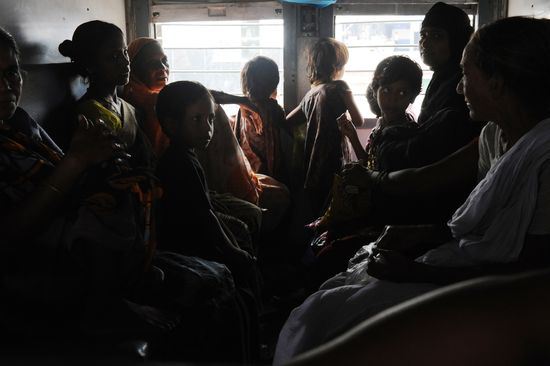
(Photo: Indian women and children wait inside a darkened train carriage at a railway station in New Delhi on July 31, 2012. A massive power failure hit India for the second day running as three regional power grids collapsed. By Roberto Schmidt/AFP/Getty Images. Dish coverage of the blackouts here.)
In a report on BYU’s gay community, Emily Shire observes that “coming out of the closet is often a two-part process for LGBT Mormons”:
The first is admitting you “suffer” from same-sex attraction. During this stage, “People often are very warm,” says Cary. “That’s the norm. They say ‘We’ll help you through this.’”
The second is actually accepting being LGBT. “I had to come out a second time. ‘No, Mom and Dad, I’m actually gay and date boys and will hopefully marry one some day,’” recalls Cary. “That was a much harder coming out. The first often serves as a buffer to the second.”
It’s not just that BYU treats homosexuality as a temporary condition. Sam (not his real name), who is currently a student at BYU, says he’s bothered that the Honor Code reduces LGBT students to their sexual behavior. “It is simplistic to view homosexuality that way, to say that I’m only gay when I’m committing a homosexual act,” he tells me. “I breathe gay. I‘m never not gay. But apparently, when I do something sexual, BYU draws the line. I’m more than my sexual urges.”
Earlier this month, Jane Perlez reported (NYT) on the mounting crisis facing Burma’s Rohingya Muslim minority, who are being denied access to lifesaving aid as they languish in displaced persons camps and face sporadic pogroms carried out by radical Buddhists:
The crisis began with the government’s expulsion of Doctors Without Borders, one of the world’s premier humanitarian aid groups and the lifeline to health care for more than a million Rohingya increasingly denied those services by their own government. But the situation has grown more dire in recent weeks, as local Buddhist officials began severely restricting other humanitarian aid to the camps and the rest of Rakhine State, where tuberculosis, waterborne illnesses and malnutrition are endemic. Some aid workers fear they are being kept away so there are fewer witnesses to rampant mistreatment and occasional bloodletting; the doctor’s group was expelled from Rakhine State after caring for victims of a violent assault on a Rohingya village that the government denies ever happened.
Sir Geoffrey Nice and Francis Wade warn that all signs point to genocide:
The situation has been allowed to fester — and actively encouraged — for too long. What were once horrible but sporadic bursts of violence have become sustained and deeply sinister.
The government has done little to help and much to harm the conditions in Rakhine state. It has rendered the Rohingya stateless, impeded aid, failed to punish perpetrators of violence and hate-speech, and thereby created an environment that allows violence to flourish. But all the while, it maintains the pretense that the mobs are operating on their own whim, and that the violence is purely communal. The tactic is familiar to state crime scholars: Policies are devised by leaders at the top, and delivered by those on the ground, with the puppeteer’s strings rarely visible. Now tensions are at a point where even small disputes are erupting into mass violence, with attacks on Rohingya occurring because of who they are, and not what they have done. All leaders in Burma must know that this is the mental state that enables genocide. And they also must know that once the genocidal mindset is free to act, it is rarely possible to stop, save by another greater force.
Previous Dish on the plight of the Rohingya here and here.
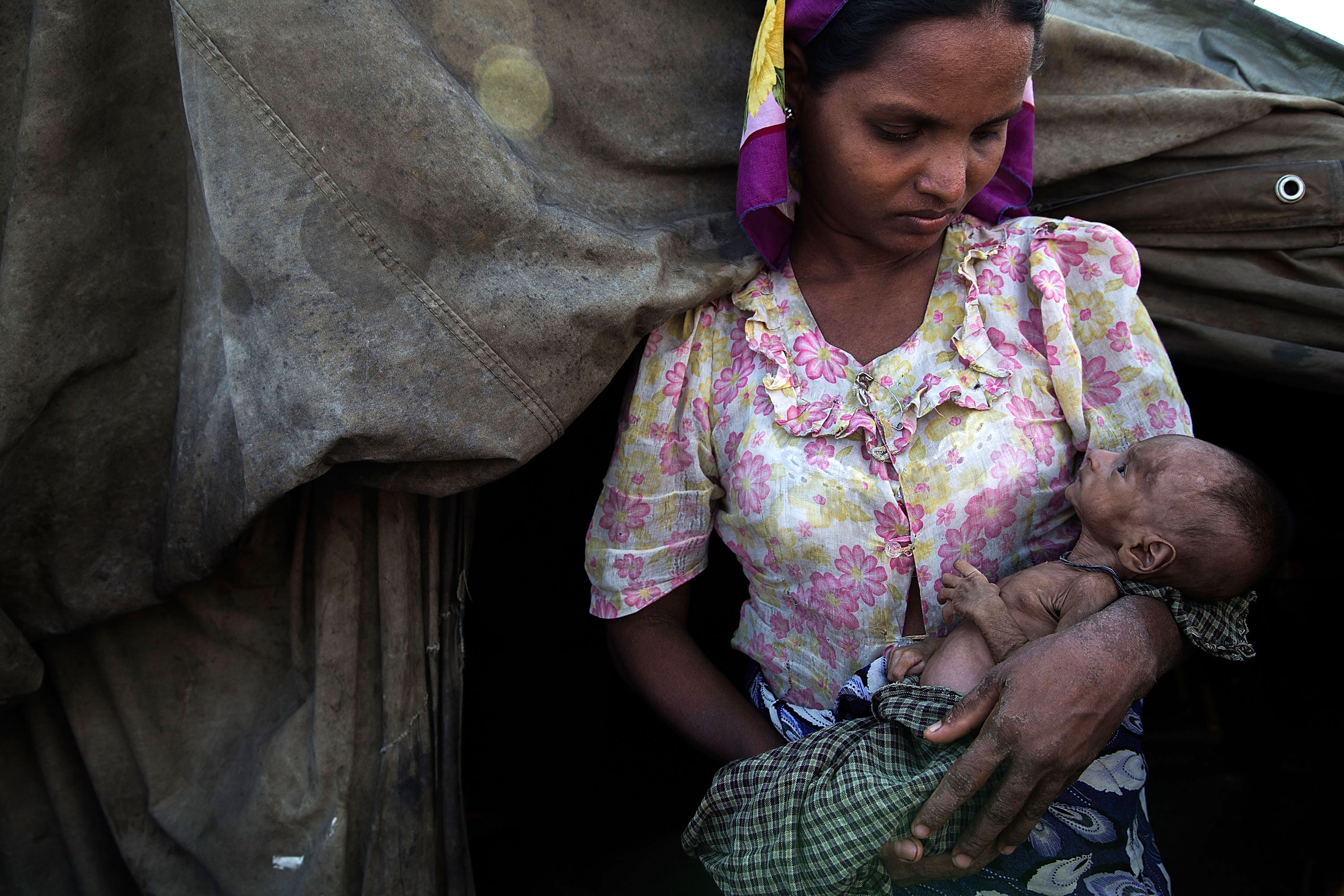
(Photo: Rosheda Bagoung holds her malnourished child outside a tent at Dar Paing refugees camp on May 10, 2014 in Sittwe, Burma. 150,000 Rohingya IDP (internally displaced people) are currently imprisoned in refugee camps outside of Sittwe in Rakhine State in Western Myanmar. Medecins Sans Frontieres (MSF), the primary supplier of medical care within the camps, was banned in March by the Myanmar government. Follow up attacks by Buddhist mobs on the homes of aid workers in Sittwe put an end to NGO operations in the camps. Though some NGOs are beginning to resume work, MSF remains banned and little to no healthcare is being provided to most Rohingya IDPs. One Rohingya doctor is servicing 150,000 refugees with limited medication. Several Rakhine volunteer doctors sporadically enter the camps for two hours a day. Births are the most complicated procedures successfully carried out in the camps. Requests to visit Yangon or Sittwe hospitals for life threatening situations require lengthy applications and are routinely denied. Malnutrition and diarrhea are the most widespread issues, but more serious diseases like tuberculosis are going untreated and could lead to the rise of drug resistant tuberculosis. By Lam Yik Fei/Getty Images)
A mid-level federal judge has ruled that Idaho’s ban on same-sex marriage is unconstitutional. Chief Magistrate Judge Candy Dale has ordered the state to allow same-sex couples to marry in Idaho and to recognize the marriage of couples who wed in other states. The court’s order takes effect at 9 a.m. Friday, meaning the state must issue marriage licenses to same-sex couples starting that morning. Gov. C.L. “Butch” Otter already has said he intends to appeal the case, meaning an appellate court could still put the weddings on hold.
On that note:
Has anybody commented yet on the curious situation in Idaho where “Butch Otter opposes gay marriage”?
Another reader sends the above video of the plaintiffs’ press conference:
Go to the 15 minute mark and watch the next two minutes as two of the plaintiffs in the Idaho marriage case explain with great emotion why marriage matters to them – and to their son.
Ah, yes, the male of the species. Deep down, forever 13.
I’m reaching the end of my clear-liquids-only laxative-overkill day before a colonoscopy tomorrow and my head is spinning a bit. You know how I am usually indifferent to food? I can’t think of anything else right now.
So I’ll make this brief: today I explored why PDA can have its political uses; and wondered how the GOP can keep denying the science of climate change and remain a faintly serious party of government. We delved deeper into Ukrainian nationalism, and the Great Debate about the Idaho Stop. We also wound up our first Book Club, with the author Bart Ehrman responding to more than a dozen reader questions about Jesus. I have to say I really enjoyed the whole book club experience, was glad to be given a nudge toward reading something longer and deeper in my web-addled brain, and learned something. As usual, Dish readers made it work – and I remain pretty much in awe of the collective mind out there, even as I rarely hesitate to pick it.
The whole thread on How Jesus Became God can be read now in its entirety here. If you didn’t have the time to join in this past month, there’s always the opportunity to read the book later and then go back and explore the conversation about it.
Which brought us to our second selection, Alexandra Horowitz’s On Looking: Eleven Walks with Expert Eyes. Read about it here. Maria Popova of Brain Pickings picked the book as one of her favorties and she’ll be curating the conversation. It will get going in earnest after Memorial Day.
19 readers became subscribers today. You can join them here.
See you in the morning, and after the dreaded procedure. Update from a reader:
I’m sorry to hear that you’re having a tough time preparing for your colonoscopy. You might not want to learn this right now, but it turns out that the clear-liquid diet is not necessary for the majority of people preparing for a colonoscopy. Several studies in recent years (here and here) have shown that a low-residue diet – solid food, but no seeds, corn, and other items that can sabotage a preparation – is just as effective as a clear-liquid diet, but is much preferred by patients.
Despite the evidence that a more liberal diet is effective during bowel preparation, more than 80% of my fellow gastroenterologists continue to advise a clear liquids only. I switched to prescribing a low-residue diet two years ago and my patients are grateful, but I’m having trouble convincing my colleagues to change their habits. As is often the case in medicine, traditions develop and habits die hard.
Another point: you refer to your colonoscopy as “the dreaded procedure.” Actually, the vast majority of patients report that the preparation, and not the colonoscopy itself, is the most difficult part of the experience. So the worst is nearly over; I hope the procedure itself goes well, and that you’ll be able to eat some real food the next time you get it done!
Amy Zimmerman appreciates the latest episode of Louie, which ends with a scene (above) lamenting the unfairness of how overweight women are often treated:
The question of “appropriate” show biz pairings is a natural extension of the horribly skewed, superficial world we live in. Schlubby “every man” types are all the rage in film comedies (see any Seth Rogen movie, ever), and always manage to score the hottest girls. The unfairness here isn’t just that chubby men are allowed to get with beautiful women, while we don’t tolerate the reverse; it’s the implication that no one in their right mind would even consider casting a “normal” woman to play a leading role in one of these stoner comedies.
The first time I watched the episode, I read Vanessa’s entire speech about the difficulty of being a fat girl as a female cri de coeur. The second time I watched it, after interviewing [Sarah] Baker [the actress who plays Vanessa] and learning that she had nothing to do with the script, it seemed more like a male mea culpa.
Louis C.K.’s insights into why a man might not want to be seen with a woman like Vanessa are unimpeachable:
his concern about double standards and casual male cruelty seem deeply felt. But his characterization of Vanessa is less unerring. A woman as confident and comfortable as Vanessa would not, I don’t think, imagine herself as the victim of her weight and blame guys like Louie as entirely as her speech suggests. As a guilt trip, her speech is perfect; as a character exploration, it’s a little bit too much of a guilt trip.
Vanessa’s teachable moment, and the episode more largely, is as scathing to Louie as possible. But it’s also condescending to Vanessa: I mean, if all Vanessa wanted in life was to hold hands with a nice guy, a girl as cool as she is could do just that. Wonder if we’ll ever see a fat girl on TV who demands more.
I’m torn because it takes a privileged man to give fat women a voice, to start a conversation that no one wants to have besides fat women themselves. And some fat women don’t want to talk about it either, just as they’d prefer never having to acknowledge their own size. Instead they do this dance with potential suitors that, to me, back before I was comfortable freely using the word “fat” to describe myself, felt like a staring contest of sorts: who’s going to point out the elephant in the room first?
That’s the difference between a character like Vanessa and a fat woman whose worst fear is a conversation about her pants size: the former is not afraid of acknowledging her size, which has come to define her in the eyes of others. The right words don’t make the wrong body any smaller, but they do take the power out of language itself. In doing so, you minimize the effects of those who call you fat and don’t mean it as a neutral descriptor, akin to “tall” or “short” or “skinny.”
Still, she declares that “it’s a beautiful thing to see the intimate passages of your mind play out on your TV screen for the very first time.” Melissa McEwan, on the other hand, hated the scene because it “pretends that there aren’t already loads of men who love fat women”:
Men who are specifically attracted to fat women, or men who fell in love with individual women who happen to be fat. Men who, in either case, didn’t need an education on how fat women are human beings, many of whom are desirous of and deserving of romantic love. Men who don’t expect to be “rewarded” in some way for loving and being attracted to fat women.
On its face, that might not seem particularly important, but it is—because the routine disappearing of these men underwrites the narratives which pathologize attraction to fat women. Which, suffice it to say, doesn’t do any favors for fat women.
It would be significantly more radical, and more progressive, for Louis CK to simply have had his character be attracted to and date and fuck a fat woman without any commentary about her weight at all. Like lots of men already do.
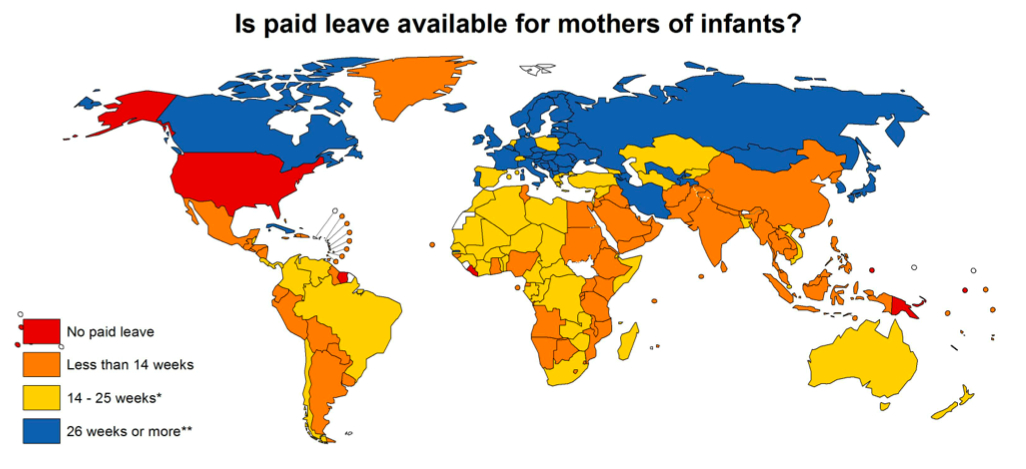
Lest we be too pleased with ourselves for remembering to call mom on Sunday, Ezra reminds us how tough it is for working mothers in the US, who have no guarantees of paid time off to care for an infant or a sick child:
While a handful of states, like California, offer modest paid maternal leave, there’s no federal guarantee of either paid maternal or paternal leave. We make mothers choose between spending a month with their newborn child or keeping a roof over their child’s head. That’s not how it looks in countries that value the work mothers do.
After North Carolina Republicans repealed the state’s Racial Justice Act last year, the state Supreme Court is considering whether to send back to death row four inmates whose death sentences were reduced to life without parole thanks t0 the law. Last month, Barry Scheck explained the case:
The four prisoners in the case have uncovered a mountain of evidence of discrimination in their cases and county, including a prosecutor’s handwritten notes in one of their cases. In it, he described prospective jurors differently by race. The white “country boy” who “drank” was “ok,” in contrast to the “black wino” who was excluded. Another African-American juror was “ok” because she was from “a respectable black family.”
The evidence also contained an unprecedented study of race and jury selection in North Carolina. Researchers found across the state, in counties large and small, urban and rural, rampant racial discrimination against African-American jurors by the prosecution was the norm.
A 1986 Supreme Court decision (Batson v. Kentucky) ruled that prosecutors cannot rely on race to dismiss jurors. In reality, though, this can be difficult to enforce, as prosecutors can eliminate jurors without expressing a reason—a prerogative known as peremptory challenge. In some states, according to the NAACP brief, “cheat sheets” have been distributed during prosecutorial conferences. These sheets instruct prosecutors on how “to hide the fact that you’re really eliminating this person because he or she happens to be black,” says Neil Vidmar, a law professor at Duke and a member of the team who prepared the brief. “The cheat sheet gives [prosecutors] a list of reasons that courts have approved as neutral explanations,” says James Coleman, also a law professor at Duke, “It gives them the answer that will give them a passing grade.”
In an interview, Walter Kirn – whose latest book, Blood Will Out, chronicles his relationship with the con man masquerading as “Clark Rockefeller” – discusses the peculiar appeal of swindlers:
Rumpus: Why are stories about impostors—The Talented Mr. Ripley, Six Degrees of Separation, Blood Will Out—so compelling? And beyond that, why are they of particular interest to you?
Kirn: We’re all impostors to ourselves. By that I mean that we know instinctively, intimately, the difference between whom we are inside and who we appear to be to others. Most of the time—when we aren’t flat lying about something or playing a particularly stylized role in some heightened dramatic situation—this difference between the internal and the external is modest and manageable. But there are moments when it frightens us, threatening to expose us as inauthentic. Well, the big-time impostors we read about in literature run this risk constantly, flirting with destruction, not just humiliation or embarrassment. It’s a spectacle that we can’t help but find compelling, and it involves a certain level of courage that we sneakily admire, perhaps.
I’ve always defined a truly alluring story as a journey we’re not equipped to take ourselves with a person we’re tempted but afraid to emulate. Impostor narratives are exactly that. When they end in disaster, as Clark’s did, or as Gatsby’s did, we can congratulate ourselves for our own wisdom. We can also experience, safely, at no cost, the terrible thrill of radical self-invention, of trading who we are for who we might be.
Rumpus: To what extent do you think Clark believed his own lies, and to what degree was he aware of all that he was doing?
Kirn: People who know Clark’s story superficially tend to find a strange comfort in the notion that he fell for his own lies. They imagine that he was delusional, confused—not unremittingly shrewd and calculating. They’re wrong, though. They’re projecting their own humanity onto a sociopathic, alien mind, a mind that couldn’t afford for even an instant to lose track of its own schemes. You or I would have trouble targeting different people with an array of specialized deceptions tailored to their respective personalities; we’d crack under the stress, the mental strain. But for someone like Clark, such pressure is a pleasure. I imagine that he woke up each morning wondering whom he could deceive that day. It made him happy, misleading people. It was his craft, not merely his compulsion.
 The Dish