The Closed Mind Of Neil DeGrasse Tyson, Ctd

Not all readers are defending NdGT:

Did Tyson actually say, “I don’t have a problem with these philosophical questions, just give me a way to test it.”? An interesting statement, given that theoretical physics has drifted quite far from that ideal. I saw Tyson once on Colbert, enthusiastically advocating theories of “string theory”, the “multiverse”, and the existence of uncountable parallel universes. All of these are notable for their lack of experimental validation, even more so for their lack of possibility of experimental validation. They are philosophical positions, but such weak ones that for anyone to take them seriously, it must be made to appear that they have the full weight of “science” behind them. I fully support the testability criterion for scientific questions. It is quite a contradiction to invoke this criterion to dismiss philosophical (and religious) questions, while at the same time degrading science by ignoring it.

A few more:

As a professor of philosophy (for 20 years now), I have found Tyson’s point of view to be depressingly common amongst my colleagues in the sciences and in the general scientific culture.

When I have taken the time to engage scientific colleagues, I have generally found the problem to be a lack of knowledge of what it is philosophy does – and to what a degree we are rooted in logic and argument (argument being viewed as a joint good-faith attempt to get at the truth in question rather than a debate we seek to win). Most scientists seem blissfully unaware of how many metaphysical and epistemological assumptions they have, and it leads to a curious naiveté about science and its limits.

However, I am reminded of Einstein, who took a different view: “Science without epistemology is – insofar as it is thinkable at all – primitive and muddled” (quoted in Rebecca Goldstein, Incompleteness (Norton: 2005), p. 29). It’s strange, really. I have the most profound admiration for scientists and the work that they do. I think science is indeed one of the human race’s most beautiful and profound achievements, and I will never fail to celebrate it. But damn … scientists can be so insular and incurious sometimes about anything that escapes their net of method. And it’s tiresome to have this popular spokesman encouraging it.

Another delves deep:

I share your apprehensions about Neil DeGrasse Tyson’s scientific monism: his smug, incurious assumption that only scientific approaches to questions of truth are worth our time and energy. That’s a not even a genuine scientific approach; it’s an engineering and technological approach to life. Real science is grounded in philosophy, and not merely practical problem-solving. But even more so, a truly scientific approach to life is one that is endlessly curious about the whole spectrum of life and philosophy, not just the narrow one of the problems that material science itself can address.

But this does reveal one of my primary criticisms of modern agnostic-atheistic scientism, which try as it might to separate itself from the Judeo-Christian tradition that gave birth to it, remains stuck in its primary philosophical assumption, which is the monotheistic view that there can only be one authentic God, and that all other Gods are false idols. The problem is that if the only tool one has is a hammer, not only do all problems begin to look like nails, but those that don’t are deemed unworthy of one’s attention and ignored.

Substitute “truth” for “God”, and the equation becomes clear. Advocates for scientism like Tyson are as convinced as any fundamentalist Christian that there can be only one true Way to find the Truth, and it just so happens to be theirs. All other ways are false, and pointless, and a waste of time. It does not occur to them, just as it doesn’t occur to a lot of traditional Christians, Jews, or Muslims, that the world we live in may in reality be polytheistic, with many truths, and many paths to these truths, each with their own relative value. That would be blasphemy to fundamentalist advocates of both scientism and monotheistic religion. And despite their many differences, both scientism and the Abrahamic religions have much in common at the philosophical level: a blind, cult-like certainty that theirs is the one true God, and all other Gods are false, graven images that must not be held in any esteem whatsoever.

This comes out in the most annoying aspect of Tyson’s version of Cosmos (and Sagan’s original one as well), which is the smug sense of certainty Tyson radiates as he presents the history and triumph of science. There is no room in his public presentation of science for what truly makes it valuable: its inherent attitude of doubt and skepticism, even about itself and its findings. Instead, we are presented with science as another form of certainty about how the world really works, and its own methods as the one true way of knowing and understanding that emerges from the failures of all other approaches to life’s difficulties. As if the world secular science has created were some kind of paradise, when even the most cursory look around would empirically show otherwise.

Don’t get me wrong; science is wonderful, but it simply isn’t the answer to most of life’s problems. Making it so becomes a problem in itself, and distorts the fundamental philosophical wisdom from which science sprang: an unbounded curiosity about reality. Those amateurish attempts of college freshmen to understand the paradoxes of consciousness and self are not worthless foolishness, any more than are those of a child wondering why the sky is blue. They are simply uneducated and in need of a rigorous, disciplined approach. And there are more important matters to address in life than merely working out the problems of why the sky is blue, that science has a very hard time even formulating the questions for, much less coming up with answers.

Tyson is right in the narrow sense: there are many questions that are rather worthless for scientists to address, but not because they are worthless questions with no way to find meaningful answers, but because science is not the right tool for addressing them. A whole body of religious, spiritual, artistic, literary, cultural and philosophical approaches remain better ways to approach such matters. And there, too, there is no one right and true way either. Monotheism has created a massive distortion in the western mind that requires the pluralism of the modern secularism as a counterpoint. But science cannot be that counterpoint if it, too, insists on being the only game in town.

Sponsored Content Watch

Screen Shot 2014-05-08 at 3.54.40 PM

Dish readers remain vigilant:

It’s official: the New York Times takes sponsored posts on its regular website. Screenshot attached. Same typeface – pretty sneaky!

How long does it take you to spot it? Update from a reader:

Umm no, it’s not the same typeface for either header or blurb. The font size is about the same but the “PAID POST” is slightly bolder, and the blurb is sans serif whereas blurbs for non-sponsored content is with serifs. That being said, however, due to the font size being the same size and the presentation on the page itself, it does lend itself to deception, despite the slight differences. The sneakiness is putting just enough differences that eagle-eyed readers would spot it but to the casual reader, the difference isn’t enough to highlight that it’s sponsored.

Nah, He’s Not 5’9″

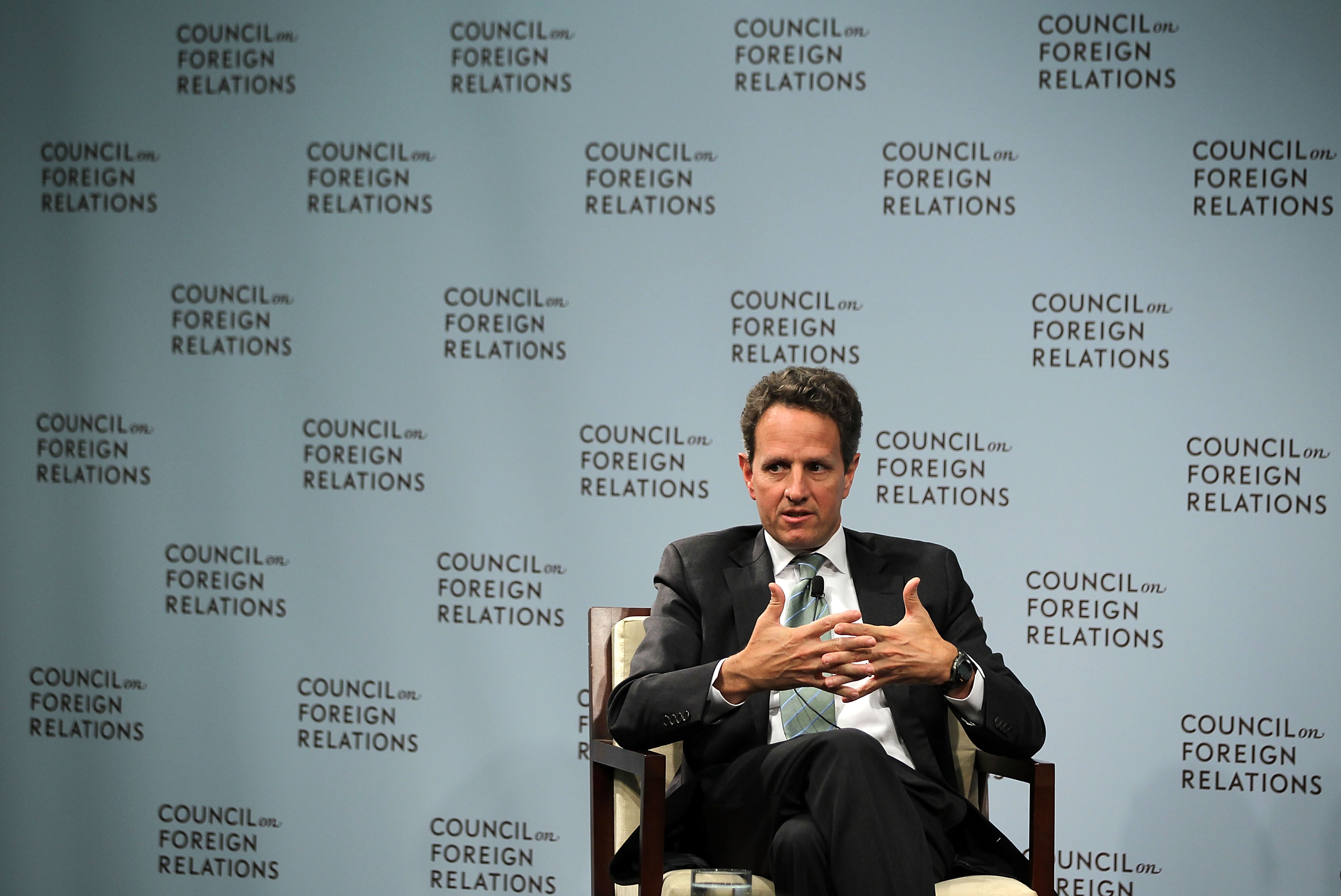
Geithner Discusses Global, U.S. Economy At Council On Foreign Relations

Well, Tim Geithner is shorter than me, anyway. Not that he’s that worried about it:

I’m almost 5-9, just below 5-9. 5-8-and-¾, something like that. You can round down, you can say 5-8. I’m relatively secure in my height.

But for me, the main take-away from Andrew Ross Sorkin’s profile is the bottom line of TARP. Whatever else you can say about it, it wasn’t a total bath for the taz-payers. Au contraire:

While there is some debate over how to calculate the proceeds from the various bailouts — TARP, the auto companies, the F.D.I.C. programs and Fannie and Freddie, among others — the evidence is persuasive. ProPublica, the nonprofit investigative organization, which keeps a tally of the bailout, puts the current profit at $32 billion. The White House Office of Management and Budget estimates that Fannie and Freddie will turn a profit of $179 billion over the next decade.

I tend to see that as an almost perfect coda to the Obama administration: maligned, battered but ultimately deeply, quietly successful.

(Photo: Alex Wong/Getty)

The Technology Of Marijuana Legalization

Matt Honan tests out a new vaporizer, the Firefly:

A personal disclosure: I’ve smoked a lot of pot. I’m no stoner, but I’ve been smoking it for more than 25 years, and in that time I’ve used all sorts of vaporizers. They’ve evolved a great deal over the years, from giant complex tabletop devices to today’s generation of e-cig-style vapes that deliver brain-hammering doses of butane-extracted cannabis oil. The Firefly does those devices one better, magically and almost instantly vaporizing actual plant material at the touch of a button. It is just wonderful.

It offers all the convenience of a pipe—it’s portable and downright stealthy; you can slip it in your pocket, carry it loaded up with marijuana—but it’s less harmful than a conventional pipe, because you are inhaling vapor, not smoke. The Firefly uses a lithium-ion battery to power a convection heating element that reaches 400 degrees Fahrenheit. The chamber is insulated by air, which means the Firefly’s housing doesn’t get hot enough to burn your fingers, or anything else, when you slide it back into your pocket.

He looks more broadly at how legalization is spurring innovation:

For the science and technology set, it’s a classic opportunity to disrupt an industry historically run by hippies and gangsters. And the entire tech-industrial complex is getting in on the action: investors, entrepreneurs, biotechnologists, scientists, industrial designers, electrical engineers, data analysts, software developers. Industry types with experience at Apple and Juniper and Silicon Valley Bank and Zynga and all manner of other companies are flocking to cannabis with the hopes of creating a breakout product for a burgeoning legitimate industry. Maybe it’s the Firefly. Maybe it’s something still being developed in someone’s living room. There’s a truism about the gold rush days of San Francisco: It wasn’t the miners who got rich; it was the people selling picks and shovels. As the legalization trend picks up steam, Silicon Valley thinks it can make a better shovel.

Update from a reader:

There are all sorts of good stuff being produced out there since the legalization of medicinal marijuana. For Oregon patients, it’s now even available in beverage form: drinkvitonic.com. Their manufacturing process is quite precise, taking a lot of the uncertainty out of the actual dose that the consumer gets. Plus it’s delicious.

(Full disclosure: the producers are friends of mine)

Something Is Picking Off The Pollinators

As we freak out about our collapsing colonies of honeybees, Brandon Keim shares the bad news that their wild cousins are also in trouble, along with other insects that plants depend on for pollination:

According to a recent survey organized by the Xerces Society, an invertebrate conservation group, nearly one-third of North American bumblebee species are declining. Other studies have reported similar trends, documenting dramatic declines in once-common species such as the American bumblebee. If that’s happening to bumblebees, says Xerces Society executive director Scott Black, it’s quite possible, even likely, that others are hurting, too.

“There’s very little information status on most of the bees other than bumblebees, but if you look at the life histories of these groups, many are likely even more sensitive to the disturbances leading to the declines, such as pesticides and habitat loss,” Black said. “Although we don’t know what’s going on with all bees, I think we could be seeing real problems.”

Among other pollinators, iconic monarch butterfly declines are well documented: Their numbers are now at a small fraction of historical levels. And entomologist Art Shapiro of the University of California, Davis spent most of the last four decades counting butterflies across central California, and found declines in every region. These declines don’t just involve butterflies that require very specific habitats or food sources, and might be expected to be fragile, but so-called generalist species thought to be highly adaptable. Many other entomologists have told Black the same thing.

Independent Journalism

Screen Shot 2014-05-07 at 3.51.53 PM

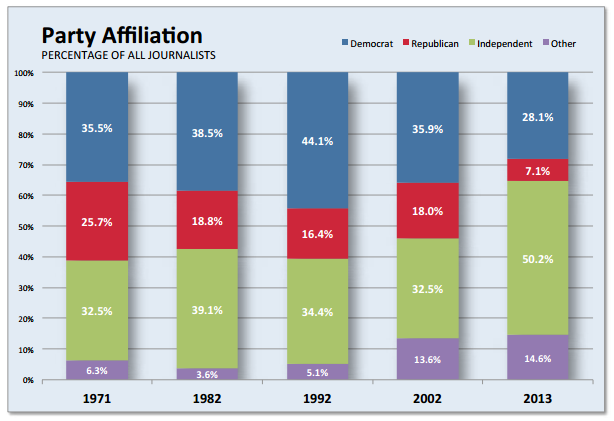
The Indiana University survey of journalists the Dish flagged earlier this week asked respondents about their political affiliations. Mollie Hemingway, echoing several commentators on the right, worries about the dearth of self-identified Republicans:

So what we see is that the percentage of journalists who identify as Democrat is roughly the same as what you see in the general population. And the percentage who identify as independent is even greater than the general population. But whoa check out that GOP figure. Only 7 percent self-identify as Republican, nowhere near what you might expect from the general population.

Let’s first pause to just note the danger of having a corps of journalists so far removed and even hostile to the views of the general population. If a newsroom has a good chance of not even having someone of the Republican variety within its confines, it’s a newsroom that probably struggles to even come close to understanding the perspective of GOP voters. It’s a newsroom that might struggle to fairly cover or might completely ignore stories about tax burdens on families, systemic failures of the welfare state, the benefits of gun ownership, or the evils of a serial-murdering abortion doctor in Philadelphia (just speaking hypothetically here).

Cillizza isn’t so sure that response is justified:

These numbers will likely affirm the belief in conservative circles that “all” reporters are secretly Democrats. (The study was conducted via online interviews with 1,080 reporters.)  While I am not in the business of disputing the study’s finding, I would note two caveats:

1. This is among all reporters not just political reporters. While that may seem like a minor issue, it’s worth noting that assuming these party ID numbers are true for those of us — like me — who cover politics day in and day out may not be entirely accurate.

2. The movement toward independent status among reporters is in keeping with a similar move in the broader electorate as they find the two parties increasingly rigid and, therefore, less welcoming.

Mankiw examines other research on the political slant of newspapers. What it found:

If a paper serves a liberal community, it is likely to lean left, and if it serves a conservative community, it is likely to lean right. In addition, once its political slant is set, a paper is more likely to be read by households who share its perspective.

Religiosity also plays a role in the story, and it helps [economist Mathew] Gentzkow and [co-author Jesse] Shapiro sort out cause and effect. They find that in regions where a high percentage of the population attends church regularly, there are more conservatives, and newspapers have a conservative slant. They argue that because newspapers probably don’t influence how religious a community is, the best explanation is that causation runs from the community’s politics to the newspaper’s slant, rather than the other way around.

The bottom line is simple: Media owners generally do not try to mold the population to their own brand of politics. Instead, like other business owners, they maximize profit by giving customers what they want.

Fat That Might Be Good For Us

Jalees Rehman discusses the implications of human fat cells being used to repair or regenerate damaged organs and tissues:

The discovery of regenerative cells within our fat has opened up new doors. As adult stem cells, they can be converted into tissues such as bone and cartilage and might provide long-sought relief for debilitating diseases such as chronic joint pain. As stromal cells, they are able to build and regenerate blood vessels, and could provide relief for millions of patients affected by poor blood flow to their vital organs. With scientists starting to engineer organs such as the heart, lungs, pancreas and liver from scratch, they are realising that ensuring blood supply to newly engineered organs is critical. The ability of cells derived from fat to grow blood vessels might make them central players in the future of organ engineering.

Discovering the regenerative power of human fat also begs a bigger question: how much more therapeutic potential resides within our bodies, just waiting to be discovered by scientists of the future? Stem cell research and regenerative medicine are providing humankind with an unprecedented array of opportunities to realise the age-old human quest for rejuvenation and longevity. But just like our predecessors – those physicians of centuries past who rubbed patients’ limbs with the fat of the dead – we can be seduced by false hopes and hypes. Stem cell biology has had more than its share of setbacks, often because it inspires dreams and promises that outpace the capacity of the science. Yet, propelled by those dreams and gigantic aspirations, we should be able to overcome obstacles, turn our back on false science, and engineer the transformative medicine to come.

A Hispanic Exodus From Catholicism?

New research indicates (NYT) that Hispanic American Catholics are moving away from the church:

There are positive findings: Mass attendance in parishes with Hispanic ministries is 22 percent higher than in the average parish, a promising sign in a church that has seen attendance at Masses dropping over the last few decades. Rates of Hispanicsbaptism and first communions are also higher.

But attendance rates at weekday Mass are quite low, participation in non-sacramental activities like youth groups is low, and contributions to collection are also low, often reflecting economic hardship. Parishes serving Hispanics often have fewer staffers per parishioner than other parishes, according to the study; parishes with high numbers of Hispanic parishioners are also less likely to have a parish school.

A Pew study released Wednesday also shows the Hispanic Catholic community is shrinking:

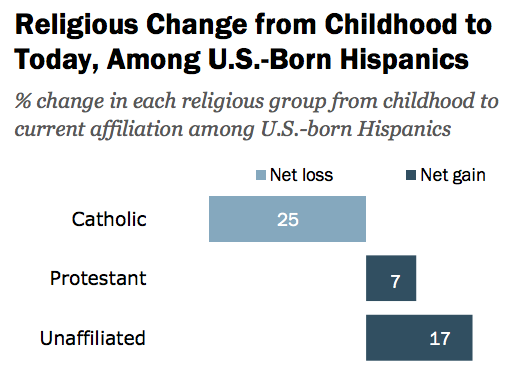
Most Hispanics in the United States continue to belong to the Roman Catholic Church. But the Catholic share of the Hispanic population is declining, while rising numbers of Hispanics are Protestant or unaffiliated with any religion. Indeed, nearly one-in-four Hispanic adults (24%) are now former Catholics, according to a major, nationwide survey of more than 5,000 Hispanics by the Pew Research Center. Together, these trends suggest that some religious polarization is taking place in the Hispanic community, with the shrinking majority of Hispanic Catholics holding the middle ground between two growing groups (evangelical Protestants and the unaffiliated) that are at opposite ends of the U.S. religious spectrum.

Elizabeth Dias comments on the Pew study, writing that the findings “are groundbreaking, but not surprising for anyone following the community closely”:

Latinos are joining Protestant churches, the report confirms, for socio-economic reason and not just religious ones. Half of Protestant converts say they left their childhood religion because evangelical churches reach out and help their members more. (Note: “Protestant” in most Latino communities tends to be synonymous with both evangelical and Pentecostal charismatic—Latino communities in the mainline Protestant churches are much smaller by comparison.) The social service priority of these congregations is significant draw. Evangelical Latino churches often act as a social safety network for their members, especially when it comes to basic needs like food, clothing, and health care.

Emma Green sees the findings as “a bad sign for the Church.” Mano Singham observes that the Pew survey suggests “Hispanics are not that different from the rest of the population”:

For example, they support same-sex marriage by 46-34% and 40% say abortion should be legal or mostly legal, as opposed to 53% who think it should be illegal. Hispanics also solidly reject traditional gender roles in marriage, saying that “a marriage in which both husband and wife hold jobs and help take care of the children (79%) is preferable to a traditional arrangement where the husband is the financial provider and the wife takes care of the house and children (18%).”

Meanwhile, Aaron Blake refutes the idea that changes in Hispanic religious affiliation will necessarily translate to success for the GOP:

Among the Hispanics who continue to affiliate with a church, just 22 percent are Protestant — compared to more than half of the United States population. Why is that important? Because Protestants — and especially evangelicals — are much more likely to be Republicans than Catholics are. In fact, the only Christian group that skews heavily GOP is evangelicals, and only 16 percent of Hispanics affiliate with evangelicals.

(For more on the differences between Christian groups, see this recent Pew study, which found that about half of white Catholics and mainline Protestants were Republicans, compared to 70 percent of white evangelicals.) The fact that the Hispanic population is still dominated by Catholics —and increasingly unaffiliateds — means it’s much less likely to swing to the GOP.

The End Of The American Entrepreneur? Ctd

A reader relates to the topic:

I am an entrepreneur, and I can tell you that in my experience, the biggest problem facing new business formation today is the explosion of consumer debt – especially student debt. If you did the overlay on the Brookings graph of new firm formation with student debt, one would be the inverse of the other.

Having debt makes you less risk-tolerant. Period. It’s bad enough to fail, but failing and having the bank up your ass and a bankruptcy hanging over your head really blows.

Another is on the same page:

Contrary to persistent belief on the right, people take risks when they have something to fall back on. In recent years, with college becoming so ridiculously expensive (along with healthcare), people are much safer as small cogs in large bureaucracies that make their money by rent-seeking. The great examples of such behavior would be the oil companies, Microsoft, and other large conglomerates.

The counterexample would be Google. It is not a surprising that Google’s workforce consists disproportionately of people whose parents held teaching jobs in universities (both in India and abroad) – jobs which that largely remained immune to the vicious debt cycles that pervade the workforce in the outside world.

Another turns to healthcare costs:

The long-term downtrend reflects people trapped in jobs in order to get affordable healthcare. As health insurance costs have gone up, the entrepreneurial spirit has been suppressed. My guess is that the recent uptick represents people who can now try to implement their entrepreneurial ideas.

Here’s a personal example. I recently wrote you about plans a former coworker and I have for starting a business. Both of us had been self-employed entrepreneurs for many years before seeking a corporate position with insurance. He and I have talked for years about the possibility, but neither of us was willing to give up our employer-based healthcare and take the risk of having no insurance, since we both had pre-existing conditions that no insurer would accept. Now we can proceed.

Related experiences from readers here and here. Meanwhile, an American in Canada offers a view from abroad:

Expats tend to shy from starting businesses because of the tax compliance issues. Tax law in resident countries contradicts US rules and results in double-taxation. And from a funding standpoint, very few non-US citizens who understand the IRS’s odd way of determining who falls under its jurisdiction are willing to partner with Americans in business. Americans are viewed as financial liabilities.

I’ve looked into opening my own business where I live in Canada, but it’s simply not worth the effort when I calculate the double accounting costs and the fact that the FEIE (Foreign Earned Income Exclusion) credit that’s often cited as being “unfair” is unavailable to those who work for themselves. Throw in FATCA and new compliance rules, which require a person to document and submit to the IRS annually every aspect of one’s financial life, and it’s a wonder anyone burdened with American citizenship – inside or outside of the country – would start a business at all.