Welcome To Droneworld

dronemap2

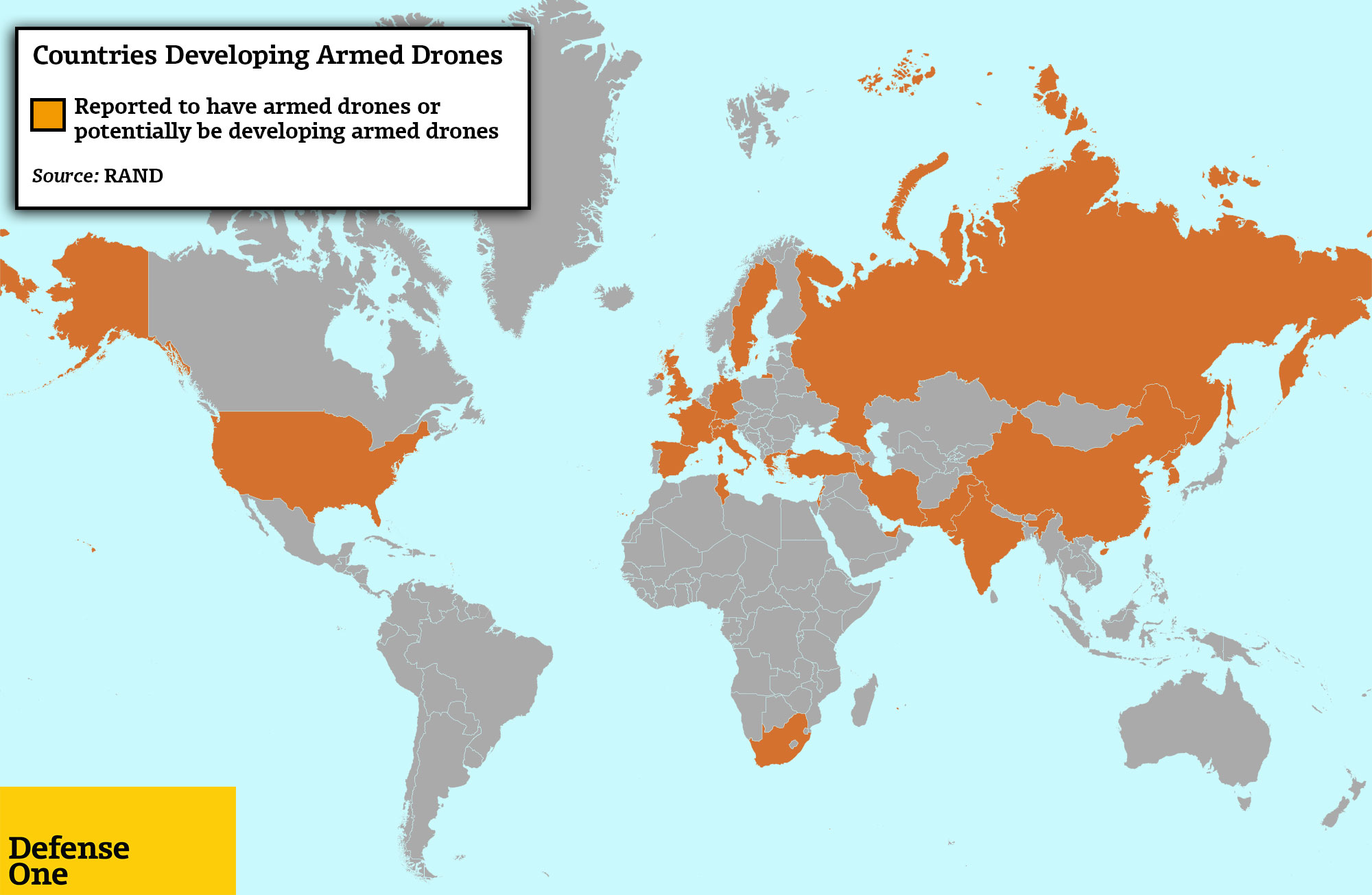
Patrick Tucker reports that it’s likely that nearly every country will have armed drones within 10 years:

After the past decade’s explosive growth, it may seem that the U.S. is the only country with missile-carrying drones. In fact, the U.S. is losing interest in further developing armed drone technology. The military plans to spend $2.4 billion on unmanned aerial vehicles, or UAVs, in 2015. That’s down considerably from the $5.7 billion that the military requested in the 2013 budget. Other countries, conversely, have shown growing interest in making unmanned robot technology as deadly as possible. Only a handful of countries have armed flying drones today, including the U.S., United Kingdom, Israel, China and (possibly) Iran, Pakistan and Russia. Other countries want them, including South Africa and India. So far, 23 countries have developed or are developing armed drones, according to a recent report from the RAND organization.  It’s only a matter of time before the lethal technology spreads, several experts say.

Friedersdorf blames the US for not setting norms for drone use while we still had a virtual monopoly on the technology:

There’s no way to go back and undo what we’ve done. But it remains the case that the sooner we start thinking farsightedly about the international drone norms that we want, the more we can do to bring them about. The best chance for future success would require us to put constraints on American behavior before other countries match our technology. That would create a short-term disadvantage, but it could pay huge long-term dividends.

Instead, the United States seems intent on developing weaponized drones that also operate autonomously. By the time an article can be written about how every country will have that technology available to them, it will be too late to stop it.

Meanwhile, Michael Horowitz fears that the Pentagon may be squandering our advantage:

As military robots shift from filling niche capabilities like bomb disposal to performing essential tasks throughout the military, they will challenge existing status hierarchies in the services. Likewise, as these devices become more capable of working with manned systems to multiply the effectiveness of U.S. forces or replace manned forces in some instances, they will require changes not only in the way the services fight, but also in the way they have thought about recruiting, training, and promoting since the creation of the modern American defense establishment in 1947. Those are threats to the military’s very identity — and they will provoke bureaucratic pushback.

Zack Beauchamp examines what can be done to change that:

[CSIS drone expert Sam] Brannen wants to create a new office in the Pentagon: the Defense Unmanned Systems Office (DUSO), with a whole staff dedicated to streamlining drone spending and thinking creatively about which systems could help the US innovate strategically and tactically.

This central drone office, DUSO, would coordinate “the cross-[Department of Defense] research, development, testing and evaluation” budget. It would also “conduct a review across existing DoD roles and missions to determine potential areas where unmanned systems technology could create military advantage” in order to “energize the use and development of unmanned systems beyond” surveillance and counterterrorism.

Every year, Washington’s think tank community produces countless reports with policy recommendations; most of them go nowhere. But, much to Brannen’s surprise, DUSO somehow ended up in congressional legislation.

Debating Republican Debates

The GOP wants to reduce the number of presidential primary debates:

At the RNC’s spring meeting, it will announce the formation of a standing committee on debates. The committee will select moderators, evaluate rules, and determine the number of debates. The total number is likely to be half of the previous cycle, and the committee will likely agree to remove delegates from any candidate who participates in a debate outside the party structure.

Ron Klaim thinks this a mistake. He argues that “GOP debates in 2012 saved the party from what surely would have led to a 50-state Obama landslide: nominating Rick Perry”:

[A] year prior to Election Day 2012 the Perry juggernaut was so strong that even the Great and Powerful Oz (aka Nate Silver) wrote a New York Times Sunday magazine piece forecasting a 55 percent chance that Perry would beat Obama in the general election. What stopped Perry, and saved the Republican Party from nominating a hopeless, hapless candidate?  Those much reviled debates, where Perry blew—not one, not two—but three debate appearances. And what finally did Perry in? One of those much maligned “media sponsored” debates, where CNBC journalist John Harwood called Perry out for being unable to name the three federal agencies he proposed to abolish. It took multiple debates to expose Perry’s weakness, and sharp questioning by a savvy reporter to make that weakness fatal. Absent those, the GOP might have nominated an atrocious candidate and left the dissection work to President Obama in the fall. Rather than trying to cut back the number of debates and wrest control of them from media types, the Republican Party should send Harwood and CNBC a bouquet and beg them to hold 20 more debates in 2016 to weed out any empty suit candidates.

Letting The Air Out Of Party Balloons

Kelly Jane Torrance notes that the US government, the world’s number-one supplier of helium, “has been selling it at a cut-rate price that has no connection to its actual value.” Now a shortage is affecting a wide range of industries:

Worldwide, cryogenics—the fancy word for the field in which liquid helium is used as a coolant—accounts for 29 percent of helium use. That includes pharmaceutical research and MRIs. Welding uses 17 percent, while 5 percent is used to detect leaks, mostly in industrial manufacturing—a critical component of safety for those employed in the sector. Party balloons use up more—8 percent worldwide. “You have to take a look at your market. If you look at the priorities of that particular gas, the number-one priority is medical,” [executive at industrial gas supplier Air Liquide Martin] Lovas says. “With one cylinder of, say, 300 cubic feet, you can do nine MRIs. Or you can fill 1,000 balloons.” …

The Federal Helium Reserve currently holds about a third of the world’s total reserves. Might American users—research laboratories, medical institutions, the Department of Defense, NASA—just buy it elsewhere once that reserve is gone? That depends on a lot of things, of course, including one very uncertain factor: the state of global geopolitics. Almost all of the remaining helium reserves are located in two areas not currently known for their willingness to do favors for America: the Middle East and Russia.

The Best Of The Dish Today

A reader sends “Sully bait in DuPont”:

rick-roll

It was a good day to rip open a new can of controversy by dumping on Neil DeGrasse Tyson’s philistine scientism – not science at which he is superb and enlightening, but scientism. Readers pushed back hard here. A good day to rant on sponsored content one more time. A good day to look out of a window at Irish turf and sky.

I tackled the thorny topic of America’s Game of Thrones – that revolving crew of dynasties that dominate politics here far more than in most other countries. We noticed that Florida is much more favorable to Hillary in 2016 than it was for Obama in 2012. And we cast a skeptical eye on Putin’s latest machinations in his chilling new masked form of warfare. Oh and one tear-jerking cat and dog.

The most popular post of the day remained the exposure of author Jo Becker’s coordinated campaign to get her exclusive sources to promote her book promoting them. Next up: The Closed Mind Of Neil DeGrasse Tyson.

You can leave your unfiltered comments at our Facebook page and @sullydish.

19 37 more Dishheads became subscribers today. You can join them here. One writes:

Hi Andrew and everyone at the Dish. I recently noticed that your site was no longer recognizing me as a subscriber, but didn’t think anything of it until I just hit my “Read On” limit on all of the devices I use. Still, I couldn’t figure out why it hadn’t been recognizing me until today when I remembered that I had recently gotten a new credit card because the old one (with which I purchased my recurring monthly membership) had been compromised. Problem solved now! And while I was there, I decided to increase my monthly contribution from $3.33/mo (which is about double the annual rate) to $4.20/mo.

Thanks again for the Dish. I may not always agree with you, but I always try to understand your point of view. Even when you’re dead wrong. Haha.  Seriously though, the Dish is the best thing on the Internet! I would be crushed if I couldn’t get my Dish every day.

See you in the morning.

America’s Game Of Thrones, Ctd

A reader writes:

I adore my Canadian wife and two dual-citizen boys (Canadian and American), but I think you were unduly charitable to Canada when you wrote that, unlike the United States, it doesn’t have real political dynasties. The head of the Liberal Party and perhaps soon-to-be Prime Minister is Justin Trudeau.

He’s featured in the above video eulogizing his father, a former PM:

You want a dynasty in Canada?  That’s easy.  Justin Trudeau, son of the great Prime Minister Pierre Trudeau. Granted, it’s taken a very long time: The father left politics in 1984, and it was only last year that the son became Liberal Party leader.  But Justin was considered dynasty material after a somewhat remarkable eulogy at his father’s funeral in 2000.  He held off for a long time because of age and family reasons, but the annihilation of the Liberals at the 2011 elections probably forced his hand.

Another has more on the Canadian dynasty:

The elder Trudeau was one of Canada’s most significant prime ministers. He repatriated Canada’s constitution from Britain, successfully passed a Canadian equivalent to the US Bill of Rights, imposed martial law during separatist terrorist kidnappings in Quebec, and was personally known for “Trudeaumania” – a Beatlemania-like popularity and public presence.

His son Justin and his party have enjoyed approval ratings above the currently governing Conservative party since his selection as party leader, but the Conservatives criticize Justin as an all-style no-substance candidate of inexperience, running on his father’s legacy.

We’ve had a few husband-wife power couples. The late leader of the current opposition party, the NDP, was a man named Jack Layton whose wife Olivia Chow was also a high-ranking NDP member. The latter is about to challenge Rob Ford in Toronto’s mayoral election, where she is the only serious candidate on the political left.

A few years ago we had a high-profile power couple when Magna steel heiress Belinda Stronach was a high-ranking conservative MP and had a very public relationship with another high-ranking conservative MP, Peter Mackay. Their relationship ended in acrimony when Stronach crossed the floor and defected to the Liberal party without telling Mackay first. Ouch.

Stephen Harper, our current prime minister, fired his chief of communications Dmitri Soudas after Soudas intervened in a local riding nomination process to help his partner, sitting MP Eve Adams, who is being redistricted.

Another adds:

The late Jack Layton, leader of the left-leaning New Democratic Party in the last election and the man credited with putting them in the official HMLO spot, was the son of a Tory cabinet minister.

Previous Dish on Layton’s legacy here. Another reader:

Toronto’s train wreck of a mayor, Rob Ford, descends from political stock. His father was a city councilman, as was Rob Ford before becoming mayor. (The mayor’s brother, Doug Ford, is also on the city council.)  The Fords fashion themselves as Canada’s right-wing answer to the Kennedys! (Thus far, only in alcohol abuse.)

Oh snap. Another looks to Japan:

The country also has a significant number of dynastic figures.  Shinzo Abe, current prime minister, comes from a family of politicians, his father being a former Foreign Minister.  Yasuo Fukuda, son of Takeo, both prime ministers (though the son didn’t last long).  Former Prime Minister Yukio Hatoyama is considered part of what Japan considered their Kennedy family, though his tenure was only nine months.

A German reader:

Germany is relatively dynasty free. Wolfgang Schaeuble’s late brother was a state-level politician. Ursula von der Leyen, currently minister of defence, is the daughter of Ernst Albrecht, former governor of the state of Lower Saxony.

Another:

I’m sure your readers elsewhere in the world – the Gandhi dynasty in India, for example – will provide lots of modern examples of familial consolidation of power.

Another swings back to the US:

You might also want to note the current races for senate and governor in Georgia: Michelle Nunn (daughter of former Senator Sam Nunn) is running for U.S. Senate and Jason Carter (grandson of Jimmy) is running for Governor.

Another makes a distinction:

It does get tiresome hearing you rant about Hillary Clinton as the beneficiary of nepotism, etc. She has been utterly qualified for every position she ever ran for. I may not agree with her much, but she’s no W. Bush. A power couple may be a troubling dynamic, but it is not in any way dynastic.  When Chelsea runs for the Senate, then you may start your grumping again.

Where It’s Really Hard To Come Out As An Atheist

In Saudi Arabia, the government deems “calling for atheist thought in any form” a terrorist act. Nesrine Malik comments:

In my experience, when it comes to atheism in the Muslim world, there is a conspiracy of sorts, akin to the [former] “don’t ask, don’t tell” principle on homosexuality in the US military – if a Muslim has lapsed, and no longer believes in God, there is no censure of that as long as one does not proselytize. Indeed, a 2012 poll by WIN-Gallup International found that up to 5 percent of Saudis polled identified as atheist, according to Sultan al-Qassemi, a number “comparable to the US and parts of Europe.” However, these atheists are almost anonymous in the public sphere, only “out,” at most, to their families and friends.

Some atheists have taken to describing themselves as “ex-Muslims,” adopting a stance similar to that of the New Atheists:

Few people define themselves as “ex-Christian” or “ex-Jewish.” The “ex-Muslim” tag is an identity, a refuge, a political statement that is not to be confused with simple lack of belief in God. It is also one that finds common cause with a new tradition of western atheism, one that couches its position more in the public rejection of religion than simple non-belief. The difference is that the former can thrive in a secular society, where communities have become weaker and individuals revel in self-expression. Muslim societies are quietly tolerant of rebellious acts of all kinds, from the sexual to the religious. But because religion, family, society, and politics are built around community, to be a declared atheist in the public space is to make a stand against the fabric of society.

Previous Dish on the atheist closet in the West here.

No Gold Stars For America’s 12th Graders

Screen_Shot_2014-05-07_at_9.02.45_AM

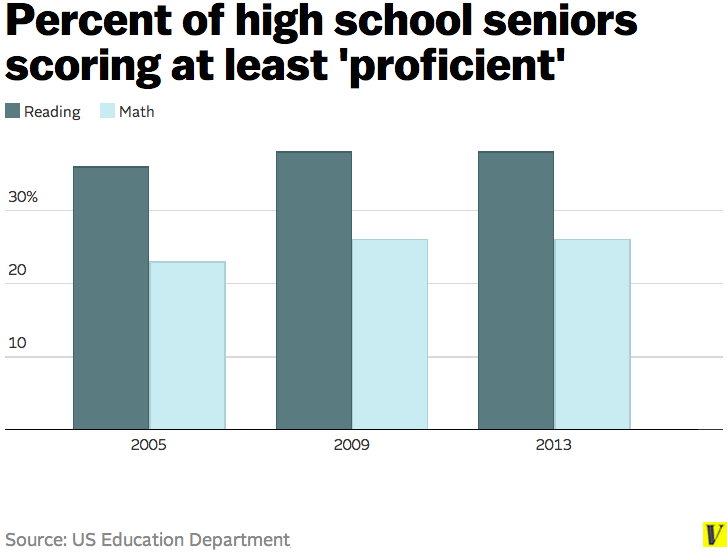
Libby Nelson finds “little good news” in the latest National Assessment of Educational Progress (“the nation’s report card”), which the DOE released yesterday:

Just 26 percent of 12th-grade students scored as proficient or better in mathematics in 2013. In reading, 38 percent were proficient or better. And there has been no improvement in 12th-graders’ scores since 2009, the last time students took the tests. … Scores released in December showed that fourth-grade and eighth-grade students have slowly improved their performance in reading and math, even though less than half of them score as proficient in those subjects. But Wednesday’s data show high school seniors haven’t even made incremental progress.

Why are seniors doing so poorly, when younger students are improving? Demographics might be a factor:

One change that probably has influenced the 12th-grade scores somewhat is the demographic changes of America’s seniors since testing began in 1992, as well as an upward trend in graduation numbers. The percentage of students who are Hispanic has risen from 7 to 20 percent in that time, and the percentage of students with a disability has doubled, from 5 to 11 percent, while the portion of students who are white has dropped from 74 percent to 58 percent. At the same time, the average freshman graduation rate has risen from 74 percent to 81 percent, meaning more students who might have dropped out in the past are now included in the sample that are tested.

But Jill Barshay is unsatisfied with that explanation:

[H]ere’s the thing. When you look at top achieving students in the top 75th and 90th percentiles. Their scores are FLAT. … High achieving students aren’t improving at all. So you can’t blame the infusion of more low performing students in the testing pool for the disappointing test scores. Even if we hadn’t introduced a greater number of weaker students into the mix, the scores of our high school students would still be stagnant.

Indeed, when you drill down by percentile, it’s the weakest students who are showing modest improvements. If not for their improvements, the national average would have declined!

Also, Maya Rhodan notes that, in the longer term, minority students’ scores are improving faster than those of white students:

Between 2005 and 2013, African-American students’ math scores jumped by five points and white students saw their scores go up by four points. Asian/Pacific Islander students and Hispanic students experienced the highest gains, with math scores increasing by 10 and seven points, respectively. Yet achievement gaps persist between racial groups and genders. Boys scored an average of three points higher than girls in math, and girls scored about 10 points higher in reading than boys. Whites scored 30 points higher than blacks in math and 21 points than Hispanic students. In reading, whites scored 30 points higher than blacks and 22 points higher than Hispanics.

Face Of The Day

Tensions Continue To Grow In Eastern Ukraine As Clashes Continue

Ieromonah Opanasiy, an Orthodox priest, sits in a tent providing humanitarian services to pro-Russian activists outside the occupied regional administration building, which serves as their local headquarters, in Donetsk, Ukraine on May 8, 2014. Tensions in Eastern Ukraine are high after pro-Russian activists seized control of at least ten cities ahead of the Victory Day holiday and a planned referendum on greater autonomy for the region. By Brendan Hoffman/Getty Images.

Do I Sound Gay? Ctd

Readers keep the popular thread going:

I’m deaf and I read lips. I’ve definitely noticed that someone’s speech can “look gay.” Sometimes this seems to trump how the person actually sounds. Occasionally I’ve mentioned something to a hearing person who says, “What? That person doesn’t sound gay at all.” Then, a little down the line, the person in question comes out of the closet. (This has only happened with gay men, not with lesbians.)

Another offers a “gay4pay perspective”:

I’m a straight male sex worker who has mostly serviced male clients. Most of my experience was in Canada but I have since moved to the US. My educational background is in the social sciences and law. At the end of nearly every session I conduct an informal, oral survey to find out some basic information about the client’s sexuality and his/her marital status and, where relevant, their “out” status (i.e. Are you “publicly” gay?)

One of the things that struck me quite early on in my experience as a sex worker was how many of my self-identified gay male clients had NO hint of a “gay voice”. At one point it was definitely a majority of them, but since moving to the US it has evened out a bit. I can tell you with absolute confidence that I did not notice any relationship between the client’s “out” status and their voice type.

Where I did detect a relationship was with age; the younger gay clients were much more likely to possess a voice that would at least hint at their sexuality. Most of the older ones (I stress these were mostly “out” clients) sounded much straighter than me, which brings me to my next point.

At least since high school, people have seriously questioned my straightness. It died down considerably during undergraduate school, but when I began law school it resumed. I have fun with the ambiguity much of the time, but there comes a point where I start wondering if it is actually affecting my prospects with women. When I ask people why I come off as gay, they point out a number of things that include my voice. Now, I personally don’t think I have a gay voice, but I do think it sounds “anti-macho” – sort of like a lot of European voices sound to Americans. I was born and raised in a part of the Arab world where anyone with some measure of civility would differentiate themselves from others with more “tribal” leanings. I speak with tremendous care, as though I love every word I say. I think it’s a terrible shame that doing so associates me with a specific sexual orientation.

My personal experience and what I’ve witnessed in my sex work, anecdotal as it is, really reinforces my view that a person’s voice and speech are things they are socialized into having.