Bullied Kids Up In Arms

Screen_Shot_2014-05-05_at_5.16.19_PM

A new study finds that kids who are bullied are more likely to bring a weapon, such a gun, a knife, or a club, to school with them. German Lopez compiles the findings into the chart seen above:

The results aren’t very surprising, given years of warnings from anti-bullying advocates. As Mother Jones points outStopBullying.gov previously indicated that 12 of 15 school shootings in the 1990s involved perpetrators with a history of being bullied. It’s worth mentioning, however, that the data shows correlation, not causation. It’s possible, for example, that people who carry weapons are more likely to fall into conflicts that lead to bullying. In those circumstances, weapons might not be carried for protection as much as aggression.

The data also doesn’t exclude other risk factors, such as mental illness or easy access to guns, from playing a role in school shootings. It’s unexplained in the study, for instance, how these students obtained weapons in the first place.

Scott Shackford fears that this finding will be used to justify more oppressive school policies:

Researchers estimate based on the poll that 200,000 teens being bullied are bringing weapons to school. … But if all these students are carrying weapons and yet there aren’t hundreds of thousands of incidences of school violence by bullying victims every day, what is the actual extent of the problem versus the fearmongering? Schools already have their terrible zero tolerance rules that have resulted in all sorts of twisted outcomes for stupid reasons. It’s easy to imagine misguided, indifferent school administrators responding to the study by exposing the bullied students to increased scrutiny, all in the guise of protecting student safety. That could have the additional impact of causing students to be even less likely to report harassment.

Ranting On The Phone At Starbucks

That’s what I did yesterday when Digiday called me up to ask about sponsored content. The resulting interview is here. Money quote:

Brian Braiker: Digiday runs sponsored content.

AS: You’re whoring yourself as well, but at least you’re covering the whoring! They’ve fired all their brothel reporters and started hiring them as brothel greeters.

Or something like that. I can get worked up after a tall, wet cappuccino.

Update from a reader:

As someone who does a lot of development of large media sites (my company specializes in this), I’m responsible for the technical implementation of many of these sponsored content schemes.

I agree with you. These publications are trashing their own credibility, and they will suffer in the long term.

That being said, I’m of a generation that doesn’t see the media as an institution in the same light that you do, so to me these are just businesses that are paying my company to torpedo their long-term viability. Which now that I think about it is pretty much what every media company we work with is doing in a number of different ways. There’s a real stink of desperation coming off of all of these guys, and they’re often very unpleasant to work with, as their stress and panic inevitably rolls downhill onto me. (It’s better than working for startups though, at least some of these companies still manage to make money.)

I’m happy to keep getting my news from you, and I’m also happy to pay for it. I think the patronage model is a better, more honest approach for both journalism and art (I refuse to refer to it as “content”), and your blog is proof that it can work. I don’t ever need to worry about you selling me stuff. If you ever have any questions about the nuts and bolts of how Google watches everything you do and then tells anyone who will pay, I’d be happy to answer them.

Nuclear Is Better Than The Alternative, Ctd

A reader agrees with me:

Yes, the left is blind on this issue. As an environmental engineer, I’m always puzzled by the reaction of so-called environmentalists who immediately reject nuclear. But the right isn’t any better. Neither political party will implement reprocessing. One, because they reject nuclear in general, and both, because terrorists.

We as a nation do not reprocess our fuel, thus we have massive amounts of fuel that must be stored. The Yucca Mountain depository was inadequate by the time it was built, with more spent fuel than capacity. In the 1970s, reprocessing was banned out of fear of terrorists getting their hands on plutonium. There are downsides to reprocessing – namely the process does create some very toxic waste streams (much more so than normal spent fuel) and potentially weapons-grade plutonium. However, France has reprocessed for decades and we’ve figured out techniques to avoid weapons grade fuel.

People don’t understand nuclear power and are needlessly scared of it because of Chernobyl and poor education on the topic (even in college). Having worked in refineries, coal plants, hydroelectric dams, and nuclear power plants, I would rather live inside a nuclear plant than within 10 miles of the others.

From an attorney who focuses on energy policy:

The basic thrust of your point is well-taken: environmentalists must be strategic about how we deal with nuclear energy, and forcing the immediate closure of nuclear plants is a counterproductive strategy, especially in parts of the country (such as the Northeast) where resources are already stretched to capacity and grid reliability is a pressing issue.

However, there are two things that you miss in your post.

First, increased reliance on nuclear energy would do essentially nothing to disentangle us from the Middle East. That part of the world supplies us with, of course, a significant amount of oil. But in the US, oil is consumed primarily for vehicle fuel, for industrial uses (i.e., plastics), and for home and industrial heating (among various other things); only a tiny fraction of it is user for electricity generation. In fact, only about 1 percent of our current electricity derives from burning oil at power plants, and no new oil-fired units are predicted in the near future. Nuclear fission, on the other hand, has only really only one major civilian application: generating electricity. (Of course, there are also various military uses for it, including weapons material and powering large ships and submarines.) There simply isn’t much overlap between oil and nuclear, and shifting our dispatch significantly to electricity generated from nuclear plants won’t help us much extricate ourselves from the Middle East.

Second, there’s economics. Let’s put aside for a moment all the other problems related with nuclear, such as safety, localized health impacts (which are  highly uncertain), proliferation risks, and the perpetual problem of waste storage and disposal. Nuclear electricity generation is, at the heart of it, just a damn expensive way to boil water. Even disregarding the generous public subsidies that nuclear energy enjoys, its overall cost per megawatt-hour is still more than that of various renewable energy sources, such as onshore wind and geothermal, and is comparable with that of solar (both rooftop solar and larger-scale generation). Moreover, the cost of solar is diminishing rapidly, and can be expected to do so on into the future; nuclear, not so much. Yes, many of these sources receive subsidies as well, but the rapid cost-saving innovations that are occurring as we speak more than justify that from an economic standpoint (to say nothing of the environmental benefits).

In short, while nuclear power plays a role in our current generation mix, it’s not the long-term solution to our electricity needs. Increasing our reliance on renewables and maximizing our opportunities for energy efficiency are.

Another reader speculates:

While I agree that there are many in the environmental movement who are on the wrong side of nuclear power, I think your previous post is too quick to label it as an ideological issue. Rather, I think it’s generational. I know that I and many others in my age range (born in the mid-’80s) are pretty agnostic when it comes to nuclear power. Our parents, however, lived through Three-Mile Island, through Chernobyl, or May 1953, when Chicago was pummeled with rain carrying radioactive dust. These were serious errors caused by either a lack of understanding or a lack of thorough oversight in nuclear power. My generation has never lived through these. The closest we have is Fukushima, and it’s hard to relate to a place that is that far away.

Another is less blasé about the dangers:

Just as you need to calculate the health and environmental effects into the electric cost of fossil fuel plants, you have to calculate the cost not only of waste disposal, safety, and security precautions, but the risk – however low – of having to evacuate and abandon an area in case of an incident like Fukushima and Chernobyl. What do you figure the cost per kilowatt hour at Fukushima was after adding in the still ongoing and fraught cleanup process there?

Every few decades nature seems to remind us that it is very hard to engineer a structure to account for every possibility. I am all for an everything-is-on-the-table approach to combat global warming and don’t discount the possibility that we will need to build more nuclear power production. But the burden is certainly on the industry and the government to convince the public that our existing plants are safe, nuclear waste is being responsibly taken care of, and future plants are prepared as they can be for “unpredictable” events.

Cleaning Up After Your Adult Kids

Living At Home

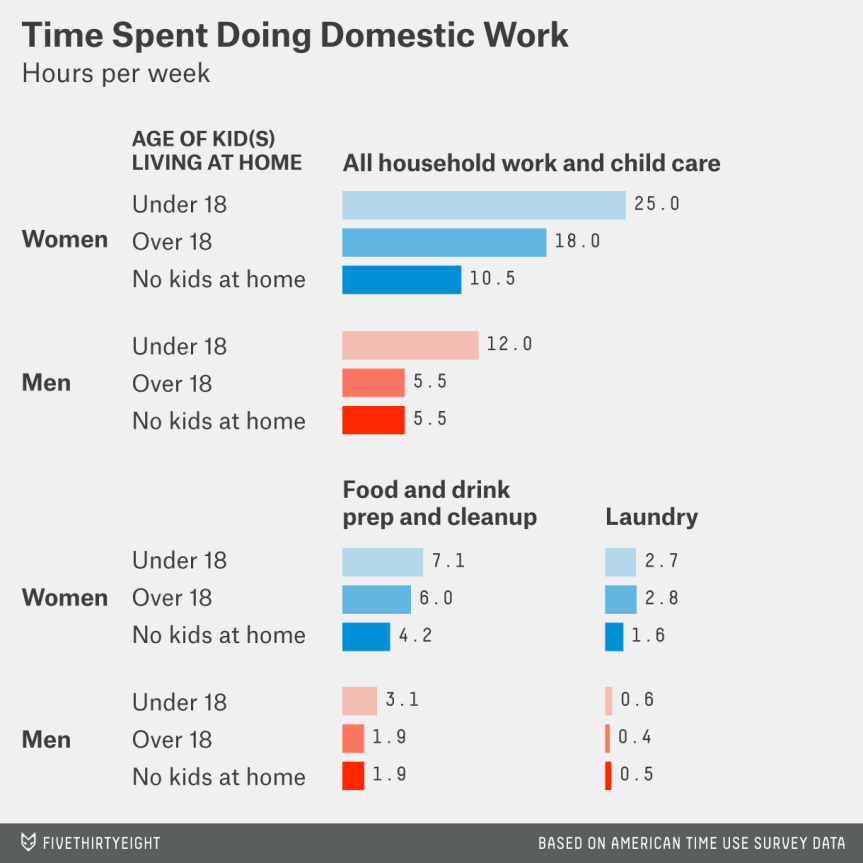
Heather Krause considers the impact that young adults living at home have on their parents:

According to an analysis of data from the American Time Use Survey, which asks a nationally representative sample of people to record how they spend their time every day, parents with 18- to 31-old children living at home are spending at least eight hours per week caring for them. That’s causing real shifts in the time they spend relaxing. (Their sex lives are also being affected.) And women are spending significantly more time taking care of these young adult children than men are. It’s not news that women do more work around the house than men, or that women have less leisure time than men. What’s new is that the period of care is getting longer, even if it’s mitigated by the increased responsibility and independence of these adult children.

The Enigma Of Authorship

Novelist Tim Parks contemplates the personal questions writers get from the readers who gather to hear them speak:

“Do you think your move to Italy altered the way you think and write?”

“Has it been useful for you as an author to translate as well?”

“Does your wife read your books and if so what does she think of them?”

None of these questions are directly addressed to the novel you are presenting. Yet one has to grant that if only one knew the answers, something would be learned. … Who are you, to be producing this stuff? That’s what they’re asking. The irony perhaps is that what’s mysterious to them is even more mysterious to you. Yet even as you try and inevitably fail to answer their questions you are probably telling them more, in your perplexity and frustration, or your wryness and charm, than you ever could have by explaining your book.

The War Over The Core, Ctd

A reader sends the above video:

It occurs to me that this isn’t the first time parents like Louis C.K. have been upset about not being able to help their children with their math homework. Remember the New Math movement? Tom Lehrer wrote a song about it. As he sardonically says in the introduction, “The important thing is to understand what you’re doing, not to get the right answer.”

But another reader takes the idea of problem solving more seriously:

I don’t know a whole lot about the Common Core, nor about NCLB. But I am a scientist, so I know that Louis CK is complaining about the form of the questions. No longer is math addition and multiplications, like it was in his school days. No more: 34+98=, 102/3=, or 21×5=.  Currently, questions come as paragraphs full of words with the numerical issue hidden in them. So the current math questions are riddles in words that sometimes barely seem to contain numbers. Before getting to the numerical question, kids needs to decipher the question and reduce it to numbers. This adds a layer of complexity to the problem. It also requires problem solving, a life skill much more important than arithmetic. Incidentally, it is a skill that academics have been screaming for for years to get into pre-academic education.

I have taught basic physics at a university. A major frustration is that most students consider physics a numbers game. Get the formula, find the numbers, punch them into your calculator and tada!: an answer. That is not physics. Academics of all stripes face such oversimplification issues. Science and other complex issues are not simple. In modern society, we need people who can tackle complex problems – be it filling out a tax form, evaluating complex personal relations, getting ahead in your job, or redefining the way (paid) news is brought. We need people who can think critically.

Another is on the same page:

My younger son, who at 8 has been taught under Common Core standards since kindergarten, loves math. He loves all the different techniques they are teaching him and has a deeper understanding of math than his older brother, who was taught to memorize math facts. That I don’t know what he is doing half the time is a feature for him, not a bug.

Also, my Ph.D husband just “took” the NY sixth grade Common Core math test posted online and said it is absolutely the way math should be taught, with multi-step problems that require critical thinking. He was just concerned about how it is scored – in his mind, multi-step problems should be graded for partial credit – and if it was perhaps too much to expect of a sixth grader. But he wasn’t sure. He certainly thought the adults who claim they can’t answer the problems are either lying or were woefully unprepared by their schools.

But another reader is worried about how students with disabilities will fare under the new standards:

I don’t like the insinuation by your reader that merely getting the right answer isn’t enough, and that you have to show your work to show you “understand the math.” For someone who struggled to “do well” in math, even though I was very good at it, this makes my blood boil.

Allow me to explain: My fine motor skills are crippled to the point that I can only write by hand at a very slow speed. I remember taking an extra hour or skipping recess just to complete a paper or test – not because I was verbose, but because it took me that long to just to write the same amount of material. After getting this documented and implemented into an IEP/504 plan, I was able to get some accommodation in all my subjects through use of a word processor … except in math.

Math was hell to me, but not because I had problems doing it. In order to compensate for my disability, I learned the formulas enough to calculate the math in my head and use the space provided as scratch paper. I was thus able to get high SAT scores in math (in the 700 range, pre-2004 tests). But math teachers, very similar to your reader, did not like that. They wanted me to “show my work.” The problem with “showing my work” is that it turns what is supposed to be a 30-minute-long assignment into a 90-minute assignment (or sloppy 45-minute one), and made an hour-long homework assignment two and a half hours long, chewing into other subjects. It also made it very hard to stay focused, which made it difficult to get problems right.

Efforts to accommodate me were often ignored, not least because the math teachers had no idea how to handle a disabled student who was actually good at math, and doing it by computer was obviously out of the question. I was a C student for the most part, except in the two years I had one teacher who did accommodate me, and my first-year calculus course in college, which was taught by a disabled professor.

Common Core tests will be administered by computer, so maybe that will make life easier for a new generation of disabled students. Or maybe that will create new problems; a reader who graduated from high school in 2006 says his experience with proficiency exams left him skeptical:

One day in my 11th-grade AP English class, our teacher had us read a few essays other kids had written for our state assessment exams. We were provided with the definitions of the scoring structure and asked to apply the correct label to each of the four essays. We all easy identified the “needs improvement” and “advanced” essays, but when it came to identifying the “basic” and the “proficient” essay, almost all of us switched the two. Why? Because while both of the essays showed about the same level of comprehension, the “proficient” one was overly complicated in a way that detracted from the content, while the “basic” essay was straight to the point. With these Common Core standards, it looks like the feds and the states are doubling down on useless confusion.

Read the entire discussion thread here.

The Internet Giant You’ve Probably Never Heard Of

Screen Shot 2014-05-07 at 1.05.33 PM

Alibaba, China’s answer to Amazon, has filed a prospectus (pdf) with the SEC for what might turn out to be the biggest Internet IPO ever:

The real figure is expected to climb to between $15 billion and $20 billion as the company gets closer to its actual sale. If it lands in the upper end of that range, Alibaba could easily eclipse Facebook’s $16 billion, making it the largest Internet IPO in history. The biggest IPO of any type on record was done by the Agricultural Bank of China, which raised $22.1 billion, according to the Wall Street Journal.

Whatever valuation Alibaba lands on, the IPO is expected to be a windfall for Yahoo. Marissa Mayer’s company holds a 22.6 percent stake in the Chinese e-commerce platform and plans to sell a chunk of that in the public offering. Depending on Alibaba’s valuation, that deal could hand Yahoo a $10 billion to $15 billion pile of cash.

Nick Bilton looks at just how huge the company is:

As of 2013, it had 231 million active users across its services, including Alibaba.com, a site where small businesses sell goods to companies abroad, and Tmall.com, a site on which Western companies like Apple and Nike market their products. Each active user, according to the company, makes 49 purchases a year. All told, the company said it now processed more than 11 billion orders a year. …

With its scale, Alibaba has generated lots of jobs. At the end of last year, Alibaba said it had 20,884 full-time employees — all of whom were located in China. Facebook, in comparison, has 6,818. As for the value of the company itself, Alibaba is expected to have a share price that could value the company at roughly $200 billion. (Amazon.com is valued at $137 billion; Facebook is valued at $150 billion.)

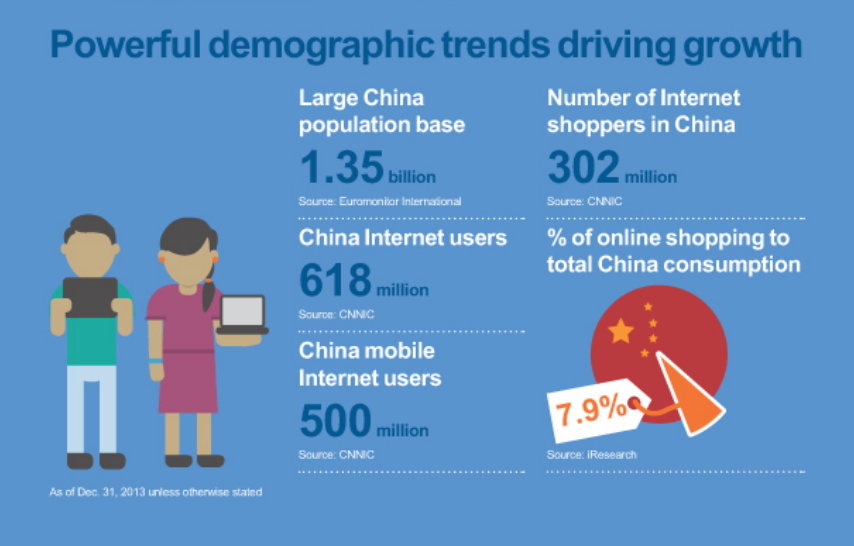
All the big numbers in Alibaba’s prospectus reveal how much potential there is to grow in China, a market which the company thinks hasn’t been fully tapped yet. Alibaba said that only 618 million people use the Internet in a country of 1.35 billion people. Of those, 302 million shop online. The company also has potential to increase its mobile users; 500 million people are connected to the Internet using mobile devices.

But Bershidsky doubts that Alibaba, whose success in China depends partly on state largesse, will make much headway internationally:

The charming story of English teacher Jack Ma setting up Alibaba in a small apartment must be understood in the context of Beijing’s efforts to help the company thrive and expand. Alibaba’s cloud division, in particular, has benefited from government funding under a special five-year plan to boost cloud-computing development. The division accounted for about 1.4 percent of Alibaba’s revenue in the nine months to Dec. 31.

The Chinese national champions’ business is mainly local. As Ma himself said about eBay more than 10 years ago, “EBay is a shark in the ocean. We are a crocodile in the Yangtze River. If we fight in the ocean, we will lose. But if we fight in the river, we will win.”

John Aziz, on the other hand, thinks that Alibaba has great potential even without the hoped-for international reach:

The really exciting thing for Alibaba is that China is still a market where the majority of people don’t even have internet access yet (just 42 percent had it at the end of 2013 compared to 81 percent in the U.S.). China is still rapidly industrializing, and millions of people are still moving from the countryside into the cities, providing a huge amount of room for Alibaba to grow in China.

Jack Ma, Alibaba’s founder, named the company Alibaba based on his impression that it was a name that could be recognized globally, by people from India, Germany, Japan, China, the United States, and so on. His ambitions have always been global. And Alibaba’s original business model was about connecting manufacturers in China to firms in the West. Whether the obvious love Chinese consumers have for Alibaba’s services can translate to Western consumers remains to be seen. But expect to see much, much more of them in the coming years.

An Effort To Eradicate Education, Ctd

chalabi-datalab-kidnap

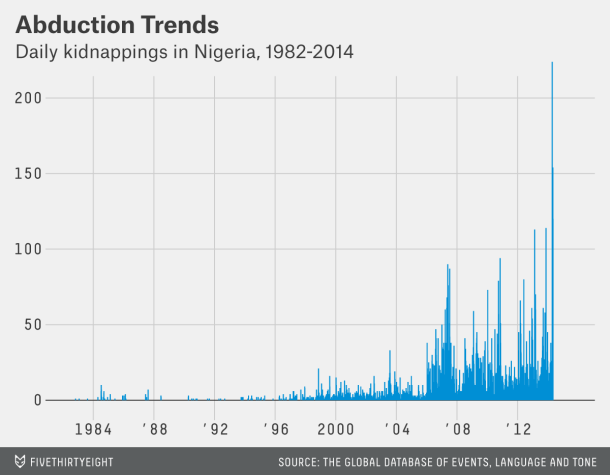
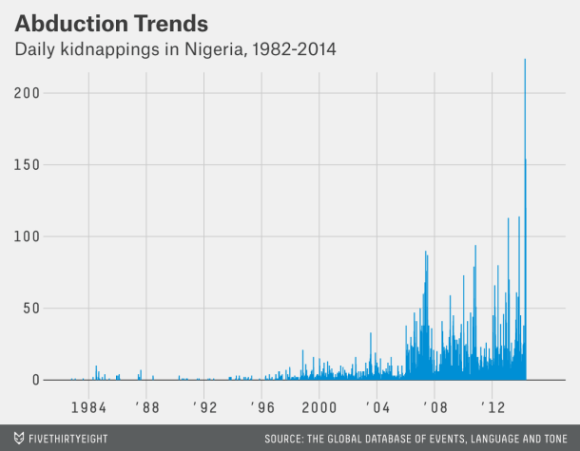
Mona Chalabi puts the kidnapping of the Nigerian schoolgirls in grim context:

I’m using GDELT, the Global Database of Events, Language and Tone, an enormous catalog “of human societal-scale behavior and beliefs across all countries of the world.” There are copious types of “behavior” it records, including protests, deportations, assassinations and kidnappings (technically, events categorized as “abduct, hijack, take hostage”). GDELT is updated daily using thousands of broadcast, print and online news sources in more than 100 languages, and includes events back to 1979.

We were able to extract every Nigerian kidnapping in the database over the past quarter-century — 25,247 in all.

GDELT’s data shows that the number of kidnappings over the past three decades has risen from just two in 1983 to 3,608 in 2013. It’s an increase so large that it’s probably not solely the result of better reporting or the rise in (and online availability of) news reports on the topic.

Maya Shwader points to some other depressing statistics:

Sadly, the exploitation of young girls is not exactly uncommon in Nigeria.

According to Girls Not Brides, 39 percent of girls in Nigeria are married off before their 18th birthday. Sixteen percent are married before they turn 15. Only 23 of Nigeria’s 36 states have adopted the 2003 UN Child Right’s Act, which declares that anyone under the age of 18 is a child. One of the states that failed to ratify the Child Rights Act was Borno, where these girls were kidnapped.

Worse yet: Nigeria has one of the highest numbers of enslaved people in the world: between 670,000 and 740,000 people out of a total population of 168.8 million. For women and girls, and even boys, this often means sexual slavery.

Alexis Okeowo discovers that the Nigerian military may have missed an opportunity to prevent the kidnapping:

[Amnesty International researcher Makmid] Kamara and I each spoke to Chibok residents who said that they had heard Boko Haram was coming to the town up to two hours before the kidnapping. They alerted security officials, but the military only sent more troops several hours after the abduction. “There is a big disconnect between the security personnel and the community. People don’t trust the military to give information to them because they fear that they will be arrested or seen as conspirators or suspects,” Kamara said. “It’s getting increasingly difficult for people to approach the security forces to provide valuable information on planned attacks or things like that.” If and when a Nigerian military operation takes place to recover the girls, observers worry that soldiers will continue to violate the human rights of northeastern Nigerians.

Boko Haram, meanwhile, has carried out a brutal attack on a northern town, exploiting a security gap created by the search for the missing girls:

Around 300 people were killed in a Boko Haram invasion of the northern Nigerian town of Gamboru Ngala in the state of Borno, AFP reports, with a local leader saying the insurgents spent 12 hours killing defenseless citizens with rifles, IEDs, rocket launchers, and more. “The attackers stormed the communities in the night when residents were still sleeping, setting ablaze houses, shops and residents who tried to escaped from the fire, were shot,” said Senator Ahmed Zannah, who is from the area.

Nigerian newspaper Vanguard reports that security forces meant to protect the town were going after the kidnapping victims and “moved to the Lake Chad axis when they received [an] intelligence report that some gunmen were sighted with abducted schoolgirls moving to the area.” That’s when the terror began.

Washington is offering to help with the search, but Alice Speri advises us not to expect too much:

“To be frank it means they’ll send a handful of FBI agents over to advise in hostage negotiations and a potential rescue operation, it’s very unlikely we are launching any US military forces to go do the mission,” Dan O’Shea, a former US Navy SEAL who spent several years working on hostage rescue operations in Iraq, told VICE News. “They are not US citizens, there’s no US equity at stake, to risk US assets. We are paying more lip service than anything else.”

Mashable obtained more details on US involvement:

Department of Defense spokesperson Lt. Col. Myles Caggins told Mashable that the AFRICOM team, part of the larger State Department-led “coordination cell” that will operate at the embassy, will have a planning and coordination role to support the Nigerian government. The military personnel heading to the country will not, he said, physically search for the girls — or the militant Islamist group Boko Haram.

A reader in Nigeria shares his view:

This is a genuinely bad situation, no matter how you look at it, but it deserves a complete portrayal which I think has been largely lost in your coverage.  It is being portrayed, rightly or wrongly, as an issue about women’s rights, slavery, and a war on education in Nigeria; neither of which are fully accurate when you examine this in full context. Nigeria is a relatively modern country where women are roughly as educated as men. Boko Haram may not like Western education, but that doesn’t mean they have any chance of ending it in a country where its people value education in terms that led to a recent comparison to Chinese, Indians, Jews – any more than the ’90s clinic bombers had of ending abortion in America.

This is not a clean-cut issue with a clean-cut solution. It’s about elusive violent Islamic salafi jihadists terrorizing the northern part of Nigeria; a region that is tremendously impoverished and uneducated for historical reasons; a government incapable of fully addressing the issue over the years; a Nigerian population (especially the largely Westernized southerners) that has become somewhat complacent about, and largely detached, emotionally and geographically, from, Boko Haram’s violence, which has mostly occurred in the aforementioned northern part.

The abuse of women (girls in this case) is nauseating and horrific, but this issue does not boil down to a women’s rights issue, education of girls in Nigeria, slavery, or hashtags that paints a very complex situation in simplistic and sensational terms.

Previous Dish on the kidnappings here, here, here, and here.

The Best Of The Dish Today

Repatriation Of Soldiers Killed In Afghanstan Helicopter Crash

The intrepid FOIA work by San Francisco gadfly and AIDSy role model, Michael Petrelis, gave us proof in Jo Becker’s own words that her book tour and promotion for Forcing The Spring were being jointly “coordinated” by her publisher, Penguin, and the Human Rights Campaign and AFER. So HRC’s head, Chad Griffin, was integrally involved in the promotion of a book that describes him as the gay Rosa Parks on the first page. We also learned that Becker tried to get another much-praised source, San Francisco City Attorney, Dennis Herrera, to bulk purchase the book for sale and hold an event at San Francisco City Hall.

herrera committee payment to chad 2Petrelis has also – through FOIA – made another discovery. Herrera paid Chad Griffin’s p.r. firm $175,000 in late 2008 to help him reach out to donors who may not have seen marriage equality as a cause to support. The conflicts of interest here are myriad. And, given the NYT’s embrace of the book – the cover of the magazine, the Book Review, the first choice of New York Times editors for a book in print, and Becker’s liberal use of her New York Times affiliation, it’s a good thing that the NYT Public Editor has decided to investigate. Stay tuned.

Earlier today I tried to tackle the question of culture, conservatism and immigration – by looking at the British political scene. We got a first-hand account of what it’s like to live on Soylent – the high-tech food substitute that tempts me so. And a reader turned the question around as our first Book Club discussion wound down: what if modernity needs Christianity to survive?

The most popular post of the day was “And Sometimes There Is A Smoking Gun Email,” followed by my post yesterday on the new world and a new era for American foreign policy, “Letting Go Of Global Hegemony, Ctd.

See you in the morning.

(Photo: Mourners gather to pay their respects as the cortege passes by following the repatriation of five British servicemen who were killed in a helicopter crash in Afghanistan at RAF Brize Norton, on May 6, 2014 in Brize Norton, near Oxfordshire, England. Captain Thomas Clarke, Warrant Officer Spencer Faulkner and Corporal James Walters, of the Army Air Corps (AAC), who were serving as the Lynx aircrafts three-man team when they died alongside Flight Lieutenant Rakesh Chauhan of the Royal Air Force and Lance Corporal Oliver Thomas of the Intelligence Corps, were believed to have been passengers on the flight. The Ministry of Defence (MoD) has denied claims by the Taliban that insurgents shot the helicopter down in Kandahar province on April 26, claiming it was a tragic accident rather than enemy action that caused of the crash. By Dan Kitwood/Getty Images.)

The Teen Pregnancy Crisis That Isn’t

05143e0e7

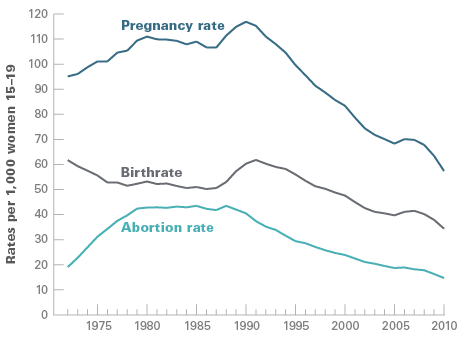
Derek Thompson relays the findings of a new report (pdf) from the Guttmacher Institute showing that teen pregnancy has become much less common over the past 30 years and that abortions among teens are also on the decline:

Even though increasing proportions of women ages 18 and 19 reported having sex, the smallest portion on record are getting pregnant. “Changes in contraceptive use are likely driving this trend,” write authors Kathryn Kost and Stanley Henshaw. Previous studies have found that media awareness of teen moms, like the eponymous MTV show “Teen Moms,” are also responsible for declining pregnancies, although the 30-year trend suggests that there’s something else (presumably sex education and wider use of contraceptives) besides a new MTV show driving the trend.

Katie McDonough thanks birth control and sex ed:

Reproductive rights advocates echoed the sentiment. “The good news is that we know what works to prevent teen pregnancy. Sex education works. Ensuring that teens have access to birth control works,” Leslie Kantor, Planned Parenthood’s vice president of education, said of the report. “When young people have accurate information and resources, they make responsible decisions.” Someone should alert Bill O’Reilly about this news so that maybe he’ll stop obsessing over Beyoncé already.

But Tara Culp-Ressler notes that most adults think teen pregnancy is on the rise:

Perhaps it seems like things are getting worse because there’s always a new trend that inspires moral panic about teens’ risky sexual behavior — like sexting, “raunchy” pop songs, the college “hook up culture,” and TV shows’ supposed “glamorization” of teen pregnancy. Social conservatives also often raise concerns about the fact that Americans are increasingly having sex and children outside of marriage, equating changing family structures with bad choices. And it doesn’t help that the public health campaigns to discourage teen pregnancy often rely on doom-and-gloom messages to shame teens for making terrible decisions that will ruin their lives.

Ultimately, the fact that more teens are successfully using birth control doesn’t fit into our larger societal narrative that kids are always irresponsible. Americans tend to be reluctant to trust teenagers to manage their own sexual health, and often treat sex as something that’s totally outside kids’ realm of understanding.