Hathos Alert

Or it could be a poseur alert. It’s longer than most but the pleasure and the pain ramp up relentlessly into a truly hathetic concoction. Update from a reader:

I completely agree that the tone of that video is deserving of the Hathos award. And furthermore, Cameron Carpenter in person is obsessively humorless in his pursuit of his “artistic vision.” (I’ve had the pleasure of seeing him live in concert and in taped interviews).

But, he is a truly incredible musician, and perhaps one of the greatest organists of all time. I don’t know if non-musicians fully understand the coordination and focus needed to play a musical instrument with all four limbs simultaneously, often with four or more independent musical lines, and to not just hit the right notes – but also make music out of that choreographic exercise. In person, or in YouTube videos, Mr. Carpenter is a truly amazing.

So, I can forgive him the hair style and sartorial excess. He brings incredible substance to the surface nonsense. And in the end, the music is what matters.

Seattle Maxes Out The Minimum Wage, Ctd

David Dayen lays into Jordan Weissmann’s “scare tactics” regarding Seattle’s proposed $15 minimum wage:

Seattle actually sought out studies on what would happen after a large minimum wage increase. In March, Mayor Murray released a report from three professors at UC Berkeley who looked at the impact of local wage laws on employment, and specifically whether businesses move outside local borders for lower labor costs. Simply put, the researchers found no such dynamic.

Matt Taylor also doubts the wage hike will crash the city’s economy:

“What is important is the phase-in period rather than the number,” said Dean Baker, an economist and founder of the Center for Economic and Policy Research.

“It’s fair to say if we were going to make it $15 next year I’d be very worried. But if you make it [that] over 7 years, there’s 15 percent inflation or somewhere around there, so in today’s dollars a $15 minimum wage would be something in the order of $12.75 [by the time it takes effect]. Right off the bat that sounds less worrisome. You’re not going to see firms going out of business because of this.” …

So please, let’s not start panicking about endtimes for Seattle and its utopian ideals of economic fairness. It’s necessary to at least pause and consider research that shows minimum wage hikes can have a modest negative affect on overall employment—specifically among teenagers—but as Slate’s $15 wage critic Jordan Weissmann himself points out, that side effect is perfectly acceptable so long as most workers are making out better in the long run. What data is there to suggest that will not be the case for Seattle?

Danny Vinik thinks it’s an important experiment even if it runs the risk of backfiring:

Massachusetts implemented the first non-compulsory minimum-wage law in 1912. Within the next eight years, 12 other states and the District of Columbia had their own minimum wage laws, although the Supreme Court struck down D.C.’s law that set a minimum wage for women and child laborers. In 1938, Congress passed a national minimum wage as part of the Fair Labor Standards Act and it eventually withstood a Supreme Court challenge.

The Massachusetts law could have been a disaster for its citizens, as no one knew for sure how a minimum wage would affect the economy. Instead, it laid the groundwork for a national minimum wage. Seattle’s low-wage workers may ultimately suffer for its $15 minimum wage, as conservatives and even some liberals are predicting. If it succeeds, though, Democrats would have a case for a higher national minimum wage than $10.10. We won’t know unless we try—a scary prospect for Seattle, but exciting for the rest of us.

The Psychology Of Rock, Paper, Scissors

A new study on the game has found that “the strategy of real players looks random on average but actually consists of predictable patterns that a wily opponent could exploit to gain a vital edge”:

On average, the players in all the groups chose each action about a third of the time, which is exactly as expected if their choices were random. But a closer inspection of their behavior reveals something else. Zhijian [Wang] and co say that players who win tend to stick with the same action while those who lose switch to the next action in a clockwise direction (where R → P → S is clockwise). This is known in game theory as a conditional response and has never been observed before in Rock-Paper-Scissors experiments. Zhijian and co speculate that this is probably because previous experiments have all been done on a much smaller scale. … In fact, a “win-stay, lose-shift” strategy is entirely plausible from a psychological point of view: people tend to stick with a winning strategy.

More Rock-Paper-Scissors tips, from a couple years ago, here. Just don’t try them on this robot.

Taking Creative Liberty With Artists’ Lives

Noel Murray unpacks why so many biographers of artists tend to depict their subjects at their worst:

Maybe biographies and biopics about artists dwell on the shady side because creative inspiration is hard to explain, and hard to dramatize. I’ve interviewed enough artsy folks over the years to know that when I ask about their process, the answers are usually either “hell if I know” or mundane and technical. And while I actually like the mundane and technical stuff, I know that doesn’t sell books or tickets. …

[I]t could just be that biographers go overboard in trying to humanize people who are seen as untouchable icons. If so, I get it. There’s an aspirational aspect to a lot of biographies and biopics: Here’s how a great person made it, and here’s why you the reader or viewer aren’t so different. But too often, the fascination with weakness doesn’t come off as it may have been intended. “Flawed” too easily becomes “fatally flawed,” even when the real evidence—the movies, the novels, the paintings, the plays, the performances, the music—suggests otherwise.

Face Of The Day

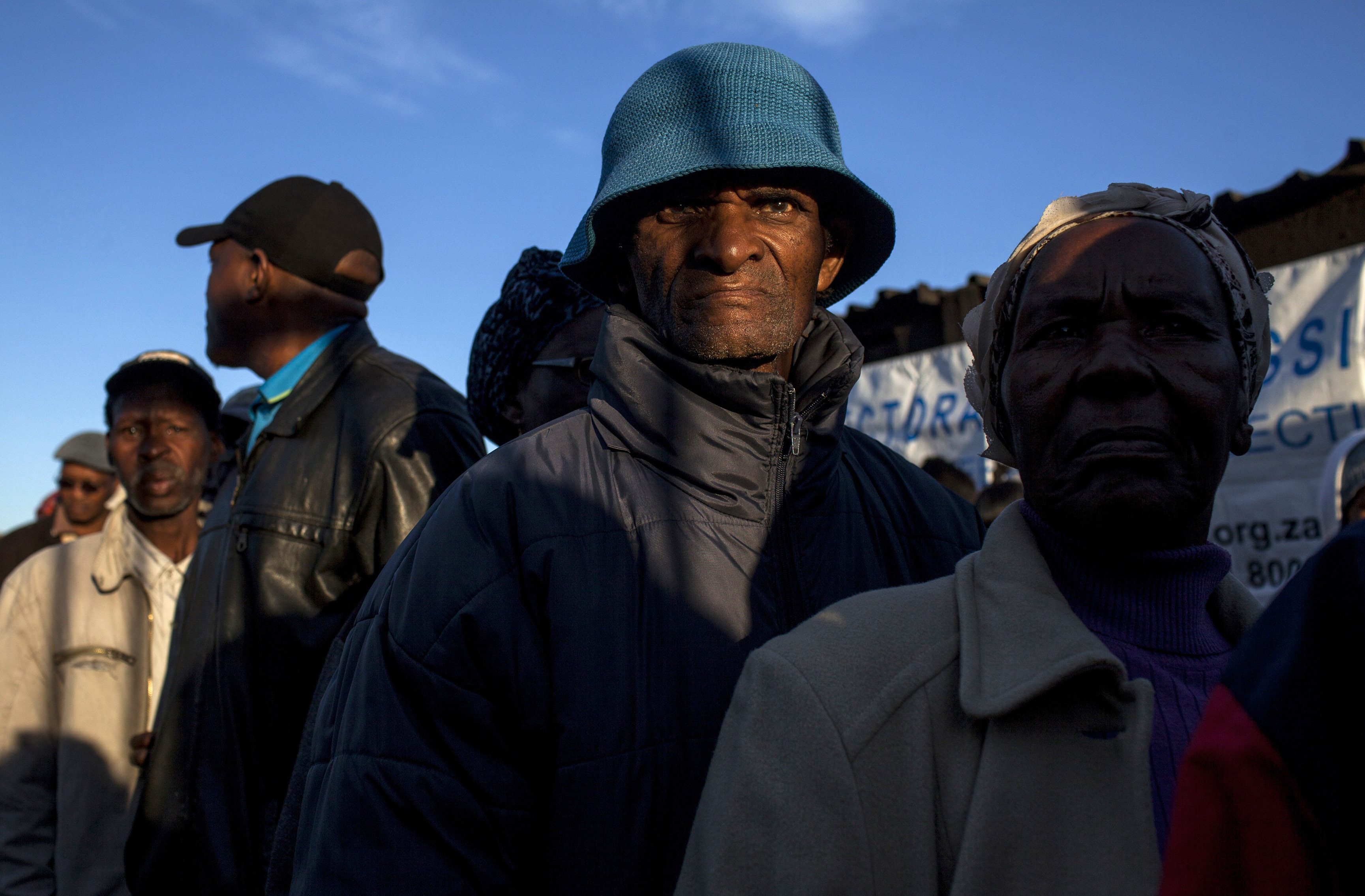
South Africans Go To The Polls In A General Election

Voters wait in long lines at the Pine Road Voting Station in Greenpoint district of Khayelitsha Township in Cape Town, South Africa on May 7, 2014. Polls have opened in South Africa’s fifth general election since the end of apartheid over 20 years ago. President Jacob Zuma is expected to return to power with the ANC party, but he is expected to lose some ground to other parties after his election campaign has been marred by allegations of corruption. By Charlie Shoemaker/Getty Images.

The Closed Mind Of Neil DeGrasse Tyson

A must-read from Damon Linker:

Go ahead, listen for yourself, beginning at 20:19 — and behold the spectacle of an otherwise intelligent man and gifted teacher sounding every bit as anti-intellectual as a corporate middle manager or used-car salesman. He proudly proclaims his irritation with “asking deep questions” that lead to a “pointless delay in your progress” in tackling “this whole big world of unknowns out there.” When a scientist encounters someone inclined to think philosophically, his response should be to say, “I’m moving on, I’m leaving you behind, and you can’t even cross the street because you’re distracted by deep questions you’ve asked of yourself. I don’t have time for that.”

“I don’t have time for that.”

Chart Of The Day

Global Poverty

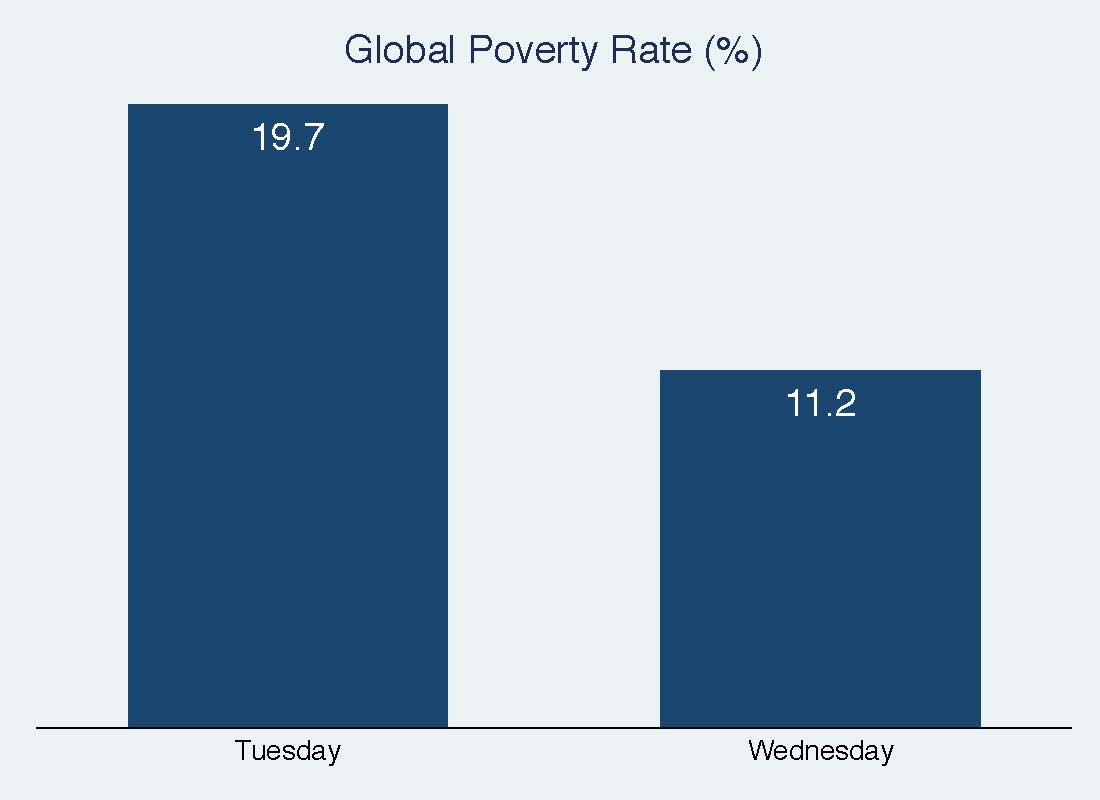
Sarah Dykstra, Charles Kenny and Justin Sandefur explain the overnight change in global poverty levels:

Global poverty numbers involve two sets of data: national income and consumption surveys (collated in the World Bank’s PovcalNet) and international data about prices around the world.   The [International Comparison Program (ICP)] is in charge of this second set of data.  It compares what people buy and at what local currency price they buy those things to come up with a ‘purchasing power parity’ exchange rate, a ratio that is designed to equalize the power of a rupee to buy what Indians buy with the power of a dollar to buy what an American buys.  Tuesday [last week], the ICP released their estimates for what those purchasing power exchange rates looked like in 2011.

In short, the new PPP numbers suggest a lot of poor countries are richer than we thought.

China’s improved PPP numbers got the most attention last week, but the change is much bigger than that:

India’s 2011 current GDP PPP per capita from the World Bank World Development Indicators is $3,677.  The new ICP number: $4,735.  Bangladesh’s 2011 GDP PPP per capita according to the WDI is $1,733; the ICP suggests that number should be $2,800. Nigeria goes from $2,485 to $3,146.

Dylan Matthews takes a closer look at the data:

The reasons the rate fell so dramatically are fairly technical. To figure out what $1.25 a day means in different countries, economists generally compare the price of a “basket” of goods across those countries. The results they get are thus pretty sensitive to the point in time when you compare baskets. The old data used a comparison from 2005; the new one is from 2011.

Basically, the World Bank found that prices of goods included in the basket were lower than the extrapolation from 2005 data had predicted they would be.

He adds some caveats about the quality of this data. Another important point:

[T]he biggest reason not to get too excited is that the 8.5 percent of the world that’s no longer counted as poor by this metric is still, by any objective measure, not faring well at all. “The people who have just been classified as ‘not absolutely poor’ don’t actually have any more money than they did yesterday, and will still struggle in terms of getting a decent job,” Dykstra, Kenny, and Sandefur note, “Many still face grim daily tradeoffs between buying school supplies or ensuring their kids are well nourished.”
Tweet Of The Day

Screen Shot 2014-05-07 at 6.38.28 PM

Thanks to Weingarten for joining me in the punch bowl.