How Many Lives Will Obamacare Save?

Sarah Kliff analyzes the Romneycare study the came out a couple days ago:

The new Harvard study estimates that for every 830 people the Massachusetts insurance expansion covered, one additional life was saved. This was a 2.9 percent decrease in the mortality rate compared to similar counties that did not have insurance expansions. … It’s hard to know whether the health care law will lead to similar gains elsewhere. Massachusetts has more doctors per capita than any other state, which could mean it was easier for people to see a doctor once they gained insurance coverage. But there’s also the possibility of even bigger gains outside of Massachusetts, where states are starting from a lower insured rate than the Bay State did in 2006. If the coverage expansion effects more people outside of Massachusetts, that could mean even more deaths prevented elsewhere.

Michael F. Cannon feels that the cost is too high:

Even if [Romney care has saved lives,] this Annals study also suggests that success has come at a very high cost. The authors estimate that “for approximately every 830 adults who gained insurance [under RomneyCare], there was 1 fewer death per year.” If we assume the per-person cost of covering those 830 adults is roughly the per-person premium for employer-sponsored coverage in Massachusetts in 2010 (about $5,000), then a back-of-the-envelope calculation suggests that RomneyCare spent $4 million or more per life saved. The actual figure may be much higher if we include other costs incurred by that law. The World Health Organization considers a medical intervention to be “not cost-effective” if it costs more than three times a nation’s per-capita GDP per year of life saved. This in turn suggests that RomneyCare would have to give every person it saves an average of nearly 30 additional years of life to meet the World Health Organization’s criteria for cost-effectiveness. Given that the mortality gains were concentrated in the 35-64 group, that seems like a stretch.

As an economist might put it, this means there are likely to be policies out there that could save a lot more lives than RomneyCare does per dollar spent.

Bill Gardner counters:

Cannon believes that there are policies that would deliver more benefit than Romney- or ObamaCare. If you are a critic of the ACA and this is what you believe, Cannon’s argument obligates you to do that better thing with the money. This poses an acute test for leaders in the 24 states that refused the ACA’s expansion of Medicaid. How many of those states refused to expand Medicaid, but then did nothing else for the health of their uninsured? If politicians in those states just refused the money and let the poor die, they do not have standing to make Cannon’s criticism about paths not taken.

Second, is it just to worry about the cost of health insurance only when we are considering insuring the poor? 55% of the US population had employer-based health insurance in 2011. Because this benefit isn’t taxed, this meant that 55% received a large subsidy for their insurance, including many affluent people. (And I’m sure Michael Cannon hates this, probably more than I do!) If you oppose the expansion of Medicaid, you should also favor the taxation of employee health benefits. Otherwise, you are arguing that we can afford to subsidize the health insurance of the rich, but that it costs too much to do it for the poor.

Sprung sees no viable alternatives to Obamacare on the horizon:

Those who don’t like the ACA can fairly argue that there are better models for extending affordable health insurance to all. … It’s noteworthy, though, that there are almost no Republican elected officials who have proved willing to commit to actual legislation that would purport to “replace” the ACA with an alternative that could make a credible claim to extend health insurance to as many uninsured Americans as the ACA does. Senators Coburn, Burr and Hatch rolled out the outline of such a plan — which looked a lot more like an opening bid to reform the ACA to conservative specs than actual replacement — and their colleagues studiously ignored it.

Suderman worries that Romneycare and Obamacare are unsustainable:

[I]t’s worth remembering that for the past several years, the price tag in Massachusetts has looked unaffordably expensive. In a 2011 review of the state’s health reform published in Health Affairs, a team of researchers looked at the results of the program over the same time frame measured by the new study. What they found was more coverage, more utilization of care—and costs that could not be supported over time. Not in Massachusetts. Not anywhere. “The pre-2010 status quo is not a sustainable option for Massachusetts or the nation,” the report said. Around the same time, state health officials were also describing the program’s costs as unsustainable, warning that, if left unchecked, they will crowd out everything else the government needs to do. Some reforms have been put in place by then, but even still, cost-containment is a challenge—in part because more coverage has led to greater use of care.

McArdle’s bottom line:

I haven’t changed my beliefs radically: I still basically think that health insurance improves mortality rates, but that that improvement is unlikely to be huge if you can get results like Oregon. However, after [Monday’s] report, I’ve revised the probability of “huge benefits” upward, and you should do the same. And beware of those who are only willing to revise their beliefs in one direction.

Conservatives And Immigration

Pointing_finger_48sheet

It’s not just a problem with the GOP. It’s an increasingly knotty problem for the British Tories, now trying to manage the rise and rise of the anti-immigrant United Kingdom Independence Party (a rough version of the US Tea Party). Alex Massie notes:

As I pointed out yesterday, the Tory share of the BME [Black and Minority Ethnic] vote in 2010 was exactly the same as their share of the vote in Scotland: 16%. True, this was an improvement on 2005 when only 11% of BME voters endorsed Conservative candidates but that’s a matter of only modest solace for Tory modernisers … Immigration is what you might term a Gateway Issue. You need to get past it before you can speak about other issues of more immediate concern to voters’ actual lives. You need to earn the right to be listened to. You need license to be heard. You need standing.

The discomfort of British Conservatives with immigration is not as easily conflated with racism as in the US. UKIP’s focus is as much on European immigrants (4,000 a week – exercizing their right to work and live where they choose in the EU) as on South Asian or Middle Eastern immigrants. And it speaks to something that I think is sometimes crudely over-looked in this debate. Conservatives in general are article-2618288-1D80455300000578-566_634x435more attached to the status quo than liberals, more suspicious of radical change, especially when it seems to be an ideological imposition by empowered elites. And so to live in a small town which has been ethnically and culturally very English for centuries and then to see in a matter of years a sudden and palpable Polish immigrant population that instantly changes the entire cultural dynamic will inevitably lead to bewilderment, anger, loss. It’s also true that Britain, in comparison with the US, is a tiny island, with limited resources and land. Remember also that European immigrants will almost immediately be eligible for treatment in the National Health Service and many other state benefits, and you can see why this is an issue.

And so conservatives are in a bind. They would like, in some ways, to reverse history – to never have had the 1986 amnesty in the US, or to have never agreed to enter the EU. But both those changes are effectively irreversible without incurring further massive subsequent changes which would disturb the status quo even more profoundly. And conservatives have a hard time making their legitimate case for cultural stability without seeming like bigots. It’s the same thorny problem with marriage equality: a discomfort with change but an inability to offer a viable, workable alternative, which leads to an understandable assumption that all opposition to gay marriage is mere rancid KKK-style hate.

And this is an eternal conservative problem.

Conservatism at its best is an imaginative attempt to balance stability and change in a manner which makes a society more coherent, more itself. When change happens swiftly, that balance is all the more necessary but also more difficult. At some point, mass immigration or a multi-cultural society or a gay-integrated world becomes the status quo to which conservatives will become attached. But in the meantime, they are pinioned emotionally between past and future and have not found leaders in either the US or the UK that have risen to the occasion of bridging the two. Fear and anger have thereby increasingly defined the new conservative center. And it’s currently a lose-lose proposition.

In part because I’m an immigrant and gay and live in a historically black city which is increasingly integrated, my own conservatism is of the much more moderate kind. Perhaps because I am not so threatened by racial and cultural change, I saw Obama as a quintessentially small-c conservative, a living blend of black and white, a realist abroad, a pragmatist at home, an integrator rather than a polarizer. I was an outlier, we now know. But at some point, that more moderate conservatism – one that actively celebrates a multi-cultural society as a traditional American value – will win. The question is simply how tortuous the path to that future will be. Which is why we are searching the landscape for a future Republican leader who gets this (and keep bumping into versions of Ted Cruz) and searching for a British Conservative who can do the same (and sussing out Boris).

(Illustrations: two posters for UKIP in the European elections on May 22.)

Quote For The Day

“For years, the mantra of conservative pro-Israel lobby groups has been that Israel will only be able to make the difficult choices for peace if it knows that U.S. support is absolute. But there’s a flip side to this, too: When Israel knows that U.S. support is absolute, it has no incentive to make difficult choices,” – Matt Duss, in a must-read on the core reason for the Israel-Palestine dead end.

The Moderate Republican In 2014, Ctd

Tillis

Thom Tillis, who threw lots of red meat to the GOP base, won the NC Senate primary last night:

Bullet: dodged. North Carolina speaker of the house Thom Tillis cruised to victory in Tuesday’s North Carolina Republican Senate primary, setting up a general election showdown with Sen. Kay Hagan (D-N.C.) this fall. Democrats had held on to hopes that Tillis, who was endorsed at the last minute by Mitt Romney, would fall short of the 40-percent threshold needed to win the race outright and head into a runoff with Greg Brannon, a far-out tea party doctor backed by Sen. Rand Paul (R-Ky.)

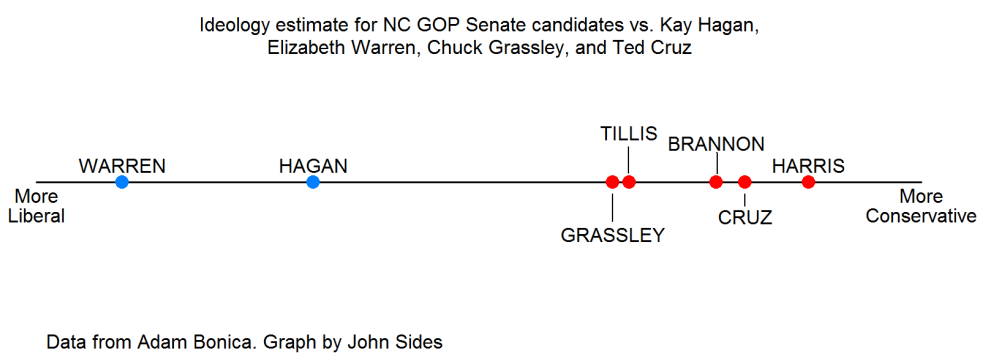
Sides provides the above chart on Tillis’ ideology:

Were Tillis to win in November, the Senate would be getting someone whose political beliefs look much more similar to Grassley’s than Cruz’s.  By contrast, Brannon’s views are closer to Cruz’s and [Mark ] Harris [another Tea Party favorite] is estimated to be even more conservative than Cruz.

Of course, we don’t know whether Tillis will beat Hagan.  Our forecast sees Hagan as the current favorite but other forecasts see the race as a toss-up.  Nevertheless, nominating a relative moderate likes Tillis probably helps the GOP win, since political science research shows that strongly ideological candidates can be punished at the ballot box. What this analysis shows is that a Republican victory in November will contribute a lot less to Senate polarization with Tillis as the nominee instead of Brannon or Harris.

Molly Ball wonders whether yesterday’s win for the GOP establishment means the tide is turning against less electable Tea Partiers:

To a degree not seen before since the advent of the Tea Party five years ago, the Republican establishment took on the warring factions that have given the GOP so many ulcers in recent years—and won. With 94 percent of the vote counted Tuesday night, Tillis had cleared the 40-percent runoff threshold, taking 45 percent of the vote to his nearest competitor’s 27 percent.

In the month ahead, similar contests will unfold in several more states, including Kentucky, home of Senate Minority Leader Mitch McConnell. The establishment—defined here as the traditionally corporate and institutional GOP—hopes to keep up the full-court press begun in North Carolina and run the table, theoretically producing the slate of nominees that will give the party the best possible shot at taking the Senate.

But Pierce rejects the claim that Tillis is a moderate:

[T]here is no Republican “Establishment” any more. This is because the notion of a Republican Establishment requires that there be at least an occasional flirtation with moderation and there are no Republican moderates any more. (It also requires that there be at least an occasional flirtation with reality, but I don’t expect miracles here.)  Tillis is a perfect example. Not only has he presided over a legislative body that is extreme in the legislation it passes, but Tillis himself has signed aboard the “personhood” crusade on reproductive rights, and he has resolutely stood in opposition to marriage equality. The difference between Tillis and Brannon, in terms of what their campaigns say about what they’d do if they were elected, is solely based on the theory that Brannon was so far off the wall that Tillis could be positioned by the media as being a moderate. The goalposts, by now, probably can be found on Mars.

Kilgore makes related points:

It’s true that had Thom Tillis been forced into a runoff it would have given the “Republican Establishment” a lot of heartburn and cost it a lot of money. Once that is said, however, I just don’t see last night as much of a landmark for the famed Establishment, and explained why in a column at TPMCafe.

For one thing, the “Establishment” did not have a great night in House races in NC. But even if all you do is to focus on Tillis’ win, it came at the sort of price that I suspect “Establishment” candidates are going to be willing to pay all over the country this year: abject surrender to party extremists on every key issues.

Ukraine Prepares For War

David Patrikarakos reports that young Ukrainians are training as partisans for a potential guerrilla war with Russia:

Ukraine has 130,000 personnel in its armed forces that could be boosted to about one million with reservists, but few troops are battle-ready while much of their equipment is outdated and unable to function effectively in a modern war situation. Ukraine’s parliament recently allocated six billion hryvnias (about $523 million) for the repair and restoration of military equipment, but given time constraints, improvement is likely to be limited.

As a result, the single biggest threat to a further Russian invasion remains the possibility of a militarized population in urban areas and perhaps the forests—and Moscow knows it.

The epicenter of the struggle for Ukraine’s east these past few weeks has been the small, seemingly unimportant town of Sloviansk. I was there the night its central police station was stormed by pro-Russia separatists, and it was a clear turning point in the crisis. The baseball bat-wielding militia I had seen in the eastern cities of Donetsk and Luhansk had been replaced with professional soldiers clearly dictating events on the ground.

Kyiv has a large strategic reserve of Kalashnikov assault rifles and other light weapons—around 5 million pieces—as a mobilization reserve dating back to Soviet times. It has made clear to the Kremlin that it is now considering the possibility of opening up this stockpile to its citizens in East Ukraine. At least half this reserve is concentrated near Sloviansk and it is the reason that Russian special forces were sent there to secure the area.

Meanwhile, Eli Lake notes, Kiev has solicited the advice of Georgia’s defense minister, Iraki Alasania, who knows a thing or two about being invaded by Russia:

Among Georgia’s tips for Ukraine: hunt moles early; watch for “non-governmental organizations” that are really Moscow’s fronts; seek out encrypted communications from the West; and if Russia does annex more territory, keep humanitarian, economic and cultural lines of communications open without formally recognizing the transfer of turf—it could be a useful way for the government in Kiev to address some of the needs of Ukraine’s Crimean citizens. …

As a general rule, Alasania said it was important “to rely more on diplomatic resources” than the military. He noted that none of the militaries of the former Soviet republics could withstand a full-scale Russian invasion. But the Russian sabotage and provocation operations currently underway? Those have a chance of being countered.

Study Links Success To Hard Work, Asians

Natasha Loder parses a new study that seeks to explain why Asian-Americans tend to do so well in school:

Although Asian Americans do often come from better educated and higher income families, socio-demographic factors could not explain the achievement gap between Asians and whites. … Being brainier isn’t the answer either. When the pair looked at cognitive ability as measured by standardised tests, Asian-Americans were not different from their white peers. Instead Dr [Amy] Hsin and Dr [Yu] Xie find that the achievement gap can be explained through harder work—as measured by teacher assessments of student work habits and motivation. (Although the authors warn that this form of assessment will capture both true behavioural differences as well as a teacher’s perception of differences.)

What might explain harder work? The authors point to the fact Asian-Americans are likely to be immigrants or children of immigrants who, as a group, tend to be more optimistic. These are people who have made a big move in search of better opportunities. Immigration is a “manifestation of that optimism through effort, that you can have a better life”. Added to this mix is a general cultural belief among Asian-Americans that achievement comes with effort. We know that children who believe ability is innate are more inclined to give up if something doesn’t come naturally. An understanding that success requires hard work—not merely an aptitude—is therefore useful. This finding is worth bearing in mind when considering the current fuss over new tests in mathematics, as some parents complain that they are now too hard.

Tom Jacobs examines how the study squares with the prevailing theories:

So what about the “tiger mom” hypothesis, which suggests Asian mothers demand more of their kids, and see to it that they achieve?

The study suggests it is, indeed, one factor in their academic success, although—contrary to the stereotype—this approach appears to be more prevalent among immigrants from India than those from China. “South Asian parents have the highest educational expectations relative to whites,” they write, “followed by Filipinos, Southeast Asians, and East Asians.”

Beyond strict mothers, the drive for academic success “is sustained and reinforced” by other factors, including “ethnic communities that offer newly arrived Asian immigrants access to … resources such as supplemental schooling, private tutoring and college preparation,” the researchers add.

Alice Park considers the findings through the lens of her own experience as an Asian-American:

Hsin also found that Asian-American students were more likely to have more self-image problems and more conflicted relationships with their parents than their white counterparts. The pressure to perform seems to take a toll on those who fail to meet expectations as well as those who do – for the latter, the expectation to be successful makes the achievement less satisfactory and less fulfilling.

So Tiger Moms may be on to something, however obvious it may seem: hard work does pay off, albeit at the cost of some self-esteem. But it may be giving them too much credit to say they do it alone. And looking back, I have to admit, however begrudgingly, that all that discipline has probably made me a more organized and confident adult. But don’t tell my mom.

In any case, noted “tiger mom” Amy Chua is feeling pretty vindicated, Max Ehrenfreund reports:

Chua and her husband Jed Rubenfeld, both professors at Yale Law School, contend the study is evidence that aspects of Asian-American culture are partly responsible for Asian children’s good grades. The couple published a new book earlier this year arguing that certain cultural traits can explain the successes of various immigrant groups in the country’s history.

“There can be no doubt that these practices and attitudes are not exclusive to Asians, and can be incredibly helpful to people outside those communities,” Rubenfeld said. The couple added that a mere change in attitude would not be enough to eliminate the obstacles confronting black children. “When it comes to America’s poorest groups, it’s pretty clear what the true causes of poverty are. You have to start with history, you know, centuries of slavery and mass incarceration,” Chua said.

Subversion For Sale

Henry Stewart has an uneasy feeling about Ai Weiwei-branded merch:

[T]he commodification of Ai Weiwei is more intense than that of any other living artist, rivaled only, maybe, by, like, Van Gogh. You can buy Ai Weiwei smart phone cases and tablet skins; you can buy Ai Weiwei snap bracelets; you can buy mugs and buttons and wallets and scarves and skate decks and tea towels and handkerchiefs and luggage tags and an umbrella with his middle finger printed on the top. Most of these items include a quote from the Larry Warsh-edited 120-page book (also for sale!) Weiwei-isms, which, according to marketing copy, “demonstrates the elegant simplicity of Ai Weiwei’s thoughts on key aspects of his art, politics, and life.”

Troublingly, for me, most of these quotes alienate Ai from his politics and turn him into a vaguely political aphorist whose pithy observations could be co-opted by the Communist censors themselves. They’re too simple. “My favorite word? It’s ACT,” is the one most printed on stuff you can buy, though other popular ones are “My activism is a part of me” and “Everything is art. Everything is politics.”

Who Should We Let In?

Freddie deBoer advocates for an open border policy as a form of humanitarian intervention:

For gay, transgender, and bisexual people in places like Russia and Uganda; for Syrians of all stripes; for those in Crimea and eastern Ukraine who fear either Putin or reprisals against linguistically and ethnically Russian Ukrainians; for those in Venezuela who agitate against the Maduro government; for women in Saudi Arabia; for liberal dissidents in Iran; for oppressed people the world over, legal entrance into the United States would represent protection against those forces that some would have us defeat with force of arms. The beauty of it is that we can accept people without having to stake a claim on every legitimate internal controversy; we merely can do so out of a desire to prevent the violence that often attends internal strife that we have no business adjudicating. I don’t suggest this as a panacea, but then, if the last decade should teach us anything, it’s the inability of military intervention to secure humanitarian outcomes. I’m willing to guess that the odds for success with this kind of humanitarian intervention are far, far higher than freedom delivered via smart bomb.

David Frum, on the other hand, wants talent-focused immigration reform:

Americans console themselves that second and third generations of immigrants will do better than the first. Many immigrants do rise in just this way. Yet the evidence for many of the largest immigrant groups—immigrants from Mexico and Central America—is not encouraging. The second generation does better than the first … but progress stalls after that. Even in the fourth generation, Mexican-American education levels lag far behind those of Anglo Americans, according to the definitive study by Edward Telles and Vilma Ortiz, Generations of Exclusion.

What holds back immigrant progress? Discrimination? Inherited cultural patterns? The economic and cultural obstacles of a society where unskilled labor no longer pays a living wage? Whatever the reason, the outcome is the same. Human capital extends across generations. Those who arrive possessing that capital bequeath it to their descendants. Those who arrive lacking it bequeath that same lack. Progress across generations is slow at best and non-existent at worst—especially as low-skilled migrants to the United States adopt the same single-parent family pattern that prevails among the poorer half of the native-born population.