We’re All Nate Silver Now

Midterms

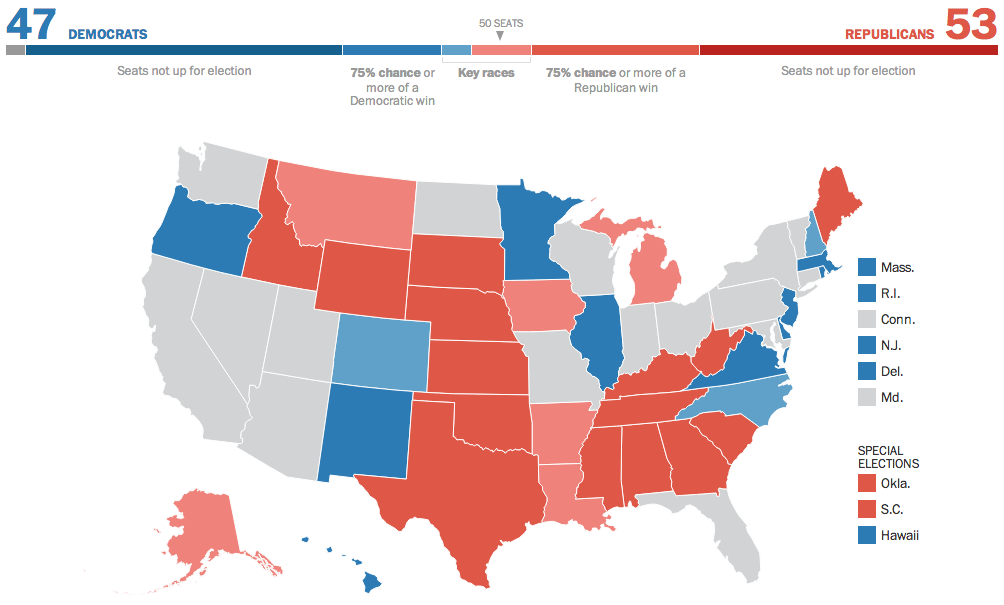
John Sides shares the WaPo’s midterms forecast:

Right now, the model estimates that Republicans have an 82 percent chance of re-taking the Senate.

How did we arrive at this conclusion? You can read more about that model here, but in brief: the model looks at Senate elections between 1980-2012 and estimates the effect of several key factors in the country and in individual states or races — the rate of economic growth, the popularity of the president, whether it’s a midterm or presidential year, the most recent presidential election outcome in that state, whether the incumbent is running, and each candidate’s qualification (measured as highest elective office to date).

Why do these factors add up to a significant GOP advantage? The main problem for Democrats is that it’s a midterm year — and the president’s party almost always loses seats in the midterm. Moreover, conditions make it difficult for Democrats to overcome this tendency: the economy is not growing that strongly and, partly as a consequence, President Obama is not that popular. Moreover, as many have noted, many seats that the Democrats must defend this year are in Republican-leaning states.

Kilgore explains how this model differs from all the others:

Election Lab, reflecting the proclivities of its “fundamentals matter most” proprietors, will place more emphasis on economic and approval ratings factors than on current polling, certainly until late in the cycle. Unsurprisingly, Election Lab enters the fray with a more robust prediction of Republican Senate gains than the competition, showing not only Montana, South Dakota, Arkansas, Alaska, West Virginia and Louisiana flipping from blue to red, but also Iowa and Michigan, which most observers show as leaning Dem. That’s particularly interesting since they also have Kay Hagan is pretty good shape in North Carolina.

Meanwhile, Kyle Kondik looks ahead to the 2016 Senate races:

Of the nine Senate Republicans who represent states Obama took in 2012, seven will be on the ballot in 2016. Sens. Mark Kirk of Illinois, Pat Toomey of Pennsylvania and Ron Johnson of Wisconsin will likely start the cycle with their odds of winning reelection no better than 50/50. Sen. Chuck Grassley of Iowa could easily get another term if he wanted it, but he’ll be 83 on Election Day 2016 and might retire, triggering a highly competitive race. Sens. Kelly Ayotte of New Hampshire, Rob Portman of Ohio and Marco Rubio of Florida will probably start as favorites by a small margin, assuming they run for reelection. Additionally, Democrats could credibly target seats in less conservative red states—places like Arizona, Georgia, Indiana and North Carolina—particularly if some incumbents, such as the 77-year-old John McCain, retire.

How To Interview A Politician

Over the weekend, Washington’s journalistic class was hobnobbing with the people they cover. Bob Woodward has helped pioneer access-journalism in which favored courtiers in The Village act as stenographers for the powerful – their skills deployed merely to figuring out which of their exclusive sources is telling the truth (a wrinkle unknown, it seems, to the access-journo of the day, Jo Becker). The idea that they would wreck their access by asking a politician questions that he really doesn’t want to answer – “Isn’t your wife German?” (see above), “Can you give us evidence for your crazy pregnancy stories?” – is preposterous.

So I give you the above video, by the intrepid BBC political reporter, Nick Robinson. Watch him go for the jugular, and watch him not release his grip until the prey is whimpering, near-lifeless on the ground. A joy to watch, and Hitch, I suspect, would approve.

What Is The Ulysses Of Romance Novels? Ctd

A reader flags this post by Sarah Wendell, who criticizes the dismissive coverage of News Corp’s $415-million acquisition of Harlequin last week. The reader vents:

Why is it reporters and their editors can write seriously about porn, marijuana, party drugs, fraternity hazing, gay sex, and numerous other topics, but come unglued when they have to write about romance novels?

I suspect reading romances is one of the most closeted behaviors American women indulge in. I am sure there are people who read the Fifty Shades of Grey books that wouldn’t be caught dead reading a Harlequin Presents paperback, in public or in private. Even violent video games are treated with more respect than romance novels. I’m a little baffled as to why the Harlequin I’m reading is somehow intellectually stunting, but episodes of Game of Thrones or 24 or even CSI are important parts of the culture – important enough to be reviewed in multiple mainstream publications, while romance novels are ignored and the business of romance is treated like a joke.

Another is less convinced that the genre deserves respect:

The search for a Ulysses of the romance genre is really misplaced. It’s a search for profundity in pornography, albeit pornography directed at women.

Now, I like pornography as much as the next man, and some pornography can be sublime, but its intent and effect are somewhat orthogonal to true art. It suppresses rather than invites reflection. So I find the pursuit of profundity there to be profound misunderstanding of the nature of the genre. Though male-centric pornography is visual while female-centric pornography is verbal, that detail does not alter the nature of the genre.

Tying in Caleb Crain’s musings on the state of the gay novel, another reader takes the conversation in another direction:

The gay novel is doing just fine if you accept romance as a part of fiction. Gay romance is a booming and very successful genre. The majority of gay romance readers, though by no means all, are heterosexual women. The majority of writers are as well. I think that qualifies this email to fit into your End of Gay Culture Watch thread as well.

The concept that straight readers won’t find gay characters “relatable” is provably false. I think it’s more likely that readers of any sexuality simply aren’t that interested in literary fiction. Actually, I don’t even think it’s the age-old literary-fiction-vs.-popular-fiction battle in this instance. Many of my friends are authors, and my Facebook news feed is currently filled with friends of mine proudly announcing their Lambda Literary Awards nominations. Several of them are in the romance category, but not all.

Maybe it’s time writers of gay fiction look to themselves and the content they produce instead of finding reasons the market isn’t responsive. The market loves a good story.

A less high-minded reader:

My romance cannon. That’s what I’m going to call it now.

Heh. Earlier Dish on romance novels here.

Coral Creations

10-arthurevans

Amelia Urry looks at the work of artist Courtney Mattison, who constructs ceramic coral reefs:

Mattison’s newest piece, Our Changing Seas III, depicts a hurricane-spiral of bleached corals coalescing to a bright center. You can read it as a message of hope or one of impending doom, depending on your disposition, but Mattison tries to stay on the cautiously sunny side. “I really hope I’m not building monuments to reefs, memorials of their demise,” she told Grist over the phone. “I would really like these to be celebrations of them — but time will tell.”

The work has a larger mission:

At the heart of Courtney Mattison’s artwork is her desire to inspire real-life changes in how people view and treat the world’s oceans and environments. Similar to the Our Changing Seas series, Courtney Mattison’s Hope Spots collection comprises 18 vignettes, each of which represents a vital marine ecosystem in its ideal form (that is, protected from various threats such as global warming or pollution).

See more of Mattison’s work here.

(Photo by Arthur Evans)

Everyone Knows When You’re Faking It

Paul Bisceglio flags a study that explains how we evolved to distinguish between genuine and feigned laughter:

Genuine laughs are produced by an emotional vocal system that humans share with all primates,” [Gregory] Bryant says in a press release. This system seems to have really strong control over our windpipes, so it allows us to shoot out quicker breaths of air when we laugh for real than when we fake it. We laugh faster as a result.

Fake laughs, on the other hand, “are produced by a speech system that is unique to humans,” and come out slower, says Bryant. (Yes, animals laugh, too.)

This speed difference between real and fake laughter is subtle, but not small enough to escape the perceptive powers we’ve honed over millennia of human evolution. Our senses are fine-tuned to pick up the most minute acoustic variations—and for good reason, Bryant and [Athena] Aktipis write. Detecting feigned laughter is an important survival tool. “You have to be vigilant,” Bryant says, “because you want to discern whether people are trying to manipulate you against your best interests or whether they have authentic cooperative intentions.”

The Cost Of Conspiracy Theories

Linda Besner considers how extreme or unorthodox viewpoints reshape mainstream culture:

Recent research suggests that the current prevalence of Enemy Above conspiracy theories [in which the threat comes from our own government and institutions] has a direct social consequence—lower voter turnout and public engagement. A study by psychologists Daniel Jolley and Karen M. Douglas, published in the February 2014 issue of the British Journal of Psychology, found that exposing subjects to conspiracy theories about the death of Princess Diana or climate change decreased participants’ self-reported likelihood to vote, donate money to political groups, or wear campaign stickers.

These conspiracy theories can take a while to kick in:

In the immediate aftermath of President Kennedy’s assassination, people were inclined to believe the official story. In 1963, a poll showed that 29 per cent of Americans trusted the accuracy of the Warren Commission’s report; in 2001, only 13 per cent believed the official narrative. Similarly, the Joint Inquiry that compiled the government’s take on the events of 9/11 was initially well received, but by 2004 polls showed a growing disbelief in its findings. A polling company found that in April of 2013, 11 per cent of American voters believed the U.S. government let the attacks on the World Trade Center happen. The “truther” movement has been actively organizing lectures and tours to tout their point of view, and while mainstream audiences may not be attending these events … [exposure] to the doubts of others has a psychological effect, even when we consciously dismiss their objections.

Map Of The Day

per-sq-mile-night-heat-map

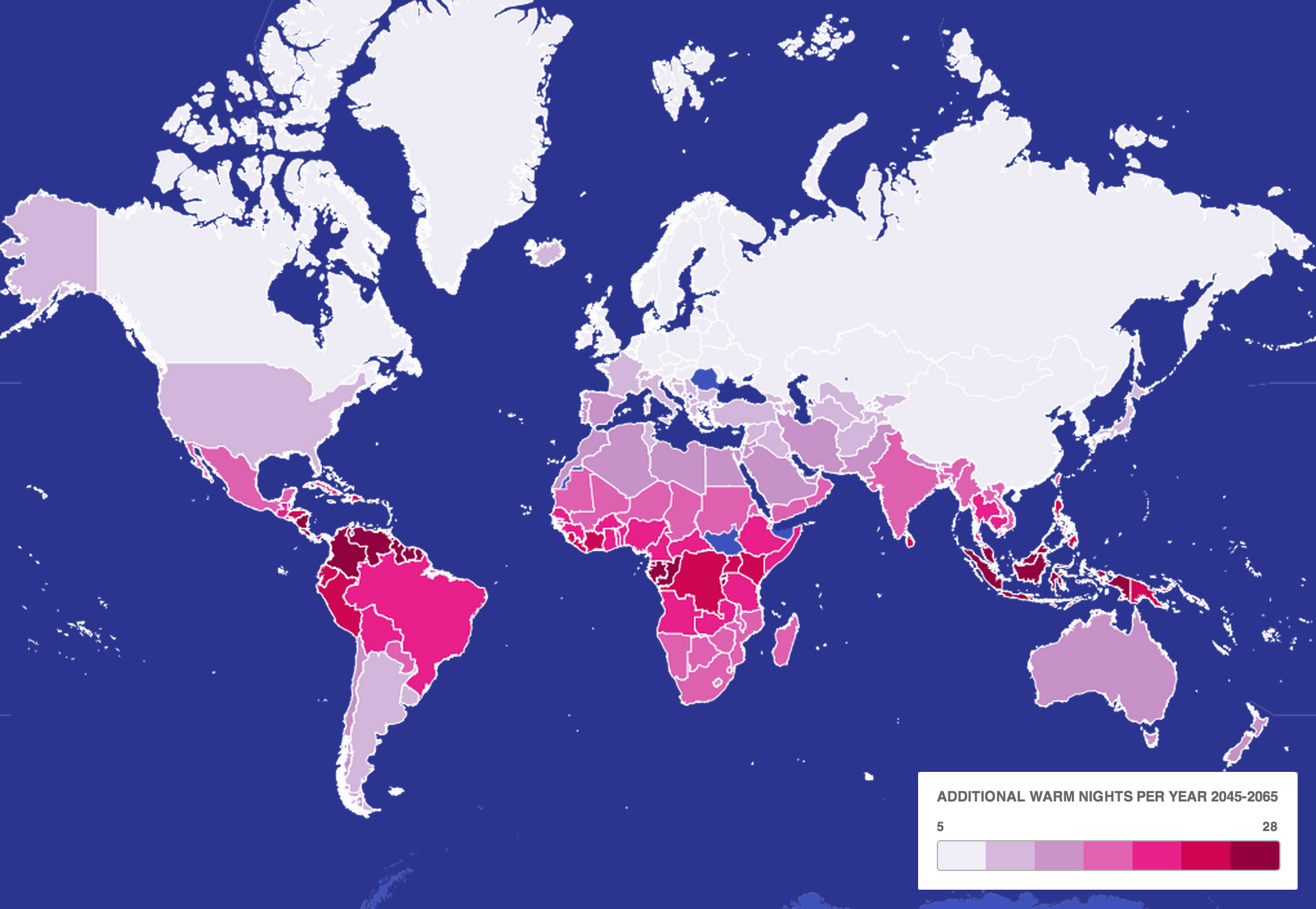
Tim De Chant explains:

Worldwide, [climate change will lead to] somewhere around two weeks of higher nighttime low temperatures. In some places, winter nights may be unseasonable warm, or in others summer nights could grow more sweltering and sleepless.

But it’s not just our comfort that’s at stake. Plants are uniquely sensitive to nighttime low temperatures. If they’re too high, plant respiration rates tend to increase. (Yes, plants respire just like us. Unlike us, they’re able to grow without eating because, during a typical day, the rate of photosynthesis greatly outpaces the rate of respiration, meaning they’re making more food than they are consuming.) When respiration rates rise in plants, they consume more of the carbohydrates they made through photosynthesis during the day. With less energy available, they might grow more slowly or put less energy into producing seeds. It happens that many staple crops, like rice and corn, are seeds, so warm nights are one way climate change could slash crop harvests.

Getting Schooled On Inequality

Leonhardt discusses the role of education in fighting inequality:

The great income gains for the American middle class and poor in the mid-to-late 20th century came after this country made high school universal and turned itself into the most educated nation in the world. As the economists Claudia Goldin and Lawrence Katz have written, “The 20th century was the American century because it was the human-capital century.”

Education continues to pay today, despite the scare stories to the contrary. The pay gap between college graduates and everyone else in this country is near its all-time high. The countries that have done a better job increasing their educational attainment, like Canada and Sweden, have also seen bigger broad-based income gains than the United States.

Yet the debate over our schools and colleges tends to exist in a separate political universe from our debate over inequality. Liberals often shy away from making the connection because they worry it holds the struggling middle class and poor responsible for their plight and distracts from income redistribution. Many conservatives fear the implicit government spending involved. And so, our once-large international lead in educational attainment has vanished, and our lead in inequality has grown.

Screened Out?

dish_subwayreading

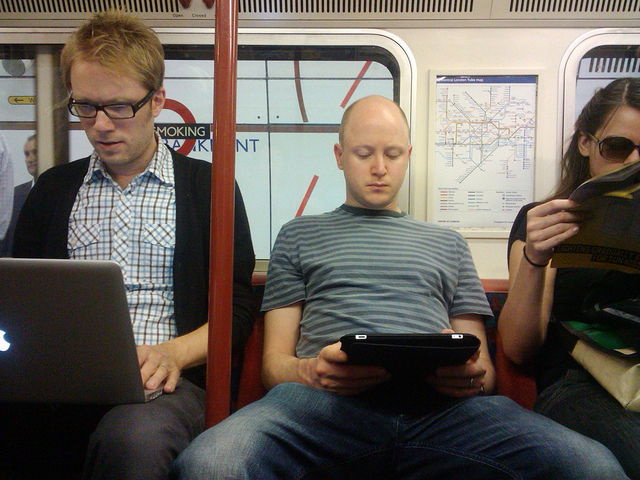
New Yorker Michael Bourne worries about what the disappearance of print books on the subway suggests about today’s reading culture:

When we talk about books, we tend to think in terms of great works of art and forget that for most people books, like newspapers and magazines, are merely a handy thing to have around for that idle moment when there isn’t something else better to do. Now, more and more often, those idle moments – on subway cars, on airplanes, in dentist’s offices – are being filled by games and movies and social media. By screens.

This doesn’t necessarily mean the end is nigh for literature as we know it. The golden age of American theater came in the 1940s and 1950s, a generation after radio and talking pictures seemingly outmoded live theater. Arguably, some of the greatest movies American directors have ever produced debuted in the 1970s, a generation after television seemingly outmoded movies. Still, a vibrant art form has to serve a utilitarian function in ordinary people’s lives or it gradually becomes relegated to the museum and the specialist viewer, as has happened to visual art and, more recently, to live theater. And if the printed page can’t survive on a New York City subway car, that once-great rolling library, where else can it survive?

(Photo: “Evolution of reading on a subway” in London, 2010, by Alfred Lui)

What Helmets Can’t Prevent

Concussions:

There’s no question that helmets save lives by preventing skull fractures and other lethal brain injuries. But according to a 2013 report on youth sports-related concussions by the Institute of Medicine and the National Research Council, “there is limited evidence that current helmet designs reduce the risk of sports-related concussions”—minor traumatic head injuries that have been tied, at least in adults, to long-term neurological problems including depression, chronic traumatic encephalopathy (a neurodegenerative disease) and chronic cognitive impairment.

Look, I’m no fan of alarmist parenting info. But the fact that helmets don’t protect against concussions might influence the choices we make as parents, so I think it’s important to know.

That’s an essential point made in our long-running thread on brain injuries in professional sports. A related sub-thread here. Update from a reader:

Perhaps the biggest misnomer perpetrated by Ms. Moyer in her Slate article is that a “better designed” helmet would prevent concussions.

The repetitive types of concussions that are beings studied as causal links to long-term brain injury are not necessarily caused by outside impacts but the forward moving brain, itself, slamming into the now-stopped skull. Lots of activities can cause these types of micro-concussions where no helmet would or could prevent that.

The only way to prevent such micro-concussions is to avoid activities where those situations can arise. Of course that’s nearly impossible unless you want to live inside an actual bubble. The same would apply to your children.

In particular Ms. Moyer (and I suspect a vast majority of people) falsely believe that bicycle helmets in particular are designed like motorcycle or football helmets, failing to realize that cycling helmets in particular are designed for one major impact. Not repeated impacts. The intent of cycling helmets are to help prevent major brain injuries and skull fractures.

As an avid cyclists, I can attest to that. When I lived in the D.C./MD area, I used to mountain bike out in Cedarville State Park in Maryland after work. Nothing technical but a fast, fun trail. During one such ride, I slid of a trial bridge and flipped into the creek, landing on my head and right shoulder. After checking to be sure the bike was ok first (every cyclist will attest to this) I brushed myself off and checked for injuries. Nothing visible but the headache and blurred vision.

With seven miles to ride back to the trial head to my car, no cell service and no one knew I was riding that day, I’m glad my helmet worked because it cracked in half on that ride where I landed on the creek rocks. After I made it home, I took some Advil and drank a beer and took a nap. I only realized after the fact when checking my symptoms did I realize I had suffered a concussion.

Having been hit by a car, crashing mountain and road riding, and mastering the multitude of ways to fall off of a bike, I’ve only had that one bad concussion on a bike. But I’ve replaced my helmets several times over the years. By the way, this why you should pay good money for a helmet because reputable companies like Bell offer crash replacement.

I think the underlying issue is that sports activities have gotten safer over the years with regards to equipment, techniques and awareness to brain injury but we need to get over the idea of 100% safe activities. As human animals such activities are the last vestiges we have to our baser instincts and the need to move and be alive. I’ll put my kids in soccer or on a bike before I put them in football. But I also know that without the ability to play and self-assess for risks children will never avail themselves of those skills when they get older.