How The East Was Lost

RUSSIA-UKRAINE-POLITICS-CRISIS-OSCE

Keating points out that Putin doesn’t need to invade eastern Ukraine in order to conquer it:

As long as the separatists, almost certainly acting under the backing if not the outright direction of Russian special operaions forces, can continue to withstand the tentative offensives launched against them, Kiev’s loss of control over Donetsk and Luhansk will become an established fact on the ground. As Interpreter editor James Miller points out in a commentary for Vice, the key player in this is not the military but the Russian government’s well-oiled propaganda machine, which has been operating at full force in eastern Ukraine, convincing many pro-Russian locals that “Ukraine is being overrun by ultranationalist Nazis who are building concentration camps for ethnic Russians and regularly lynching Russian sympathizers.”

Tens of thousands of Russian troops are still massed on the Ukrainian border, and there’s little sign that they’re leaving, but at the moment Russia can simply leave them in place as a warning of what would happen in Ukraine launched a full-scale assault to retake the contested areas—a campaign that would almost certainly involve large numbers of civilian casualties.

This map from the WaPo gives a detailed picture of the forces Russia has committed to threatening Ukraine. Berman thinks Friday’s violence in Odessa, in which 31 Russian demonstrators died in a fire, could be the pretext for an old-school invasion Putin was waiting for:

Beyond the human nature of the tragedy, which is obvious, lies the political one that now faces the Ukrainian government. If, as has been assumed by most observers, the Russian troops who have spent the last six weeks massed on Ukraine’s borders have been waiting for an excuse to intervene in order to either “restore order” or “protect Russian citizens” from “fascists” this tragedy would seem to be it.

Not only does it provide the requisite death toll, but the manner of the victims’ passing pushes all sorts of historical buttons, not just in Russia, but also in the West, where dozens of victims being burned alive in a locked building brings flashbacks to earlier pogroms.

Lucian Kim situates the turmoil in Donetsk and other eastern regions within Putin’s general strategy:

The illusion of a conflict is crucial for Putin’s plan to polarize Ukraine and prevent it from achieving the political stability needed to ward off economic collapse. If a few more pro-Russian regions break off as separatist republics, so much the better. Although the violence in the Donetsk region is very localized, images of icon-carrying villagers blocking Ukrainian troops in armored personnel carriers serve the narrative of a beleaguered Russian population under assault. Kremlin-controlled Russian TV presents a parallel reality where the United States is doing its best to split Ukraine; the Kiev government broke the Geneva agreement to defuse the crisis; and foreign mercenaries are backing up Ukrainian forces in Slovyansk.

Never mind that the supposed people’s uprising in Donetsk is a caricature of the Maidan, which was an explosion of citizens’ anger. For a Soviet man and former KGB agent like Putin, the concept of civic activism—ordinary people acting without instructions or payment—is incomprehensible.

The Dish covered recent violence in Ukraine here.

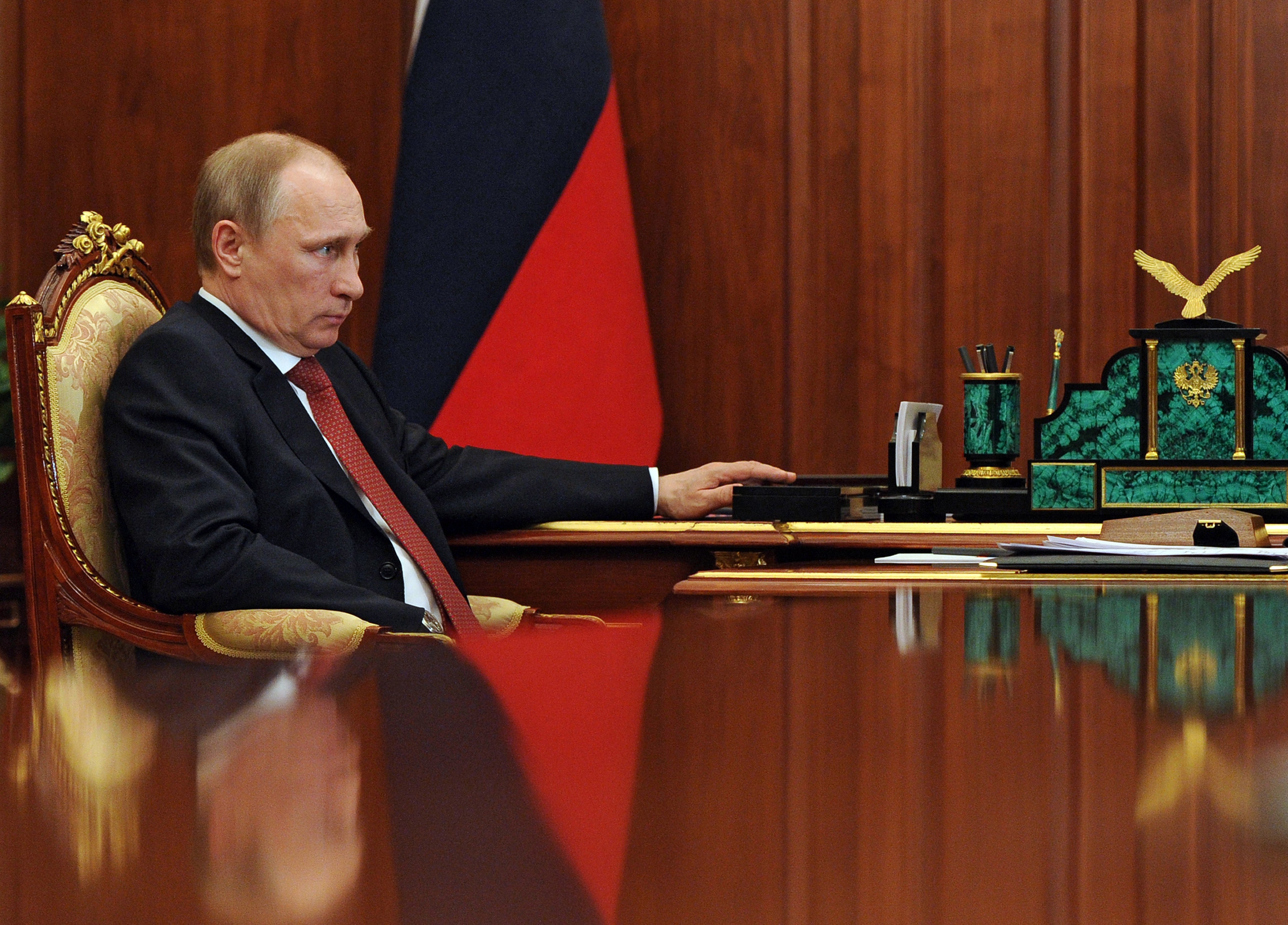
(Photo: Russia’s President Vladimir Putin attends a meeting in the Kremlin in Moscow, on May 5, 2014. German Chancellor Angela Merkel said yesterday Putin and OSCE head Didier Burkhalter are expected to discuss establishing a ‘national dialogue’ in Ukraine ahead of elections when they meet in Moscow on May 7. By Mikhail Klimentyev/AFP/Getty Images.)

The View From Your Obamacare: Women’s Health

A female reader writes:

I saw this thread and how timely it is! Last night I went to the lady doctor (that’s my euphemism for President Obama Visits Boston To Talk About Health Caregynecologist) for the first time in over a year, just for my annual check up.

Cost of annual check up: $0
Cost of three-month supply of birth control: $0
The feeling of getting free birth control for the first time in my life (that wasn’t a bunch of condoms): PRICELESS.

I’m still on cloud nine from it 24 hours later. It’s the little things, ya know? Those three packs, in the past, have cost me anywhere from $60 to $100. On average, $20/pack/month, for a yearly savings of at least $240! You don’t have to be ill to benefit form the ACA, healthy people are helped too. Obamacare FTW!

Another:

Obamacare changed absolutely nothing about my (employer-based) insurance coverage except for one thing: free birth control. The previous copay was in no way burdensome, but it regularly makes me appreciate the impact on the high school students I teach and how much I appreciate the law making it easier for them to graduate sans-baby. However, the numerical impact of the law doesn’t take into account the relief I get from knowing that I don’t have to worry about how getting tests done to see if a lump is benign or cancerous (benign, thankfully) will look to an insurance company if I ever do strike out on my own. Or my relief that a close friend with multiple pre-existing conditions doesn’t have to worry about coverage. Changes in healthcare affect far more than the people who show up in the statistics.

Another:

The reader who told of his PTSD and need for mental health coverage, which he is finally able to receive thanks to Obamacare, reminded me of my biggest complaint about the program.

It ought to have included dental care instead of elective contraception coverage. Some years ago, I experienced significant dental issues but possessed only medical insurance. Had I allowed my condition to deteriorate such that I could no longer eat, perhaps then medical coverage would kick-in, at great expense and after great suffering.

It baffles me still that medical, dental, and mental health are handled as separate segments in the overall health care system. Need I point out the obvious that each individual is a whole person with a single body?

Access to medical, dental, and mental health care are true human needs. Obamacare should have focused on meeting all those needs, including the mental and dental coverage that too many employers had failed to make available, instead of opting to cover the pill. Except for it palliative uses, the pill is not a form of health care.

(Photo by Yoon S. Byun/The Boston Globe via Getty Images)

“It’s A News Report … Except It’s Also An Ad!”

My rather lonely crusade against sponsored content – advertising disguised as journalism – looks lonelier by the day. The desperate need for profit has trumped every other value in the online writing business. That’s a defense, in some respects, of course. If the price of ethics is extinction, it’s too high for business. And maybe this disturbing abandonment of the integrity of journalism will simply be a passing fad, a sign of desperate economic straits, until the market finally sorts itself out, and readers start to wise up to the deception intrinsic the whole thing. I sure hope so.

But that rather optimistic scenario has always missed an important piece of the puzzle, it seems to me. My fear is that once advertising has its foot in the door of journalism proper – i.e. is fully integrated within journalism and increasingly indistinguishable from it – the door will soon be flung wide open and never shut again. Increasingly, companies seeking to advertise will dispense with intermediary sites like Buzzfeed altogether, and create their own sites in which advertising and journalism are completely fused. And how will “journalism” respond then? What happens when Unilever is the host company and the Guardian is merely its branding vehicle? Why not get rid of the journalistic middleman when you can flood the Interwebs with your own propaganda, paid-tweets, and sponsored posts? On the other side of the fence, “news” sites will see the advantages in surrendering more and more to advertising, since the revenues are so much more lucrative than any subscriptions or regular ads could ever be, and as news sites compete with each other for more and more ad dollars. In that market – where there are no journalistic ethics to speak of any more – my bet is that the most craven will win.

Well, here’s a harbinger of sorts: a seemingly journalistic inquiry by Vice into the future of warfare – fused with an ad for a video game, Call Of Duty. New York Times journalists and other serious sources are in the video – but the video is also an ad. Money quote:

In the trailer, which Vice says is only a taste of a longer investigation into private military contractors, Thomas reads a series of alarming statements about the rise of military contractors as grainy shots of gun-toting men scroll in the background. Snippets of interviews with private contractors are played, and for one sequence, Thomas is strapped up with a bulletproof vest and rushed through an apparent simulation of an evacuation mission before the video comes to an end. “The next generation of Call of Duty is coming,” reads the final frame. And apparently, the next generation of branded content isn’t far behind.

Will The Economy Protect Democrats?

Pew’s latest makes it seem unlikely:

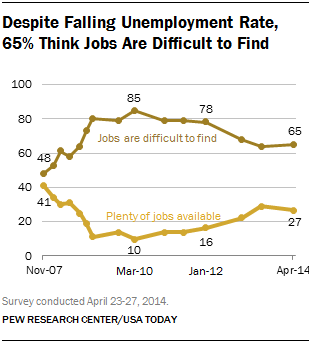
From the public’s point of view, jobs remain scarce: 65% say jobs in their community are difficult to find while 27% say there are 5-5-14-5plenty of jobs available. Since the recession, perceptions of the job market have become less negative as the unemployment rate has declined. However, there has been virtually no change in these views since last June (64% jobs hard to find), although the jobless rate has fallen by more than a percentage point (from 7.5% to 6.3%) since then.

Moreover, there has been no increase in economic optimism. About as many say that economic conditions will be worse (24%) as better (25%) a year from now, with 49% predicting little change. Asked to describe the economic recovery, 66% say the economy is recovering but not so strongly, 26% say the economy isn’t recovering at all, while just 6% think the economy is recovering strongly.

Jonathan Bernstein is skeptical the better jobs numbers will mean much for the upcoming elections:

When Ronald Reagan’s approval turned around in 1983, for example, his strong rally still didn’t much exceed one percentage point of approval a month. And that occurred as the economy moved from a deep recession to a solid recovery, a different set of circumstances from the mild improvements that might be happening now. President Barack Obama’s approval rating is around 44 percent. A return to 50 percent by election day is a best-case scenario, and even that wouldn’t cause a dramatic tilt in the electoral playing field. Given how closely contested Senate control appears to be, a small nudge could be very important – but it’s a small nudge, nevertheless.

A far more realistic outcome is that good economic news just keeps Obama on the very mild upward path he’s been on since the Affordable Care Act exchanges were fixed.

Waldman spotlights the Democrats’ rhetorical dilemma:

Democrats have been spending a lot of time lately talking about inequality, which is not a function of what happened this month or last month, but the result of forces and trends that have evolved over the last thirty years. That’s an important discussion to have, and an argument that resonates with voters, particularly when Republicans are inclined to deny inequality exists, or that it matters if it does. But when you’ve been saying that we have a profound and deep-seated inequality problem that was three decades in the making, it’s awfully hard to turn around on the evidence of a month or two of job growth and say, “Things are going much better now!”

That doesn’t mean Democrats can’t argue, as they surely will, that the Obama administration’s policies are helping the economy pull out of the long and painful period of difficulty we’ve had since the Great Recession. And of course, they can also say that things would have been much worse had the other guys been in charge. But because they’ve begun to talk about how the system is rigged, they can’t sing “Happy Days Are Here Again.”

A Strike Against Transparency

drone_approval_maps

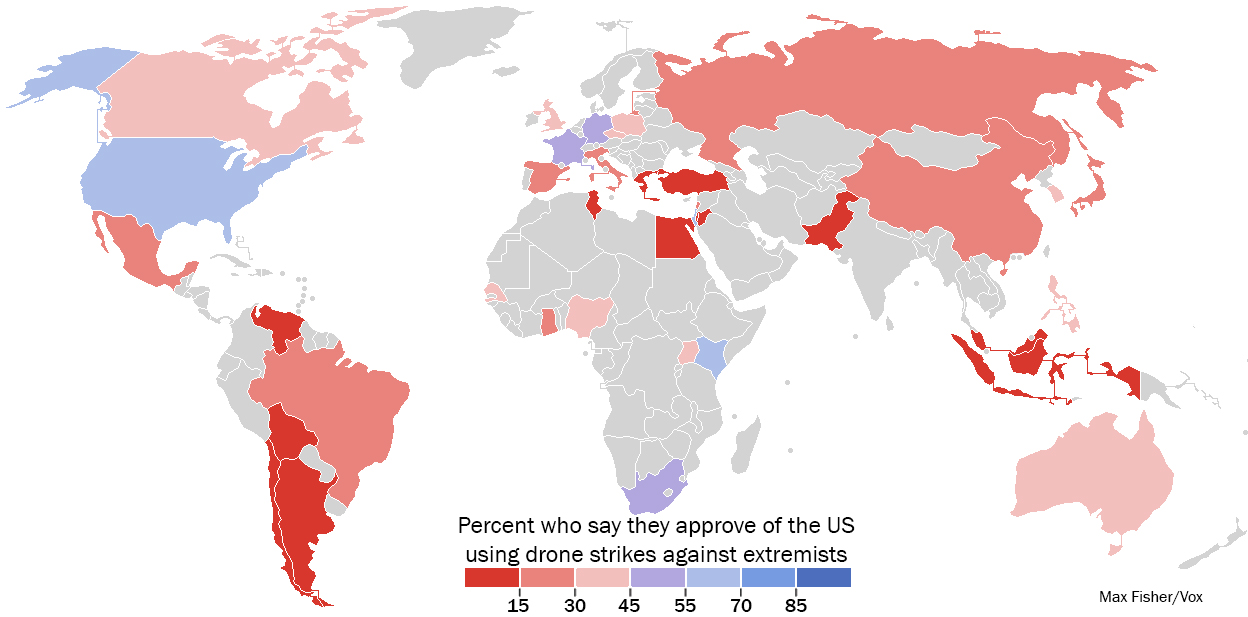
The Pew Global Attitudes Survey illustrates how unpopular the drone program is around the world:

In 33 of the 39 surveyed countries, a plurality of people say they oppose the drone program in the United States. That means more people disapprove than approve of targeted killings in 85 percent of the countries surveyed.

Last week, Mark Mazzetti reported (NYT) that the Senate “quietly stripped a provision from an intelligence bill that would have required President Obama to make public each year the number of people killed or injured” in drone strikes. David Cole is aghast:

The Senate’s decision is particularly troubling in view of how reticent the administration itself continues to be about the drone program. To date, Obama has publicly admitted to the deaths of only four people in targeted killing operations. That came in May 2013, when, in conjunction with a speech at the National Defense University, and, in his words, “to facilitate transparency and debate on the issue,” President Obama acknowledged for the first time that the United States had killed four Americans in drone strikes. But according to credible accounts, Obama has overseen the killing of several thousand people in drone strikes since taking office. Why only admit to the four Americans’ deaths? …

[I]f the US government’s targeted killings are lawful, we should have no hesitation in making them public. Surely the least we can do is to literally count and report the lives we’ve taken. Yet even that, for “the most transparent administration in history,” is apparently too much.

Quote For The Day

“Now I feel strong and beautiful. I walk proudly down the streets of Manhattan. The people I love, love me. I make the funniest people in the country laugh, and they are my friends. I am a great friend and an even better sister. I have fought my way through harsh criticism and death threats for speaking my mind. I am alive, like the strong women in this room before me. I am a hot-blooded fighter and I am fearless.

But I did morning radio last week, and a DJ asked, “Have you gained weight? You seem chunkier to me. You should strike while the iron is hot, Amy.” And it’s all gone. In an instant, it’s all stripped away. I wrote an article for Men’s Health and was so proud, until I saw instead of using my photo, they used one of a 16-year-old model wearing a clown nose, to show that she’s hilarious. But those are my words. What about who I am, and what I have to say? I can be reduced to that lost college freshman so quickly sometimes, I want to quit. Not performing, but being a woman altogether.

I want to throw my hands in the air, after reading a mean Twitter comment, and say, “All right! You got it. You figured me out. I’m not pretty. I’m not thin. I do not deserve to use my voice. I’ll start wearing a burqa and start waiting tables at a pancake house. All my self-worth is based on what you can see.”

But then I think, Fuck that. I am not laying in that freshman year bed anymore ever again. I am a woman with thoughts and questions and shit to say. I say if I’m beautiful. I say if I’m strong. You will not determine my story — I will. I will speak and share and fuck and love and I will never apologize to the frightened millions who resent that they never had it in them to do it. I stand here and I am amazing, for you. Not because of you. I am not who I sleep with. I am not my weight. I am not my mother. I am myself,” – the stupendously talented Amy Schumer. If you haven’t yet, read the whole glorious, hilarious thing.

Bloody Bangui

CAFRICA-UNREST

In a penetrating report from the Central African Republic, worth reading in full, Graeme Wood describes the state of the country:

It is a country the size of Texas, with as many people as Boston, and an economy less than a tenth the size of Chattanooga’s. Reliable data doesn’t exist for the number dead, but from December until March, street lynchings became so common that they ceased to be news. The danger is unequaled anywhere in present-day Africa except, perhaps, Nigeria on a bad day. Bangui competes with Damascus for the title of world’s grimmest capital city. …

The government of CAR has already begun taking steps to make its most powerful institutions Muslim-free. The armed forces, or FACA, dissolved when the Séléka arrived, and they are now being reconstituted without much care for the histories of its members—whether they are implicated in communal or political violence or whether they remain loyal to the Anti-Balaka. No one is sure if the FACA will represent the whole country or just the Christians.

(Photo: A man holds his machete as young people, who created a self-defense committee for their district, meet before leaving for a patrol on March 12, 2014 in Bangui. By Sia Kambou/AFP/Getty Images)

An Effort To Eradicate Education, Ctd

Three weeks have passed since Islamic militants kidnapped more than than 200 Nigerian schoolgirls, and the situation only seems to be getting worse.  The Economist finds that the government’s response “began with confusion and has become increasingly shambolic, creating chaos that in other countries would see senior heads roll”:

President Goodluck Jonathan has remained remarkably silent about the kidnapping of the girls, a story that outraged many and triggered one of Nigeria’s rare street protests. Five years into an insurgency by the Islamist sect Boko Haram that claims thousands of lives every year, Mr Jonathan seems distracted while the military has failed to stop the bloodshed despite a multi-billion dollar-a-year budget. … Messages from the Nigerian military are odds with statements from the girls’ school and other state authorities. The defense ministry issued an inaccurate report claiming all but eight of the girls had been found and then retracted it, further damaging the government’s credibility.

Alexis Okeowo notes, “The circumstances of the kidnapping, and the military’s deception, especially, have exposed a deeply troubling aspect of Nigeria’s leadership: when it comes to Boko Haram, the government cannot be trusted”:

Children have been killed, along with their families, in numerous Boko Haram bombings and massacres over the past five years. (More than fifteen hundred people have been killed so far this year.) State schools and remote villages in the north have borne the brunt of Boko Haram’s violence this year. The group is believed to be at least partly waging a campaign against secular values. The kidnapped girls were both Christian and Muslim; their only offense, it seems, was attending school.

Last June, I visited Maiduguri, the capital of Borno state and the birthplace of Boko Haram, to report on the insurgency and the Nigerian government’s counteroffensive, a security operation that placed three northeastern states, including Borno and Yobe, under a state of emergency as troops launched attacks on terrorist hideouts and camps. The military cut phone lines and Internet access, and, while residents were glad for the intervention, there was a sense of living in the dark. Gunshots, a bomb blast: was it Boko Haram or a military attack? Were the hundreds of men disappeared by the military actually terrorists—even the young boys? And was the government, as it claimed, really winning the war?

Meanwhile, Frida Ghitis describes the kidnapping as “an international crisis that requires international help”:

[I]t is urgent that the plight of these girls and their families gain the prominence it so clearly deserves. Global attention will lead to offers for help, to press for action. Just as the intense focus on the missing Malaysian plane and the lost South Korean ferry prompted other nations to extend a hand, a focus on this ongoing tragedy would have the same effect. Nigeria’s government, with a decidedly mixed record on its response to Boko Haram, will find it difficult to look away if world leaders offer assistance in finding and rescuing the kidnapped girls from Chibok, and another 25 girls also kidnapped by Boko Haram in the town of Konduga a few weeks earlier.

Previous Dish on unrest in Nigeria here and here.

Not Breathing Easy

OzonePollution-1

The American Lung Association’s annual State of the Air report shows that much of the country is still suffering from “dismal levels of pollution”:

More than 147 million people, or roughly half the nation, live in places with unhealthy concentrations of ozone or particulate pollution. Fifty-three million others reside in areas that the association has slapped with a most troublesome “F” grade for pollution. The health implications of this coast-to-coast blanketing of foulness are hard to overstate.

Suzanne Goldenberg notes that ozone levels are rising across the country:

The report, which is based on data collected between 2010 and 2012, found smog, or ozone, had worsened in 22 of the 25 biggest US metropolitan areas, including Los Angeles, Houston, Washington-Baltimore, New York City and Chicago – and said there was a high risk of more high-ozone days because of climate change. … Smog, or ozone, which is the most widespread air pollutant, forms more readily in hotter temperatures, and is expected to increase under climate change. “It’s going to make it harder to clean up air pollution,” said Janice Nolen of the American Lung Association. “Days that wouldn’t ordinarily have high ozone levels are going to have them.” She added: “It’s going to be much harder to keep ozone pollution down to the levels that we should be breathing.”

Meanwhile, Brad Plumer explains why more than half of the 10 most polluted US cities are in the Golden State:

Why does southern California dominate the list? One reason is that tailpipe emissions from all those cars and trucks interact with high heat and bright sunlight to create ozone pollution. An especially hot summer made things worse. So did the geography of the Central Valley, whose weather patterns tend to trap pollutants in the region.

He adds that not all the news is grim:

That all said, it’s worth putting this in historical perspective. … [S]ix major air pollutants have all fallen 72 percent since 1970 – due, in large part, to the Clean Air Act. Over that same period, the economy has grown 219 percent, the number of miles we drive has grown 165 percent, and the amount of energy we use has grown 47 percent. So it’s certainly possible to drive down air pollution and still get much, much richer.

(Map by Mark Byrnes)