Book Club: Can Christianity Survive Modernity? Ctd

Readers take stock of the conversation:

Your original question, “Can Christianity survive modernity?” has two dimensions to it, only one of which is addressed in Ehrman’s book. That’s the question of how modern scholarship sees the scriptural and historical record of Jesus and his age. But another, how-jesus-became-godoverlapping issue is also brought to bear by modernity. The Christian tradition about who Jesus was, and how his Divinity can be defined, is bounded by a very particular set of notions about God that in an earlier era were either forcibly isolated from the rest of the world’s religious cultures, or only passively separated by the limits of those times.

But in the modern age, when vast amounts of historical knowledge of not just Christianity, but the rest of the world is readily available, we now know what multiple branches of Hinduism thinks, what the various sects of Buddhism understand, what Bahai believes, what Taosim grasps about the nature of the cosmos, what shamanism discovers, even what secular mystical and hallucinogenic experience has to offer, and and so on. The modern mind isn’t just confronted with scholarly knowledge of Christianity’s real past; it’s also confronted by a whole range of experiential and conceptual knowledge about God, Divinity, and ultimate reality, including of course modern science itself. And the two can’t be separated anymore. That’s the dilemma of Christianity’s confrontation with modernism in a nutshell.

Another:

In arguing that Ehrman’s book does not “effectively debunk Christianity’s core claims in modernity,” I am struck by how elastic and indefinite the responses of you and your readers of faith are as to the notions of truth and Christian doctrine generally.   That is not meant as criticism, just an observation. One reader valued “the messiness and contradictions in the gospel accounts” as a virtue itself.  Another reader said the “literal truth or untruth [of the story of Christ] is of little to no interest,” and the practicing Catholic reader believes that the foundational doctrines of his church are “of course” not accurate because the truth of Jesus’s life and message can’t be known.  An earlier reader explicitly bookclub-beagle-tradvised you “to consider steering clear of words like ‘truth.'”

Is it then the better question to ask “whether postmodernism can save Christianity?”  And does the new historical research require a postmodern religious approach?  If so, what are the implications of that? It could strengthen and deepen Christianity’s core message and appeal.  But maybe not.  It seems certain to be consequential though.  Will this approach favor liberal Protestant faiths but pose a greater challenge to the more institutional Catholic Church?  If Christian doctrinal truths are admittedly unknowable and subjective to both Gospel writers and readers, does that mean that choosing between different Christian denominations is ultimately only a matter of personal comfort and/or inertia?  Or might this approach – as fundamentalists would argue – logically and inevitably weaken Christianity’s claim against competing faiths?

Another:

I’m an engineer and a recent convert to Catholicism (although I was always careful to say that I followed Dorothy Day, not Paul Ryan).  I know that my conversion process was not rational.  My overwhelming experience of something I can only call Grace has shattered every conviction I had about who I was, who/what God was, and my place in this universe.

I get impatient with those, on both sides, who try to use evidence to prove or disprove religious concepts. A scientist used modern tissue analysis as proof that a Eucharistic Miracle happened.  I felt that same impatience reading Ehrman’s book. None of these investigations have any relevance in comparison to my lived experience of Christ.

It’s not that I don’t think such investigations have value. I just see them as belonging to a realm of inquiry that is disconnected from my relationship with God.  If the Eucharistic Miracle turns out to be pig blood or the disciples had hallucinations of Jesus brought on by grief, it just doesn’t change anything about what happens when I pray.  It seems to me that a faith resting on such proofs is disconnected from the Source of faith.  For myself, I am better off learning how to tap into that Source more deeply and regularly.

I recently went on a pilgrimage to Assisi, the home of St. Francis and St. Claire.  They were declared saints soon after their deaths. Many artifacts of their lives were preserved within the lifetimes of those who knew them, and the town itself has been a place of pilgrimage ever since.  Pilgrims can be assured that the artifacts are real. When you walk the streets of Assisi, you are walking in the paths of the millions of pilgrims who came there to worship, contemplate and pray.  Even my agnostic husband felt the presence of so many souls seeking peace.

On the same trip, we saw a piece of wood that St. Helena claimed to be part of the table from the Last Supper, now preserved in the papal basilica of St. John Lateran.  She found it in the early 300s.  Who knows if it’s real?  For 1700 years, the faithful have venerated it as a connection back to the last peaceful moments Jesus had with his community of disciples, moments we recall every time we celebrate the Eucharist.

That veneration makes it holy.  The pilgrims make Assisi holy.  We make Christ holy. First the disciples and then the 2,000-year-old Christian community of the faithful experienced Jesus as someone extraordinary.  Jesus brought a powerful message that has come down through the ages and drawn millions of souls towards a stronger connection with the Source of faith, and more just, loving and care-taking relationships with each other.  How could the manifestation of such a person not be celebrated as miraculous?

Another:

You wrote, “I cannot rationally reconcile the divine and the human as single concept. But my faith, my personal experience of Jesus, forces me to accept it.”

And in so doing you are essentially recapitulating the experience of the disciples and the church. They tried every other explanation for what they had seen and heard, and none of them captured the length and breadth and depth and height of this man’s life.  So they were forced to come up with a formulation that made no sense, because it was the only thing that MADE sense.  Like the scientists who have to hold the absurd formulation that light is BOTH a particle and a ray, because only under those circumstances can they actually use their mathematics to make the equations correspond with the observed facts.

Credo quia absurdum. 

A Poem For Friday

5613593878_afe893c316_b

“Metamorphosis” by Nina Cassian:

How long is it since
deer antlers grew on my forehead
and, on my behind, a salamander’s tail?

Today,
I am neutered,
or become a domestic fowl.
I submit to conventions,
I eat regularly—
and I sleep—
my beak in my feathers.

(From Continuum: Poems © 2008 by Nina Cassian. Used by permission of W.W.Norton & Company. Photo by Crista Rowe)

Will Reefer Rock The Vote?

Alexandra Gutierrez argues that ballot initiatives, including one on marijuana legalization, could hand Democrats an Alaskan Senate seat:

Three initiatives that were supposed to appear in the August primary have been bumped to the general election. So now, on top of deciding whether they want reelect a Democrat in a year where Republicans could seize control of Congress, Alaskans will be voting on initiatives to increase the minimum wage, to allow the sale of marijuana, and to make it harder to build an unpopular open-pit mine near the world’s largest salmon run.

Any one of those initiatives could be seen as a gift to Democrats. Together, they could boost turnout by up to 5 percent, according to political scientist Caroline Tolbert.

But Harry Enten doubts the marijuana initiative will play a big role:

[A] closer look at the evidence suggests Begich might not stand to benefit. Overall, past marijuana ballot measures haven’t meant that more young people come out to vote. This year’s senate race in Alaska would likely have to be very close for the marijuana ballot measure to make a difference.

Lastly, Bernstein points out that, if “there’s one thing certain about public policy issues, public opinion and vote choice, it’s that we don’t know why we vote the way we do”:

Issues may matter on the margins, and it’s possible that an issue will push marginal voters to show up at the polls (though we should be careful, it may be that whatever issue one’s party focuses on will do the trick). But the relationship isn’t straightforward. And just asking people about it won’t help us understand.

Great* News On Jobs

jobslsotinpostwwiirecession

The headline number on this morning’s jobs report – 288,000 jobs added in April – looks pretty good on its face:

The hiring spree surpassed most analysts’ expectations and is the strongest showing in more than two years. Businesses added workers across a broad array of sectors, including business services, retail and construction. The unemployment rate plunged to 6.3 percent — the lowest level since 2008 — though part of that was due to workers leaving the labor force.

The upbeat report provided a convincing counterpoint to data released earlier this week that revealed economic growth was virtually flat during the first quarter. Many analysts attributed that weak reading to the unusually cold winter and argued that a spring thaw is already underway. The Labor Department also increased its estimates of hiring during the previous two months by 36,000 net jobs. Wall Street opened higher on the news.

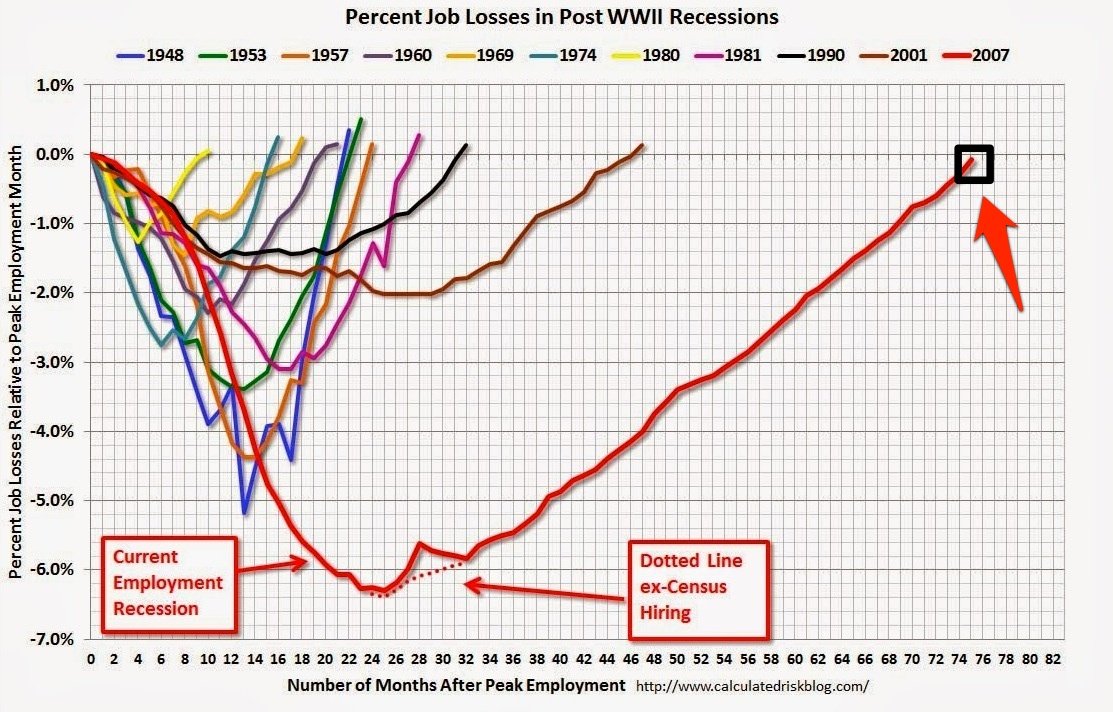
The chart above, via Joe Weisenthal, shows that we have almost made up the job losses from the recession. But as Neil Irwin points out, there’s a huge downside:

The number of people in the labor force fell by a whopping 806,000, wiping out the February and March gains and a bit of January as well.

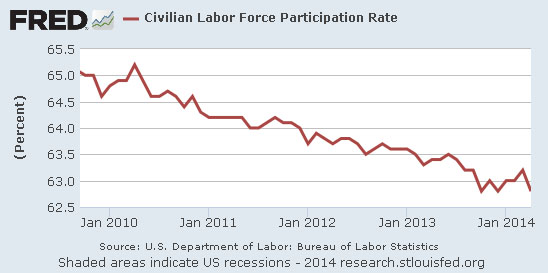
The labor force participation rate fell by 0.4 percentage points to 62.8 percent, returning to its December level. And the number of people reporting they were unemployed fell by 733,000, which sounds good on its surface, but paired with the similar-sized decline in the labor force points to job seekers giving up looking rather than finding new employment.

It would be irresponsible to draw any definitive conclusions from a single month’s data, but this isn’t the only area in which this report has some soft underbelly. Both hours worked and wages were unchanged. If the economy is to ever expand more robustly, it will require workers to make more money, giving them the income to buy more goods, services and houses; in April at least, there was no progress on wages.

David Leonhardt adds that the business and household surveys are extremely divergent:

The monthly survey of businesses showed that the economy added 288,000 jobs last month — and 238,000 on average over the last three months, the best such pace in more than two years. The monthly survey of households showed that the economy actually lost 73,000 jobs; the only reason the unemployment rate fell is because people dropped out of the labor force, no longer looking for work and thus not counted as officially unemployed.

It’s tempting to try to combine the two surveys into one neat package and claim that the economy added jobs, albeit not enough to bring people back into the labor force. But that’s not right. If you believe the household survey, the economy lost jobs. If you believe the business survey — which is much larger than the household survey — job growth was quite strong. They cannot both be right.

Drum advises against freaking out about the declining labor force participation rate:

blog_civilian_labor_force_participation[T]here are two things to keep in mind: (a) the participation rate has been shrinking steadily for a long time, and (b) it’s a pretty volatile number from month to month. The chart below shows both things. The participation rate has been steadily shrinking since 2000, and it’s been shrinking even faster ever since the end of the Great Recession. And the big drop in April? As you can see from the tail end of the chart, the participation rate hasn’t actually changed since October. It’s just been bouncing up and down.

Bottom line: Don’t take the April numbers too seriously. The long-term trends are important, but there’s so much noise in the month-to-month numbers that you can’t draw too many conclusions from them.

What’s to explain the decline? Patrick Brennan thinks it could be Obamacare:

If the early-February CBO report that predicted that in a few years, 2.5 million fewer Americans will be working than otherwise would because of the Affordable Care Act is right, that’s going to start showing up in a big way this year. In one sense, this is a good thing: Many people have access to affordable health insurance outside of holding a job for the first time. But when we’re worried about a secular decline in labor-force participation, this is a worrying trend.

Another explanation: We could be seeing the delayed effect of the expiration of unemployment benefits for those out of work for (about) 27 weeks or more. You might expect that to be the argument laid out by supporters of extending those benefits, though I haven’t seen much of it.

Oh Peggy

She is now comparing Pope John Paul II to Barack Obama in terms of leadership. Guess who wins! For some reason, she fails to acknowledge that under John Paul II, thousands of children were raped by members of the organization John Paul II ran, and the machinery he was in charge of not only failed to stop this, but actively perpetuated it and covered it up. Nowhere in her column does this come up – it’s yet another reality (like American torture) she wants to walk swiftly past (“Some of life has to be mysterious”). Noonan goes on to say:

Great leaders are clear, honest, suffer for their stands and are brave. They conduct a constant dialogue.

Whatever else one can say about the pontificate of John Paul II, the idea that it was about a constant dialogue is absurd. Under John Paul II and his orthodoxy-enforcer, Joseph Ratzinger, the scope for any dialogue within the church was essentially ended. Whole areas of theological debate were ruled impermissible; discussions about faith and morals were also discouraged and any hints of heterodoxy, i.e. thinking, were monitored and punished. John Paul II’s papacy was capable of detecting the most trivial form of theological dissent and punishing it relentlessly, while it found itself miraculously blind when it came to the endless rapes and abuse of children and adolescents that we know now were endemic.

This wasn’t leadership; it was the abdication of basic moral responsibility for the church John Paul II ran. And these were not only crimes of commission but also of omission. A monstrous figure like Marciel Macial was lionized by John Paul II even as he sold drugs, was a bigamist,  abused countless young men, and even raped his own son. Cardinal Bernard Law was rewarded for his own disgusting cover-up of child-rapists with a sinecure in Rome.

Of course, it’s sometimes hard to pin down what the fuck Noonan is saying because her favorite word is “seems.” Never “is” – but “seems.” The world is always described through her own fuzzy, soft-focus lens, where no objective truth can really penetrate. And so you stumble upon the only actual substantive claim she makes in the column:

How wonderful it would be to see an American president appreciate all the possibilities of becoming a great energy-producing nation—all the new technologies and jobs, all the rebound they’d bring. To have a leader who feels and conveys a palpable joy in the transformative nature of this new world.

Here’s what Obama recently said about “becoming a great energy-producing nation—all the new technologies and jobs, all the rebound they’d bring.” It’s from the State of The Union this year:

One of the biggest factors in bringing more jobs back is our commitment to American energy. The all-of-the-above energy strategy I announced a few years ago is working, and today, America is closer to energy independence than we’ve been in decades.

One of the reasons why is natural gas – if extracted safely, it’s the bridge fuel that can power our economy with less of the carbon pollution that causes climate change. Businesses plan to invest almost $100 billion in new factories that use natural gas. I’ll cut red tape to help states get those factories built, and this Congress can help by putting people to work building fueling stations that shift more cars and trucks from foreign oil to American natural gas. My administration will keep working with the industry to sustain production and job growth while strengthening protection of our air, our water, and our communities.

Here is the SOTU from 2013:

Today, no area holds more promise than our investments in American energy. After years of talking about it, we’re finally poised to control our own energy future. We produce more oil at home than we have in 15 years. We have doubled the distance our cars will go on a gallon of gas, and the amount of renewable energy we generate from sources like wind and solar — with tens of thousands of good American jobs to show for it. We produce more natural gas than ever before — and nearly everyone’s energy bill is lower because of it.

Open your eyes, Peggy. There is world outside your 1980s nostalgia-fest. And it’s as different from your reality as “seems” is from “is”.

Neoconservatism Now

“It was notable that the panel offered not one example of something they thought Obama should do now to respond to the crises in Ukraine, Syria, Libya, Egypt or lots of other places.  They were full of examples of what he should have done in the past, and absolutely certain he would not do the right things in the future, including decisive military action against the Iranian nuclear program,” – Daniel Serwer, listening to Robert Kagan, Walter Russell Mead and Leon Wieseltier, all now arguing for what they argued for in 2003 – a US-initiated war in the Middle East.

Giving Big Government “A License To Kill”

In response to Matt K. Lewis’ “conservative case” for the death penalty we posted yesterday, Balko points out that the practice is “susceptible to the same problems Lewis points out when criticizing the things governments do that he believes aren’t legitimate”:

When it comes to the trappings of public choice and political economy, the corruption of power and tunnel-visioned public officials, the criminal justice system is no different than, say, the Environmental Protection Agency, the Department of Education or the Occupational Safety and Health Administration. Actually, there is one important difference: The consequences of government error in the criminal justice system are far more profound. …

Lewis makes clear that he only supports the death penalty for the most heinous of crimes, and only for those crimes for which the defendant’s guilt is certain. At first blush, it’s hard to quarrel with that position. The rub is that we’ll always need to draw that line somewhere. How heinous must the crime be? And how certain of guilt must we be? There have been more than a few exonorations in cases in which it seemed unimaginable that the accused people could possibly have been innocent. And yet they were. We now know that prosecutors and police are capable of fabricating and planting evidence. Not that it’s necessarily common, but it happens. That means that even DNA cases aren’t necessarily iron-clad. The science behind the testing may be certain, but the gathering and testing of evidence will always be done by humans and be subject to all the biases, imperfections and temptations to corruption that come with them.

Meanwhile, Max Ehrenfreund finds little reason to think the death penalty acts as a deterrent:

In fact, research suggests than criminals are mainly concerned about whether they’ll be caught, not what might happen to them afterward. “It’s the certainty of apprehension that’s been demonstrated consistently to be an effective deterrent, not the severity of the ensuing consequences,” said Daniel Nagin, a professor at Carnegie Mellon University. Nagin led a committee at the National Research Council that reviewed the evidence on executions and crime and concluded that the existing research is inconclusive. In any case, he argues, effective law enforcement is most important in preventing crime. People are more likely to break the law when they feel they can get away with it. “The police are really at the center of the action in terms of deterrence,” Nagin said.

Do I Sound Gay? Ctd

Readers turn their gaydar on:

Yes, you definitely sound gay. But not super gay, if that makes sense. Somewhere between Neil Patrick Harris and Dan Savage on a scale of zero to George Takei.

Another:

You don’t sound “stereotypically” gay.  You sound … British.  Which to American ears is a touch fey.

One way of testing this was to ask my old high school friends whether they knew I was gay in my teens. I reunited with a few dear old friends last year. They all told me they had no idea. But I think for them, my nerdiness obscured my gayness. Another reader:

“Poohsticks”! That isn’t gay so much as just twee as fuck. The biggest straight creepers I knew in the ’80s were indie boys who would wear their cardies to cakewalks and go on the pull.

Ah, yes, those were the days … Another reader:

You don’t sound gay; you sound European. Yes, I realize this might be even worse for a Brit.

It is. Another shifts focus:

Yep, I have a gay voice. And I hate it, but I don’t worry about it too much, unless I’m watching video of myself. Straight people have acknowledged my voice sounds gay. When I worked for a French oilfield services company, I met a woman who had me figured out, though she didn’t realize it, when she commented that I sounded gay when I spoke French. I was startled, given that I wasn’t really out then. It dawned on me that my voice simply sounded Southern and American to her when I spoke English, but the gay came out when I spoke French. So apparently my voice is definitely gay in any language.

Many others sound off:

Thanks for starting this discussion! I’m straight, but I’m a musician/artist and tend to move among gay circles a bit more frequently than others at my day-job or in my family. As a singer, and a vocal pedagogist, this topic has always fascinated me.

I know gay men with no perceptible lilts or lisps, and others that are ostentatious caricatures of that type of diction. The well-trained gay singers I know don’t tend to bring their accents into sung music in their native language (almost exclusively English, since I’m in the Midwest), possibly because in voice study, diction is part of the regimen. During the course of an art song or choral piece, you often have a long time to plan how that “s” is going to sound, and the melodic line obscures any lilt. Even with those who maintain sibilant s’s in sung English language music, it will often disappear when they’re singing in a non-native language.

I hope you get input from speech pathologists or other singers on this thread. As I said, I’ve long been fascinated by why sexual orientation in men leads to this unique set of accents/dialects.

Something else that occurred to me: there’s no “lesbian” accent, and few women sound anything like the effeminate-ish brogue of some gay men like Tim Gunn. So these men are not affecting a female cadence; it’s something else.

Another is on the same page:

I know your post was focused on the voices of gay men, but I believe that many lesbians have a unique tone, timbre, or whatever you call it to their voice as well. I would love to see someone do a study that does a technical analysis of the voices of straight and gay women to see if there’s a quantifiable difference.

And another:

The “gay voice” issue is utterly fascinating to me. I’m a (straight, female) bankruptcy attorney and part of my job involves meeting with a fairly large number of new clients each week for consultations. It’s an interesting and unusual interaction because I get to ask complete strangers about some pretty intimate details of their personal lives, including a lot of things people generally don’t tell their family members and best friends, within a few minutes of meeting them. One of the things I’ve discovered is that I always, ALWAYS know that a guy is gay before we get to the section of the questionnaire where I ask for the names of any “spouses or significant others” residing in his household. I usually know it within about a second of the time he walks through the door. It’s both something in the voice and also something in the whole way gay guys move that is different from straight guys. I’ve never been able to pinpoint exactly what it is, but I instantly know it when I see it.

But ironically, I have absolutely no clue when it comes to lesbians. I went to lunch three times with an attorney friend who talked nonstop about her “partner” Susan and I honestly thought she was talking about her law partner (who she oddly seemed to really enjoy taking cooking classes with), until she actually posted something on Facebook starting with “As a lesbian…” So much for my A+ gaydar.

One more:

Thank you for addressing the issue of gay voice. Growing up gay and full of shame, I realized early on that I could consciously avoid overtly acting like a sissy. At age three my aunt, when I asked her to paint my toenails red like hers, informed me that “little boys don’t do that, only little girls.” So I never asked again. It was a bit like a conscious and successful attempt to improve my left-handed handwriting after getting bad marks in penmanship.

After hearing my own recorded voice for the first time, however, I was stunned. It not only sounded like a sissy but, to my ultimate horror, it sounded like Liberace. I don’t mean to bash poor Lee, but realizing that I could only grow up to be like him moved me to suicidal ideation at age 11. I did try hard to sound less queer, even acting in high school plays so I could be someone else, but with only partial success. I knew my voice gave me away.

Since I hated and feared this type of voice, when I matured sexually I found it a total sexual turn-off in others. I didn’t know that there were gay men with a “normal” voice and for years limited myself to anonymous casual sex with no tell-tale speaking. Ultimately, some sort of inner strength I didn’t know was there, coupled with changing times, enabled me to come out and seek a relationship with a man. (And I share your experience of the universe shifting with that first kiss – it felt like falling backward through infinite bliss.) But it had to be someone who sounded straight. And I did find someone. I entered a relationship with him because I liked him and because of his boring, straight-sounding, Midwestern voice. He was not my “type” physically and the sex was never the greatest, but we’ve been together for 35 years and, partially thanks to lovely you, we were married in New York in November.

I know this may sound rather sad and pathetic and self-loathing coming from a 66-year-old retired physician, but there it is. By the way, I don’t think you sound gay, but it may just be the residual British accent that obscures deeper indications. Patrick in “Looking” has total gay voice, but his British boss (with the delectable ears) does not. The mysteries of sexuality are infinite and fascinating.

Squandering Our Antibiotics Supply

Antibiotics Discoveries

The World Health Organization has issued a lengthy report (pdf) rounding up the best available international data on drug-resistant bacteria and warning that the post-antibiotic era of our nightmares could be coming soon:

The WHO report, “Antimicrobial resistance: global report on surveillance”, collates data from 114 countries, looking at the seven most common bacteria responsible for serious disease and regional levels of resistance.  … Avoiding the proliferation of antibiotics resistance should have been easy. WHO’s recommendations are, as ever, for people to use their prescriptions as instructed by their physician and to not share antibiotics. We know that not finishing a course of antibiotics can leave bacteria in the body and help it towards building a resistance. It should be avoidable. But there are other issues, such as overuse with livestock. In all cases, WHO is urging for “harmonised global standards”.

Another problem is that drug companies don’t put much effort into developing new antibiotics:

[R]esearch in this area has largely stalled, and only a handful of new antibiotics have been created over the past decade. That’s partly because it isn’t as profitable for pharmaceutical companies to invest in creating new drugs. Last year, the U.S. government formed a partnership with a pharma giant in the hopes of spurring innovation. Some infectious disease experts are urging Congress to pass tax credits to encourage the development of new antibiotics.

Susannah Locke reminds us why this is a really, really big problem:

It’s easy to forget what the world was like before the first antibiotic was discovered in 1928. Diseases like pneumonia and simple scrapes and infections could often cause death. Today, antibiotics have become indispensable for modern medicine — they’re used for surgeries, transplants, kidney dialysis. Without antibiotics, giving birth would be much more dangerous. Without antibiotics, an estimated one in six hip replacement patients would die.

The short story is that we really, really don’t want this to happen. You can read more about what the post-antibiotic world would look like in Maryn McKenna’s story here.

Russell Saunders, a pediatrician, can’t imagine “what it would be like to practice medicine without recourse to antibiotics”:

I get immensely frustrated when I encounter lazy medical providers who scribble out a prescription for a Z-Pak for every patient who smiles the right way. Even though I know it makes some people happy to leave my office with a script, I am professionally obligated to be parsimonious with a resource as precious as effective antibiotics. Hopefully, with increasing awareness of the antibiotic-resistance problem will come less pressure on providers to err on the side of treating disgruntled patients.

Previous Dish on antibiotics here, here, and here.