Do Animals Get Depressed? Ctd

The song in this video is fairly insufferable (you can mute it without losing anything), but the story certainly isn’t:

A reader recommended it:

You should link to the recent footage of a goat rescued from an animal hoarder who was inadvertently separated from his companion donkey and went into a depressive decline, refusing to eat or move although otherwise checking out as healthy. The rescuers examined the animal’s history and realized what the problem likely was. A volunteer drove 14 hours round trip to fetch the donkey to reunited it with the goat. There was an immediate improvement in the goat’s attitude toward life.

Another responds to the question at hand:

Oh my goodness yes!  Dogs can TOTALLY gets depressed My Dalmatian, for instance: we moved when he was two, and we thought the poor thing would never recover from the shock!  It got so bad that this normally voracious creature, who once sat stock still begging for someone’s lunch for twenty by-the-stopwatch minutes, actually stopped eating his dogfood altogether.  My brother even walked right by him with a full stack of hot pizzas and he didn’t even look up!  We finally had to give him doggie uppers we were so worried about him.

On that note:

I know you’re not a Michael Moore fan, but his short lived TV Show TV Nation did a “Pets on Prozac” segment. It’s a little sad and a little funny.

Another reader:

Of course animals can get depressed, sometimes severely so. Ask virtually any staffer at a large animal shelter if they have seen cats with Fatty Liver Syndrome. This awful, self-perpetuating disease occurs when a depressed cat will not eat and its body goes into starvation mode, forcing fat from their reserves to move to the liver to be converted to lipoproteins for survival. This overwhelms the liver and causes the body to shut down, yet it also has the effect of making the cat feel full, perpetuating the starvation.

This ironically comes as a direct result of improvements in adoption rates at large shelters.

In decades past, a shelter would typically euthanize dozens of animals in a day or a week. But as acceptance of spay and neuter surgery, keeping pets indoors, and other progressive policies took hold, many shelters were able to go “no-kill,” meaning that they did not euthanize healthy, adoptable animals. But an unintended result is that the average time spent in a shelter for, say a cat, went from a few days to often weeks or months. And for some cats, a shelter can be a very depressing place, with barking dogs, a constant parade of new people, cleaning chemicals, and so forth.

I ran the world’s largest cat-only adoption organization and sanctuary, and to combat this depression we utilized a whole host of techniques, including creating small free-roaming colonies, dramatically increasing the number of volunteers providing one-on-one petting and interactions, and sending cats out to long-term foster care. The consequences of depression, like Fatty Liver Syndrome, can be reversed if caught early. But it’s even more important to not let it happen in the first place.

Update from a reader, who points out that “Monty Python was all over this 40 years ago”:

Another:

You may have already seen this, but no discussion of dog sadness is complete without Allie Brosh’s story about moving with her dogs.
Jihad 2.0, Ctd

ISIS’s online propaganda machine may be sophisticated, but they aren’t the only Iraqis on Twitter. Anti-ISIS voices are also making themselves heard:

While ISIS’s brutality — and its inclination to display it on every social media platform available — has been well covered, the Iraqi counter-campaign has garnered relatively little attention in Western outlets. But the #No2ISIS hashtag has already surged on Instagram and seems to be doing so on Twitter as well. Anti-ISIS protesters in London began using the hashtag earlier today on posters, while the Iraqi ambassador to the U.S., Lukman Faily, has even appeared in photos holding placards with the hashtag.

The idea is simple: For many Iraqis, the quickest way to counter the ISIS propaganda machine is to make one themselves.

Meanwhile, Jillian York wishes Twitter would stop shutting down the jihadis’ propaganda accounts:

Is there any benefit to Twitter allowing these accounts to thrive? Anna Therese Day, an independent journalist who has been working on the ground in Syria since 2012, believes there is. “As a conflict journalist, the Internet, particularly social media, has been an invaluable tool in identifying and reaching out to sources and interview subjects,” says Day. “In the case of ISIS, I’ve personally used various Internet applications to stay in touch with them as well as other sensitive sources, and their public internet presence has informed a significant part of our understanding about the group’s recruitment, worldview, and motivations as well as how they relate to each other.”

It isn’t just journalists who see Twitter as an important channel for communication with these groups. In 2011, amid calls from Sen. Joseph Lieberman for Twitter to block al-Shabaab’s accounts, Kenyan military spokesman Maj. Emmanuel Chirchir tweeted that “Al Shabaab needs to be engaged positively and twitter is the only avenue.”

Working Less Pays More

You don’t have time to watch this right now:

… because you’re working too much:

The 40-hour workweek is mostly a thing of the past. Ninety-four percent of professional workers put in 50 or more hours, and nearly half work 65 or above. All workers have managed to cut down on our time on the job by 112 hours over the last 40 years, but we’re far behind other countries: The French cut down by 491 hours, the Dutch by 425, and Canadians by 215 in the same time period. Workers in Ireland and the Netherlands are also working less. We’re also increasing our productivity, getting more done in the time we spend at work. It went up by nearly 25 percent between 2000 and 2012. …

Taking some time off actually improves a worker’s productivity at work. A study from Ernst & Young found that every ten hours of vacation time taken by an employee boosted her year-end performance rating by 8 percent and lowered turnover. Former NASA scientists found that people who take vacations experience an 82 percent increase in job performance upon their return, with longer vacations making more of an impact than short ones.

Relatedly, Cohn wants the US to have better work-family policies. Here he addresses the main pushback:

Conservatives in particular complain that requiring paid leave would hurt businesses, because employers must scramble to fill vacant posts—and do so temporarily. But if you talk to actual business leaders, you hear a different, much more nuanced story.

The trend among Fortune 500 companies has been towards offering longer leaves, with more compensation. Google, for instance, recently announced that it was extending paid leave for its employees by several weeks. One study found that the market even rewards such behavior; when companies announce they are extending parental leave, share prices rise.

The reason is that offering workers more leave tends to improve retention. Although the evidence is far from definitive, many studies have shown that, overall, new parents (and, in particular, new mothers) are more likely to return to work if they have the opportunity to take an extended leave for newborns. If companies don’t offer such long breaks—if they insist employees come back too soon—the new parents are more likely to abandon the job altogether and never come back. When workers who would rather work leave their jobs anyway, to take care of children, the companies aren’t the only ones who suffer. The economy does, too.

Zachary Goldfarb asks:

Why hasn’t the president been more aggressive on family leave? He’s enacted other major family-related benefits, such as the expansion of health care insurance under the Affordable Care Act, and proposed other child-focused policies, including a plan to offer pre-K to 4-year-olds from low- and moderate-income families. The idea of paid leave, however, hasn’t seriously come up in White House policy discussions, according to a person who has been deeply involved in those talks.

The reason has to do with the substantial cost of such a program, and the difficulty of funding it without raising taxes on the middle class — which would violate a major 2008 campaign promise. Recall that during his first presidential campaign, one of Obama’s big promises was that he would not raise taxes on any household earning less than $250,000 a year. He has tried to hold firm to that pledge, rejecting pressure from liberals who argue that it creates an unnecessary limit on what he can accomplish.

An Orthodontic Hat Trick, Ctd

On the subject of Luis Suárez, a reader writes, “The one thing you might want to mention is that human bites are very, very nasty”:

I’m a clinical pharmacist working in a big-city emergency department, and by far, the worst bite wounds and consequences we get in the emergency room are human bite wounds. The potential for infection with seriously awful bacteria is quite high. Eikenella Corrodens is the worst, and it causes infections almost exclusively from human bite wounds. When it gets into a joint (you see this in “clenched-fist injuries,” virtually always the result of someone hitting someone else in the mouth and lacerating their knuckles), it can especially cause lots of issues, including moving to the heart valves and causing endocarditis.  The infections from those bites are really tough to treat.

If it were me, I’d much rather be bitten by a dog or cat or any type of (non-rabid) animal than a human.

Physician Matt McCarthy elaborates on the many disgusting organisms living in your maw:

The pathogens that live in the mouth include common Staph and Streptococcus species, as well more obscure, yet potentially lethal bacteria like Eikenella, Fusobacterium, Peptostreptococcus, and Prevotella. You might not have heard of Eikenella, but at our hospital we see it quite frequently, typically as the causative agent of endocarditis, a potentially life-threatening infection of the heart. The bacteria can live harmlessly in the mouth, but if enough of it gets into the bloodstream, it can wreak havoc. There’s a good chance Luis Suárez has Eikenella living in his mouth—most of us do.

But wait, there’s more: Syphilis can also be transmitted via biting. The one case I know of occurred when a prostitute bit a 47-year-old man in the right nipple during sex. The nipple bled profusely, eventually became ulcerated, and failed to respond to several rounds of antibiotics. It was more than a month before doctors figured out it was syphilis. Not that anyone involved is known to be carrying around an STI—but would you want to explain how you caught syphilis from Luis Suárez?

Should Parking Spaces Be For Sale?

A reader suggests the topic:

While you’re mulling over paying for restaurant reservations, how about the public variation on this issue? I speak of companies that pay people to occupy public street parking spaces and then sell the use of the space to the highest bidder, or companies that provide apps allowing people to do this on their own.

This has become an issue here in San Francisco, where the city attorney has just sent a cease-and-desist letter to one business. In essence, a driver pulls into a parking space on the public street in a neighborhood where parking is especially scarce. They then advertise the immediate availability of that space online to the highest bidder. When the bidder arrives, they pull out of the space, and the “buyer” pulls in.

The city attorney’s argument is that parking is a public resource that shouldn’t and can’t be privatized. I happen to agree with him, but maybe your readers would like to discuss?

They previously discussed the topic herehere, and here. After almost fifteen years of Dish, there seems to be no subject you readers haven’t tackled.

Adopt American?

Kathryn Joyce registers a decline in domestic adoption rates:

[F]fewer women are willing to relinquish children for adoption if they find themselves pregnant at a young age, or while unmarried. A 2010 report from the Center for American Progress noted that annual domestic infant adoption rates have fallen so significantly that they are hard to track accurately. There is the simple fact that teenage pregnancies are down across the country. And for young women who do experience unplanned pregnancies, there are more choices available today. Although adoption is often presented as the pro-life alternative to abortion, the Center for American Progress report found that the greater acceptance of single parenthood is a stronger factor in fewer women choosing adoption than the availability of abortion, since both adoption and abortion rates have fallen, while rates of unmarried parenthood have dramatically increased.

Paradoxically, Rebecca Buckwalter-Poza notes that hundreds of American-born children are being raised by Canadian and European adoptive parents:

Over the past 10 years, Canadian parents have adopted more than 1,000 American-born children; another 300 are growing up in the Netherlands; and at least another 100 will be raised in the United Kingdom. … The best estimate, from Joan Heifetz Hollinger, a professor at the University of California-Berkeley School of Law, is that as many as 500 infants, most of whom are blackleave this country through outgoing adoption every year. When it comes to the adoption of black infants, the European market is all demand and America all supply. Social acceptance of single parenthood, the accessibility of contraception, and the legalization of abortion have drastically reduced the number of children available for adoption domestically in much of Western Europe, and U.S. agencies have emerged to meet the demand.

Buckwalter-Poza adds, “the perseverance of race-based preferences is troubling for a number of reasons, not least of which is that black children are less likely to be adopted than white”:

Any policy – official or not – that slows the adoption of non-white children is a worrying one. More than 100,000 thousand children become eligible for adoption in the US in a given year; on average, about 50,000 of these children will be adopted annually. Rough math finds a troubling truth: Approximately 46 percent of black children awaiting adoption were placed in 2012, compared to 58 percent of eligible white children over the same time period.

It can be argued that outgoing adoption is an indirect consequence of the commoditization of adoptees in the American market: White children are, in these terms, more “valuable,” and there is, as now-judge on the Seventh Circuit Court of Appeals Richard Posner once put it, “a glut of black babies.” Foreign prospective parents, it seems, appear less concerned with a child’s race than American parents; in some countries, international, transracial adoption has become “the norm.” One legal scholar explicitly champions outgoing adoption as a “win-win” for black adoptees, arguing that they benefit when we allow less racist countries to adopt children of color.

The Best Of The Dish Today

Catherine Rakowski captions the latest viral sensation from Upworthy ClickHole, which you won’t believe until you see it:

At 1:00:46 you’ll be surprised, at 1:49:03 you’ll be touched, and what happens at 2:16:44 will blow you away.

Today, we tracked one step forward on marijuana – the feds are thinking of reclassifying the substance – and one step back – the House Appropriations Committee tried to stamp out the will of DC’s voters on decriminalization. We tallied the astonishing progress toward marriage equality – almost half of gay Americans now live in states with civil marriage rights.

Meanwhile, Iraq remained Iraq: ISIS veered toward total control of Anbar province and Maliki refused to budge on a new multi-sectarian government. And I asked a pretty simple question on the question of Iraq: why don’t we treat other people’s civil wars as if they are other people’s civil wars?

Plus: David Cameron’s unexpected survival; John Boehner morphs into Michele Bachmann; and the Dish came out for Nigeria in the World Cup. And one of the most sublime poems in the English language – a gay Catholic defense of wilderness.

The most popular posts of the day were about our policy toward Iraq: Raging Against Obama – And History, and The “Simplification” Of The Issues. 

Many of today’s posts were updated with your emails – read them all here.  You can always leave your unfiltered comments at our Facebook page and @sullydish. 15 more readers became subscribers today. You can join them here – and get access to all the readons and Deep Dish – for a little as $1.99 month.

See you in the morning.

How Big A Problem Is Student Debt?

Screen Shot 2014-06-26 at 6.48.49 PM

Leonhardt believes the problem is overblown:

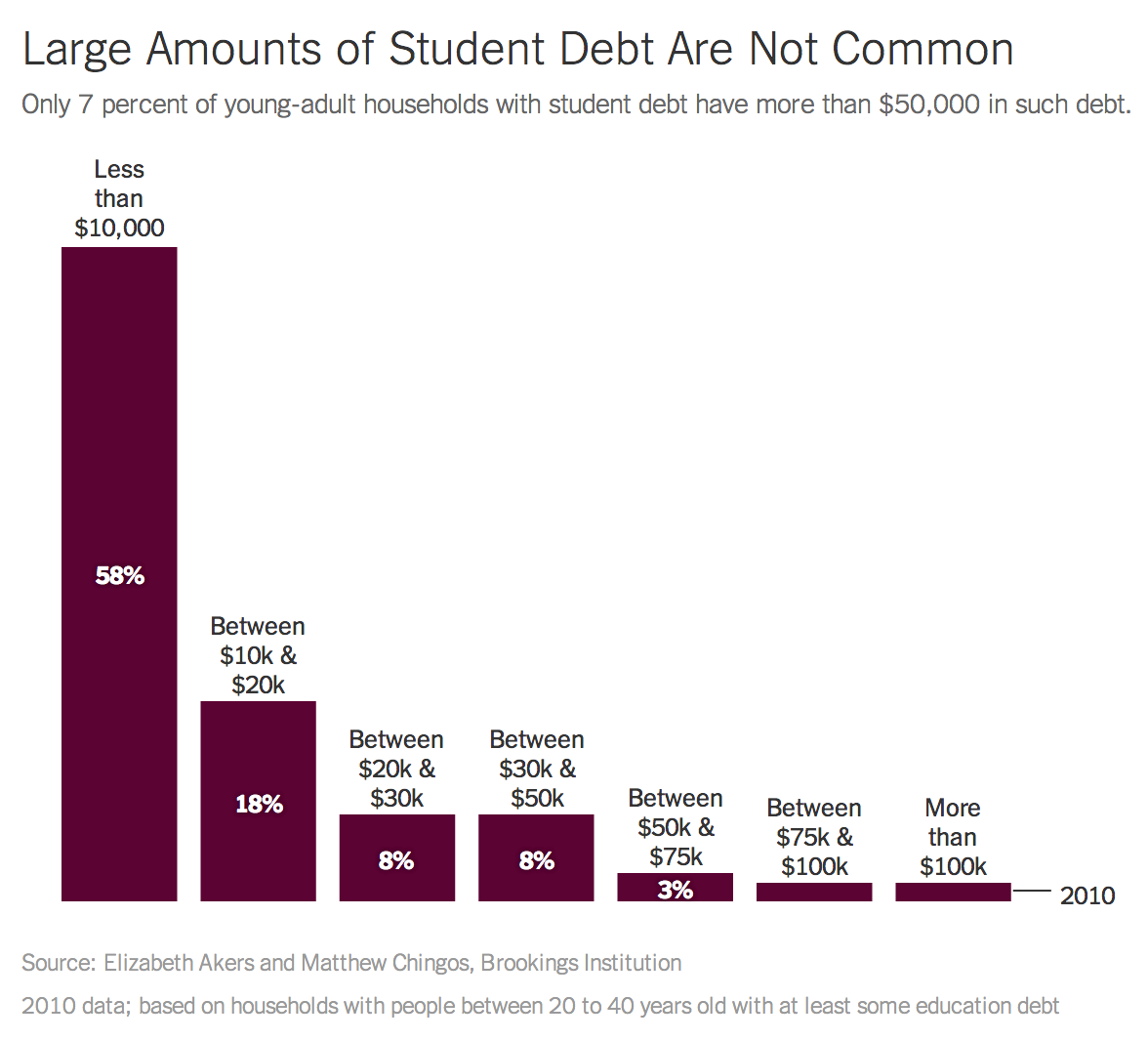
In fact, the share of income that young adults are devoting to loan repayment has remained fairly steady over the last two decades, according to data the Brookings Institutions is releasing on Tuesday. Only 7 percent of young-adult households with education debt have $50,000 or more of it. By contrast, 58 percent of such households have less than $10,000 in debt, and an additional 18 percent have between $10,000 and $20,000. “We are certainly not arguing that the state of the American economy and the higher education system is just great,” Matthew Chingos, a Brookings fellow and one of the authors of the new analysis, told me. “But we do think that the data undermine the prevailing sky-is-falling-type narrative around student debt.”

Choire Sicha tears into Leonhardt:

All this data comes from the Survey of Consumer Finances, which is conducted by the Federal Reserve Board of Governors and the Department of Treasury. … Of all the households in that study, only about 1711 have “household heads” that are younger than 40. That’s what they’re extrapolating from. (And, intriguingly, a small number of those have a head of household younger than 18.) This is not a big sample!

What, obviously, does this data completely omit? Well, one obvious thing is…

households who are headed by someone who is not under 40. One thing we know is that, in 2012, 36 percent of Americans aged 18 to 31 were not their head of household, because they were living with their families. This survey also clearly combines family and non-family households. (Also, there’s some unknown amount of statistical imbalance from same-sex households; 31 percent of same-sex households are likely to have two college-degreed people, compared to 24 percent of opposite-sex married households and just 12 percent of opposite-sex cohabiting households.)

But Freddie questions Choire’s statistical know-how:

This is something I’ve written about before – people dramatically overestimate the sample size needed to make responsible statistical conclusions. A sample size of almost 2,000 isn’t just big, it’s enormous. The standard error of a sample of this size will be very low. Absent systematic sampling bias (as opposed to error), the odds of the underlying population being significantly different from a sample of this size is tiny. Saying that it’s not a big sample just displays ignorance about the standards applied in statistical research.

His take on the topic:

[T]he student loan crisis is indeed a crisis, a moral and practical problem of considerable size. But it’s not the size that most people think it is. And more, it doesn’t change this fact: that despite the endless concern trolling of almost our entire media, the constant tendency for the (college educated) professional writers in our culture to say that “college isn’t worth it,” a college education remains a very good investment for the large majority of graduates. American college graduates are, by essentially any international standards and in comparison to Americans with only a high school degree, in a very economically secure class.

At the same time, Derek Thompson makes the case that college isn’t actually getting that much more expensive:

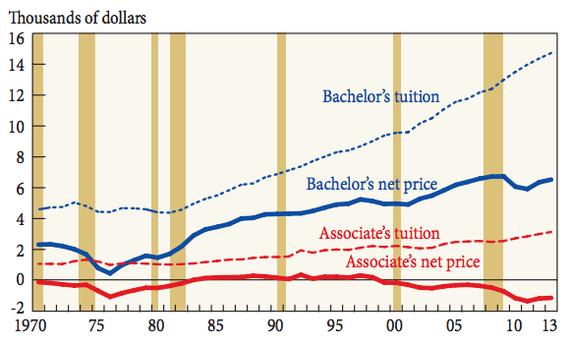
One of the confusing things about college is that it’s hard to keep straight its price, cost, and value. The sticker price of college  that is, the published tuition  isn’t paid by most middle-class students, who receive grants, tuition breaks, and tax benefits. The average net price of a bachelor’s degree is still 55 percent lower than the sticker price today. For many students, tax benefits eliminate the full cost of an associate’s degree. College is much cheaper than advertised.

7a2c3da3e

Meanwhile, Matt Phillips argues that “if you managed to rack up giant student debt loads, that’s likely because you’ve undertaken – and finished – the kind of extensive education that enables you to earn a good salary over time.” He adds:

The real student debt problem comes in the relatively modest amounts of borrowing done by low-income, first-generation college goers, who are four times more likely to leave school after the first year than students without those risk factors. Incidentally, this is also why increased funding of state schools is probably the answer. And, of course, most elites didn’t go to state schools. (Go SUNY Binghamton!)

Jordan Weissman concurs:

If you talk to people who study education policy for a living, they’ll tell you that the real victims of student debt aren’t English grads who took out a bit too much money to attend the University of Michigan or Oberlin. Those kinds of borrowers usually end up just fine.

However, there is a huge contingent of working-class and minority students – some of whom are among the first of their families to attend college – who are getting chewed up by student debt. These are young people, and increasingly older adults, who might not have gone to college 20 or 30 years ago, but do now because the economy is brutal for job-seekers without a degree. They borrow for school, often to pay the inflated tuition at an unscrupulous for-profit institution or little-known vocational school, then frequently drop out. Suddenly, they find themselves in debt, with no degree and no guidance on how to manage their loans.

Christopher Ingraham adds, sensibly:

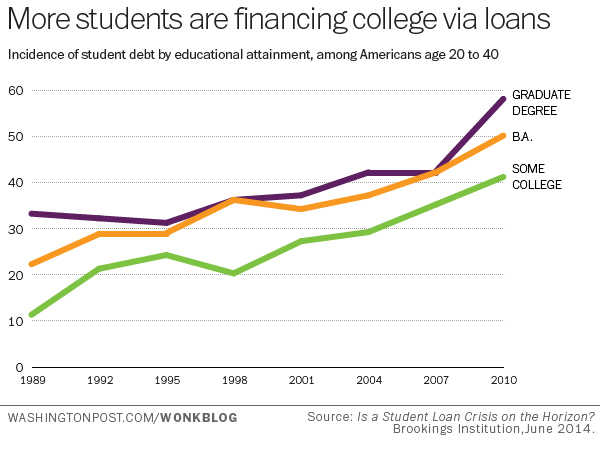
The big story in student debt over the past 20 years is not  and never should have been  the few people taking on huge debt burdens, but rather that the share of all students graduating with any student debt has risen sharply:

debt

In 1989, 22 percent of households headed by twenty-to-forty-somethings with a degree were saddled with student loan debt. That figure more than doubled by 2010, standing at 50 percent. It’s likely climbed even more since then. That number is probably an underestimate, too. … Another important consideration is that the data above only go back to 1989. If we could extend it further, to the 1960s and 1970s, when Boomers were graduating, we’d likely see even lower rates of student debt back then. This is the reason why it feels like student debt is everywhere these days compared to the ’60s and ’70s, it is everywhere.

Lastly, Mike Konczal notes that today’s student debtors spend 13.4 years paying off their loans, in contrast to the class of 1992’s 7.4 years.

Was Sectarian Strife Inevitable? Ctd

A reader grabs the question by the horns:

I am a longtime reader and feel the need to weigh in on this ongoing debate about sectarianism in Iraq. I wrote my dissertation (under the supervision of Juan Cole) about Iraqi anti-colonialism during the era of indirect British rule (1932-1958) and am currently working on a book that expands the project a bit to cover 1914-1963. As of this fall, I will be an assistant professor of history.

In my view, there is something really problematic about the way in which this debate about sectarianism in Iraq is evolving. On one side we have the argument that sectarianism is an inescapable element of a primordial culture, and that the current violence is the inevitable consequence of the (British) colonial myopia that forced Sunnis, Shi’a, and Kurds into an artificial nation-state. On the other side, we have the argument that sectarianism is a fundamentally modern phenomenon, the entirely avoidable outgrowth of an (American) imperial ignorance that insisted on viewing Iraq as a collection of distinct sects and proportioning power and influence along sectarian lines.

Both arguments ignore the basic realities of Iraqi history between 1920 and 2003.

The constructionists, as you have noted, often fail to take seriously the significance of sectarian violence in the aftermath of the Gulf War, either ignoring the brutal suppression of the Shi’a intifada or dismissing it is an act of political brutality that was statistically (but not ideologically) sectarian. The primordialists, though, are guilty of ignoring an earlier period of communal coexistence in the 1940s and 1950s. Fanar Haddad, Reidar Visser, Sinan Antoon and other constructionists are on very solid ground when they point to this period, which was absolutely not an historical mirage or a superficial alliance of collective interests, as the casual observer might assume. It is true that the Kurds were never entirely integrated into this burgeoning sense of Iraqi collectivity, but the Kurdish issue is not exactly what we have in mind when we talk about sectarianism in Iraq.

So what the hell really happened, then? If we can’t simply wave our hand and bemoan the original sins of British colonialism in setting this whole tragedy in motion OR point our finger at the neo-conservatives for making this avoidable bloodshed inevitable, how can we account for what is happening? Fanar Haddad might be a bit reductive in the Vox interview that you cited – though he does explicitly reference the Iranian Revolution and the rebellion of 1991 as part of a “cumulative process” of deepening sectarianism, but his book Sectarianism in Iraq gives far greater attention to the formation of sectarianism before and after 2003.

The language of today’s sectarianism is a gradual and logical outgrowth of the narrative of shu’ubiyya, a reference to Persian Muslims who supposedly worked to undermine Arab cultural and political unity in the ‘Abbasid period. This narrative was heavily utilized during Saddam during the Iran-Iraq War and during the suppression of the 1991 uprising, but its modern usage really dates back to the way that Arab nationalists talked about the Iraqi Communists during the Qasim years (1958-1963). Again, given the concentration of Shi’a in the Iraqi Communist Party, the casual observer might insist that this was surely just primordial sectarianism cast in different ideological terms, but I contend that the historical evidence weighs strongly against that conclusion. Some of the principle proponents of this anti-communist shu’ubiyya discourse were Shi’a, like the famous poet Badr Shakir al-Sayyab. The political violence that followed the 1958 Revolution tended to gradually undermine the secular basis of the dominant political parties and to replace these modern political identities with older loyalties rooted in ethnic and religious ties.

There is obviously a very complex historical argument that lies beneath this brief sketch, but it is really important to note that the tragedy of Iraq ought to be seen as part of the broader trajectory of secularism and socialism in decline. The fact that the decline of ideological and class loyalties in Iraq has given rose to bloody and violent sectarian strife does not necessarily indicate that sectarianism was lurking beneath the surface all along. The failures of British colonialism and Hashemite nation building, the violence of both communist and anti-communist partisans in the early 1960s, the unique depravity of Saddam Hussein, the incompetence and unforgivable ignorance of the American neo-conservatives, the foolish policies pursued by Nuri al-Maliki, the despicable role played by the Saudis, and the grotesque ideology of the Jihadis have all played their own important roles. It would be quite a pity, though, to ignore the historical significance of coexistence in mid-century Iraq and chalk this all up to the primordial hatreds of a backwards civilization.

I do really appreciate and respect you for engaging in this debate at a time when so many Americans simply want to shake their heads.