Aereo’s Air Ball

Jacob Kastrenakes recaps yesterday’s SCOTUS ruling against the streaming-TV service:

In a 6–3 ruling, the court found that Aereo’s service violates the Copyright Act by playing back recordings of broadcasters’ TV shows  even though it legally captures those shows over the air and obtains individual copies for each viewer. Aereo had argued that it was merely providing technology that its subscribers were renting in order to watch TV, positing that the viewers were responsible for playing back those recordings. …

The ruling is one of the most important seen by the television industry since the 1984 Betamax case but in many ways will have an opposite effect, stifling one area of innovation that was beginning to force the industry out of its comfort zone. “Insofar as there are differences, those differences concern not the nature of the service that Aereo provides so much as the technological manner in which it provides the service,” the ruling reads.

Brian Barrett is disappointed:

It’s a precedent that will make the future of streaming content both stunted and confusing. And that, beyond present and would-have-been future Aereo subscribers being pretty bummed out, is the biggest concern about today’s ruling. While the decision doesn’t prevent future technologies from developing, it does set a precedent that’s going to be very hard for future cord-cutting efforts to get around.

But Kyle Chayka sees little reason for innovators to be concerned:

Importantly, the ruling is not relevant for other cloud-based services, which may have been impacted by a judgment on Aereo’s business. The Department of Justice amicus brief advised that the Aereo decision “need not call into question the legitimacy of innovative technologies that allow consumers to use the Internet to store, hear, and view their own lawfully acquired copies of copyright works.”

David Post isn’t too concerned either:

The majority is at pains, in several places, to say that the case is just about broadcast television and the re-transmission of broadcast signals. Not about cloud storage, or streaming services, or gaming platforms, or anything else. Just broadcast TV, and what you may or may not do with over-the-air broadcast signals. Congress has made a choice about those signals; anyone who re-transmits them (like the cable companies do) has to pay royalties to the broadcasters. If that’s what it means … the decision has nothing to say about any other content-delivery or content-storage platforms that deal with the vast array of non-broadcast-TV content.

Timothy Lee, however, stresses the ambiguity in the ruling:

The problem is that the court never provides clear criteria for this “looks-like-cable-TV” rule. As Justice Scalia puts it in his dissent, “it will take years, perhaps decades, to determine which automated systems now in existence are governed by the traditional volitional-conduct test and which get the Aereo treatment. (And automated systems now in contemplation will have to take their chances.)”

In the process of ruling against Aereo, the Supreme Court has created a mess that will take lower courts years to clean up. Online services that are similar to Aereo in some respects and different in others are more likely to face lawsuits, and the lower courts will have to sort out which services are similar enough to Aereo to face copyright liability.

What’s next for Aereo? They’re “probably done”:

Aereo’s backers have said there’s “no plan B” for the company in the aftermath of today’s loss. The tens of millions of dollars the company raised so far have largely gone to pay legal costs, and the road forward for the company is probably either a fire-sale of the core technology or a quick pivot into some other, DVR-like function. Aereo’s CEO claims that “our work is not done,” but it’s tough to know what that means. Without the ability to skip out on retransmission fees, Aereo’s entire business model is gone.

Alyssa warns the TV industry against complacency:

Broadcasters should not take their victory at the Supreme Court as a sign that they will be able to operate the same way forever. Instead, broadcast and cable companies should take the Aereo ruling as a stay before Congress acts to explicitly legalize competitors such as Aereo. In the time they have been given, they should move as fast as possible to respond to the clear customer demands that Aereo exposed. …

What might the market have been like if Hulu had partnered with Roku to offer not just streaming subscriptions, but a set-top box, offering consumers a complete package as an alternative to a cable subscription? Similarly, it is remarkable that Apple and a cable company have not yet been able to come to terms to bake television subscriptions into Apple TVs. AmazonBasics, the electronics line from Amazon (the company’s chief executive, Jeff Bezos, owns The Washington Post), sells a range of relatively inexpensive television antennas, and the company El Gato makes a range of streaming television tuners that are not yet available in the United States.

Rather than leaving these innovations to others, cable companies and broadcasters should find ways to get on board and bring new products and services in-house.

Police State Watch

Alecia Phonesavanh’s baby son was severely injured by a flashbang grenade when a SWAT team raided their home to bust her husband’s nephew for a petty drug sale. She tells her terrifying story:

There’s still a hole in his chest that exposes his ribs.

At least that’s what I’ve been told; I’m afraid to look. My husband’s nephew, the one they were looking for, wasn’t there. He doesn’t even live in that house. After breaking down the door, throwing my husband to the ground, and screaming at my children, the officers – armed with M16s – filed through the house like they were playing war. They searched for drugs and never found any.

I heard my baby wailing and asked one of the officers to let me hold him. He screamed at me to sit down and shut up and blocked my view, so I couldn’t see my son. I could see a singed crib. And I could see a pool of blood. The officers yelled at me to calm down and told me my son was fine, that he’d just lost a tooth. It was only hours later when they finally let us drive to the hospital that we found out Bou Bou was in the intensive burn unit and that he’d been placed into a medically induced coma.

Sullum segues from Alecia’s ordeal to discuss a new ACLU report on the militarization of American police departments, which shows that SWAT team raids are becoming standard practice for drug searches:

Examining a sample of more than 800 SWAT deployments by 20 law enforcement agencies in 2011 and 2012, the ACLU found that 79 percent involved searches, typically for drugs. Research by Eastern Kentucky University criminologist Peter Kraska has yielded similar numbers. …

Police typically justify no-knock raids and heavy firepower by claiming the target is apt to be armed. That is what they said about Thonetheva, the Phonesavanhs’ nephew, who had no weapons when he was arrested at a different location on the day of the raid that sent Bou Bou to the hospital. (There also were no weapons in his parents’ house, where the Phonesavanhs were staying.) In the ACLU’s sample that sort of outcome was common: In at least one-third of cases where a weapon was believed to be present, none was found. Police records indicated recovery of a weapon in one out of three such cases. In the rest, the records did not address that point.

Balko remarks on the disturbing trend:

SWAT teams today are overwhelmingly used to investigate people who are still only suspected of committing nonviolent consensual crimes. And because these raids often involve forced entry into homes, often at night, they’re actually creating violence and confrontation where there was none before.

When SWAT teams are used in a way that’s consistent with their original purpose, they’re used carefully and cautiously. The ACLU report finds that, “In nearly every deployment involving a barricade, hostage, or active shooter, the SWAT report provided specific facts that gave the SWAT team reason to believe there was an armed and often dangerous suspect.” By contrast …

… incident reports for search warrant executions, especially in drug investigations, often contained no information about why the SWAT team was being sent in, other than to note that the warrant was “high risk,” or else provided otherwise unsubstantiated information such as “suspect is believed to be armed.”

The Clintons: Lucky In Their Enemies Again

If you were a Clintonista, carefully plotting your path back to power, could you hope to pick a more perfect foil than Todd “legitimate rape” Akin? And, yes, he’s baack! And with a doozy:

My comment about a woman’s body shutting the pregnancy down was directed to the impact of stress on fertilization. This is something fertility doctors debate and discuss. Doubt me? Google “stress and fertilization,” and you will find a library of research on the subject. The research is not conclusive, but there is considerable evidence that stress makes conception more difficult. And what could be more stressful than a rape?

Now all the Clintons need is a stupid impeachment effort … oh wait! Bachmann FTW!

Chart Of The Day

gayampercent

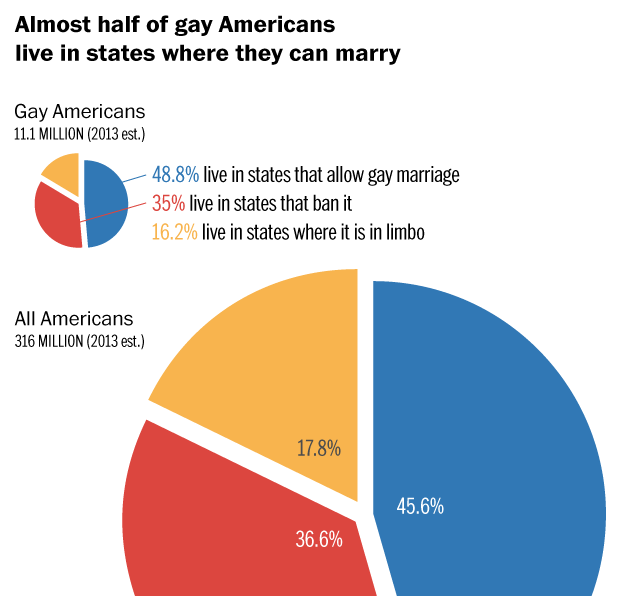
Philip Bump put it together:

Nearly half of the 11-plus million gay Americans (how we arrived at that figure is explained in more depth below) now live in states that allow gay marriage, and are more likely to live in such states than Americans on the whole. 48.8 percent of gay Americans live in states where they can legally marry, according to our estimates. The percentage of Americans in those states overall is at 45.6 percent. And, of course, a large portion of the country live in states where the legal status is in limbo.

Speaking of that limbo, Bazelon looks at yesterday’s court ruling out of Utah:

The 10th Circuit stayed its ruling to give the opponents of gay marriage a chance to appeal to the Supreme Court. Rick Hasen and plenty of other people think this means gay marriage is headed back to the justices as early as next term. So far, though, there’s no split over gay marriage in the lower courts since the DOMA ruling. Anyone want to subscribe to my (minority) theory that gay marriage could become the law of the land without another word from the high court? Gay marriage has so much righteous momentum behind it—maybe it doesn’t need another push from Kennedy. Though surely, with a record of 20–0 this year in the lower courts, he will be ready to give it.

I’m prepared to make that bet with Emily – although you never know. Ilya Somin sounds off:

For reasons I explained in this post, I am skeptical about the validity of the argument embraced by the Tenth Circuit majority. But I do believe they reached the right result, because laws restricting marriage to opposite-sex couples are an example of unconstitutional sex discrimination. This reasoning was endorsed by the district court opinion affirmed by the Tenth Circuit (though it also endorsed other constitutional arguments against laws restricting marriage to opposite-sex couples).

Be that as it may, [yesterday’s] decision is an important victory for advocates of same-sex marriage. But Judge Kelly’s dissent suggests that the legal battle over the issue is far from over. The question is likely to return to the Supreme Court, quite possibly sooner than many of us at first anticipated.

My reaction to the Utah ruling – and the more exciting one in Indiana – here.

About Those 300* Military Advisers

A small detail adds some context:

Two Iraqi advisers to Mr. Maliki said there would be more than 1,000 American private security guards coming to Iraq to protect the 300 military and intelligence advisers that will be here to help the Iraqi government fight ISIS, far more Americans than previously acknowledged. One adviser said the number of private guards would reach 1,700.

And the beat goes on.

When The Phone Goes Dead

Alice Robb takes note of a remote village in Papua New Guinea where locals call the deceased on their cellphones:

[The villagers] have long been confident in their ability to talk to the dead, believing they can communicate with the world of spirits in dreams, visions, and trances induced by special rituals. The introduction of mobile phones has opened up new possibilities: The Ambonwari believe they can use them to contact their dead relatives, whose numbers they obtain from healers. And once they reach them, they can ask for anything. “It is a general conviction,” write [anthropologists Borut] Telban and [Daniela] Vavrova, “that once people know the phone numbers of their deceased relatives they can ring and ask the spirits to put money in their bank accounts.”

I asked Telban if the villagers are discouraged that they never get through to the spirit world; he assured me that they’re not. They might assume the spirits aren’t available. And they ring random numbers so often that occasionally they do reach someone, whose voice they attribute to a spirit.

Meanwhile, in the US, hardly anyone seems to use their cellphones to call the living:

In fact, the use of voice calls – which has been dropping since 2007, the year Apple introduced the original iPhone – has fallen off a cliff lately. As of last year, cell providers in the U.S. are now making more money per user from data use than voice calling. (The U.S. is only the seventh nation to reach the data-voice tipping point — it happened in countries like Japan as early as 2011.) A recent survey of 7,000 U.S. high-school seniors found that only 34 percent made phone calls every day — far fewer than the number who texted or used apps like Snapchat, Facebook, and Instagram. And companies like AT&T and Verizon, which saw the data boom coming years ago, have been spending more and more on new, bigger LTE data networks, while essentially giving away their voice plans for free.

A Thad Unorthodox Strategy, Ctd

Screen Shot 2014-06-26 at 1.30.29 AM

Matt Lewis sums up “perhaps the biggest thing we can all learn” from Thad Cochran’s victory:

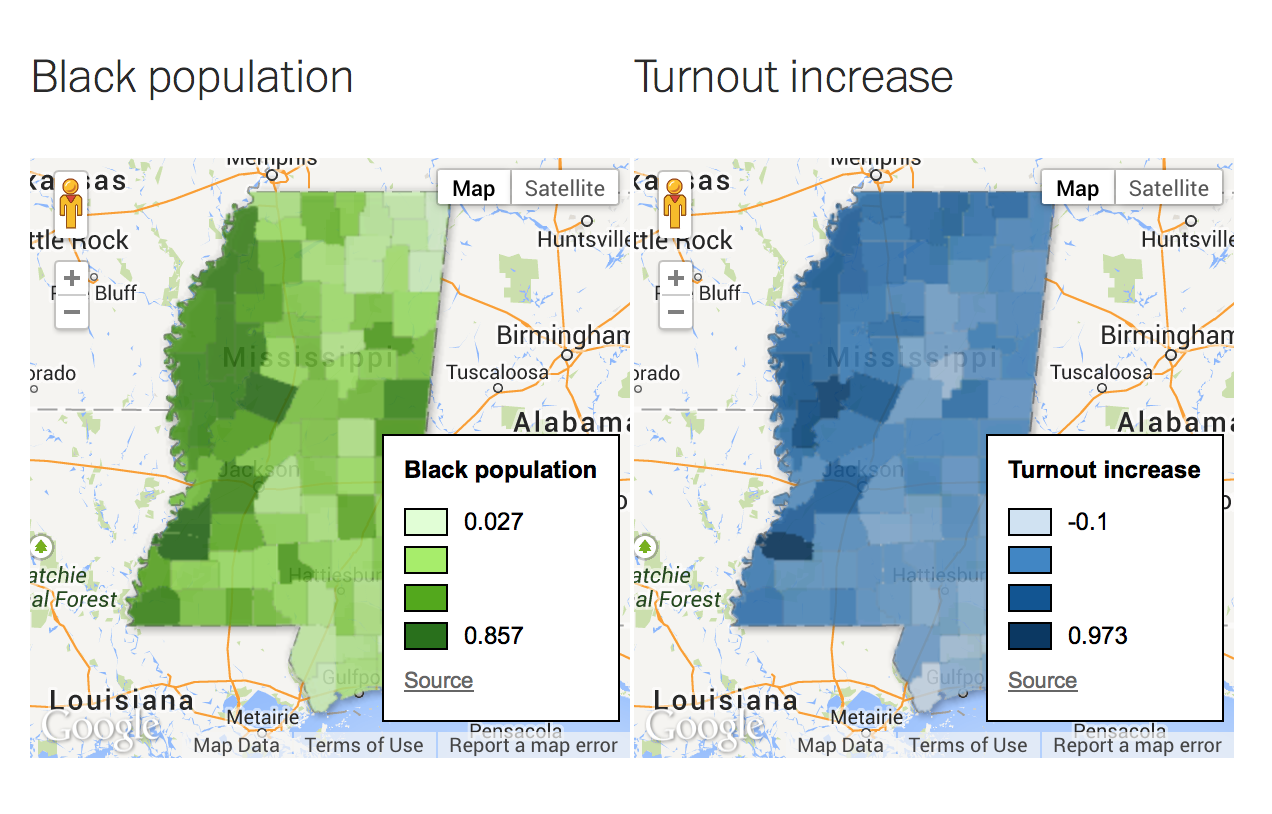
Adapt, and you will overcome. … Essentially, [GOP strategists] conceded that if the election were about who can be the most conservative, Cochran couldn’t beat McDaniel. So rather than playing a losing hand, they changed the game. Cochran appealed to African Americans and other Democratic base voters — who can vote in GOP races in Mississippi’s open primary system, and who would prefer to be represented by the relatively pro-government Cochran than by the anti-government McDaniel. Basically, Cochran’s plan B was to woo Democrats. And it worked. (I realize this was a unique case, but what if Republicans always hustled this hard to win over African American voters…)

Serwer addresses the backlash from the base:

Conservatives may cry foul over McDaniel’s loss, whether or not it’s proven that Democrats made the difference. But there’s nothing wrong with crossing over to vote for the lesser of two evils in a primary in a place like Mississippi, where the result of the Republican primary for statewide office usually determines the outcome of the general election. It’s not even unique to Mississippi or this election – those of us who live in Washington, D.C. are quite familiar with the concept. The Democratic Primary almost always determines who will win the general election of citywide office in D.C., people who would be Republicans anywhere else register as Democrats so as to have a voice in the process. McDaniel himself voted Democratic a decade ago.

Alec MacGillis adds, “It is hard to overstate the significance and historical ironies of black Mississippians crossing party lines to rescue a senior member of the state’s Republican establishment.” Amy Davidson challenges McDaniel for crying “irregularities” in the face of those ironies:

What does he consider “regular” at a polling place in Mississippi? Whom would he like to see there?

Perhaps it might have occurred to him to appeal to black voters, who do make up more than a third of the state. Strategic voting, of the winking kind, is when you vote for the other party’s weaker or more marginal candidate, hoping that it will help your side further along. If Mississippi’s black voters were really the pawns of national machine-politics operatives, they might have been directed to get McDaniel in. His nomination would maybe give the Democratic candidate a chance that he wouldn’t usually have in Mississippi, or maybe McDaniel would have just embarrassed the G.O.P. nationally, as he had shown every indication he might do. (In addition to the break-ins, there was “Mamacita”-gate.)

But, in the past few weeks, Cochran, a deep conservative himself, made a real, targeted pitch to black Mississippians that, given the choice, he would be a better senator, and enough black voters and community leaders bought it. That’s how elections work, though not how they worked for generations in Mississippi, where people were killed in living memory just for the right to register to vote.

Jaime Fuller also responds to McDaniel contesting the results:

There is one section of Mississippi election law that the McDaniel team seems to think could work to their advantage. That section reads: “No person shall be eligible to participate in any primary election unless he intends to support the nominations made in which he participates.” In other words, if the Democratic voters who helped Cochran win plan to vote for his opponent, former Rep. Travis Childers, in the fall, that would, theoretically, be against Mississippi law.

“I wouldn’t be too optimistic if I were [McDaniel]” says John M. Bruce, head of the University of Mississippi political science department. “This issue has already been adjudicated.” A 2008 decision by the 5th Circuit Court of Appeals said that in order for a ballot to be thrown out, poll workers would need to ascertain that the voters already were planning on supporting a different candidate a few months down the road. As Bruce says, “that’s not enforceable”. Bruce — who has lived in Mississippi for over 20 years, says that he can’t remember anyone ever discussing this section of the state’s election law at such length. The 2008 case was mostly unnoticed. “No one even thought about this law,” he noted.

Sabato et al. look beyond those sour grapes:

The national Republican Party is the big winner. … Nowhere was the jubilation greater, once Cochran had won, than in the D.C. halls of GOP power. Now they don’t have to spend a dime this fall in Mississippi, and they don’t have to waste a breath defending McDaniel elsewhere.

Zeke Miller questions the conventional wisdom of the runoff coverage:

Conservative political consultant Keith Appell cautioned against interpreting Tuesday’s results as a knockout punch against the Tea Party, blaming McDaniel’s failure to win the required 50% of the vote in the initial primary on a blogger who incited outrage—and sympathy for the incumbent—by strangely filming inside the nursing home housing Cochran’s ailing wife. “Interpreting this as some kind of ‘Empire Strikes Back’ moment is an overreach,” Appell told TIME. … Conservatives and Tea Party activists have to take the long view, the big picture is that they’re really winning,” Appell added.

(Map by Philip Bump)

What’s This “Ex-Im Bank” People Are Talking About?

Yglesias voxsplains:

There is an influential current of thought in right-of-center America flying under the banner of libertarian populism, which holds that a free market agenda can be framed as a fight for the interests of the little guy. The Export-Import Bank is a great example of the kind of thing a libertarian populist might oppose. That’s because the bank is a pretty textbook example of the government stepping in to arbitrarily help certain business owners.

The way it works is that the Ex-Im Bank guarantees loans extended by private financial firms to foreign companies that want to buy certain US-made products. The main beneficiaries of this scheme are a handful of large American manufacturing companies — Boeing, GE, and Caterpillar prominent among them — who are in effect receiving a subsidy. Secondary beneficiaries include the private financial firms whose loans are guaranteed and the foreign customers who get access to discount loans via the Ex-Im Bank.

If you want an example of big government stepping in to help out some favored businesses, you’re not going to find a much better example.

Alex Rogers adds:

The bank [is] supported by the White House, the Democratic-controlled Senate, the business community and at least 41 House Republicans… . Its supporters credit it with supporting about 205,000 American jobs, while opponents say it could easily be replaced by the private sector. Congress must renew the Ex-Im bank’s charter by Sept. 30 or it will be unable to back new loans.

How Rebecca Robins distills the dilemma for both parties:

The Ex-Im Bank debate has splintered the Republican Party between those concerned about corporate welfare and those committed to upholding traditional allegiances to big business. Meanwhile, Democrats have found themselves allied with large corporations in the fight to keep the Ex-Im Bank alive.

Danny Vinik wants it dead:

Already liberals are unsure about whether to support the bank or not. In the New York Times, Joe Nocera professed his support for the bank. But Jared Bernstein, the former chief economist for Vice President Joe Biden, was less sure. At his blog, he noted the benefits of the bank, but also explained that “the Brat’s of the world [sic] have a point in that for politicians to pretend otherwise, invoking red-meat slogans like ‘free trade,’ ‘the government doesn’t create jobs,’ ‘the government doesn’t pick winners,’ and then support institutions like the XMB is nonsensical.” Ultimately, the Ex-Im bank does pick winners and losers.

That’s where the investigations reported by the Wall Street Journal become so damaging: If they prove true, then officials are choosing winners and losers based on kickbacks. And that should make the decision easy for liberals: Join with conservatives and oppose the reauthorization of the Export-Import bank.

Drum disagrees:

Killing Ex-Im is basically a conservative hobbyhorse, but plenty of lefties have weighed in too. Dean Baker points out that an interest rate subsidy is basically the same as a tariff, so if you’re in favor of free trade you should be opposed to Ex-Im. Paul Krugman admits that Ex-Im is mercantilist and therefore a bad idea—except when the economy is weak and monetary policy is up against the zero lower bound. Which it is, so Ex-Im acts as an economic stimulus, more or less, and we should probably keep it around for now.

Edward Alden is aligned with Drum:

The Export-Import Bank’s role is a small one, helping less than two percent of all U.S. exports. For a certain class of exports to developing countries–mostly aircraft and large infrastructure projects such as mining, telecommunications and oil and gas development–the bank offers various kinds of loans, insurance and loan guarantees to ensure that U.S. companies get paid. These are transactions that private sector banks are reluctant to finance completely because of the risks involved. Yet the Export-Import Bank, because it is backed by the full credit of the U.S. government, is able to do so. And its track record is impeccable–in the past five years it has actually earned $2 billion for the U.S. Treasury.

If the bank is shuttered, it’s not like those projects will disappear. Instead the contracts will go to European or Canadian or Chinese companies that are getting the same sort of export credit support from their governments (indeed, often more generous) that the Export-Import Bank currently offers. If American companies want to compete they will likely move production to other countries to become eligible for that financial support. Jobs will move with them.

Map Of The Day

Screen_Shot_2014-06-23_at_5.07.38_PM2

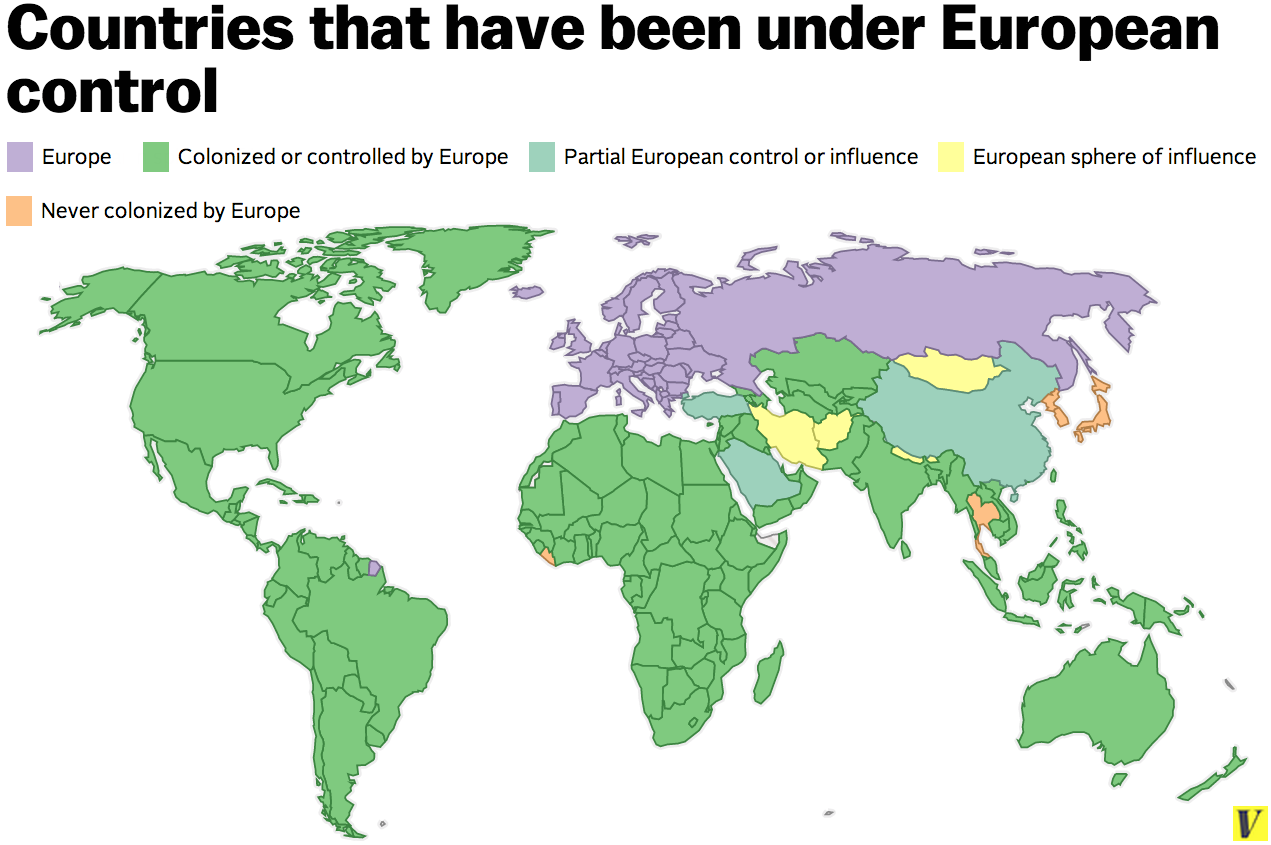
Max Fisher captions:

There are only four countries that escaped European colonialism completely. Japan and Korea successfully staved off European domination, in part due to their strength and diplomacy, their isolationist policies, and perhaps their distance. Thailand was spared when the British and French Empires decided to let it remained independent as a buffer between British-controlled Burma and French Indochina. Japan, however, colonized both Korea and Thailand itself during its early-20th-century imperial period.

Then there is Liberia, which European powers spared because the United States backed the Liberian state, which was established in the early 1800s by freed American slaves who had decided to move to Africa. The Liberian project was fraught — the Americans who moved there ruled as a privileged minority, and the US and European powers shipped former slaves there rather than actually account for their enslavement — but it escaped European domination.