The Whoring Just Keeps Getting Worse

If you think I’m a crank on the surge of sponsored content replacing journalism, take a look at one big media company’s bet on the future:

The new [Yahoo] publications combine original articles and material licensed from other sites, as well as big photos and videos into an endless page of tiles aimed at enticing people to linger. Mixed into that stream is a different kind of advertising — so-called native ads or sponsored posts — which look almost exactly like all the other articles and videos on the page except that they are sponsored by brands like Knorr, Best Buy and Ford Motor. These ads, Yahoo hopes, will attract the attention of more readers and make more money for the company. In some cases, Yahoo editors even help to write that advertising — a blurring of the traditional lines between journalists and the moneymaking side of the business.

If Yahoo wanted to become an advertising or public relations company, I’d have no problem with that. But what they’re doing is deliberately deceiving readers on what is advertising and what is journalism, and using journalism as a cover for a lucrative public relations business. Here’s the industry consensus in a quote from the editor of Yahoo Food:

I think our involvement elevates the advertising. Our ability to bring editorial knowledge and finesse to advertising content makes it better and gives it a point of view.

And in so doing makes it more and more indistinguishable from editorial. That’s also the paradox of one of the recent native ads that got a lot of positive press:

the native ad at the New York Times on female incarceration by Netflix’s “Orange Is the New Black”. Check it out here. It’s gorgeously produced, vividly presented  – in ways more innovative and arresting in design than the NYT’s own editorial product! Yes, unlike Yahoo or Buzzfeed and the other whoring sites, there are markers that this is not produced by the editors of the paper. But then it gets a bit confusing because it was created by the NYT – by a

newly formed Brand Studio unit, which was built to create native ads for advertisers. The article was written by Melanie Deziel, an editor at the studio who worked in the past at The Huffington Post and BuzzFeed. The illustrations are by Otto Steininger, whose work has appeared on the cover of The New Yorker.

So you have a journalist writing ad copy and a New Yorker artist creating visuals for an article that is created by the NYT, but is actually an advertisement. The cumulative effect, if the ads keep improving in quality, have more journalistic input and better graphics, is to make fake journalism less and less distinguishable from, you know, real journalism – journalism informed by an independent writer’s views, rather than paid for by a client.

This decision to merge advertising and editorial was driven by one thing and one thing only: money. As ad rates have dropped, websites have gone back to their sponsors to ask them how high they should jump to get some more love:

Last year, Ms. Mayer met repeatedly with Unilever executives and asked how Yahoo could improve. When she shared her thinking about sponsored content for some new digital lifestyle magazines, Mr. Master said, “We put our hand up and said, ‘We will do that.’ ” Unilever has since expanded its commitment to advertising on Tumblr and Yahoo sites.

Use your magazine to inject corporate propaganda into what appears to be independent journalism and “we will do that.” Quite why any self-respecting editor of journalist would do that is another matter. But self-respect went out a long time ago in this business, didn’t it?

Map Of The Day

articseaice

NatGeo is making a major change to its next atlas:

National Geographic’s mapmakers drew their new rendition based on how the Arctic looked in 2012, using sea ice data collected by NASA and NSIDC. While the amount of Arctic ice grows and shrinks throughout the year depending on the season, the Atlas depicts multiyear ice — ice that’s older than an year – in solid white, and the winter’s sea ice maximum is noted with a line drawn around it.

Should Dinner Reservations Be For Sale? Ctd

A reader sides with Tyler Cowen on the question:

Once again, Chicago leads the way while New York sleeps – especially in the restaurant world. Consider Next Restaurant in the city’s Fulton Market District, run by famed chef Grant Achatz. You can only get a table by buying a ticket or by buying a subscription to the three different menus that the restaurant offers throughout the year.  I don’t know how many people are on the waiting list now, but when the restaurant opened in 2011, some 20,000 people signed up for the privilege of making a reservation. The restaurant (and its adjacent lounge, The Aviary) are hot, hot tickets, and prices can run nearly $500 a plate. This is not a reservation you miss.

Another is less enthusiastic:

I’m not sure how charging for reservations would fix the problem of customers showing up late and complaining about not being seated. My guess is that someone who has paid for a table is going to be even more pissed if he or she is not seated immediately, regardless of the time of the original reservation. (And is it really that hard for the person taking reservations to simply state that any party arriving more than five minutes late will lose the table, no exceptions?)

Anyway, here’s a compromise:

If I pay for a reservation and arrive late, I’m shit out of luck. But if I’m on time and the table isn’t ready (say, within five minutes), then the restaurant deducts the reservation fee from my bill. I’m sure guests arrive late all the time, but I’d also bet I’m not the only one who’s had a reservation at an expensive restaurant only to be told, “It’ll just be another five minutes” a dozen times before finally being seated.

Update from a reader:

“But if I’m on time and the table isn’t ready (say, within five minutes), then the restaurant deducts the reservation fee from my bill.” There is a corollary to this: If you linger too long after getting your check (say, five minutes), then the restaurant charges you enough extra for it to pay the reservation fee of the people you are keeping waiting.

Another interesting idea from a reader:

In my humble opinion, the best solution is the simplest and fairest one for those restaurants that want to charge for reservations and patrons somewhat wary of doing so. Have the reservation fee be a deposit that’s applied towards the cost of the bill. If the patrons no-show, that deposit is gone.

How To Get Away With Murder

6141545235_722f89fbde_z

Use a car:

According to a recent report by the League of American Bicyclists, barely one in five drivers who end bicyclists’ lives are charged with a crime. The low prosecution rate isn’t a secret and has inspired many to wonder whether plowing into a cyclist with a car is a low-risk way to commit homicide. …

Data on the official number of prosecutions in fatal bicycle collisions is sparse, and following up on prosecution is the least-covered point. A May 2014 report from the League of American Bicyclists reads, “We don’t know much about the consequences of most crashes that result in bicyclist fatality.” Based on incomplete data, the report estimates, “Nationally, 45 percent of fatal cyclist crashes had some indication of a potential enforcement action; 21 percent had evidence of a likely charge; [and] 12 percent resulted in a sentence.” Put another way, killing a cyclist with a car was effectively legal in more than seven of every eight cases.

Update from a reader:

I agree with the absurd situation regarding the law and driver vs biker. Sure, there are laws on the books in many places that supposedly protects bikers, such as the one here in Alabama (as well as many places else) that stipulates cars had to clear a certain distance from bikes while passing them on the road. Enforcing them, however, are a whole different matter.

My little brother was side swiped by a car a few years ago.

Luckily, he had just minor concussion from the accident. However, the driver was not charged with any wrong doing with regards to the incident, even though she was clearly at fault. Worse, she sued my family for supposed damage to her car, and we lost because we didn’t hire a lawyer. We were hit with a 1000 dollar judgment.

We ended up hiring a lawyer for a total of $750 (including court costs and subpoena costs), and had the case thrown out on a technicality on appeal (we mounted a pretty convincing appeal and everything, but in the end, the new judge still didn’t find our counterclaim sufficient).

In short, not only the laws, but also the enforcers and the judges, are pretty much against the bikers in most instances. We’re at a point where bikers getting mauled down by cars most likely won’t get any justice, in a criminal case, but might actually be found liable for damages in a civil case.

(Photo of Alvaro Olsen’s ghost bike by Scott Beale / Laughing Squid)

An Orthodontic Hat Trick

Tunku Varadarajan tackles yesterday’s big World Cup story:

During a goal-front tussle for the ball with [Italian defender] Giorgio Chiellini – a man as unappetizing as you could hope to find on a football field – [Uruguayan striker Luis] Suárez dipped his face onto his opponent’s shoulder and put his prodigious teeth to work. In scenes that were straight out of a comic opera, Chiellini, incensed, ran about wildly, his shirt pulled off his left shoulder, showing the world his bite-marks, the Suárez imprint on his body.

The ref somehow managed to miss the chomp, and Uruguay beat Italy 1 – 0. Varadarajan now expects “all hell to break loose”:

This is the third time the Uruguayan has bitten an opponent during a football match, and FIFA, the game’s governors, will have no choice but to ban him from the rest of this tournament. He cannot be allowed to play again in the Cup. Were it not for laws that immunize players from prosecution for their on-field actions, Suarez could well be facing charges for assault.

Mark Gilbert agrees:

Zinedine Zidane was banned for three games and fined about $6,000 after butting Italian defender Marco Materazzi in the chest in the 2006 World Cup final. Materazzi was also sanctioned after admitting he’d provoked the French captain. Suárez’s biting is much worse and he’s already a repeat offender. He clearly needs a time out, both from the current tournament and from football in general.

Meanwhile, John Cassidy half-seriously mulls over the “diplomatic implications” of the bite:

If FIFA, soccer’s organizing body, doesn’t suspend Suárez for the rest of the tournament and vacate the game, who knows what the Italian government might do: withdraw its Ambassador from Montevideo, say, or suspend its exports of pasta and olive oil. The U.N. might end up getting involved, and possibly even the Vatican. As a soccer fan who grew up in Buenos Aires and is now surrounded by Italians, Pope Francis has a vested interest in making sure that Suárez isn’t allowed to progress to the knockout stages, where Uruguay could well end up playing Argentina.

Adding a bit of context, Brian Merchant notes that “human-on-human biting isn’t actually all that uncommon”:

2007 National Institutes of Health study found that human bites were the third most-treated kind of mammal bites in the emergency room, behind dog and cat bites, accounting for anywhere between 5-20 percent of bite cases. That’s a not-insignificant number of human bites.

The study exclusively examined “occlusive bites” – the intentional teeth-on-skin aggression a la Suarez and Tyson – versus “fight bites,” which occur when a fist or arm gets punctured when it slams into someone else’s mouth. Men are 12 times as likely to sustain biting injuries, and in nearly 90 percent of the cases – surprise – alcohol was involved, the study found. You’re getting the picture. Men, drunk or jacked up on adrenaline, in a pub or an arena, are prone to turning into sweaty, tweaked-out vampires.

Why Didn’t They #BringBackOurGirls?

bringbackourgirlstrend

Because, writes Max Fisher, “neither Boko Haram nor its kidnapping exist in a vacuum”:

There is the deep and growing economic and political marginalization of northern Nigerians, who happen to be mostly Muslim. There is the ever-worsening Nigerian government’s corruption and incompetence, which has included a military response to Boko Haram so heavy-handed and fumbled that it has killed and alienated a number of Nigerians who might otherwise be allies against the terrorist group. There are multiple, overlapping cycles of violence and distrust and resentment.

Then there was this:

Nigerian security forces, in their campaign against Boko Haram, have actually been detaining (some might say kidnapping) the family members of Boko Haram fighters since 2011. The family members, often women or girls, are not accused of crimes, but held for what appears to be simple leverage (some might say ransom). Of course this does not excuse Boko Haram for adopting the same tactic, but it helps shed some light on why the group might see this as a valid way to fight the government it so hates.

More than 200 of the girls remain missing, and while the Nigerian government has concluded an investigation into the incident, they won’t release its findings to the public. Meanwhile, Hayes Brown passes along the news of what looks like another mass kidnapping of women and children:

Militants reportedly attacked the village of Kummabza, located in Nigeria’s northeast Borno State, over the weekend, abducting more than 60 women and girls, as well as 30 boys. Local police have yet to confirm that the kidnappings took place and journalists have yet to independently verify the story on the ground. “Sources from the villages where the victims were taken, however, insisted that the victims included young girls and babies,” Nigeria’sPremium Times reported. Though no group has taken credit for the attack, fingers are being pointed at Boko Haram, the group who launched the kidnapping in neighboring Chibok in April.

As was the case in April, the lack of clarity on the ground and independent verification is leading to confusion over just who went missing and when.

George Will Loses The Plot, Ctd

Will recently defended his controversial column on sexual assault (covered here on the Dish):

Allahpundit has the play-by-play:

When asked to respond to one critic who accused Will of trivializing the crime of sexual assault, the conservative columnist said he takes sexual assault more seriously than his critics do. “When someone’s accused of rape, it should be reported to the criminal justice system that knows how to deal with this, not with jerrybuilt, improvised campus processes,” he asserted. Will went on to dismiss those for whom he said “indignation is default position.” He added that the outrage over his column will, like “summer storms,” dissipate as rapidly as it arose. In conclusion, the columnist said that he would not take one word of his column back if he had the chance.

Ramesh sticks up for Will:

It takes an extreme lack of charity to read Will as saying what the Post-Dispatch claimed. What he was actually saying is that rape is being defined too broadly on college campuses. He wasn’t criticizing “victims of sexual assault” but rather saying (for example) that women who had consensual sexual encounters they later regretted shouldn’t be counted in their number. There’s a legitimate debate about this question. Op-ed pages should air it, not suppress it — and I’d like to think that I would say so even if I didn’t agree with Will.

Friedersdorf is on the same page:

Will is not talking to rape victims and saying, “Boy, are you guys lucky.” Will’s argument is that perceived victimhood of all sorts confers a coveted status on college campuses. In context, it is clear that Will only finds this unseemly in cases where the status afforded to victims winds up generating fake victims.

Meanwhile, on a related note, Cathy Young is critical of California’s college sexual assault bill:

The bill, sponsored by state Senator Kevin De Leon (D-Los Angeles) and developed in collaboration with student activists, does nothing less than attempt to mandate the proper way to engage in sexual intimacy, at least if you’re on a college campus. It requires schools that receive any state funds through student aid to use “affirmative consent” as the standard in evaluating sexual assault complaints in the campus disciplinary system. …

In a Slate.com article defending “affirmative consent,” feminist writer Amanda Hess stipulates that such laws should be “broad enough to include nonverbal cues.” But that would leave fact-finders, in real courts or campus pseudo-courts, to try to decide such questions as: Was a head motion a nod that indicated a “yes”? Does pulling someone closer during an embrace amount to consent to sex? Does a passionate response to a kiss amount to a “nonverbal cue”?

David Bernstein snarks:

Two obvious questions arise: (1) Why just on campus? If this is a good idea, why not make it part the tort system? If that’s too drastic, let’s start, with say, members of the California legislature. For internal disciplinary purposes, their sexual activity should be governed by the same standard they want to impose on students. What plausible grounds could they have for rejecting application of a standard they would impose on students to themselves? (2) If we’re limiting things to campus, why just students? Why should students be judged under this standard, but not faculty and administrators? It’s hardly unheard of for professors, administrators, and even law school deans to engage in sexual relationships of dubious morality.

The answer is that it’s not a good idea, and it’s a product of the current moral panic over the hookup culture.

But Alyssa isn’t having it:

It is one thing to suggest that proponents of a particular social reform have overstepped by seeking out a legislative remedy. It is quite another to suggest, in rather nasty terms, that because the tactics are inappropriate the cause is ridiculous, or to misattribute the push in question to “the current moral panic over the hookup culture.”

Nobody seems particularly happy with the current sexual climate on college campuses, whether their priority is the sexual assault rate or the state of university disciplinary procedures. And it seems to me that people of all political persuasions could see many of their concerns addressed in a discussion about consent that focuses less on law and regulations and more on manners and customs.

If you are worried (statistics to the contrary) that men will be falsely accused of sexual assault, what possible harm can come to them from talking about how to communicate effectively with their partners, both to obtain their consent and to ensure everyone’s pleasure? If you are worried about the decisions that girls make, why not frame the discussion in terms of helping them assess their own comfort levels and asserting them confidently and clearly?

Michelle Dean also shakes her head:

Bernstein isn’t speaking from careful study or thinking. He’s speaking from his “understanding,” as when he offers his own I’m-from-Mars view on how consent in sex really works:

The vast, vast majority of “sexual contact or behavior” is initiated with only *implicit consent.* [UPDATE: There is one type of sexual relationship that, as I understand it, involves primarily explicit consent—the relationship between a prostitute and her (or his) clients, with exact sexual services to be provided determined by explicit agreement in advance.]

Oh dear. It’s hard to pick the most wrong-headed part, though the “UPDATE” might take the prize. I am not sure the “vast majority” of sexual consent is implicit in the way he suggests here at all. I do not think we are looking at any real danger of people being marched off to death camps for kissing each other. I am absolutely certain that sex workers are not the only people who prefer that consent be clear, open and well-stated between the parties.

Bernstein, meanwhile, is partaking in the privilege of victimhood with a post about the “smear machine” that is now targeting him thanks to Dean’s article.

Did McCain Unwittingly Help Fund ISIS?

Steve Clemons nails the compulsive interventionist for his enthusiastic support of various Sunni powers backing the insurgency against Assad in Syria:

“Thank God for the Saudis and Prince Bandar,” John McCain told CNN’s Candy Crowley in January 2014. “Thank God for the Saudis and Prince Bandar, and for our Qatari friends,” the senator said once again a month later, at the Munich Security Conference. McCain was praising Prince Bandar bin Sultan, then the head of Saudi Arabia’s intelligence services and a former ambassador to the United States, for supporting forces fighting Bashar al-Assad’s regime in Syria. McCain and Senator Lindsey Graham had previously met with Bandar to encourage the Saudis to arm Syrian rebel forces.

And where did that support end up? Clemons fingers former Saudi intelligence chief Prince Bandar bin Sultan for funding ISIS, which he suspects was the reason Bandar resigned that post in February:

As one senior Qatari official stated, “ISIS has been a Saudi project.” ISIS, in fact, may have been a major part of Bandar’s covert-ops strategy in Syria. The Saudi government, for its part, has denied allegations, including claims made by Iraqi Prime Minister Nouri al-Maliki, that it has directly supported ISIS. But there are also signs that the kingdom recently shifted its assistance—whether direct or indirect—away from extremist factions in Syria and toward more moderate opposition groups. …

Like elements of the mujahideen, which benefited from U.S. financial and military support during the Soviet war in Afghanistan and then later turned on the West in the form of al-Qaeda, ISIS achieved scale and consequence through Saudi support, only to now pose a grave threat to the kingdom and the region.

Drum believes the moral of this story holds regardless of whether Clemons’ suspicions are correct:

Clemons’ piece is vaguely sourced, and Saudi Arabia has strongly denied accusations that it has supported ISIS. Nonetheless, it’s a fairly commonly held view, and it certainly demonstrates the dangers of trying to pick sides in Middle East conflicts. The US may have been doing its best to support the FSA, but that doesn’t mean our allies are doing the same. Unfortunately, there are inherent limits to just how precisely you can pinpoint aid in conflicts like this, and that means the possibility of blowback is never far away. That sure seems to have been the case here.

If the Saudis are backing ISIS, which he is quite sure they are, Peter Lee spitballs about what their endgame might be:

Anbar sheiks and local Ba’athists have, I would expect, a pretty clear-eyed understanding that ISIS will treat them well only as long as it is in ISIS’ interests to do so.  Al Qaeda in Iraq, after all, became an onerous and resented burden in Anbar, which the sheiks were able to shed through the “Anbar Awakening” i.e. death squads a go go a.k.a a JSOC/Sons of Iraq joint operation.

So I speculate that the cooperation of local non-jihadist anti-Maliki Sunnis with ISIS is predicated on the understanding that Saudi Arabia is condoning and endorsing the ISIS campaign, with the idea that once a “government of national unity” i.e. government with a Sunni veto is installed in Baghdad, or the whole country just fragments into de facto and increasingly de jure Sunni, Shi’a, and Kurdish zones, the Gulf states will step up in financial and security matters to avoid ISIS completely filling the resultant political and economic vacuum.

And in some ways, it seems to me, the only people who can truly defeat ISIS are Sunni Iraqis, just as they were the only ones, with help from JSOC, who could have defeated al Qaeda in Iraq, after the US invited them in. If we leave well alone, these various forces could fight to a new and more stable equilibrium – after intensifying the conflict even more.

A Thad Unorthodox Strategy: Reax

Cillizza sizes up the significance of Cochran’s narrow win over his Tea Party challenger:

He bet on incumbency. … Look at Cochran’s message on TV in the closing days of the race. It’s a Republican message circa 2004: I have tons of seniority in the Senate and that means good things for the state. Vote me out and you can kiss all of that goodbye. (Hell, he brought Arizona Sen. John McCain in to campaign for him in the final days of the contest!)  There is absolutely no evidence — before this victory — that a longtime incumbent running on being, well, a longtime incumbent could win in the modern day Republican party.  And especially not in a runoff!

Aaron Blake adds:

[I]t’s rare for an incumbent to improve his or her performance in a runoff, as Cochran did. And more often than not, the challenger surges in a big way. Of the last seven incumbents facing primary runoffs in big-ticket races, all but two have fared significantly worse in the runoff, ceding around 75 percent (or more) of the “up for grabs” votes to the challenger.

Like me, Josh Marshall is struck by the sectarianism within the GOP underscored by McDaniel’s loss:

[I]t seems clear that Democrats played some role, quite possibly a very important role in Cochran’s victory. And the fact that almost by definition a lot of them were black Democrats, courted by the Cochran camp, is going to put gas and kerosene and everything flammable on the bonfire of intra-party recrimination. This will not go down easily.

Or as one very prominent Tea Party activist put it:

Ben Jacobs has background on that “teaming up”:

As Cochran appealed to Democrats, particularly African Americans in the racially polarized state, McDaniel’s campaign cried foul and talked about using election monitors to discourage Democrats from voting. At issue was a Mississippi law that mandated that any voters in a party primary would have to commit to supporting that party’s nominee in November. However, the law was nigh on unenforceable and would have also presented challenges for McDaniel himself who had refused to commit to support Cochran if he lost his primary.

And now McDaniel will challenge the election results, likely along the lines of that Mississippi law. Tim Murphy has more on the runoff’s racial character:

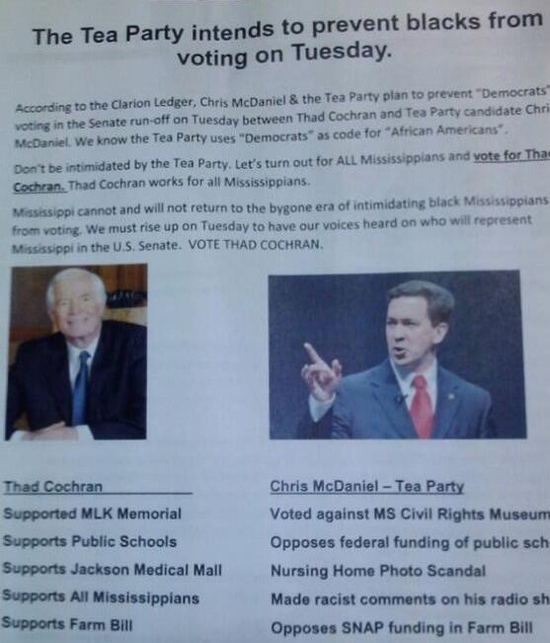
Team McDaniel’s [poll-watcher] tactics seemed to bolster Cochran’s outreach strategy. “The tea party intends to prevent blacks from voting on Tuesday,” read one mailer distributed in pic_cornerblack neighborhoods. It noted that McDaniel had once hosted a controversial radio show and had voted against a civil rights museum. “Mississippians cannot and will not be intimidated to the bygone era of intimidating black Mississippians from voting,” this campaign flyer declared. The mailer asserted that McDaniel “made racist comments on his radio show.” It was a point Cochran’s campaign had been hammering for months, seemingly without affecting a sufficient number of white Republican primary voters. As a right-wing radio host in the 2000s, McDaniel had blamed hip-hop for gun violence. He had mocked poor blacks for craving “big screen plasma TV’s, Randy Moss jerseys, Air Jordan sneakers or any type of ‘bling-bling.’” He had decried discussion of reparations for slavery—pledging to move to Mexico, if such a law were ever passed. He also had spoken at events held by a neo-Confederate group that bashed Abraham Lincoln and celebrated secession.

His incendiary comments, some of which were first reported by Mother Jones, gave Cochran a bona fide reason to ask African-American voters, who comprise 36 percent of the state’s electorate, to keep McDaniel far from Washington’s halls of power.

A few other Tea Party candidates lost last night, but Weigel warns against over-interpreting the results:

Having narrowly bailed out Thad Cochran and avoided disasters in Colorado and New York, “the establishment” is thumming on war drums and predicting victory everywhere. It’s certainly possible! But a narrow defeat of Tom Tancredo doesn’t auger anything spectacular; a narrow Mississippi victory that dependent on mobilizing the hates of the Tea Party and lovers of SNAP is not necessarily applicable to turnout models in the swing races.

And how much was really at stake for the GOP? In Oklahoma, the winner of the Senate primary was always assured to become a senator (Democrats are heading for a runoff between a state senator and a crazy perennial candidate), but the rise of an ambitious thirtysomething black conservative has been halted. In Mississippi, McDaniel was strongly favored over Childers. In New York, had Hanna lost, his Tea Party foe would have been elected by default — no Democrat was running.

Molly Ball zooms out:

If there’s any segment of the GOP that ought to have egg on its face, it’s national Tea Party groups and figureheads. Dave Brat, the obscure college professor who took out Cantor, won largely without the help of these groups. Meanwhile, when they were the most heavily involved, in races that should have been favorable to them, they couldn’t close the deal. The organizations claiming to speak for the Tea Party nationally do not appear to be plugged into the real grassroots or have the ability to mobilize effectively in support of the candidates they favor.