Quote For The Day

ONE-1963.06

“There are many homosexuals, who neither desire nor are suited for homophile marriage, that ridicule what they call the “heterosexual” institution of marriage. This is only a clever twisting. Marriage is no more a strictly heterosexual social custom than are the social customs of birthday celebrations, funerals, house-warmings, or, for that matter, sleeping, eating, and the like. I participate in those, not because they are heterosexual or homosexual things, but because I am a human being. Being homosexual does not put one out of the human race. I am a human being, male and married to another male; not because I am aping heterosexuals, but because I have discovered that that is by far the most enjoyable way of life to me. And I think that’s also the reason heterosexual men and woman marry, though some people twist things around to make it appear they are merely following convention.

After all, there must be something to marriage, else what is the reason for its great popularity? ONE1953.08-200x241Marriage is not anybody’s “convention”. It is a way of living and is equally good for homosexuals and heterosexuals.

I think it is high time the modern homophile movement started paying more attention to homophile marriage. … Homophile marriage is not only a strictly modern idea that proves our movement today is something new in history, it is the most stable, sensible, and ethical way to live for homophiles. Our homophile movement is going to have to face, sooner or later, the problem of adopting a standard of ethics. We have got to start laying the groundwork. I can’t think of a better way to begin than by pushing homophile marriage,” – Randy Lloyd, One magazine, June 1963.

It seems to me vital to appreciate that the idea of marriage equality goes back a long, long way. It was raised as a subject worthy of a cover-story in One magazine as early as August 1953 (see cover above to the left) – although, as Jim Burroway notes, at that point it was mainly to dismiss it as a reduction in human freedom. Ten years later, you have a somewhat “conservative” case for gay marriage – and its main audience are gay men and women who obviously oppose such an idea. And it’s hard to convey to people in their twenties that, for the longest time, the strongest opposition to marriage equality came from within the gay community itself.

No one believes me any more when I recall how unpopular it was among gays to support marriage equality in the 1980s and early 1990s. Jim Burroway rightly, I think, sees the AIDS epidemic as the turning point:

In 1970, Jack Baker and James McConnell tried to get married in Minneapolis (see May 18) and sued in state and federal court when their request for a license was denied. That ended with the U.S. Supreme Court refused to hear the case. Most gay rights groups at that time were caught up in the broader sexual revolution rhetoric, and had little interest in pushing for something as conventional as marriage. That attitude remained through the 1970s and the 1980s. But when AIDS hit the gay community in the 1980s and partners found themselves blocked by law and relatives from caring for and properly burying their partners and remaining in the homes that they shared together, it finally dawned on a lot of people that they really were married, regardless of whether they had thought of themselves and each other that way or not. And so here we are, a half-century later, and marriage is now at the forefront of the gay rights movement. And in just a few short years, we’ve already seen it expand in ways that Randy Lloyd probably never could begin to imagine.

Somehow, he managed to omit the vital role played by Ted Olson and David Boies.

“For Muslims, The Great War Changed Everything”

1024px-Muster_on_the_Plain_of_Esdraelon_1914

That’s Philip Jenkins’ claim in an essay explaining how the radical Islam we know today was a consequence of World War I:

When the war started, the Ottoman Empire was the only remaining Islamic nation that could even loosely claim Great Power status. Its rulers knew, however, that Russia and other European states planned to conquer and partition it. Seizing at a last desperate hope, the Ottomans allied with Germany. When they lost the war in 1918, the Empire dissolved. Crucially, in 1924, the new Turkey abolished the office of the Caliphate, which at that point dated back almost 1,300 years. That marked a trauma that the Islamic world is still fighting to come to terms with.

How could Islam survive without an explicit, material symbol at its heart?

The mere threat of abolition galvanized a previously quiet Islamic population in what was then British India. Previously, Muslims had been content to accept a drift to independence under Gandhi’s Hindu-dominated Congress party. Now, though, the Khilafat (Caliphate) movement demanded Muslim rights, and calls for a Muslim nation were not far off. That agitation was the origin of the schism that led to India’s bloody partition in 1947, and the birth of Pakistan.

How to live without a Caliph? Later Muslim movements sought various ways of living in such a puzzling and barren world, and the solutions they found were very diverse: neo-orthodoxy and neo-fundamentalism, liberal modernization and nationalism, charismatic leadership and millenarianism. All modern Islamist movements stem from these debates, and following intense activism, Egypt’s Muslim Brotherhood was formed in 1928.

(Image: Ottoman forces preparation for an attack on the Suez Canal in 1914, via Wikimedia Commons)

Alice In Patentland

In a ruling handed down on Thursday in Alice v. CLS Bank, SCOTUS invalidated a set of software patents because the software in question only used computers to apply an abstract concept. Julie Samuels casts the ruling as a death blow to patent trolls:

Most software patents are both vague and overbroad, making it hard for anyone—lawyers, engineers, everyday inventors—to understand what they actually cover. And there are tons of them: The patent office issues approximately 40,000 every year.

So entered the patent troll. These bad actors do not usually make or sell anything. Instead they take these meaningless, low-quality (but valuable) patents to troll the companies that are inventing and producing. This problem costs our economy billions of dollars annually and should be taken seriously. But patent trolls are simply a product of our broken patent system. The root of the problem—and the troll’s weapon of choice—is the low-quality software patents that have flooded the system.

And this brings us back to the Alice v. CLS Bank ruling.

The Supreme Court did not abolish software patents—something some advocates had hoped for but was by all accounts highly unlikely—but it did significantly tighten the standard for what is and what is not patentable. This will undoubtedly lead to fewer low-quality software patents. And that is excellent news. Specifically, the court unequivocally stated that if you have an idea so abstract that it cannot be patented, simply tying it to a “generic computer cannot transform a patent-ineligible abstract idea into a patent-eligible invention.” It also stated that tying an abstract idea to “purely functional and generic” hardware similarly would not make the idea patentable.

But Timothy Lee argues that the distinction the ruling makes between abstract and less abstract software is meaningless, because “at root, software is nothing more than a sequence of mathematical operations.” He makes the case for throwing out software patents altogether:

In practice, the courts have only allowed patents that claim complicated mathematical algorithms. For example, in a 2011 decision the Federal Circuit approved a patent because the mathematical algorithm it claimed “required the manipulation of computer data structures.” Of course, a “computer data structure” is just the way a computer organizes numbers and symbols. …

If a patent claims a mathematical formula simple enough for a judge to understand how it works, she is likely to recognize that the patent claims a mathematical formula and invalidate it. But if the formula is too complex for her to understand, then she concludes that it’s something more than a mathematical algorithm and uphold it.

But this makes the law highly unpredictable, since it effectively depends on the mathematical sophistication of the judge who happens to take the case. And it’s also logically incoherent. The courts originally excluded algorithms from patent protection because they are basic building blocks for innovation — that’s as true of complex algorithms like data compression as of simple ones.

Coffee-Powered Cars

They could be coming:

Oil can be extracted from  grounds by soaking them in an organic solvent, before being chemically transformed into biodiesel via a process called “transesterification”.

The study, recently published in the ACS Journal Energy & Fuels, looked at how the fuel properties varied depending on the type of coffee used. As part of the study, the researchers made biofuel from ground coffee produced in 20 different geographic regions, including caffeinated and decaffeinated forms, as well as Robusta and Arabica varieties.

Dr Chris Chuck, Whorrod Research Fellow from our Department of Chemical Engineering, explained: “Around 8 million tonnes of coffee are produced globally each year and ground waste coffee contains up to 20 per cent  per unit weight. This oil also has similar properties to current feedstocks used to make biofuels. But, while those are cultivated specifically to produce fuel, spent coffee grounds are waste. Using these, there’s a real potential to produce a truly sustainable second-generation biofuel.”

Not Milk?

milk

Americans are drinking nearly 40 percent less milk than they did when Nixon was in office, with whole milk consumption dropping 78 percent over the same period:

What’s causing the plummet? Replacement, mostly. Americans are still drinking the same amount in beverages as they did back in the 1970s, only they’re now spreading that fluid intake across a much larger pool of beverage options. “We essentially went from milk, carbonated soft drinks (CSDs), coffee, and juice in the 1970s to a myriad of alternatives available today,” a report (pdf) published last year by CoBank notes. The “we” in that construction might as well be replaced for “youth,” because it’s America’s young that are letting all that milk sour. The most pronounced declines from the late 1970s to the mid 2000s are in the 2-11 year old, and 12-19 year old demographics.

As you may remember, this worrying trend is almost certainly to blame for Alabama’s plunging marriage rate.

What Can We Do For Uganda’s Gays? Ctd

The latest move by the administration:

The United States on Thursday cut aid to Uganda, imposed visa restrictions and canceled a regional military exercise in response to a Ugandan law that imposes harsh penalties on homosexuality.

Kim Yi Dionne weighs the risks:

Some analysts raise concerns that punitive measures by Western governments will generate a backlash that will “have the unintended effect of emboldening homophobic rhetoric that links aid and LGBT rights to neocolonial intervention,” and could further endanger the lives of sexual minorities. The anti-homosexuality act in Uganda has already yielded an increase in human rights violations.

But the answer might be different if we draw from University of Florida political scientist Conor O’Dwyer‘s study of gay rights in Poland. Prior to Poland’s accession to the European Union, the European Parliament warned it would block accession of any country that violated the rights of sexual minorities. Initially, the EU restrictions generated a political backlash against sexual minorities in Poland. But the political backlash against same-sex rights in Poland can be partially credited with mobilizing same-sex rights activists.

Tim Fernholz puts the plummeting of Uganda’s currency in context:

Since passing laws mandating the life in prison for “homosexual acts” in February, Uganda has seen its currency weaken considerably, with US dollars now costing nearly 6% more since the day the law was signed. (In the same period, the euro has weakened against the dollar by less than 1%.)

It’s not that markets are moral. The latest sell-off comes after the United States announced Friday that it would cancel aid programs and military exercises with Uganda; other Western countries are doing the same, including Norway, Denmark and Sweden. Threats to enact responses like these helped kill an earlier version of Uganda’s anti-gay bill that included the death penalty for some violations, but the country’s president, Yoweri Museveni, went ahead with the new version anyhow.

Foreign aid makes up about 4% of Uganda’s gross national income, and is equal to more than a third of government revenues. If its volume continues to decrease significantly, that’s going to be noticeable—already, local traders are predicting dollar shortages.

Previous Dish on the issue here.

The Best Of The Dish Today

Day One: The Championships - Wimbledon 2014

Just in case you had a sliver of hope that the US would avoid being drawn in to yet another Muslim sectarian bloodbath, we got the following news today:

Secretary of State John Kerry said on Monday that the Sunni militants seizing territory in Iraq had become such a threat that the United States might not wait for Iraqi politicians to form a new government before taking military action. “They do pose a threat,” Mr. Kerry said, referring to the fighters from the Islamic State in Iraq and Syria. “They cannot be given safe haven anywhere.”

“That’s why, again, I reiterate the president will not be hampered if he deems it necessary if the formation is not complete,” he added, referring to the Iraqi efforts to establish a new multisectarian government that bridges the deep divisions among the majority Shiites and minority Sunnis, Kurds and other smaller groups.

So we’ve gone from 300 military advisers and a new government before any military action … to a threat of potential airstrikes regardless in less than a week. When you think how long it took to ramp up the Vietnam disaster, that’s pretty damn quick. And check out what Kerry just said about ISIS: “they cannot be given safe haven anywhere.” That presumably means that their advance must not just be checked but reversed, a massive undertaking which is about as likely as a multi-sectarian democratic government in Baghdad.

From where I’m sitting, I see no way to achieve the ends John Kerry just outlined without a new war. And who will fight it? That shoe is the one that is yet to drop. My view: not a single American soldier, not a single cent, to build an Iraq that never existed and, at this point, never can. If Obama tries to do it, there has to be an insurrection from his supporters and from all sane Americans. If the Saudis and the Sunni states cannot rein in ISIS, then let the Iranians fight them.

As for the alleged danger to the West, let’s just remember one vital achievement in US foreign policy this past year:

The final stockpile of Syria’s chemical weapons has been shipped out of the country, according to the OPCW, the Organisation for the Prohibition of Chemical Weapons. Ahmet Uzumcu, the chief of the international watchdog organization, said the weapons were loaded Monday aboard the Danish ship Ark Futura and departed the Syrian port of Latakia. “A major landmark has been reached today,” Uzumcu said, qualifying that that meant all “declared” weapons were out of the country.

They will not be able to use WMDs, which renders the one percent doctrine moot. As for training Jihadis, that will go on, as it has gone on. Either we weather that threat, keep close tabs on it, maintain our intelligence advantage, and stay out of that hell-hole, or we decide we can’t risk anything and get sucked back into it. If Obama wants to find a middle ground, he’ll be the first Westerner ever to discover it in Iraq.

Today, we noted that Rand Paul is one of the few figures on the national scene able to resist the intervention beloved of liberal internationalists and neocons alike. I’d been concerned by his recent waffling. But he’s giving me a clear reason to vote for him if he keeps his non-interventionist nerve. Not-very-gay gays got to say their piece – and got hammered by readers. I reviewed “The Case Against 8” documentary premiering on HBO tonight. I pondered the endemic sectarianism of Iraq and the post-modern nihilism of the neocons (and their cable news bookers). And we highlighted some killer male Beyoncé wannabes.

The most popular post of the day was Saturday’s Mental Health Break – the Onion’s take on a dating website ad. Next up was an argument that Led Zeppelin is the most influential rock band of all time.

See you in the morning.

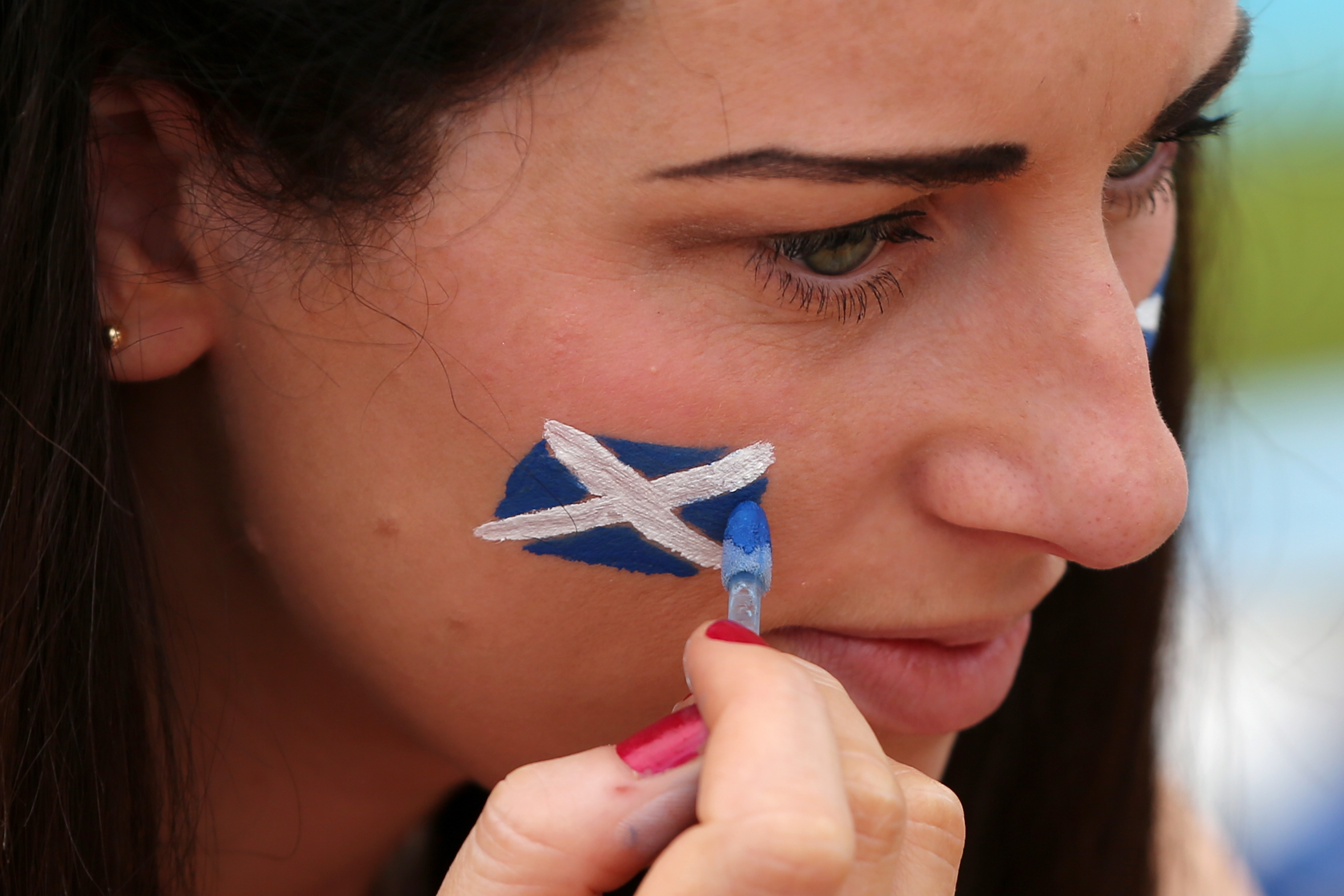
(Photo: Fans of Andy Murray queue outside before the start of day one of the Wimbledon Lawn Tennis Championships at the All England Lawn Tennis and Croquet Club at Wimbledon on June 23, 2014 in London, England. Notice that it’s the Scottish flag being painted and not the British one. By Dan Kitwood/Getty Images)

Bringing Nightmares To Life

dish_tress

That was photographer Arthur Tress’ goal for his “Daymares” series, a collection of his stagings of children’s creepy dreams from the late ’60s and early ’70s. Jen Carlson recently talked to Tress about the project, which grew out of another series that focused on waterfront parks around New York City:

So as I was doing that series, I photographed a lot of children, because that’s where kids played, along the waterfront. And then I got asked to do a workshop with a childhood educator named Richard Lewis, who still has something called the Touchstone Center in Manhattan, and he does workshops on creativity and children. Every year he has a different theme, and one year he did children’s dreams, to get kids to write poems and paintings from their dreams. So he called me in to photograph his class. So I said, you know, that’s a terrific idea, and I’m going to pursue that by asking children and my friends what dreams they remembered from childhood.

You wouldn’t really just find those things by walking around, so they had to be staged and directed, and so I began doing what’s called staged photography—this is around 1970—and that was kind of unusual for the time, people were doing street photography. I was looking for mythological, archetypical, kind of nightmarish images. That kind of became my trademark for the next 20 years, that kind of surreal disturbing photography.

See more of his work here, here, and here.

Where Developmental Dreams Came True

In his memoir Life, Animated, Ron Suskind recounts raising a son, Owen, who was diagnosed with autism as a toddler. In a review of the book, Rachel Adams describes how the family stumbled into a surprising form of therapy:

The only time Owen seems calm and relaxed is while he’s watching Disney videos. One afternoon, there is a breakthrough. The entire family is watching The Little Mermaid when they make an exciting discovery: the seemingly meaningless phrase Owen has been muttering for the past few weeks, which sounds to them like “juicervose,” is actually a stanza from the film’s last song, “just your voice.” Some of Owen’s therapists dismiss his vocalizations as echolalia, an autistic tendency to repeat sounds without understanding. But the Suskinds are convinced that Owen’s words represent a genuine effort at communication. Soon after the “juicervose” episode the family visits Disney World, where Owen is transformed. Surrounded by beloved characters and themes, he is more focused and receptive than he has been since the onset of his symptoms. The Suskinds become convinced that Disney may be the key to recovering their son’s ability to express himself.

Back in April, Hanna Rosin talked to the Suskinds and Dan Griffin, Owen’s therapist, about how the Disney treatment took hold:

Ron: I came up with the idea of having him use the voice of the sidekicks to solve the problem for a boy like Owen. Dan immediately got it. He gets up real close and says, “Let’s say there’s a boy like you. He’s a little different. He’s struggling and going through tough times and he wants to go backwards.” And without skipping a beat, Owen says, “I would prefer Merlin,” and starts doing this whole riff as Merlin about how he turned Arthur into a fish, and remember, the more you swim, the more you’ll learn, and on and on. And Dan looked at me with a “that’s not in the movie” look. And that’s when we realized he could improvise on cue and use the characters to tap into his inner voice and tell us what was really going on. He ended up in this strange middle ground between the movies and his life, and Dan and I could get into that space and shape it and guide it. …

His internal voice became external and we could hear it and shape it. It was like he felt relief, that he had found a way to talk to himself. That was the moment he started to self-heal.

Read an excerpt from Life, Animated here. Earlier Dish on Suskinds’ book here.