Correction Of The Day

“In stories published June 3 and June 8 about young children buried in unmarked graves after dying at a former Irish orphanage for the children of unwed mothers, The Associated Press incorrectly reported that the children had not received Roman Catholic baptisms; documents show that many children at the orphanage were baptized. The AP also incorrectly reported that Catholic teaching at the time was to deny baptism and Christian burial to the children of unwed mothers; although that may have occurred in practice at times it was not church teaching.

In addition, in the June 3 story, the AP quoted a researcher who said she believed that most of the remains of children who died there were interred in a disused septic tank; the researcher has since clarified that without excavation and forensic analysis it is impossible to know how many sets of remains the tank contains, if any. The June 3 story also contained an incorrect reference to the year that the orphanage opened; it was 1925, not 1926,” – the AP.

Soldiers In Disguise

Moisés Naím examines how authoritarian regimes are using ostensibly independent “civil society organizations” to give themselves a gloss of popular support:

We’ve seen the same thing in Tehran, Havana, and Caracas, where people who take to the streets to protest their leaders are often confronted by violent groups of civilians posing as common citizens who support the regime. In Iran, they’re called the Basij, or the Organization for the Mobilization of the Oppressed. In Cuba, they’re known as the Rapid Response Brigades, and they routinely dole out severe beatings to critics who dare to publicly express their opposition to the Castros’ dictatorship. This “political technology” has been successfully exported to Venezuela, where the well-trained and armed “civilians” battling opposition groups are called colectivos. Orwell himself couldn’t have imagined names that better obscure the true nature of these associations.

The reality is that these groups, “movements,” and non-governmental organizations (NGOs) are appendices of their governments and draw their “activists” from the armed forces, security services, and government militias. They carry out their repressive deeds disguised as “civil society,” in an attempt to mask the behavior of governments that want to avoid being recognized by the international community for what they really are: autocracies that violate global norms, trample human rights, and brutalize their critics. They have even earned their own acronym—GONGOs—for “Government-Organized Non-Governmental Organizations.” Their rise is forcing us to rethink our benign definitions of NGOs and civil society to accommodate armed groups of civilians and even, most provocatively, terrorists.

Strange Bedrock-fellows

NATO chief Anders Fogh Rasmussen claims that Russia “engages actively” with environmental groups that oppose fracking in Europe, in order to prevent the continent from developing a viable alternative to Russian natural gas imports. Keith Johnson finds this plausible:

Russian energy firms and officials, as well as Kremlin-controlled media, have lambasted fracking on environmental grounds for years. Top Gazprom officials and even Russian President Vladimir Putin have attacked the technology, which, if adopted, could ease Europe’s dependence on Russian gas.

But one thing has for years puzzled energy experts: Well-organized and well-funded environmental opposition to fracking in Europe sprang up suddenly in countries such as Bulgaria and Ukraine, which had shown little prior concern for the environment but which are heavily dependent on Russia for energy supplies. Similar movements have also targeted Europe’s plans to build pipelines that would offer an alternative to reliance on Moscow.

John Upton is skeptical:

[W]ho are these allies [Rasmussen cites]? Has Russia sent undercover operatives to sneak into green groups? Or is there some sort of collaboration between the should-be foes? Rasmussen didn’t elaborate.

“That’s my interpretation,” he said. Green groups have denied the bizarre allegations. “The idea we’re puppets of Putin is so preposterous that you have to wonder what they’re smoking over at Nato HQ,” Greenpeace said. And NATO promptly distanced itself from the allegations, describing them as Rasmussen’s personal views.

Geoffrey Lean doubts it makes much difference either way:

Unfortunately, however, fracking doesn’t seem likely to help much. Even by 2030, says the International Energy Agency, shale will only meet 3 per cent of EU gas demand. Energy efficiency – and maybe renewables – offer better potential for cutting gas imports. Perhaps Putin would get more for his money by working to restrict them.

But Steve LeVine can think of another reason why Russia would infiltrate:

As well as its strategic aims, such a Russian intelligence operation might also include an element of pay-back. In 2011, Putin accused the US of funding protests against his rule, and the following year he attacked Western-funded NGOs specifically. Two months ago, Putin accused Western NGOs of funding “nationalist and neo-Nazi groups” in Ukraine. It’s true that Western NGOs have sought to pluralize Russian society and loosen Putin’s tight grip on power. Now, by apparently responding in kind, Putin is sending a message that he intends to remain a potent political and economic force in Europe for some time to come.

You’re Bankable Enough, Hillary

Her latest quote on personal wealth to cause consternation:

‘But they don’t see me as part of the problem,’ she protests, ‘because we pay ordinary income tax, unlike a lot of people who are truly well off, not to name names; and we’ve done it through dint of hard work,’ she says, letting off another burst of laughter.

But Eric Boehlert believes that the media, such as the anchors seen above, are taking Clinton’s words out of context. Regardless, Morrissey sees a pattern emerging that could hurt the Dem narrative this fall:

Senate Democrats wanted to use income-inequality messaging against Republicans in the midterms as a way to distract from the non-recovery economy, ObamaCare, multiple scandals, and the collapse of Barack Obama’s foreign policy. Obama himself has been teeing up this strategy for more than a year. With Hillary Clinton actually embodying the persona that Democrats tried to hang on Romney in 2012, that messaging will backfire as Hillary Clinton sucks up more and more of the oxygen from the political scene. The phrase “limousine liberal” will be poised for a big comeback this midterm season, and Democrats will have Hillary to thank for it.

Beutler cautions the Republican strategists ready to exploit such remarks:

Nearly all viable presidential candidates are extremely rich. Obama is himself quite rich, though not exactly Kennedy/Bush/Kerry/Romney rich. The next GOP nominee might not be quite as cartoonish a plutocrat as Romney, but he will almost certainly be wealthy, and, crucially, will almost certainly promote an agenda that would exacerbate economic inequality.

When Clinton said “we pay ordinary income tax” she wasn’t just taking a gratuitous jab backwards at Romney for paying taxes at a sub-15 percent rate. She was presaging an agenda that will almost certainly call for eliminating or reducing tax preferences that allow an entire class of people of great wealth to reduce their effective tax rates. I don’t know if she’ll propose jacking up the capital gains tax, or closing the carried-interest loophole. I don’t know if she’ll target individual tax loopholes, or advocate for capping tax expenditure benefits or anything about what her economic agenda will look like. But I am 100 percent confident it will include some measures along these lines, and nearly as confident that the Republican candidate will oppose it in every particular.

This is the GOP’s core problem. Clinton’s gaffes don’t really solve it for them.

Cillizza is less forgiving:

“It’s going to be a massive issue for her,” one Obama adviser told WaPo’s Phil Rucker in a terrific piece about Clinton’s wealth as an issue in 2016. “When you’re somebody like the secretary of state or president of the United States or first lady, you’re totally cut off [from normal activity], so your perception of the middle-class reality gets frozen in a time warp.”

Democrats are right to be worried. Here’s why. The single most striking number from the 2012 exit poll was how voters responded when asked which candidate attribute was the most important to them in deciding how to cast their ballot. Roughly one in five (21 percent) said the most important candidate trait was that he “cares about people like me.” (That was more than double the 9 percent who said caring about people like them was most important to their vote in 2004.) Of that group, President Obama beat Mitt Romney 81 percent to 18 percent. Let me repeat: 81 to 18 — in an election that was not exactly a blowout. …

Now, Clinton is not Romney. (That’s the whole point she keeps trying to make.) And voters tend to be more open to the “X politician is only looking out for rich people” attack when it’s made against a Republican rather than a Democrat. But Clinton needs to understand that her clumsy talk about her wealth can, if not handled properly going forward, turn into a gateway to a broader “she just doesn’t get it” argument that could be very effective for Republicans looking for a way to slow her momentum in the race.

But Waldman, roughly on the same page, doesn’t think Clinton’s gaffe “will mean much politically, nor should it”:

She’s right that people don’t see her as part of the problem, but it isn’t because of what kind of taxes she pays. It’s because she’s a Democrat, and most voters understand that there is a fundamental difference between the two parties on questions of economics generally, and the treatment of the wealthy in particular.

She could have just said, “People don’t see me as part of the problem, because of what I and other Democrats stand for. We want a higher minimum wage, and a fair tax system…” But because of the blue-collar imperative, Clinton obviously felt that she had to make a statement of identity that bound her to ordinary people. Which is really hard when your wealth runs into the nine figures.

Recent Dish on the Clintons’ money problems here. Update from a reader:

FDR, JFK, RFK … HRC.  Very wealthy people all.  It’s the values and policies that count.

Democrats are naturally less vulnerable than Republicans on the issue of personal wealth for the simple and excellent reason that, regardless of their own circumstances, they promote an agenda that is more clearly designed to help working people.  Americans don’t begrudge rich people their wealth; they begrudge them their cluelessness, or callousness, or hypocrisy, or general unhelpfulness – all of which tend to be more typical of Republican candidates when it comes to economic policy.

The irony is that if Hilary continues to be defensive and evasive about her personal fortune, she’ll come across as a hypocrite, which actually will turn people off.

The Neocons Just Don’t Care

Stephen Walt delivers a righteous screed:

One reason neoconservatism survives is that its members don’t care how wrong they’ve been, or even about right and wrong itself. True to their Trotskyite and Straussian roots, neoconservatives have always been willing to play fast and loose with the truth in order to advance political goals.

We know that they were willing to cook the books on intelligence and make outrageously false claims in order to sell the Iraq war, for example, and today they construct equally false narratives that deny their own responsibility for the current mess in Iraq and portray their war as a great success that was squandered by Obama. And the entire movement seems congenitally incapable of admitting error, or apologizing to the thousands of people whose lives they have squandered or damaged irreparably.

Like Richard Nixon or Silvio Berlusconi, in short, the neoconservatives keep staging comebacks because they simply don’t care how often they have been wrong, and because they remain willing to do or say anything to stay in the public eye. They also appear utterly indifferent to the tragic human consequences of their repeated policy failures. Being a neoconservative, it seems, means never having to say you’re sorry.

And never ever taking responsibility for the consequences of their actions. They are the post-modern nihilists they accuse the left of being. Only much more shameless. But it’s worth repeating that they only appear on cable news because the brain-dead producers and editors decide they will. The blame for treating these congenital fantasists, hysterics and war-mongers as experts lies in part with the sheer laziness and cynicism of cable news bookers.

Read my take on the neocons’ unique relationship with the truth here. Other recent Dish on their attempted renaissance here, here, and here.

(Cartoon by Matt Bors)

Was Sectarian Strife Inevitable?

Not necessarily, according to Fanar Haddad, who tells Beauchamp that he’s “right not to buy the ancient hatreds line” about Sunnis and Shiites in Iraq, and that the internecine conflict of the past decade is largely a product of modern history:

The roots of sectarian conflict aren’t that deep in Iraq. In early medieval Baghdad, there were sectarian clashes, but that is extremely different from what you have in the age of the nation state. Come the 20th century and the nation state, we’re all part of this new “Iraq” entity — you feel a sense of belonging, so it becomes a question of how you divide the national pie. And I think that’s the main driver, the main animator behind sectarian competition in Iraq.

That’s a very new one. The state was established in 1921. Not too long after that, you start hearing about how the majority — the Shias — are being neglected, excluded, marginalized, or what you have you. After that, you’ve got the ever-present Arab-Iranian or Iraqi-Iranian rivalry that superimposed itself (not entirely by accident) onto sectarian relations. For whatever political end, people will try to conflate or suggest Iran with Shias. This has been particularly divisive. I’ll skip through the next 80 years of statehood, except to say that throughout them, the default setting was coexistence. Sectarian identity for most of the 20th century was not particularly relevant in political terms. Obviously, this is something that ebbs and flows, but there were other frames of reference that were politically dominant. Come 2003, plenty changes.

Until 2003, “the default setting was coexistence?” The British, when they were occupying, were constantly needing to put down rebellions by the Shi’a and the Kurds. One of the more recent books on Iraq’s bitter history is summarized on Amazon thus:

The authors, one an assistant professor of political science at Wright State University, the other a fellow at the U.K.-based Royal Institute for International Affairs, contend that Saddam Hussein’s regime, far from being an inexplicable evil, was a not-so-surprising result of Iraq’s history. The British, they say, who gained control of the region after the breakup of the Ottoman Empire, more or less made violent governance necessary through two key decisions: first, to attach the Kurdish province of Mosul to Arab Baghdad and Basra, giving the new nation a built-in secessionist movement, and second, to favor the Sunni Muslim minority at the expense of the more numerous Shi’a.

In 1991, the Kurds and the Shia rose up against the Sunni Saddam who had run Iraq with a Sunni elite. The result was the deaths of tens of thousands of people, the relocation of up to two million and the astonishing draining of the Southern marshes as a sectarian form of collective punishment. That was coexistence? Did the invasion and the chaos it spawned make matters a lot, lot worse? Of course, because it removed the only competitive source of loyalty – the Iraqi state.

Did the surge resolve this?

A thousand times no. As this blog repeatedly insisted – see the entire thread “Iraq Surge Fail Update” – it brought about a temporary calm, as the Sunni tribes were persuaded/bribed to take on the Islamist forces they are now – surprise! – allying with again, and as the forms of democratic processes took place. But it never resolved the structural sectarian division or hatred – both of which had obviously grown more intense after wave after wave of sectarian mass murder and the cycle of revenge. The surge never resolved the core political question it was designed to solve. This is not really Petraeus’ fault. An American commander is not an Iraqi political leader. But from the beginning, Maliki acted – understandably – as a Shiite first and as an Iraqi second (just like Saddam but in reverse). And if you see Saddam as a product of Iraq, Maliki’s resort to clumsy and sectarian brute force can be seen as exactly the same thing. Want to know why Kurdistan has been a success story? Because it is not riven with the sectarian hell of the entire country.

I can claim some foresight on this. In the midst of our Iraq Surge Fail thread, in February 2010, I wrote:

I find Biden’s recent premature bragging about Iraq to be as idiotic as Cheney’s once was. History tells us that just as you believe that what Churchill called the “ungrateful volcano” is dormant, it explodes again. And every time we think some crisis has been resolved, it often turns out it wasn’t. The next few months are full of potential explosions and the Beltway’s shallow notion that this is an old story is not reliable. This is not over by any means. And anyone who confidently says so is a fool.

Toby Dodge puts more blame on Maliki personally:

Maliki has done nothing to drive back a tide of corruption that swept across Iraq’s new political elite after 2003. Instead, unfair access to state largesse has become a tool for securing loyalty. Dissatisfaction with state failure, corruption and government incoherence came to a head in the March 2010 elections, when Maliki’s State of Law coalition was out-polled by Ayad Allawi’s Iraqiyya. It was during this election campaign and ever since that Maliki has deployed a divisive sectarian rhetoric to draw attention away from the failings of the state in an attempt to rally the Shia population to his rule. By damning his political opponents first as closet Ba’athists and then simply as terrorists he has sought to demonise Sunni politicians as complicit in the crimes of Saddam and supportive of the shadowy groups that have terrorised Iraq.

But Juan Cole notices that Shiite leaders are keeping it relatively cool for now:

In a statement on Friday, Sistani’s office issued a clarification of the statement of the previous week that called on young men to enlist in the army. The statement said that the call was directed to all Iraqis, not just the Shiites, and that it had not been intended to help the sectarian militias but only the national army. The new statement asked all Iraqis, especially those living in mixed neighborhoods, to avoid any conflict of a sectarian sort. It also apologized for the inability of the army actually to deal with so many volunteers and urged tha latter to get its act together.

On Saturday morning in Baghdad’s eastern district of Sadr City, a militia loyal to Shiite cleric Muqtada al-Sadr was formed and carried out exercises and mounted a spectacle. They called themselves the “Peace Brigades,” and their role is to protect holy sites and houses of worship belonging to all the religious groups of Iraq. Guerrillas of the fundamentalist Islamic State of Iraq and Syria (ISIS) have already destroyed tombs and shrines in Mosul and have threatened to raze Shiite shrines.

Jamie Dettmer puts in a word for Iraq’s Christians, some of whose oldest communities are right in the path of ISIS:

The Nineveh plains, the original Assyrian heartland, where Christians speak Assyrian as their first language and Arabic their second, has been also experienced an exodus despite Christian leaders earmarking the strip of land sandwiched between Mosul and Iraqi Kurdistan as a possible place of refuge when sectarian attacks in Basra and Baghdad mounted after the American invasion. Since 2003, Christian families started to arrive from the south looking to settle on extended family holdings, but many moved on because of the depressed economy, partly a consequence of the Nineveh plains remaining disputed territory between the Iraq government and the Kurds. The Christian exodus, though, started during the Iran-Iraq war because many locals had been trading with Iran and their businesses collapsed during the conflict.

The Christians here are now on high alert, as they are in the nearby towns of Al-Qoush and Bashiqa. Entering Bartilla we are closely questioned at a checkpoint by members of a self-defense force of 500 unpaid part-timers. The force, known as the Church Guards, was formed after simultaneous bombings in August 2004 of six churches in Baghdad and Mosul, the first in a wave of bombings of nearly 30 other churches throughout Iraq.

Previous Dish on the sectarian dimension of the Iraq conflict here and here.

Engaging The G

Readers shift the discussion away from trans folk:

I’m writing in regards to your post about the gay guy who thinks of himself as a regular guy who happens to be gay. I feel the same. After coming out later in life (I was 26), I shifted in a way so that most of my friends were gay. I suppose it was a way to surround myself with people who I knew wouldn’t judge me. But then I realized that I couldn’t relate to most of the gays around me. I met my (now) husband and we slowly drifted away from virtually everyone we know who is gay. I found, more and more, that gay men seemed to use being gay as an excuse for being adults who refused to grow up. They continued to be bitchy, like in high school, and do nothing but talk about being gay.

I’m a regular guy who happens to be gay. I like beer, scotch on the rocks, shooting things, heavy metal (and classical music too), and watching Star Wars. I find that I don’t relate to the gays who conform to the stereotype. Heck, my entire bachelor party was with straight guys – and we had a blast. Where are all the “normal” gay men??

Another:

I related a whole lot to the reader. Unlike him, I’m perfectly happy identifying myself as gay, and in some ways I’m not 100% traditionally masculine, least of all in my affinity for Glee (lol), but I’ve never been comfortable with the word “queer”, don’t really have the “gay voice” that you discussed in another recent thread, and my clothes and hairstyle are pretty traditionally masculine, so people I meet for the first time often don’t recognize my being gay without my telling them so.

Since the sexuality of other masculine gay guys is as inconspicuous to me as mine is to them, it can make it pretty difficult for me to pick up guys, especially since masculine guys tend to be the only kind of guys that I’m attracted to (a fact which I can no more help than my being gay in the first place, but which nonetheless often elicits disapproval from the activist-types). It was nice to hear that an older gay man in a similar boat has been able to find venues to meet other gender-conforming masculine gay guys. I need to find some outlets like that myself. I’m not uncomfortable in gay bars or gay-rights campus groups and have made plenty of friends at both, but neither one has been great for me in terms of meeting guys who I’m romantically attracted to and compatible with.

These sentiments came in for a pounding from the in-tray. Some extracts:

Your reader’s issue isn’t with gay men; it’s with effeminate gay men, which he conflates with all gay men. The cognitive dissonance is astounding. He first says there’s nowhere in the gay community for guys like him, then proceeds to list an incredible array of sub-communities and support groups that totally invalidate his point. The gay community is a big, diverse, mess of a community. No one type of person “owns” gay.

But it was the MSM [“Men who have Sex with Men”] comment that killed me.

The reason that label exists is because the people who employ it see their orientation as purely sexual. It isn’t about love, it’s about SEX with men. The idea that any gay man would think that label should be applied to themselves is a sure sign that they have not yet come to terms with their orientation. If you think sex trumps love, then you don’t really understand masculinity at all. You’re chasing a caricature.

Another response:

There is no totalitarian “gay establishment” that tells you, or me, or your reader that we must tow a gender-neutral line or be other than who we are. That may have been somewhat more the case 25 years ago, when your reader came out, but it is not the case today.

I think that somewhat exaggerates the change – but the change surely has occurred, in part because my original reader might well have stayed in the closet, or married a woman, in the past. To reiterate my own position: I think there is plenty of space within the gay population for every single way of being homosexual. And that includes the participants in RuPaul’s Drag Race and my more traditionally masculine emailers. The trick is to make everyone feel at home, and sometimes we don’t always do that, and not with malice. Another reader adds:

And those “DL” athletes and celebrities who “haven’t been offered anything worth coming out to?” Yeah, they’re just chickenshit closet cases. It’s 2014, not 1974. We have openly-gay pro athletes and soldiers. Gay identity is what you make of it. You can be out in a traditionally-masculine field without committing career suicide. If you’re not in immediate danger of homophobic violence or financially dependent on bigoted assholes, staying in the closet is simple cowardice.

Checking In With, You Know, Americans

Screen Shot 2014-06-23 at 12.40.47 PM

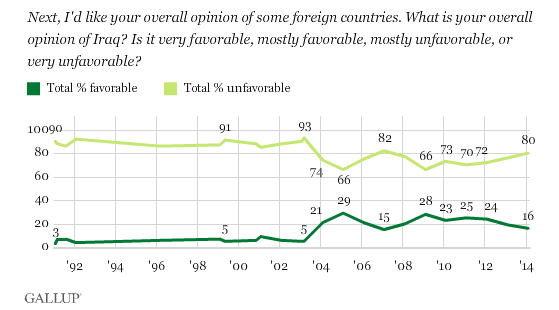
As Dick Cheney urges sending ground troops into Iraq, the public is deeply opposed. (It’s worth recalling that in 2011, when president Obama withdrew all forces from Iraq, he had 75 percent support in the Gallup poll.) 42 percent of Cheney’s fellow Republicans think that Iraq is no longer America’s responsibility. A majority of Democrats and a plurality of Independents think Obama’s response has been about right. Majorities of Democrats and Independents do not see an increase in terrorism to the US as likely; while 60 percent of Republicans do.

What you see should dampen hopes that Republicans have shifted from a Cheneyesque posture to a Paulite one. But they’re divided. And with any luck, the latest Sunni insurgency could help advance a debate in their ranks that they’ve been loath to have for many years. And that’s no small thing. The GOP’s major policy initiative in the past decade was the Iraq War. It was the signal concern of the Bush-Cheney administration and they asked the country to judge them on it. The country did – which is why Barack Obama is president. But the party then went into a strange cone of silence on the question. The neocons kept peddling the idea that the surge “worked” – which, according to its architects, meant a reconciled multi-sectarian government able to govern democratically. No one really pushed back on that transparently false narrative. And then it was on to criticizing Obama! Only now that the issue has come back into the American consciousness – and in the context of a primary process in the near-future – does the GOP have a chance to figure this all out.

My own view is that the continuing conflagration can only help Paul – because it is highly unlikely to result in anything but more grief, more violence and more terror, but with Americans more deeply involved. That’s likely, in my view, to tilt the debate away from interventionism. I could be wrong – Iraq tends to prove everyone but the deepest pessimists wrong – but this poll, cited by Philip Klein, should serve as a steaming cup of reality for the neocons:

CNN/ORC poll taken in December 2011, around the time of the U.S. withdrawal, found that Americans expected Iraq would get overrun by terrorists, but overwhelmingly supported withdrawal anyway.

Specifically, the pollsters offered a series of scenarios and asked if they were likely or unlikely to happen in the “the next few years.” The results: 54 percent said it was unlikely Iraq would “continue to have a democratic government that will not be overthrown by terrorists”; 60 percent said it was unlikely Iraqi security forces would “be able to ensure safety and security in Iraq without assistance from the United States” and 63 percent said it was unlikely Iraq would “be able to prevent terrorists from using the country as a base of operations for planning attacks against the United States.” Despite this pessimism, 78 percent of Americans in the same poll said they approved of the decision to withdraw.

So Americans are not exactly surprised by the last few weeks. Not as surprised as the Obama administration, actually. Because they, unlike the expert fixers, see something that cannot be fixed by outsiders as the obvious conclusion. And on this, the American people, and not their leaders, are right.

First Cut

dish_circumcision2400bce

Dan Colman points to the earliest known illustration of circumcision, from a tomb in Sakkara, Egypt, that dates to 2400 B.C.E.:

The origins of circumcision remain unclear. According to this online essay, a stele (carving on stone) from the 23rd century B.C.E. suggests that an author named “Uha” was circumcised in a mass ritual. He wrote:

“When I was circumcised, together with one hundred and twenty men, there was none thereof who hit out, there was none thereof who was hit, and there was none thereof who scratched and there was none thereof who was scratched.”

By the time you get to 4,000 B.C.E., you start to find exhumed Egyptian bodies that show signs of circumcision. And then come the artistic depictions. The Sakkara depiction comes with the perhaps helpful written warning,“Hold him and do not allow him to faint.”

Previous Dish on male genital mutilation hereherehere, and here. The latest from MGM apologists:

One of the other reasons often cited for opposing circumcision — decreased penile sensitivity in circumcised men — is not borne out by science. …

One inquiry included thousands of Kenyan men who were split into two random groups, only one of which would have its participants circumcised. With a large sample of previously uncircumcised men now willing to be circumcised for the study, scientists finally had a basis for comparing sensitivities re: circumcision, and their findings belied the conventional wisdom. “Overall, the circumcised men actually report that their penises are more sensitive [after circumcision], and that they have an easier time reaching orgasm,” the authors wrote.

Further, in a collective review of 10 studies using almost 20,000 men as subjects, scientists “did not see any differences between circumcised and uncircumcised men in terms of sexual desire, pain during sex, premature ejaculation, problems with erections, or problems with orgasms.”

Obama’s Iraq Plan, Ctd

IRAQ-US-DIPLOMACY-KERRY

Noah Feldman understands why the president might have felt he had no choice but to re-intervene in Iraq:

Begin with the baseline: The U.S., its allies and its regional Middle Eastern opponents such as Iran cannot tolerate the existence of a functioning al-Qaeda successor state in large swaths of Iraq and Syria. The Islamic State in Iraq and the Levant wouldn’t be satisfied with a landlocked statelet. By ideological preference and by geostrategy, the ISIL state would have the imperative to expand to the Mediterranean coast, including Sunni-majority areas of Lebanon. [Friday], a dozen ISIL fighters were apparently under siege in a Beirut building – a sign of potential future expansion.

Once the conflict reaches Lebanon, this would probably bring in the Israelis. Nuclear Israel and near-nuclear Iran would then have to figure out whether they hated each other more than they hate Sunni al-Qaeda. If this isn’t a World War III scenario, it’s getting close.

But if these scenarios pan out, they merely make the conflict far more complex, with many more active participants, allowing many more unintended consequences to unfold. And if you want evidence that we don’t really know what’s happening or could happen, look at Washington’s surprise at the demonstrable weakness and incompetence of the Iraqi army. And conceding that we are now intervening directly – what else can Biden’s visit to Baghdad convey – and yet following up with a few hundred military advisers seems to me to give us the taint of meddling with scarcely any real influence on any outcome. Maybe it’s a form of stalling, but as the Sunni/ISIS insurgency sweeps across the Sunni parts of Iraq, it’s obviously the thin end of the wedge.

Kenneth Pollack further unpacks the “known unknowns” of the intervention:

The United States and the Maliki government (and the Iranian regime, for that matter) clearly share an interest in defending Baghdad and the other cities of central and southern Iraq from conquest by the Sunni militant coalition. However, Prime Minister Maliki is also determined to reconquer the rest of the Iraqi territory lost to the ISIS offensive last week.

That would seem to run counter to the Administration’s (entirely correct) insistence that the United States should not choose sides in the Iraqi civil war, nor help either to militarily crush the other (and jeopardize the safety of its civilian populace).

That is why Washington has, again rightly, insisted on a political strategy that would reconcile Iraq’s warring communities and ensure the safety of all. Has the Obama Administration agreed that these American advisors would support Prime Minister Maliki’s objective of retaking all of Iraq? If so, will American advisors advise/lead/accompany Maliki’s forces (ISF and Shi’a militias) if they are able to fulfill the Prime Minister’s goal of counterattacking into the Sunni-populated regions of Iraq where the potential for ethnic cleansing and atrocities against civilians will increase dramatically? If not, does the Iraqi government understand this?

At the same time, the administration says it hopes to broker a political solution to the crisis. But James Traub doesn’t see that happening as long as Maliki “can keep his grip on power while pursuing a ruthlessly sectarian agenda”:

The administration is working with Iraqi leaders to shape the process [of forming a government after April’s elections], as it did in 2010. That is not an altogether hopeful precedent. Last time around, the hope was that Maliki would govern along with Ayad Allawi, the former prime minister whose Iraqiyya party had actually won more seats than Maliki’s State of Law. This time, the White House is cajoling Shiite leaders to jettison Maliki in favor of a less divisive and authoritarian figure. According to reports from Baghdad, Shiite leaders have begun to consider doing just that.

The administration has, however, just agreed to send 300 military advisors to the country without demanding political reform as a quid-pro-quo. Obama probably felt that, with the Visigoths already rattling the gates of the capital, he could not afford to wait for the political jockeying to play out over the coming months.

Ben Van Heuvelen is more sanguine, arguing that we can affect a political reconciliation, but only with Iran’s help:

The central tenet of President Obama’s emerging Iraq strategy is that military action won’t bring stability unless Iraqi leaders can build a government that all Iraqis might be willing to fight for. “As long as those deep [ethno-sectarian] divisions continue or worsen, it’s going to be very hard for an Iraqi central government to direct an Iraqi military to deal with these threats,” he said on Thursday. The only problem with Obama’s formulation is its implicit assumption that Iraqi leaders can simply choose to make up. In aggregate, they have taken hundreds of millions of dollars from Iran, and some are directly affiliated with Iran-backed militias. As a result, only Iran can push Iraqi leaders toward reconciliation.

Ayatollah Khamenei, however, has come out against any US involvement:

“The main dispute in Iraq is between those who want Iraq to join the US camp and those who seek an independent Iraq,” said Khamenei, who has the final say over government policies. “The US aims to bring its own blind followers to power since the US is not happy about the current government in Iraq. ” Khamenei said Iraq’s government and its people, with help of top clerics, would be able to end the “sedition” there, saying extremists are hostile to both Shia and Sunni muslims who seek an independent Iraq.

Earlier on Sunday Iran’s President Hassan Rouhani said some countries “feed terrorists by their petrodollars,” in a veiled reference to the Arab Gulf states, and warned that such support would come back to haunt them. “Rest assured, tomorrow will be your turn. The barbarous terrorists will go after supporters of terrorism in the future,” said Rouhani.

But is Iran the only unsavory partner we need to salvage this mess? Not according to Les Gelb: “There’s only one strategy with a decent chance of winning: forge a military and political coalition with the power to stifle the jihadis in both Iraq and Syria”:

This means partnering with Iran, Russia, and President Assad of Syria. This would be a very tricky arrangement among unfriendly and non-trusting partners, but the overriding point is that they all have common interests. All regard the jihadis as the overwhelming threat, and all would be willing to take tough joint action. And with this fighting arrangement in place, the “partners” could start seriously fixing the underlying political snake pits in Damascus and Baghdad. …

I’m certainly not saying that Assad is a good guy and that we should abandon pursuing his eventual departure, or that we can now trust Russia and Iran. Washington has and will have serious problems with all these countries. And most certainly, the U.S. will have to stay on its guard. But the fact is that there is common ground with Moscow and Tehran to combat the biggest threat to all of us at this moment. Russia frets all the time about the jihadis in the Mideast making joint cause with Muslim extremists in Russia; it’s Moscow’s number one security issue. Iran worries greatly about the Sunni jihadis torturing and killing Shiites in Syria and Iraq. There’s nothing more frightening in the world today than these religious fanatics.

As so often, Gelb adds a dash of realism. If our real problem here is the possibility of fanatical Islamist terror, then the US is only one of many powers with an interest in intervening, and Assad and Iran and Russia are our partners, not our enemies in this endeavor. But even then, there is no solution to this constantly exploding “ungrateful volcano” (as Churchill described Iraq) than a multi-sectarian democratic government and that is, by any reasonable inference of the past decade or so, a non-starter. Throwing arms, humans and money at a project that has never actually worked and that, in the current chasm, cannot work, is a mug’s game. I can see the reasons behind getting better intelligence, but not much more. On this, I stand with Rand Paul.

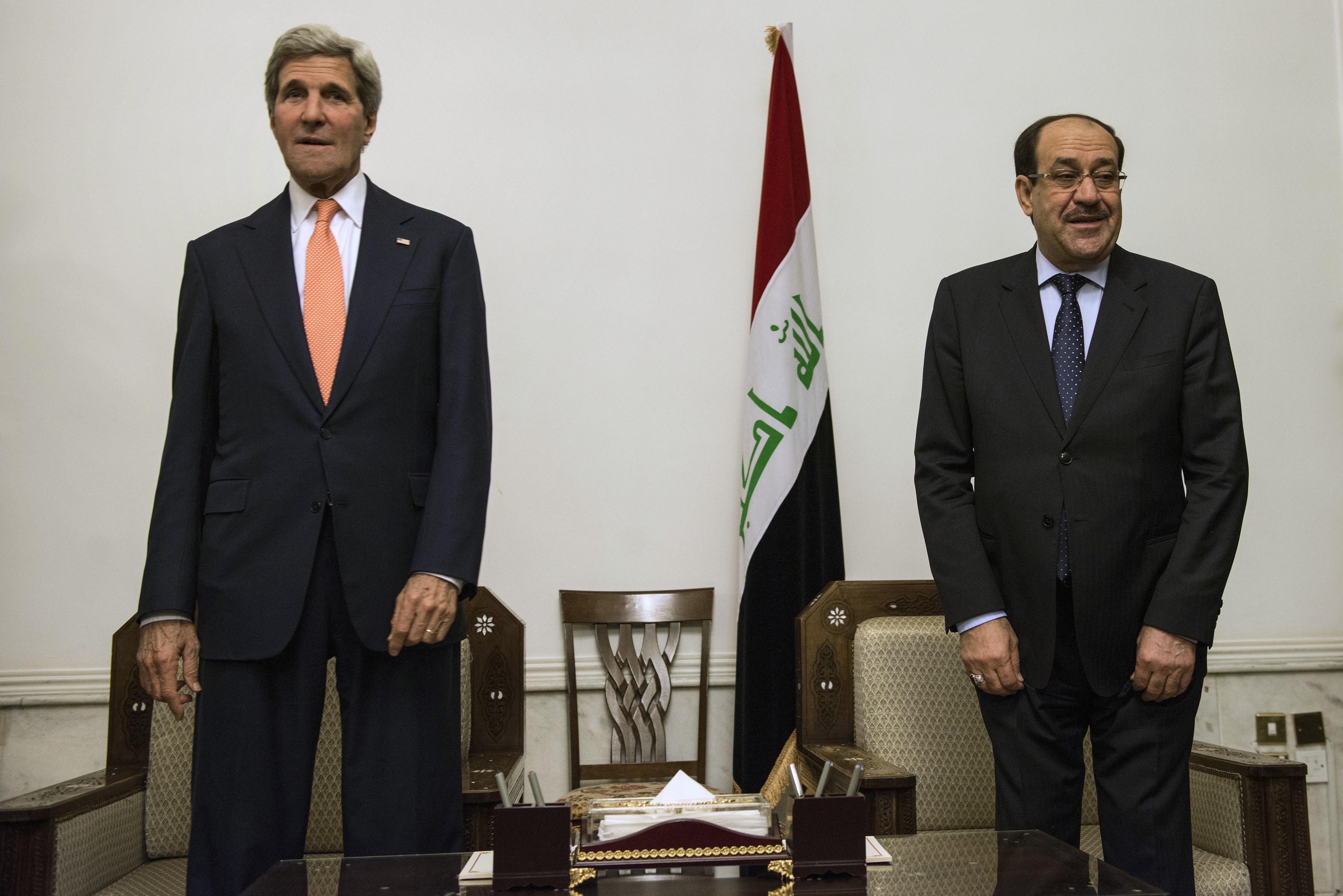
(Photo: Iraqi Prime Minister Nuri al-Maliki and US Secretary of State John Kerry meet at the Prime Minister’s Office in Baghdad on June 23, 2014. Kerry was in Baghdad to push for Iraqi unity and stability, as Sunni militants swept through western towns abandoned by the security forces. By Brendan Smialowski/AFP/Getty Images.)