George Will Loses The Plot

In his column last Friday on what he sees as the dangers of progressivism in universities, George Will provoked widespread outrage by expressing skepticism in statistics about campus rape and mocking the Obama administration’s response to the crisis. The line that seemed to really set people off was his allegation that campus progressivism seeks to “make victimhood a coveted status that confers privileges,” which in turn makes “victims proliferate”. In fairness to Will, he wasn’t specifically referring to sexual assault here, and the line has since been widely quoted out of context. But Twitter wasn’t about to give him the benefit of the doubt.

Marcotte covers the backlash:

Sexual assault victims were so outraged at being told they exaggerated their experiences to get some unnamed “privileges” that they took to Twitter to explain how un-fun it actually is to come out about your rape.

Wagatwe Wanjuki kicked it off with a tweet reading, “Where’s my survivor privilege? Was expelled & have $10,000s of private student loans used to attend school that didn’t care I was raped.” The hashtag #SurvivorPrivilege swiftly emerged, with survivors explaining, one tweet at a time, as the various ways your life can go to hell after you survive a sexual assault.

The psychological toll of enduring sexual assault was a major theme. Sexual assault survivors recounted having flashbacks and panic attacksfeeling like “damaged goods”, and living in fear of having it happen again. The elusive nature of justice was another major issue, with women telling hair-raising stories of their attackers getting away with sexual assault and everyone pretending it didn’t happen.

But perhaps the saddest survivor “privilege” is the one that often gets talked about the least: How frequently survivors find coming out about being assaulted means losing your entire support system, as people get mad at you for making them have to think about it. Or even just because they start to think that being around you is a bummer.

But even if Will didn’t mean to say that being a victim of sexual assault confers privilege, his views on the issue are still at odds with reality. Alyssa examines his contention that sexual assault can’t be as prevalent as progressives say it is:

As I wrote last week, most studies that balance the perspectives of survivors and law enforcement suggest that there is a false reporting rate of between two and eight percent. So why does the idea of the false report persist? Daniel Kahan, the Elizabeth K. Dollar Professor of Law at Yale Law School, who has written extensively on the phenomenon of “motivated reasoning,” that the way we weigh evidence is influenced by strong goals, needs and worldviews, studied the cultural norms that affected views of acquaintance and date rape cases. He found that attachment to traditional gender roles played a significant role in driving skepticism that survivors actually meant it when they said no to sex.

James Hamblin points out that the epidemic Will refuses to believe in is starting to become more visible:

According to a report today from the U.S. Department of Education, the number of sexual assaults reported on college campuses increased by 50 percent between 2001 and 2011—from 2,200 to 3,300 cases. That’s actually more heartening than disconcerting, in that it’s unlikely that sexual assault increased by that much; rather, more victims are coming forward. They come forward when they don’t feel they’ll be blamed for being raped, dismissed as drunken sluts, and when there are appropriate outlets for reporting and justice.

But it’s still underreported and underpunished, thus condoned. According to the Centers for Disease Control, 18 percent of American women report having experienced rape at some point in their lives. The way sexual assault is defined in the media is critical to shifting culture from blaming victims to blaming aggressors. “Victims proliferate” when aggressors proliferate, or when victims were there all along.

Katie McDonough notices that Will never quite gets to the point:

If men like Will really do believe that most sexual assaults are a byproduct of the “ambiguities of hookup culture,” why aren’t they writing smug editorials about affirmative consent? If the actual crisis is that young men are being falsely accused of rape at an alarming rate (they are not), then wouldn’t some legitimate action be required? But instead we just get Will’s ridiculous column. It seems that even Will doesn’t take his own ideas that seriously.

Linker bluntly calls the column “outrageously stupid, transparently absurd — the kind of tossed-off, back-of-the-napkin theorizing one would expect of a guy who spends a little too much time in the make-up chair at Fox News.” Maria LaMagna psychoanalyzes Will:

[H]e appears to have succumbed to what in many college curriculums is known as the “just-world fallacy,” by which one assumes that real-world consequences, including tragedy, are solely a product of just deserts. In fairness to Will, we all do it. We prefer to believe we live in a fair world, one where bad things only happen to bad people who deserve them. When tragedy strikes someone, we reassure ourselves by thinking, “That could never happen to me, or anyone I care about.” The colloquial term for this magical thinking is “blame the victim.”

Amy Davidson determines that Will’s column is not ultimately about sexual assault or even women:

The true target of his column is “progressivism,” which he seems to regard as an engine for the mysterious elevation of people whom he doesn’t feel should call themselves victims. In that, his column is of a piece with a general conservative complaint (one also heard in some recent Supreme Court decisions).


Ta-Ta To Teacher Tenure?

Emily Badger summarizes yesterday’s big education news:

A Superior Court judge in Los Angeles on Tuesday struck down state laws in California governing teacher tenure, ruling against teachers unions in a sweeping decision that’s expected to upend how teachers are hired and fired in the state – and possibly far beyond it.

The case, Vergara v. California, will likely be appealed to the Supreme Court and could set off similar legal challenges in other states. Brought on behalf of nine public-school students in the state, the case challenged a set of laws, including one that gives teachers in California tenure as early as 18 months into their careers. Another requires layoffs on a last-in/first-out basis that excludes consideration of teacher quality.

Students Matter, a Silicon Valley-based group that brought the suit, argued that these policies make it hard to fire “grossly ineffective” teachers and to retain high-quality junior ones, and that low-income minority students disproportionately suffer as bad teachers are shuttled into their classrooms.

Alexander Nazaryan cheers the ruling:

[Judge Rolf M.] Treu vividly depicted the dreary state of affairs I witnessed as a public school teacher: tenure is awarded for no reason other than seniority, as if merely showing up every day were an incredible feat of pedagogy. It is so expensive to remove a teacher (perhaps as much as $450,000 in California), that most school districts don’t even bother, instead shuffling the lemons to a dropout factory where no one will notice their baleful presence.

And it perpetuates the noxious practice known as last-in-first-out, which privileges seniority above all other attributes, so that when reductions in the teaching force occur, they mandatorily target the most junior teachers, regardless of how good those teachers may be. As it happens, the youngest teachers often teach at the most challenging schools, so that the inane LIFO rule (I couldn’t think of a less appealing acronym if I tried) further destabilizes the very institutions that crave stability.

Meanwhile, Ravitch is predictably pissed:

This is a big win for the Billionaire Boys Club. Name a state that has no due process rights for teachers and excellent public schools. One?

Yglesias considers the politics at stake:

Teachers unions, obviously, think Treu got it wrong. And they will have many liberals allies who regard the anti-tenure movement as thinly veiled union-busting. What’s more, even though conservatives will largely cheer this policy outcome, the legal logic isn’t one conservatives normally embrace.

Treu is essentially advancing a disparate impact theory, holding that a policy that has no discriminatory intent is nonetheless unconstitutional because its negative consequences fall much more heavily on minority kids than on white ones. Typically this is a left-wing theory of how anti-discrimination policy should work that conservatives view very skeptically. The particular politics of public education have scrambled the normal ideological alignment somewhat in this case.

Chait elaborates:

What makes the California lawsuit fascinating is that it employs a classic liberal legal strategy. The plaintiffs show (1) current tenure rules make it nearly impossible for schools to fire chronically ineffective teachers, (2) having a chronically ineffective teacher imposes irreparable harm on a child in the form of lost wages, and (3) chronically ineffective teachers are disproportionately concentrated in schools with high numbers of minorities students. The third point turns the case into an equal protection violation.

Eric Posner is skeptical:

I do not believe that this case will be affirmed on appeal; or if it is, I believe that it will be distinguished away to oblivion. Courts have had nothing but trouble trying to enforce “social rights” like the right to an education where those rights exist (in states like California, and in many foreign countries), and generally give up. …

[I]f, as the court says, these rules discriminate against low-income and minority students because school authorities funnel the grossly incompetent teachers whom they can’t fire to the weakest schools, isn’t the proper remedy to forbid this behavior directly? The court is never very clear whether it is enforcing a right to education (meaning a right not to be taught by a grossly incompetent teacher) or a right not to be discriminated against (a right not to be taught by a grossly incompetent teacher because you are a minority or are poor).

But Dana Goldstein argues that even if the ruling stands, it may not be a boon for students:

For high-poverty schools, hiring is at least as big of a challenge as firing, and the Vergara decision does nothing to make it easier for the most struggling schools to attract or retain the best teacher candidates.

From 2009 to 2011, the federal government offered 1,500 effective teachers in 10 major cities – including Los Angeles – a $20,000 bonus to transfer to an open job at a higher poverty school with lower test scores. In the world of public education, $20,000 is a major financial incentive. All these teachers were already employed by urban districts with diverse student populations; they weren’t scared of working with poor, non-white children. Yet less than a quarter of the eligible teachers chose to apply for the bonuses. Most did not want to teach in the schools that were the most deeply segregated by race and class and faced major pressure to raise test scores. …

The lesson here is that California’s tenure policies may be insensible, but they aren’t the only, or even the primary, driver of the teacher-quality gap between the state’s middle-class and low-income schools. The larger problem is that too few of the best teachers are willing to work long-term in the country’s most racially isolated and poorest neighborhoods.

Zooming out, Stephen Sawchuk notes that the ruling comes amid “a contentious national debate about teacher quality and teachers’ unions”:

Nationally, some 16 states have taken steps to tie tenure-granting to teacher performance; seven return teachers with weak evaluations to probationary status. Florida and Kansas have both eliminated either the continuing employment or due process associated with tenure; North Carolina did, too, but that move was recently declared unconstitutional.

The Ever-Imploding Iraq, Ctd

IRAQ-UNREST

The Iraqis are requesting help in recapturing Mosul and other northwestern cities from ISIS, but Ed Morrissey doubts there’s anything we can do:

We pulled out all of our forces three years ago when the Obama administration failed to negotiate for a residual force for this exact scenario. In order to land an effective fighting force to defend Baghdad and retake Mosul, we would need to commit tens of thousands of troops and a large amount of materiel in a big hurry. Logistically speaking, that would be a feat worthy of George S. Patton and the Battle of the Bulge in order for us to get to Baghdad before ISIS does, especially with Iraqi security forces collapsing.

Politically speaking, it’s a dead letter. Obama just coughed up five prizes to the Taliban in his haste to get the US out of Afghanistan. Does Iraq really expect Obama to restart the Iraq War all over again after spending his entire national political career speaking out against it?

Let’s get a few things clear here. The American people – much more than Obama – wanted to get out of Iraq completely; and the Maliki government – much more than Obama – wanted the same.  Since the failure of the surge to create anything like a multi-sectarian government, this unraveling was only a matter of time. I’m actually surprised it didn’t happen as we were pulling out, or a year ago. No doubt the Syrian implosion has had an impact. But this is Iraq: a country created to be divided, and requiring brutal authoritarianism to stay in one piece. The idea that the US can actually do anything about this is fantasy.

But a fantasy that the Bloomberg editors embrace:

Much of what is happening in Iraq now is the fault of Iraqi Prime Minister Nouri al-Maliki, who has ruled Iraq in far too sectarian a fashion, alienating the very Sunni leaders who helped to subdue ISIL’s precursor in 2007. That complicates matters, and any deal to rescue him should include a binding commitment from him to bring Sunni leaders into the government: These leaders trust the U.S. more than any other player in Iraq.

U.S. involvement would also be needed to overcome the deep tensions and rivalries between the government in Baghdad on one side and the Kurds and Turks on the other. Crushing ISIL may be the one clear common interest they have, yet cooperation is unlikely without diplomatic grease from an outsider, and the U.S. is the only realistic candidate.

They’re really like Charlie Brown and the football.

Something we were incapable of doing with more than a hundred thousand troops in the country is somehow feasible today? The hegemonic knee jerks. Max Boot blames Obama for all of this, of course:

Islamist militants are now in the process of establishing a fundamentalist caliphate that includes much of northern Syria and western and northern Iraq. And that in turn threatens the U.S. and our regional allies because this new Islamist state is certain to become a training ground for international jihadists who will then strike other countries–including possibly ours.

It is harder to imagine a bigger disaster for American foreign policy–or a more self-inflicted one. There was no compelling reason why the U.S. had to pull our troops out of Iraq; if President Obama had tried harder to negotiate a Status of Forces Agreement, he probably could have succeeded. But his heart was in troop withdrawal, not in a long-term commitment.

Boot still actually believes that the US should have stayed in Iraq indefinitely. This is a form of madness. Juan Cole, mercifully, provides the perspective that Morrissey and Boot omit:

Those who will say that the US should have left troops in Iraq do not say how that could have happened. The Iraqi parliament voted against it. There was never any prospect in 2011 of the vote going any other way. Because the US occupation of Iraq was horrible for Iraqis and they resented it. Should the Obama administration have reinvaded and treated the Iraqi parliament the way Gen. Bonaparte treated the French one?

I hasten to say that the difficulty Baghdad is having with keeping Mosul is also an indictment of the Saddam Hussein regime (1979-2003), which pioneered the tactic of sectarian rule, basing itself on a Sunni-heavy Baath Party in the center-north and largely neglecting or excluding the Shiite South. Now the Shiites have reversed that strategy, creating a Baghdad-Najaf-Basra base.

And Nader Uskowi stresses that the primary fault lies with Maliki:

After the U.S. withdrawal, Saudi Arabia and Iran have followed sectarian policies in Iraq that have partly caused the present situation; by supporting Sunni militias in opposition to the government and Shia militias in support of it. But at the end of the day, it is the Iraqi government and its leader, who has been in power for two full terms and is trying to stay on for a third term, that should be held responsible for maintaining security and stability in the country.

But what if the country is so constituted that that is impossible without a dictatorship?

(Photo: A picture taken with a mobile phone shows Iraqi soldiers talking as smoke billows behind them on a road in Hawijah, west of Kirkuk, in northern Iraq on June 11, 2014. Jihadists seized all of Mosul and Nineveh province, long a militant stronghold and one of the most dangerous areas in the country, and also took areas in Kirkuk province, to its east, and Salaheddin to the south. By STR/AFP/Getty Images.)

The Power Of Conservative Media’s Brat Pack

Conservatives Hold Health Care Rally On Capitol Hill

I watched Fox News a little compulsively last night. Where else? If you’re really going to understand the groundswell in Virginia, it’s essential viewing. I gleaned a few things. The first is that we shouldn’t under-estimate a story that hasn’t gotten widespread MSM attention, but which was a big event in the conservative media in the last few days. The story was – and is – about a large influx of illegal immigrants under the age of 17 – from Latin American countries other than Mexico – just showing up at the border and seeking refuge. For a non-wingnut version of the story, here’s CNN:

“We are seeing hundreds turning themselves in daily. And I mean hundreds at a time,” said Chris Cabrera, a leader of the local chapter of the National Border Patrol Council, a labor union representing U.S. Border Patrol agents. Many of the immigrants use Screen Shot 2014-06-10 at 9.23.41 PMrafts to cross the Rio Grande, equipped with instructions to follow the river until reaching the Border Patrol site to surrender. “They know that once they get to the station, we are going to give them paperwork and we are going to set them free into the United States,” Cabrera says.

U.S. law prohibits the Department of Homeland Security from immediately deporting the children if they are not from Canada or Mexico. Instead, the children are turned over to Department Health and Human Services supervision “within 72 hours of DHS taking them into custody,” an official said … The numbers are staggering. He estimates that more than 60,000 unaccompanied juveniles will cross in 2014 and that the numbers will rise from there. “You’re talking kids from 17 years old, on down to some that are 5 or 6 years old, traveling by themselves,” Cabrera says.

The number of these undocumented minors has overwhelmed the resources of border states, leading the president to declare an “urgent humanitarian situation”. And the influx seems related to the Obama policy of easing up on the immigration of minors – which Cantor had expressed some sympathy for. Put all that together and you have a news event almost tailor-made to both expose the chaos at the border with respect to immigrant kids and to create a sense of emergency that would boost turnout and intensity in the last few days of the Brat campaign.

And look: this isn’t irrational. It’s perfectly understandable that an immigration loophole that would mean tens of thousands of undocumented children simply walking into the US would galvanize people who believe the border is insecure.

But the story would never have had traction without the relentless focus from the Brat Pack media complex. And who would be members of that Brat Pack? Step forward, as they say, Laura Ingraham, Ann Coulter, Mark Levin, and Matt Drudge (with a somewhat more niche version in Mickey Kaus). In ways I really cannot but admire, these anti-amnesty enthusiasts latched onto the Brat campaign, pumped up the hysteria and rhetoric day after day, turned the illegal children crossings into a mini-media firestorm, and, against all those odds, never let go. Mickey has a bit of a slightly stunned post this morning on the great adventure he has just completed:

I would have settled for his challenger, Dave Brat, getting more than 40%. I was all ready to (legitimately) spin that as a warning shot across Cantor’s bow.

But Mickey is a minor media figure here. The key figures behind this upset are Ingraham, Levin, Drudge and Coulter. Their constant championing of Brat, their genius at always backing the upstarts and the rebels, their swagger against the Republican Establishment and their dominance of the Republican base debate were all indispensable to Brat’s victory. And that’s why I think the amazement at the money imbalance in the race misses something important. The kind of media exposure Brat got for free was almost certainly worth far more than the brutal ads Cantor flooded his district with. Brat got endorsements from the men and women who truly have credibility with the Tea Party base. And that media universe has much more power with the grassroots than anything the establishment could hope for.

For a long time, I’ve argued that one of the critical flaws in the current GOP is that its massive and lucrative media-industrial complex has effectively supplanted its legislative-governing identity. And so absolutist principles, and high-flown rhetoric – laced with readings from sacred secular texts and references to the philosophy of the Founding Fathers – carry enormous clout. In this world of jaw-jaw, there is a premium on sticking to “principles” as the ultimate mark of devotion to the conservative cause, and certainly utter disdain for any kind of compromise in a messy, multifaceted, multicultural and multiracial society. That’s why its typical representative is now a university professor, marinated in ideology, and uninterested in governance. This is now a party not of pragmatic, reality-based governors and legislators, but a church with an increasingly rigid theology.

And that’s why, even as the Hannity and Kelly enthusiasm for this grass-roots insurrection was palpable and infectious last night, there was a slight anxiety around the edges. From time to time, they referred rather defensively to an alternative “left” version of last night, which could portray this revolt in defense of constitutional government as a lurch to the loony right. They showed both contempt for this narrative and also fear of it. I don’t think they have yet resolved that tension – or will for quite some time.

(Photo: Conservative radio host and commentator Laura Ingraham addresses a health care reform protest on December 15, 2009 in Washington, DC. By John Moore/Getty Images.)

Your Lunchtime Cantor Wrap

eric cantor

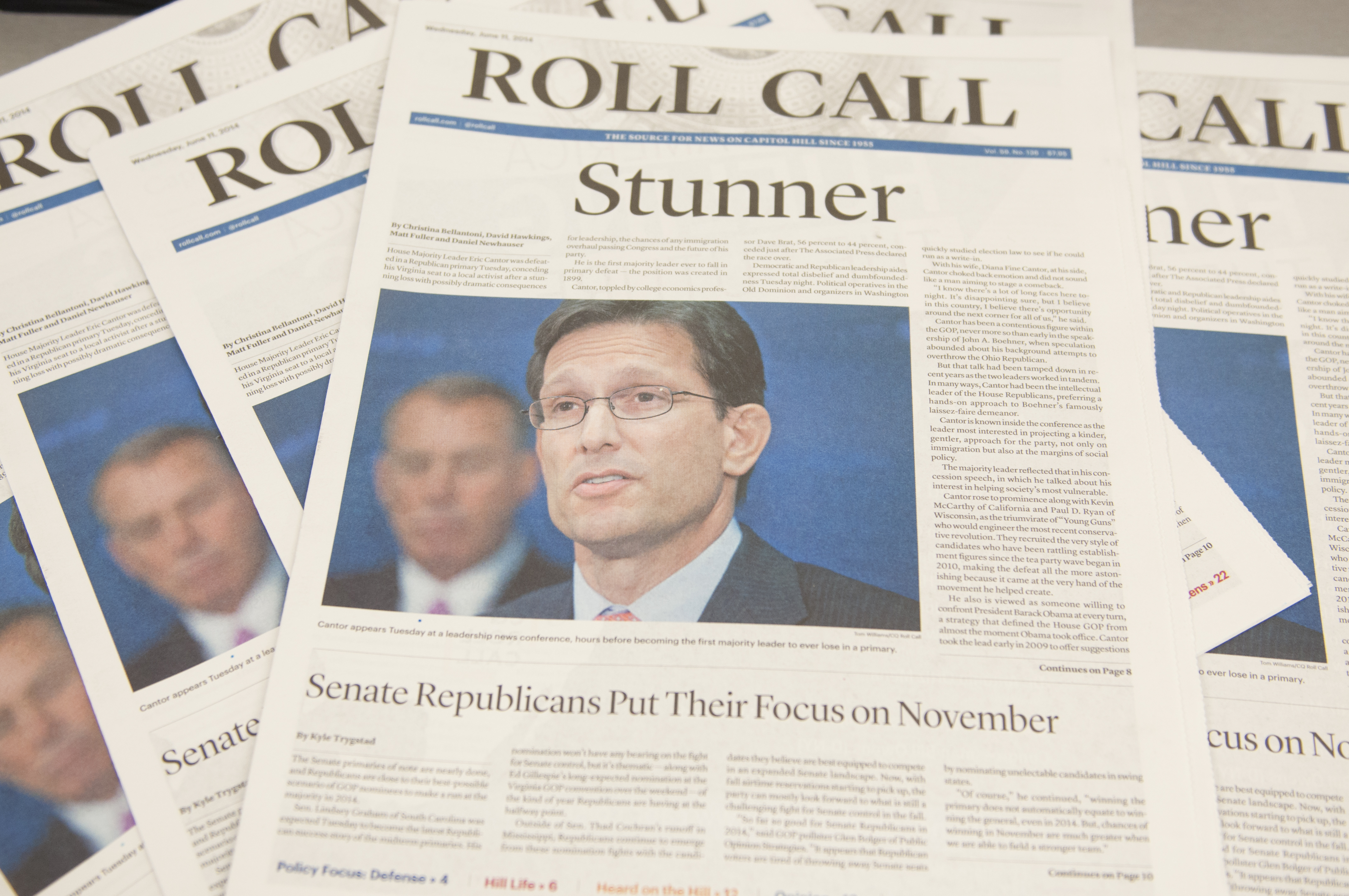
If you’re interested in catching up, here are the Dish’s posts on the Virginia earthquake last night: Brat’s Tea Party fundamentalism; the role of the talk radio/online right; a very strong Dick Morris Award nominee; did some mischievous Democrats help?; or not?; a mega-tweet-reax from last night; a big blogger reax round-up; was there a Jewish factor involved in a more conservative district?; and the solidly conservative voting record of the man not conservative enough for the GOP in 2014.

Thinking all this through may take a while. Stay tuned …

(Photo: By Meredith Dake/CQ Roll Call)

Map Of The Day

screen shot 2014-06-11 at 9.32.30 am

Armin Rosen explains ISIS’s expanding grip on Iraq and Syria:

ISIS operates across a vast geographic area. Jalula, Iraq, the easternmost population center under ISIS’s control, is over 360 miles from Raqqah, Syria, the group’s westernmost zone of control. ISIS sprawls across the Iraqi-Syrian border. It’s attacked inside of Iraqi Kurdistan, sits at the doorstep of Syria’s Alawaite heartland, and has broad operational abilities inside Iraq’s Sunni Triangle, and even its Shi’ite south. ISIS cuts across ethnic and sectarian regions, controlling major cities and desert wilderness.

In analyst Shiraz Maher’s view, ISIS controls more territory than the governments of Israel and Lebanon. It controls nearly a third of Iraq alone, according to the Long War Journal.

And they are far from finished:

Sources told Al Jazeera on Wednesday that gunmen had set up checkpoints around Tikrit, which lies between the capital Baghdad and Mosul, which was [captured] by ISIL [aka ISIS] on Tuesday. “All of Tikrit is in the hands of the militants,” a police colonel told the AFP news agency. A police brigadier general told AFP that fighters attacked from the north,  west and south of the city, and that they were from ISIL. A police major told the agency that the militants had freed about 300 inmates from a prison in the city, the capital of Salaheddin province.

Meanwhile, sources said the nearby city of Kirkuk, home to Iraq’s biggest oil refinery, was also being attacked by ISIL.

What Really Doomed Cantor?

https://twitter.com/DaveBratVA7th/statuses/473261119986229248

John Avlon points to turnout:

[D]on’t give the TeaVangelist team too much credit for strategic genius. The key factor in this upset is a 12% voter turnout—meaning that 6.1% of the local electorate could make a majority. This is a paradise for activists and ideologues—Main Street voters, not so much.

No one seriously doubts whether Cantor could have won a general election in his Virginia district. This is purely a numbers game. An unrepresentative turnout makes for an unrepresentative result. And for Republicans, it is perhaps the most pointed reminder of the dangerous game they’ve been playing by stoking the fires of furious conservative populism. Golem ultimately turns on its creator.

Sure. But Cantor won massively in previous primaries where the turnout was actually lower. Morrissey rightly calls Avlon’s logic absurd:

First, Cantor himself got elected through the same supposedly unrepresentative process of the primary system. … Also, it should be noted that turnout in this primary was actually higher than those earlier primaries that nominated Cantor (almost 20,000 more than in 2012) and were supposedly more representative — and that Cantor got fewer votes this time than in his last primary.

Morrissey also declares that, “that immigration wasn’t the only reason Cantor lost, but it’s absurd to think it didn’t play any role.” I’m with Morrissey. Why? Because immigration was easily the hottest issue as the race came down to the wire. Look at that tweet above. But Jamie Weinstein thinks the emphasis on immigration is misguided:

[T]he truth is that most polls show that a majority of Republicans support a type of legalization proposal similar to what Graham helped write and pass through the Senate and, to a much more limited extent, Cantor supported in the House. There is even a poll of self-identified tea party sympathizers that shows that 70 percent support an immigration bill that would provide some type of pathway to legalization for illegal aliens in the country if certain conditions are met.

Perhaps these polls are all wrong. Perhaps the political class has overlooked the potency of the immigration issue for voters. But it is also possible that we are exaggerating the importance of one House primary, however shocking its result. What if all Cantor’s supporters stayed home because they thought their man was safe and everyone who opposed immigration reform showed up? Maybe Cantor was tossed out because voters thought he cared more about rising the House leadership ranks than representing them?

Maybe. PPP’s polling (pdf) backs that analysis up:

Cantor has a only a 30% approval rating in his district, with 63% of voters disapproving. The Republican leadership in the House is even more unpopular, with just 26% of voters approving of it to 67% who disapprove. Among GOP voters Cantor’s approval is a 43/49 spread and the House leadership’s is 41/50. Those approval numbers track pretty closely with Cantor’s share of the vote last night.

72% of voters in Cantor’s district support the bipartisan immigration reform legislation on the table in Washington right now to only 23% who are opposed. And this is an issue voters want to see action on. 84%  think it’s important for the US to fix its immigration system this year, including 57% who say it’s ‘very’  important. Even among Republicans 58% say it’s ‘very’ important, suggesting that some of the backlash against  Cantor could be for a lack of action on the issue.

I’m really unconvinced by PPP’s take. It seems really strange when you look at the dynamics of the race. And a poll of all the voters in Cantor’s district is not the same as the actual poll of the minority who showed up. So yes, don’t over-extrapolate from the immigration issue. But don’t deny its potency either. Larison’s take:

The backlash over immigration shows something else, which is the extent to which Republican voters have come to distrust their party leaders and the reason for that distrust. Cantor predictably said that he was against an immigration amnesty bill, but the problem for him was that large numbers of his constituents simply didn’t think he would do what he said. It is understandable that Republican voters would be especially wary of the promises from their leaders on immigration. Party leaders have repeatedly tried to ignore what the voters want on this issue, and many of them have made no secret of their desire to take immigration “off the table” before the next election, and in practical terms that means giving in to at least some of what the administration wants. Add to this Cantor’s focus on his own political aspirations and his perceived neglect of his constituents, and you have a recipe for electoral defeat.

Waldman doesn’t see the loss as a major blow to immigration reform:

It’s true that other Republican members of Congress are going to look at Cantor’s defeat as a cautionary tale. After all, if you’re a backbencher who just saw the Majority Leader get crushed by some nobody in substantial part because of immigration, it’s not exactly going to give you a lot of enthusiasm for sticking your neck out for the good of the national party when it might cost you your seat. But it wasn’t as though there was much of a chance for immigration reform to pass even before this. To put some rather arbitrary numbers on it, the odds went from 20-1, or maybe 50-1, to 100-1. In other words, immigration reform probably wasn’t going to happen before, and it probably isn’t going to happen now.

Judis observes that “Brat’s case against immigration reform was directed at big business as much as it was directed at the immigrants themselves”:

If he is elected in November, Brat may, of course, jettison the anti-Wall Street and anti-big business side of his politics. His actual economic views appear to be close to those of the Cato Institute and Ayn Rand. His solutions for America’s flagging economy consist in flattening the tax code and cutting spending – positions that will certainly not alienate the Chamber of Commerce or Business Roundtable. But in defeating Cantor, Brat echoed the age-old, darker, and more complicated themes of right-wing populism. These themes will continue to resonate, even if Brat abandons them.

Jia Lynn Yang considers the implications for big business:

Brat’s win signals that it’s not just the lawmakers supported by the BRT and the Chamber that are under threat. The business lobby groups themselves have increasingly become political targets–and they could start hearing their names mentioned unflatteringly in many more stump speeches to come.

Kilgore feels Cantor needed to play more to the base:

Interestingly enough, a Republican incumbent initially considered far more vulnerable than Cantor, U.S. Sen. Lindsey Graham, romped to victory yesterday without a runoff over a field of six opponents trying to exploit his RINO reputation. Graham had the same kind of financial advantage as Cantor enjoyed, but also made himself a chief purveyor of red meat to “the base” in his abrasive exploitation of the Benghazi! “scandal,” and more recently, his suggestion that Barack Obama was courting impeachment by his handling of the Bergdahl exchange.

Cantor has been a conspicuous sponsor of the “conservative reform” band of intellectuals encouraging Republicans to think more deeply about a positive governing agenda. He might have done better by emulating Graham and finding some decidedly non-intellectual buttons to push among right-wing activists. That’s a lesson that won’t be lost on Cantor’s soon-to-be-former colleagues in Congress, and on the emerging Republican field for president in 2016.

Beutler downplays the immigration angle:

For more than a year now, Cantor’s stable of influential operatives and former operatives have done battle with the purity obsessed hardliners and opportunists who tried to seize control of the party’s legislative strategy. Many of them sought retribution by taking aim at Cantor in his district.

In the end the right’s beef with himas with McConnellwas about more than just affect. It was about his willingness to use power politics and procedural hijinks to cut conservatives out of the tangle when expedient. The lesson of his defeat isn’t that immigration reform is particularly poisonous, but that the right expects its leaders to understand they can’t subsume the movement’s energy for tactical purposes, then grant it only selective influence over big decisions.

Jason Zengerle focuses on Cantor’s shape-shifting:

During his 14 years in Washington, Cantor reinvented himself so many times that I ultimately lost count somewhere around Cantor 6.0. And that was ultimately the reason for Cantor’s downfall. The serial reinventions left Cantor with few allies and myriad enemies. He was the worst thing a politician could be: someone who inspired great passion, but only negative ones. As we’ve seen this year with Boehner and with Senator Mitch McConnell, Establishment Republicans can withstand Tea Party primary challengers. But Cantor couldn’t because, unlike Boehner and McConnellwho despite their opposition to Obama never entirely cozied up to the Tea Partyhe attempted to be something he was not.

Robert Tracinski, a constituent, thinks Cantor’s downfall was a failure of principle:

Here’s my favorite Eric Cantor story. At the Republican Convention in 2008, I approached Cantor after an event, introduced myself as a constituent, and told him where I lived. It’s a tiny place, more of a wide spot in the road than an actual town, so this was partly a test to see how well Cantor knew his own district. I turns out that he did recognize the town, and to prove it, he started to tell me about how he had worked on getting us an earmark for a local Civil War battlefield park. An earmark, mind you, just after Republicans had officially renounced earmarks in an attempt to appease small-government types. Cantor suddenly realized this and literally stopped himself in mid-sentence. Then he hastily added: “But we don’t do that any more.”

That, ladies and gentlemen, was Eric Cantor: the soul of an establishment machine politician, with the “messaging” of the small-government conservatives grafted uneasily on top of it.

So yes, you can now tear up all those articles pronouncing the death of the Tea Party movement, because this is the essence of what the Tea Party is about: letting the establishment know that they have to do more than offer lip service to a small-government agenda, that we expect them to actually mean it. Or as Dave Brat put it in one of his frenzied post-victory interviews, “the problem with the Republican principles is that nobody follows them.”

Cantor’s Voting Record

It was pretty damn conservative:

Using DW-NOMINATE Common Space scores (which measure the ideological positions of Members of Congress based on the entirety of their roll call voting records), we find that Cantor is more conservative than 61% of Republicans in the (current) 113th House and more conservative than 76% of Republicans in the 113th Senate. Though already a sound conservative in the current Congress, Rep. Cantor would have been among the most conservative Republicans (more conservative than 83% of Republicans) 20 years ago in the 104th House.

But Derek Willis adds that, as “a member of leadership, Mr. Cantor has had to take votes that angered conservatives”:

Since becoming leader in 2011, Mr. Cantor has overseen eight votes in which a bill passed without a majority of Republicans supporting it, angering some rank-and-file lawmakers.

Even so, there are few current House Republicans who have disagreed with Mr. Cantor on even one in five votes in the current Congress: The small group that did consists of the libertarian-leaning Thomas Massie of Kentucky and Justin Amash of Michigan, and the relatively moderate Chris Gibson of New York and Walter B. Jones of North Carolina, a wild card among the G.O.P. for his antiwar positions. The same was true in the 112th Congress.

Mr. Cantor’s voting record is also very similar to that of other top House Republicans, including Majority Whip Kevin McCarthy of California, Paul Ryan of Wisconsin and Jeb Hensarling of Texas.

Was There A Jewish Factor?

Josh doesn’t think so:

But a reader makes a distinction between this year’s primary and the several others in Cantor’s career:

Two factors in Cantor’s defeat that have not been played up as much as one would have thought … at least not yet:

1.  Cantor’s district was gerrymandered big time to make it a safe seat for him, under the assumption that Democrats would likely be gunning for him.  That left him with a much more rural, Christian district (that was even further to the right than he has been, as impossible as that sounds to anyone who is not a Tea Party disciple).  He got burned by his party’s effort, in a purple state, to make sure that suburban Richmond would remain a red congressional seat.  Poetic justice, if you ask me.

2.  Compounding that, Cantor is Jewish.  Anti-Semitism runs pretty deep in Christian conservative districts in the Commonwealth of Virginia.  Xenophobia’s cousin, if you will.

A NYT report lends a little weight to that theory:

David Wasserman, a House political analyst at the nonpartisan Cook Political Report, said another, more local factor has to be acknowledged: Mr. Cantor, who dreamed of becoming the first Jewish speaker of the House, was culturally out of step with a redrawn district that was more rural, more gun-oriented, and more conservative. “Part of this plays into his religion,” Mr. Wasserman said. “You can’t ignore the elephant in the room.”

Some more context on the Jewish angle:

It’s worth noting that Cantor was not merely the only Jewish Republican in the House caucus (one among 233 lawmakers), he was the highest ranking Jewish member of the US Congress in American history. Though there’s no shortage of support on Capitol Hill for Israel, especially among Republicans, Cantor … held a special role for Jewish conservatives in the United States. When Netanyahu visited the United States four years ago, he met privately with Cantor before an official visit with Hillary Clinton, then the US secretary of state at the time, and he told Netanyahu that House Republicans would act as a ‘check’ on the administration of US president Barack Obama.

Although there’s no love lost for Cantor among Jewish Democrats, who largely noted they wouldn’t be sorry to see his exit from Congress and from the House leadership, his loss is a blow to big-tent Republicans who desire as broad and diverse a leadership as possible.

My own feeling is that this is overly paranoid. We’ve seen absolutely no evidence of anti-Semitism in the Brat campaign’s rhetoric, the issue never hurt Cantor before, and there are countless other reasons to explain the loss.