
A boy pays his respects in the Normandy American Cemetery in Colleville-sur-Mer, France on June 5, 2014. Tomorrow, June 6, is the 70th anniversary of the D-Day landings. By Matej Divizna/Getty Images.
A boy pays his respects in the Normandy American Cemetery in Colleville-sur-Mer, France on June 5, 2014. Tomorrow, June 6, is the 70th anniversary of the D-Day landings. By Matej Divizna/Getty Images.
Earlier this week, Palestinian President Abbas finalized a deal with his Hamas rivals to form a unity government in the occupied territories. Bernard Avishai reads the agreement as a sign of how much ground Hamas has lost:
Tuesday’s reunification agreement suggests one of two things. The first is that Abbas—who is seventy-nine and concerned about his legacy after Kerry’s unsuccessful nine-month initiative to broker peace—has decided to get out in front of the mounting anger in the Palestinian street about the failure of the talks and adopt something like Hamas’s harder line. The second is that Abbas simply has beaten Hamas at its own game, forcing it to recognize his authority and to accept his nonviolent, internationalist strategy. Both conclusions may be true to some degree, though most Israelis impulsively jump to the first. Which is truer?
“Abbas has not knocked out Hamas, but he is winning on points—he has the opportunity to extend the umbrella of nonviolence to Gaza,” Mohammad Mustafa, the Deputy Prime Minister responsible for the economy, told me in Ramallah. A central player in both the old and new Palestinian governments, Mustafa, a former World Bank official, is also the head of the billion-dollar Palestine Investment Fund. “This is an agreement for real,” he went on. “Hamas’s situation has changed. The biggest factor is regional—especially Egypt. Hamas lost their alliance with Syria some time ago. But they had alternatives. Morsi”—Mohamed Morsi, the deposed Egyptian President—“made them feel comfortable. Tunisia, Turkey was a big ally, Iran was coming their way. Now there aren’t really many friends for Hamas.” He added that the fall of the Muslim Brotherhood in Egypt had “convinced Hamas that they really lost.”
But Efraim Inbar considers it a coup for the Gaza-based militants:
Despite the current “unity” discourse, the Palestinians remain as divided as before. The only true test for “unity” of a political entity is monopoly over the use of force.
As long as the military branch of Hamas remains independent, there is no unity; just evidence of the “Somalization” of Palestinian politics. Islamic Jihad also remains fiercely independent in Gaza, as well as other jihadist organizations. In fact, under the current accord, instead of the PA regaining lost Gaza, Hamas is gaining better access to the West Bank. …
In fact, it is hard to believe that Hamas will give up control over the Gaza Strip. The de facto statehood which Hamas enjoys is good business, as it allows for the extraction of taxes and fees. In addition, it serves the extremist Hamas ideology that demands building Islamist political structures and keeping alive the military and theological struggle against the unacceptable Jewish state. Hamas has made it clear that it has not mellowed one bit on this issue. It also hopes to get a better foothold in the West Bank to fortify its role in Palestinian society. Hamas seeks to emulate the road taken by Hizballah in gaining political hegemony in Lebanon while maintaining a military force independent of the central government.
But Sheera Frenkel reports that the US may have been holding back-channel talks with Hamas for months, indicating that the group has made more concessions to peace in private than it would dare to do in public:
“Our administration needed to hear from them that this unity government would move toward democratic elections, and toward a more peaceful resolution with the entire region,” said one U.S. official familiar with the talks. He spoke on condition of anonymity, as the U.S, government’s official stance is that it has not, and will not, talk to Hamas until certain preconditions are met. “It was important to have that line of communication,” the U.S. official said.
State Department deputy spokesman Marie Harf denied the talks. “These assertions are completely untrue,” Harf told BuzzFeed. “There is no such back channel. Our position on Hamas has not changed.”
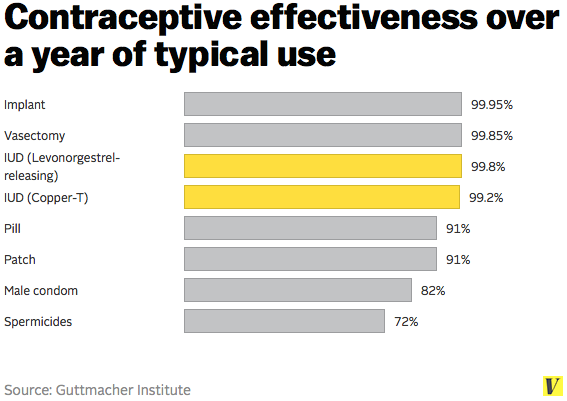
An Ohio Republican is trying to limit women’s access to long-term birth control. Elizabeth Nolan Brown ridicules his reasoning:
The first hearing for House Bill 351, sponsored by Cincinnati Republican Rep. John Becker, was held yesterday. At the hearing, Becker said insurance plans should be barred from covering IUDs because preventing the implantation of a fertilized egg—which IUDs could theoretically do, though they primarily work by preventing sperm from getting to that egg in the first place—could be considered abortion. “This is just a personal view. I’m not a medical doctor,” he added.
Sound policy reasoning there, Rep! Becker also acknowledged the wording of the bill could be interpreted to ban coverage of birth control pills, too, but he hadn’t intended it that way. He’s not a medical doctor, remember, just someone trying to play one with the weight of the state behind him. Under H.B. 351, all insurance plans in Ohio would be barred from offering abortion coverage. This isn’t a ban on “taxpayer funded abortions” we’re talking about—it’s an explicit restriction on the kinds of legal services that private insurance companies (and by extension, employers who offer health plans) can offer. Conservatives decry this sort of thing vociferously when it’s Obama making every insurance company and employer cover certain services.
German Lopez illustrates the bill’s folly with the above chart:
The bill, in other words, attempts to stop women, particularly low-income women, from using one of the most effective, practical forms of birth control.
The only exemption in the bill is for ectopic pregnancies, which could threaten the life of the mother. Pregnancies involving rape, incest, and other life-threatening circumstances would not be exempted. Becker’s bill isn’t the first time Ohio’s Republican-controlled legislature has moved to restrict abortions. In the latest state budget, Republicans approved a slew of measures that will, among other things, allow state officials to more easily shut down abortion clinics.
Tara Culp-Ressler highlights the impact the bill would have on poor women in particular:
The unintended pregnancy rate for women living below the poverty level is more than five times as high than the rate for the women in the highest income level, largely because they struggle to access affordable birth control. Since long-lasting forms of birth control like the IUD remain effective for years without the need to take a daily pill or a monthly shot, public health experts recommend them for women who struggle with avoiding pregnancy. But IUDs are expensive, and can cost as much as $1,000 upfront. A large 2012 study focusing on low-income women in St. Louis found that when cost barriers to IUDs are removed, more women choose them and fewer women end up needing abortions.
“The thing to remember is that that cover came out when I was in college, and I was a reader of the New Republic, and I knew that that was  where all the hot, young wannabe narrative journalists went. I knew that no black people worked at the New Republic. I also knew that the New Republic very much opined on quote-unquote “black issues” very often, in a fashion that struck me to be blunt and completely ill-informed and utterly ignorant. [Laughs]
If you want to know the source of some of my motivation, it’s that. It strikes you to be a young person and watch people in general speak about you as though you’re not there … Specifically I’m reacting to … the idea of people having a conversation as though you’re not in the room, with no curiosity about who you are about your humanity. Discussing you as a problem. Disease, an infection. That’s what comes across in that cover,” – Ta-Nehisi Coates with Isaac Chotiner, TNR.
Jennifer Senior warns that our gadget dependency both deprives us of sleep and encourages absent-minded eating:
It’s already fairly well established that people consume more food when watching television. Recently, researchers at the University of Bristol found the same among those who eat in front of their computers, though their sample was small and the design of their study was a bit eccentric (they fed 44 subjects the same meals at lunchtime; those who ate while playing computer solitaire were apt to eat twice as many cookies 30 minutes later as those who ate far from a glowing screen). The theory, whether it’s television or a desktop: You remember eating when you’ve made a separate activity out of it; you don’t if you’re doing something else, and therefore misgauge your appetite.
Yet it’s increasingly difficult for Americans to unplug.
Last winter, The Journal of Clinical Sleep Medicine reported that nine out of ten of us use a technological device in the hour before bed. (In 60 percent of those cases, it’s the TV, but that’s in aggregate; for Americans under 30, it’s cell phones, which the researchers deemed much more disruptive.) According to a Pew study from 2010, 65 percent of Americans sleep with their cell phones on or next to their beds (for people 18–29, that number jumps 90 percent.) And in 2012, a poll by Harris Interactive found that 54 percent of Americans look at their phones while lying in bed.
None of which is to say that curtailing email and Facebook and Twitter use will make us lose ten pounds. But it cannot hurt, at the very least, and reminds us that all of our cells, be they inside our bodies or in the palms of our hands, could use a good rest.
Stephen Walt thinks so:
First, he has put the idea of a further NATO expansion on the back burner for a long time, and maybe forever. Russia has opposed NATO’s march eastward ever since it began in the mid-1990s, but Russia was not in a position to do much about it. The brief 2008 war between Russia and Georgia was Putin’s first attempt to draw a red line, and that minor skirmish dampened enthusiasm for expansion considerably. This time around, Putin made it abundantly clear that any future attempt to bring Ukraine into NATO or even into EU membership will be met with firm Russian opposition and will probably lead to dismemberment of the country.
Second, Putin has restored Russian control over Crimea, an act that was popular with most Crimean residents and most Russians as well. The takeover entailed some short-term costs (including some rather mild economic sanctions), but it also solidified Russian control over its naval base in Sevastopol and will allow Russia to claim oil and gas reserves in the Black Sea that may be worth trillions of dollars. … Third, Putin has reminded Ukraine’s leaders that he has many ways to make their lives difficult. No matter what their own inclinations may be, it is therefore in their interest to maintain at least a cordial relationship with Moscow. And Ukraine’s new president, Petro Poroshenko, got the message.
Posner also disputes the theory, advanced by Tom Friedman, that Putin “blinked” after weighing the costs of the Ukrainian adventure against the benefits for his regime:
Russia’s economy was not weakened–the stock market was trading in the 1400s before the crisis and is trading in the 1400s today. The ruble is roughly unchanged, a hair lower. No
one really knows whether China got a bargain or not; too much depends on unknown contingencies. But it is clear that Russia has benefited from closer relations with China. NATO hardly seems revived, the European countries are in turmoil and divided in their response to Russia, and as dependent on its gas as ever. Defense spending is not likely to increase, but even if it did, Russia would hardly care since it has no plans to invade Poland or Germany, and knows that they have no plans to liberate Crimea or provide military aid to Ukraine.
Against these trivial costs if that is what they are, consider Russia’s gains. … Saying that Putin “blinked” is like saying that the boy who stole a cookie from a cookie jar blinked because he took only one cookie rather than all of them.
Meanwhile, the conflict itself continues apace, and Russian involvement has by no means ended. Anna Nemtsova reports that the rebels in eastern Ukraine have taken over a border town, opening a supply corridor with Russia:
What this means is that even as Russian President Vladimir Putin meets with senior European leaders on Thursday and he and U.S. President Barack Obama circle each other warily during the D-Day commemoration in Normandy on Friday, the war in eastern Ukraine may be moving into high gear. Although Putin has withdrawn most of the Russian troops that had been poised on the frontier threatening a conventional invasion, the way is now open for volunteers and operatives of various stripes, along with supplies, to move freely into the country.
A couple of journalistic colleagues and I had been hearing about attempts to open this corridor for several days as we traveled in eastern Ukraine. The Russian ministry of foreign affairs, Russian parliament parliamentarians and the Russian volunteers in Ukraine we spoke to all talked about establishing what they called a “humanitarian corridor.” We had been looking for the hole in the border, and we discovered it Wednesday near a city called Sverdlovsk in the region of Luhansk.
(Photo: Sasha Mordovets/Getty Images)
Computer-assisted trucking is coming soon:
Like Olympic skiers racing in single file to reduce air resistance, two 18-wheeler trucks in Nevada recently proved that uncomfortably close convoys can save drivers fuel and money.
The key, instead of bold Olympic athleticism, is robotic assistance. A computer-assisted truck was able to follow closely behind a human-driven truck perfectly, maintaining exactly 33 feet of distance between the vehicles. The promise is a future of safer, more fuel efficient, and more robotic trucking.
While Nevada is a friendly state for driverless cars, the system tested is only partially automated, with a driver in the computer-assisted truck still responsible for steering. In a way, that makes this a very, very advanced cruise control. The technology, developed by Peloton Tech, uses radar and a wireless link so that the following trucks travel at the same speed, braking simultaneously for safety, and doing so on an automated system that doesn’t have the delays of human reaction time. In addition, the drivers of both vehicles also have a video display, expanding both drivers’ vision and reducing blind spots.
Besides safety, the major selling point of this system is that the reduced drag saves fuel costs. Peloton says the “technology saves more than 7% [of fuel] at 65mph – 10% for the rear truck and 4.5% for the lead truck,” which is tremendous because “Long-haul fleets spend 40% of operating expenses on fuel, accounting collectively for over 10% of U.S. oil use and related carbon emissions.” These savings come primarily from reduced aerodynamic drag.
Joseph Stromberg determines that the “factors that block a broad rollout of self-driving trucks fall mainly into two categories”:
One is safety. People are understandably concerned about the idea of computers driving cars around on the roads, and those worries are amplified for tractor-trailers that can weigh up to 80,000 pounds when fully loaded. But experts actually predict that automated systems will make trucking safer, by eliminating distracted driving and human error. And Google’s driverless cars, at least, have now gone more than 700,000 miles without an accident. …
The other problem is legal. Right now, just a few states (including California, Nevada, and Florida) have laws on the books regarding driverless cars, and their legal status as a whole is murky. For driverless trucking on Interstates to be practical, all states would need to explicitly allow these vehicles on public roads. Advocates are hopeful that national legislation will solve this problem. It’s all very uncertain, but in 2012, Google’s Sergey Brin predicted the Department of Transportation would begin regulating autonomous vehicles nationally as early as 2017.
Update from a reader: “You CANNOT reference computer-assisted trucking and not include this video of Jean Claude Van Damme doing the splits between two Volvos!”:
Finally, a headline worthy of our age:
Why Is Gawker’s Top Story A Four-Year-Old Post About Vajazzling?
Not to be outdone by this one:
Boy Sentenced To Jail Because Of Large Penis
We also have news that Buzzfeed is now changing its presentation of ads-disguised-as-journalism by labeling them “promoted by” rather than “presented by” and originating with a “brand publisher” rather than a “Buzzfeed partner”. You may ask: what the fuck is a “brand publisher”? But that very bullshit is integral to the whole money-grubbing grift, isn’t it? The destruction of the English language is integral to the entire empire of adlisticles. And, as always with inherently corrupt enterprises like Buzzfeed, the alleged improvement is actually a deeper shade of con:
Gone is the not-yellow background, replaced by a small, actual yellow box with the words “promoted by.” Thing is, when you now look at their homepage, this new box layout makes the ad content blend in even more.
You can go about your day now.
Bilge Ebiri isn’t sold on Disney’s multi-dimensional villains, epitomized by Angelina Jolie’s performance in Maleficent:
Disney’s recent move away from classic villains is, on some level, a good thing, in that it allows them to delve into some heretofore unexplored types of relationships, and to find psychological complexity where once there was none. But I can’t help but feel like something has been lost as well. The Evil Queen, Maleficent, the Coachman, Shere-Khan. We didn’t spend a lot of time getting to know them. They were mysterious, elemental, totemic. And so, we could fill them with our own fears. They were charismatic enough that we brought our own complexity to them. These bad guys also put our heroes into sharper focus: Try to imagine Snow White without the Evil Queen, Peter Pan without Captain Hook.
Devon Maloney also has misgivings about Maleficent:
Role reversals in fairy tale retellings like these, when wielded well, are tools of rehabilitation. They provide an alternative to boorish archetypes and flat concepts of “good and evil,” and they prompt children (and adults as well) to consider the nuances of morality. But rather than restructuring the stories, these new retellings simply swap the characters around. (In a great criticism of Frozen writer Kip Manley calls that structure “the Rules.”) Villains wind up with the exact same traits as their “good” nemeses; no discomfiting outlier behavior for them. Evil—actual, absolute evil—is always obliterated. Good women remain feminine and kind, and always morally understandable, as they should be, and the villainess almost always regrets the qualities that made her an outcast. By the end, she’s been absorbed into the very “happily ever after” template the retelling purported to subvert.
 The Dish