Dating With Mental Illness, Ctd

A reader writes:

Molly Pohlig’s perspective on dating with mental illness is right on. I have PTSD and have watched the effects, pre- and post-diagnosis, torpedo many a relationship. In addition to the PTSD, I have two chronic pain conditions, so there is also the toll of being a physical caretaker. One man filled this role with ease; I ended our engagement for fear that I would destroy his gentle and kind nature with the rage and swings that are part of my life.

I spoke with a friend about this while my last relationship was in its death throes. He understands – he has PTSD himself from childhood trauma (very different than my adult-acquired version) and deals with depression, anxiety, and chronic migraines. He said he thought that the only way for someone struggling with an issue this serious to have a relationship was for them to find someone else with mental illness.

I thought he was being ridiculous and just flirting. I was wrong about the first part and right on the second. We are scheduled to be married this fall.

It works because our crazy is balanced. I don’t suffer daily anxiety, so things that make him anxious don’t feed me and I can ground him. He doesn’t struggle with intimacy issues, so he can remind me how to be a feeling person, rather than an emotionless automaton. It’s less stressful for him to take care of me, since I will have to take care of him some days, too. Plus, having someone who understands that there are limits to what you can control takes a huge burden off your bad days.

Is this the only way for someone with mental illness to find a partner? No, of course not. But it’s something I never would have considered as a way to make relationships a little easier until I tried it.

Another:

I’m coping with bi-polar disorder, would like to date, and envy those who hold down families, careers, and social lives with the condition. I can’t afford to date on my disability income with meager part-time work. What kind of financial stability can I possibly offer him as a life partner? I don’t know how Molly Pohlig does it, or does she depend on the other person paying her way?

Update from a reader:

I finally subscribed. It was this post that did it. I’ve struggled with mental illness (depression, anxiety). I am, at this very moment in my life, negotiating a new relationship and I don’t want my issues to torpedo this one as they have so many before. I had an incredibly empathetic reaction to this post and realized: where else can I read about foreign policy, pet ethics, and then have a moment like this? Of genuine heart? So, ya got me.

A Rebel By Any Other Name

Rebels

Will Moore looks at the labels applied to insurgents over time:

I plugged the words “bandits,” “communists,” “guerrillas,” “insurgents,” “rebels,” and “terrorists” into Chronicle and produced the graph [above]. We see that the US Civil War produced an enormous use of the word “rebels,” and though the count today is a much smaller percentage of the total number of words published in the Times,[1] we see that “rebels” grew dramatically in prominence in 2011. “Communists” first appears around 1918, and then explodes after 1945. The impact of 9/11 upon the word “terrorists” is equally prominent.

The Eight Billion Dollar Store

On Monday, the national discount store chain Dollar Tree announced that it would buy out its competitor Family Dollar for $8.5 billion in cash and stock:

Both Dollar Tree, which sells items $1 and less, and Family Dollar, which sells $1 items but also higher priced goods, have struggled amidst a weak economy. While years ago recession boosted deep-discount stores’ sales, Family Dollar reported in April declining second-quarter profits while announcing that it could cut jobs and close nearly 400 underperforming stores. Earlier this month, its third-quarter report noted a 33% drop in profit. Difficult economic conditions have become financial headwinds for discount store shoppers, who are forced to choose between discretionary and necessary items. … [A]verage shoppers have an annual income under $40,000, and 50% receive government assistance.

But the recession bonanza for discount stores has faded, Annie Lowrey observes, and now some of these chains are struggling:

So what’s happening in the consumer economy that might help explain the malaise? The answer is “not much” — that is, not much is happening, and that’s hurting retailers.

Unemployment is dropping, but consumers from the very low end of the market all the way through the middle remain skittish. Wages aren’t rising. Government support for strapped households has faded. As a result, retailers are struggling mightily to juice sales. The low end of the market is also seeing more competition for the penny-pinching customer, a result of the expansion of brick-and-mortar dollar stores through the Great Recession, retailers across the board offering lower-cost options and amped-up competition from online giants like Amazon.

To Matt Phillips, the Family Dollar/Dollar Tree merger is a perfect illustration of Thomas Piketty’s critique of contemporary American capitalism:

Let’s start with the backdrop: Essentially, the lower-income Americans that are the target customers of dollar stores have gotten too poor to buy anything other than food (a vivid illustration of Piketty’s point about income inequality). That has depressed margins and profits at these discount retailers. The fact that these poor Americans—and the retailers that serve them—are doing so badly attracted the attention of some of the richest and best-connected investors in the world. Funds associated with the activist investors Nelson Peltz and Carl Icahn have snapped up significant chunks of Family Dollar in recent months—as has the hedge fund manager John Paulson.

Extensive Dish cover of Picketty’s book here.

“Sartorial Slumming”

Kate Dries observes that denim-on-denim, or the “Canadian Tuxedo,” is so hot right now. Marcotte is unconvinced:

https://twitter.com/AmandaMarcotte/statuses/494103531507310594

Meanwhile, Judith Thurman – in what could well be the first New Yorker piece illustrated by Kim Kardashian in open-thigh jeans – examines the history of denim and other forms of “sartorial slumming”:

You may suppose that dressing like the indigent, in rags and tatters, to make a statement about art, politics, or identity, started with the punks. But Count Tolstoy adopted the rough homespuns of Russian serfs, along with a credo of “voluntary poverty,” inspired by Christ and Buddha, that wasn’t popular with his family members. In the nineteen-twenties, Paul Poiret accused no less than Chanel of perpetrating a look that he called la misère de luxe: costly couture outfits made from jersey tricot, a proletarian fabric formerly used only for work clothes and men’s underwear. It was suddenly chic to look as though you had something better to do, and to think about, than changing an effete toilette three times a day.

Update from a reader:

If you want a real example of double-denim the first time around, you could try this video:

C’est la vie!

The Hard Work Of Working From Home, Ctd

Readers – not to mention Dish staffers – can relate to a recent post:

I’ve worked from home for 15 years and I can’t imagine working any other way. The thought of having some middle manager keeping tabs on when I enter or leave the workplace, how long my lunch is, and when I choose to take off early for the day is now repugnant to me.

As a self-employed home-based freelancer, exactly the type reviewer Jenny Diski is describing, I decide how much my time is worth. When I want to take a few days off, I take them. When I’m finished with work at 2pm, I don’t sit in front of my computer trying to look busy for someone else – I go outside to play with my kids. If I want to take a vacation or pay off a credit card, I don’t have to figure out how to slice up a fixed monthly income differently; I can just take on an extra project or two, spend a couple weeks working longer hours, and get a fat check for my efforts.

I admit I’m extremely fortunate; I’ve been working this way for a long time and have a large stable of clients and steady work. Building up to that from nothing can be a tenuous and nerve-wracking prospect. And there are, of course, downsides.

You experience a kind of existential angst when you don’t get new jobs for a couple of weeks. I do take on too much work at times because it’s hard to say no. And it took me a long time to learn how to create boundaries between my work and home life, because I was the only one who could enforce them.

But those downsides are far outweighed by positives. The vast majority of us did work a normal job once and have chosen this path with eyes wide open. Whatever sense of stability a non-freelance job might offer, we’ve decided that being in control of our time and our money and our lives is infinitely more valuable.

Another nods:

Not everybody working from home is taking on small projects for an ever-changing list of clients. I’ve been working out of my house for more than 10 years now as an independent software developer. I have two long-term clients who pay me well to create and maintain software for them. I spend very little time networking and I enjoy the flexibility that I get from working out of my house.

I make more money, and because of the tax laws I’m able to dump a huge percentage of my income into my retirement plan tax-free while making a number of tax deductions not available to the average full-time employee. My car is 10 years old with only 100,000 miles on it because I’m not commuting 50 minutes each way to work each day. As for stability – I’ve survived a number of layoffs that full-time employees did not.

That being said, I know that this could all end tomorrow and I’d be back out looking for another client or two or even a full-time job. For the last 10+ years, however, I’ve been enjoying the independent contractor deal.

Another suggests that working from home is a different experience for mid-career professionals than for entry-level employees:

I’m a filmmaker who’s been working from home as a freelancer since 2008, mainly as an editor or producer of web content and the odd documentary film. At this point I wouldn’t trade it for the world, but I’ve had it good because I didn’t jump into it without a plan.

I’d been employed at a commercial production company prior to working for myself. That production company immediately became one of my primary clients, unloading work on me that they were too busy to handle. Additionally, I had built relationships with some of their clients, who – once they found out I’d gone into business for myself – were quick to throw work my way (and, more importantly, to recommend me).

So I made the jump from the baseline of having already built a solid professional network. I wouldn’t advise someone coming into the job market to try this without having already established themselves professionally. Desirable clients (meaning the ones willing to pay a premium for skilled craftsmanship, rather than the clients prowling Craigslist for discount labor) will always work with someone they know over taking a chance on a newbie. Acquaintances who have tried to make the jump to the freelance work without having an established network have invariably ended up working too many low-pay gigs, and eventually returned to the comforts of a 9-to-5.

The Best Of The Dish Today

I have only one thing to add to the endless news of Israel’s brutal, unrelenting onslaught in Gaza: and it’s at the very end of a live TV interview Chris Gunness did today. Gunness is the head of the UN’s Relief and Works Agency in Gaza. Israel bombed another of their schools today, killing children sleeping in a place they thought was safe. This seems to me to be the only human response:

I’m trying to restrain my emotions for the sake of intellectual clarity. In that spirit, a reader rightly noted how the US, in Afghanistan, has also killed children in collateral damage. That’s undeniable, and because we do not have video or photographs of the aftermath of drone strikes, we may be, in Gaza, seeing something that we too have done in counter-terrorism, and not fully owned. An independent study – at variance with official statistics – came to the following, harrowing conclusion:

“TBIJ reports that from June 2004 through mid-September 2012, available data indicate that drone strikes killed 2,562 – 3,325 people in Pakistan, of whom 474 – 881 were civilians, including 176 children. TBIJ reports that these strikes also injured an additional 1,228 – 1,362 individuals,” according to the Stanford/NYU study.

I cannot verify this – but I do not dispute the core point it makes. Singling out Israel for blame in atrocities is unfair when the US has done exactly the same – and when the level of sheer annihilation and misery in, say, Syria rivals and easily surpasses the gruesome toll and utter devastation in Gaza. But there are differences as well. The grimmest survey finds that the US killed 176 children over eight years; Israel has now killed over 250 children in a few weeks. And Syria is a full-scale civil war with evenly matched forces. Gaza is utterly at the mercy of Israel, whose Iron Dome has kept civilian Israeli deaths to a bare minimum. So this is truly a Goliath vs David moment in Gaza. And Goliath is still pounding David into the dust.

On another note, another reader noted that my own position on sex and Christianity has a rather orthodox adherent – C.S. Lewis, in fact, in Mere Christianity (Book 3, Part 5):

Finally, though I have had to speak at some length about sex, I want to make it as clear as I possibly can that the centre of Christian morality is not here. If anyone thinks that Christians regard unchastity as the supreme vice, he is quite wrong. The sins of the flesh are bad, but they are the least bad of all sins. All the worst pleasures are purely spiritual: the pleasure of putting other people in the wrong, of bossing and patronising and spoiling sport, and back-biting, the pleasures of power, of hatred. For there are two things inside me, competing with the human self which I must try to become. They are the Animal self, and the Diabolical self. The Diabolical self is the worse of the two. That is why a cold, self-righteous prig who goes regularly to church may be far nearer to hell than a prostitute.

The “pleasures of power” – what a wonderful phrase. How much more energy do today’s Christians expend excoriating the very human impulse to sex, and how little they spend warning against the entrapments of power?

Four other posts worth revisiting: the gathering punch of Obama’s calm sanctions against Russia; a new thread on whether all kids should get trophies; and why one great place to read is an empty pub – maybe with a talking Kindle Flare.

The most popular post of the day was So It Really Is All About Sex, Then, Rod? followed by The Shifting Israel Debate.

Many of today’s posts were updated with your emails – read them all here.  You can always leave your unfiltered comments at our Facebook page and @sullydish. 24 more readers became subscribers today. You can join them here – and get access to all the readons and Deep Dish – for a little as $1.99 month. Gift subscriptions are available here. Dish t-shirts and polos are for sale here (full details here). A new subscriber writes:

Hi Andrew. I’m a regular Dish reader but seemed to have resistance to subscribing (to this and other blogs). But tonight I had to sign up, mainly to acknowledge your courageous and constant coverage of the war in Gaza. I am heartsick about this inhuman carnage and can think of nothing to do about it.  At least you keep trying to show the pictures – and the excerpt from Tony Judt have been so prescient. Thank you.

See you in the morning.

Best Cover Song Ever?

No surprise about this hugely popular choice in the in-tray:

I nominate Jeff Buckley’s “Hallelujah”:

The Leonard Cohen version was beautiful, no doubt, but Buckley’s version made it gorgeous!

How another reader puts it:

It’s a revelatory interpretation that takes a poetic, if unremarkably performed, slow dirge and turns it into a soul-incinerating prayer. It’s an amazing example of a good song finding its most powerful expression in the hands of another artist.

Another notes, “I don’t even think ‘Watchtower’ has a whole book written about it.” Another piles on the praise:

To date, Cohen’s song has been covered over some 2,000 times according to leonardcohen.com.  It has been covered professionally by the likes of everyone from Willie Nelson, K.D. Lang, Bono, and Justin Timberlake just to name a few. Buckley voice brings harmony and soars to the hauntingly beautiful words of Cohen.  No matter whatever mood I am in, this is one song that’s on all my playlists. It is truly the best cover ever.

But the contest isn’t over yet.

Dish Shirts Are Here!

shirt-combo

[Update: Premium tri-blend tees are no longer available. 100% cotton versions here.]

Finally – after lots of your input – we’re psyched to offer you a choice of four custom Dish shirts. If you’re dying to take a look and want to skip the descriptions below, head straight to our storefront and buy your shirt now!

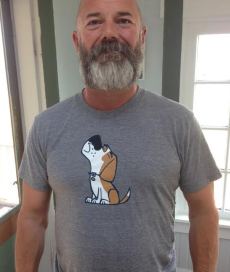
We thought we’d start our store simply enough by offering two t-shirts. The first is a light blue one emblazoned with the Dish logo across the chest (see above on the left). Or if you prefer the baying beagle by herself, check out the gray Howler Tee (modeled by the dashing bear on the right). I love the lone howler myself – only other Dishheads will get it.

andrew_howler-teeWe picked American Apparel t-shirts that use high-quality screen-printing and a higher quality tri-blend fabric that’s super soft, durable, and has a bit of stretch that retains its slim shape. There are  sizes for both men and women – no generic “unisex” option this time around, as you insisted. We’ve also lowered the price by half compared with the t-shirts we did a few years ago.
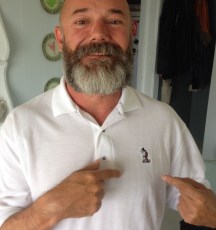
Want something a little more formal you can wear to the office, church, or restaurant? Check out the polo shirts, which come in white (see below left) and navy blue (see above right). Both of these classic polos are made with a “Silk Touch” poly-cotton fabric and embroidered with the familiar Dish beagle on the left breast. The polos run a little large, and the high-quality fabric is shrink resistant, so keep that in mind when you pick your size. For the perfect fit, consult the sizing chart.

andrew_white-poloBecause we’re doing the higher-quality screen-printing option with a bulk-ordering process, in order to keep prices down, these particular shirts will only be available for a limited time, so you need to order very soon to be part of the first printing. So if you’re interested in a shirt, don’t hesitate – buy now!

As always, we welcome your feedback in the in-tray. And send us a pic of you wearing your new shirt! You may see it appear on the blog.

But first go here to grab your new t-shirt or polo. It’s one critical way to keep the Dish independent and running for years to come. And they’re pretty sweet as well.

Bearing Witness, Or Wearing Us Down?

The firehose of social media allows both reporters and citizen journalists to reach massive audiences in real time. David Carr weighs the ups and downs of this immediacy when it comes to war reporting:

Bearing witness is the oldest and perhaps most valuable tool in the journalist’s arsenal, but it becomes something different delivered in the crucible of real time, without pause for reflection. It is unedited, distributed rapidly and globally, and immediately responded to by the people formerly known as the audience. It has made for a more visceral, more emotional approach to reporting. War correspondents arriving in a hot zone now provide an on-the-spot moral and physical inventory that seems different from times past. That emotional content, so noticeable when Anderson Cooper was reporting from the Gulf Coast during Hurricane Katrina in 2005, has now become routine, part of the real-time picture all over the web. …

So now that war comes to us in real time, do we feel helpless or empowered? Do we care more, or will the ubiquity of images and information desensitize us to the point where human suffering loses meaning when it is part of a scroll that includes a video of your niece twerking? Oh, we say as our index finger navigates to the next item, another one of those.

Mathew Ingram’s take:

Although Carr doesn’t get into it, the other downside that some have mentioned is that the news environment has become much more chaotic, now that everyone with a smartphone can upload photos and report on what is happening around them — including the terrorist groups and armies that are involved in the conflict that is being reported on, and the ultimate victims of their behavior. Hoaxes and misinformation fly just as quickly as the news does, and in some cases are harder to detect, and those mistakes can have real repercussions.

At the same time, however, there are some fairly obvious benefits to the kind of reporting we get now, and I would argue that they outweigh the disadvantages. For one thing, as Carr notes, we get journalism that is much more personal — and while that personal aspect can cause trouble for reporters like Mohyeldin and Magnay when they stray over editorial lines, in the end we get something that is much more moving than mainstream news has typically been.

But Micah Zenko fears that this environment has encouraged “chicken-littleism” to run rampant in the media:

The long-standing phenomenon of “if it bleeds, it leads” is now significantly amplified and spread in near real time via social media. For example, virtually anyone who uses Twitter for news gathering will notice that tweets run overwhelmingly toward the alarming, negative, or just horrific. Social media also makes this bad news more intimately personified, since a photograph of human suffering will generate more clicks, retweets, and favorites than a 140-character description alone. Incredibly brave activists, researchers, and journalists in conflict-prone countries wittingly feed this insatiable demand with emotional stories of intense heartbreak or tragedy, and an occasional story of personified heroism in the middle of all the chaos.

Dismal descriptions and perceptions of the world are reinforced by the near absence or minimization of positive international news stories. Now if it doesn’t bleed, it isn’t even newsworthy.