This week’s story is Amy Bloom’s “Silver Water,” in which a woman movingly describes her older sister’s descent in mental illness. How it begins:
My sister’s voice was like mountain water in a silver pitcher; the clear blue beauty of it cools you and lifts you up beyond your heat, beyond your body. After we went to see La Traviata, when she was fourteen and I was twelve, she elbowed me in the parking lot and said, “Check this out” And she opened her mouth unnaturally wide and her voice came out, so crystalline and bright that all the departing operagoers stood frozen by their cars, unable to take out their keys or open their doors until she had finished, and then they cheered like hell.
That’s what I like to remember and that’s the story I told to all of her therapists. I wanted them to know her, to know that who they saw was not all there was to see. That before her constant tinkling of commercials and fast-food jingles there had been Puccini and Mozart and hymns so sweet and mighty you expected Jesus to come down off his cross and clap. That before there was a mountain of Thorazined fat, swaying down the halls in nylon maternity tops and sweatpants, there had been the prettiest girl in Arrandale Elementary School, the belle of Landmark Junior High. Maybe there were other pretty girls, but I didn’t see them. To me, Rose, my beautiful blond defender, my guide to Tampax and my mother’s moods, was perfect.
She had her first psychotic break when she was fifteen. She had been coming home moody and tearful, then quietly beaming, then she stopped coming home. She would go out into the woods behind our house and not come in until my mother went after her at dusk, and stepped gently into the briars and saplings and pulled her out, blank-faced, her pale blue sweater covered with crumbled leaves, her white jeans smeared with dirt. After three weeks of this, my mother who is a musician and widely regarded as eccentric, said to my father, who is psychiatrist and a kind, sad man, “She’s going off.”
Read the rest here. The story also can be found in Bloom’s collection, Come to Me. Previous SSFSs here.
CYJO’s series “Mixed Blood” portrays mixed-race families:
CYJO identifies herself as a Westerner of Korean ethnicity (she was born in South Korea and raised in the United States) and photographed the series “Mixed Blood” from 2010–13 in both New York and Beijing. … CYJO said one of the reasons she began the series was a curiosity about exactly what “mixed ethnicity” currently represents, noting that as countries such as China continue to modernize, how the mix of new culture will blend with longstanding traditions will be interesting to follow. While there are people who fear cultural blending, CYJO said the idea of a global identity and our definition of self, culture and race is rooted in life experiences and personal choices.
“But the bigger question is how will cultures and people maintain their individuality?” she asked. “What will be those cultural differences aside from language and food that will make a culture unique? There’s so much more we can learn from each other, especially from our differences.”
“Mixed Blood” is traveling to multiple cities in China. The exhibition, which launched at Today Art Museum in Beijing, is sponsored by the US Embassy, Beijing, curated by Nik Apostolides, and designed by Timothy Archambault. Check out the book here. See more of CYJO’s work here.
Still haven’t gotten around to reading Ulysses or In Search of Lost Time? For the literary-minded Daniel Genis, a 10-year stint on Riker’s Island helped:
Aside from consuming The New Yorker, Harper’s, and The Atlantic (“not the easiest magazines to give away in prison”) nose to tail, Genis lavished the bulk of his attention on serious fiction, especially the long, difficult novels that require ample motivation and time under the best of circumstances. He read Mann, James, Melville, Musil, Naipaul. He vanquished “Vanity Fair” and “Infinite Jest.” He read, and reread, the Russians, in Russian. He kept up with Chabon, Lethem, and Houellebecq. At first, Genis resisted “Ulysses,” but his father kept bringing it. “I argued that he wouldn’t have the willpower to get through it once he became a free man,” [his father] Alexander Genis told me. …
The seven volumes of Proust took Genis a year to finish. Much of it was spent in solitary confinement—he had been charged with “unauthorized exchange” after several prisoners “sold [him] their souls” for cups of coffee (“some Christian guards didn’t care for my sense of humor”). He read “In Search of Lost Time” alongside two academic guidebooks, full of notations in French, and a dictionary. He said that no other novel gave him as much appreciation for his time in prison. … In prison, time was both an enemy and a resource, and Genis said that Proust convinced him that the only way to exist outside of it, however briefly, was to become a writer himself. He finished a novel, a piece of speculative fiction about a society where drugs have never been criminalized, titled “Narcotica.” Later, when he came across a character in a Murakami novel who says that one really has to be in jail to read Proust, Genis said that he laughed louder than he had in ten years.
A reader, responding to this post on financial literacy, adds something relevant to this post as well:
Funny coincidence: Catey Hill published a piece this morning about a young murderer who’s become a self-taught investment expert, and an advisor to his fellow inmates and even prison staff. One guard dubbed him the “The Oracle of San Quentin”. Here’s a fun bit:
Carroll also stresses the importance of reading beyond financial publications. His magazine list includes some highly unlikely fare for a men’s prison, including Teen Vogue (great for insight into things that teens adopt first, like social media); PopStar! (to keep up with the entertainment industry) and Shape (for fitness innovations and products).
Paul Gallagher recommends Rainer Werner Fassbinder’s short film Das kleine Chaos (A Little Chaos), above. He sees the influence of Godard and Bertolt Brecht:
The story concerns three young wannabe criminals, who take their lead from the b&w gangster films of 1940’s and ‘50’s Hollywood. Made in 1966, it’s an assured and highly stylish nine minutes of celluloid that proves Fassbinder’s ability to adapt his influences, better them and make them his own.
Godard’s influence also struck Jordan Hoffman, who found the movie “one of those films you watch in complete rapture because you have no idea what is coming next”:
A group of youngsters (lead by young R.W. replete with John Lennon-style hair) can’t get anywhere in life selling magazine subscriptions, so they turn to a life of crime … only a life of meta-crime. The look and character dynamic is stolen wholesale from Godard, but the dialogue and action is, again, dirty and bordering-on-too-violent. Imagine if the three from Bande a Part not only ran through the Louvre but also stole some paintings. A facinating short.
Laurie Penny calls out a literary double-standard, arguing that “when men write about their experiences in a political context, it’s never called ‘confessional’—it’s just ‘literature’, or a ‘memoir'”:
[M]ale political experience is never coded as male—it’s just universal truth. In five years as a columnist and commentator who also happens to be young and female, I have lost count of the times I have been encouraged by editors to write about being a woman, in a way that is “provocative” without really challenging sexism. I have been encouraged to be a “voice” for young women—to draw attention away from how most newspapers’ political pages are still dominated by men’s words, men’s agendas.
Now that I’m lucky enough to be able to pick and choose, I often hear the same thing from younger women writers: that they can pay their rent, or have their pitches listened to, only if they write about fashion or diets or dating in a way that is modestly feminist but still fluffy enough to sit within the “women’s pages,” which are usually part of a paper’s lifestyle section by virtue of not being considered serious politics.
Along the same lines, Katie Roiphe speculates that critics raving about My Struggle, Karl Ove Knausgaard’s extensively detailed autobiographical novel, would hold their tongues if the author were instead a “Carla Olivia Krauss”:
I don’t think we would be able to tolerate, let alone celebrate, this sort of domestic diarylike profusion from a woman.
A 30-page riff on going to a party with children, and trying to balance your food while watching your child, and what exactly happens to her shoes, would appear, if a woman wrote it, both banal and egoistic. (Knausgaard writes, “I felt a surge of warmth in my breast. Leaned over and picked up a diaper and a pack of wipes while Heidi clung to me like a little koala bear. There was no changing table in the bathroom, so I laid her on the floor tiles, took off her stockings, tore off the two adhesive tabs on the diaper and threw it into the bin under the sink while Heidi watched me with a serious expression. ‘Just wee-wee!’ she said. Then she turned her head to the side and stared at the wall, apparently unmoved by my putting on a clean diaper, the way she had done ever since she was a baby.”) Reviewers and readers alike would think it was narcissistic, well-traveled, self-indulgent. …
I am not trying to make the point that male readers and critics would dismiss Carla, which they would, but that female readers and critics would as well. … The particular variety of rage aimed at women who document their daily lives, especially if they don’t involve a childhood of poverty or abuse or illness, is deeply entrenched and irrational. It’s not just that we don’t think of what they are doing as art, but that it annoys us, riles us. It feels presumptuous, vain, narrow, feminine, clichéd. It is not chic the way Knausgaard’s stormy ruminations on the minor oppressions of family life are chic.
Meanwhile, Sheila Heiti applauds Adelle Waldman for narrating her novel The Love Affairs of Nathaniel P. from a male perspective. She argues that “formally, not just factually, it’s important that the author is female”:
This is hardly the first book in which a woman inhabits the mind of a man, but here it seems we’re never meant to forget that a woman is behind the writing. Just as we later see Nate outsourcing his conscience to the women around him, it’s as if the novel’s subject – the dissection of the male psyche in the context of dating – has been outsourced to Waldman, a writer who has the talent to write about anything but was given this subject because she is a woman; because the men in her milieu who have written about Nates haven’t looked so closely at the pain these men cause: her book is less an apologia than the case for the prosecution. It is methodical; Waldman has done the work of imagining so we can all understand this sort of guy’s behaviour and mentality. It’s almost a public service.
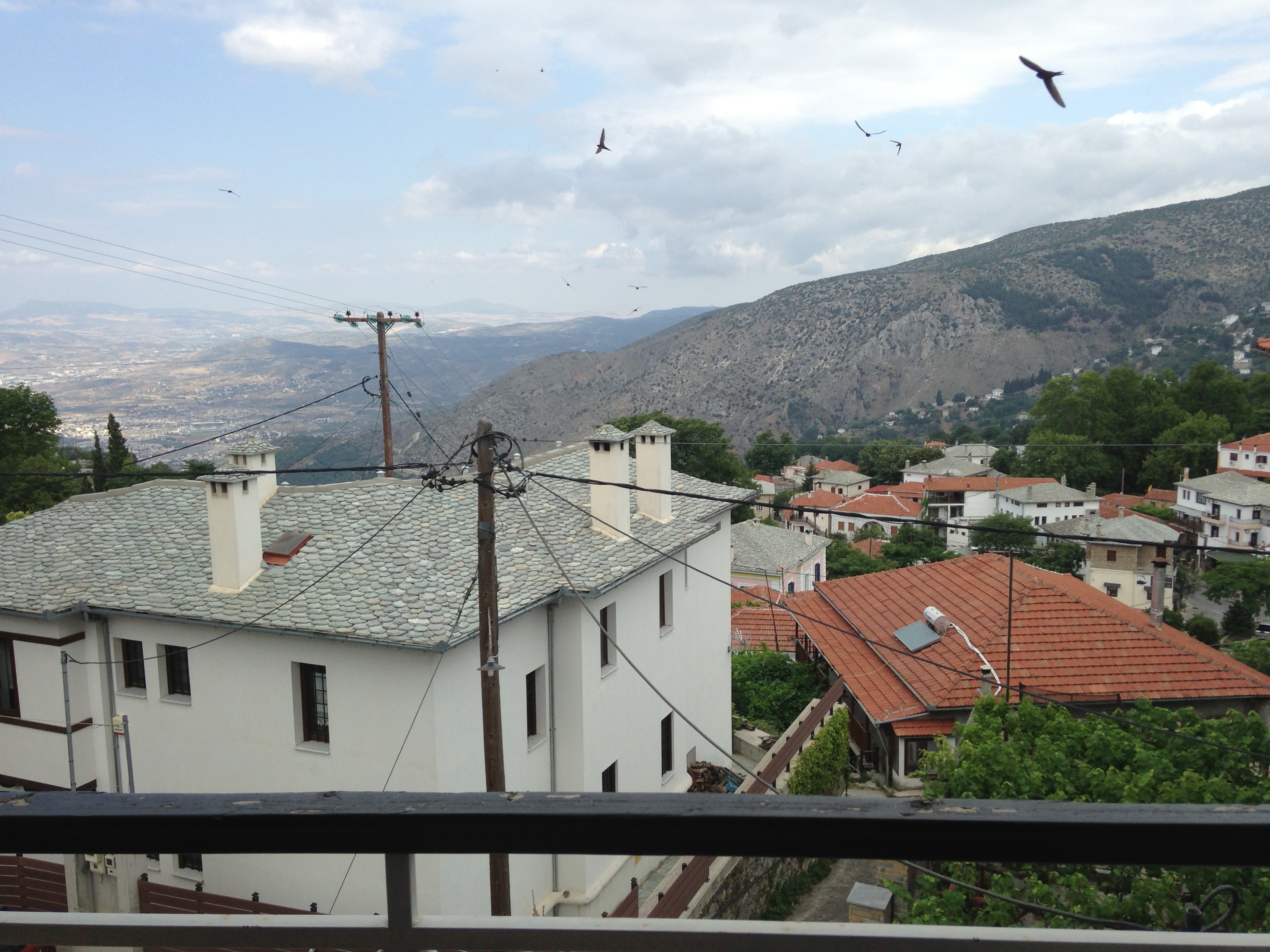
You have until noon on Tuesday to guess it. City and/or state first, then country. Please put the location in the subject heading, along with any description within the email. If no one guesses the exact location, proximity counts. Be sure to email entries to contest@andrewsullivan.com. Winner gets a free The View From Your Window book or two free gift subscriptions to the Dish. Have at it.
Leon Neyfakh singles out 1994 as a turning point for the Internet: “The number of websites grew from 623 at the beginning of the year, according to one study, to more than 10,000 at the end.” He presents an oral history of the period when just “clicking around on things was wildly entertaining, because it was so novel”:
[Michelle] Johnson [first editorial manager of boston.com, website of the Boston Globe]: When we launched boston.com [in the fall of ’95] … [o]ne of the first responses that we got was from some guy in India who was like, “Oh my God, I can get the Red Sox scores in real time!” Of all the stuff we were doing we weren’t expecting people to get that excited about getting sports scores—it hadn’t crossed our minds. We were also focused on a local audience, and here was this guy from halfway around the world who was jumping up and down about getting to read our sports stories.
She continues:
The thing that shocked me the most was how quickly young people moved away from print. I would not have bet anybody that [it would happen] as fast as it did…. I felt a little blindsided…. The term “cannibalize” did come up. I remember people saying we’d cannibalize the print product by giving away stories online. And at the time I was squarely in the camp of, “the Web wants to be free.” It was just the culture back then: You can’t charge people for stuff online. Had I taken the longer view, I would have seen that we were training a generation to expect great stuff for free and that that was going to hurt us. But back then I would have thrown my body on the tracks and said we’d be crazy to charge for this.
Roman Khudyakov, a member of the Russian Duma, is gravely concerned about a moral threat to the country’s children: he recently discovered that youngsters are being exposed, on a daily basis, to a graphic image of male genitals. The object of Khudyakov’s outrage is the hundred-ruble note (worth a bit less than three dollars), which shows the façade of the Bolshoi Theatre, adorned with a world-famous sculpture of a chariot driven by the Greek god Apollo. It is Apollo’s intimate parts that, in Khudyakov’s opinion, pose a dire problem.
In a televised interview on Euronews, he said he had evidence that the hundred-ruble note provoked unhealthy curiosity:
he had personally seen a little boy and a little girl closely examining the bill and pointing to the region of the body in question. (If true, the two kids must have been highly inquisitive: it is extremely difficult to even discern the actual “parts” without magnifying the image.) Khudyakov’s proposed solution was to mark the bill with an eighteen-plus rating. Better still, as he suggested in a letter to the Russian Central Bank, remove the morally improper bills from circulation and replace them with ones bearing an image of Crimea, annexed by Russia in March.
Khudyakov’s initiative may sound like a joke—and, indeed, the Russian media and social networks promptly made fun of it, suggesting that children should now be barred from human-anatomy classes and museums—especially in St. Petersburg and Italy, where a minor might be exposed to the works of Michelangelo and other Renaissance sculptors—and certainly kept away from the statue of the Manneken Pis, in Brussels. The lawmaker’s attack on the banknote was hardly a joke, though. It was, rather, of a piece with the anti-liberal trend that has dominated the Russian scene since Vladimir Putin’s return to the Kremlin.
— Herdwick Shepherd (@herdyshepherd1) May 26, 2014
Dish poetry editor Alice Quinn writes:
Last Friday on July 4th, in an Ask Me Anything segment, Andrew responded to a reader’s question as to whether after 30 years here he identified more as American or English. I was struck by his saying, “The impact—when I look at it now—of the English countryside on my psyche was bigger than I ever really anticipated. I find myself drawn constantly to that sort of rural calm.”
We’ve recentlypostedpoems by John Clare (1793-1864), and I can’t seem to stop reading and memorizing his work, particularly the sonnets which are so expressive of his tender devotion to the English countryside. So this week we’ll post a few more and dedicate them to Andrew, to England, and to readers of The Dish who may be moved to learn some poems by heart this summer. We’ll start with one with a dog to up the ante with Mr. Sullivan! In the poem, “nine-peg-morris” refers to a game played on squares cut in turf.
“The Shepherd Boy” by John Clare:
Pleased in his loneliness he often lies
Telling glad stories to his dog—and e’en
His very shadow that the loss supplies
Of living company. Full oft he’ll lean
By pebbled brooks and dream with happy eyes
Upon the fairy pictures spread below,
Thinking the shadowed prospects real skies
And happy heavens where his kindred go.
Oft we may track his haunts where he hath been
To spend the leisure which his toils bestow
By “nine-peg-morris” nicked upon the green
Or flower-stuck gardens never meant to grow
Or figures cut on trees his skill to show
Where he a prisoner from a shower hath been.
Richard Linklater spent more than a decade filming his new movie Boyhood:
[I]n 2001, a few years after his eldest daughter started elementary school, he felt compelled to make a movie about growing up. But focusing on any one facet of the passage through youth would require “trumping something up”—exactly the opposite of what worked in his unfussy observational classics Dazed and Confused and Before Sunrise. So, long interested in research like the famous Grant Study, which has tracked 268 Harvard students’ development over 76 years, he devised a longitudinal method: film a single child actor for a few days each year for more than a decade, resulting in a fictional coming-of-age story whose star actually comes of age onscreen.
In a rave review, Dana Stevens looks back at Boyhood‘s cinematic precursors:
I can think of few feature films in the history of the medium that have explored the power, and the melancholy, of film’s intimate enmeshment with time in the way Richard Linklater’s Boyhood does.
There’s François Truffaut’s Antoine Doinel series, in which we watch that character, a truant kid played by Truffaut’s onscreen proxy and eventual quasi-adopted son Jean-Pierre Léaud, age from around 12 to around 32. But since those five films were made over a period of 20 years, the shock of watching Léaud grow up comes at us serially, in chunks. Michael Apted’s extraordinary Up documentaries, which check in every seven years on the progress of the lives of a group of British schoolchildren first filmed in 1964, are even more widely spaced; visiting each new installment is like attending a family reunion, wondering who will show up and what condition he or she will be in.
Like Stevens, Chloe Schama finds the film a “carefully calibrated, subtle exploration of the various textures of different ages and the passage of time”:
It’s hard to write about this theme – and probably much harder to make a film about it. The subject lends itself to hazy, dorm-room theorizing of a particularly cringe-inducing variety. But the film seems self-conscious of its pretensions. Yes, it opens with a dreamy shot of young Mason lying in the grass while Chris Martin croons “Look at the stars, look how they shine for you …” And it ends with a conversation between Mason and an implied new love interest about the true meaning of “carpe diem.” It’s like, the girl says, the reverse: “the moment seizes us.” Yeah, Mason agrees: “It’s always right now.”
But these awkward articulations of the philosophical undertones of the film seem almost tongue-in-cheek, and they’re not so prevalent as to become oppressive. The point here seems to be that college freshman Mason is not much more enlightened about the funny tricks of time than his wistful six-year-old self, but there is beauty in his attempts to approach some insight on the matter.
Praising the film as a “masterpiece,” Marlow Stern marvels at how the scriptwriting process came together:
Linklater began the project with a skeleton of sorts. He had each character’s main plot points mapped out, and knew how the film would end—as well as its final shot—at conception. According to Linklater, he’d watch and edit the footage he’d shot from the previous year several times before starting an outline, which would later evolve into a script, for the following year. Sometimes, the script wouldn’t fully materialize until a few days before shooting.
“I got to watch my film, think for a year, and re-script it,” says Linklater. “I could never re-shoot anything, but could re-script it, which is where I’d incorporate the incremental changes of my four actors growing and changing, and where I could adjust any ideas I had to the reality in front of me.”
The actors filled in the free-form “unconventional script” with their own life experiences. Linklater and Hawke based the latter’s character on their fathers, since both men were Texan insurance agents who found happiness in their second marriage. Arquette based her character heavily on her mother who, like her character in the film, went back to school, got her degree, and became a psychiatrist. Ellar, meanwhile, seemed to gain more and more confidence in his acting ability as the “living project” progressed, and it shows onscreen.
In an interview, Ellar Coltrane talks about what it’s like to watch that process play back now that the movie is finished:
[M]y experience with it changes every time I watch it, really. I watched it a couple of weeks ago and it was so different from the first time I watched it. … [W]here the film ends is more or less—especially the first time I watched it—where I am in my life. It’s exactly where Mason is in that last scene. I was going through that emotional change and that process. So it was very super fresh, and every time I watch it I’m getting a little farther away from the film and from where the character is at the end. So I can’t imagine in 10 years, but I’ll always have it. And it’s comforting to know that I’ll always have this thing to watch at any point in my life and just remind myself.
The movie isn’t as Here Comes the Big Cry as the trailer and the concept would make you think; it’s far too smart and wise for that. Yet I still bet it makes you bawl your head off. Boyhood comes as close as capturing actual human existence as any film I’ve ever seen. It will feel like you have watched a full life, fully lived. And the best part: As the film ends, Mason’s life is only beginning. Everyone’s always is.


 The Dish