Why Not Just Provide The Pill Over The Counter? Ctd

A reader writes:

I have no problem with forms of the birth control pill being made an over-the-counter drug. Women are intelligent beings who can figure out how to use these drugs correctly, and the side effects from using birth control pills are less severe than those of other drugs currently sold over-the-counter.

That said, just selling a birth control pill over the counter wouldn’t make up for losing contraceptive coverage from health insurance. An IUD can cost upwards of $1,000 upfront for the exam and insertion. That’s a big chunk of change that many women can’t save up for. It also happens to be one of the most reliable forms of birth control because women don’t have to take a pill at the exact same time every day; once it’s in, you can largely forget about it until you want to take it out.

So pushing birth control as an OTC drug does not eliminate the need for women to have contraceptive methods covered on their health insurance.

Another speaks from personal experience to make the case “why birth control pills should not be sold overthe-counter”:

I took the pill on and off for about ten years when I was in my late teens and 20s. At first, it was prescribed by a general practitioner, and then by an elderly OB/GYN. After I married, I moved to Connecticut and needed to find a new OB. I went with the closest provider listed in my insurance booklet, which turned out to be a Planned Parenthood.

I have a history of migraine with aura.

I don’t get severe migraines as these things go, and I don’t get them frequently. Like 1/3 of migraine sufferers, however, I get weird symptoms that precede the headache – mine are visual and include flashes and zigzags of light, which is typical. According to a quick google search, 5-10% of women of childbearing age have migraine with aura, so this is hardly an exotic diagnosis.

The doctor at Planned Parenthood took the time to review my medical history. She started asking probing questions about having checked the box for “migraines” on my medical history form, which seemed bizarre to me. And then she told me she would not be renewing my prescription for the pill. While the absolute risk is still comparatively low, women who have a history of migraine with aura have a greatly increased risk of stroke if they take the combined pill (meaning the pill with both estrogen and progesterone; the vast majority of women on the pill take the combined pill).

I thought she was crazy until I went home and googled it, and she was absolutely correct. The WHO unequivocally states that women with a history of migraine with aura shouldn’t take the combined pill. Women with a history of migraine with aura can safely take progesterone-only versions of the pill, but those are less effective.

The pill is a drug. Drugs have side effects and risks. These risks are greater for some of us than others. When a drug is sold over the counter, people tend to assume the risks are minimal, and with the pill, this isn’t the case.

Update from a reader, who responds to that last paragraph:

So let’s put it behind the counter and have pharmacists dispense it. Thanks to credential creep, American pharmacists get almost as much training as doctors. Every drugstore has a licensed pharmacist but they have little practical authority to use that training. Their two main jobs are to catch doctor screw-ups and to waste your time waiting for them to check with you that yes, you have been on this medication for ten years.

Why not use the pill as a wedge to introduce the intermediate class of drugs between prescribed and OTC that most Western countries have? It’d eliminate a lot of unnecessary med-maintenance appointments with physicians, increasing capacity and lowering costs.

The Jews Of Shanghai

The Sephardi Chief Rabbi of Israel, Rabb

Julian Gewirtz and James McAuley explore the history of the city’s Jewish community:

As early as 1845, when Shanghai was forcibly opened to foreign trade under the unequal treaties that concluded the Opium Wars, a network of prominent Sephardic Jewish merchant familiesthe Kadoories, the Hardoons, the Ezras, the Nissims, the Abrahams, the Gubbays, and, most prominently, the Sassoonstook root in the city and eventually joined the ranks of its Western occupying elite.

Small but powerful, this Sephardic merchant class financed many of the Beaux Arts mansions along the stately Bund, Shanghai’s version of Vienna’s Ringstrasse. Completed in 1929, Victor Sassoon’s Cathay Hoteltoday the Peace Hotelwas the Bund’s crown jewel, the center of their cosmopolitan social world. In that sense, much of what survives today from prewar, European Shanghai is an artifact of Jewish Shanghai. When Nazi refugees arrived in the mid-’30s, Shanghai’s existing Jewish community became even more visible, swelling in size to nearly 30,000.

It was in this period of traumatic conflictin Europe and in Asiathat Chinese leaders across the ideological spectrum, relying on stereotype but not necessarily on a Western anti-Semitic vocabulary, began to discuss the Jews as a people worthy of special attention.

The association between Jews and prosperity survives in China today:

Whether this association is philo-Semitic in its enthusiasm or anti-Semitic in its reliance on caricature is difficult to say, perhaps because the Chinese popular imagination seems to have imbued a historically negative Western stereotype with a decidedly positive meaning. At the Shanghai Jewish Refugees Museum, which commemorates the city’s hospitality during World War II, an elderly Shanghai native working as a security guard recalled to us that he had known what Jews were as he was growing up because “Jews lived in Shanghai” and “Jews built the Peace Hotel.” He grinned broadly. “We say that a person who is very shrewd is ‘like a Jew.’” A compliment? At least in Shanghai.

(Photo: The Sephardi Chief Rabbi of Israel, Rabbi Shlomo Amar (C) prays with a group of Orthodox Jews on June 12, 2006 during a tour of the historic Ohel Rachel synagogue which was built in 1920 during the period of the first wave of Jewish migration to Shanghai. The Chief Rabbi is in China to meet government leaders in Shanghai and Beijing and toured the synagogue which is only open to the Jewish community during special religious occassions and used to house up to 700 devotee’s in the period 1920 – 1949 when many Jews sought refuge in Shanghai. By Mark Ralston/AFP/Getty Images)

Cooling Off With Compost, Ctd

A reader says the case for no-till farming is more complicated than it seems:

While the evaporation argument made by the Ars Technica article is valid, I don’t see the benefit from the change in albedo – the amount of sunlight reflected from the Earth’s image001surface. During most of the hot and sunny portion of the summer, for example, the crops we grow on our family farm in Missouri will have grown tall (corn) or canopied (soybeans) so that the residue is in shadow. Other crops like winter wheat are planted and harvested on a different cycle, so there might be more benefits from the effect on albedo.



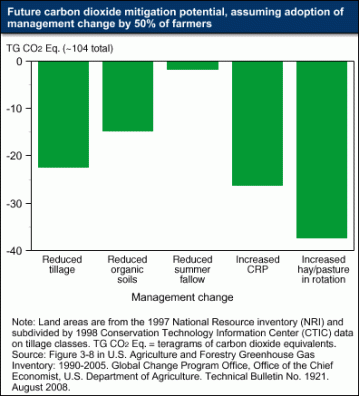
Regarding carbon affects, there are drawbacks to no-till systems. Typically, more herbicide is required to kill weeds, and more nitrogen (which is produced with fossil energy) is required for fertilizer. Farmers argue about the comparative yields, but generally, flat land farmers still use conventional tillage. A recent USDA analysis shows that 35.5 percent of US cropland was planted with no tillage in 2009. No-till use has increased a great deal since it began to be adopted in the 1980s, but even in the US it’s still used on a minority of farms. There’s research under way at the Economic Research Service of the USDA on the potential of various methods to mitigate carbon dioxide additions to the atmosphere. Here‘s an example of their analysis [partly illustrated in the above graph].

Overall, higher temperatures and the greater risks and uncertainty of more extreme weather conditions are driving forecasts for 15- to 20-percent reductions in crop yields over the next 25 to 50 years. The implications of those forecasts are sobering.

The Past Is A Place You Can Visit

Susan Cheever, author of the recently-released e.e.cummings: A Life, reveals a mystery that haunted her while working on the poet’s biography: his father was killed and his mother injured in a 1926 car accident caused by driving over railroad tracks into the path of an oncoming train. How could the pair have missed it hurtling toward them? The incident, never fully explained in previous books about Cummings, made her think about the research methods available to biographers (NYT):

EECummings_pd4Three official types of research are the foundation of writing biography: Primary-source research uses original papers found in libraries, archives or occasionally an attic; secondary-source research uses the work of other writers and researchers; interviews can be with experts, people whose memories are useful or other writers and researchers. There is a fourth kind of research. It doesn’t have a fancy name; it is just going to the places where the story happened. Landscapes often speak, and houses hold ancient scenes and memories and secrets.

She reveals how this fourth research method helped her solve what happened that night in New Hampshire almost nine decades ago:

Once I saw the crossroads, the accident made perfect sense. The tracks were perfectly flush with the road and came toward it at a 45-degree angle from the right — Rebecca Cummings’s blind side in the driver’s seat, especially in the snow. I walked around a bit, noticing which of the trees were second growth and which might have been there in 1926. I could almost hear the screech of brakes from the locomotive and the dreadful sound of metal crushing the wooden frame of the Franklin and shattering the windshield. I could see the brakemen running through the snow and imagine Rebecca’s insistence that her husband’s body be covered. The Chevy engine ticked quietly. An occasional car passed going north. Then the dachshund began to whine. I was back in 2012. I said a small prayer for the soul of Edward Cummings and got in the car for the short drive up to Silver Lake.

(Image: self-portrait of e.e. cummings)

The Best Of The Dish Today

The emails on religious freedom keep pouring in, and I’d like to sleep on them before responding at length again. The arguments are dense and complex and I want some time to think them through some more and not get too defensive in response. So bear with me.

Today, I noted the astonishingly categorical dismissal of a ban on marriage equality by a Bush appointee judge in Kentucky, of all places. We mulled one response to the ACA fights: why not make all contraceptives over-the-counter medications? I argued that, in the context of the culture war, the religious right is actually losing – and not winning – most of its battles. We celebrated rap as poetry. And we said goodbye to pi.

The time-lapse above is of the recent massive pro-democracy protest in Hong Kong. I guess I needed cheering up a bit.

The most popular post of the day was KY Lubricates The Case (apologies for the headline); followed by Perspective, Please.

Many of today’s posts were updated with your emails – read them all here.  You can always leave your unfiltered comments at our Facebook page and @sullydish. 17 more readers became subscribers today. You can join them here – and get access to all the readons and Deep Dish – for a little as $1.99 month. One writes:

So, after 13 months of being unemployed (largely of my own doing … following my heart and all that), I have finally found meaningful employment in the foothills of the Rocky Mountains, working on an environmental-public policy issue that I’d bet most of your readers care about.  After a few years in DC and NYC, I’m now living in the middle of the country, but still feel happily (albeit much more tangentially) connected to the freneticism of our nation’s public life – thanks largely to this blog, you and your readership.

Your daily posts on politics and culture and reading your readers’ sane and informed commentary during this rather destabilizing period in our country has helped me keep my political-moral compass. And your “View From Your Window” has kept me feeling happily in love with the beauty of this country – urban, rustic, autumn, summer, whatever.  VFYW was a small and symbolic, but integral part of what led me to Colorado.

So, one of the first decisions I made after getting the call that I’d been hired (after roughly 120 job applications) was doing my fair share to keep this blog going.  I feel bad that I skimped for as long as I have.  But now that I have a steady income, I’m trying to align my paycheck with my values.  So, you get $20.

See you in the morning.

This Is A Refugee Crisis

EL SALVADOR-POLICE-OPERATION

Amanda Taub illustrates how gang violence in Central America is driving thousands of unaccompanied children to seek refuge in the US:

Children are uniquely vulnerable to gang violence. The street gangs known as “maras” — M-18 and Mara Salvatrucha, or MS-13 — target kids for forced recruitment, usually in their early teenage years, but sometimes as young as kindergarten. They also forcibly recruit girls as “girlfriends,” a euphemistic term for a non-consensual relationship that involves rape by one or more gang members.

If children defy the gang’s authority by refusing its demands, the punishment is harsh: rape, kidnapping, and murder are common forms of retaliation.  Even attending school can be tremendously dangerous, because gangs often target schools as recruitment sites and children may have to pass through different gangs’ territories, or ride on gang-controlled buses, during their daily commutes.

Why now? The Economist‘s take:

El Salvador, Honduras and Guatemala have had shockingly high murder rates for years, however. The reason so many of them have decided to leave at once is a widespread rumour that Mr Obama’s administration has relaxed the barriers against children—and their mothers if the children are young enough—entering the United States.

A leaked border-agency memo based on interviews with 230 women and children apprehended in the Rio Grande Valley concluded that they had crossed the border mainly because they expected to be allowed to stay. Migrants talk of a “permiso” (permit) to stay in the United States, although this may be a misunderstanding of the American immigration procedure in which many children are put in the care of family members while waiting for deportation hearings. Some Hondurans conspiratorially say they think America is preparing for war; that’s why they are letting more youngsters in. Others blame Facebook: it is easy for relatives in the United States to show the trappings of prosperity.

Julianne Hing disputes the notion that Obama’s policies are to blame for the influx:

Republican lawmakers are having a field day casting Obama administration policy, namely DACA—a program initiated in 2012 which gave a narrow class of undocumented youth short-term work authorization and protection from deportation—as responsible for the sudden uptick of new migrants. In early June, Alabama Sen. Jeff Sessions even called Obama “personally responsible” for the influx, Think Progress reported. It’s become popular political fodder for politicians with midterm elections on the mind.

However, humanitarian groups like the United States Conference of Catholic Bishops and the Women’s Refugee Commission have noted the jump in unaccompanied minor border crossings since late 2011 (PDF), long before Obama announced DACA in June of 2012. What’s more, in interviews with hundreds of detained youth, multiple agencies and researchers have found that the vast majority have no idea about the existence of DACA, let alone the notion that they might take advantage of it for themselves.

Dara Lind accuses the administration of getting its response to the crisis backwards:

The Obama administration now believes that the government’s top priority should be swiftly returning a child to his or her home country if it’s not immediately clear that he or she deserves legal status here. That means the administration sees this as an immigration crisis — children coming to the United States because they can, for economic opportunity, family reunification, or to game the system. If that’s the case, a crackdown will deter families from sending their children, because the odds would no longer be in their favor.

It means they don’t see it as a refugee crisis — children will now be assumed not to be in danger unless they can prove otherwise. But if families are currently sending children because they’re genuinely convinced the children are in mortal danger, a crackdown won’t have as much of a deterrent effect.

(Photo: A policeman checks a man during the operation ‘safe house’ at the Maquilishuat neighborhood in San Salvador, El Salvador on January 15, 2014. Salvadorean police make ‘safe house’ operations to search for drugs and gang members in violent neighborhoods. By Jose Cabezas/AFP/Getty Images)

Getting Along, In Concert

In an interview, Andrew Bowie, a jazz-playing philosopher, claims that what we can learn about politics from the symphony has to do with practice rather than theory. He points to Daniel Barenboim and Edward Said’s East-West Divan Orchestra, along with jazz, as examples of what he means:

The Barenboim-Said Orchestra offers an example of communication between people whose political views are often totally opposed. Barenboim cites two musicians from the orchestra on opposed sides of the Arab-Israeli disputes who cannot agree at all on issues of justice and politics, but who can agree on the importance of getting the phrasing in a Beethoven symphony right. Philosophers also hardly ever agree on anything, but they have to coexist, so finding modes of communication and interaction which circumvent inevitable differences should be crucial. The point of something like music, where participation is essential, is that what happens in successful participation cannot be fully cashed out in discursive terms. Our political judgements, on the other hand, should have to be publicly cashed out, and this means we often arrive at irreconcilable conflicts, where both sides’ judgements may, of course, anyway be mistaken. …

[T]he world of music is … actually notorious for being riven by conflict – but it does also offer examples of cooperation and communication beyond everyday antagonisms in other domains. That is one of the things I love about the jazz scene, where people from wildly different backgrounds, with very different levels of experience and skill, and very different musical conceptions, can play together successfully.

Face Of The Day

Clashes In East Jerusalem As Palestinian Teenager Reported Murdered

Palestinian youths clash with Israeli police near to the house of murdered Palestinian teenager Mohammed Abu Khdair in Jerusalem on July 2, 2014. Police found a burnt body in a forest west of Jerusalem early Wednesday morning in what appears to have been a revenge kidnapping and murder carried out by right-wing Israeli extremists after three Israeli teenage boys were found dead on Monday north of the Palestinian town Halhul, near Hebron. By Ilia Yefimovich/Getty Images.

Quote For The Day

“Stern fathers often make the mistake of believing that their children will not defend the home or the values of the family if martial discipline is not instilled. But turning the homestead into a garrison then drives the children to go AWOL. Instead, all the father has to do is make his home a place of love and, yes, comfort. Having done that, his sons will defend it from any real threat with fire in their eyes.

Ideologues prefer the idea of an ideological nation, a crusader state. Crusader states inspire great battle poetry. But a democratic republic like America needs no purpose, no mission civilisatrice. It needs no poetry. America just needs to be our home — that will require sacrifice enough,” – Michael Brendan Dougherty, taking on David Brooks.

Why Rock Stars Get Laid Like Rock Stars

Cody Delistraty examines new evidence that musical talent may be a sexually selected trait:

For over 140 years, research had not been able to verify Darwin’s theory, that is until a recent study conducted by Benjamin D. Charlton confirmed that indeed, “music is a product of sexual selection through mate choice.”

But the findings come with some nuance. Charlton and his fellow researchers at the University of Sussex found that women in the middle of their menstrual cycle – at their most fertile – tended to believe men with strong musical abilities carried better genes than men without that skill and thus preferred them as mates. For the study, 1,465 women listened to four different piano compositions of increasing levels of complexity and were asked which composer they desired most. Women who were not at a point of peak conception were generally ambivalent, not preferring a single composer over another, but those who were on days six through 14 of their respective reproductive cycles overwhelmingly preferred the composer of the most complex song.