Data Geeks Are Watching You Flirt

In a post yesterday cheerily titled “We experiment on human beings!”, OkCupid co-founder Christian Rudder admitted to conducting Facebook-style research on OKC users. As Sonali Kohli sniffs, the experiments “mostly show that people are extremely shallow and easily manipulated”:

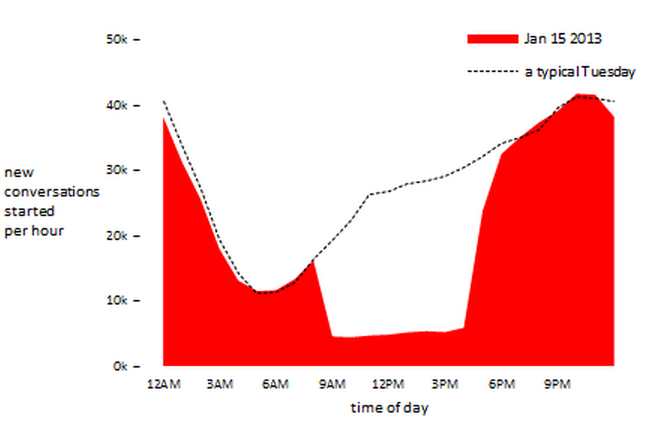
For example, here’s what happened to traffic when OkCupid removed all the pictures from profiles for a day:

screen-shot-2014-07-28-at-1-35-37-pm

When people couldn’t see photos, they left the site in droves. Users who stuck around wound up responding to first messages faster, spent more time chatting than usual and exchanged contact information sooner. But when the photos returned, the blind dates generally stopped talking.

That’s “extremely shallow”? More like extremely human. The way we scope out potential partners doesn’t end when we go online. As Jacob Kastrenakes notes, another experiment involved the outright manipulation of users:

full-matrix_medium

[I]n [that] experiment, the dating site began telling people who should have been bad matches for one another that they were actually good matches, and vise versa. In doing so, it found that just being told whether you’re a good or a bad match for someone was enough to increase or decrease correspondence with them. It wasn’t enough to fully offset the calculated compatibility between the two, but it did have a noticeable impact.

That undoubtedly made for some interesting first-and-last dates. But Brian Fung argues that OKC’s experimentation is more forgivable than Facebook’s:

People join OkCupid for a very specific reason, and that’s to find dates. To the extent that knowing how profile pictures affect your likelihood of getting said dates, the research furthers users’ own objectives. … [T]here’s no such motivating factor when it comes to Facebook. Unless you’re a page administrator or news organization, understanding how the newsfeed works doesn’t really help the average user in the way that understanding how OkCupid works does. That’s because people use Facebook for all kinds of reasons that have nothing to do with Facebook’s commercial motives. But people would stop using OkCupid if they discovered it didn’t “work.”

Jay Hathaway isn’t so sure:

How is this any better than Facebook using our news feeds to see if it can make us miserable? OkCupid doesn’t have a very thorough justification. “[G]uess what, everybody: if you use the Internet, you’re the subject of hundreds of experiments at any given time, on every site. That’s how websites work,” is about as close as they get to giving a fuck.  But perhaps we’re more willing to accept this sort of thing from OkCupid because online dating already feels like consenting to participate in a social experiment. It’s a game we play with virtual strangers, while Facebook is a place we trust with our “real friends,” even when we know we probably shouldn’t.

The New (And Improved?) Paul Ryan, Ctd

Noah Smith hails the congressman’s anti-poverty plan as “a sea change in the way Republicans see the role of government”:

In his first inaugural address, Ronald Reagan famously declared: “In this present crisis, government is not the solution to our problem; government is the problem.” Over the next 2 1/2 decades, Republicans and conservatives tended to drop the “in the present crisis” part. They’ve treated government as an obstacle to human welfare always and everywhere, instead of a tool that can sometimes be used to improve things. Ryan’s plan is the first glimmer of a big awakening on the right — the realization that the crisis we now face isn’t the same as the one we faced in 1981. Perhaps a decade-and-a-half of falling real incomes and falling mobility has finally cracked the hard shell of triumphal post-Reaganism. If so, the fear that the conservative movement would degenerate forever into obstructionist self-parody — that the Tea Party is the future — has proven unfounded.

Think about it: In 2014, the Republican Party’s main idea man — who just two years ago ran for vice president on the same ticket as a man who called the poorer half of America “takers” — is now proposing to use a government bureaucracy to send social workers to help poor people make more money, while simultaneously mailing them government checks. That is a big, big deal. Compared with that epochal shift, the particulars of Ryan’s plan hardly matter.

Michael Brendan Dougherty agrees:

Ryan’s plan — along with Dave Camp’s tax plan and proposals by Sens. Marco Rubio, Rand Paul, and Mike Lee on a range of issues — reveals that at least some in the GOP are moving beyond the party’s “You didn’t build that,” anti-47 percent posturing. These proposals constitute green shoots in what had been a policy-thinking desert for the Obama-era right. If I had my druthers, some enterprising senator would pick up a few of Jon Huntsman’s proposed financial reforms.

Democrats may accuse all these proposals of being a mere performance put on for the benefit of grandee policy commentators. But what exactly is the policy agenda Hillary Clinton wants to enact? So far, all we have are gloomy reports about her difficulty balancing how she talks about the go-go 1990s. The GOP has a long way to go, but the latest Ryan proposal is a sign that at least it’s moving.

Jonathan Bernstein hopes Congress might at least start having a substantive conversation about some of these issues:

Policy experts analyzing Ryan’s anti-poverty agenda seem to think that there’s a viable policy here. Given that Ryan remains in some ways the heart of the House Republican conference, it’s good news if Ryan’s contradictions include at least one policy containing genuine substance. Of course, liberals aren’t going to endorse much of that substance. But a debate (or, even better, a legislative clash) between substantive liberal and substantive conservative policy proposals has the potential to produce something worthwhile. In any case, it would be a vast improvement over the symbolic posturing that consumes most of Congress’ time.

Could it all be, as Krugman says, a con? Sure. Ryan doesn’t enter this discussion with much credibility. Republican efforts to pass appropriations based on his budget proved to be a fiasco. But perhaps he’s earned some credibility with his new proposal. Meanwhile, those of us concerned with the effects of a broken Republican Party (as opposed to those who simply want to enact liberal policy) should encourage any positive signs we see.

But Chait remains skeptical:

The idea of letting states decide how to spend federal anti-poverty money has long divided the parties. Republicans assume that states will act in the best interest of their poorest citizens. Democrats assume the opposite. The trouble for Ryan is that, over the last few years, the United States has conducted a vast experiment that has proven his assumption wrong in the most horrifying way possible. Supreme Court Justice John Roberts allowed states to opt out of accepting Medicaid money to give health insurance to their poorest citizens. The money is, essentially, free. Washington would pay 90 percent of the cost of enrolling a person in Medicaid, and the remaining 10 percent would be made up, or more than made up, by the reduced cost of sick uninsured people showing up at the emergency room. In a display of almost fanatical indifference to the well-being of their most vulnerable citizens, nearly every Republican-controlled state government has eschewed this free money. Not only have state-level Republicans failed to display deep concern for the poor, they seem to actually enjoy subjecting them to intense physical and financial distress.

Meanwhile, McArdle pushes back on Jamelle Bouie and Jordan Weissmann’s claim that it’s a mistake to focus, as Ryan does, on long-term poverty when most Americans who fall into the safety net only do so temporarily:

[C]hronically poor people are more likely to require extra government benefits because they don’t have any of the assets that the temporarily poor bring with them from the middle class: reliable cars, houses, savings accounts, credit cards, friends and family who have spare cash to help out. The chronically poor will need more help, for longer, than folks who are struggling through a temporary job loss or divorce. Which means that, at the very least, they take up a disproportionate share of resources. It seems entirely possible — perhaps even likely — that the chronically poor still account for the majority of spending in many programs.

So, mathematically, I think the argument being made by Bouie and Weissman fails; it obviously makes a lot of sense to focus on the group that generates a disproportionate share of our entitlement spending. At the very least, we should consider the strong possibility that those struggling with chronic poverty might need very different kinds of help than those dealing with a temporary income problem — rather than suggesting, as Bouie does, that we should obviously focus on doing whatever is best for people having an acute poverty episode because they’re the majority.

Previous Dish on Paul Ryan’s plan here.
Congress Pauses Bickering To Advance VA Reform

German Lopez voxplains Congress’ plan to fix the VA, which was unveiled yesterday with much bipartisan back-patting:

The bill sets $10 billion for a pilot program that reimburses private care for veterans who live more than 40 miles from a VA facility or experience long wait times. It also allocates another $5 billion for the VA to hire more doctors and nurses and upgrade medical facilities. And it gives the VA permission to enter into 27 major medical facility leases across the country. The bill also allows the VA secretary to quickly dismiss or demote senior executive employees for misconduct and poor performance, and it forbids the VA from attaching bonus payments to wait time goals. Legislators estimate the bill costs $17 billion. About $12 billion of that is new spending, while $5 billion will be paid for with offsets from the rest of the VA.

The idea is to improve the VA’s ability to see patients in a timely manner within the VA system. If that’s not possible or a patient can’t access a VA facility, a private option is offered as an alternative. In any remaining situations where the VA can’t get patients into care quickly, there will also be less of a financial incentive to manipulate records. And it will be easier for the VA secretary to hold those who continue engaging in fraudulent behavior accountable, even if they hold senior positions.

But Vinik worries that the “fix” might not fix much:

Most of the political press has greeted this bipartisan breakthrough with cheers, but it’s not clear that this legislation makes sense. Earmarking money to hire more medical personnel is undoubtedly important, but Phil Longman, who knows more about the VA system than almost anybody, told me recently that allowing veterans to seek non-VA care could undermine the system. Excellent VA hospitals, which already have a lack of patients, may be forced to close if veterans go elsewhere. The current deal only sets up a two-year pilot program, but Republicans will certainly look to extend it before it expires. As Longman warned, this legislation, which the House and Senate are expected to pass later this week, could be a “Trojan horse” for privatization.

Drum’s just encouraged that Congress managed to do anything at all:

All things considered, it would be a good sign if this bill passed. The VA, after all, isn’t an inherently partisan issue. Just the opposite, since both parties support vets about equally and both should, in theory, be more interested in helping vets than in prolonging chaos for political reasons. In other words, if there’s anything that’s amenable to a basically technocratic solution and bipartisan support, this is it. In a way, it’s a test of whether our political system is completely broken or just mostly broken. “Mostly” would be something of a relief.

That doesn’t really reassure Waldman, though:

Take a look at what characterizes the VA issue. First, there was a dramatic and troubling scandal. Second, the scandal involved victims that everyone in both parties wants to be seen supporting. Third, the way to fix the problem, at least in the short term, was fairly obvious. Fourth, that solution involved at most some mild ideological discomfort for both parties, but nothing they couldn’t tolerate. Finally and most importantly, addressing the problem involved zero political cost to either party. How often does an issue like that come around? Once or twice a decade? But that, apparently, is what’s required to actually pass meaningful legislation to get government functioning properly.

Previous Dish on VA reform here.

Borderline Politics On The Right, Ctd

immigration3

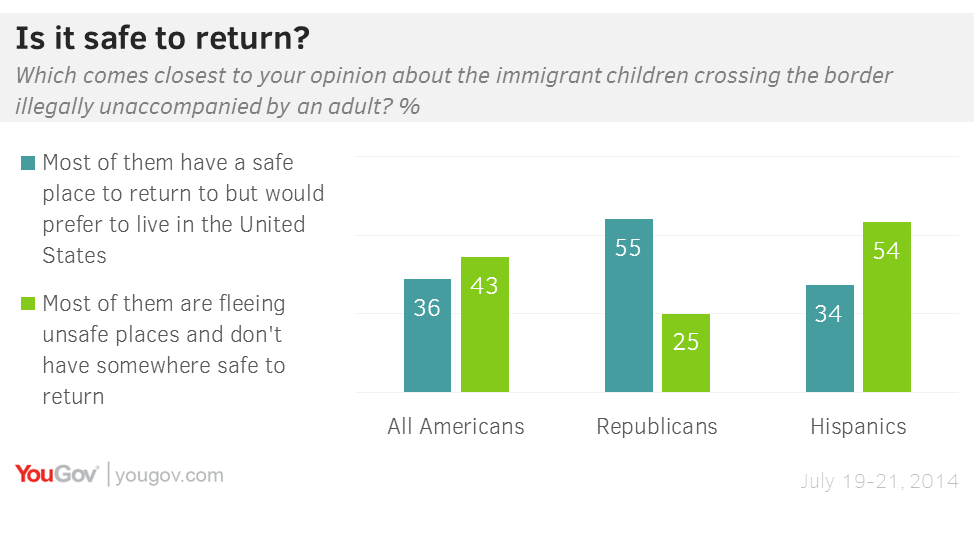
A new Economist/YouGov poll further illustrates the widening partisan gap on immigration and the isolation of Republicans in particular:

While most say they have at least some sympathy for the children, a majority of Republicans reports little or no sympathy. More than three in four Hispanics say they are sympathetic, and a majority of Hispanics report “a lot” of sympathy for the children. That reflects the large differences in these groups in how they judge the children and their motivations in coming to the United States. Overall the country is closely divided on whether the children now coming to the United States illegally are fleeing unsafe situations in their home country or have safe homes but would just rather live in the United States. Republicans see the children as coming from safe places; Hispanics, and a plurality of the public overall, do not.

This apparent nativist turn augurs poorly for the GOP, Molly Ball believes:

In the past, contrary to popular belief, support for immigration reform has seldom been toxic in Republican primaries. (A notable exception came four years ago in Georgia, when Nathan Deal ran to the right on immigration on the way to winning his gubernatorial primary and the governorship.) But the current crisis on the border has inflamed the perpetual hot-button issue, particularly among the vocal minority of the Republican base for whom the only acceptable “reform” is mass deportation. And candidates like [David] Perdue are exploiting the issue as a wedge.

That’s bad for immigration reform, which was already stalled largely because of House Republicans’ fear of just this sort of political backlash. And it’s probably bad for the long-term prospects of the Republican Party, whose elites are convinced its future national success rests on increasing its share of the Hispanic vote—a process they believe must start with passing immigration reform. Here’s a representative take from Tom Donohue, president of the (100 percent, openly pro-amnesty) Chamber of Commerce: “If the Republicans don’t do it, they shouldn’t bother to run a candidate in 2016,” he said in May.

But George Will wants to welcome the child migrants with open arms and make them into Americans:

I’d like to second the motion. If America cannot find a place for children fleeing terror and crime and violence, then America is no longer America. Hugh Hewitt, to his great credit, put forth a similar proposal earlier this month. Will and Hewitt may be on to something, Zach McDade explains, because children of immigrants now make up the majority of American children:

It’s a demographic fact that gets surprisingly little attentionthe fact that, if not for immigrants and their children, the U.S. child population would be shrinking. There are more than 17 million children with at least one immigrant parent in the U.S. They represent over a quarter of the 70 million people under 18 years old. Their proportion will grow over time, as the number of children born to non-immigrant parents declinesin both relative and absolute terms.

This matters, because today’s young people make up tomorrow’s productive workforce, generating economic activity and supporting retirees. We already face a declining young-to-old population ratio, putting huge strain on Social Security and other safety net programs. The children of immigrants will provide a crucial and growing buffer against this demographic shift.

The Cost Of Climate Inaction

It’s hefty:

A new report estimates the cost of mitigating the effects of climate change could rise by as much as 40% if action to reduce greenhouse gas emissions is delayed 10 years — immediately outweighing any potential savings of a delay. The White House’s Council of Economic Advisers, U.S. President Barack Obama’s source for advice on economic policy, compared over 100 actions on climate change laid out in 16 studies to extract the average cost of delayed efforts. Released Tuesday, the findings suggests policymakers should immediately confront carbon emissions as a form of “climate insurance.

Rebecca Leber adds:

Putting numbers to the cost of inaction takes aim directly at a classic Republican rebuttalthat it’s better to wait for the so-called “unsettled science” to settle on exact timing and magnitude of global warming’s consequences. “If anything, we understate the cost of delay,” Chairman of the Council of Economic Advisors Jason Furman told reporters on a press call Monday.

The Grey Lady Endorses Legal Weed, Ctd

This embed is invalid

In response to the NYT’s pro-pot announcement, Nate Silver calculates that around 77 percent of Americans who fit the NYT editorial board’s demographic profile support legalization:

[P]eople with this demographic profile are somewhere around 25 or 30 percentage points more supportive of marijuana legalization than the average American. That implies that back in 2000, when only about 30 percent of Americans supported legalization, perhaps 55 or 60 percent of these people did. The margin of error on this estimate is fairly high — about 10 percent — but not enough to call into question that most people like those on the Times’ editorial board have privately supported legalization for a long time. The question is why it took them so long to take such a stance publicly.

And if you want to know why no one watches Meet The Press, check out their boomer pundit-fest above in which they could find no proponent of legalization at all, along with the familiar condescension and dated “jokes”. Nate’s too right that “there’s a particularly large gap between elite and popular opinion on marijuana policy”:

Consider that, according to The Huffington Post, none of the 50 U.S. governors or the 100 U.S. senators had endorsed fully legal recreational marijuana as of this April — even though some of them are very liberal on other issues, and even though an increasing number of them represent states where most voters support legalizing pot.

Perhaps some of this is smart politics — older Americans are less likely to support marijuana legalization and more likely to vote. But there’s also a more cynical interpretation: racial minorities, low-income Americans and young people are disproportionately more likely to be arrested for marijuana offenses than senators or newspaper editorial board members (or their sons and daughters). The elites may be setting the policy, but they’re out of touch with its effects.

Update from a reader:

Like you, I wholly believe that we shouldn’t shy away from disturbing images and videos when they’re reporting things that have actually taken place. But for God’s sake, did you have to post that horrible, terrible, terrifying, nauseating video? I’m speaking, of course, about the cadre of grey-haired idiots debating pot legalization on Meet the Press, a program I swear to God I forgot existed.

So, c’mon, trigger warning next time? Something simple, like, “Warning: this video may cause you to vomit all over yourself uncontrollably.”

You know what’s good for nausea? Another reader gets serious:

That MTP clip is unreal.  If I were the father or son or spouse of one of the millions of marijuana users whose life has been irrevocably ruined by The War On Drugs and I saw those comfortable Beltway insiders having a silly pun-fest while wondering what the rush is on legalization, I would probably have thrown my laptop out the window in anger and disgust.  Fuck them.

The Torturers’ Non-Defense

As we await the release of the Senate Intelligence Committee report on the Bush-Cheney torture program, some of those likely to go down in history as war criminals are gearing up for a self-defense. George Tenet, we are told, is among them. Here is how he once defended himself:

Mr. Tenet flashed his anger at these accusations in 2007, when he was asked about the interrogation program during an interview with the CBS program “60 Minutes.” Wagging a finger at the correspondent, Scott Pelley, Mr. Tenet said over and over, “We don’t torture people.”

“No, listen to me. No, listen to me. I want you to listen to me,” he went on. “Everybody forgets one central context of what we lived through: The palpable fear that we felt on the basis of that fact that there was so much we did not know. I know that this program has saved lives. I know we’ve disrupted plots.”

There are two defenses here: it wasn’t torture (even though it looks like it); and it was justified given the terrible intelligence failures of Tenet’s CIA operatives, who had no idea where the next attack might be coming from. It’s worth recalling in that context the actual words of the UN Convention Against Torture, which was signed by Ronald Reagan and torn to shreds by Dick Cheney. It guts both lines of Tenet’s purported defense. First up, there can be no attempt to craft techniques that are close to torture but designed to slip through a legal loophole. The Treaty’s full title is, for example, “Convention against Torture and Other Cruel, Inhuman or Degrading Treatment or Punishment“. The definition of torture is this:

any act by which severe pain or suffering, whether physical or mental, is intentionally inflicted on a person for such purposes as obtaining from him or a third person information or a confession, punishing him for an act he or a third person has committed or is suspected of having committed, or intimidating or coercing him or a third person, or for any reason based on discrimination of any kind, when such pain or suffering is inflicted by or at the instigation of or with the consent or acquiescence of a public official or other person acting in an official capacity. It does not include pain or suffering arising only from, inherent in or incidental to lawful sanctions.

Intimidation and coercion are also expressly forbidden, when implemented and authorized by an officer of state. President Reagan included the broad definition in his signing statement:

The United States participated actively and effectively in the negotiation of the Convention. It marks a significant step in the development during this century of international measures against torture and other inhuman treatment or punishment. Ratification of the Convention by the United States will clearly express United States opposition to torture, an abhorrent practice unfortunately still prevalent in the world today.

In other words, the entire point of the Convention is to prevent any wriggle room around what torture is and to include inhumanity. And if you don’t believe that stretching people till their limbs break, near-drowning them hundreds of times, hounding them day and night with sleep deprivation, or subjecting them to freezing temperatures, mock executions and amount to inhumanity, you are no longer human. In a court of law, Tenet would be out of luck.

Just as important, the context is irrelevant. Tenet’s plea to understand the context he was working in has no place here:

No exceptional circumstances whatsoever, whether a state of war or a threat of war, internal political instability or any other public emergency, may be invoked as a justification of torture.

Get that? Read it again.

The Worst Ebola Outbreak In History

Ebola Deaths

We’re in the midst of it:

The outbreak is unprecedented both in infection numbers and in geographic scope. And so far, it’s been a long battle that doesn’t appear to be slowing down. The Ebola virus has now hit four countries: Sierra Leone, Guinea, Liberia, and recently Nigeria, according to the country’s ministry of health. The virus — which starts off with flu-like symptoms and often ends with horrific hemorrhaging — has infected 1,201 people and killed an estimated 672 since this winter, according to the numbers on July 23 from the World Health Organization.

Dish alum Gwynn Guilford is alarmed by the spread of Ebola to Lagos:

So far, Ebola has been confined to Guinea, Sierra Leone, and Liberia—war-torn and largely rural west African countries. But Lagos is different; not only is it Africa’s biggest city, with 21 million people. It’s also one of the world’s most densely populated. And perhaps scariest of all, it’s a center for international travel—meaning that if it’s not contained, the virus could easily go global. [Patrick] Sawyer’s was the first-ever recorded case of Ebola in Nigeria, according to the Nigerian Tribune.

So far, the Nigerian government’s efforts to contain it inspire little confidence.

The Bloomberg editors call for a Pan-African response to the outbreak:

There is a reservoir of talent elsewhere in Africa — the doctors, nurses, epidemiologists, lab technicians and administrators in Uganda, Republic of the Congo, Democratic Republic of the Congo and Gabon who have been through this and know how to handle Ebola. By organizing teams of them to help with the current epidemic and pass their skills on to their counterparts in Guinea, Sierra Leone and Liberia, the World Health Organization could establish a pan-African partnership that central and east Africa could, in turn, rely on down the road.

International donors such as the U.S. and the European Union could help fund and provision the African teams. They could enlist the help of international mining companies present in Guinea, which have certainly extracted value from these countries and have both a humanitarian and an economic interest in stability and ending the epidemic.

Ishaan Tharoor finds that one “of the continuing challenges is getting local populations to abide by the edicts of government authorities and foreign health workers.” A reason this has proven difficult:

The hysteria caused by the spread of Ebola has led also to the spread of rumor and conspiracy theories. Angry crowds have accused foreigners of bringing the virus in their midst: In April, the threat of violence forced [Paris-based medical NGO] MSF to evacuate all its staff from a treatment center in Guinea. In Sierra Leone, which has the largest number of Ebola cases at present, thousands protested over the weekend outside the country’s main Ebola treatment facility in the eastern city of Kenema.

Police had to disperse the crowd with tear gas and a 9-year-old was injured in the leg by a police bullet, Reuters reports. The demonstration was sparked, the news agency claims, by a rumor spread in a nearby market that the disease was a ruse used to justify “cannibalistic rituals” being carried out in the hospital.

Abby Haglage explains that a “full 42 days (double the potential incubation time of the disease) without any new infected are needed before the CDC can declare the outbreak officially over”:

“The concern is the outbreak can be reseeded much like a forest fire with sparks,” says [Stephan] Monroe [of the CDC]. “Until we can identify and interrupt every chain of transmission, we won’t be able to interrupt the outbreak,” he says, reinforcing the need to track those who may have come in contact with carriers. “Until we get all the fires put out, there’s still a possibility that it will reignite.”