
A reader writes:
I’ll keep it short. Do I think ISIS would really have killed, directly or indirectly, tens of thousands of Yezidis? As former military intelligence deployed to that exact area and with fairly intimate experience with how takfiris think of Yezidis, yes I do. I really thought that if someone didn’t begin to intervene in a big way, there would be tens of thousands of dead Yezidis by this time next week. Now there won’t be. I kind of don’t give a shit about anything else.

Another writes:
I spent 10 months in 2009-2010 specifically in Sinjar with the US Army. Having never heard of the Yazidi previously I was very interested in learning their background and beliefs and found them all to be easy to get along with and supportive of our presence. And as soon as ISIS started making moves in Northern Iraq, I was very worried that I would wake up one morning to news of Sinjar (an ancient Roman/Parthian/Persian border town that seems to have been traded back and forth multiple times over the centuries) and its Yazidi minority being persecuted or worse.
While I have generally appreciated the coverage of the recent events in Northern Iraq I feel like most people I listen to or read are
making some large logical and geographical leaps. Sinjar, although previously occupied by the Kurdish Peshmerga, is far from the Kurdish Autonomous Region (some 200 km). Sinjar Mountain itself is a strange anomaly. The area of Western Nineveh is generally flat with small 1 to 2 meter hills that litter some patches. Then seemingly out of no where is a stand alone mountain with the town of Sinjar at its southern base. Comments like “But it will bring jubilation to the terrified thousands on Mount Sinjar, for whom salvation is now coming” are utterly ridiculous. Sinjar Mountain is not connected to the mountains that make up Kurdistan.
Sinjar, the mountain and the religious minorities are an island in the new Sunni ISIS sea. The only way to bring them real relief would be for the Kurds to gain back ground and establish supply lines to Sinjar. I would imagine that would be highly unlikely if Erbil is being threatened. I feel like more reports I have read are mixing the Kurdish and Sinjar parts of the ISIS offensive together. This is lazy and wrong and setting our expectations up for failure. I sadly do not see a good end for the Yazidi near Sinjar. Their only real hope is to get to the Kurdistan region proper. Any US attempts to do anything but drop food and water to the Yazidis on the mountain would take a lot of troops (not just special forces, so real boots on the ground) and I can’t think of a good end state even if we put the troops necessary to hold the mountain.
Another:
Thanks for your thoughtful post. I just wanted to outline why I am supporting this intervention, while I opposed the inane intervention in Libya (you linked the two).
In Libya there was no genocide occurring. There was no targeting of minorities. The battle was simple: a naked power struggle. Second, in Libya we had no ally at stake. By intervening we actually undermined an ally, as Qaddafi had assisted us post 9/11, removed his nuclear program, and had generally aligned with the West. We destroyed that and left anarchy.
In northern Iraq the difference is acute. The minorities there will be obliterated, which is the major byproduct of our Iraq intervention in 2003; we have insured the destruction of communities that existed for thousands of years. Second, the Kurds are an actual ally. Our interests are aligned. This isn’t some fanciful ally that McCain imagines exists in Syria or in Western Ukraine. If we let the Kurds fall, then that would make us look like fools.
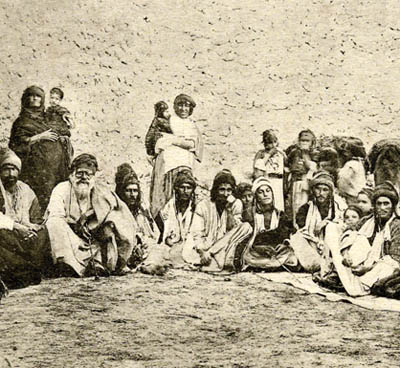
(Photos: the entrance to Sinjar, by a reader; Yazidis on the mountain of Sinjar, Iraq/Syrian border, 1920s. Via Wiki.)

