The Next Newspaper Die-Off

by Dish Staff

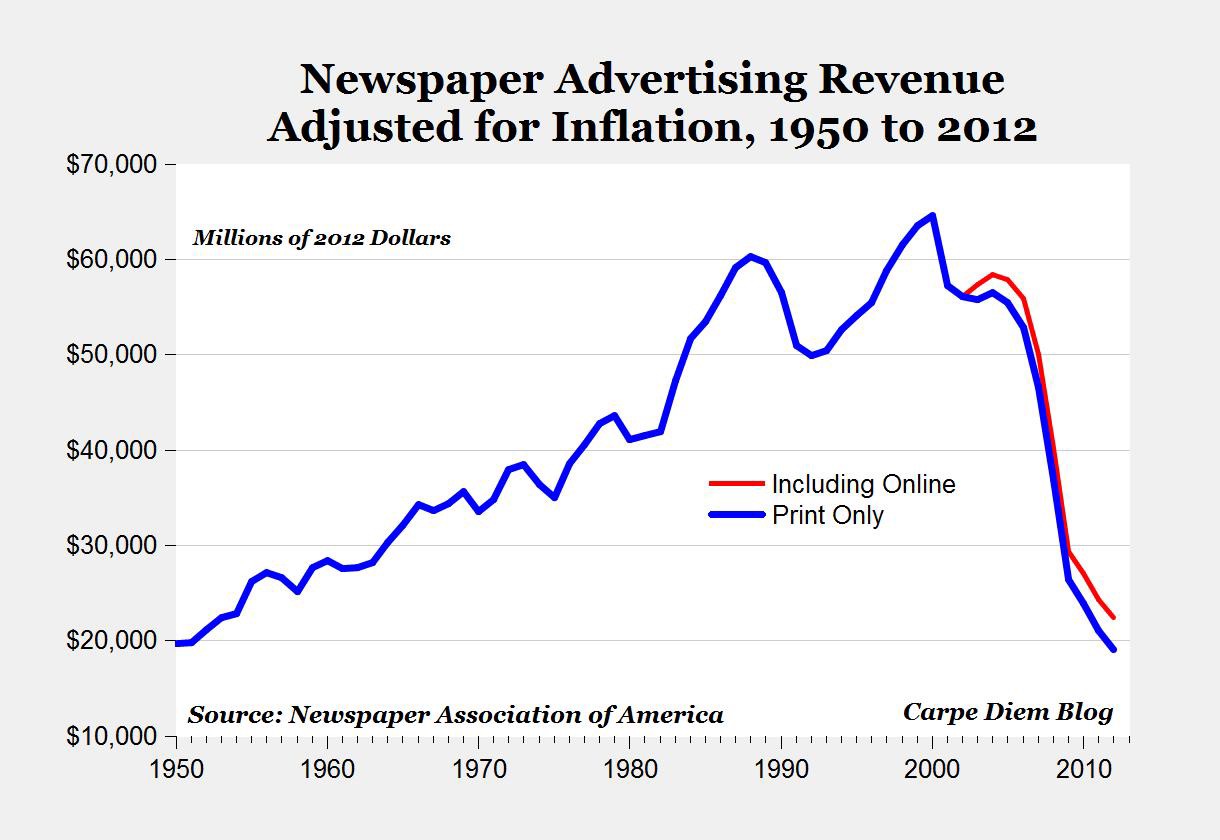
Newspaper Ad Dollars

Clay Shirky predicts that it will hit soon:

As Dick Tofel of ProPublica often points out, newspaper revenue has been shrinking since 2006, but the American economy has been growing since 2009. Between 1970 and now, the US has averaged only six years between recessions; the current period of growth crossed the six year mark this spring. We are statistically much closer to the next recession than to the last one, and in a recession, ad dollars are the first to go. Many papers will go bankrupt the way Hemingway’s Mike Campbell did: Gradually, and then suddenly.

The death of newspapers is sad, but the threatened loss of journalistic talent is catastrophic. If that’s you, it’s time to learn something outside the production routine of your current job. It will be difficult and annoying, your employer won’t be much help, and it may not even work, but we’re nearing the next great contraction. If you want to get through it, doing almost anything will be better than doing almost nothing.

(Chart from Mark Perry.)

It’s 2003 Again

by Jonah Shepp

What else can one possibly take away from this Noah Rothman exegesis of Peggy Noonan’s and Charles Krauthammer’s cases for expanding the new Iraq war to Syria? Here’s the crux of the argument:

The mission Krauthammer describes does not appear to require a significant American ground force, though it would be one which would only be effective in Iraq. The Islamic State’s stronghold in Syria will require an entirely different strategy, one far more robust and which may require putting American service personnel in harm’s way. But rolling back the Islamic State in Iraq is an acceptable short-term goal, and the American people should be informed that this is the mission in which their military is presently engaged. Those opposed to going to war to rid the world of ISIS worry that achieving that objective will require more commitment than most are willing to admit. And it is possible that the American national interests at stake in this region, while appreciable, are not threatened to the degree that would merit a return of tens of thousands of American troops to Iraq. At least, not yet.

These are worthwhile debates to have, and Americans need to have an honest discussion about this threat. It is a discussion that must be led by their president. It seems, however, that some conservatives are beginning to observe that those who object to a military solution to the Islamic State threat rest their argument on the claim that it heralds a new occupation of Iraq. This is a straw man argument. The vast majority of Americans of every political stripe do not want to reoccupy that country, and this is not on the table. Destroying ISIS, however, is.

Right, because we all remember what happened the last time right-wing hawks sold the American public on a war that they alleged would have no long-term consequences. After the past decade, I suppose I shouldn’t be all that surprised that the cheerleaders for this new war are demanding that their opponents make a probative case against intervention, while the neo-neocons’ contention that a light-touch war with no “significant” ground force is presented as obviously true. (By the by, how many soldiers constitute “significant”? 1,000? 10,000? 100,000? No one wants to say…) For more of the same, see Elliott Abrams here. Brian Fishman wishes advocates of an all-out, two-front war on ISIS would stop bullshitting the public already about what that would entail:

No one has offered a plausible strategy to defeat ISIL that does not include a major U.S. commitment on the ground and the renewal of functional governance on both sides of the Iraqi-Syrian border. And no one will, because none exists.

But that has not prevented a slew of hacks and wonks from suggesting grandiose policy goals without paying serious attention to the costs of implementation and the fragility of the U.S. political consensus for achieving those goals. Although ISIL has some characteristics of a state now, it still has the resilience of an ideologically motivated terrorist organization that will survive and perhaps even thrive in the face of setbacks. We must never again make the mistake that we made in 2008, which was to assume that we have destroyed a jihadist organization because we have pushed it out of former safe-havens and inhibited its ability to hold territory. Bombing ISIL will not destroy it. Giving the Kurds sniper rifles or artillery will not destroy it. A new prime minister in Iraq will not destroy it.

Please do not step in here with the fly-paper argument: that the conflict will attract the world’s would-be jihadis to one geographic area where we can target them all and thereby solve the problem. Notice that no authorities on jihadism ever make this argument. That is because they understand that war makes the jihadist movement stronger, even in the face of major tactical and operational defeats.

There is a case to be made for this war. It is not the case that its backers are making. They still seem to inhabit the same alternate universe as Donald Rumsfeld, in which the only limit to what American power can accomplish is the imagination of the Commander-in-Chief. I may not support all of Obama’s foreign policy choices, but I find it reassuring that he is nowhere near as prone as his predecessor was to flights of imperial fancy. As Fishman rightly points out, one cannot make the argument that the withdrawal of US forces from Iraq precipitated the current crisis without also acknowledging that the 2003 invasion set the ball rolling. The honest case for more intervention now, it seems to me, is that Bush’s Iraq adventure obligated the US to accept responsibility for maintaining the new Iraqi order we created and protecting the people of the Middle East from the jihadist menace our war unleashed.

But the usual suspects can’t make that argument, because to do so, they’d have to admit that they were wrong in the first place.

Inequality Is Only Growing Worse

by Dish Staff

Net Worth

Drum flags new numbers that put that fact in stark relief:

[N]ew census data shows that when it comes to net worth—which is basically total wealth—the biggest change has been at the bottom. Even after taking some lumps immediately after the recession, the well-off had recovered and even made some gains by 2011. But the poor have been devastated. Their median net worth has always been pretty close to zero, but by 2011 it had plummeted to $-6,029. On average, poor families were in the hole to the tune of $6,000, an astronomical and completely debilitating number to someone with barely poverty-level earnings.

Badger’s analysis:

The Census data suggest that the wealth gap in America has widened over the past decade, regardless of how you slice it. The gap between the bottom and top quintiles in America has widened, as has the gap between blacks and whites, and between workers with only a high school degree and those with much more. This implies that the returns to higher education in America are growing (in 2000, households headed by someone with a bachelor’s degree were worth 2.4 times as much as those with only a high school diploma; by 2011 the ratio was 3.4). And racial inequality in wealth is growing, too (in 2000, white households had a net worth 10.6 times larger than blacks; by 2011 it was 17.5).

Danielle Kurtzleben observes that the report “also found that the median net worth of the top 20 percent divided by the median of the second 20 percent was 39.8 in 2000. Today, it’s 86.8.”


Piggishness

by Sue Halpern

Last night our twelve-year-old dog got into the trash. We came home from dinner out and the trash can had been tipped over and a week’s detritus was strewn across the kitchen. Pransky, the offender in question, had her tail firmly between her legs and was looking nervous and, possibly, guilty. If I had taken a picture, she now might be featured on the wonderfully inculpatory Dog Shaming blog. Instead, she is sleeping on the couch, all trespasses forgiven.

Wild Pigs A Growing Problem In BerlinThe question of whether dogs feel guilty, or just look guilty, has been long debated, and the jury remains out. Still, as Professor Marc Bekoff has written “there’s not reason why dogs cannot. And there’s solid, biological/evolutionary reasons to assume dogs can and do.” Of course, there are solid, biological/evolutionary reasons for dogs to raid the trash, too. So much of what we, humans, consider to be “bad” behavior in dogs, is behavior that comes with strong instinctive ties. The term “house breaking” offers a good clue to the power dynamic of domestication. Think about those collars that emit “ultrasonic sounds” to dogs that bark. Or the ones that zap them with a jolt of electricity if they jump. A barking dog! Can you imagine that?

There must be a better way.

Enter, pigs. Or, more accurately, the pig pheromone androstenone, which is secreted by male pigs when female pigs are in heat. Apparently, what turns on female pigs, turns off dogs of either sex. By chance, Texas Tech professor John McGlone happened to have some in his house, a house that also happened to be home to a yappy Cairn Terrier. And then, magic!

So, he gave one little spritz to his dog, Toto, and immediately the dog stopped barking. Right on the spot. ‘It was completely serendipitous,” said McGlone, who works in the Animal and Food Sciences department of the College of Agriculture and Natural Sciences. “One of the most difficult problems is that dogs bark a lot, and it’s one of the top reasons they are given back to shelters or pounds.”

Suddenly, an idea was born. After extensive testing and publishing of the results, and with funding help from Sergeant’s pet care products, Stop That was developed and hit store shelves under the Sentry pet products name about a year ago. It has been met with tremendous success by pet owners who were on their last legs in trying to curtail bad behavior in dogs.

“My dogs were instantly focused and silenced with one spritz,” said one product reviewer on Amazon.com. “It’s changed my life.”

With that, a new term was coined, interone, which McGlone and his colleagues define as a product that is a “pheromone in one species and has a behavioral effect in another species, but we do not know if it is a pheromone (naturally produced) in the other species.”

And what if that other species is…us? According to The Long Term Ecological Network website, humans are also susceptible to the charms of androstenone, which in the UK has been marketed as a porcine aphrodisiac called Boar Mate since 1972.

At Guy’s Hospital in London scientists sprayed chairs in the visiting room randomly with Boar Mate, and when women arrived for treatment they chose those chairs over others. The active ingredient in the pig perfume is androstenone, and other British tests show that men with high levels of this chemical (measured in urine samples) tend to be married, father more children and occupy positions of power in industry. (Aggressive young criminals also have an excess of androstenone.)

Bad dogs to bad boys, and it gives new meaning to “male chauvinist pig,” too.

(Photo of a wild boar from Getty)
Protests Don’t Make You Popular

by Dish Staff

A recent poll on Ferguson found that “fifty-nine percent of Americans — including 67 percent of whites but just 43 percent of blacks — think the protesters’ actions have gone too far.” Robert Shapiro is unsurprised. Data he compiled shows that “the American public has traditionally responded unfavorably to protesters seen as disruptive, even if nonviolent”:

The majority of Americans felt this way toward the Freedom Riders in the Civil Rights Movement and toward civil right protesters and demonstrators in general. The same was true for the Vietnam antiwar movement and student protests on college campuses. The public clearly supported the Chicago police over the protesters during the 1968 Democratic National Convention, and they favored the police and the National Guard responses to disturbances in colleges and high schools. And a majority of women as well as men, no less, objected to the protests by the women’s movement.

Other historical public opinion data provide more insight.

Although most Americans support the right to protest in general, they prefer other means of achieving political goals — notably, the ballot box.  When asked in an October 1983 Louis Harris & Associates survey about “the most effective way blacks in this country can achieve a better break for themselves — take to the streets in protest, or register and vote in larger numbers to increase their political power, or just be patient and hope things get better for them?” only 1 percent said protest, while 85 percent said register and vote.

That said, he cites evidence “that protests put and keep issues on the political agenda.”

News Of The World

by Bill McKibben

Climate Change And Global Pollution To Be Discussed At Copenhagen Summit

Every day there’s something more immediately important happening in the world: ISIS is seizing an airbase this morning, and California is recovering from an earthquake, and Michael Brown is being buried.

But there’s nothing more important that’s happening each and every day than the ongoing deterioration of the planet on which we depend. Though on a geological time scale it’s proceeding at a hopelessly rapid pace, in terms of the news cycle it happens just slowly enough to be mainly invisible. It’s only when a new study emerges, or a shocking new data set, that we pay momentary attention, until the Next New Thing distracts us.

Here’s one installment in this ongoing saga, released this morning by Environmental Health News and National Geographic. It’s about birds, and the fact that across the planet they’re in serious trouble:

In North America’s breadbasket, populations of grassland birds such as sweet-trilling meadowlarks are in a free-fall, along with those everywhere else on the planet. Graceful fliers like swifts and swallows that snap up insects on the wing are showing widespread declines in Europe and North America. Eagles, vultures and other raptors are on the wane throughout Africa. Colonies of sea birds such as murres and puffins on the North Atlantic are vanishing, and so are shorebirds, including red knots in the Western Hemisphere. Sandpipers, spoonbills, pelicans and storks, among the migratory birds dependent on the intertidal flats of Asia’s Yellow Sea, are under threat. Australian and South American parrots are struggling and some of the iconic penguins of Antarctica face starvation.

While birds sing, they also speak. Many of their declines are driven by the loss of places to live and breed – their marshes, rivers, forests and plains – or by diminished food supply. But more and more these days the birds are telling us about new threats to the environment and potentially human health in the coded language of biochemistry. Through analysis of the inner workings of birds’ cells, scientists have been deciphering increasingly urgent signals from ecosystems around the world.

Like the fabled canaries that miners once thrust into coal mines to check for poisonous gases, birds provide the starkest clues in the animal kingdom about whether humans, too, may be harmed by toxic substances. And they prophesy what might happen to us as the load of carbon-based, planet-warming gases in the atmosphere and oceans climbs ever higher.

This news follows by a couple of weeks a study showing that invertebrate numbers–not species, but total numbers–have fallen 45% in the last 35 years. That seemed impossible to me when I first read it, so I checked with a few biologist friends. Yep, they said, for the species that have been studied that seems right. One added, “when I was a boy and we’d go for a drive in the summer, the windshield would be splattered with bugs. That doesn’t happen so much any more.”

Or consider this: Researchers using the incredibly sensitive GPS sensors found that the ongoing western drought had cost the region 63 trillion gallons of lost groundwater since 2013, taking enough weight off the crust of the planet that the Sierras had jumped 0.6 inches skyward.

Can we just review? Forty five percent fewer invertebrates in the last 35 years. We’re talking about a scale of destruction–of habitat, of climate, of cell biology–that staggers the mind. There are some things that could be done, but they are mostly enormous too (above all, stop burning fossil fuel.) Taking those giant steps would first require really paying attention. We have the satellites and sensors and supercomputers that we need to sound the alarm, but mostly we tune out the sound.

(Photo: Residential homes sit in front of the coal fueled Ferrybridge power station as it generates electricity on November 17, 2009 in Ferrybridge, United Kingdom. By Christopher Furlong/Getty Images)

The Case For Undergraduate Law Degrees

by Dish Staff

Brent T. White argues that “the lack of an undergraduate route to legal education is perplexing”:

First, in most countries—including those requiring additional graduate-level training to become a licensed attorney—law is an undergraduate degree. Second, there is little rationale for excluding the study of law from the full range of undergraduate academic subjects. On the contrary, limiting legal education to graduate students has contributed to the mystification of law and created a reality in which too few people are equipped to grapple productively with the complex array of legal issues that are pervasive in business, government, and society.

Third, a law degree would offer many benefits to undergraduates, including the ability to independently research, read, and understand the law, as well as training in critical thinking and problem solving, analytical reasoning, and persuasive writing—all of which are highly marketable skills that translate well into a variety of professions, law-related or not. Finally, undergraduate law degrees would be the best response to the reality that many law-related tasks are performed by people who are not lawyers but who need legal training.

Ally With Assad?

by Dish Staff

Hassan Hassan argues that we shouldn’t, because he hasn’t really been fighting ISIS in the first place:

One might argue that Assad’s strategy was a cynical game and that once he is assured of his survival, he would be well-positioned to fight the group. But even that argument ignores basic dynamics: If Assad genuinely wants to fight ISIS today, he is as capable of doing that as Prime Minister Nouri al-Maliki was when ISIS took over three Iraq provinces. ISIS controls large swathes in rebel-held Syria, areas that have been outside the regime’s control for one to three years. How could the Assad regime fight against ISIS in Raqqa or Deir Ezzor, for example? Would the local population fight side by side with the regime? That is extremely unlikely, given that people have condemned reports that the United States intends to strike against ISIS in Syria while ignoring the regime’s atrocities for more than three years.

A more prudent approach is to look at the rise of ISIS as a long-term menace that can only be addressed through a ground-up pushback. The opposition forces are not only possible partners, they’re essential in the fight against ISIS. After all, they’re the ones who have been fighting ISIS since last summer, and drove it out of Idlib, Deir Ezzor and most of Aleppo and around Damascus. It cost them dearly: more than 7,000 people were killed. Fighting ISIS should be part of a broader political and military process that includes both the regime and the opposition, but not Assad.

Max Abrahms sees the situation differently:

Our national security ultimately depends on crushing ISIS not only in Iraq, but also in Syria. In the past, Assad’s forces were reluctant to engage ISIS directly. But the gloves have come off in the last couple of weeks. If Assad perceives ISIS as an existential threat, he will tolerate — even secretly welcome — U.S. military assistance. This is an opportunity Washington should seize not for him, but for us.

But James Antle seeks out the genuinely “realist” position:

Contrary to the BuzzFeed headline, few foreign-policy experts want a full operational alliance with Syria or Iran. Some have called for what Crocker, Luers, and Pickering have described as “mutually informed parallel action” against ISIS. Others have merely suggested the U.S. not destabilize ISIS’s enemies in the region, while the al-Qaeda offshoot is beheading American journalists and terrorizing religious minorities in Iraq. Even without any practical cooperation, it is hard to see how Syria and Iran wouldn’t to some extent be beneficiaries of any successful military action against ISIS. But for all the tyranny and terror ties of those regimes, ISIS is most directly the progeny of those who toppled with twin towers and attacked the United States on 9/11. After more than a decade at war in Afghanistan in response to the Taliban providing a safe haven for Osama bin Laden, wouldn’t an ISIS state in parts of Iraq and Syria be a worse outcome?

Keating believes Assad has played his cards perfectly and gotten just what he wanted:

There’s been speculation for some time that the Syrian leader would seek to use the crisis in Iraq to his advantage. It’s pretty apparent that Syrian forces tolerated the rise of the group in a bid to divide the rebels and scare off wary Western supporters, and only began attacking it after the Iraq crisis began this summer. It was a high-stakes gamble given that ISIS now reportedly controls about a third of Syrian territory, but one that could finally be paying off for the internationally isolated Syrian leader. …

Even if the U.S. doesn’t coordinate with Assad’s government—the White House position as expressed by Deputy National Security Adviser Ben Rhodes is still that he’s “part of the problem”—the shift in priority to ISIS does make it more likely that the American government is going to accept Assad remaining in power. Or at least it makes it less likely that the U.S. will take any major steps to remove him. Assad played the long game with a pretty weak hand and now appears to be winning.

Although they don’t necessarily make the case for an alliance, Ishaan Tharoor observes that the events of the past three years have sort of proven Vladimir Putin right about the folly of pushing regime change in Syria:

In his New York Times op-ed, Putin reminded readers that from “the outset, Russia has advocated peaceful dialogue enabling Syrians to develop a compromise plan for their own future.” That “plan for the future,” the Russians insisted, had to involve negotiation and talks between the government and the opposition, something which the opposition rejected totally at the time. In November 2011, Putin’s foreign minister Sergei Lavrov criticized other foreign powers, including the United States, for not helping pressure opposition forces to come to the table with the Assad regime. “We feel the responsibility to make everything possible to initiate an internal dialogue in Syria,” Lavrov said at a meeting of APEC foreign ministers in Hawaii.

The Arab Spring was in full bloom and U.S. officials thought regime change in Syria was an “inevitable” fait accompli. That calculus appears to have been woefully wrong. Now, the conflict is too entrenched, too polarized, too steeped in the suffering and trauma of millions of Syrians, for peaceful reconciliation to be an option.

A Hobby Lobby Patch For Obamacare

by Dish Staff

On Friday, the Obama administration proposed a fix to the ACA’s contraceptive mandate that it hopes will render the effects of the Hobby Lobby ruling moot by providing a way for employees of closely-held corporations with religious objections to the mandate to obtain contraception coverage. Sarah Kliff outlines the new rule, on which the administration is now seeking comment:

The Obama administration wants to extend the accommodation for religious non-profits — where the health insurance plan, rather than the employer, foots the bill for birth control — to objecting for-profit organizations. At a company like Hobby Lobby, for example, this would mean that the owners would notify the government of their objection to contraceptives. The Obama administration would then pass that information along to Hobby Lobby’s health insurance plan, which would be responsible for paying for the birth control coverage. …

The White House will also give more leeway to religious non-profits, like hospitals and colleges, that do not want to comply with the contraceptive mandate. These non-profits will no longer be required to notify their health plan that they will not provide contraceptives, as preliminary regulations would have required. Instead, these employers will now only be required to notify the federal government of their objection and the government will have the responsibility of notifying the insurance plan.

But religious organizations that object to the mandate in and of itself are not satisfied:

“Here we go again,” said Russell Moore, president of the policy arm of the Southern Baptist Convention, the largest U.S. Protestant denomination. “What we see here is another revised attempt to settle issues of religious conscience with accounting maneuvers. This new policy doesn’t get at the primary problem.”

The U.S. Conference of Catholic Bishops said it’s worried that the administration’s proposal could limit which for-profit businesses can receive a religious exemption. “By proposing to extend the ‘accommodation’ to the closely held for-profit employers that were wholly exempted by the Supreme Court’s recent decision in Hobby Lobby, the proposed regulations would effectively reduce, rather than expand, the scope of religious freedom,” the group’s statement read.

Charles Pierce expected as much:

After all, the opposition to birth control is not based on the opposition to a government mandate. It’s based on the opposition to the medicine, and the purpose that medicine serves. The question being litigated — in public and, sadly, in the courts — is not constitutional. It’s theological. The essential text is not the Constitution. It’s Humanae Vitae.

Scrutinizing how this rule change will adjust the terms of the debate over the mandate, Marty Lederman argues that the religious objectors have few legal legs left to stand on:

The regulation does not require the organizations to contract with an issuer or a TPA–and if they do not do so, then the government currently has no way of ensuring contraceptive coverage for their employees.  But even if that were not the case–i.e., even if federal law coerced the organizations to contract with such an issuer or TPA–Thomas Aquinas College and the other plaintiffs haven’t offered any explanation for why, according to their religion, the College’s responsibility for this particular match between TPA and employees would render the College itself morally responsible for the employees’ eventual use of contraceptives, when (i) such employees would have the same coverage if Aquinas had contracted with a different TPA; (ii) such employees would continue to have coverage if they left the College; and (iii) the College itself does not provide, subsidize, endorse, distribute, or otherwise facilitate the provision of, its employees’ contraceptive services.

Be that as it may, it appears that this will now be the primary (if not the only) argument the courts will have to contend with in light of the government’s newly augmented accommodation.

And Jonathan Cohn wonders what the Supreme Court will make of it:

With Hobby Lobby, the justices implied strongly that the old workaroundthe one the Administration was already providing churches and the likewas acceptable. With Wheaton, the Court said that, no, asking employers to write a letter to insurers infringed upon their religious freeom. That’s what made Justice Sonya Sotomayor and two of her colleagues angry enough to write a blistering dissent: The second directive seemed to undermine the spirit of the first. With this new regulation, the Administration is basically calling the Court’s bluff, as Ian Millhiser puts it at ThinkProgressto force the Court, once and for all, to decide whether any workaround passes muster or if the contraception requirement itself is simply unacceptable.

Ebola Is Mostly Killing Women

by Dish Staff

Liberia Battles Spreading Ebola Epidemic

Lauren Wolfe wants more attention paid to that fact:

Data show that many infectious diseases affect one gender more than another. Sometimes it’s men, as with dengue fever. Sometimes it’s women generally, as with E. coliHIV/AIDS (more than half the people living with the virus are female), and Ebola in some previous outbreaks. Sometimes it’s pregnant women and mothers, as with H1N1 (an outbreak in Australia is currently infecting women over men by a 25 percent margin).

Yet when women are the primary victims of an epidemic, few are willing to recognize that this is the case, ask why, and build responses accordingly. Indeed, experts say that too little is being done to put even the small amount that is known about gender differences and infectious diseases into practice — to determine in advance of outbreaks, for instance, how understanding gender roles might help in the development of a containment or prevention strategy. Not only that, but there is too little research being done to understand how infectious diseases affect the sexes differently on a biological level. It’s like Groundhog Day each time a disease surges, and people are losing their lives because of it. “We can’t get past the ‘interesting observation’ stage,” says Johns Hopkins University professor Sabra Klein. Public health officials generally gather data on age and sex in a crisis, but “nobody goes somewhere with it.”

(Photo: A West Point slum resident looks from behind closed gates on the second day of the government’s Ebola quarantine in her neighborhood on August 21, 2014 in Monrovia, Liberia. By John Moore/Getty Images)