Too Much Gun For A Small Town

by Dish Staff

Outrage In Missouri Town After Police Shooting Of 18-Yr-Old Man

Amanda Taub spells out why militarized small-town police are especially dangerous:

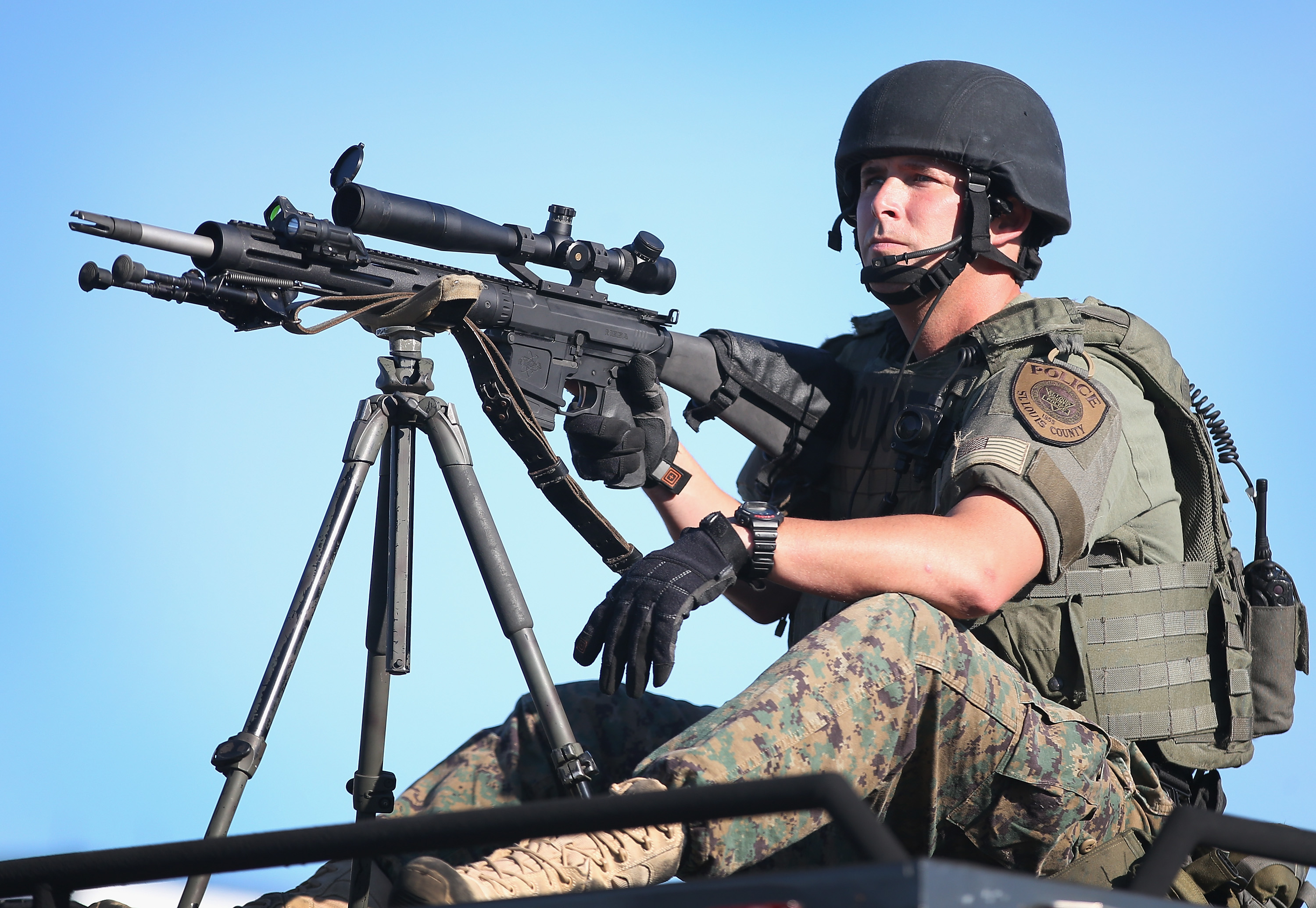
When the ACLU asked officials in the town of Farmington, Missouri (less than a 90 minute drive from Ferguson) to provide a copy of training materials for its Special Response Team, which is roughly like a SWAT team, the town sent only a copy of a single article. The article warned that “preparations for attacks on American schools that will bring rivers of blood and staggering body counts are well underway in Islamic training camps,” and went on to say that “because of our laws we can’t depend on the military to help us … By law, you the police officer are our Delta Force.”

In contrast, SWAT programs in larger cities tend to train extensively, and constantly. The Los Angeles police department’s SWAT teams go through months of intensive training before being brought on, and once there spend at least fifty percent of their on-duty time training, former LAPD Deputy Police Chief Stephen Downing told me. It is effectively impossible, Downing suggested, for small police departments to appropriately train their officers in the use of SWAT-style equipment, because they simply do not have sufficient resources or personnel. Small departments simply do not have the resources to support that type of program, but they do have the guns and trucks and armor, which they use.

Taub also runs down some of the military equipment the Ferguson cops are using:

Mine Resistant Ambush Protected Vehicles, or MRAPs, are heavily armored trucks designed to withstand the detonation of land mines or IEDs. They were first deployed by the US military in 2007, designed specifically for use in Iraq, where al-Qaeda and Iranian-backed Shia militias were using highly developed IEDs. Now the vehicles are being passed down to police departments.

Asked why MRAPS were being used in Ferguson, a place with neither land mines nor IEDs, Ferguson police chief Tom Jackson replied that “people are using bombs now.” However, there have been no reports of bombs being used in Ferguson — he may have been making an existential point about bombs being items that exist in the world.

Gene Healy previews the ghastly dystopian crowd-control weapons DHS is working on:

A Homeland Security report obtained by the Electronic Frontier Foundation in 2013 revealed that the agency has considered outfitting its expanding inventory of drones with “non-lethal weapons designed to immobilize” targets of interest. Meanwhile, both Homeland Security and the Pentagon maintain a keen interest in developing crowd-control weapons for occupations at home and abroad. In 2007, the department’s science and technology arm “contracted for the development of the ‘LED Incapacitator,’ a nauseating strobe” weapon meant to overwhelm and disorient targets with rapid, random pulses of light.

Some have called it the “puke saber,” but the final product won’t necessarily be handheld. As the department noted in a cutesy blogpost entitled “Enough to Make You Sick,” “output and size can easily be scaled up to fit the need; immobilizing a mob, for instance, might call for a wide-angle ‘bazooka’ version.”

(Photo by Scott Olson/Getty Images)
Will Foley’s Murder Change Obama’s Iraq Plans?

by Dish Staff

In the wake of James Foley’s murder, Fred Kaplan urges Obama to start building a regional coalition to defeat ISIS:

If the jihadists of ISIS are as dangerous as Obama says they are (and the evidence suggests they are), then it’s time to plow through diplomatic niceties and pursue the common interests of nations with which we otherwise might not get along. Yes, it’s politically awkward, to say the least, for Obama to make common cause, even on this one issue, with Assad (a monster whom he once said “must go”) and the mullahs of Tehran (most of whom regard America as the “great Satan”). But in World War II, Roosevelt and Churchill joined with Stalin to defeat Hitler—and, if they hadn’t, Hitler would have won.

The net against ISIS should be widened further. A good model here is the 1990–91 Gulf War, in which Presidents George H.W. Bush and Secretary of State James Baker assembled a vast coalition to push Saddam Hussein’s army out of Kuwait. Nearly every Arab country in the region—Saudi Arabia, Jordan, Egypt, even Syria—sent whole armored divisions or air wings. Many of them didn’t do much in the war, but the important point was that they were there. Their presence demonstrated that this wasn’t a war of Western imperialists against Muslim Iraq; it was a multinational war against aggression.

Jacob Siegel expects the US intervention in Iraq to escalate, but points out that merely holding the recent gains against ISIS will require a sustained involvement anyway:

Defeating ISIS in an open confrontation has not been part of any proposed plan, but weakening the group and pushing back its advances could go from the de facto U.S. approach to the official strategy if the air campaign expands. The most visible result of the air campaign is the retaking of the Mosul Dam, a key piece of infrastructure that ISIS captured from Kurdish forces in early August. After a sustained bombing campaign with more than half the total U.S. airstrikes so far, 51 out 84 targeting ISIS positions around the dam, it was retaken Tuesday by Kurdish Peshmerga and Iraqi special forces.

The dam is no longer in ISIS’s hands, but keeping it that way may require keeping American airpower on call for the foreseeable future.

Spencer Ackerman scopes out what sort of escalation might be in the works:

One option under consideration, not directly related to the Foley killing, is a request for hundreds of more US marines to deploy to Baghdad to bolster security at the US embassy and related installations. The request, made by the State Department recently, is said not to be a response to an new anticipated push by Isis into Baghdad, which it has stopped short of attempting to seize. An official who was not cleared to speak to the press characterized it as coming out of an abundance of caution. …

The US Central Command continued on Wednesday to send fighter jets and armed drones to harass Isis near the Mosul Dam, a critical piece of infrastructure that the US considers to no longer be under Isis control. The warplanes launched 14 strikes against Isis vehicles and weaponry, tacitly a rejection of Isis’ demand with the Foley killing that the US relent in its newest air campaign in Iraq.

Ramping up the air campaign may soon become easier, as Baghdad appears willing to let US bombers take off from Iraqi bases:

The back-channel discussions over the bases, which have not previously been reported, highlight the White House’s uncertainty about escalating its low-level air war against the Islamic State. President Barack Obama proudly pulled all U.S. troops out of Iraq in late 2011. He has repeatedly stressed that the military campaign there that began Aug. 8 will be limited in both scope and duration. With broad swaths of Syria and Iraq under Islamic State control, key U.S. allies are pressing the administration to step up the fight. Taking off from Iraqi bases would make it much easier to do so because it would put the American aircraft closer to their targets.

“Everything is harder when you’re doing it from the outside,” a senior military official said. At issue is a little-noticed aspect of this air campaign: None of the strikes against Islamic State targets inside Iraq have been carried out by U.S. aircraft based inside Iraq.

Morrissey flags a new poll showing that 54 percent of the American public supports airstrikes against ISIS:

Obama deserves credit for taking action, if belatedly and perhaps not as robustly as some would like. So far, though, Americans aren’t inclined to think that his policies in Iraq have improved. His approval rating in June on the question was 42/52, and today it’s 42/51. In fact, slightly more strongly disapprove now (36%, from 34%) and slightly fewer strongly approve (16% from 17%) than in June, although all of those moves are within the margin of error. Interestingly, the American public likes the air strikes, but not arming the Kurds, which seems like more of a slam-dunk.

Living In Fear Of The Police

by Dish Staff

Lanre Akinsiku shares what it’s like:

To be black and interact with the police is a scary thing. The fear doesn’t have to come from any kind of historical antagonism, which, trust me, would be enough; it can also come from many data points of personal experience, collected over time. Almost all black men have these close-call-style stories, and we collect and mostly keep them to ourselves until one of us is killed. You know how the stories go: I was pulled over one day and the cop drew his gun as he approached my window; I was stopped on the street, handcuffed and made to sit on the sidewalk because the cop said I looked like a suspect; I had four squad cars pull up on me for jaywalking. We trade them like currency. And it almost goes without saying that these stops are de facto violent, because even when the officer doesn’t physically harm you, you can feel that you’ve been robbed of something. The thing to remember is that each of these experiences compounds the last, like interest, so that at a certain point just seeing a police officer becomes nauseating. That feeling is fear.

Relatedly, Coates recalls, “A few weeks ago I received an anxious text from my wife informing me that a group of young men were fighting outside of our apartment building”:

My wife wanted to know what she should do. She was not worried about her own safety—boys like this are primarily a threat to each other. What my wife wanted was someone who could save them young men from themselves, some power which would disperse the boys in a fashion that would not escalate things, some power. No such power exists. I told my wife to stay inside and do nothing. I did not tell her to call the police. If you have watched the events of this past week, you may have some idea why.

Among the many relevant facts for any African-American negotiating their relationship with the police the following stands out: The police departments of America are endowed by the state with dominion over your body. This summer in Ferguson and Staten Island we have seen that dominion employed to the maximum ends—destruction of the body. This is neither new nor extraordinary. It does not matter if the destruction of your body was an overreaction. It does not matter if the destruction of your body resulted from a misunderstanding. It does not matter if the destruction of your body springs from foolish policy. Sell cigarettes without proper authority and your body can be destroyed. Resent the people trying to entrap your body and it can be be destroyed. Protect the home of your mother and your body can be destroyed. Visit the home of your young daughter and your body will be destroyed. The destroyers of your body will rarely be held accountable. Mostly they will receive pensions.

Matt Zoller Seitz, who is white, got into a fight with a hispanic man in front of a local deli. The cops took his side:

I said, “Oh, no, he didn’t hit me first. He poked me in the chest.”

“That’s assault,” my cop said. “He hit you first.”

“I don’t think he actually meant to touch me, though,” I said, while a voice deep inside me said, Stupid white boy, he’s making it plain and you’re not getting it.

“It doesn’t matter if he meant to touch you, he hit you first,” he said. He was talking to me warmly and patiently, as you might explain things to a child. Wisdom was being imparted.

“You were in fear of your life,” he added.

By now the adrenaline fog seemed to be lifting. I was seeing things in a more clinical way. The violence I had inflicted on this man was disproportionate to the “assault,” and the tone of this exchange with the cop felt conspiratorial.

And then it dawned on me, Mr. Slow-on-the-Uptake, what was really happening: this officer was helping me Get My Story Straight.

His takeaway:

I’ve never been profiled. I’ve never been stopped and frisked. I’ve never experienced anything of the sort because of the gift that my parents gave me, and that my son’s parents gave him: white skin. I’ve had encounters with police, mostly during my youth, in which I’d done something wrong and thought I was about to get a ticket or go to jail but somehow didn’t, because I managed to take back or apologize for whatever I’d said to a cop in petulance or frustration; these encounters, too, would have likely gone differently, perhaps ended differently, if I hadn’t been white.

Again, I already knew this stuff. But after that night in front of the deli, I understood it.

The tweet above is from Shirin Barghi’s elegant and powerful series on the last words of people shot by police.

Where Online Social Liberalism Lost The Script

by Freddie deBoer

I’ve developed something of a reputation as a socially liberal critic of today’s social liberalism. I got an email from a Dish reader who asked me to flesh out where I’m coming from.

I guess what it all comes down to, for me, is that social liberalism was once an alternative that enabled people to pursue whatever types of consensual personal behavior they wanted, and thus was a movement that increased individual freedom and happiness. It was the antidote to Jerry Fallwell telling you that you were going to hell, to Nancy Reagan saying “just say no,” to your conservative parents telling you not to be gay, to Pat Robertson saying don’t have sex, to Tipper Gore telling you that you couldn’t listen to the music you like, to don’t have sex, don’t do drugs, don’t wear those clothes, don’t walk that way, don’t have fun, don’t be yourself. So of course that movement won. It was a positive, joyful, human, freeing alternative to an exhausted, ugly, narrow vision of how human beings should behave.

It seems to me now that the public face of social liberalism has ceased to seem positive, joyful, human, and freeing. I now mostly associate that public face with danger, with an endless list of things that you can’t do or say or think, and with the constant threat of being called an existentially bad person if you say the wrong thing, or if someone decides to misrepresent what you said as saying the wrong thing. There are so many ways to step on a landmine now, so many terms that have become forbidden, so many attitudes that will get you cast out if you even appear to hold them. I’m far from alone in feeling that it’s typically not worth it to engage, given the risks. The hundreds of young people I teach, tutor, and engage with in my academic and professional lives teach me about the way these movements are perceived. I have strict rules about how I engage with students in class, and I never intentionally bring my own beliefs into my pedagogy, but I also don’t steer students away from political issues if they turn the conversation that way. I cannot tell you how common it is for me to talk to 19, 20, 21 year old students, who seem like good people, who discuss liberal and left-wing beliefs as positive ideas, but who shrink from identifying with liberalism and feminism instinctively. Privately, I lament that fact, but it doesn’t surprise me. Of course much of these feelings stem from conservative misrepresentations and slanders of what social liberalism is and means. But it also comes from the perception that, in the online forums where so much political discussion happens these days, the slightest misstep will result in character assassination and vicious condemnation.

Suppose you’re a young college student inclined towards liberal or left-wing ideas. And suppose, like a lot of such college students, you enjoy Stephen Colbert and find him a political inspiration. Now imagine that, during the #CancelColbert fiasco, you defended Colbert on Twitter. If your defense was noticed by the people who police that forum, the consequences were likely to be brutal. People would not have said “here, let me talk you through this.” It wouldn’t have been a matter of friendly and inviting disagreement. Instead, as we all saw, it would have been immediate and unequivocal attack. That’s how the loudest voices on Twitter and Tumblr and Facebook act. The culture is one of attack, rather than of education. And the claims, typically, are existential: not “this thing you said is problematic from the standpoint of race,” but rather “you’re a racist.” Not “I think there’s some gender issues going here that you should think about,” but “you’re a misogynist.” Always. I know that there are kinder voices out there in socially liberal circles on social media, but unfortunately, when these cyclical storms get going, those voices are constantly drowned out.

If you are a young person who is still malleable and subject to having your mind changed, and you decide to engage with socially liberal politics online, what are you going to learn immediately? Everything that you like is problematic. Every musician you like is misogynist. Every movie you like is secretly racist. Every cherished public figure has some deeply disqualifying characteristics.  All of your victories are the product of privilege. Everyone you know and love who does not yet speak with the specialized vocabulary of today’s social justice movement is a bad, bad person. That is no way to build a broader coalition, which we desperately need if we’re going to win.

On matters of substance, I agree with almost everything that the social liberals on Tumblr and Twitter and blogs and websites believe. I believe that racism is embedded in many of our institutions. I believe that sexual violence is common and that we have a culture of misogyny. I believe that privilege is real. I believe all of that. And I understand and respect the need to express rage, which is a legitimate political emotion. But I also believe that there’s no possible way to fix these problems without bringing more people into the coalition. I would like for people who are committed to arguing about social justice online to work on building a culture that is unrelenting in its criticisms of injustice, but that leaves more room for education. People have to be free to make mistakes, even ones that we find offensive. If we turn away from everyone that says or believes something dumb, we will find ourselves lecturing to an empty room. Surely there are ways to preserve righteous anger while being more circumspect about who is targeted by that anger. And I strongly believe that we can, and must, remind the world that social justice is about being happy, being equal, and being free.

(Thumbnail image via Alfred Hermida)

To Russia Without Love

by Dish Staff

russia_favorability_rating_2014.0

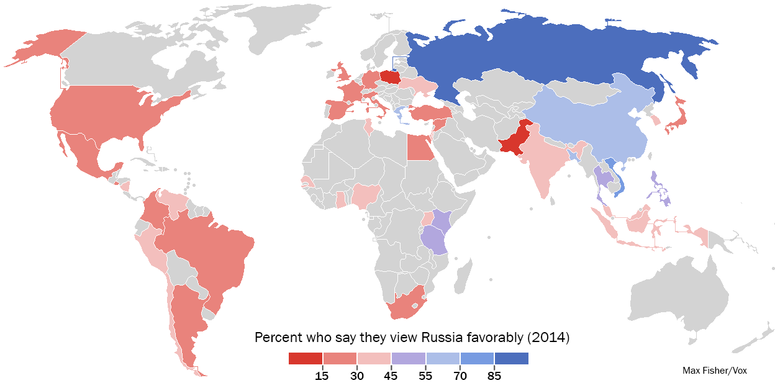
Max Fisher highlights a Pew study (pdf) released last month that documents attitudes toward Russia in countries around the world. As you can see from the map, the erstwhile superpower is not very well liked at the moment:

Russia is most unpopular in Poland, which, as a long-suffering Soviet puppet state, is exceptionally alarmed about Russia’s recent invasion of Crimea and its sponsorship of separatist rebels in eastern Ukraine. In Poland, only 12 percent say they have a favorable view of Russia, with 81 percent holding an unfavorable view. The rates are not much higher in the rest of Europe, which is part of why European leaders are becoming much more willing to impose tough sanctions on Russia, even at some cost to European economies.

But Russia is also deeply unpopular in the Middle East.

This is most true in Turkey, where only 16 percent hold a favorable view of the country, with 73 percent holding an unfavorable view. This may be a result of Russia’s sponsorship of Syrian leader Bashar al-Assad, who has been able to get away with slaughtering thousands of civilians in that country’s civil war in part because Moscow shields him from international action.

Jan Cienski zooms in on how Eastern European countries, most of which are notably absent from the Pew report, are responding to Putin’s aggression in Ukraine—or not responding, as it were:

Despite their common experience of spending a half-century under Moscow’s heel as part of the Soviet bloc, it has proven impossible for Poland to forge a regional alliance against Russia. Some countries are awake to the danger of Russian tanks and green-uniformed troops appearing on their own borders; others are still keen to cut commercial deals that require being in the country’s good graces.

“The Hungarians are still conducting a policy of rapprochement with Russia. The Czechs don’t care what is happening in Eastern Europe. The Bulgarians first joyfully accept, then doubt, then again accept [Russian proposals for the South Stream, a new natural gas pipeline running through Bulgaria to Southern Europe],” said Roman Kuzniar, national security advisor to Polish President Bronislaw Komorowski, in a recent radio interview. “The Baltic countries also do not have a common front. That shows how easily we are divided, even among countries which have a heightened geopolitical awareness.”

Europe’s Policing Lessons For America

by Dish Staff

Michael Bond criticizes American crowd-control techniques:

One of the most worrying aspects of this drama is what it reveals about US crowd-control methods. In Europe, many police forces have started to accept that the traditional model of public-order policing, which treats all crowds as potentially dangerous, often makes things worse. This model dates back to the French Revolution, which seeded the idea that crowds turn people into primitive, dysfunctional automata, and that the only way to deal with protestors is to attack, disperse or “kettle” them – a draconian form of containment.

Such tactics are slowly being abandoned in Europe because social psychologists have demonstrated time and again that they can have a dramatic and often catastrophic effect on how people in crowds behave. They have found that the way a protest is marshalled has a greater influence on whether it ends peacefully or violently than the actions of any hooligan minority within the crowd. This puts the police in a powerful position, even before they take aim with rubber bullets or tear gas.

He argues that Europe has this figured out. Matt Steinglass finds that Europe is transfixed by the events in Ferguson. One reason why:

The confrontation in Ferguson, as many observers have noticed, looks uncannily like the ones in Ukraine, Gaza and Iraq. There is clearly some kind of a global blowback going on, in which military techniques of forcible population control developed for use at the periphery of states’ areas of sovereignty are now being applied at the centre. Leonid Bershidsky, a brilliant Russian journalist and editor, laid out the similarities in a fascinating column yesterday in Bloomberg View. “Police officers around the world are becoming convinced they are fighting a war on something or other, whether that’s drugs, terrorism, anarchists or political subversion,” Mr Bershidsky writes. “This mindset contrasts with the public’s unchanged perception of what the police should be doing, which is to keep the streets safe, a conceptual clash that can lead to unexpected results.”

The difference between these two kinds of policing, Mr Bershidsky writes, can be modeled as the division between the London Metropolitan Police Force established in 1829, which conceived itself as fighting crime in concert with the populace, and the repressive colonial police forces the British Empire employed in “colonies of rule” such as Ireland and India, who conceived of themselves as keeping potentially hostile local populations in line.

Final Thoughts on Israel and Palestine

by Freddie deBoer

Activists Hold Palestinian Solidarity March And Rally

I want to put my discussion of Israel to bed for the week, as some emailers are complaining that I’m “fixated” on the issue. I’m writing about Israel and Palestine a lot in part because I’m getting the most emails on that question.

Many people who have written wonder, with various degrees of indignation, why I don’t perform the typical preemptive apologetics that so often come with criticism of Israel. Why don’t I take time to balance my complaints about Israel by mentioning all the bad things about Hamas? Where are my explicit denunciations of anti-Semitism? Why don’t I come out and say whether Israel should be wiped off the map? I don’t do these things for two reasons. One, because I think it’s in the best interest of everyone– including those committed to the defense of Israel’s government and policies– to return normalcy to this debate. On what other issue am I expected to explicitly disclaim attitudes that I don’t believe and haven’t mentioned? No, it’s true: I’m not anti-Semitic, I don’t think Jews secretly run the world, I don’t believe in Islamic governance either, and I don’t want Israel “wiped from the map.” But when did I suggest such a thing? Acting as if this issue has to be treated with kid gloves in a way that is wholly unique in American politics does no favors to either side of this debate. I have been counseled many times in my life to avoid this specific issue because of the potential professional consequences. I appreciate that people are talking out of a desire to help, and situations like that of Steven Salaita and Norman Finkelstein demonstrate the sense in this advice. But to not engage out of fear of the  consequences exacerbates the problem, and incidentally plays into the hands of anti-Semitic tropes. My country spends billions of dollars and an enormous amount of diplomatic capital on Israel, that makes Israel my business, so let’s hash it out. We are adults. We are capable of arguing as adults. So let’s just argue the way we usually do.

I also don’t seek balance because I don’t pretend that there is equality of blame in this issue. Many smart, decent people I know treat this issue with a “plague on both houses” attitude, talking about a “cycle of violence,” or “ancient grudges.” They speak as though this issue is so polarized and so complex that we can’t make meaningful judgments. I find that, frankly, bullshit. I’m not usually a big fan of Max Fisher’s work, but he had this perfectly right: the occupation is wrong, it is the problem, and Israel is to blame. Israel has been illegally and immorally occupying the Palestinian territories for almost 50 years. And Israel has the ability to end it. The Israeli government could unilaterally withdraw from the territories and leave the Palestinians to build their own state, or they could fully incorporate Palestinians into a  new unified Israeli-Palestinian state that recognized total and  complete political and social equality between all people. If you find those ideas radical, consider that they are merely what basic liberal democracy requires. I am completely agnostic on the notion of one state or two, but I know that what our most basic political ideals require is a world where we have achieved perfect political equality between Arabs and Jews. Israel is capable of creating such a world. Palestinians are not.

For those who fear Israel’s annihilation, I would say that while your fear is understandable, given the facts, it is not rational. No one disputes that Israel’s military capacity is incredible for such a small nation, and that’s true even setting aside its secret nuclear arsenal. The Western world is totally committed to the defense of the modern Israeli state. The United States would go to war to defend Israel’s right to exist. NATO is committed to Israel and the UN, for all its criticisms of Israel, would support an American defense of Israel. We’re talking about a commitment to defend Israel with nearly limitless military power. Do the Palestinians enjoy any such equivalent protection? Yes, you are entitled to consider the sweep of history when you think about Israel’s future, but you are also required to consider facts. And the facts tell us that the people who should truly fear annihilation are the Palestinians. They are the ones who are existentially threatened. They are a nation of refugees. They are a people without a state. To insist on this reality isn’t extremism. It’s just taking an honest look at the world around you.

What American defenders of Israel must recognize is that it is Israel’s diplomatic isolation that threatens it in the long term, not Hamas’s rockets. And the occupation will always isolate Israel, because the occupation is wrong. Some emailers have suggested that anti-Semitism is behind all of Israel’s international critics. To which I say, really? Criticism of Israel from South America is all anti-Semitism? From Western Europe? From sub-Saharan Africa? Did tens of thousands of South Africans march in protest of Israel’s assault on Gaza because of  anti-Semitism? America’s protection is powerful, but it is not limitless, and its hegemony is slowly crumbling. In the next century, Israel must secure its future not through the blessing of a superpower but by earning the reputation of a moral nation. That cannot occur while Palestine is occupied.

And more than securing Israel’s security, ending the occupation is a matter of securing Israel’s soul. What strikes me most about interacting with Americans on this issue, even political and informed Americans, is how many don’t fully comprehend the rise in ultra-conservatism and ethno-nationalism in Israel. People don’t want to think of Israel as that kind of country, and so they shut their ears to it. Yet the evidence grows every day; Netanyahu’s cabinet is virulently extreme, the fringe right-wing parties grow more powerful, the racism and bigotry of the street protests more and more explicit and unafraid. Look, just today, we learn that the Israeli government is targeting the family of Mohammed Abu Khder, the 16 year old Palestinian who was burned to death by Israeli terrorists. This is the type of ugliness, of nastiness, that is seeping into the firmament of Israeli society. This is what journalists like Gideon Levy and Max Blumenthal have been investigating in their work, and this is why they are considered so dangerous: because they threaten to expose to progressive people the reality of the growing reactionary nature of Israel’s internal politics.

50 years from now, and 100, there will still be Jews and there will still be Palestinians in this region. The question is, what form will their relationship take? Will an independent Palestine have been given complete self-determination and diplomatic recognition, a two state solution? Will it be a unified state that recognizes the complete equality of all of its citizens, regardless of their ethnicity or religion, a one state solution? Or will Israel continue to be an apartheid state, brutalizing a stateless people? The latter is the possibility that most threatens Israel’s future, make no mistake. And so the question is what future we, as a nation that subsidizes the occupation in every way imaginable, are willing to argue for, and how long we are willing to ignore what’s staring us in the face.

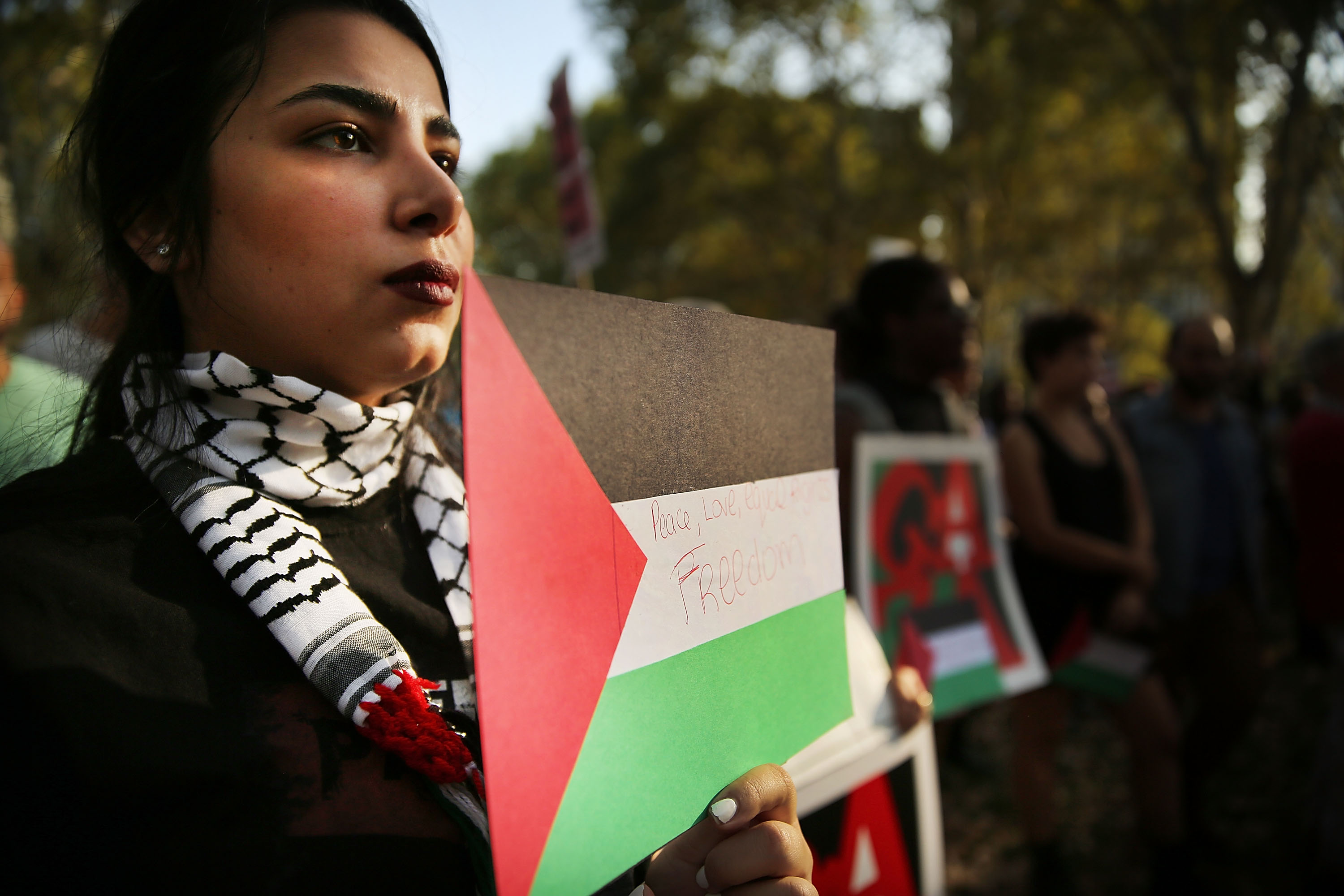
(Photo: A demonstrator prepares to march across the Brooklyn Bridge to protest against Israel’s continued military campaign in Gaza on August 20, 2014 in New York City. By Spencer Platt/Getty Images)

Foley’s British Executioner, Ctd

by Dish Staff

The ISIS jihadist who beheaded American journalist James Foley in a video released by the group on Tuesday has been identified:

As an international manhunt got under way on Wednesday, the English-speaking militant was identified to the Guardian by one of his former hostages as the ringleader of three British jihadists thought to be the main guards of foreign nationals in Raqqa, a stronghold of Islamic State (Isis) rebels. The militant who appeared on the Foley video, who called himself John and is believed to be from London, was said to be the main rebel negotiator during talks earlier this year to release 11 Islamic State hostages – who were eventually handed to Turkish officials after ransom demands were met.

The FBI, MI5 and Scotland Yard’s counter-terrorism command were all on Wednesday night racing to identify the militant who fronted the propaganda video that showed the brutal murder of Foley, the journalist who had been missing in Syria since 2012. Sources in Syria recognised the man as a point-man for hostage negotiations in Raqqa, where he is said to have held discussions with several families of jailed foreign nationals over the internet.

Josh Rogin and Eli Lake link Foley’s abduction and murder to a ring of foreign-born jihadists suspected in the kidnapping of other journalists in Syria. Several members of that ring were arrested and charged with false imprisonment shortly before Foley was kidnapped in November 2012:

The case fell apart because the two Western journalists who had been abducted in Syria in July 2012 and could identify the suspects did not appear to testify at the trial. One of them had testified against Shajul Islam at pretrial proceedings and said Islam was part of a cell of foreign-born extremists in Syria that included 10 to 15 U.K. citizens. Islam, through his lawyer, denied being involved in the abductions at the time.

One U.S. intelligence official told The Daily Beast that both U.S. and British counter-terrorism agencies have taken a keen interest in the suspected militants. “There is no official product on this yet for the intelligence community,” this official said. “But people who are out there and collecting on this believe the [Foley] abduction and the [Islam] trial are connected.”

The US had apparently tried to rescue Foley last month:

Details on the nature of the unsuccessful operation remained sparse late Wednesday. When American forces landed in eastern Syria — most likely in Raqqa province, where Foley is thought to have been held and killed — they came under heavy fire. The elite troops killed a number of militants, and one of the pilots involved in the operation sustained a minor injury when his aircraft came under fire, a senior administration official told Foreign Policy.

According to a defense official with knowledge of the situation, the operation occurred in early July. The same official added that the operation was based mostly on human intelligence — as opposed to satellite photographs and intercepted communications — and the military now believes the hostages had been moved from that location just days before the raid took place.

Obama denounced the killing in a press conference yesterday afternoon, calling ISIS a “cancer” but not committing to a particular course of action in response. After weighing the pros and cons of a retaliatory effort, Zack Beauchamp sees the president in a bind:

Obama’s Wednesday statement was two things: an emotional tribute to James Foley’s life, and a furious condemnation of ISIS and its goals. “Jim Foley’s life stands in stark contrast to his killers,” the president said. “[ISIS] has no ideology of any value to human beings. their ideology is bankrupt.”

What the presser wasn’t, however, was a policy address. Saying “the United States will continue to do what we must do to protect our people,” as Obama did, doesn’t say much about the choice between “hit them harder” and “don’t take the bait,” or any other clear US action or lack thereof. The American policy response is still just unclear. Regardless of what the US ends up doing, it should be clear that this isn’t an easy call for Obama. Sadly, it’s much harder to destroy ISIS than it is to condemn the atrocities they commit.

The Guardian weighs in on what Foley’s murder means in terms of the Anglo-American role in the fight against ISIS:

Bluntly put: if we target them, they will target us. The foreign secretary, Philip Hammond, was right to say on Wednesday that we – Americans and British in particular – have always been in their sights as one of the “far enemies” they reckon with. But fighter bombers over the Mosul dam, arms for the Kurds and help for the Baghdad government bring us more into the “near enemy” category, and that has consequences. Consequences in the region and, potentially, consequences at home in the United States and Europe.

We should not be alone in a contest with Isis. Regional powers should take on a greater role, perhaps even military, but certainly a more coherent diplomatic role. There should be a suspension of the rivalries which helped create the opportunity Isis seized.


The Other Shooting In St. Louis

Disturbing footage of Kajieme Powell’s death has emerged:

Lopez captions:

The newly released video begins before police arrive on the scene. A bystander has followed Powell after he took energy drinks and muffins from a market without paying for them, and can be heard chuckling over Powell’s erratic behavior. Powell is seen slowly pacing around the scene of the eventual shooting before police arrive. When the officers enter and draw their guns, Powell ignores warnings to put down his knife, and advances on them. He then repeatedly yells, “Shoot me!”

But Powell does not appear to be holding a knife high, and he looks to be walking normally — and to be further than two or three feet from the officers — when they open fire, killing him.

Ezra is deeply troubled by the video:

It is easy to criticize. It is easy to watch a cell phone video and think of all the ways it could have gone differently. It is easy to forget that the police saw a mentally unbalanced man with a knife advancing on them. It is easy to forget that 20 seconds only takes 20 seconds. It is easy to forget that police get scared. It is easy not to ask yourself what you might have done if you had a gun and a man came at you with a knife.

But there is still something wrong with that video. There is something wrong that the video seems obviously exculpatory to the police and obviously damning to so many who watch it. The dispute over the facts in the Michael Brown case offers the hope that there is a right answer — that Wilson either did clearly the right thing or clearly the wrong thing. The video of the Powell case delivers a harder reality: what the police believe to be the right thing and what the people they serve believe to be the right thing may be very different.

Excessive Restraint

by Dish Staff

Medical resident Ravi Parikh considers the cons of physically restraining patients:

In some situations, restraints may be ineffective and even harmful. Doctors and nurses often employ restraints when a patient is at risk for falling or delirious. However, evidence suggests that restraints do not reduce one’s risk of falling.  Likewise, a study in the Journal of the American Medical Association suggested that restraints increase the risk of delirium in the hospital by 4-fold, possibly by increasing patients’ levels of anxiety and stress due to involuntary immobilization.  Physical restraints and the resulting immobilization they cause are also associated with increased rates of pressure ulcersrespiratory complications—and even death via strangulation and aspiration. Even more disturbingly, a 2006 report by the U.S. Department of Health and Human Services concluded that hospitals failed to report more than 40 percent of deaths related to restraints to The Centers for Medicare and Medicaid Services (CMS).

Though these statistics may make the ICU seem like an asylum, it is not. The majority of patients I cared for in the ICU never required restraints. And for the others who were confused or agitated, our team could usually avoid restraints by adjusting or prescribing medication.