How Does Ferguson End?

by Dish Staff

Jonathan Cohn tries to imagine a resolution to the crisis:

First, and most obviously, the investigation of Brown’s death must produce some kind of concrete result. And it will probably have to be the investigation that officials from the Justice Department are conducting. The people of Ferguson have absolutely no faith in the Ferguson police and, really, who can blame them?

Josh Marshall looks on as the police flail around:

For all the pyrotechnics, literal and figurative, and all the various outrages, large and small, what I see more than anything else is no one in control. And that’s been the dominant theme for days. … There are ways, even heavy-handed ways to quell protests and riots. But this seems like a repeated use of the same heavy-handed tactics that have proven counter-productive night after night.

Jelani Cobb observes that Missouri State Highway Patrol Captain Ron Johnson, who temporarily calmed tensions last week, isn’t calling the shots:

In the span of twenty-four hours, Johnson had gone, in the community’s eyes, from empowered native son to black token. One of the local activists I’d met in Feguson sent me a text message after the curfew announcement saying, “Johnson has good intentions but no power. This is beyond him.” On Sunday, Johnson stepped into the pulpit at Greater Grace Church, the site of a rally, and apologized to Brown’s family, saying, “I wear this uniform and I feel like that needs to be said.” With that, he implicitly condemned the Ferguson Police Department for their failure to do so. Johnson had promised not to use tear gas in the streets of Ferguson but, during a skirmish with looters on Saturday night, police tear-gassed the crowd. Johnson’s address at the church carried the message that his allegiances were, nonetheless, with the people of Ferguson. James Baldwin remarked that black leaders chronically find themselves in a position of asking white people to hurry up while pleading with black people to wait. Johnson finds himself asking black people to remain calm while imploring white police officers not to shoot. The problem here is that few people in Ferguson believe that the former is any guarantee of the latter.

Along those lines, Emily Badger sees the calling in of the National Guard as somewhat superfluous at this point:

As early as last Monday, two days after the shooting, the streets in Ferguson were full of officers dressed in camouflage and armored vehicles with gun turrets on top. The city responded immediately to the first rounds of protest and looting after Michael Brown’s death with what some critics have likened to the municipal equivalent of shock and awe. That tactic left little room for a ramped-up force in the face of further unrest. … Now it’s unclear what kind of calming effect the Guard can have — Nixon said he was sending in the soldiers to help restore order — when tensions between law enforcement and local residents have already been so inflamed. It’s possible the community at this points needs to subtract officers, not add them. The circumstances that could still restore order may also have little to do with the presence and tenor of law enforcement on Ferguson’s streets, but with the community’s confidence in an investigation that’s still unfolding.

Morrissey agrees that the National Guard is no panacea:

The difference is the authority level more than the heightened capabilities. The National Guard’s thunder may have been partially stolen by the previous arrival of the Missouri Highway Patrol, which also operates under the authority of the governor. The issue in both cases was to assert a higher authority than the city and county levels, which had lost the confidence of local residents. There is still plenty of value in that escalation, but only insofar as local residents have confidence in the governor to restore order and justice in all directions.

Unfortunately, that doesn’t appear to be the case so far, perhaps in no small part because it may not be locals who are causing the problems. Until they can end the magnet that’s attracting agitators from around the country to exploit the situation and perpetuate it for their own ends, the actual people of Ferguson will be in for a long nightmare, and the longer it goes the less confidence they will have in law enforcement at any level.

We Made Police Misconduct Inevitable, Ctd

by Freddie deBoer

National Guard Called In As Unrest Continues In Ferguson

Readers sound off my post about our complicity in police misconduct:

You write, in part, “It’s human nature: people who are subject to little or no review will inevitably behave badly.” Hogwash.  What you have, apparently, bought into is the belief in some parts of Christianity that we are all born evil.  And that, therefore, we all require constant outside pressure in order to behave well.  I’m guessing that, consciously, you would reject that worldview.  But it’s what your statement comes down to.  (And personally, my experience of humanity has been very much otherwise.)

The problem is rather that some people do need outside constraints.  I would suggest that it is, most of the time, only a very small portion of the total.  But that small portion is highly visible when their constraints are off.  (It’s the same phenomena which causes people to believe that the streets are more risky than ever, even as crime rates have been falling for a couple of decades.  Bad things make headlines.)

Yes, police misconduct is a problem that needs to be addressed.  And may even be especially high in some minority urban areas.  But to address it effectively, we need to have a clear view of the police as a whole.  There are doubtless some places, possibly including Ferguson, where the police department as a whole is a problem.  Then again, it would only take a couple of people, even there, to lead to the problems we have seen.

Suppose you have three problem individuals, out of 50+, on the Furgeson PD.  One is the guy who ordered everybody into combat gear.  One is a guy who started the shooting (since once that starts, in a tense situation, many others will follow).  And, of course, one may be (depending on what really happened) the guy involved in the original incident. That’s all it would take – less than 10%.  I’m not saying that that’s all there were; just that no more are actually needed for things to deteriorate.

Saying, or acting, like we believe that everybody on the police department, there or elsewhere, is nasty unless tightly controlled is only going to make it harder to make things better.  People, even good people, get defensive when they are accused of being evil.  If you really want to get positive changes, you have to recognize that most of the police are dedicated good guys, who would join in your efforts with a will … if you refrain from tarring them all with the same brush.

Well: it happens that I don’t believe that human beings are basically good, despite how often that’s said, but I don’t think I’ll convince anyone of that in the space of a blog post. I’ll just say this: maybe it’s true that only some people need to be subject to close scrutiny to behave well. As you say, it only takes a small amount of people to ruin everything, and as I indicated, the cyclicality and regularity of these problems seems to suggest that the problem is systemic rather than individual. Indeed, some readers are complaining that I’m going after the cops in an unfair way, but I’m actually arguing that the system we’ve created has given the police little incentive to behave well. That’s not an exoneration of the individuals, but it is a way to look for deeper causes than personal immorality. I would add that it’s impossible to know who’s going to be good and who’s going to be bad, without scrutiny, before the fact. So we’re still left in a place where we need strictly defined and strictly enforced accountability measures for police, and we need them to operate in an atmosphere that does not default to deference. And finally, whatever is hypothetically the case, we are hearing every day from the poor and racial minorities, in this country, that they fear the police. That’s their reality, and we need to respond to it.

Another:

Thanks for this posting. However the problem very much pre-dates 9/11. The National Registry of Exonerations lists more than 2,000 wrongful convictions since 1983, and, I think it is safe to say, this is just the tip of the iceberg.

Unfortunately, there appears to be a corrupt system that includes prosecutors who are happy to convict and then unwilling to reverse their position once new evidence comes to light. We see the problem all too clearly in my state, Illinois, where Governor George Ryan put a moratorium on implementing the death penalty in 2000 after 13 people had been exonerated – most of those exonerations requiring many years and often bitterly fought. In Chicago, taxpayers have been required to pony up millions of dollars in settlements over and over again in cases where the police have over-reached (to put it mildly). The most notorious cases being John Burge who was found to have been involved in torturing 200 suspects between 1972 and 1991.

The problem is African American and low income communities of all races know/believe this stuff goes on all the time. But, in general, white and better off communities either don’t believe it or don’t want to believe it or don’t care or some combination of all of the above. Which goes to your point that we get the police department the public wants to have.  Most police officers are good. But the system defends the bad ones with such vigor, it tarnishes the entire system among the people who need it most, but are also most victimized by it – low income communities. The public needs to re-think what is costing everyone to continue like we have.

And another:

This is not merely a post-9/11 problem, although I agree that the outpourings of public support (for first responders) you cite certainly contribute. History repeats itself. I recall my own experience from the 1960s-70s.

After a stint in the military, I came home to my west Bronx neighborhood to find it in transition from a middle class, Irish-Jewish enclave to ghetto. It was 1968. Heroin ruled the streets, crime was rampant, students at nearby Columbia were rioting and, shortly after, the South Bronx would literally erupt in flames. I continued to work in the neighborhood for the next 13 years as a public utility employee. While I watched my old neighborhood burn down, I was able to observe much else that occurred on the streets.

Then as now, the police routinely despised and brutalized the people they were supposed to serve.  Granted, they were overwhelmed and often demoralized.  At the same time, they had no incentive to address the root cause of much street crime, heroin.  The reason was precinct-level corruption which, as revealed in testimony before the Knapp Commission, was endemic. There was little incentive for a cop to run drug dealers off his beat when they might well have been the source of income that may have equaled or exceeded his regular paycheck.

Hopefully, that cycle of despair doesn’t exist to impede efforts to resolve today’s already daunting societal problems.

(Photo: Police officers arrest a demonstrator on August 18, 2014 in Ferguson, Missouri. By Joe Raedle/Getty Images)

Pope Francis: Stop ISIS

by Matthew Sitman

Mark Shea passes along the full text from Pope Francis’ press conference yesterday, including this statement about U.S. efforts to stop ISIS from killing even more Iraqi minorities:

Q. You know that recently the U.S. forces have started bombing the terrorists in Iraq, to prevent a genocide, to protect minorities, including Catholics who are under your guidance. My question is this: do you approve the American bombing?

A. Thanks for such a clear question. In these cases where there is an unjust aggression, I can only say this: it is licit to stop the unjust aggressor. I underline the verb: stop. I do not say bomb, make war, I say stop by some means. With what means can they be stopped? These have to be evaluated. To stop the unjust aggressor is licit.

But we must also have memory. How many times under this excuse of stopping an unjust aggressor the powers [that intervened] have taken control of peoples, and have made a true war of conquest.

One nation alone cannot judge how to stop an unjust aggressor. After the Second World War there was the idea of the United Nations. It is there that this should be discussed. Is there an unjust aggressor? It would seem there is. How do we stop him? Only that, nothing more.

Secondly, you mentioned the minorities. Thanks for that word because they talk to me about the Christians, the poor Christians. It’s true, they suffer. The martyrs, there are many martyrs. But here there are men and women, religious minorities, not all of them Christian, and they are all equal before God.

To stop the unjust aggressor is a right that humanity has, but it is also a right that the aggressor has to be stopped so that he does not do evil.

Francis, it seems to me, is taking a measured position here. He supports involving the United Nations. He rejects any “war of conquest.” And he underscores, rather emphatically, that the purpose of intervention should be to stop the aggression of ISIS, with his language suggesting military force should be a last resort. For reasons I can’t explain, Max Fisher compares this to the crusades, claiming that Francis’ remarks “might make you wonder what millenia you’re in”:

During the Middle Ages, between 1096 and 1272 AD, popes also endorsed the use of Western military action to destroy Middle Eastern caliphates. Those were known as the crusades; there were nine, which means that this would be number 10. The historical record suggests, though, that prior crusades were usually not endorsed from the comfort of jet-propelled airplanes, nor were they announced via Twitter.

The ignorance involved here is stunning, with the casual use of that word “also” – as if there’s no real difference between the medieval crusades and today’s prevention of genocide – doing far too much work. You’ll notice what Fisher doesn’t say, which is how this comparison is analytically useful in any way. What do we learn about the present situation by referencing the crusades? I don’t know, because Fisher doesn’t explain. I suppose the takeaway is that the crusades were bad, therefore Pope Francis is wrong. But this isn’t analysis; it’s snark with a veneer of Voxsplaining. It’s wrenching historically charged events out of context to seem clever. Ed Morrissey has a more helpful take on Francis’ comments:

Francis seems to stop short of explicitly endorsing military force, but that’s only theoretically speaking. If anything short of military force could stop ISIS, Francis wouldn’t need to make this statement in the first place. The question will be — and actually is, in Francis’ statements — just what kind of force to apply.

In many wars, one can debate whether one side or the other, or both, have committed “unjust aggression.” In the case of ISIS, which is conducting genocides, ethno-religious cleansing, and wholesale massacres, as well as condemning women into sex slavery, there is no debate on the nature of the conflict. There is, however, debate on what it would take to put a stop to all of the above “unjust aggressions,” which is Francis’ first qualifier on his endorsement. According to the rough parameters of the just-war doctrine, there should be no more force than what is necessary to bring an end to the injustice being perpetrated. Pope Francis doesn’t want to offer any prescriptions for the specific methods but just the moral framework for the decision.

Jack Jenkins and Hayes Brown note the dilemma Francis faces:

For Francis, the issue is more complicated than a firm yes-or-no endorsement of armed intervention, as the situation in Iraq is effectively a real-world example of an agonizing conundrum that has plagued Christian theologians for millennia. After all, when fellow Christians are literally staring down the barrel of a gun held by someone who fully intends to pull the trigger — such as ISIS — how does one respond while still living out Christ’s charge to “turn the other cheek”?

And Jenna McLaughlin seems a bit suspicious that Francis approved intervention now that Christians are involved:

The Vatican’s support for the US intervention, which includes strikes by drones and piloted US fighter jets as well as humanitarian aid for the Yazidis, seems to be somewhat unusual. Just last September, Francis held a massive vigil urging the United States to refrain from engaging militarily in the conflict in Syria following massive chemical weapons attacks, which killed more than 1,300 people. Francis described war in 2013 as a “defeat for humanity,” echoing the words of Pope John Paul II. In 2003, the Vatican condemned the US invasion of Iraq as a “crime against peace.”

But, as the AP points out, “The Vatican has been increasingly showing support for military intervention in Iraq, given that Christians are being directly targeted because of their faith.”

What she seems to assume is that the only difference between Syria and Iraq is that one involves more Christians. I don’t think that’s the case at all, but pointing out that Francis might have a particular concern for the people of whom he is the spiritual leader says nothing about the cogency of his remarks yesterday.

The View From Your Window Contest: Winner #218

by Chas Danner

VFYWC-218

Only one reader correctly guessed this week’s view:

Way too easy. Come on, at least make us work for it. Its’s clearly New York City, NY, USA.

Another is packing his bags:

I don’t care where it is, but I could live there!

Another elaborates:

If every human being could spend two weeks annually at such a place, workplace violence and domestic abuse would disappear.

A confident guess:

Obviously, this is a rare, full daylight view of Lamplight Village, so often painted by Thomas Kinkade, The Painter of Light:

lamplight-village

And available for just three installments of $16.66 (that includes a free, light-painting Thomas Kinkade action figure). Another has a less sentimental guess:

Vaduz, Liechtenstein. Because of reasons.

Or perhaps the UK?

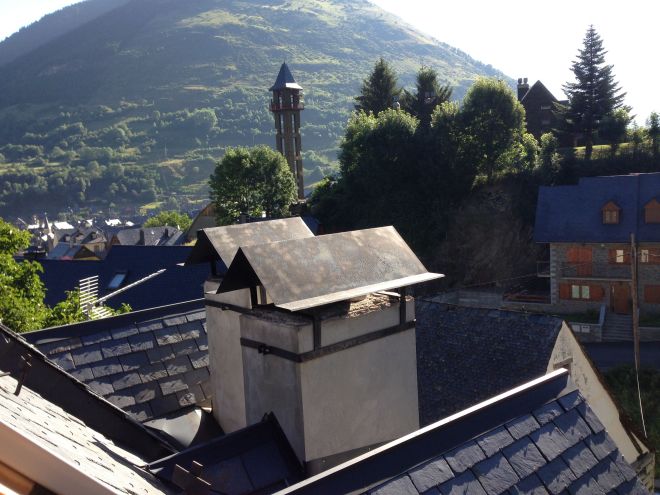
This is a straight-up stumper. No (readable) signs, no cars, no people. no livestock. Six buildings partially visible, and a paved road running through, in some very lovely mountains. Let’s start with the mountains: those could be the Rockies (or other range in western North America), the Alps, the Andes, or somewhere odd like Japan or New Zealand. The sun looks to be more or less directly overhead, so let’s eliminate the southern hemisphere.

My first impulse was Switzerland, but the houses don’t look typically Swiss. My next impulse was Scotland. That feels closer.

If anyone is going to actually decode this (i.e., if anyone is going to get it without having been here on vacation and recognizing it) my guess is that they are going to figure outyellow-box what is up with that yellow box on the side of the building in the foreground that looks like a hand soap dispenser. I am not going to be that person.
So for the sake of keeping my resolution and my sanity I’m going to throw a virtual dart at a map of the Scottish Highlands and say… Fort Augustus, Scotland. Hoping for proximity…

Another:

I’m really looking forward to finding out how the winner deduced this, because I haven’t a clue. We have that funny yellow box on the side of the foreground building, but after much googling I still have no idea what it is. Perhaps the style of the sign on the road evokes something for someone, but not for me. Perhaps the combination of the old stone construction, the slate roofs, the solid shutters, and the mountainous setting all add together in a unique way for someone out there, but not for me. Or perhaps the trees make it clear. The best I can get is somewhere in Europe.

Well you’re right about Europe. Another:

I think those who wanted a difficult contest got there wish. Just because I want to make a guess, I’m saying Rottenturm, Switzerland because it looks like it could be somewhere in Europe and that’s where my grandmother was born and lived until she was eighteen and fled Europe for the United States. The look of the buildings and the slopes behind them are how I imagine that town must look.

This reader better watch out for Uncle Sam:

That is almost certainly where I do my secret banking in Switzerland. I’m not allowed to be more specific.

Another Dish-informed contestant gets closer:

La Mare-aux-Geais, France. Looks like a hameau. Now where did I recently read the word hameau? Oh yes, in the Dish post about La Mort Aux Juifs. The description of the hameau in that post is two houses and one farm. So that is my guess.

This reader gets really close:

The landscape combined with the slate roof, stone buildings, and dormer windows is a good fit for the Pyrenees.  But this is a really tough one to narrow down further.  There are a million little towns and villages in the French and Spanish Pyrenees, and there’s not really a good way to explore them all.  I’ve officially given up and will randomly pick the French town of Fos.  I’m anxious to see how the winner(s) this week will identify the exact spot.  Grit, determination, and many hours of browsing google earth?  ESP?  What will the secret be?

The Pyrenees it is, and the French side was the most popular incorrect guess this week. This reader gets in the right country, only the wrong part of that country:

I know this is probably somewhere in southern Germany/the Alps but those slate-shingled roofs, the mountains, and the green foliage remind me of the tiny sub-region of “O Bierzo,” the far western corner of the province of León in Spain, just east of the region of Galicia (in fact, they speak the Galician language there, too). Slate-shingled roofs are very common in O Bierzo as well as in neighboring Lugo province, but clay shingles are the norm nearly everywhere else in the country.

Alas, the only players to nail this week’s exact town in Spain were previous winners. For instance, a neuroscientist:

ridgeLine_1

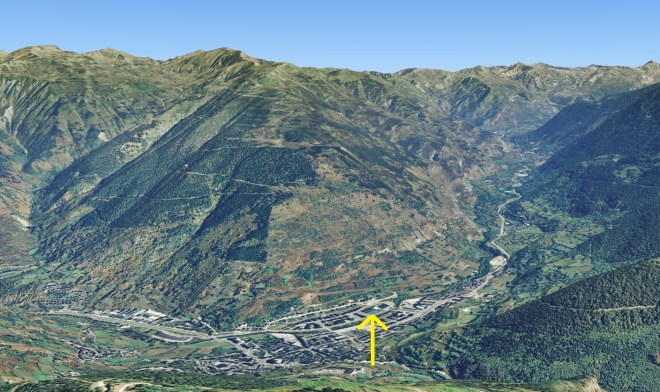
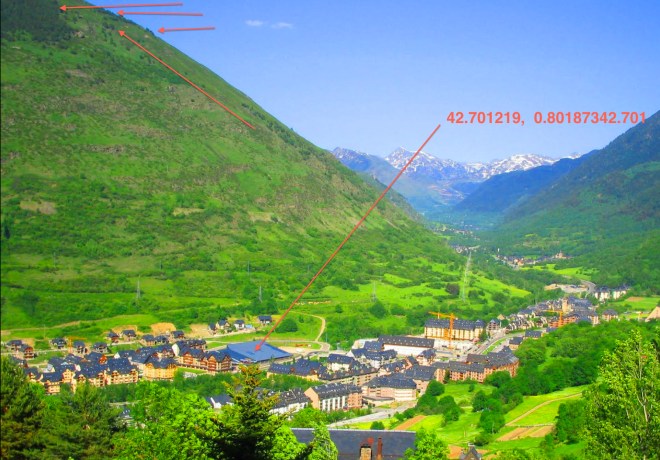
This one was fun. At first the general alpine-ness suggested the Alps, but poking around there didn’t turn up the right mix of architectural features. Cycling fans know that if it’s not the Alps then it’s the Pyrenees, so off to the Franco-Spanish border. The ridgeline matched one outside Vielha, Spain, just a stone’s throw from the French border and familiar to obsessive cycling fans who remember it as the teams’ home base before last Tour de France stage 16.

ridgeline

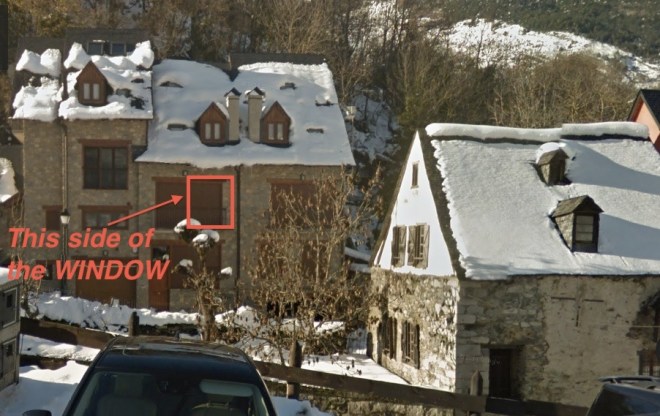
From there, it was a process of roof-matching in Street View to ID the right structure among so many pretty buildings. The rushing stream in the picture is a great hint. Based on sight-lines, I think the window must be the southern-most one on the top floor at 52 Carrèr Major:

theWindow

Amazing. Contest #164 was from another part of the Spanish Pyrenees as well. And here’s the winner of Contest #166:

This was the most difficult contest in quite a while.

View from about the same spot

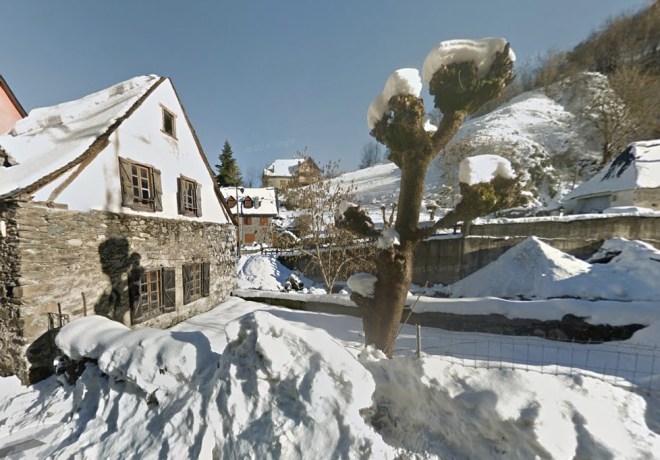
This week we are in the Spanish Pyrenees in the town of Vielha. For the building appears to be named Nere and the closest address on I could find is 54 Carrèr Major, 25530 Vielha, Lleida, Spain.

WINDOW

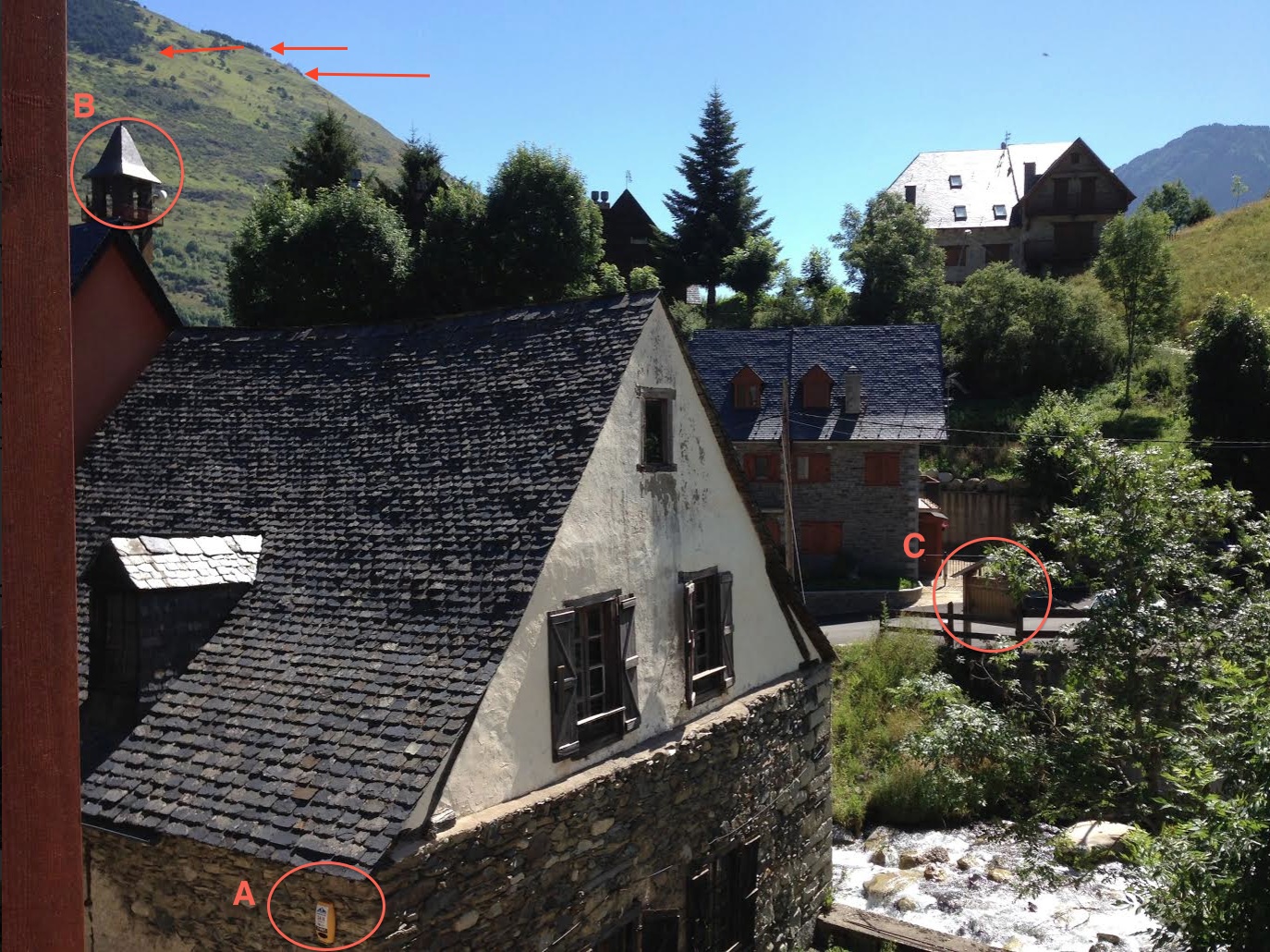
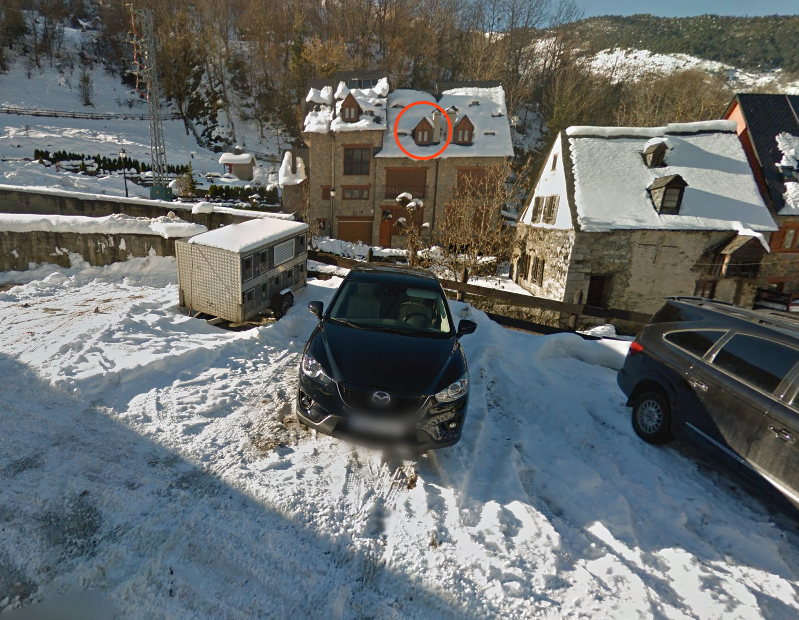
On the second floor of the building, there are two large windows that open onto small balconies. I believe the contest window is the one on the left when facing the building (i.e. the one further south). The window is in the box in the attached picture. I also attach one street view picture showing a snowy version of the same scene, but just from one floor down. And for good measure attached is a third picture taken from the parallel street across the Arriu Nere showing the building with the contest window and two of the buildings in the contest picture.

Alt view

Rest assured, the more the difficult the contest, the happier Grand-Champ-Chini gets:

Now that’s what I’m talkin’ about. After a tough few days I needed a good view to hunt and this one made up beautifully for Dish Editor Chris Bodenner’s maddening eephus pitch from last week.

VFYW Vielha Bird's Eye Marked - Copy

The lack of landmarks means that we’ve got a classic “hard” view on our hands, but its proximity to Spain’s biggest ski resort makes me think that there’ll still be a decent number of responses. Eight correct answers, perhaps?

VFYW Vielha Actual Window Marked - Copy

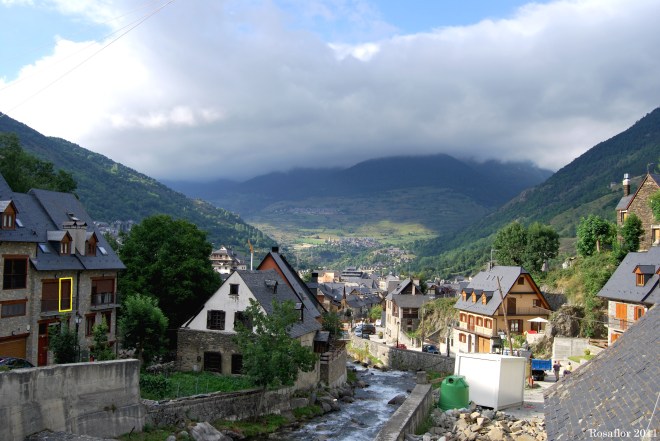
This week’s view comes from Vielha, Spain in the Val D’Aran just a few miles south of the French border. The picture was taken from a sliding living room door on the second physical floor of the Casa Mijaran rental apartments (most likely Mijaran #1) located at 54-52 Carrer Major and looks east-north-east along a heading of 71.37 degrees over the banks of the River Nere, a tributary of the Garonne River. I’ve also attached a picture from the interior showing the likely spot where your viewer was standing.

VFYW Vielha Interior View Casa Mijaran 1 - Copy

Lest any regular players get too intimidated, this week’s winner was off by only 7.1km:

A really difficult one this week! I am pretty certain it is on the Pyrenees, given the terrain and the architecture, but finding the exact mountain village with the scant clues present in the picture is beyond me. Just for fun I am going to guess Arties, Spain, though I’d be flabbergasted if I turn out to be right.

Flabbergast away. Nice job.

This week’s view actually came from friend-of-the-Dish Jonathan Cohn:

View-from-Window---1

It’s from an apartment in Vielha, Spain, where we spent a week in July. Vielha is in the Pyrenees in Catalonia and near the French border.

View from Window - 1

The photo will be tough, I think, but there are mountains and a bell tower in the center of town which are both visible in the shot. There’s also a creek/small river in one of them. That could help too.

We’ll do an easier view for next week. If you’d like to try and find out where, we’ll see you on Saturday.

(Archive: Text|Gallery)

You Go To War With The Warmongers You Have

by Freddie deBoer

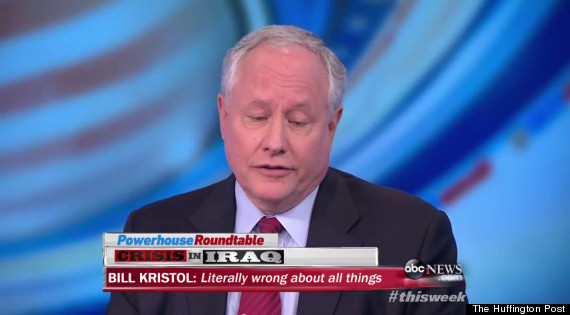
Kristol

Though the left is often seen as home to only pacifists and those who see the hand of imperialism in all proposed military action, there is also a healthy strain of messianic militarism on our side. I regularly engage with lefties who believe we should be “doing something” for the people of Syria, although what that something entails is not consistent or clear. In this telling, the Syrian uprising is a legitimate revolutionary force, the Islamists among them a small corruption that doesn’t jeopardize a post-Assad future, and the situation such that the United States could deploy military power in a way that increases stability and humanitarian outcomes rather than degrades them. These lefties believe in revolution, and they want the United States to be a revolutionary power.

Well, I would simply start by asking: is the United States military in the habit of supporting revolutionaries? What about the history of this country compels you to think that it has the capacity to support revolution, or any interest in doing so? If the United States goes to war, it doesn’t go with some hypothetical benevolent military machine. It goes to war with its actual existing military machine, under the auspices of the same-old warmongering politicians and officials, and with the same old military leadership. We don’t have some spare revolutionary force lying around. So: do you want to break bread with those people? Do you want to give your support to them? Do you want them to do what they do? Because that is a necessary precondition of getting involved. The neocons who want us to get into every war are not suddenly going to throw up their hands and say “we’re sitting this one out, the lefties have got it.” You are free to say that you don’t want to get involved with Bill Kristol and his cronies. But they will most certainly get involved in your war.

There are more arguments against intervening in Syria than I can count. The first and most salient is the only argument we need against calls for more righteous bloodletting: should implies can. The United States went to war under ostensibly humanitarian pretenses in Iraq. We had over 100,000 troops stationed there, and the result was a humanitarian calamity, limitless slaughter. We sent cruise missiles to liberate the people of Libya, and the country has descended into civil war and chaos. Saying that we should free the Syrian people implies that we can. But for now, I want left-wing advocates of military intervention in Syria to recognize: anything that the United States does, will be done in the way that the United States always does it. This will not suddenly become the country you want it to be. And no matter how much you wish it were different, you will be lying down with the Tony Blairs and the Dick Cheneys and the Weekly Standards and the Commentarys. They will be getting involved, and they will exercise more control than you ever can. That’s reality.

Back in a rare moment of clarity, before quickly rediscovering his cruise missile liberalism, Peter Beinart wrote an apology for his previous support for the war. He explained that he had come to learn “a painful realization about the United States: We can’t be the country those Iraqis wanted us to be. We lack the wisdom and the virtue to remake the world through preventive war.” That was true then, and it’s true now. Because the United States is not that country. Because everything about our history, recent and distant, teaches you that this country does not rescue. It doesn’t liberate. It supports dictatorships, destroys enemies, secures resources, destabilizes countries, drops ordnance, and generally imposes its will. But it does not liberate, and no amount of wishing will make it the kind of power you want it to be.

(Image from HuffPo’s “True Chyrons For Bush-Era Iraq War ‘Experts’“)

“No. No. No.” Ctd

by Dish Staff

A reader writes:

That email is such a compelling, extraordinarily well-written, and utterly heartbreaking account of a truly sadistic and unspeakably selfish rape. I find myself completely ashamed that I share similar chromosomal make-up with someone capable of such an act. This account should be required reading for all men, and not merely because it’s always good to remember that sexual assault creates far more damage – lasting damage – than just the violent act itself, but also as a broader reminder that empathy is one of the most important values that anyone can have and demonstrate in all aspects of our lives.

The disgusting selfishness displayed by this woman’s rapist, and the total lack of empathy for the feelings and well-being of another human being is truly chilling. And the planning that took place to execute this violent assault. So many opportunities to take a step back from the precipice. So many opportunities to listen to the inner voice that says “No. This will hurt someone.” And yet.

We must do better. We fathers of sons must do better.

Another gut-wrenching story:

I wanted to write to tell you that rarely have I been moved – rocked may be a better word – by something on your blog more than that story of a woman’s rape and its aftermath. Considering all of the subjects you deal with on a daily basis and how long I’ve been reading the Dish, that’s saying something. It’s also saying something because I’m a man, and yet much of what she wrote rings very true for me. Let me explain.

When I was in my late 20s, I learned that the woman I planned to marry had also been raped while in college, also while studying abroad.

She also had said nothing about it to anyone. A few weeks before I was planning on asking her to marry me, she felt that she needed to share with me what had happened to her. Needless to say, I was shocked and stunned and angry in a way I’d never been before. I desperately wanted vengeance, and yet I wanted to concentrate on not making it about me. I wanted to support her in any way I could. 

In the days and weeks after that, she revealed that there was more she had to tell me, and it wasn’t just about that horrible night. Much like the woman in the email, she was struggling and ashamed because of some things she’d done after that night – some things she’d done while trying to regain the identity and self-control which had been taken from her. She was with people she normally wouldn’t surround herself with, abusing alcohol and drugs. There were sexual encounters she was ashamed of. She was “typically responding.” They were things that didn’t seem like the type of things the woman I know would do, and they were fairly recent.

As the man who loved her, these were very difficult things to hear. They were even more difficult things to understand. I felt like I didn’t know who she was before she met me, or at least that there was a part of her I wasn’t privy to.

It unsettled me, and I’m embarrassed to say that these revelations eventually unravelled our relationship and our plans to marry. I tried hard to come to grips with all of this new information, but I simply couldn’t return to the level of trust and confidence I had in her before.

It’s painful to write that, because I understand now what I didn’t then: that none of this was her fault. These weren’t character flaws. Those incidents weren’t who she was. They were an attempt to recover from what had been done to her. I knew this, but after reading the email you posted, it suddenly made sense in a way it hadn’t before. I’m sitting here today, at my desk, ashamed of not being more understanding, ashamed of quietly blaming her for how she conducted herself in the months after she was raped. Ashamed of judging, of holding those things against her instead of understanding that she needed someone to do the exact opposite.

She has since moved on with another man and married him, and I am happy for her. Like the woman in the email you posted, she was not defeated by her rapist. She’s successful. She has a young family. No one around her knows the things she’s been through. Her parents don’t even know, which makes me wonder how many women (and men) are quietly suffering in our midst. But I’m sure her husband knows, and that he’s a more loving, more understanding man than I ever was.

Or maybe he doesn’t. Maybe what I taught her is that you have to keep those things to yourself if you want to have a life with someone. My stomach hurts just writing that.

I want to thank this woman for sharing her story, for explaining her struggle so honestly and eloquently. As horrified and saddened as I felt after having read that, I hope she knows she’s helped me understand what my ex had been through in a way I never had before. And that like she said, she is surely not alone, sadly.

What’s God Have To Do With Our “Libertarian Moment”?

by Matthew Sitman

Tea Partyjpg

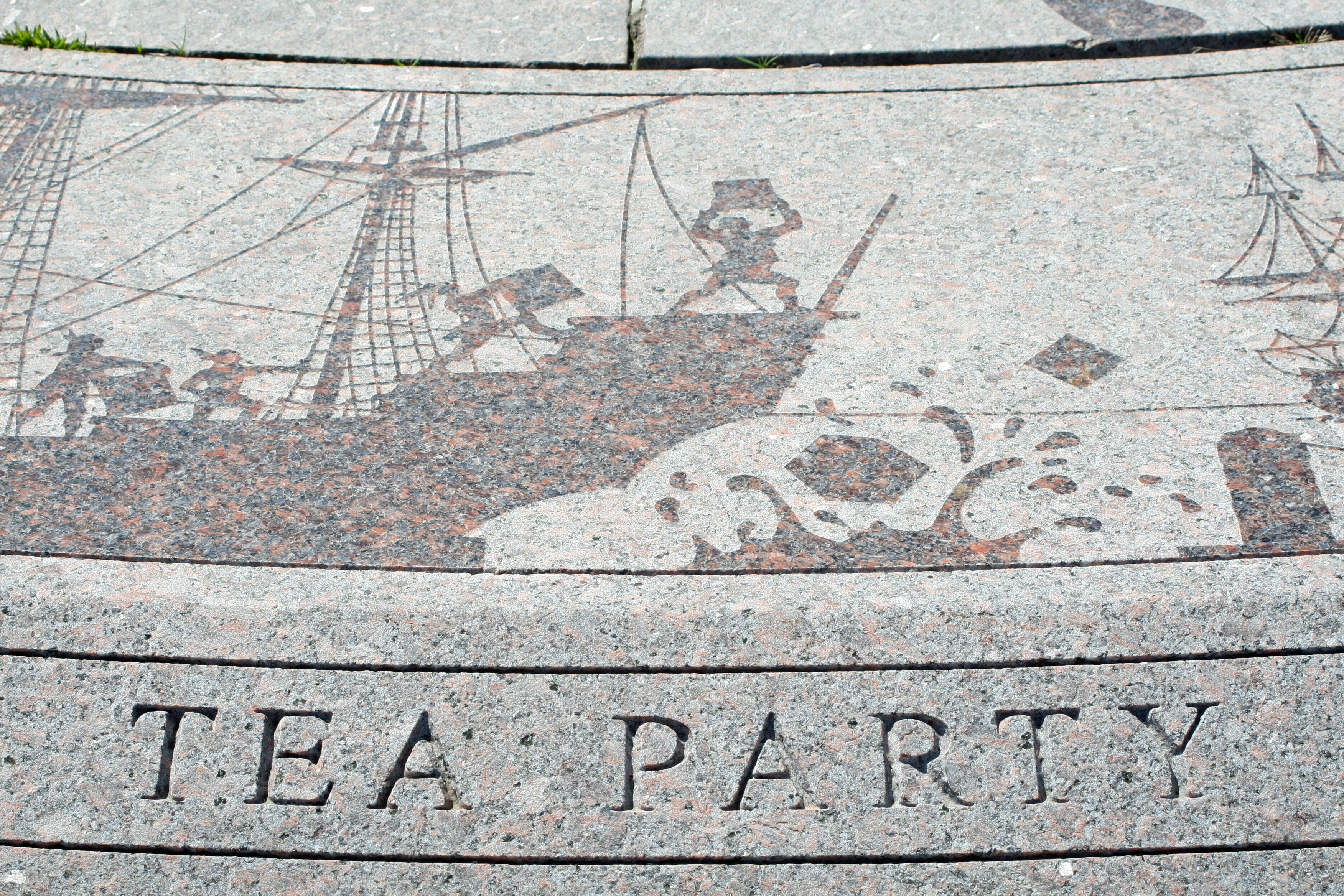
Last week Sarah Posner expanded on Ed Kilgore’s argument that the efforts of the Christian right are a big reason for the rise of libertarianism in the United States – and why Robert Draper’s NYT Magazine story on libertarian politics was off the mark:

I do think that non-religious libertarians played a role in elevating some of the Tea Party agenda to the fore of the Republican Party. But Kilgore is right that the Christian right — a movement very much at home in the Tea Party movement, and one which would take up a good deal of space in a Venn diagram of the coalition — made that libertarian-ish conservatism an ideology that could find a comfortable and uncontroversial place in a political party whose electoral fortunes hinge on holding together a coalition of religious conservatives and anti-regulation free marketers.

An essential dogma of the religious right is that government should provide minimal services for and impose minimal demands on the citizenry. Sound familiar? But the reason isn’t, as popular libertarian dogma would have it, because the government should keep its nose out of your business. Dating back to conservative Christian red scares, anti-union and anti-New Deal ideology, and to Christian Reconstructionist framing of the proper role of government in relation to the church, the family, and the individual, these principles emerge from the idea that the secular state is the enemy of a proper Christian ordering of markets, social norms, and family and religious life.

The thrust of Posner’s piece is to express doubts about “the so-called ‘libertarian moment’ that we may or may not be witnessing,” viewing it not as the emergence of anything new, but rather a sleight of hand concealing the religious right’s grip on the Republican Party. Move along everybody, the theocrats are still running the show, is what she and Kilgore seem to be saying. The Tea Party, don’t you know, has more conservative Christians than real libertarians among its ranks. That’s true but beside the point – it only shows that the Republican Party might fail to exploit the emerging libertarian sensibility, especially among younger voters, that Draper describes. And it has absolutely nothing to do with where this sensibility comes from and what issues are driving it.

Posner is right that, historically, the Christian affinity for some libertarian ideas has not been about a principled defense of freedom, but rather anxiety over the government supposedly imposing secular values on ordinary, God-fearing Americans. The rhetoric of limited government really has been used to advance the agenda of the religious right. But what does that have to do with millenials who are fine with pot and gay people and tired of the wars that have marked so much of their lives? Here’s an important passage from early in Draper’s story:

[T]he age group most responsible for delivering Obama his two terms may well become a political wild card over time, in large part because of its libertarian leanings. Raised on the ad hoc communalism of the Internet, disenchanted by the Iraq War, reflexively tolerant of other lifestyles, appalled by government intrusion into their private affairs and increasingly convinced that the Obama economy is rigged against them, the millennials can no longer be regarded as faithful Democrats — and a recent poll confirmed that fully half of voters between ages 18 and 29 are unwedded to either party. Obama has profoundly disappointed many of these voters by shying away from marijuana decriminalization, by leading from behind on same-sex marriage, by trumping the Bush administration on illegal-immigrant deportations and by expanding Bush’s N.S.A. surveillance program.

It’s true that Draper speculates about the fortunes of Rand Paul and the Republican Party, but he made clear that Republicans would need to do some real work to take advantage of the younger generation’s political views – as he put it, “Republicans would seem well positioned to cast themselves as the fresh alternative, though perhaps only if the party first reappraises stances that young voters, in particular, regard as outdated.” The premise of Draper’s article, in other words, is exactly the opposite of everything Posner and Kilgore write – that our libertarian moment exists independent of the Republican party and it’s religiously-based social conservatism. Draper’s point is not that the libertarian moment is a Republican moment, but that younger voters increasingly hold libertarian-leaning positions on a constellation of issues increasingly, and that, just maybe, a figure like Rand Paul can be a vehicle for their aspirations. But even if Paul can’t, these libertarian sentiments exist. They are, in a way, the independent variable in Draper’s story.

Posner’s article is titled “The ‘Libertarian Moment’ Wouldn’t Exist Without Religion” and Kilgore’s “The So-Called ‘Libertarian Moment’ Is Engineered By The Christian Right.” Both get it exactly wrong. Consider Draper’s description of younger voters noted above – what does any of that have to do with an amorphous “religion” or the Christian right, apart from their notable absence? I would love for Posner to explain how support for pot legalization “wouldn’t exist without religion” or for Kilgore to demonstrate how the Christian right “engineered” millenials wariness of the surveillance state, because those are the kinds of issues our libertarian moment is about. If the most interesting thing you can do with all this is rail against the Republican party, you’re missing the point.

(Photo by Randy Robertson)

Calling Out Catcalls

by Dish Staff

catcalling3

YouGov’s Peter Moore presents a new survey:

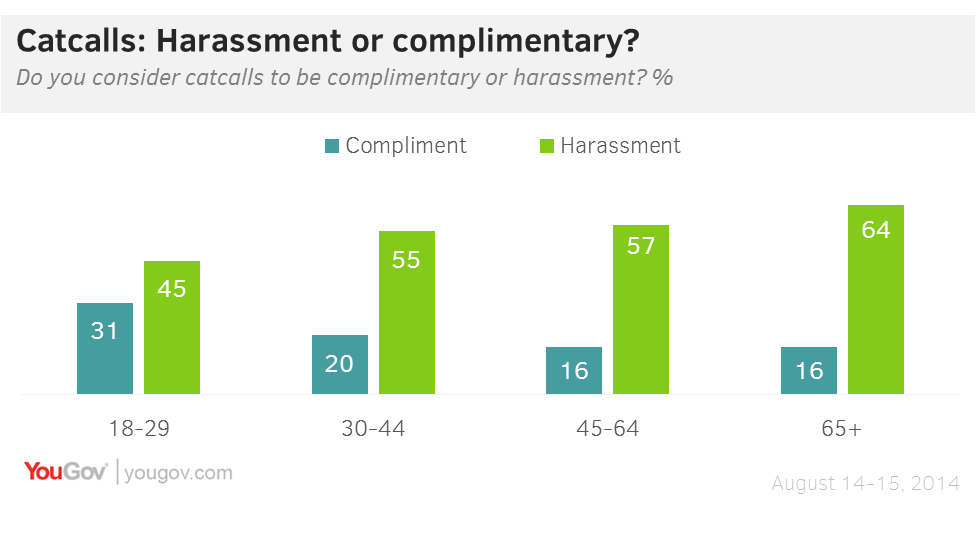
[A]ccording to a large majority of the public, it is never appropriate (72%) to catcall. 18% say that it’s sometimes appropriate, while 2% think that it’s always appropriate. Men (22%) were only marginally more likely than women (18%) to say that it is ‘sometimes’ or ‘always’ appropriate. Asked whether catcalls are compliments or not, most Americans (55%) say that they [constitute] harassment, 24% aren’t sure while only 20% think that they are ‘compliments’.

As seen in the chart above, the relationship between age and catcall-attitudes may come as a surprise:

The question of whether or not catcalls are harassment or complimentary reveals a significant generation divide. Under-30s are the least likely group to say that catcalls constitute harassment (45%), and are the most likely to say that catcalls are complimentary (31%).

In another study released this year, 57% of women indicated they had suffered street harassment and 23% reported they had been “purposely touched or brushed up against in an unwanted, sexual way” while in public. Bryn Donovan recently collected some catcall horror stories:

One woman was harassed right after having her dog put down after his battle with cancer.

I’m at least glad she let the guy have it. Two of the women I talked to had been catcalled while going home from a funeral. One of them had stopped at a convenience store, wearing a black dress, because she had cried so hard at her friend’s service that she needed some Gatorade. A man called after her, making kissing noises and saying, “Damn girl you make that dress look gooood.” A doctor told me possibly the worst story. She had finished a terrible shift in the ER. After declaring a 15-year-old girl brain dead, she had a painful talk with the family about organ donation. Then she admitted a 14-year-old girl who had been raped, beaten, and left for dead, and a long-term patient of hers suddenly coded and died. She came out into the parking lot at 10 a.m. and got catcalled. The family of the 15-year-old was walking out with her, and when the doctor hugged the girl’s mother, the stream of harassment got worse.

Many of us have a long history with harassment, beginning in our early teens. One of my friends thought being pregnant would make her temporarily immune. Nope. I honestly thought that at my age, I would be done with it. Middle-aged women, I am always told, are invisible. I don’t want to be invisible in social situations or at work, but on the street? Yes please.

For more stories, read through our 2012 thread The Terror Of Catcalling.

Is Edward Snowden the World’s Dumbest Spy?

by Freddie deBoer

Michael B. Kelley thinks he might be! Such a fine line between espionage mastermind and espionage incompetent. Kelley does a deep dive into Snowden’s interviews and, with the help of some very, very willful reading and powerful cognitive dissonance, concludes that Snowden has distributed essential intelligence to those commies in Russia and China.

Well, actually, that’s not quite true. Kelley admits that he doesn’t know whether Snowden has done any such thing. He just waits until the long piece’s third-to-last paragraph to make that admission. “Fifteen months after his epic heist, we still don’t know if Snowden was telling the truth when he said he destroyed the tier 3 documents between June 12 (the SCMP leak) and June 23 (the flight to Moscow).” I would call that a fairly important qualifier! I think you’ve buried your lede here, Michael. I mean, if you’re writing a piece about how you think somebody leaked something, but you have a paragraph where you admit that you have no evidence that he in fact leaked that something, you might want to put that up near the top. Just a thought.

Kelley is part of the professional Edward Snowden skepticism circuit, which has kept a lot of “National Security Experts” gainfully employed. (Stimulus!) But Kelley isn’t a part of the knuckle-dragging, “hang his lifeless carcass from the Pentagon flagpole” school of anti-Snowden rhetoric. Instead, he’s part of another class of Snowden critics, the Snowden concern trolls. It’s carrying water for the national security state, just for the sophisticates. In this genre, you cast your aspersions on Snowden, intimate he’s a Russian or Chinese spy, or that he’s been duped by Russian or Chinese spies, or that he’s so deluded he doesn’t know he’s fallen into the trap of the Russians or Chinese. But you do it all while hemming and hawing and giving a little sugar to the people who don’t think we should have a limitless domestic surveillance system. You undermine him and what he’s done, but you do it with a veneer of journalistic objectivity.

But I said that Kelley must think Snowden is the world’s dumbest spy. Here’s Kelley’s thesis: Snowden stole three types of documents, Tier 1, Tier 2, and Tier 3. The first two have a legitimate whistle blowing purpose, and Kelley concedes that someone could steal them out of legitimate civil liberties concerns. But Tier 3, in Kelley’s view, has no legitimate white blowing value, and so the only reason to steal them is to give them to the Russians or the Chinese. Or sell them to the Russians or the Chinese. And Snowden has wound up in… drum roll please… China and Russia.

Now, as Kelley is perfectly aware, it would have been incredibly easy for Snowden to have simply gotten the Tier 3 files and given them to a foreign government. For an encryption and communications expert like Snowden, it would have been no great difficulty to send those files securely online… or, you know, send a flash drive via UPS. That’s part of the great scandal here: that somebody like Snowden had such carte blanche to explore the domestic surveillance files of the NSA, and that he was able to walk out of there with so much information without anyone noticing. Indeed: were I interested in keeping the NSA’s secrets, I’d be a lot more worried about all of the other contractors I don’t know about than I am about the one I do know about. So since he knows Snowden could have easily taken the info and run without ever telling the world, he has to come up with a version where Snowden either legitimately wanted to blow the whistle on the NSA and then also wanted to give intelligence to the Russians and China so he fled there, or where Snowden acted like a whistle blower just to hurt the USA’s legitimacy and fled to Russia and China to share the Tier 3 documents with them.

Both of these are really dumb. If he was both legitimately interested in spreading the word about the NSA’s illegal activities but wanted to also help America’s antagonists, whether for money or any other motive, then he’d have hurt the value of the Tier 3 documents by going public. When you tell the world that you’ve gotten your hands on some explosive documents, and you tell the government agency you took them from what you took, then those files become much less valuable. The espionage value of intelligence that the other side knows you’ve shared is far lower. And if the whistle blowing is all a con as part of an elaborate scheme to hurt the United States, hiding out in China and Russia is the very worst thing he could have done. Does Michael Kelley really think that the Chinese and Russian intelligence services are that bad at their jobs? If this was all some elaborate plan to discredit the United States, would Russia’s spy agencies really say to Snowden, “make sure you hide out in China and Russia– that’ll  add to your credibility with the American people”? How dumb would they and he have to be, if that was the plan? Indeed, the fact that Snowden ended up in those countries makes it much less likely he’s a spy. If he were a spy, he’d have fled someplace way less suspicious.

Given that, by his own admission, Kelley has no evidence that Snowden shared damaging intelligence materials with any other foreign governments, and given that if he were a spy, he’d be doing a terrible job of it, I conclude that in fact Snowden is who he says he is: a whistle blower, one who fled to China and then Russia because he was on the run from an American government that would like very much to throw him in some closet somewhere, preferably in a friendly dictatorship where he could be tortured. Was it a good idea to go to China in the first place? I have no idea. I’ve never been on the run from the world’s most powerful country. And I have no idea what conditions Snowden was under when he grabbed those documents, if he had much choice, or what was on his mind. I do know that he’s in Russia because he’s been trapped there by our government, and that if he’s a spy, he’s gotta be the world’s worst.

No One’s Watching The Skies

by Dish Staff

Mark Jacobson mulls over the decline of UFO culture:

It is true that very little beyond a shadow of a doubt forensic proof of alien presence has come to light over the years, but there are a number of subsidiary reasons for the seeming twilight of the UFO moment. With voracious proliferation of vampires, New World Order conspiracies, and the unprecedented rise of evangelical Christianity, the simple flying disc from far, far away has become a quaint, almost nostalgic specter. The saucer may have been the post-war generation’s signifier of the strange, but even versions of the unknown outlive their usefulness.

The end of the era may have commenced with William Gibson’s Neuromancer, which located the drama of the unknown inside the claustrophobic cyberspace accessible to the common keyboardist. Instead of the far-flung wonder to the universe, much of what falls under the rubric of contemporary ufology has become deeply interiorized, resigned to the viscous psych-sexual abduction phenomena described and popularized by people like Budd Hopkins, Whitley Strieber, and John Mack.

Update from a reader:

While it may seem as if the UFO community is dying, there’s still a lot of interest in UFOs. I write for the weird news section of HuffPost, which does a lot of UFO stories. In fact, HuffPost is the only major news website with its own full-time UFO reporter, Lee Speigel. Those stories attract a lot of attention, and Lee gets a lot of deserved credit for focusing on the science and not the “woo woo” part of the UFO community.