“No. No. No.”

by Dish Staff

A reader shares a horrific experience:

I was a 20-year-old virgin when another college student raped me. Twice. Twice in one night.

I’ve felt the urge to tell my story a hundred times before. It took me years before I decided to tell anyone what had happened, and it’s taken me over a decade to write something like this. Perhaps it’s the renewed attention that sexual assault has gotten of late, which has allowed me to read too many stories that tell of trials so familiar to my own. No matter what the details or circumstances, the effect rape has on someone is strangely and horribly similar. How we repress memories with impressive efficiency or remember others with absolute precision. How we move backward while trying to move forward. It all resonates. Sadly, we are all members in one of the world’s most populous clubs.

I was a junior in college. My academic scholarship had given me the opportunity to study abroad in France. Some girl friends and I had taken some time at the end of the year to travel, and in the last days of the trip, we decided to go out to a bar to dance and have fun. I was thought to be the one who was a little too responsible, planning our itineraries and making sure everyone was safe and accounted for. Sometimes my friends even teased me with the nickname “Mom.” But I did love to dance and never turned down an opportunity. I can remember exactly what I wore that night, and only because of what would later happen: a long-sleeved mint-colored T-shirt with a long black skirt and running shoes. Yes, running shoes. Dressed to impress I was not. More like the only thing I had clean at the end of our trip.

My friends had started up a conversation with a group of college guys who were studying abroad as well.

I was dancing solo to some old school disco. One guy from this group brought me a drink and started dancing with me – not grinding, not sexual, just dancing. I got his name, which sounded foreign, and he briefly told me his background. There wasn’t much more to the conversation. I kept dancing. As I took my last sip of the fruity drink, he put his arm around my shoulders and ushered me outside. Maybe for fresh air, maybe for a smoke, I don’t know. All I know is that I was quickly losing my sense of agency. He didn’t pause outside but rather steered me down the street to the train. I quickly felt like I might as well have been in a wheelchair, pushed along to a destination that wasn’t up to me. Awake yet pliant.

Soon we’re on the train. He sat us in the two seats closest to the door. I struggled to sit up straight. He’d hold me up. My vision began to blur. I tried to focus on an old French woman sitting across from us. I remember her looking at me disapprovingly, as if she thought I was yet another typical American student who’d had too much to drink. Or maybe she knew something wasn’t quite right. I’ll never know, nor why I didn’t look at her and say, “Help.” Even though at that point I knew I was in need of rescue.

Shortly before, I was dancing and feeling perfectly fine; now something was wrong. Later, piecing together the timeline and events of the evening, I’d figure out that there was likely more in that fruity drink than what the bartender’s recipe book called for.

That train ride lasts about 20 minutes, but not in my memory. Nor do I remember getting off the train or how he got me to his apartment, but then I was there. He handed me more to drink, a glass of white wine. I don’t remember if I drank it, but I remember the glass. I knew I was in trouble but I still trusted that if I could concentrate on staying awake I’d be okay, so I concentrated on that – staying awake. The next thing I remember is him on top of me. My physical control was gone. My body was heavy. I could not consciously move my limbs. My arms were by my side, like a corpse.

I remember trying to will my arms to push him off of me, but they wouldn’t move. I couldn’t see what he was doing, but I knew what he was doing. The last firm memory I have is telling him, “No. No. No. Please don’t. I don’t want to have sex with you. I’m a virgin. Please don’t do this to me. No, please don’t. I’m a virgin. No, no, no.” That part I remember clearly, and it still gives me chills today.

I closed my eyes as they teared up. When he entered me, I blacked out.

That’s where I leave off. I don’t remember the rest. Or maybe my mind put that somewhere where I’ll never find it. Maybe I’m one of the lucky ones for being spared those memories.

I came to the next morning, in his bed. The sun was up. He was lying next to me, on his side facing the wall in a black hoodie with the hood pulled up. I got up and started to collect my missing clothing. I noticed a used condom on the floor. And then, as if there was a way to feel even worse, a second one. I almost vomited at the sight. It felt like there was a gaping, throbbing hole between my thighs.

He stirred in the bed. Before he could get up, I said the first thing that came to my mind: “I don’t know where I am.” He mumbled and pointed, “The train is up the street.” I scurried out of his apartment and found the train station. I discovered I was in a different part of the city, some miles away. I don’t know why but I also had no money. I jumped the turnstiles to catch one that would bring me back in the direction of the city and hoped no one would come through to check for a ticket.

When I got off the train, I saw a police officer and asked him where my hostel was. Oh, how I wish I’d asked him to take me to a hospital. But I didn’t. Already I wanted to pretend it hadn’t happened. After so many years of saving myself for the right man, the right moment, the right experience. After so many years of being in control, having my boundaries respected, only to have some stranger in a bar steal it from me in such a sadistic way.

When I got back to the hostel, I found that his roommate had spent the night in my bunk. He couldn’t get a train home because they didn’t run later than the one we took shortly after midnight. He said to me, “I asked the girls if you would be okay. He can be a little aggressive.” One of my friends said, “We told him not to worry. If anyone can handle themselves, it’s you.” I deflated. And what had just happened was sentenced to live inside me, quietly, for as long as I could stand it.

We spent the rest of the day as we’d planned, sight-seeing in Paris, but now with my rapist’s roommate in tow. I did my best to act normal, but each step I took caused my vagina to throb like a bruise that was being punched with every step. With each pain shooting up through my pelvis, some of the night’s memories popped into my head. Others weren’t there. Rather than openly confront what had happened, I tried to bury it. I couldn’t say anything. I wasn’t worried about what would happen to him; I was worried about what would happen to me.

Months after the rape, when I was back in my dorm room in the States, my rapist contacted me by email. Apparently his roommate, who had kept in touch with one of my friends, was able to pass along my address to him. I don’t remember most of it. I could barely look at it. But one sentence seared itself in my memory: “I hope I didn’t hurt you.” (I hope I didn’t hurt you?) I deleted it as soon as I reached the last line. It didn’t happen. It couldn’t have happened. No one could know.

What transpired in the years after my rape follows a pattern many know all too well. The layers of shame. Trying to figure out what your body, your sexuality, is worth when someone can simply take it from you. Did it matter what I wanted at all? Or was I whatever other people made of me? You doubt your own judgment. You forget how to trust yourself. I started drinking too much, smoking too much, self-destructing by putting myself in situations and relationships that reinforced my feelings of self-doubt and worthlessness.

Taking back that control of my sexuality was a difficult, if not impossible, task. I didn’t know how to feel normal again. The wonderful guys who cared about me, and who I cared about, were no longer viable options. I feared they’d find out my secret and would no longer want me. I couldn’t bear disappointing them, so although I tried to date them, ultimately, I rejected them as soon as things looked like they were becoming too intimate physically. As soon as I saw that loving and hopeful look in their eyes, that look that I believed would change once they knew. I thought I was doing them a favor and I was doing myself a favor, saving myself from the rejection I’d feel when they found out. They stood there, surprised, confused, and crushed, and yet I wasn’t going to let them know my secret – that I wasn’t good enough for them anymore.

Instead, the two significant relationships in my twenties were with men who were often jealous, controlling, and unfaithful. Part of me knew I deserved more than that; part of me wasn’t so sure anymore. In between those relationships, I let others, who although they couldn’t have known it at the time, take advantage of my vulnerability. I let them because they wouldn’t be disappointed in me. I found it hard to say “no” anymore because what if I did say “no”? “No” didn’t always work. Wasn’t it better to say “yes” and feel like I had some kind of control? Or say nothing at all and pretend this was normal?

A therapist would later tell me these were typical responses to sexual trauma. Every woman’s dream, I thought: typically responding to sexual trauma.

So many times I have wished I had lost my virginity at age 15 to my first love who cared for me and respected me, enough to not pressure me into anything even though I knew he was much more sexually experienced than I was. At least then I would’ve had some positive sexual experiences to go back to, to reclaim, to strengthen the foundation that I’d tried so hard to build for myself and that my rapist so quickly tore down.

It was even two years before I finally broke down and cried about it. Because fuck him – I didn’t want to give him that, too. I even feel guilty about thinking about it or talking about it, because there are so many women and men out there, girls and boys, who have been through much worse. But it is empowering to know you’re not alone, to know it wasn’t your fault, to know that a man who fucks a drugged corpse is a coward who can’t earn a woman’s body on his own. He’s a man who is not a man. He planned it. He had the drug. He targeted me. He timed it so that he caught the last train out to the apartment. So his roommate couldn’t come home. So I couldn’t escape. I don’t know why he picked me, but he did. Did he know I had an internal power he couldn’t dominate without artificial means? Because I do. Did I look like an easy target? Did he know I wouldn’t report him? I don’t know. But he was right about that too.

I never wanted to be a victim, even though that’s what I was. It’s why so many of us don’t tell a soul, especially initially. You figure if no one knows they can’t look at you differently or treat you differently than they had before. You won’t receive their looks of pity, or even worse, some sense of skepticism or disbelief. They won’t see you as damaged, somehow less than the woman you were before. Even though that’s how you feel.

In some ways, I know I’m a more resilient person for having gone through that, which feels perverse to think. But he did not defeat me. I maintained straight A’s and attended an Ivy League grad school. I was successful professionally soon after that. I’ve found real love and trust, which is what allows me to write this today. It’s been a lot of hard work, but I’ve been greatly rewarded for the willingness to try. And yet still today, years later, I battle the memories of that night and all that came after. And all that didn’t.

And now this: last November, on a whim, I decided to see if I could find him. I’d never had the urge before. I’ve thought about that night a lot, and all the nights since, but I didn’t think much about him. Maybe he was in jail. Maybe he’d moved abroad and I’d never find him. Whatever might come, I decided to throw the few things I knew about him into a Google search. Much to my surprise, he turned up in a matter of seconds.

My jaw dropped and my breath stopped. There he was. His face. His CV. The website of his business, right here in the US. I learned that he’s not in jail nor has he had a difficult life at all. No, he’s quite successful in his own right. I read his list of honors and awards he’s won. I know I’ve unknowingly walked by his office a couple of times. I learned he has a wife and young children. One is a girl. It makes me wonder how he picks her up in his arms and doesn’t think about some pathetic animal doing the same to her. I don’t know how he lives with himself.

It’s difficult knowing that while he’s caused me an inordinate amount of needless suffering that’s spanned almost half of my life, he simply got to move on with his. He suffered no consequences whatsoever.

And yes, part of the shame is knowing I did nothing to hold him to account, and that I may have put other women at risk by not doing so. It was so practiced and planned it seems unlikely I was his only victim. So, add that on to the shame of something I’m not guilty of, that I didn’t ask for. As well as the knowledge that while I get to live with his face every day, he probably wouldn’t recognize mine if I sat right next to him on a train.

Maybe one day I’ll tire of that injustice and decide that I should confront him. Maybe one day I’ll feel it’s my responsibility, since I’ve had a glimpse of what he’s capable of and he’s got a daughter in his care. But he’s taken enough of my life as it is and it’s tough to give him a second more thought, so I generally don’t. For now I continue to concentrate on living with the joy of the life I’ve worked so hard to reconstruct.

It saddens me to see women and men who were braver than I was, who came forward to confront their abusers, be put through the humiliation of an insensitive spotlight. Accounts of abuse and assault abound, and I find myself asking, “When is enough enough?” I hope everyone who has been through something similar eventually finds a bit of peace, though we all know that “peace” isn’t quite the right word. There’s acceptance and there’s resilience and there’s making the most of the rest of your life. Peace, it turns out, can be taken from you quite easily.

An American War Zone, Ctd

by Dish Staff

https://twitter.com/AntDeRosa/status/500288449619197953

The Ferguson police have released new details about the events of August 9, including the name of the officer who shot Michael Brown. Ben Mathis-Lilley and Elliot Hannon have the latest:

Ferguson police chief Thomas Jackson announced that six-year police veteran Darren Wilson is the officer who killed Michael Brown. According to Jackson, Wilson encountered Brown at 12:01 p.m. on August 9th and, by the time another officer arrived on the scene at 12:04 p.m. Brown had been shot. Jackson said that Wilson did not have a previous disciplinary record. A report handed out to reporters by Ferguson police alleges that Brown stole several boxes of cigars from a QuikTrip convenience store (later burned down in rioting) and assaulted the store’s cashier shortly before the shooting.

Ezra reacts to the news:

During Friday’s press conference, Ferguson Police Chief Tom Jackson tried to sow doubt that Brown really was One Of The Good Ones. He released stills from a “strong-arm robbery” showing someone who might be Brown grabbing a convenience-store clerk by his collar and throwing him backwards. The Good Ones don’t rob convenience stores. The Good Ones don’t assault clerks.

But this is a sick conversation. The Good Ones don’t deserve to be shot when they’re surrendering. But neither does anyone else. … If Brown surrendered, the threat was neutralized, and Wilson shot him down anyway, then the shooting was illegal whether or not Brown had previously committed a violent crime.  This case is not about whether Michael Brown was One Of The Good Ones. It’s not even about whether he robbed a convenience store. The penalty for stealing cigars from a convenience store is not death. This case is about whether Wilson was legally justified in shooting Michael Brown.

Is Kurdistan All It’s Cracked Up To Be?

by Dish Staff

Kurdistan’s image in the West as a stable, successful, democratic proto-state is not entirely in line with reality, Jenna Krajeski remarks:

Kurdistan is booming on the promise of oil wealth, and their securitymaintained by the peshmergahas enticed investors to the region. But progress has come alongside reports of rampant corruption, a widening gap between the rich and poor, and increasingly authoritarian tendencies in a government still dominated by family names. Disenfranchised Kurds find little hope of influencing the authorities or benefiting from the oil wealth. Perhaps nothing in Kurdistan illustrates its internal fissures more than the peshmerga themselves. …

And while crisis has unified the peshmerga who may be divided along party lines, not every Kurd is willing to take up arms to defend Kurdistan. A generation of Kurds living for over a decade in relative stability, many benefiting from the increasing wealth and education opportunities, have little interest in becoming soldiers. “Like other youth around the world, the Kurdish youth want to go to school, enjoy life, and travel abroad,” Natali said. “[They want to] take advantage of the opportunities of living a normal life, which means not going to the mountains to fight.” If the Kurdish and American governments hope that Kurdish nationalism will provide an endless flow of fighters for the peshmerga, they may be disappointed. The Kurdistan that President Barzani so desperately wants to usher into independence is one where people want to live more than they want to fight.

Kurdish leaders are also not blind to the need to manage their image and cultivate relationships in Western capitals. Kate Brannen looks into the KRG’s K-Street operation:

To spread their message in Washington, Kurdish leaders have long maintained relationships with members of the media, the think tank and academic communities, politicians on Capitol Hill, and officials in and out of government. For the last several years, the Kurds have also retained a slew of lobbying firms, including Patton Boggs, to work on their behalf. The Kurdish Regional Government, which runs the Kurds’ proto-state in northern Iraq, spends at least $1 million a year on these efforts, according to documents filed with the Justice Department.

The lobby’s influence appeared to have paid off when the White House announced it would conduct airstrikes over Kurdish territory. The U.S. government has also begun fulfilling the Kurds’ long sought-after goal of direct U.S. military support, including the provision of much-needed weapons and ammunition. France also announced Wednesday that it, too, will begin providing arms to the Kurdish forces. But some experts warn not to misread the situation. Kurdistan’s roster of high-powered lobbyists and high-profile public advocates has helped it gain American weaponry, but the influence campaign has yet to accomplish the Kurds’ primary goal: winning U.S. support for the creation of an independent Kurdish state. For the moment, that remains a bridge too far for the Obama administration, just as it did for the Bush administration before it.

A reader, meanwhile, chimes in on Kurdistan’s oil, writing that “a lot of executives and security experts in companies that have taken exploration license from the KRG are reassessing their emergency and security plans right now”:

ExxonMobil blocks in KRG 30-11-2011If you look at the map you will see that the status of Erbil might not be what raises the most concern. The most prolific assets in Kurdistan are traversing the Green Line, and in particular to the north-west of Kirkuk. As you will see from the attached map, the two primary Exxon assets are Al Qush and Bashiqa, both of which are in the Christian areas that ISIL ran through and where the Peshmerga retreated from. This also applies to Hunt oil’s primary asset and to the very prolific Shaikan bloc.This means that for the oil interests, the big question now is: can the KRG provide the security they promised? Can they put people on the ground for the foreseeable future and not risk seeing them on a YouTube channel from some Jihadi group? Can the KRG protect their assets in the disputed areas if relations with Baghdad should come to a confrontation sometime in the future? So far companies have bought into the KRGs assurances, but the ISIL progress will have dented that belief significantly.

An American War Zone, Ctd

by Dish Staff

Events in Ferguson seemed to take a turn for the better yesterday, with a “notably smaller police presence” presiding over “wholly peaceful” protests:

On Thursday, August 14, Missouri Governor Jay Nixon told voters he would be “reframing” the chain of command among police in Ferguson. The office of Sen. Claire McCaskill of Missouri confirmed that the St. Louis County Police Department, which had been in charge during Wednesday night’s protests, would be removed from Ferguson. The chief of the St. Louis city police department also announced that his department would not be participating in Ferguson on Thursday night.

On Thursday afternoon, Governor Nixon formally announced that the Missouri Highway Patrol would be taking over police response to protesters in Ferguson. However, he said, the St. Louis County Police Department would remain in charge of the criminal investigation into Brown’s death.  Protesters gathered again Thursday by the police station and along West Florissant. However, protesters did not block the road. Police were absent from afternoon protests. … Missouri Highway Patrol captain Ron Johnson marched with the protesters and apologized to those who had been teargassed.

Alex Altman describes the scene as a “dramatic departure” from the unrest of previous nights:

[It was] a peaceful – if extremely chaotic – demonstration that had the vibe of a street party. And some of the credit should go to Johnson, an African-American captain with the Missouri State Highway Patrol who was appointed Thursday by Gov. Jay Nixon to assume control of a situation that had veered badly out of hand. With the change in leadership came a change in tactics. Gone were the gas masks, the armored SWAT tanks and the semiautomatic weapons trained on angry crowds. There were no barricade lines, no cops in riot gear. For long stretches of the night, there were barely any police in sight at all. But there was Johnson, striding through the crowd in his blue uniform, approaching groups and glad-handing as if the contentious scene were a reunion of old acquaintances. “This is my family. These are my friends,” he said. “And I’m making new friends here tonight.”

Margaret Hartmann suggests Johnson’s presence made a difference:

Johnson, who is black and grew up in Ferguson, was welcomed by demonstrators, and many embraced him, thanked him for joining the march, and asked him to pose for selfies. Matt Pearce of the Los Angeles Times reports that a young man came up to Johnson and started filming as he told him his niece had been tear-gassed this week. “When you see your niece, tell her Captain Johnson said he’s sorry and he apologizes,” Johnson replied. The man walked away then came back to shake Johnson’s hand.

Dara Lind praises the turnaround:

Governor Nixon did exactly what he needed to do in placing one agency in charge of the response to protesters. Until there are no longer dozens of police from multiple agencies responding to protests, the Ferguson Police Department can’t fix its relationship with the community and defuse tension. Now that there is a clear agency to hold accountable, hopefully that tension will begin to be defused – and as tension is defused, it’s likely police will feel they need to de-escalate their presence.

Radley Balko suggests that de-escalation is exactly the right strategy for the police to take:

Maj. Max Geron is in charge of the Media Relations Unit, Community Affairs and Planning Unit of the Dallas Police Department. He’s also a security studies scholar who recently wrote his master’s thesis on policing and protests at the Naval Postgraduate School. Specifically, his thesis studied police reactions to the Occupy protests in Oakland, New York, Portland, and Dallas.  “The ideal police response to a protest is no response at all,” Geron says. (Geron emphasized that he was speaking as a scholar, and his views don’t necessarily represent those of the Dallas Police Department.) “You want to let people exercise their constitutional rights without interference.”

Barring that, Geron says, it’s important for police to communicate with protesters to establish expectations. “The technical term is negotiated management. What that means is that you want to come to an agreement about what’s expected, what’s allowed, and most important, you want to reach an agreement about what won’t be allowed.” But Geron cautions against setting arbitrary expectations, such as mandatory dispersal times. “Most protesters will meet, protest, and go home when they feel they’ve made their point. If they aren’t breaking any laws, they can be left to express themselves.” Establishing a dispersal time then gives protesters something to rebel against.

Yishai Schwartz seconds that:

This growing body of research focuses on the difference between how police and peaceful fans perceive a rowdy crowd. Police tend to see a crowd with a handful of hooligans as a uniform body inherently prone to violence, while ordinary fans near these hooligans at first see themselves as entirely distinct. But because the police are the ones with batons and armor, they end up imposing their perception onto the crowdquite literally, by advancing on the crowd, hooligans and peaceful fans alike. The crowd then unifies around their shared victimhood, turning some peaceful fans violent. The police’s perception of a crowd as violent mob becomes a self-fulfilling prophecy.

Recognition of this dynamic led senior officers in Portugal’s police force to implement a distinctly low-profile form of policing at the 2004 European Championship. There, matches had fewer policeman overall, and virtually no police visible in riot gear. The police also worked closely with a team of researchers so that their methods could be studied both quantitatively and accurately. After Euro 2004 proved peaceful, with far fewer arrests and violence than both earlier and later championships, the team of researchers published a comprehensive analysis of police tactics and their effects. The 2008 study in Psychology, Public Policy and Law combines quantitative data with questionnaire information collected directly from English soccer fans, and the paper’s conclusion forcefully advocates low-profile policing as a means of curtailing crowd violence.

Meanwhile, Obama impressed few people with his remarks on the matter yesterday:

President Obama took a break from his vacation on Martha’s Vineyard today to speak about the death of Michael Brown in Missouri. Referring to the shooting and subsequent demonstrations as “something that’s been in the news,” Obama said, “I know many Americans have been deeply disturbed by the images we’ve seen in the heartland of our country as police have clashed with people protesting.” “Today,” he said, “I’d like us all to take a step back and think about how we’re going to move forward.” Obama called once again for calm reflection, acknowledging both sides. “There is never an excuse for violence against the police,” he said. “There is also no excuse for police to use excessive force against peaceful protests.”

Scott Shackford rolls his eyes:

I thought about highlighting some comments from the four-minute speech, but it’s just that shitty that I can’t quote anything that you can’t just make up in your own head. Calls for peace and calm? Check. Statement that feds are investigating? Check. Declaration that we all have “shared values” in the face of clear evidence otherwise? Check. Belief that we’re all equal under the law as though that has ever been the case for law enforcement officers? Check. … Completely absent: Any sort of reference to the militarization of the police, the very thing that has become a central, fundamental part of this narrative. It’s the one component that is drawing the left and the right together. And yet, the issue of these police officers having absurd, unnecessary weapons and trucks is completely unmentioned.

Paul Waldman cuts the president some slack:

It’s understandable to hear Obama talk this way. First of all, he was probably eager to avoid saying anything that would get anyone too riled up, particularly while the situation is ongoing. And since the Justice Department is participating in the investigation, it’s important for him as the head of the federal government not to express an opinion (yet) about what actually happened between Michael Brown and the officer who killed him, lest it appear that that investigation is anything but an objective one.

All that may be true, but it still won’t go down easy.

But Brendan Nyhan suggests there’s no good way for Obama to address the issue:

Many who have called on Mr. Obama to speak up may not realize that it could be counterproductive for him to be visibly involved in the debate. Research by a Brown University political scientist, Michael Tesler, shows that the mere mention of Mr. Obama, the first African-American president, polarizes the public along racial lines on issues ranging from health care to how people feel about his dog, Bo. The Ferguson controversy may end up being as divisive as the Trayvon Martin case and the arrest of the Harvard professorHenry Louis Gates – two racially charged controversies that became more prominent and arguably more polarized after Mr. Obama addressed them.

Previous Dish on Michael Brown here. More to come shortly.

The Unlicensed Adult

by Phoebe Maltz Bovy

New teenage drivers are all alike; every new adult driver is tragi-comic in his or her own way. Katha Pollitt’s 2002 New Yorker essay (paywalled) remains the foremost text in the field of Late Bloomer Studies, Auto Division, but that doesn’t stop the rest of us from trying. I’m sure I have my own such essay in me, but the memories are too fresh. So I will instead present Elana Berkowitz’s account of being a displaced New Yorker first learning in her 30s:

For my first solo outing, I drove to a national forest outside Los Angeles for a hike. Distracted by all the mirrors to adjust and dashboard gauges check, I overlooked one very critical thing — the gas light. I ended up stuck at the top of a very steep and winding road with no fuel and no cellphone reception. Screaming in panic, I descended in neutral, hitting the occasional guardrail, until I found a gas station. Having never pumped gasoline, I fumbled nervously with the levers and buttons as other drivers giggled and stared. I vacillated between annoyance and mortification, until all I could do was burst into a fit of laughter.

Yikes! (I still have never pumped gas, but that’s because NJ law forbids us from doing so.) But Berkowitz sees the experience as a positive one:

We’ve all read about the risks of diminishing brain plasticity with age, making it more difficult to absorb new information. When people heard I couldn’t drive, they’d respond with “But it’s so easy.” Yes, maybe it was easy to learn when you were 17. As we cross the threshold of 30, we reconcile ourselves to the fact that if we have not yet made progress on becoming an astronaut or an accomplished cellist, it isn’t happening. But learning something new that had seemed impossible has filled me with possibility. (And, also, filled me with tears. Yes, I cried learning how to drive, but it was only once and I guarantee it was warranted.)

She only cried once! I’m impressed.

But for an outrageously positive spin on being an unlicensed adult, turn to Matthew Schneier’s recent lifestyle story about the New Yorkers – himself included – whose non-driving is an inconvenience principally because it gets in the way of their vacation plans (NYT):

Not driving did not hold me back from covering fashion weeks in London, Milan and Paris. But this Fourth of July, it did pose a problem when a caravan of friends trundled to Hebron, N.H (population 600).

There was no way to get there without driving, and nowhere, save the post office and general store a few paces away, I could conveniently reach once we had arrived. Thus began my weekend of anxious dependency, one that echoed many summer weekends before it. No alternative plan could be made when the majority of the group headed out for a hike. No sightseeing was possible farther than the dusty center of the town square. I arrived when they arrived, and left when they left.

I summered, in sum, at the mercy of my friends-turned-captors, and let me take the opportunity to make clear that I appreciated deeply their kindness and (to be frank) amused indulgence.

Schneier found a woman who may actually be too glamorous to drive – a problem I wish I had, because as thrilled as I am to have a license, driving is – as I’d say if I were more glamorous – quite a bore:

“I’ve just gone by the motto, ‘Some people drive, and some people are driven,’ ” said Melissa Bent, 36, an art adviser. “I’m the latter.” Over the years, she has become adept at plotting clever ways around her inability. When, as a gallerist, she needed to travel to Los Angeles, she would hire a local art student to be her chauffeur (upside: they knew all the local galleries). And in Boulder, Colo., where she was calling from on a recent July afternoon, she was discovering the bus system. (“You wouldn’t believe the guffaws from all the people,” she said.)

Plusses And Minuses, Ctd

by Dish Staff

A reader responds a recent post:

Thank you for making me laugh out loud. Another so-white-it-hurts posting, this one about plus-sized women by Tyler McCall. There was nothing provocative about reading this article because “people I talked to” isn’t real research – it is a limited sphere at best, and boy was her sphere white.

WOC (women of color) are missing from this.  I live in New Orleans, and from what I have seen, they make everything in my size here (20). Style is incredibly varied because Black women, Latina women and Asian women are great customers.  This article had no mention of Igigi and Kiyonna, higher-end plus-sized houses, or discount retailer Ashley Stewart and Dress Barn. Or even Torrid. Of course all these sites prominently feature WOC as models. There was recently a successful Twitter campaign to get Torrid to not use only light-skinned models.

If you click on her hyperlinks throughout, they lead to other articles that sometimes contradicted the part she had highlighted.  The elastic waistband that women wear at size 16 or 18 – click the link and it is her railing against them. I am sure her editors just linked to whatever keywords they could.

It was an oddly lazy piece – “we” = white women. Market testing is fallible. Size 14 is not 22, so choosing between a model who is an 8 and one who is a 14 is odd and would not show me even vaguely what the dress would look like on me. So I would skip it.  But my closet is not empty. And all the brands I mentioned above are doing great. Plus there is Zulily and other online-only retailers, as well as the thriving eBay market for reselling if you do gain or lose weight – something she did not consider.

The use of only-white perspectives in McCall’s piece is something feminism is very much having a problem with. The article is prescriptive without even including WOC.  And telling WOC that they need to go out there:

if we’re not seeing ourselves represented, then we need to go out and represent ourselves, and that’s why the Internet is so amazing because there’s so many beautiful women with really strong voices making names for themselves

When WOC are already out there, but not celebrated, interviewed or included in these types of postings, it’s ridiculous. And when their style does get recognition, it is because a White Women co-ops it … Katy Perry, anyone?

The Morality Of Brain Science

by Dish Staff

Carey Goldberg interviews Daniel Dennett about how our understanding of neuroscience affects how we view free will. Dennett suggests reframing the debate:

This is a question that’s already millennia old: How can there be free will if everything basically works on cause and effect? So now we have a new layer on that age-old argument, which is that we can see more about the actual workings of the brain. Do you see that adding anything or is it the same-old same-old?

In one sense, it’s the same-old same-old. It doesn’t show that we don’t have free will, but it does show something interesting. And that is: An important element of free will, not often publicly and articulately or explicitly discussed, but an important one, is that we keep our thinking to ourselves. We want to have certain privacy about our thoughts, because if we wear our hearts on our sleeves all the time, then people will exploit that. They’ll charge us too much for everything we buy. If they know too much about what we’re thinking, if they can read our minds, then we are to some degree disabled as agents. There’s a very important moral to this story that’s not too hard to follow. If your head is in an fMRI machine, don’t play rock-paper-scissors for money. That’s about the only practical moral.

A Zoolander Award?

by Phoebe Maltz Bovy

Allow me to humbly nominate a new award for the Dish, or at least for my time guest-blogging: a Zoolander Award for fashion absurdity. We have two contenders:

First, from Gwyneth Paltrow’s lifestyle website GOOP, a nondescript pair of $795 sneakers that may evoke – in an abstract way – a blood-splattered military uniform.

Second, a pair of merely $175 sneakers that arrive already looking like you’ve stepped in mud:

The problem with making things look covered in splotchy mud is… obvious.

Do you have any good nominees? Email dish@andrewsullivan.com.

Painless Meat? Ctd

by Dish Staff

On the question, a reader points to a troubling trade-off:

It is surely theoretically possible to produce meat, eggs, and dairy with far less cruelty. In fact, we could hardly do it more cruelly than we currently do. But is is a fantasy and always will be. Raising animals for food is one of the most environmentally destructive things humans do. Doing so less cruelly would significantly increase its environmental footprint.

To consider just one of many factors, animals confined so tightly that they can hardly move burn many fewer calories than animals that are free to move about. Permitting them more movement would increase the need for feed crops. Growing crops to feed animals instead of humans directly is outrageously inefficient (animals are food factories in reverse) and requires vast amounts of fossil-fuel fertilizer. The fertilizer run-off is creating dead zones in the oceans of the world that are huge and growing. Feed crop production already uses about one-third of the Earth’s arable land and an out-sized proportion of its fresh water. Livestock operations are one of the biggest threats to biodiversity.

I could go on and on, and most of these problems become worse in the dreamland of “painless meat.” The upshot is that while we are waiting for this fantasy world to arrive, we should be eating plants.

Another takes a very different approach:

You want locally produced, antibiotic-free, hormone-free, free-range, grass-feed meat raised in the most natural way possible? Get a gun and shoot a deer.  Deer are so overpopulated in many parts of the country you will be doing the environment a favor. I recommend one of these rifles.

The 300 blackout round is a larger bullet in the same package as the standard NATO round, so it’s still effective against dear while being a lighter gun that is easily accessorized with any doodad you might need.  (You may hear from some old timers that still love their Elmer Fudd walnut stocked bolt action rifles, but then you’d just be listening to the same people that will tell you how reliable old rotary phones were).  You will have to get a five-round clip, however, as many states don’t let you hunt with a larger clip, though honestly you don’t need a larger clip to hunt deer.

On the other hand if you want to hunt wild pigs, I’d still stick with the 300 blackout round but you will need a larger clip, at least if you want to help cut down on the wild pig problem, and believe me they are a menace.  (You want to take out more than one pig at a time, while deer you only want on at a time).

Another testifies:

After the Agriprocessors kosher meat scandal back in 2008, our family decided we couldn’t eat meat any more unless we could find kosher meat that was raised and slaughtered in a humane manner.  Yes, it’s a big compromise on price, which does impact the quantity of meat we eat, but the quality of the meat has increased dramatically. For those who can afford to buy this kind of product even once in awhile, it’s worth a try. The non-kosher equivalent will certainly be cheaper, but a shout-out to kolfoods.com for their transparency and hard work in making it possible to “feel good about the meat you eat”.

Elsewhere on the subject of animal cruelty, our first reader wrote yesterday:

There is good news on a topic the Dish has covered here, here, here, and here:

SeaWorld Entertainment has mimicked its beloved performing whale, Shamu, taking a deep dive: its stock plunged as much as 35% after the company posted ugly second-quarter results and lowered revenue forecasts for the full year. . . . CEO Jim Atchison attributed the weak results to animal rights campaigns and negative media attention. The company, which has 11 US theme parks including three SeaWorlds and two Busch Gardens, has come under close scrutiny over the treatment of its killer whales. …

The activists have gotten help from politicians and the media. Blackfish, a widely watched 2013 documentary on the lives of performing killer whales, sparked debate about the ethicality of attending theme parks like SeaWorld after it aired on CNN. In March, the film’s director stood alongside a California assemblyman who proposed legislation to outlaw killer whale entertainment performances and captive breeding programs.

Pot Arrests Are Climbing?

by Dish Staff

Marijuana

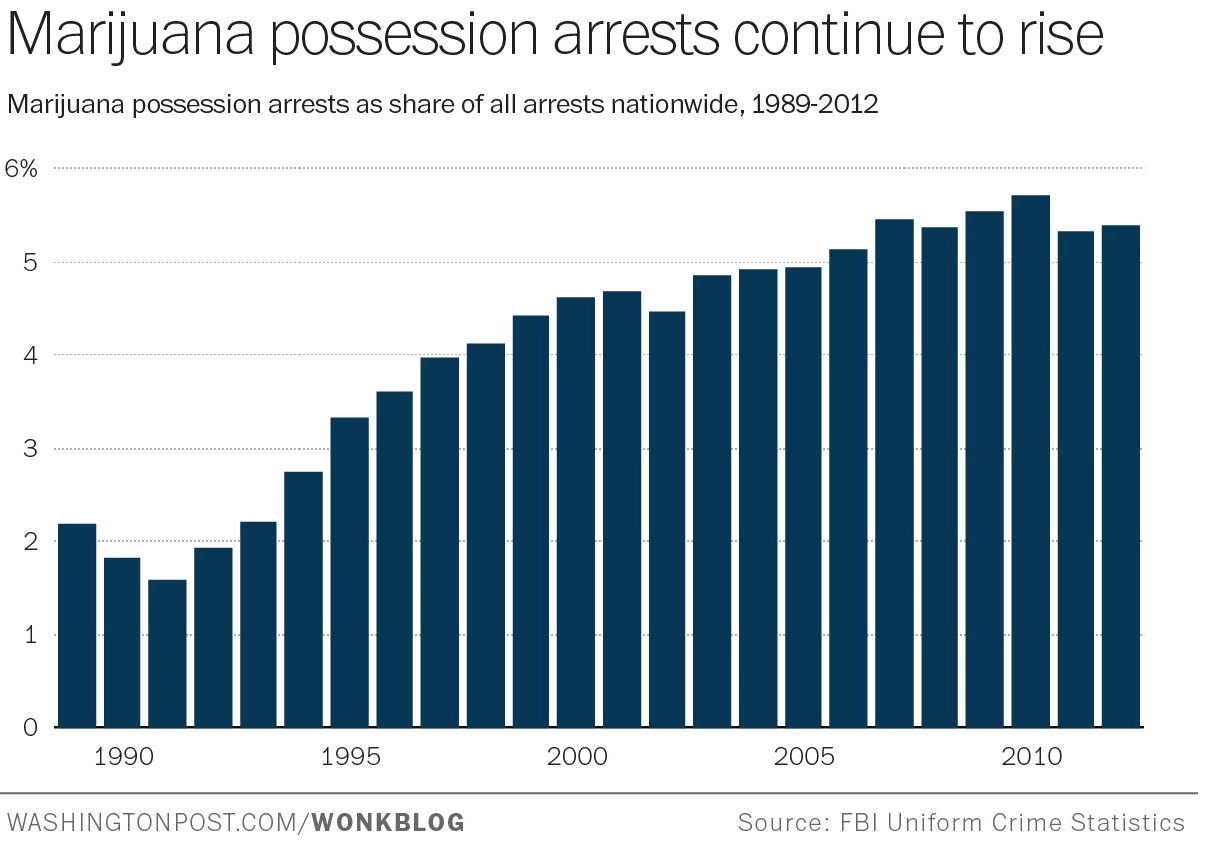
Ingraham points out that “the percent of all arrests related to marijuana possession has steadily risen even as public attitudes toward the drug have shifted, states have relaxed their marijuana laws, and new research has come to light thoroughly debunking the Reefer Madness mindset of earlier decades”:

At least 658,000 people were arrested for marijuana possession in 2012, accounting for 42 percent of all drug arrests and 5.4 percent of all arrests for any offense, according to FBI data. The actual numbers are likely even higher, since a handful of states either don’t report arrest data to the FBI, or only do so on a limited basis. But the focus on marijuana arrests varies considerably by state. In New York, an astonishing one out of every eight arrests – 12.7 percent – are for simple marijuana possession. But across the state line in Massachusetts, fewer than one out of every 100 arrests are for marijuana possession.

Friedersdorf visited Boulder to witness the effects of legalized marijuana firsthand:

One thought I never had was that Boulder would be better off if its marijuana smokers were all imprisoned, or at risk of arrest, or casually breaking the law to facilitate a habit that isn’t going away. After such a brief visit, I can’t claim to have seen every aspect of marijuana culture in Boulder, or to have definitive proof that legalization will be sound public policy. That can’t yet be known. But everything I saw inclines me to agree with a modest conclusion drawn by the Brookings Institution after it completed a more intense study of legalization. “It’s too early to judge the success of Colorado’s policy,” wrote John Hudak, a Brookings fellow in governance studies, “but it is not too early to say that the rollout, or initial implementation, of legal retail marijuana has been largely successful.” If catastrophe looms in this perennially blessed city, it is as yet unseen.