Just Another Ceasefire, Or Something More? Ctd

by Dish Staff

The ceasefire between Israel and Hamas fighters in Gaza has been extended for five days, despite an exchange of fire last night that briefly threatened to unravel the truce. Negotiations over a longer-term truce are ongoing in Cairo, but it’s not clear whether they’re going anywhere. Haaretz’s live blog has the latest updates on the situation:

One of spokesmen for the Hamas leadership that resides outside the Gaza Strip asserts that Israel’s responses so far in Cairo have not met the Palestinians’ minimal demands, and no real progress has been made. He did not rule out the possibility that the fighting would be renewed “to force Israel to acquiesce to Palestinian demands.” In contrast, a member of the Hamas delegation, Khalil Al-Hayya, who returned to Gaza from Cairo, said just a little while ago that there is still a chance of reaching an agreement. He expressed hope that the Egyptian mediator would succeed with his intensive efforts to secure a deal.

Lest anyone forget amid Hamas’s bellicose rhetoric, Rami Khouri makes the point that Palestinians, by and large, want peace, too. Only that’s not all they want:

Hamas and other Palestinian militant groups recognize that they will never destroy Israel. In their own way, they’ve even acknowledged the need to coexist peacefully — a reality they express in terms of a “long-term truce,” even while saying they wouldn’t themselves recognize Israel. So what does Hamas expect to achieve through continued fighting, and why does it enjoy, for now, almost unanimous Palestinian support?

It wants to force Israel to do two things: to honor the terms of the 2012 ceasefire agreement that would allow Gazans to live a relatively normal life, with freedom of movement, trade, fishing, marine and air transport, as well as economic development. And it wants to force Israel to address what are in Palestinian eyes the root causes of the conflict: the 1947-48 ethnic cleansing and displacement of the Palestinians.

Israelis are justified in demanding security and acceptance in the region. But that’s only half of the equation. Ending Palestinian refugeehood, occupation and siege is the other. The message Israelis should take away from Gaza is that if the Palestinians don’t see movement toward their reasonable goals within a framework of international legitimacy, the Israelis shouldn’t expect to rest in peace either.

But Daniel Gordis fears that Israelis are taking away another message, that they need to double down on the national security state:

Some Israeli villages surrounding Gaza are now ghost towns; many residents simply refuse to return home. They do not believe the IDF’s assurances that all the tunnels have been found and destroyed, and are beyond frightened that terrorists could pop out of the ground, quite literally, in their backyards. Israelis are united to a degree not seen in a long time, because they feel threatened as they have not in many years. And, many are pointing out, none of this would have happened had Ariel Sharon not pulled out of Gaza in 2005. Many are now convinced that if the pull-out from Gaza was foolish, a parallel move on the West Bank would be suicidal. Once again, as was the case during the Second Intifada a decade ago, Palestinian violence may have dealt the Israeli political left a death blow.

A.B. Yehoshua argues that Israel needs to stop calling Hamas a terrorist organization and start treating it as a legitimate adversary if it wants to talk seriously about peace:

In my own view, Hamas’s frustration derives from a lack of legitimization by Israel and by much of the world. It is this frustration that leads them to such destructive desperation. That’s why we need to grant them status as a legitimate enemybefore we talk about an agreement or, alternatively, about a frontal war. That is how we functioned previously with Arab nations. As long as we label Hamas as a terrorist organization, we cannot achieve a satisfactory cease fire in the south and won’t be able to negotiate with the Gaza government …

The skeptics among us will argue that Hamas would not sit with us for such open negotiations. If so, then we must propose meetings within the framework of the united Palestinian government. And should Hamas reject that proposal, then our war will become a legitimate war in every sense of the word, fought according to the general rules of warfare.

Previous Dish on the latest Gaza ceasefire here and here.

Where Are the Libertarians on Ferguson? Here, LMGTFY

by Elizabeth Nolan Brown

Apologies for another defensive libertarian post, but there seems to be a meme going around that libertarians don’t care or aren’t talking about what’s going on in Ferguson, Missouri. And like most things mainstream left/right pundits say about libertarians, it has almost zero relation to the truth. “Why aren’t libertarians talking about Ferguson?” The Washington Post’s Paul Waldman asks. Why, indeed?

https://twitter.com/walterolson/status/499411327660875776

https://twitter.com/VSleazy/status/499268686859878402

https://twitter.com/walterwkatz/status/498263834797146112

Radley Balko, a libertarian writing for the same paper as Waldman (and who literally wrote the book on the dangers of U.S. police militarization), reported on Ferguson in the paper and has been tweeting nonstop about it. Here are some thoughts from Jonathan Blanks of the Cato Institute from the day of the shooting. Here’s Reason, where I work, covering the shooting and its aftermath this whole time.  Here’s Conor Friedersdorf covering it at The Atlantic. Here’s some more of the ample, ongoing commentary from libertarians on Twitter:

https://twitter.com/davidharsanyi/status/499706373991858176

https://twitter.com/TPCarney/status/499340369394667520

If you don’t think libertarians are talking about (and outraged over) Ferguson, you’re clearly not reading or talking to many libertarians.

To make his case that libertarians were being silent on this, Waldman cited two Republican politicians and one libertarian journalist that only writes a weekly column. (He does note at the bottom of the article that Reason was, in fact, covering Ferguson.) Leaving aside the fact that two-thirds of this sample of libertarians does not consist of libertarians, it’s still an absurd premise. One could easily pick three GOP or Democrat politicians and writers not talking about Ferguson and conjure up a similar storyline.

https://twitter.com/ggreenwald/status/499908496465620993

Waldman et al clearly want to give the impression that libertarians “believe that when somebody’s grandson has to pay taxes on their inheritance, it’s a horrifying injustice that demands redress, but when somebody else’s grandson gets shot walking down the street, that’s just how things go sometimes,” as he wrote at the Post. But this is a lie, or at least self-deception. Cato’s Jason Kuznicki sums up the mindset nicely:

https://twitter.com/JasonKuznicki/status/499614773685026816

People like Waldman and Pollitt try to claim the moral high-ground on these issues. But in times that matter, they would rather waste time and space on making libertarians look bad than come together with us on a serious issue on which we all agree.

Obama Blocked Clinton On Syria

by Dish Staff

That’s what Rogin reports:

Clinton and her senior staff warned the White House multiple times before she left office that the Syrian civil war was getting worse, that working with the civilian opposition was not enough, and that the extremists were gaining ground. The United States needed to engage directly with the Free Syrian Army, they argued; the loose conglomeration of armed rebel groups was more moderate than the Islamic forces—and begging for help from the United States. According to several administration officials who were there, her State Department also warned the White House that Iraq could fall victim to the growing instability in Syria. It was all part of a State Department plea to the president to pursue a different policy.

“The State Department warned as early as 2012 that extremists in eastern Syria would link up with extremists in Iraq. We warned in 2012 that Iraq and Syria would become one conflict,” said former U.S. ambassador to Syria Robert Ford. “We highlighted the competition between rebel groups on the ground, and we warned if we didn’t help the moderates, the extremists would gain.”

Rogin frames nonintervention in Syria as a mistake by Obama, but Douthat rightly sides with the president:

[T]here is, and will continue to be, an argument that as fraught-with-difficulty as directing arms to more moderate/secular rebels would have been, the upside for American interests still would have been higher than what’s ensued in the absence of such an attempt. But to make the case for that counterfactual, it isn’t enough to say, “look how bad things have ended up without our involvement.” You need a plausible account of how that involvement would have worked, how it could have been made effective enough to matter, and how its significant risks would have been contained. And given what we know about our own capacities, the interests of the region’s powers, and the realities on the ground, a best-case outcome for that counterfactual still seems less likely than two others: One in which we expended a great deal of energy, manpower and resources while making no difference whatsoever, and another in which chaos’s ripples were wider, and we ended up called upon to protect our friends, in Kurdistan and perhaps elsewhere, against an even greater threat.

Drum is on the same page:

It’s human nature to believe that intervention is always better than doing nothing. Liberals tend to believe this in domestic affairs and conservatives tend to believe it in foreign affairs. But it’s not always so. The Middle East suffers from fundamental, longstanding fractures that the United States simply can’t affect other than at the margins. Think about it this way: What are the odds that shipping arms and supplies to a poorly defined, poorly coordinated, and poorly understood rebel alliance in Syria would make a significant difference in the long-term outcome there when two decade-long wars in Afghanistan and Iraq barely changed anything? Slim and none.

An American War Zone

by Dish Staff

Just a handful of scenes last night from Ferguson, Missouri, following the fifth night of protests against the police shooting of unarmed teenager Michael Brown:

More to come shortly.

What El Salvadorians Are Escaping

by Dish Staff

Óscar Martínez makes it clear:

When a family keeps its children out of the gangs, the gangs have a way of still getting to the family. The case of the former residents of San Luis Ranch repeats itself ceaselessly. Every month, you see a newspaper headline announcing a new group abandoning their homes. The families are threatened for all sorts of reasons: because their sons didn’t want to join a gang, because a family member filed a police report, because they won’t let a gang member rape their daughter. Or simply because they visited their grandfather in enemy territory.

Pushed out of their neighborhoods, the families are recast as wanderers, bouncing from house to house until they can find a new community, which will likely be controlled by the same gang that forced them to flee in the first place. Or it will be controlled by the rival, which is just as bad: The 18th Street Gang would never accept an MS-13 family moving into their neighborhood, and vice-versa. The families scatter with the threat chasing closely after. Any day, the clique that runs their new neighborhood will figure out why they left their old one and then, most likely, kill them. Many of these people will never find the safety they sought when they gave up their homes.

It’s only natural that someone who can’t find a corner in which to hide in his own country would consider migrating to the United States to join relatives already there.

Should We Know Where Our Food Comes From?

by Phoebe Maltz Bovy

As someone who’s long been skeptical on that front, I got a kick out of James Ramsden’s response to the food-knowledge pseudo-crisis in Britain:

[A] new survey by BBC Good Food Magazine has found our knowledge of the seasons to be pitiful. Of the 2,000 people polled, only 5% could say when blackberries were plump and juicy. And 4% guessed accurately at when plums were at their best. One in 10 could pinpoint the season for gooseberries. All of this is despite 86% professing to believe in the importance of seasonality, and 78% claiming to shop seasonally.

In the great scheme of our foodish shortcomings – the obesity, the steady rise of ready meals, our unwillingness to cook – does it really matter if people don’t know when a broad bean is in season?

“Know where your food comes from,” though, is the standby answer of what would make us improve our diets. But is that the case? Should individual consumers of food (that is, all of us) become experts in food production? Is that even possible? And what if a little – but insufficient – knowledge leads us to the wrong choices, “wrong” defined as the opposite of what we think we’re accomplishing when (ugh) voting with our dollars? Farmer Bren Smith recently cast doubt on consumers’ abilities in this area (NYT):

Especially in urban areas, supporting your local farmer may actually mean buying produce from former hedge fund managers or tax lawyers who have quit the rat race to get some dirt under their fingernails.

We call it hobby farming, where recreational “farms” are allowed to sell their products at the same farmers’ markets as commercial farms. It’s all about property taxes, not food production. As Forbes magazine suggested to its readers in its 2012 Investment Guide, now is the time to “farm like a billionaire,” because even a small amount of retail sales — as low as $500 a year in New Jersey — allows landowners to harvest more tax breaks than tomatoes.

Knowing where your food comes from may seem like a harmless-enough activity, at least if the worst that comes of it is, you’ve accidentally bought a tomato from a retired 35-year-old financier. And there’s something to be said for knowing that your food isn’t tainted, that neither workers nor animals were abused, although ideally (IMHO, as they say), this is something the state would take care of, not individual consumers conducting individual research projects.

The problem comes when it shifts from hobby to moral necessity, and when – as Emily Matchar has convincingly argued – the burden of dietary expertise ends up falling on women. The food-movement refrain – that we don’t think enough about what goes into our digestive tracts – also ignores that many women already think about this plenty, a point made most eloquently in a newspaper comment from a while back. Commenter Anath White wrote:

I adore Mark Bittman (and even received his boxed cookbooks last Christmas) but surely he must mean MEN when he writes “a time when few of us thought about what we ate?” A bit younger than he is, I’ve been aware of what I eat since my teens – in other words, most of my life. And I’d wager most of the women he knows would say the same thing.

Indeed.

Map Of The Day

by Dish Staff

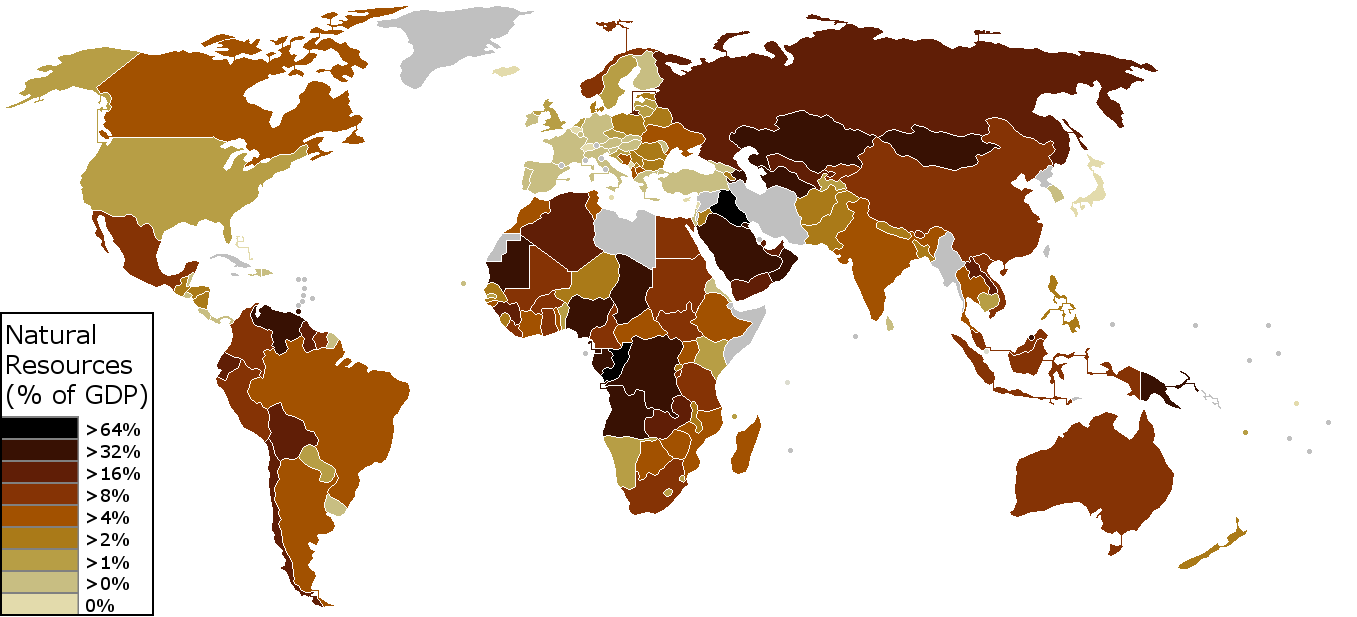
UcQkq0b

Yglesias digs up a creation by Redditor nonmetuammori that maps out, based on World Bank data, how much the economies of different countries depend on natural resources. Matt comments:

The news that, say, Saudi Arabia depends heavily on its oil wealth probably won’t shock you. What really jumps out here, however, is that most of the people who live in countries that have a low resource contribution to GDP live in rich countries (the USA, Japan, Germany, France) not in countries that lack natural resources. Places like Canada and Australia that have high incomes and resource-dependent economies take up a fair amount of space on the map but they have very little population density. There are more people in Italy than in Australia and Canada combined.

Does “Stupid” Have A Place In Political Discourse?

by Dish Staff

About two weeks ago, Paul Krugman caused a tiff by obliquely calling Paul Ryan “stupid,” leading Laurence Kotlikoff to respond, “No one, and I mean no one, deserves to be called stupid.” (Krugman later clarified that he believes Ryan isn’t stupid, but rather a “con man.”) In a post relevant to all in the blogosphere, Noah Smith mulls over the power of the s-word:

Now, calling people “stupid” is certainly not polite. But I never cease to be amazed at how effective it is in terms of making people choke on their own rage. People really do not like being called stupid. … In the end, I think people overreact to the “stupid” insult because, as a society, we use arguments the wrong way. We tend to treat arguments like debate competitions– two people argue in front of a crowd, and whoever wins gets the love and adoration of the crowd, and whoever loses goes home defeated and shamed. I guess that’s better than seeing arguments as threats of physical violence, but I still prefer the idea of arguing as a way to learn, to bounce ideas off of other people. Proving you’re smart is a pointless endeavor (unless you’re looking for a job), and is an example of what Stanford University psychologist Carol Dweck calls a “fixed mindset.” As the band Sparks once sang, “Everybody’s stupid – that’s for sure.” What matters is going in the right direction – becoming less stupid, little by little.

Megan McArdle similarly sees “stupid” as a rhetorical crutch:

Ultimately, calling people stupid is simply a performance for the fellow travelers in your audience. It’s a way that we can all come together and agree that we don’t have to engage with some argument, because the person making it is a bovine lackwit without the basic intellectual equipment to come in out of the rain. So the first message it sends – “don’t listen to opposing arguments” – is a stupid message that is hardly going to make anyone smarter. The second message it sends is even worse: “If he’s stupid, then we, who disagree with him, are the opposite of stupid, and can rest steady in the assurance of our cognitive superiority.” Feeding your own arrogance is an expansive, satisfying feeling. It is also the feeling of you getting stupider.

Update from a reader:

When Krugman suggested that Paul Ryan was a “stupid person’s idea of what a thoughtful person sounds like,” he was not calling Paul Ryan stupid. He was, quite plainly, suggesting that those who thought that Ryan was thoughtful were the stupid ones.

Another elaborates:

I read both Krugman’s original article and his supposed clarification and I did not at all get the impression that he was calling Paul Ryan stupid. He begins with a quote by Ezra Klein, in which he describes Dick Armey as “A stupid person’s idea of what a thoughtful person sounds like”. Krugman goes on:

It’s a funny line, which applies to quite a few public figures. Representative Paul Ryan, the chairman of the House Budget Committee, is a prime current example. But maybe the joke’s on us. After all, such people often dominate policy discourse. And what policy makers don’t know, or worse, what they think they know that isn’t so, can definitely hurt you.

This is Krugman’s only reference to Ryan in the entire column, so this has got to be where his critics are accusing him of, at the very least, implying that Ryan is stupid. However, the plain reading of the passage does not bear this interpretation out. This is, after all, English grammar. Words have consequences.

Obviously, Paul Ryan is a public figure who, in Krugman’s estimation (and to follow his implied comparison), would be a substitute for Dick Armey in Klein’s quote. Krugman is in no way saying that Ryan is stupid, but rather that he is “A stupid person’s idea of what a _______ person sounds like”. In this blank you could insert the word “smart”, “serious” or any one of a number of descriptions, but I think it is quite clear that Ryan is NOT being singled out as being stupid. At least, not by Krugman is this particular column he isn’t.

With that said, Krugman DOES seem to be obliquely accusing anyone who believes that austerity cures recessions and that stimulus spending makes them worse of being wrong and, perhaps even wrong-headed. In fact, you might even take that a step further and accuse Krugman of calling pretty much anybody who believes these things stupid, but those who interpret him as specifically calling Paul Ryan “stupid” here are, I hate to say it, kind of stupid.

Kimono Cardigans

by Phoebe Maltz Bovy

A Tokyo style blogger recently took issue with a mislabeled kimono:

While it seems like the accompanying photo of a sundress was unintentional and due to the awkwardness of Twitter image selection (the linked Telegraph article includes story-appropriate images), this tweet started a conversation about the various non-kimono items currently going by “kimono”:

Indeed, there’s “kimono” everything, even, from Kate Spade of all places, a kimono-themed iPad cover.

Graham Ruddick explains the pseudo-kimono trend in Britain:

The kimono is a traditional Japanese garment that has been historically known as a thin full-length robe influenced by the east Asian culture However, it has been reimagined for western shoppers in a similar form to a casual cardigan and is flying off the shelves of fashion retailers. New Look is selling a kimono every five seconds, the equivalent of 1,440 a day, and claims to have been the first major fashion chain to sell them in the UK.

Things did not go so well the last time a traditional garment was “reimagined for western shoppers in a similar form to a casual cardigan.” Remember Navajo-chic-gate of 2011-2012?

What often happens, in such conversations, is a descent into utter confusion. It’s not clear where the line falls between the cultures one can and cannot dress as. A generic “British” is presumably fine – by all means, take Hyacinth Bucket as your style inspiration. (Some of those floral dressed weren’t bad, in a kind of Elaine Benes way…) But how about the traditional dress of Estonia? Is the line whiteness-or-not, the wealth of the country, or both? It seems not all that exploitative – if still Orientalist – to go out and buy all Korean skincare products after reading a blog post about how Korean women get “poreless skin.” (Yes, I do believe that positive stereotypes about East Asian women’s skin were Edward Said’s main concern.)

Now for some first-person-as-second-person:

If you happen to be a bit of a Francophile and a Japanophile, is one of these acceptable but not the other? Is a Breton-inspired shirt from Muji or Uniqlo (says someone who owns both) different than a kimono-inspired cardigan from a Western European company? If you yourself are of an ethnicity (Eastern European Jewish) that was, until relatively recently, thought to be in disguise if in Western attire, aren’t you sort of always culturally appropriating (unless in Hasidic garb), or is this just like everything else to do with white privilege – all that matters is the time you live in? My ancestors would have been defined as ‘Oriental,’ but I am not.

Discussions of cultural appropriation, at least in the first person, tend to inspire such sinkholes. Consider the following, from Jarune Uwujaren’s 2013 post:

Is the Asian fusion takeout I order every week culturally appropriative? Even though I’m Black, is wearing dreadlocks appropriating forms of religious expression that really don’t belong to me? Is meditating cultural appropriation? Is Western yoga appropriation? Is eating a burrito, cosplaying, being truly fascinated by another culture, decorating with Shoji screens, or wearing a headscarf cultural appropriation?

Each, then, to her own, culturally-specific sinkhole.

The best I can conclude is as follows: If people of the group in question are offended, then you have to at least consider that you’ve crossed a line. I mean, you don’t have to. I suppose one could take the approach that the offended are in the wrong, but in such cases, why? There are times when violating rules of PC is courageous, but wearing a headdress to a music festival after learning that this offends many American Indians isn’t one of them. As for the kimono cardigans, it seems as if the offensiveness comes not from Westerners wearing traditional Japanese dress because they find it attractive, but rather from things that are not kimonos being labeled as such. And – speaking still more generally – if the culture you’re appropriating from looks down its nose at you, someone from what they view as an inferior culture, trying to imitate theirs (hi, France!), you’re in the clear.