Why Is Latin America Nuke-Free?

by Dish Staff

As Taylor Marvin puts it, “the simplest answer is that nuclear weapons have gone out of style”:

In an era where interstate war is comparatively rare, the value of a nuclear security guarantee has shrunk when nuclear weapons’ diplomatic and image costs have grown. As the threat of major war has receded both around the world and in the region — which is partially due to US hegemony in Latin America, as Joe Young noted — the practical security gains from nuclear weapons have declined. Given the time, effort, and resources required to acquire nuclear weapons, if states cannot expect enough security or prestige gains to justify their costs they will be more hesitant to invest in them. Tellingly, countries that have armed in the last few decades have tended to be isolated or facing extraordinarily dangerous security situations: Israel, North Korea, Pakistan, and South Africa are all a little of column A, and a little of column B. None of the Latin American states with the resources to develop nuclear arms are, or more arguably have been, in this situation.

Beyond security, nuclear weapons are no longer seen as a path to international status. If a Latin American country armed itself today with a nuclear weapon it would be more likely to receive global condemnation than great power prestige. Indeed, in the modern era aircraft carriers are arguably a more important military status symbol than nuclear weapons.

Thinking In Third

by Dish Staff

Research suggests that adding a little distance to how we think about ourselves might improve how we act:

Participants were told, upon entering the lab, that they faced a nerve-wracking task: to impress a member of the opposite sex, in one study, or to give a speech. To up the ante, they also knew their performance would be videotaped and later analyzed. But right before they began, they were told to prepare themselves for the task ahead. Some participants were assigned to do so by speaking to themselves in the first person; the rest were instructed to address themselves using their own first name, as well as non-first-person pronouns like shehe, or you.

Though we don’t tend to look kindly upon those who speak of themselves in the third person, the practice is not without its benefits. According to reviewers, who were blind to participants’ condition, those who’d avoided I and me in their pep talks actually appeared less nervous, and did a better job on the task at hand. Speaking to ourselves as though we are someone else, it seems, lets us distance ourselves from an overwhelmingly stressful experience.

Face Of The Day

Typhoon Survivors Continue To Rebuild Lives 9 Months After Haiyan Devastation

A young girl plays with a toy gun in the coastal area renamed by residents “Yolanda Village” in Tacloban, Leyte, Philippines on August 13, 2014. Tacloban residents continue to focus on rebuilding their lives nine months after Typhoon Haiyan struck the coast on November 8, 2013, leaving more than 6,000 dead and many more homeless. With many businesses and government operations back up and running and with the recent start of the years typhoon season, permanent housing continues to be the main focus with many families still living in temporary accommodation. As well as continuing recovery efforts, Leyte is preparing for the arrival of Pope Francis, who will visit the region from January 15- 19. By Chris McGrath/Getty Images.

The Knots Of Depression

by Dish Staff

Like Elizabeth, Rod Dreher uses the death of Robin Williams to discuss his own experiences with depression:

It seems so elemental — of course your mental state affects your perception of reality, duh! — but unless you’ve lived through it, it’s hard to understand how profound it can be. I walked around the house as if I were wearing a heavy wool blanket soaked in cold water almost all the time. Reason is largely powerless in the face of it. You can’t just snap out of it. You can’t make an argument for why you shouldn’t be depressed, and why things are really not as bad as you think they are. I mean, you can try this, and maybe it will help a bit, but it’s like being tied up and thrown off a pier, and being told by well-meaning people standing on the pier how you can save yourself by swimming to safety.

Some people — like Robin Williams — are not going to be able to save themselves, or be saved, for the same reason that some people who are thrown into the water bound by knots they did not tie will drown. I could be wrong about this, but I trust in the mercy of God in the case of poor souls who suffer so much that they cannot see any other way to relieve their pain.

The death prompted Ty Foster to come out as bipolar:

I can’t speak for anywhere else, and I can’t really speak for any other disabilities, but I know that in my home country [the US], we are still quite a long way from eliminating the stigma that surrounds mental illness. When I’m depressed, it’s hard enough to get myself to the bathroom and back, let alone getting myself to a freaking doctor. Recovery is made all the more difficult by the fact that the world around me, in many insidious ways, causes me to feel even more alone, weird, creepy, scrutinized, awkward, unworthy than I already would. So the hell with that world.

Relatedly, Jason Millman flags research finding that “improvements in understanding mental illness … didn’t help reduce the social stigma”:

People were more likely to say they didn’t want an alcoholic to marry into the family (up from 70 percent to 79 percent) or have someone with schizophrenia as a neighbor (up from 34 percent to 45 percent). Most in 2006 also said they were unwilling to work closely with someone who had schizophrenia (62 percent) or alcohol dependence (74 percent), and most thought people with either illness would likely be violent.

“There was no support that greater scientific understanding translated into reduced prejudice in the United States or elsewhere,” Pescosolido wrote in a more recent March 2013 review of research into the social stigma around mental illness. Reducing the stigma, she points out, will depend on a better understanding of the social and cultural factors shaping it.

Vladimir Putin, Locavore, Ctd

by Dish Staff

annual-change-in-euro-zone-consumer-price-indexes-all-items-fruit-vegetables_chartbuilder

Jason Karaian looks at how Putin’s counter-sanctions on EU produce imports stand to affect European farmers and consumers:

While it’s never a good time for farmers to lose a big market like Russia, now is particularly inopportune. Bumper crops have pushed down prices in recent months, which is bad for producers as well as policymakers—the euro zone has been flirting with deflation this year, and a glut of produce once destined for Russia but dumped closer to home could push prices down even further[.]

“We can only hope that European consumers eat more pears,” a Belgian fruit farmer told the Wall Street Journal (paywall). … To add insult to injury, the upcoming apple harvest in Europe will be one for the record books, according to an industry forecast published yesterday. “The same day it’s announced we have a big crop our largest customer, Russia, stops buying, so it’s like a Black Thursday,” the commercial manager of a French apple concern told FreshPlaza. “The producers will be hit,” an Athens fruit seller told Euronews.

And Alec Luhn measures the impact, as well as the politics, of the ban in Russia:

State-controlled television has been downplaying any effects of the ban. “Consumers will barely be able to notice any price increase…. Even if people have to travel abroad for some dishes, it will lead to greater profits for Russian tourist firms,” reporters on Rossiya 24 exclaimed during a newscast on Friday, Aug. 8. But analysts predict an overall rise in food prices that will further exacerbate inflation, which has already risen beyond the Central Bank’s predictions to 7.5 percent.

The import ban doesn’t only affect luxury goods. Almost one-third of Russian families don’t obtain the minimum amount of calories and nutrients designated by the Health Ministry, according to the Russian Presidential Academy of National Economy and Public Administration, and they will likely have even more difficulty as cheap products from Ukraine are taken off the shelves.

Bershidsky highlights the ban’s potential impact on Putin’s shaky Eurasian Economic Union project, which the Russian president still wants as part of his legacy:

Putin has not given up. Rebuilding at least a smaller, narrower version of the Soviet Union remains at the center of his agenda. He wants it to be part of his legacy. Armenia — dissuaded by Moscow from EU association — and Kyrgyzstan are on track to join the EEU this year. As of 2015, the member states will harmonize their tax systems.

The other members of Putin’s union, however, don’t have the same interest in imposing or enforcing a ban on imported food. Belarus and Kazakhstan have nothing to retaliate against: Only Russia faces Western sanctions. “This is our domestic matter,” Belarussian President Alexander Lukashenko said yesterday. “If we need Polish apples, we buy them, but for our domestic market, not for Russia.” Kazakhstan President Nursultan Nazarbayev’s press service clarified after he talked to Putin on the phone that the food embargo was “Russia’s unilateral measure that doesn’t involve” other EEU members.

In Anne Applebaum’s view, the trade angle of this conflict puts to rest the “McDonald’s theory of international relations”:

This week, as Russia, a country with 433 McDonald’s, ramps up its attack on Ukraine, a country with 77 McDonald’s, I think we can finally now declare the McPeace theory officially null and void. Indeed, the future of McDonald’s in Russia, which once seemed so bright—remember the long lines in Moscow for Big Macs?—has itself grown dim. In July, the Russian consumer protection agency sued McDonald’s for supposedly violating health regulations. This same consumer protection agency also banned Georgian wine and mineral water “for sanitary reasons” at the time of the 2008 Russian-Georgian war, and it periodically lashes out at Lithuanian cheese, Polish meat, and other politically unacceptable products as well. …

This week—as Russia bans most American, European, Canadian, Australian, and Japanese agricultural goods—globalization suddenly began to unravel a lot faster than anybody imagined. Vladimir Putin knew sanctions were coming and openly declared that he didn’t care. He also knows that a trade war will hurt a wide range of his countrymen, but he didn’t mind that either.
So You Think You’re Part Cherokee

by Dish Staff

Iron Eyes, the “Crying Indian” in the famous 1970s anti-pollution PSA above, had no actual Cherokee heritage, though he claimed he was “born and raised on a ranch in Oklahoma to family of Creek and Cherokee farmers.” Miley Cyrus, Johnny Cash, and Elizabeth Warren, too, have made dubious claims to Cherokee heritage, as Russell Cobb notes. But Cobb understands the allure. He describes how a college encounter with British exchange students marked his entry into the “tribe of the Wannabes: non-Native Americans who insist on claiming Indian heritage”:

The British exchange students really seemed interested. They clearly wanted to know an Indian. “I think I’m part Choctaw,” I said. “But only, like, one-sixteenth, so I’m not on any tribal rolls or anything.”

Now that I’d said it, it had to be true. After all, my mother’s family came from rural eastern Oklahoma, right on the dividing line between the Choctaw and Cherokee Nations. The family’s cemetery plot in Checotah was right next to the Indian section. And, like Liz Warren’s Papaw, we had high cheekbones.

So I would belong to the tribe of the Wannabes for a while, especially during my early 20s, when I actually didn’t know what the hell I was.

The tribe gave me a sense of identity and it carried some instant prestige when traveling abroad. Europeans love Indians, I discovered. I never fully bought in, however. I knew plenty of people who tried to cash-in on some supposed Indian great-grandfather to qualify for a tuition break or minority status. That wasn’t me.

There was one small problem: The only Indians I knew in Tulsa were a lot like me. They grew up on the same ‘80s pop music and TV shows, followed the same sports teams (even the Oklahoma Sooners, who got their name illegally stealing Native land in the late 19th century). They didn’t ride horses and they didn’t even have cool names, like Iron Eyes. Most of them weren’t any darker than I was. So I didn’t want to be them. I wanted to be like that Indian in that commercial, stoically paddling his canoe through the American landscape, offering a rebuke to the crass commercialism of mainstream America. Oh, wait…

A Breakdown In Kabul?

by Dish Staff

The agreement John Kerry brokered to resolve the Afghan presidential election crisis is looking shaky today after Ashraf Ghani announced that he would not necessarily agree to share power with his rival Abdullah Abdullah if an ongoing audit of the vote showed that Ghani had won:

Ghani said the winner will appoint the loser “by decree” as a chief executive to serve “at the discretion of the president.” Abdullah has demanded more authority if he loses. Ghani also said Tuesday that although he “hoped” the audit of 8.1 million votes could be done in time to have the new president attend a NATO summit in early September, no inauguration date has been set because of “technical uncertainties” with the slow-going ballot review. He said both he and Abdullah will attend the summit, considered key to winning new foreign aid for the ailing Afghan economy. …

Ghani was careful Tuesday not to claim victory. But he spoke in a distinctly presidential tone as he laid out a wide-ranging policy agenda for the next government, including banking and anti-corruption initiatives as well as the rights of women and Taliban prisoners.

Representatives of the Ghani and Abdullah camps were scheduled to start a round of meetings today to hash out the technical details of the agreement. Omar Samad examines the potential pitfalls and what it will take to overcome them:

The contentious issues that are outstanding and still need to be ironed out are: 1. Planning for the upcoming transfer of power and identifying the new government’s priority challenges and collaborative frameworks. 2. Agreeing on a national governance agenda, drawing from the two sides’ respective electoral platforms and programs in sectors such as security, economy, foreign affairs, and social services. Figuring out unresolved issues should be left to professional advisory groups that could also involve non-partisan figures.

3. Defining the parameters of power sharing as part of a unity government structure. The two sides will need to step away from a zero-sum option, show flexibility and use creative methods to clearly define the authority of the president and the newly proposed post of chief executive. Models from other countries can used if applicable to the Afghan context.

But Jim White rolls his eyes:

With 15 negotiators on each side, I would expect that the first week or two of the negotiations will resolve such crucial issues as the shape of the table and the length of the breaks between sessions. They might also want to make a “no punching” rule, as there appears to have been another fight today while ballots were being reviewed.  It’s hard to see how Kerry could make a third trip to put the power sharing back on course since the first two have been such spectacular failures.

Thomas Scherer isn’t optimistic that the two men, each of whom believes himself to be the elected president of Afghanistan, will work things out in the end:

Why have the candidates continued to fight? There was almost certainly fraud on both sides as supporters took advantage of Afghanistan’s insecurity and institutional deficits and found varying ways to “rock the vote.” However, the mere presence of fraud rarely matters; the fraud must be great enough to change the results. The preliminary results of the June 14 run-off show Ghani ahead with 4.5 million votes to Abdullah’s 3.5 million, about 56 percent to 44 percent. Does Abdullah really believe that he can overcome a million-vote difference?

I argue, with a couple assumptions, that Abdullah can reasonably believe that he can still win. As such, the parties will continue to fight over every vote and escalate when necessary, further threatening the stability of Afghanistan. This high-stakes game of electoral chicken will likely continue until the two sides collide or until the United States, desperate for some semblance of stability, can persuade a candidate to accept defeat.

Chart Of The Day

by Dish Staff

Suicides

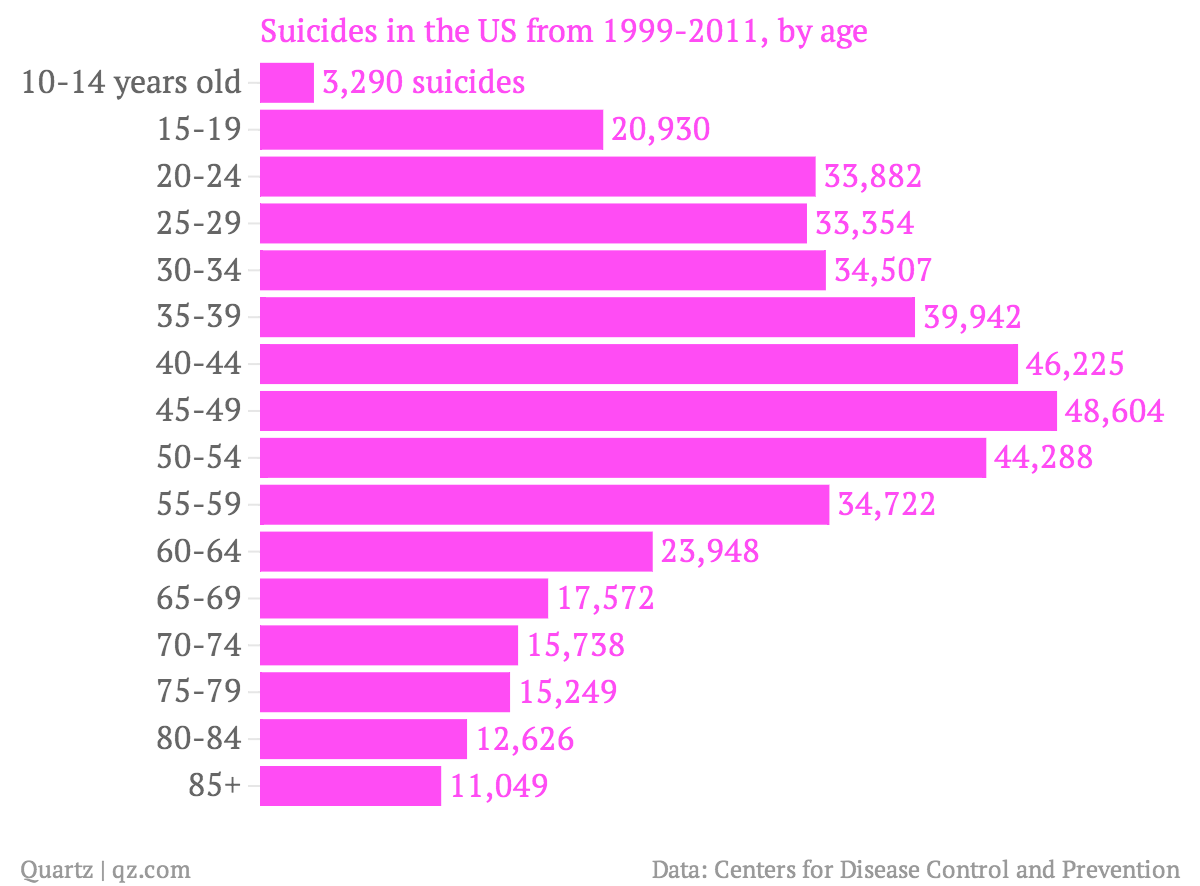
Sonali Kohli breaks down the demographics of suicide:

Though suicide awareness and prevention efforts in the US are largely targeted toward either teens or the elderly, Williams represents a demographic of the country—middle-aged, white, male—with an increasing incidence of suicide. Suicide occurrence in the US is most common among middle-aged people. Between 1999 and 2011, more than 48,600 people between the ages of 45 and 49 committed suicide, compared with 20,930 teens between the ages of 15 and 19.

A Cure For Ebola? Ctd

by Dish Staff

Yesterday the World Health Organization determined that it is “ethically sound” to administer promising but unproven Ebola treatments on a wide scale, countering earlier criticism that one such treatment, the experimental antibody therapy ZMapp, had been made available exclusively to Westerners. The Liberian government has announced that it will be administering the drug to two afflicted doctors in the country, but as Josh Lowensohn notes, it remains unclear just how much medicine will ultimately make it to West Africa:

Supplies of the drug have also dwindled due to difficulties producing it, though Canada today said it would donate 800 to 1,000 doses of the drug to be used in aid efforts. A separate drug called TKM-Ebola, which is also developed in Canada, could end up being used as well after getting a nod from the US Food and Drug Administration last week to restart human testing of the drug on those who are already infected.

Peter Loftus notes ominously, “The maker of the experimental Ebola drug that was given to two infected Americans said Monday that its supply has been exhausted after the company provided doses to a West African nation [presumably Liberia]”:

Mapp Biopharmaceutical Inc. said in a brief online statement it had complied with every request for the drug that had the necessary legal and regulatory authorization. The company said it provided the drug, called ZMapp, at no cost in all cases. San Diego-based Mapp didn’t name any countries that requested the drug and didn’t release additional details.

Alexandra Sifferlin considers how health officials will make the tough decisions about administering the drugs:

[N]ow the question is: With not enough to go around, who gets them? That’s ultimately at the discretion of the countries themselves, and before that happens, there’s a waiting period as the WHO formulates another panel of technical experts to create guidelines for the best use of these drugs. Some of the questions they will try to answer are: At what stage of the disease are the drugs or vaccines effective? Are they effective at the beginning of the disease or at the later stages? What are the safety issues related to the drugs? What’s the efficacy of the drug—do 30 percent of people respond or 50 percent?

“It think [who gets the drugs] is one of the most difficult questions to answer,” says Dr. Abha Saxena, the coordinator for the global ethics team at WHO. “There is a limited supply and there is a lot of demand. But who gets it is contextual, it will depend upon on the country, the situation, and they type of drug that will eventually go forward into either trial or compassionate use.” The panel will meet by the end of this month.

Meanwhile, Amanda Taub suggests that “most of the people Ebola kills may never actually contract it”:

New, worrying information from Sierra Leone suggests that damage from the disease may go far beyond deaths from the Ebola virus itself. Rather, Ebola is claiming more victims by damaging already-weak local health systems and their ability to respond to other medical problems, from malaria to emergency c-sections. The ebola-driven rise in deaths from those other maladies may outpace the deaths from ebola itself.

The effect of the loss of services may be severe. Even before the Ebola outbreak, Sierra Leone was ranked the seventh-worst country in the world for maternal and child mortality. In 2012, the aid group Save the Children reported that 18 percent of children in Sierra Leone did not survive to age 5, and one in 25 women died of childbirth or pregnancy-related causes. If these fears prove correct, those numbers may be about to get much worse.