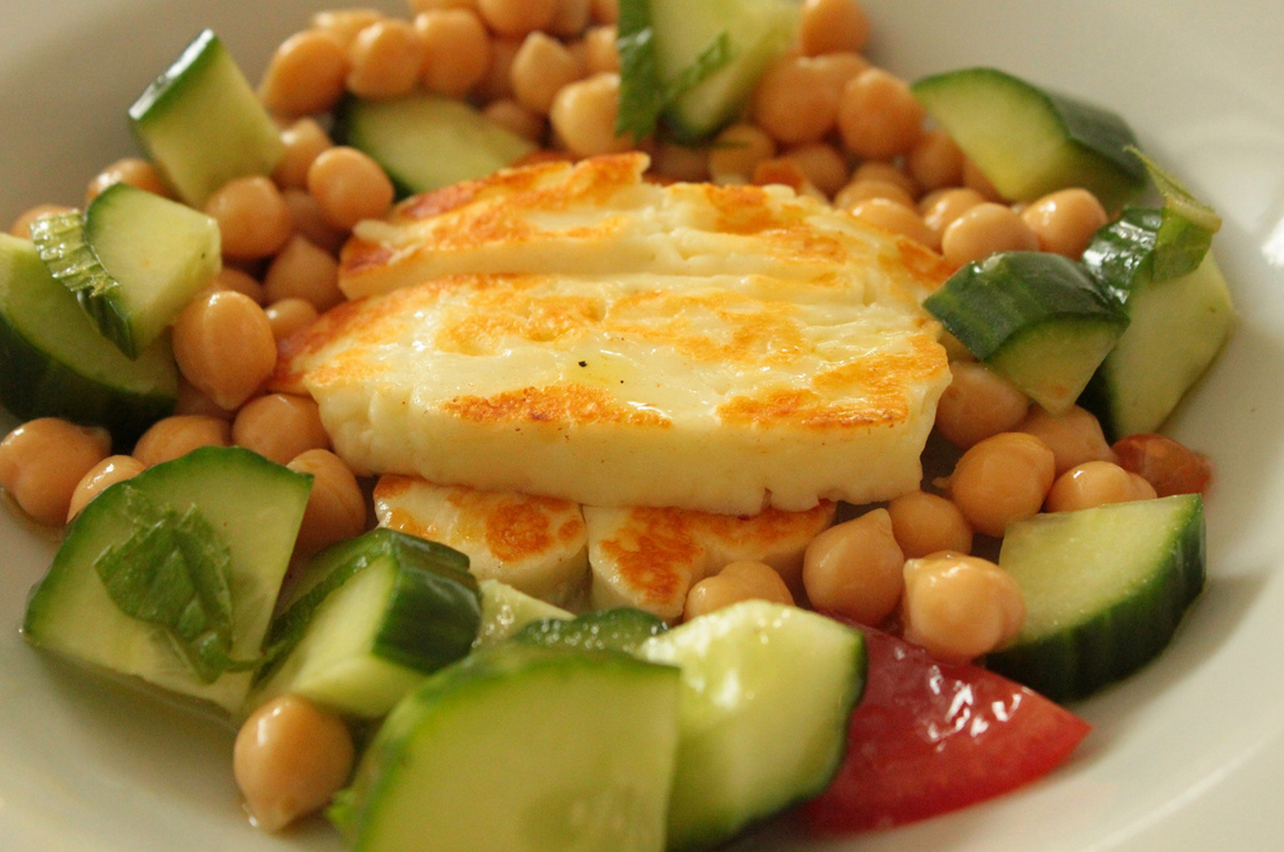
The Halloumi Menace

halloumi

Rebecca Smithers flags new findings about the salt levels in various cheeses:

Halloumi and imported blue cheese such as Roquefort contained the most salt – more than sea water – while cottage cheese contained the least, according to a major new research study carried out by Cash (Consensus Action on Salt & Health) and published in the British Medical Journal…. [The study] is based on an extensive survey of 612 British and imported cheese products sold in UK supermarkets in 2012, using data on the labels to analyse the salt content (g/100g). It looked at the salt reduction targets for ten popular cheeses set by the Food Standards Agency watchdog and implemented by the Department of Health, to be achieved by 2012. While 85% (333 of the 394) of cheeses have already met their targets, 81% (318 of 394) would still get a red (which means ‘high’) colour rating under the so-called ‘traffic light’ labelling scheme.

Daily Mail headline reminds that the saltiest cheeses are “foreign” in origin. Meanwhile, James Ramsden stands up for the high-sodium dairy products:

This latest study, which brings little new information to the table, reckons salt content to be considerably lower in supermarket own-brand cheddar and “cheddar-style” cheeses than in their branded equivalents. This, they inform us with the sort of dreary lack of appetite you’d expect from a group such as Cash, “demonstrates that it is technically possible to produce cheese with less salt in it”.

Sure. Just as it’s technically possible to make decaffeinated coffee, alcohol-free beer and vegan sausages. But that’s kind of missing the point. And cheese needs salt. Sarah Hampton, who makes goat’s cheese at Brock Hall farm in Shropshire, says: “The effect of salt in cheesemaking performs an essential function in the casein matrix, creates texture and flavour, and affects protein hydration in the cheese body.”

Should more cheeses be made with less salt? “I personally like to be quite sparing with salt quantities,” Hampton says. “For the kinds of semi-soft and semi-hard cheeses I make, too much salt can foreshorten the flavour. But some cheeses need that saltiness. Feta, for example, is more salty than a fresh goat’s cheese, but that level of salinity constitutes the character of the cheese. An unsalted feta would be horrendous.”

(Photo of Halloumi salad by Judith Doyle)

A Poem For Saturday

14413842553_a884dd1bfe_k

Dish poetry editor Alice Quinn:

While on vacation, I’ve been listening to Natalie Merchant’s arrangements of traditional American folk music on her album entitled The House Carpenter’s Daughter.

They turned my mind to the selections of anonymous lyrics and songs from the 13th through the 15th centuries, chosen by W.H. Auden and Norman Holmes Pearson for their incomparable five-volume anthology, Poets of the English Language, published in the Viking Portable Library in 1950. (Sets of these can be found in good used bookstores all over the country and, of course, online.)

This is one of my favorites.

“The Unquiet Grave”:

“The wind doth blow today, my love,
And a few small drops of rain;
I never had but one true-love,
In cold grave she was lain.

“I’ll do as much for my true-love
As any young man may;
I’ll sit and mourn all at her grave
For a twelvemonth and a day.”

The twelvemonth and a day being up,
The dead began to speak:
“Oh who sits weeping on my grave,
And will not let me sleep?”

“‘Tis I, my love, sits on your grave,
And will not let you sleep;
For I crave one kiss of your clay-cold lips,
And that is all I seek.”

“You crave one kiss of my clay-cold lips;
But my breath smells earthy strong;
If you have one kiss of my clay-cold lips,
Your time will not be long.

“‘Tis down in yonder garden green,
Love, where we used to walk,
The finest flower that e’er was seen
Is withered to a stalk.

“The stalk is withered dry, my love,
So will our hearts decay;
So make yourself content, my love,
Till God calls you away.”

(Photo by Matthew Murdock)

Best Cover Song Ever?

The Dish staff provides a lot of great fodder for the popular reader thread. Dish editor Matt writes:

What do you get when a country legend hits the studio with an aging punk star to record a Bob Marley song? You get this version of “Redemption Song” by Johnny Cash and The Clash’s Joe Strummer, found on the former’s posthumously-released collection of rarities, alternative takes, and covers, Unearthed:

While not as famous as Cash’s cover of “Hurt,” I’ve always loved this recording’s spiritual power, made all the more striking by the fact that both men would be dead by the time the world would hear it. It’s also a fitting song for these low-down times, a kind of protest song marked by Marley’s prophetic religion – and who better to sing about deliverance by “the hand of the Almighty” than a man with the voice of God?

Dish editor Tracy writes:

I nominate Cibo Matto’s very ’90s bossa nova cover of Nirvana’s “About A Girl” and the Talking Heads’ classic cover of Al Green’s “Take Me To The River”:

Dish editor Chas, a former DJ, writes:

If we’re going to talk about great cover songs, then we have to talk about jazz trio The Bad Plus. They include at least one cover on every album, using brilliant arrangements that are often distant departures from the source material. Notable examples include Black Sabbath’s Iron Man, Rush’s Tom Sawyer and Blondie’s Heart of Glass, but my favorite is their version of Vangelis’ Chariots Of Fire Theme (and I don’t even like the original song):

And while we’re on jazz, be sure to check out Brad Mehldau’s freakin’ incredible cover of Radiohead’s Paranoid Android.

Also, on the off chance anyone hasn’t mentioned it yet, this really popular podcast only plays covers and the few times I’ve listened to it I’ve been pretty impressed.

Here’s Dishtern Phoebe:

I nominate Rufus Wainwright covering “Everybody Knows” by Leonard Cohen:

Wainwright and Cohen are now family, which is part of what makes the cover special, but it’s also a great song and cover. And Wainwright’s sparkly shirt in the video, also great.

And from Dish staffer Brian, a talented banjo player who performs around Brooklyn:

The overwhelming support for Jimi’s version of All Along the Watchtower provides an opportunity to point out that Hendrix had some of his own work reinvented in the bluegrass world. While we’ll never see the likes of Hendrix again, it could be argued that Jerry Douglas has done for the dobro what Jimi did for the Stratocaster:

Tony Rice’s cover of Norman Blake’s Church Street Blues speaks for itself. It’s probably my favorite thing on the internet, aside from the Dish:

And while we’re on the subject of bluegrass guitar covers, here’s Doc Watson shredding House of the Rising Sun:

Dish editor Jonah writes:

The piano reduction was the original cover song. It’s how Franz Liszt, the greatest pop star of the 19th century, covered Beethoven’s symphonies, and it’s how this anonymous YouTuber covers Radiohead’s “Paranoid Android”:

I stumbled across this video while searching for the better-known rendition by jazz pianist Brad Mehldau, but found that in some ways, I liked this one better. It’s a shorter, more approachable spin on Mehldau’s interpretation, albeit not quite as polished, and adds some flourishes that classical piano fans will appreciate. Plus, the bird’s eye view of the hands is a great way to watch a talented pianist in action.

Dish editor Jessie offers several great ones:

Ok, not exactly deep cuts here, but surprised no one’s mentioned: Tina & Ike covering CCR’s “Proud Mary”, Otis Redding covering the Rolling Stones “Satisfaction”, Devo doing the same, Aretha Franklin covering Otis Redding’s “Respect”:

… more Aretha Franklin covering “The Weight” by The Band, and Marvin Gaye covering Gladys Knight & the Pips’ “I Heard It Through The Grapevine.” And this guy:

And lastly, Dish editor Chris writes:

I’ve been responsible for curating the cover thread, so many of my own favorites are already mentioned. (And you can blame me for the bias towards Girl Talk and Cartman – though the Christopher Walken twist is even better.) But one great cover that I haven’t seen among the thousands of emails is Antony Hegarty’s tribute to Leonard Cohen’s “If It Be Your Will”:

I first heard that song in the Film Forum premiere of the Leonard Cohen documentary, I’m Your Man, whose soundtrack is a font of great covers, including the Wainwright one Phoebe mentions above. (Teddy Thompson’s take on “Tonight Will Be Fine” is another.) But circling back to Antony, if the goal is to jump genres, don’t miss his warbling rendition of Beyonce’s “Crazy In Love”:

Happy Rice Pudding Day!

44838741_1890e11d33_o

Megan Garber takes stock of the micro-holidays catalogued at Daysoftheyear.com, including (just today!) Garage Sale Day, Rice Pudding Day, Book Lovers Day, and Bowling Day:

Micro-holidays, which teeter somewhere in the center of the continuum between universality and irrelevancy, are political. They do what all holidays will, in the end: convene our attention around a cause. But they are different from official holidays in one crucial way: They are opt-in.

In that, they are in some ways the temporized equivalent of all those “What Kind of Person Are You?” Internet quizzes, or of those “You Know You Grew Up in the ’90s” demolisticles: They’re about finding communities of like minds within the social chaos of the Internet. Every year, people will discover delightfully nerdy new ways to celebrate National Grammar Day – and they will do that in part because they are self-identified grammar nerds. Who are sharing a thing with other self-identified grammar nerds. The exchanging of grammar-mistake pet peeves and the starting of heated fights about the Oxford comma – some traditional ways of celebrating the day – say something about who they are as people. It says something, also, about what they want to share as people. It suggests the thing that has been true all along, but that the Internet is reminding us of anew: that being and sharing are often the same thing.

(Image via Terry Chay)

Taking Aim At The Accreditors

Jordan Weissmann takes note of a Republican movement to “smash the cartel” of college accreditors:

In order for their students to receive federal aid, colleges and vocational programs need to be accredited. The accrediting agencies, which are independent of the government, mostly give their blessing to schools that look an awful lot like traditional institutions of higher education, with brick-and-mortar buildings, well-credentialed faculty, and a nice mission statement. …

“As was the case for airlines, trucking, and telecommunications, higher education needs a deregulatory agenda that breaks down these barriers to entry,” the American Enterprise Institute’s Andrew Kelly wrote in the reform conservative manifesto “Room to Grow.” In January, Lee introduced legislation that would give states a major role in the accreditation process. The bill has nods of approval from potential presidential contenders Marco Rubio, who has his own proposal on the issue, and Paul Ryan, who dedicated a little-discussed section of his anti-poverty plan to “shaking up the accreditation status quo.” The hope is that once Washington breaks the hold of today’s accrediting agencies, new, high-tech approaches to education can flourish.

Dish Shirts: Last Chance For Premium Tees!

Untitled-1

[Update: Premium tri-blend t-shirts no longer available. 100% cotton versions here.]

Sales for our two premium tri-blend t-shirts have started to taper off, and since we screen-print them in bulk orders to keep the price down (one-by-one digital printing is a more expensive process), we will discontinue our first two designs this weekend. So if you still want one of these attractive premium tees, head here now and place your order no later than midnight Sunday EST. A quick reminder of the t-shirt details:

The first is a light blue one emblazoned with the Dish logo across the chest (see above on the right). Or if you prefer the baying beagle by herself, check out the gray Howler Tee (modeled above on the left). I love the lone howler myself – only other Dishheads will get it. We picked American Apparel t-shirts that use high-quality screen-printing and a higher quality tri-blend fabric that’s super soft, durable, and has a bit of stretch that retains its slim shape. There are sizes for both men and women – no generic “unisex” option this time around, as you insisted. We’ve also lowered the price by half compared with the t-shirts we did a few years ago.

So go here now to grab one before they’re gone for good. But if you’re one of our readers allergic to synthetic fabrics and can only wear 100% cotton shirts, that option will be available for the Howler and Logo designs next week, so hold tight. And the polo shirt – in navy blue or white – will continue to be available. One reader doesn’t care either way:

Is The Dish ever going to post emails from subscribers who do not give a fuck about your tee shirts? No, really. Some subscribers – well, me obviously – are simply not interested in advertising junk on their chests, even blogs.

Readers herehere, and here disagree. One more:

Okay, okay, I love the lone howler design too – not for its super-secret insideriness, but because the simple but attractive design can be appreciated by anyone, without wondering “D?SH?” I think the white-and-tan dog would look fantastic on a blue or brown background (probable on green or yellow, too), but the gray? Meh – it does nothing for me. When you have it on a blue t-shirt (light or dark), I will buy it. I promise. Even if it’s no longer the super-duper mega-quality wonder-shirt you’re constantly threatening to remove forever from our reach.

Stay tuned; we’re rolling out many color options for the 100% cotton shirts next week. And one final note on the higher-quality tri-blends you’ve been ordering: because they are screen-printed in bulk, the ordering process is a bit longer than usual, so we really appreciate your patience. Your shirt is arriving very soon!

A Poem For Friday

8138356843_391a431009_b

“Transmarine” by Carol Moldaw:

An open hull nudging reeds and sand,
she kept to herself the pleasure he provoked,
the undercurrent dimpling as he stroked,
and drifted, slackly moored under his hand.
Turning to him, she let him loose the knot,
drop the rope, and push his foot against
the pier to lift her free. Her muscles tensed;
he took her like a sail the wind had caught
and guided her until she guided him,
and when they were no place that either knew,
where sky and sea and shadow echoed blue,
they plunged—and were knocked back at the world’s rim.

(From So Late, So Soon: New and Selected Poems © 2010 by Carol Moldaw. Used by permission of Etruscan Press. Photo by Nikos Koutoulas)

The Tea Party Isn’t Over

Incumbent Vote

Silver finds that incumbent Republicans still have plenty of reason to worry about primary challengers:

Between 2004 and 2008, just four of 39 Republican senators running for renomination, or 10 percent of them, got less than 65 percent of the primary vote. This year, five of 10 have fallen below that threshold: not only Roberts, Cochran and McConnell, but also Lindsey Graham of South Carolina and John Cornyn of Texas, who both benefited from running against divided fields.

In fact, the average share of the primary vote received by Republican incumbent senators so far this year is 73 percent. Not only is that lower than 2004 through 2008, when incumbents averaged 89 percent of the vote — it’s also lower than 2010 and 2012, the years when the tea party was supposedly in ascendency, when GOP incumbents got an average of 78 percent.

He concludes that “there’s no evidence the threat from primary challenges has been reduced going forward. It may even still be increasing.” Bernstein isn’t so sure about that:

Think about general elections in districts dominated by one party. Sometimes, the out-party won’t even bother fielding a candidate, and the incumbent will receive 100 percent of the two-party vote. Other times, a certain loser can be found to at least show the flag. Depending on the district, that hopeless candidate might be destined for, say, 30 to 40 percent of the vote. If a systematic change takes place that makes it far more likely for hopeless losers to file in those districts, the average incumbent margin of victory is going to be much lower — but the chances of incumbent victory won’t change.

That might be what’s happening in Senate primaries. Whether it’s campaign finance, or institutional changes within the Republican Party, or some other change, it’s possible that it’s easier to enter races for hopeless losers who nonetheless are capable of running something resembling a real campaign, and therefore of winning a solid share of the primary vote. Without, in fact, making it any more likely that incumbents will lose.

But Waldman asserts that the “Tea Party wins when it wins, and it wins when it loses”:

That’s the magic of an insurgent movement like the Tea Party. A win strengthens it by showing its members that victories are possible if they fight hard enough. And because the movement has organized itself around the idea of establishment Republican betrayal, its losses only further prove that it’s doing the right thing. Furthermore, if ordinary Republicans have to become Tea Partiers to beat Tea Partiers (even if only for a while), the movement’s influence is greater, not less.

If You Can’t Say Something Nice

Melissa Dahl recounts her week of almost unrelenting positivity:

I decided to, temporarily, quit complaining. No shit-talking for one whole week. I went home and excitedly told my plan to my boyfriend, who laughed at me — a reaction signaling that maybe this was a bigger problem than I’d realized.

My little experiment was inspired by my friend Meena Duerson, who recently did her own seven-day complaining cleanse. “I remember noticing that I was venting a lot both at work, in conversations with friends, and at home with my husband, and it wasn’t cheering me up — it was stressing me out more,” she told me.

Dahl concludes that complaining has its upside:

In the end, my experience ultimately pushed me toward seeing the benefits of a little kvetching, something Robin Kowalski, a Clemson University psychology professor, has argued before. “There’s no doubt in my mind that complaining can serve some very beneficial functions,” she said. “For one, it’s a great icebreaker.” You’d never strike up a conversation with a stranger waiting next to you for a subway about how reliable the trains are running lately, after all. (And, as we’ve recently learned, small talk with people we don’t know is very good for us.) A little bit of negativity has some health benefits, too, as a study published last year found that pessimistic older adults were more likely to live longer, healthier lives.