The End Of Marriage Equality’s Winning Streak?

Dale Carpenter thinks it may be drawing near:

Now that I’ve listened to all three hours, and if oral argument is any guide, I think the Sixth Circuit is likely to reject the claims for same-sex marriage and marriage recognition in a split decision. Most media accounts (see New York Times story here and the Post account here) also characterize the Court’s decision as a toss-up leaning toward rejection of the constitutional arguments for same-sex marriage, with Judge Daughtrey a very likely vote to strike down bans on same-sex marriage, Judge Cook a likely vote to uphold the bans, and Judge Sutton sitting in the middle but mostly critical of the claims. If anything, I’m a bit more confident that the Sixth Circuit will reject the claims than some observers seem to expect.

Ari Ezra Waldman unpacks Sutton’s judicial philosophy:

Judge Sutton is a bit of a wild card. A conservative — he wrote in the Harvard Law Review: “Count me as a skeptic when it comes to the idea that this day and age suffers from a shortage of constitutional rights” — Judge Sutton voted in favor of the constitutionality of Obamacare and does not always follow a party line. His questioning was back and forth, balanced between the sides. A review of his questions and a cursory analysis of some of his writings and decisions suggest that he is primarily concerned with judicial modesty and restraint. He thinks that the federal courts have done too much, creating new rights and reading rights and regulations into the Constitution that do not belong.

Mark Joseph Stern expects Sutton to rule against equality:

At one rather awkward point, Sutton launched into a strange monologue about the gay rights movement’s tactics, one that seemed barely tethered to the merits of the case at hand:

I would’ve thought the best way to get respect and dignity is through the democratic process. Forcing one’s neighbors, co-employees, friends, to recognize that these marriages, the status deserves the same respect as the status in a heterosexual couple. … If the goal is to change hearts and minds … isn’t it worth the expense? Don’t you think you’re more likely to change hearts and minds through the democratic process than you are through a decision by five justices of the U.S. Supreme Court?

These words should be very unnerving for supporters of same-sex marriage. Don’t come to us with your demands for equal protection and fundamental rights, Sutton implied; take your case to the voters instead. Being a legal stranger to your spouse and child isn’t so bad, he suggests, that you need to turn to the federal courts for relief. This reasoning stands in stark contrast to Kennedy’s Windsor opinion, which explained that marriage bans “demean” gay couples and “humiliate” their children. In Kennedy’s eyes, gay marriage bans “degrade” gay people. In Sutton’s eyes, they merely annoy them.


The Road To Baghdad Is Paved With Good Intentions

Beinart recognizes the limits of American power to fix the Middle East but insists that our moral obligation to prevent a genocide in Iraq trumps all:

As I have learned myself very painfully, there is an enormous amount the United States cannot do. It cannot solve Iraq’s political problems. It may not even be able to hold Iraq together. It cannot solve the horror in Syria. It cannot defeat the Taliban. It cannot stop Libya from descending into anarchy. But it can save the people in the Sinjar Mountains, both by dropping supplies to keep them alive, and by bombing ISIS so Kurdish forces can retake the areas nearby. And in so doing, it can stop genocide. Thankfully, Obama is doing just that.

Is there a risk that the U.S. will find itself sucked back into a costly and futile effort to impose our will on Iraq? Perhaps, but everything we know about Barack Obama suggests he will resist that fiercely. And so will most Americans. It’s a risk worth taking, in part because in Iraq today, as in Southeast Asia four decades ago, we are culpable. Were it not for our war, and the anarchy it has bred, the Yazidis would likely not be facing imminent death. The reasons Americans want to turn away from Iraq are precisely the reasons we should not.

Greenwald, on the other hand, is pissed off that we’re intervening, stressing that “humanitarian airstrikes” are always and everywhere a contradiction in terms:

For those who ask “what should be done?,” has the hideous aftermath of the NATO intervention in Libya – hailed as a grand success for “humanitarian interventions” – not taught the crucial lessons that (a) bombing for ostensibly “humanitarian” ends virtually never fulfills the claimed goals but rather almost always makes the situation worse; (b) the U.S. military is not designed, and is not deployed, for “humanitarian” purposes?; and (c) the U.S. military is not always capable of “doing something” positive about every humanitarian crisis even if that were really the goal of U.S. officials?

The suffering in Iraq is real, as is the brutality of ISIS, and the desire to fix it is understandable. There may be some ideal world in which a superpower is both able and eager to bomb for humanitarian purposes. But that is not this world. Just note how completely the welfare of Libya was ignored by most intervention advocates the minute the fun, glorious exciting part – “We came, we saw, he died,” chuckled Hillary Clinton – was over.

Along the same lines, Walt argues that it’s time for us to get the hell out of the Middle East for good:

Some will argue that we have a moral responsibility to try to end the obvious suffering in different places, and a strategic imperative to eradicate terrorists and prevent the spread of WMD. These are laudable goals, but if the history of the past twenty years teaches us anything, it is that forceful American interference of this sort just makes these problems worse. The Islamic State wouldn’t exist if the neocons hadn’t led us blindly into Iraq, and Iran would have less reason to contemplate getting nuclear weapons if it hadn’t watched the United States throw its weight around in the region and threaten it directly with regime change.

So instead of acting like a hyperactive juggler dashing between a dozen spinning plates, maybe the best course is to step back even more than we have already. No, I don’t mean isolationism: What I mean is taking seriously the idea of strategic disengagement and putting the whole region further down on America’s list of foreign policy priorities.

But US interests are also at play here. Rather than genocide, Fisher observes that Obama’s real “red line” for ISIS appears to have been its incursion into Kurdistan:

Invading Iraq’s Kurdish region, it turned out, was Obama’s red line for ISIS. There are a few reasons why. The Kurdish region is far stabler, politically, than the rest of Iraq. (Kurds are ethnically distinct from the rest of Iraq, which is largely ethnic Arab; most Kurds are Sunni Muslims.) The Kurdish region, which has been semi-autonomous since the United States invaded in 2003 and has grown more autonomous from Baghdad ever since, also happens to be a much more reliable US ally than is the central Iraqi government. It has a reasonably competent government and military, unlike the central Iraqi government, which is volatile, unstable, deeply corrupt, and increasingly authoritarian.

It’s not hard to see how a cost-benefit calculation might lead the Obama administration to choose defending just Iraqi Kurdistan over defending all of Iraq from ISIS: the Kurdish region is smaller, it already has a competent military on the ground, it is reliably pro-US, and it can probably be protected at much lower risk to the US. With the rest of Iraq in chaos, the Kurdish region is also America’s last reliable base in the country, so if Erbil falls to ISIS then the US could effectively be out altogether.

And Kenneth Pollack doesn’t buy the arguments against humanitarian intervention:

At least according to the accounts we have received so far, the humanitarian need seems clear and pressing. The United States has the lift capacity to air drop humanitarian supplies and the military capacity to provide at least some degree of air support to the refugees against attack by ISIS fighters. That said, without a corresponding ground force, air power alone may not be enough to prevent a determined assault by ISIS. That is not an argument in favor of deploying ground troops, but neither should it be an argument against employing air power alone. Just because we are not certain to save them does not mean we should not try at all.

Any humanitarian intervention always begs the question, why intervene to help this group and not some other? There are vast numbers of people suffering in the world, so this is always going to be a question that some will ask. My response is that there are some situations where the suffering is acute, danger is imminent, and where there is something that the U.S. can do about it. Those are the cases where they U.S. should unquestionably act, and those criteria greatly diminish the number of eligible cases. I think the immediate situation of the Yazidi and other northern Iraqi minorities are clearly part of that set of cases. Moreover, I think it absurd to allow ourselves to be paralyzed by academic debates over which groups are most deserving of American assistance when there is a clear and pressing humanitarian need that we could be addressing.

Still, it’s not clear that Obama has a strategic plan here:

Retired Gen. Barry McCaffrey told MSNBC’s Chuck Todd he is “dismayed” by President Obama’s strategy in Iraq, and that it demonstrates “muddled thinking.”

“If you’re going to protect refugees, 50,000 people without water and food, you don’t do two F/A-18 strikes on an artillery unit somewhere in the vicinity,” McCaffrey insisted, criticizing Obama’s decision to authorize “pinprick strikes” against ISIL in the Sinjar Mountains, where tens of thousands of Yazidis are trapped as they flee from ISIL terrorists. “It looks to me as if a lot of this is internal U.S. politics to show we’re doing something,” McCaffrey said.

Who Are The Yazidis?

Raya Jalabi profiles the ancient faith community whose ongoing persecution at the hands of ISIS was a major factor driving Obama’s decision to authorize air strikes in Iraq:

The ancient religion is rumoured to have been founded by an 11th century Ummayyad sheikh, and is derived from Zoroastrianism (an ancient Persian faith founded by a philosopher), Christianity and Islam. The religion has taken elements from each, ranging from baptism (Christianity) to circumcision (Islam) to reverence of fire as a manifestation from God (derived from Zoroastrianism) and yet remains distinctly non-Abrahamic. This derivative quality has often led the Yazidis to be referred to as a sect.

At the core of the Yazidis’ marginalization is their worship of a fallen angel, Melek Tawwus, or Peacock Angel, one of the seven angels that take primacy in their beliefs.

Unlike the fall from grace of Satan, in the Judeo-Christian tradition, Melek Tawwus was forgiven and returned to heaven by God. The importance of Melek Tawwus to the Yazidis has given them an undeserved reputation for being devil-worshippers – a notoriety that, in the climate of extremism gripping Iraq, has turned life-threatening.

Under Ottoman rule in the 18th and 19th centuries alone, the Yazidis were subject to 72 genocidal massacres. More recently in 2007, hundreds of Yazidis were killed as a spate of car bombs ripped through their stronghold in northern Iraq. With numbers of dead as close to 800, according to the Iraqi Red Crescent, this was one of the single deadliest events to take place during the American-led invasion. The Yazidis had been denounced as infidels by Al-Qaida in Iraq, a predecessor of Isis, which sanctioned their indiscriminate killing.

A BBC feature explores the Yazidis’ beliefs and customs further:

Their own name for themselves is Daasin (plural Dawaaseen), which is taken from the name of an old Nestorian – the Ancient Church of the East – diocese, for many of their beliefs are derived from Christianity. They revere both the Bible and the Koran, but much of their own tradition is oral. Due in part to its secrecy, there have been misunderstandings that the complex Yazidi faith is linked to Zoroastrianism with a light/dark duality and even sun worship. Recent scholarship, however, has shown that although their shrines are often decorated with the sun and that graves point east towards the sunrise, they share many elements with Christianity and Islam.

Children are baptised with consecrated water by a pir (priest). At weddings he breaks bread and gives one half to the bride and the other to the groom. The bride, dressed in red, visits Christian churches. In December, Yazidis fast for three days, before drinking wine with the pir. On 15-20 September there is an annual pilgrimage to the tomb of Sheikh Adi at Lalesh north of Mosul, where they carry out ritual ablutions in the river. They also practise sacrifice of animals and circumcision.

Listening To The President

Amid the impending flurry of opinions, ideas, regrets, conclusions and arguments that you will greet today, it’s well worth eight minutes of our time simply to listen to what president Obama said last night about the US intervention in Kurdistan yesterday. Here’s what he obviously wants in descending order of importance: security for US personnel in Erbil; no genocide of the Yazidis; and a functional, multi-sectarian coalition government in Baghdad. The first two are achievable in the short term; the last is subject to the profound vicissitudes of the broken state of “Iraq”. Which is to say: we can see no long term clearly right now.

Like most decisions that come down to the president alone, this is a very, very tough one. The reasons to resist being pulled back into any conflict in Iraq are too obvious and manifold to state. But let me note one massive irony: one reason why ISIS appears to have made so much progress is because they are armed with American military equipment, abandoned by the Iraqi army. And the only reason ISIS exists at all in Iraq – and al Qaeda before them – is that the United States so thoroughly broke that country from 2003 on. So the proximate reasons for this American intervention are the unintended consequences of previous American interventions. You can see how global hegemony eventually provides endless reasons for its own perpetuation – and why some of us want to restrain and temper its ambitions.

Another obvious conclusion: the speech last night was very similar to the reasoning behind the ill-fated rescue of Misrata in the Libyan uprising. Again: an allegedly imminent slaughter of civilians. Again: the need to act expeditiously because of fast-moving events on the ground. And we saw how that intervention ended  – in chaos and disorder that has only enabled more slaughter and unrest. If we thought Libya had persuaded Obama that he should not act when he can to save thousands of innocent civilians threatened by murderous religious fanatics, then we misjudged his moral core.

Do I reject that moral core? Of course not. I would not want even the toughest realist in the White House to be unmoved by a possibly imminent mass execution of civilians. And this is not merely a possible mass execution. It’s attempted genocide. That distinction matters to me, and should matter to America. ISIS has now slaughtered countless innocents, as has the government of Assad in Syria. But the possible genocidal attempt to wipe out the entire, ancient Yazidi population makes this more than yet another grotesque incident in someone else’s civil war. Non-interventionism meets its toughest test when it comes to atrocities like these.

Then there is the issue of the Kurds, a feisty, stateless people whose sanity stands in stark contrast to some of their neighbors. They too have endured genocidal attacks in the past  – from Saddam Hussein. They have been staunch American allies for decades and critical to what’s left of any decent future in that part of the world. They are not active participants in the Sunni-Shiite Arab Iraq-Syria civil war. They have played a largely defensive game, with some opportunistic land grabs, while developing their own region in a manner Baghdad seems incapable of more broadly. If Erbil were to fall for lack of ammunition in the short term – because they are being targeted by US-made military equipment – then equalizing that imbalance in the short term seems to the least we can do.

Nonetheless, I remain troubled by this – as I think the president is as well.

The danger of getting sucked into the Iraqi vortex is great. What if air-strikes are not enough? What if ISIS manages to invade Kurdistan – or does unspeakable damage to the dam now under its control? We are talking about a Jihadist force born of a fanatical fusion of a depraved version of Islam with brutality and violence of unlimited scope. What we are now signaling, in other words, is that there are limits to what the United States will tolerate with respect to ISIS’ dominance and power projection. That means we could find ourselves forced to intervene again and again on these lines and for these reasons. Only the president’s fortitude and restraint – or willingness to retreat from the goals he has just set out – can save us. At that point, if the immediate need to save the Yazidis and Kurdistan is behind us, it is absolutely imperative that any further military action be authorized by the Congress. An expeditious act of executive authority is one thing. Another risk of war is something else entirely. And such a decision should not be a president’s anyway. It should be a decision by the American people, through their elected representatives.

My main fear of the intervention is that it might convey to Iraq’s terrible leadership that the US once again will do their hard work for them – and thereby relieve them of the task of constructing a new government, capable of rallying Sunnis, Shiites and Kurds to restrain ISIS. Perhaps the danger is now so great the dysfunction in Baghdad could break – and with indirect American support, a new and more widely legitimate Iraqi government can begin to roll back or at least cauterize the Jihadist onslaught. That’s the optimistic scenario.

But when has an optimistic scenario ever been borne out in Iraq? That is the question. As Barry Ritholtz put it today:

Each time I think I have finally put George W. Bush’s misadventures out of my mind, something comes about to remind us how utterly bereft of reason or intelligence the decision to invade Iraq was. It is likely to haunt the U.S. even longer than the disastrous Vietnam War.

“It Just Wasn’t That Type Of War”

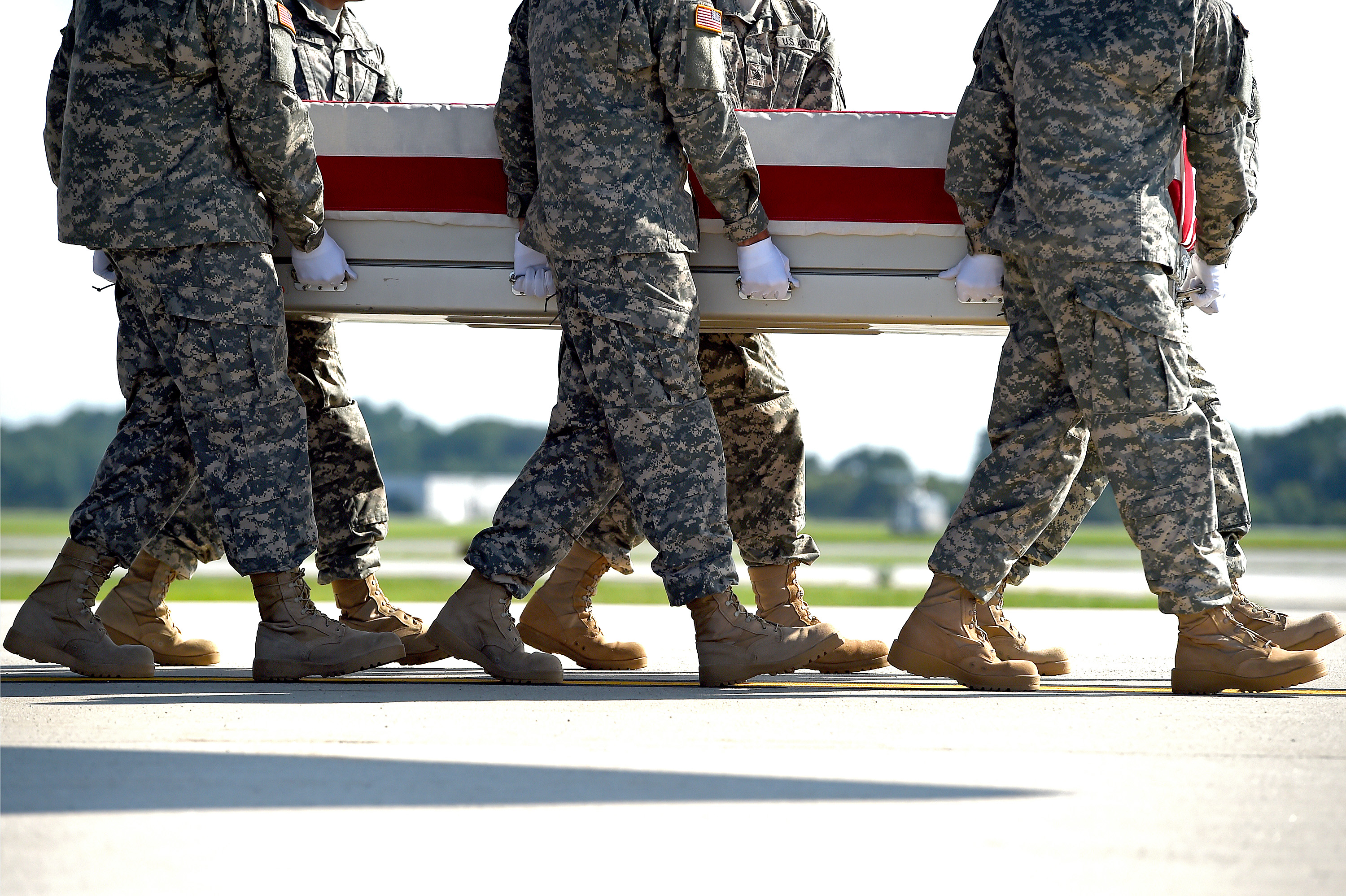
Remains Of Two-Star General Killed In Afghanistan Returned To US

Elliot Ackerman, who served as an adviser to Afghan special ops forces from 2008 to 2011, revisits the rationale behind the long-drawn-out American entanglement in the Graveyard of Empires. In his Afghanistan days, he writes, “words like ‘win’ and ‘end’ weren’t part of our vocabulary. These days, such words seem even less well suited to that war”:

John Paul Vann, a U.S. official in Vietnam and the subject of Neil Sheehan’s “A Bright Shining Lie,” said of that war, “We don’t have twelve years’ experience in Vietnam. We have one year’s experience twelve times over.” The same could be said of Afghanistan. Because Afghan commanders like Kareem often work in the same provinces for decades, they see an unending stream of their U.S. counterparts come and go, fighting smaller, months-long wars amid their unending one.

When Kareem and I sat for our meetings, neither of us ever offered a plan like this: “If we hit them in Mangritay, they’ll have to move south to Rarakaray. Then we’ll hit them there, forcing them across the border, securing the district, then maybe the province, allowing me to go business school and you to tend a quiet plot of land in the shadow of the Hindu Kush.” It just wasn’t that type of war.

For professional military officers, Afghanistan is an important stop in any career, a place to earn your combat bona fides. For many servicemen, those volunteering for multiple tours, it’s been a refuge from the drudgery of garrison life. For the Afghans, the war isn’t fought for the winning. It’s been going on since 1979, a beat to walk, something to police. Cops don’t talk about winning the war against crime. They fight it, but they don’t win it. Kareem and other Afghan commanders with whom I worked thought of war in the same way.

Recent Dish on our war in Afghanistan here and here.

(Photo: U.S. Army soldiers carry the flag-draped transfer case containing the remains of U.S. Army Maj. Gen. Harold J. Greene during a dignified transfer at Dover Air Force Base on August 7, 2014 in Dover, Delaware. By Patrick Smith/Getty Images)

Obama’s Iraq Strikes And Executive Power

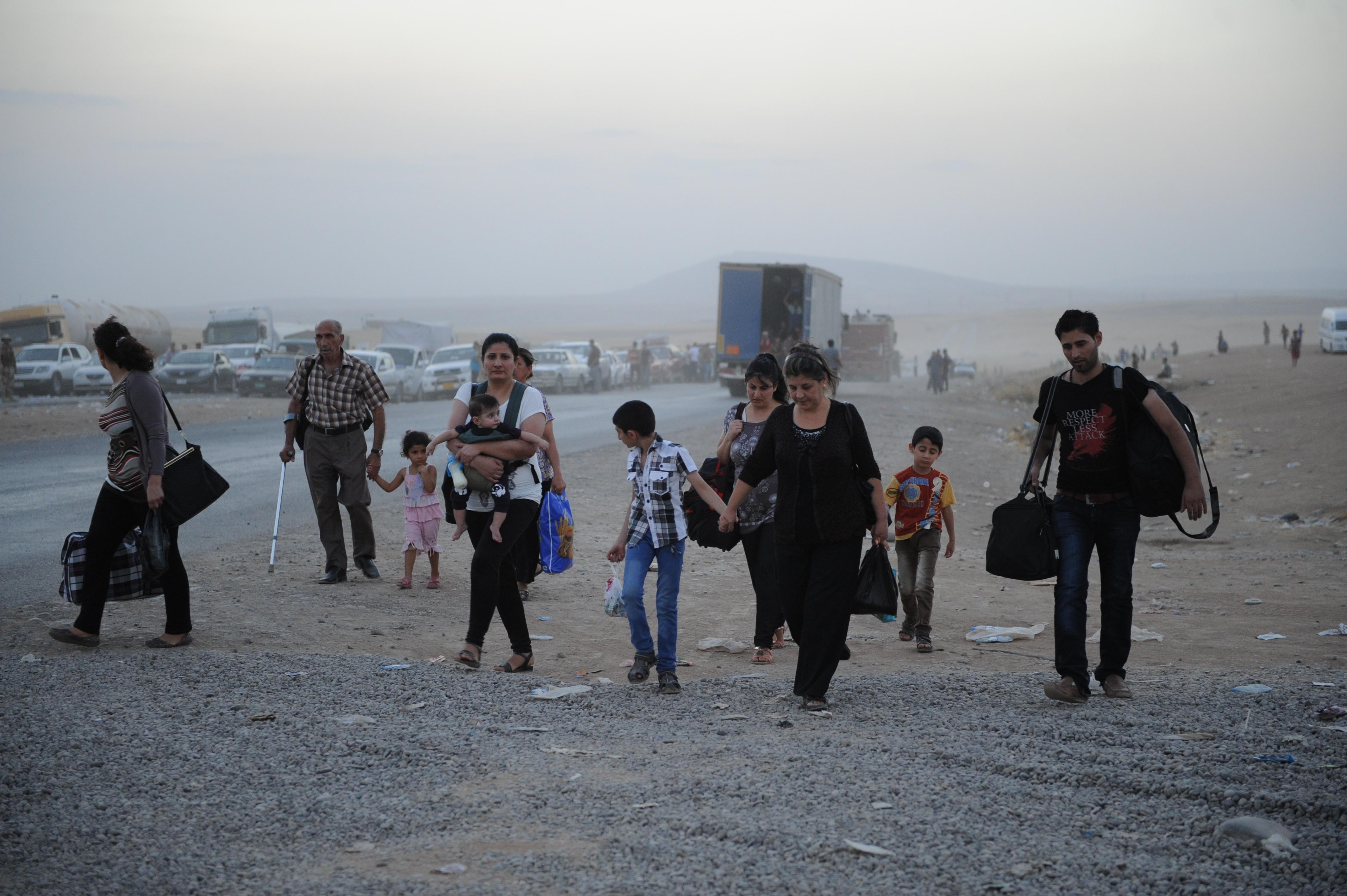
Thousands flee Iraq's Mosul

Ed Krayewski’s not so sure Obama’s decision to re-intervene in Iraq is a good idea, but he’s positive that intervening without Congress’s formal sanction is a bad idea:

As a murderous regime intent on dragging the Middle East back into the Dark Ages makes advances in the region, it’s worth remembering how governments there have encouraged virulent strains of extremist Islam as a way to maintain their own power. If the U.S. were to intervene to defeat ISIL, it would almost certainly cause more harm than good. Yet with ISIL hunting down minorities in Iraq and the Iraqi government powerless to do anything to stop them, the question of whether the U.S. ought to intervene to protect those civilians from ISIL and a situation U.S. policy helped create is a harder one to answer. President Obama’s decision to order limited air strikes in this situation may not be the wrong call. But, given the last half century of U.S. war policy, he will certainly bypass Congress despite claiming to “consult” it. Making the decision unilaterally, outside the constitutional framework, will be the wrong call.

Ilya Somin cautions Obama against escalating unilaterally:

It is possible that the military action envisioned will indeed be so small-scale that no congressional authorization is required. But what if it turns out that very limited strikes and stepped-up assistance for Kurdish and Iraqi government forces are not enough to impede ISIS’ advance? In that event, any significant increase in US military involvement would require congressional authorization.

In addition to meeting constitutional requirements, congressional support could also give military intervention valuable political legitimacy and staying power. If the president goes in on his own, political support could evaporate quickly if anything goes wrong. Since he alone would bear the blame, congressional leaders – especially those from the opposition Republicans – would have every reason to hang him out to dry. For that reason, among others, it is generally better to enter a war only if there is a broad political consensus in favor of doing so, including both the president and Congress.

But Jack Goldsmith expects that Obama’s views on his constitutional prerogatives to fight Islamist terrorism are becoming more expansive, by dint of necessity:

Wanting to declare the statutory war against Islamist terrorists over, the administration has long maintained that the residual use of Article II in this context will be exceptional and limited.  Given the large and growing nature of the Islamist threat, not just in Syria and Iraq, but elsewhere, I do not see how the President can protect U.S. national security interests with exceptional and limited uses of force under Article II.  Put more simply, the threat is not limited, and neither can (or will) be our response.  The current crisis in Iraq might be a test of this view, and of whether the Congress and the nation are comfortable with a President using force in its name under the broad, unilaterally determined parameters of self-defense, or whether it wants more formal and defined input and guidance and limitations from the legislature.

(Photo: Thousands of Yazidi and Christian people flee Hamdaniyah town of Mosul to Erbil after the latest wave of ISIL advances that began on Sunday has seen a number of towns near Iraq’s second largest city Mosul fall to the militants on August 6, 2014. By Mustafa Kerim/Anadolu Agency/Getty Images.)

Back To Iraq: Blog Reax

https://twitter.com/marieharf/status/497729146358099968

https://twitter.com/PentagonPresSec/status/497725099970031616

For Lawrence Kaplan, Obama’s decision to authorize airstrikes on ISIS targets in Iraq was a no-brainer:

The Yazidi, a tiny sect probably as old as the biblical province its members call home, have nearly been wiped out on dozens of occasions, by dozens of persecutors, and yet they survive. During the Iraq War, they turned to the Americans for protection, and the Americans turned to them for all manner of support. (The Yazidi supplied a disproportionate number of interpreters to the U.S. Army.) For this, the insurgents slaughtered the Yazidi, killing 500 on a single day in 2007. Whenever I would visit their ancestral home in the town of Sinjar, they would plead for stepped-up assistance from Washington.

The Yazidi need that assistance, and they need it today. For an administration that famously prefers to achieve its desired results abroad through suasion rather than brute force, this presents a conundrum. It should not.

Christine Allison argues that protecting Iraq’s religious minorities is a moral obligation:

If, through our own inactivity, we allow the Yazidis and Christians to suffer so much that they leave the country, what are we doing to Iraq, the cradle of civilisations? What about the smaller minorities, Shabaks and Mandaeans, who have found stability and shelter in the Kurdish region? Do we sit back and watch an extinction event in northern Iraq? As we commemorate the centenary of the first world war, we have only to look over Iraq’s border to see Turkey’s struggle to come to terms with its past in those years. Inaction in Iraq now will produce the same result: an ethnically “cleansed” landscape, a haunted population.

So now, in addition to our humanitarian efforts, we must turn to the Kurds, who, with their referendum on independence are apt to be perceived as causing “the break-up of Iraq”. But paradoxically, with their forces on the ground, they are the best protectors of northern Iraq’s diverse population. Air strikes and humanitarian drops are a beginning. But in the medium and longer term, London and Washington must find a way to maintain the balance of power between Baghdad and Kurdistan and still work closely with Kurdistan’s fighting forces to assure security.

Dreher also throws his full support behind the intervention:

It is my devout hope that the US kills as many ISIS berserkers as we possible can. I saw today video of a Christian child who had been decapitated by these monsters, and heads of Christians on pikes. There was news today that they were slaughtering Yazidi men and taking their wives as plunder. They are worse than Waffen SS. I’m pretty strongly noninterventionist, but that is not an absolute position, especially not when we can fairly be blamed for setting off this crisis. As they say in Texas, some people just need killin’.

Morrissey calls Obama’s announcement “the right and … only possible steps”, though he doubts airstrikes alone will do the job:

The Kurds have spent the last 23 years living in peace and freedom, relying on the US to protect their interests while being caught between the Turks, Iranians, and Iraqis. Walking away from the Kurds after their long support of our efforts to stabilize Iraq even at the expense of their own dreams of independence would be a betrayal that would send shock waves around the world to other groups working with the US — especially in Afghanistan. The Kurds will be the canary in the coal mine of American credibility for decades to come.

In the meantime, it will take more than a couple of airstrikes to stop the genocides of ISIS to come. The so-called Islamic State and its leadership is perhaps the most explicitly bloodthirsty regime to arise in generations or perhaps centuries, and nothing short of utter defeat will stop them from continuing to annihilate all those who do not bow down to them. The US and the West will have come to grips with this reality sooner or later, and in terms of lives lost and the effort necessary to stop ISIS, sooner would be much more preferable.

To Dan Hogdes, the events in Iraq prove that the US has to be the world’s policeman:

When people say “We don’t want America to be the world’s policeman,” I don’t think most of them actually mean it. What they really mean is “We don’t want America to be the world’s policeman, and the world’s prosecutor, judge and jury as well.”

And that’s a fair argument. But at the moment, with the implosion of the authority of the UN, there is no effective prosecutor, judge or jury. Earlier this week the UN patted itself on the back for the successful conviction of Khmer Rouge leaders Nuon Chea and Khieu Samphan. They are 88 and 83 respectively. Their victims – an estimated two million of them – died 40 years before. Pol Pot himself never faced justice. If we want a world based on laws then someone ultimately has to enforce them. And there is only one state on the planet with the means and inclination to do so. That state is the United States.

But the limits of the mission are very much in doubt. Ryan Goodman questions them:

[I]s this mission really just to protect US personnel or also to aid the Kurds? The New York Times reported that “aides said [the President’s] hand was not forced until ISIS won a series of swift and stunning victories last weekend and Wednesday night against the Kurds in the north, who have been a loyal and reliable American ally.” Similarly, Rep. Adam Smith, the ranking Democrat on the House Armed Services Committee, said “he supported intervening on behalf of the Kurds, as opposed to the unpopular Baghdad government. ‘The Kurds are worth helping and defending.’”

On the second mission (protecting religious minorities on Mount Sinjar), the President outlined three criteria for such humanitarian actions: “[1] innocent people facing the prospect of violence on a horrific scale, [2] when we have a mandate to help — in this case, a request from the Iraqi government — and [3] when we have the unique capabilities to help avert a massacre.” It is unclear, in my mind, why those three criteria won’t also apply to ISIS’s genocidal efforts elsewhere in the country, and the US ability “to help avert” those massacres.

Zack Beauchamp believes that the “key cause of all of this is ISIS’ somewhat surprising advance into territory held by Iraq’s Kurds”:

“This is a big deal,” Phillip Smyth, a researcher at the University of Maryland who follows this situation closely, said. “First, they push the Christians out of Mosul [Iraq’s second-largest city], and now they’re doing that.”

Smyth sees at least two basic motivations for the ISIS advance. One is simple opportunism: not every Kurdish unit is equally strong, and ISIS will take any territory it thinks it can, given the chance. The second is more strategy: they likely want to cut off Iraq’s Kurds from Kurdish communities in Syria, where ISIS is fighting a second front against the Syrian government. “They’re trying to cut off geographic links between those two territories,” he said.

John Cassidy asks, “Once the U.S. bombing starts, when will it stop?”:

That is one of the many tough questions that Obama and his colleagues will have to answer. Are the sole goals of the mission to help out the Yazidis and prevent Erbil from falling? Or is this the beginning of a U.S.-led effort not merely to halt the advance of ISIS on its eastern front, in the Kurdish region, but to roll it back everywhere in the country? On these questions, Obama was studiously ambiguous. … Already, though, one Rubicon has been crossed. A President who came into office on a promise to pull the United States out of Iraq, and who followed through on his pledge, has just ordered more combat operations in, or over, Iraq.

Josh Marshall wants to know what changed on the ground to tip Obama towards intervention, and why our understanding of ISIS’s and the peshmerga’s capabilities has been so wrong:

[W]hat’s happened to ISIS, which was supposed to be a fairly small, rag tag force, highly spirited perhaps but not a force capable of making gains against a disciplined regular army? Quite a bit of American weaponry did fall into ISIS hands when the Iraqi Army fled. But advanced weaponry usually requires significant training to use effectively or at all and additional time to integrate its use into a fighting force. It seems highly questionable that all that weaponry could have transformed ISIS’s capabilities so quickly.

And if ISIS hasn’t changed, is it possible that the Peshmerga were never really the vaunted force they were made out to be? That’s the question asked by this editorial in a Saudi paper. Whether it’s one of these misapprehensions or the other or both, either would seriously change the situation in Iraq from what we’d been led to believe as recently as a few days ago.

Indeed, if the Kurds can’t finish ISIS on the ground, even with American air support, what happens then? That’s where Jacob Siegel spots a major flaw in Obama’s plan:

The consensus among ex-CIA analysts, former military officers, and Iraq veterans who spoke with The Daily Beast is that the Peshmerga’s abilities were overrated. No one questions the Kurds’ willingness to fight, but their military prowess appears to have degraded in the years since the U.S. military stopped training them and withdrew from Iraq. … Air strikes against ISIS targets can weaken the group, buy time, and prevent it from massing on Kurdish forces, but according to military and CIA veterans, air power alone will not be decisive.

“The advisors need to be pushed out, if they haven’t been already,” said Nada Bakos, a CIA veteran who led the team analyzing the terrorist network that was ISIS’s predecessor in Iraq. The advisors she referred to are the special operations troops who have so far stayed away from the battlefield, offering intelligence and advice from headquarters in areas remote from the fighting.

Juan Cole is having flashbacks to 1991:

The Neocons who wanted to go to war against Iraq in the early zeroes always said that one reason a war would be good was that the US was spending a lot of money on the no-fly zone over Kurdistan– as if a whole war wouldn’t be much more expensive (it was, by about $1 trillion). Apparently not only has the Iraqi federal army almost completely collapsed, finding itself unable to take back Tikrit, but now the so-called Islamic State was making a move on Iraqi Kurdistan’s capital of Irbil. Obama’s hope that the so-called “Islamic State” can be stopped by US air power is likely forlorn. The IS is a guerrilla force, not a conventional army. But one thing is certain. A US-policed no fly zone or no go zone over Iraqi Kurdistan is a commitment that cannot easily be withdrawn and could last decades, embroiling the US in further conflict.

Lastly, Michael Crowley remarks on Obama’s evolution when it comes to genocide and US intervention:

In his 2007 comments about genocide, Obama at least seemed to imply that, because the U.S. can’t prevent slaughter everywhere, it shouldn’t take humanitarian action anywhere. But as President he has adopted a different point, first in Libya and now in Iraq: Just because we intervene in some places doesn’t mean we have to intervene everywhere. That doesn’t make for a very tidy doctrine. Nor will it console the miserable people of Syria. But it will bring jubilation to the terrified thousands on Mount Sinjar, for whom salvation is now coming.
Why Lady-Deodorant Costs More

Danielle Kurtzleben revisits the question of gender-specific price disparities:

There are a few reasons why women are paying more for certain goods and services. Not really knowing or thinking about this pricing gap is certainly part of it — as a woman, it’s easy to pick the Powder-Fresh deodorant and never give the stick of Cool Rush a second thought.

But, Kurtzleben argues, there may be more to it:

Of course, there’s an obvious answer here: society expects women to look a certain way. Put into economics terms, there’s a higher return on investment for beauty for women. Beauty products are becoming more popular among men, it’s true, but expensive skin cream is still optional. For women, all those trappings are more necessary.

Map Of The Day

opSPO1O

Every phone call Obama has made to another world leader so far this year. Max Fisher captions:

The most significant detail here is Europe: Obama’s phone calls in 2014 have been overwhelmingly with European leaders. This just goes to show how much the Ukraine crisis has come to dominate US foreign policy this year. Tellingly, the foreign leader whom Obama has called most frequently is, by far, German Chancellor Angela Merkel. That may surprise you — US-German relations are probably not the first topic that comes to mind when you think about US foreign policy — but it makes sense given the Ukraine crisis. The German leader is the most influential figure within the European Union, and the EU is the body with the most power to help Ukraine and to punish Russia for its role in the crisis.