A Cure For Ebola? Ctd

Brian Till objects to the disparity between the treatment American Ebola patients Nancy Writebol and Kent Brantly are receiving, including an experimental antibody therapy called ZMapp, and the little to no care afforded African patients:

The inequality in care couldn’t be starker. When a doctor and aid worker from the United States are stricken with a horrific disease, an erstwhile unknown cure is sent from freezers at the National Institutes of Health in suburban Washington, D.C., to a hospital on the other side of the world, and a Gulfstream jet outfitted for medevac is arranged to deliver them to one of the world’s premier medical centers. But when two Liberian nurses working at the same hospital are stricken with the same disease, they are treated with the standard of care that other affected Africansthose lucky enough to receive any medical attention at allhave been afforded for the past seven months: saline infusions and electrolytes to keep them hydrated. …

The Obama administration has not said whether it will allow ZMapp to go into production. Mapp Biopharmaceuticals published a statement to their website late Monday stating that the company is working “with appropriate government agencies to increase production as quickly as possible.” (An executive at BioProcessing, a Kentucky firm that produces at least one component of ZMapp, told an industry publication last August that his company can produce the proteins for ZMapp in two weeks.)

A TPM reader with a background in bioethics speculates about why the experimental drug was given to these two aid workers, and no, it’s probably not because they’re white:

It’s hard to overstate how unusual it is for a drug at this stage of development to be given to humans.

This CNN piece suggests that they’ve only tried it on eight macaques so far. That’s a small number; they’d normally do significantly more testing in primates (or some other good animal model) before moving on to humans. Then when they did move to humans, they’d begin by testing for safety, then do various complicated further tests on larger numbers of people, and only then, if it had proved to be safe and effective, would they be able to apply for FDA approval.

This means, first, that this probably wouldn’t have been considered a “treatment” yet, just a promising lead. But second: trying a drug at this stage on humans has serious ethical risks. You’d want to be really, really sure that the people in question had given informed consent, and that that informed consent included their being absolutely clear that this drug not only might not work, but that it might actually be harmful to them. You’d want to be sure that they understood what it means for a drug to be at this preliminary stage of testing, and that they fully appreciated the fact that they were taking a huge gamble. … I think that this (along with the fact that the drug seems to require careful handling of the sort that would best be provided in a serious hospital, and the fact that there seems to have been only a limited amount of the drug available) would argue strongly in favor of trying the drug first on doctors, and specifically doctors who understand how much of the normal testing process was being bypassed, and what that meant.

Julia Belluz deflates the ZMapp hype, pointing out that just because the two Americans who received the drug appear to be doing well so far, that doesn’t prove anything about its efficacy:

[T]his drug has never undergone testing in people, only monkeys. The data on the efficacy of ZMapp in monkeys has never even been published. Studies on similar drugs are not entirely confidence inducing, either. In this study, two of the four monkeys given monoclonal antibodies 48 hours after exposure to Ebola survived. In this second study, the animals had a 43 percent survival rate when given the drug cocktail after the onset of symptoms. So even though the treatment of monoclonal antibodies decreased the mortality rate — if given close to exposure of the illness —  scientists haven’t moved past these tiny animal studies to testing in actual people.

Mapp Biopharmaceuticals is also just one of some 25 labs in seven countries working on these antibody cocktails for Ebola, and none of them have entered a phase one trial in humans, according to the journal Science. For this reason Dr. Martin Hirsch, a Harvard virologist, told Vox, “It’s too premature to say that the patients being treated miraculously improved.”

Olga Khazan explains why scientists are looking for an ebola treatment rather than a vaccine:

Vaccines don’t work that well in fast-moving epidemics. There are a few things you can do with a vaccine once an outbreak starts. One is immunizing healthcare workers and the families of infected patients. Sometimes doctors try “ring vaccination,” or targeting residents of villages on the perimeter of the outbreak in an attempt to isolate and quash it.

But most vaccines take a few weeks to provide immunity, and even then, they don’t always control the disease’s spread. Donald Allegra, chair of infection control at Newton Medical Center in New Jersey, remembers trying to halt the advance of measles in a Cambodian refugee camp in the 1970s. “We vaccinated 10,000 kids, but didn’t have an effect on the outbreak,” he said. “Vaccines and acute outbreaks don’t work very well together.”


Book Club: How Extremists Need Each Other

A reader winds down our discussion by tying the lessons of Montaigne to the current crisis in Gaza:

It seems to me the most compelling angle to look at Montaigne right now is how living through the civil war of religion in France his whole adult life shaped his philosophy of bookclub-beagle-trmoderation. I had no idea how bloodcurdling the conflict between the Catholics and the Huguenots were. That was just shy of half a century of neighbors dragging neighbors out in the streets to be tortured, killed, and perhaps slowly roasted over an open flame for witchcraft! All over what we now think of as slightly different flavors of Christianity!

Montaigne has been accused of being too bloodless and passive, with his stubborn refusal to pass definitive judgement and his pursuit of equanimity as a cardinal virtue. But if you consider the bloody backdrop of the times he lived through, his very moderation is the bravest and most radical stance I can think of.

As the mob violence spiraled out of control on both sides, the pressure to fall in line and declare the moral supremacy of your cause must be almost irresistible. In fact, “us or them” thinking would have been rational, in a prisoner’s dilemma kind of way. Instead, he championed the power of individual human dignity. Even amid war, he coolly proclaimed, the lives of most people are unaffected most of the time. For an observer of his caliber, that is a statement not of insensitivity but of quiet defiance. Life goes on.

He lived according to his philosophy of modest courage. For instance, he chose not to fortify montaigne.jpgthe defenses for his estate even as anarchy engulfed the countryside. Instead, he hosted travelers so graciously that one group who planned to rob him changed their minds. Politically, he was a passionate moderate who believed the civil war was a political problem with a political, not theological, solution. He complained that as a Catholic with many Protestant friends, he was considered “a Guelph to the Ghibellines and a Ghibelline to the Guelphs”. He toiled as a go-between for the king and the protestant Henry de Navarre.

It seems to me that the true fight that is going on in the Israeli-Palestinian conflict is the moderates on both sides trying to hold the line against the absolutists on both sides. Even though the ultimate goals for the extremists on both sides are diametrically opposite, their medium-term goal is actually the same: to escalate conflict and prevent any compromise from tainting the purity of their victory. Unfortunately, it is shockingly easy to escalate conflict, especially with partisans on both sides searching for the worst in the others’ actions or rhetorics to justify their own hostile reprisals.

Montaigne would probably advise us to watch out for passion and zeal, so that we do not empower the absolutists. Easier said than done, even for those of us sitting safely with our American asses in our air-conditioned homes. But we all need to be more like Montaigne.

Putting A Price On Your Pet’s Life, Ctd

A reader adds to the growing thread:

When our late cockapoo was 10 years old, he was diagnosed with diabetes and very shortly after went blind. This meant two shots of insulin a day for the rest of his life, and our choice of a blind dog or a $3,200 cataract operation that would restore his sight. After several months of watching him getting increasingly more depressed about his blindness (and suffering our own depression from it), we sprung for the cataract surgery. Without doubt, it was the best $3,200 we ever spent. The look on his face the day after the surgery, when we took him out for the first time, was priceless. Like a puppy! The psychic relief that it gave my wife and me, and our two daughters, was priceless.

cockapoo

And despite the inconvenience of dealing with a diabetic dog (injecting him with insulin twice a day, other geriatric illnesses and conditions that flow from diabetes, urinary incontinence that got worse over time, inability to board him for vacations, and so forth), he lived five more years, all but the last six months or so of it with a very high quality of life. We put him to sleep at 15 1/2, when we knew he was giving up and would be gone within a few weeks, and it was still the toughest day of our collective lives.

I mention this because, when I tell this story to friends who are from rural areas, they laugh and tell me what a bunch of softies we are, that they would never spend $3,200 on an operation for a dog, that dogs will adapt to blindness. They see spending $3,200 on cataract surgery for a dog as nothing short of preposterous. But I can’t imagine living with him being blind, knowing we could do something about it.

A reader shares a resource for those facing life-or-death decisions for their pets:

Since I don’t have children, I sense that I would likely go overboard to care for my border collie. When I came across this quality-of-life scale for pets a few years ago, I bookmarked it so I could be more objective when the time comes. I hope other Dishheads may find it helpful.

Another raises an eyebrow:

I’m surprised your reader thinks that giving a dog chemotherapy will make it “very sick” and is “like torture.” Actually, at least with the kind given to my dog – which gave us another 15 months of very high quality life with her – it is very rare that an animal will get sick, or indeed suffer any side effects whatsoever. Mine had none. I’m sure a vet or two will weigh on the subject, but I just wanted to make this point.

Another nods, with many other readers sharing their stories and photos:

A reader pointed out that “chemo is awful” when discussing why he or she would not subject her family cat to it. I would suggest that she talk with her veterinarian about it before assuming that human chemotherapy treatment and pet chemotherapy treatments are perfectly analogous. In general, the side effects of pet chemotherapy are much, much less severe. My dog lost his leg to cancer about 20 years ago, and we put him on chemotherapy at the time. Of course we can never truly know what was going on in his head, but externally he was as happy, goofy, and active as ever during his treatment, and he loved going to the treatment center. And he ended up living three more years (his pre-chemo prognosis was three to six months).

Another updates us on his dog’s chemo experience, chronicled in “The Last Lesson We Learn From Our Pets”:

1044795_10201205134237952_1267167286_nLast summer I wrote to you about my dog Jack, who had recently completed chemo. At the time of treatment, we were told that our investment would likely get us a year, give or take, with the dog. A year came and went this past October, and Jack continues to be the happy, goofy, if old dog we had hoped he’d become. You may remember him from the photo that ran last summer [seen to the right].

Since then – and this is where we tie into the current thread – we’ve had to euthanize both cats in the house. The first cat became very ill, very quickly. The vet recommended tests, surgery, and ultimately a feeding tube. All of this was done with the understanding the cat would recover and live for several more years. Instead, we subjected the cat to incredible suffering for the better part of a week before we had to call it quits. My wife and I vowed that we would not repeat this.

When the other cat began his downhill slide, we discussed with the vet that our focus was on quality of life, not quantity of treatment. She was completely on board with this, and the cat had a glorious last week. One of the things we did was let him out in the yard to hunt, under supervision, and let his inner warrior get a one long, wonderful taste of life. When it was time to end things with this pet, we knew the suffering had been minimized, and therefore the experience was much, much easier. We have no regrets, and have planned a similar sendoff for the dog.

Another reader:

Several weeks ago, our beloved nine-year-old dog was diagnosed with a melanoma tumor in her mouth. As you know, this is one of the most aggressive cancers. We live on one of the Neighbor Islands in Hawaii, and our vet told us we would have to fly her to Honolulu for specialty treatment as there were no facilities for the required surgery where we live. Within two days we were on a plane to Honolulu with Gwendolyn to meet with the doggie oncologist at the specialty hospital.

2013-12-22_02-52-08_489

Following examination, including a cat scan, the doctors determined that it was in the early stages and gave us the option of surgical removal of part of the bone and teeth in her upper jaw. The surgery was performed and she was back home and feeling fine two days later. She is also receiving a very promising new melanoma vaccine that is used for both canines and humans. So far her prognosis is excellent. Other than a slight dent in the side of her face, you would never know she had had such a procedure. She has fully recovered.

So far the treatment, including travel, has cost in excess of $13,000. We are very fortunate that we can afford it and consider the cost about the equivalent to a really nice vacation. We will enjoy whatever time we have with Gwennie far more than that. We are realistic enough to know that if the cancer recurs we will most likely not pursue this course further, but we felt we had to give her the chance for more life. As a life-long animal lover, I know that there can be no greater pain for some of us than losing a well-loved pet. I also wish that we humans were treated with the same compassion when our time comes as we extend to our furry family members.

An equally loving pet owner chose the opposite approach:

PupsI have two 13-year-old dogs who are as dear to me as any family member (more so than a few). A recent trip to the vet with revealed congestive heart failure in one and possible Cushing’s disease in the other. The dog with congestive heart failure also has bad teeth that if treated would cost between $700 and $800. Both diagnosing and treating Cushing’s disease would require multiple trips to the vet. I am lucky to have a vet who understood completely why I declined treatment for both dogs.

I have been down this road before, once spending $700 on an ill and elderly rabbit who died on the operating table. I also spent $1,300 on a guinea pig’s teeth until realizing I would be shelling out $500 every six months. The guinea pig was euthanized.

I love my pets and cherish the way they have enhanced my life. But the sad truth is that they are approaching an age from which they will surely die of something. I doubt it will be either tooth decay or Cushing’s disease. I am not poor and could probably afford the treatments for my dogs with some economizing. But they are comfortable, they are treated for pain twice a day, and I will do all I can to make the last years of their lives comfortable. For me, declining treatment is an act of love and acceptance.

Another takes issue with the reader who wrote, “I understand that there is a sentimental component to the decision to forego a $5,000 operation for your pet, but from a moral standpoint I have no hesitation. Given that there is an oversupply of dogs and cats, putting one down simply means you can drive to the humane society and save another”:

Intellectually, I agree 100-percent with this. However, until it happens to you, you just cannot know to what lengths you will go for a pet. One of my dogs suffered a back injury. He was in great pain. I took him to a specialist who, after a $2,500 MRI, determined that he was a good candidate for successful back surgery. There were no guarantees, needless to say, but Homer was only six and a half years old at the time. I decided he was worth it and took money out of my retirement savings to get him the surgery.

Yes, he was on the end of a six-foot leash for two months. He didn’t like it. I slept with him on the living room floor for the first six weeks, then we built some kick-ass stairs for him to walk up to the mattress on my platform bed, where I tied a scarf around my wrist to his collar and he continued recuperating without being allowed to jump down, and believe me, his personality would dictate that he jump down. He has recovered beautifully, and even seems to have learned the benefit of using the stairs to get up and down from my too-high bed.

IMG_4915

Would I do it again? I don’t know. My other two dogs are just fine. I do get them dentals as needed, and they do go to the vet more than your average dogs. Homer has developed seizures, so we’re working through medications and dosages to keep them at a minimum.

I guess the answer on just how far you will go for your pets is so personal and individual that there might not be all that much point in discussing it. If someone told me to my face that I was stupid for spending the money that I spent on him (we call Homer the “Eight-Thousand-Dollar Dog,” though altogether I am sure I spent more like $10,000), I would call them something far worse than stupid.  Certainly financial circumstances can change enough as I get closer to retirement that the choice will be taken from me.  For now, I’m happy to spend the money to keep any one of my dogs happy and healthy and with me.

The Return Of Uganda’s Anti-Gay Act?

Politicians are working to bring reintroduce it after the country’s constitutional court struck it down on a technicality Friday:

On Tuesday, members of parliament supporting a new version of the measure held a press conference to announce that they would try to push a nearly identical version of the Anti Homosexuality Act through parliament within the next three days. The legislators claim to have nearly 100 of their colleagues signed up for the newest attempt to pass the law, according to government watchdog site Parliament Watch. The latest version of the law would look more or less like the old law, imposing stiff jail terms on homosexual individuals and organizations who work on LGBT rights in the country. However, there could be one addition this time: Parlimentarian Nabilah Naggayi Sempala said at the news conference that she’d like to see the law criminalize the act of heterosexual anal intercourse.

Maybe we were too quick to seize on “actual good news.” Still, Alexis Okeowo suggests things are better for Uganda’s gays now than they were five years ago:

The court’s decision reminded me of Devine, a flamboyant, self-assured general manager for a local company, whom I met two years ago. We had a drink one evening in downtown Kampala, at a neon-lit lounge staffed by a waiter who Devine gleefully told me liked to hit on him.  … “The word ‘gay’ wasn’t even mentioned five years back. Now people acknowledge that we are here. It has gotten better these days,” Devine said. He explained to some of his friends that he was gay, and, after their initial surprise, they accepted it. He and his friends could now go to Mulago, a public hospital, to get free H.I.V. testing and counselling. When he went to a clinic with a transgender friend, the doctor recorded the friend’s gender as male, even though he is biologically female. “That’s how far we’ve come,” Devine told me. At the same time, he said, “You wonder who’s watching you, and you have to pretend you’re not gay.”

Looking East From Africa

20140809_gdc460_2

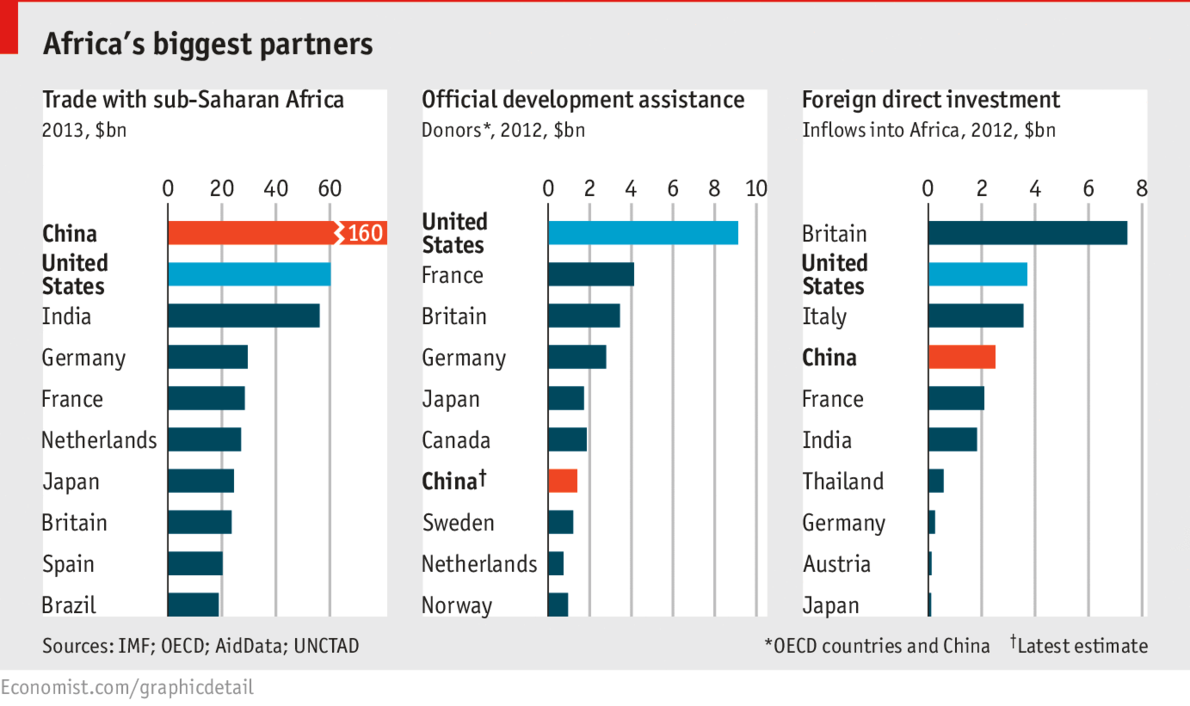
President Obama is hosting 51 current and former African leaders in Washington this week for a grand summit on revitalizing American engagement on the continent. Reviewing Obama’s mixed record on this issue, Jay Newton-Small sees the summit as an attempt to make good on some of the expectations he raised early in his presidency. But like most issues in international politics these days, it’s also about China:

As the U.S. is pivoting to Asia, Asia is pivoting to Africa. China’s investments in Africa surpassed those of the U.S. in 2010 and are now five times as big—$15 billion to U.S.’s $3 billion. China’s investment in the raw-resource laden continent is expected to reach as high as $400 billion over the next half century. While, Obama says “the more the merrier,” as he told The Economist, “my advice to African leaders is to make sure that if, in fact, China is putting in roads and bridges, number one, that they’re hiring African workers; number two, that the roads don’t just lead from the mine, to the port to Shanghai.”

To that end, Obama has a distinctly American message for African leaders. He has seized upon the conference to underline the power of democracy for emerging nations. It is not by accident that he invited so many former African leaders: a message to Africa’s many aging dictators that it’s okay to step aside and give someone else a chance. Obama has proven that he isn’t Africa’s savior, and there’s only so much he can do.

Max Nisen assesses how our aid, trade, and investment in Africa measure up to China’s:

Evaluating just how much China’s businesses and government have invested in Africa is tough, especially given the opacity of Chinese government dealings. Though the US still leads in UNCTAD’s tallies of direct investments in Africa, that’s declining. One study estimated that China invested as much as $75 billion in unrecorded projects alone from 2000 to 2011. That would boost the figures below from China dramatically:

China’s FDI has grown at about 53% a year since 2001, compared to 14% for the US. Less than 1% of US FDI investment goes to Africa, and $14 billion won’t do much to change that. By contrast, China invests 3.4% of its worldwide FDI stock in Africa. Its massive investments in infrastructure dwarf US efforts. Since China surpassed the US in 2009 to become the continent’s biggest trading partner, the gap has only grown. Last year, the US had about $85 billion in bilateral trade with Africa; China reported more than double that with $210 billion.

Stephen Mihm looks to history to explain why the US isn’t as robustly invested in Africa as it is in other parts of the world:

By the early 20th century, the U.S. had managed to get a foothold in places such as South Africa, but in general, its trade paled compared with that of Britain. Moreover, it was lopsided. Americans, in other words, didn’t actually buy a whole lot from Africa. The continent was instead viewed simply as a dumping ground for U.S. products. In 1901, for instance, goods from Africa constituted a mere 1.2 percent of total U.S. imports. That figure barely budged in the succeeding years.

And actual direct investment in Africa was negligible, with the exception of Firestone’s investment in rubber plants in Liberia before the outbreak of World War II. Africa, when it appeared on the radar of U.S. businessmen, was a place to sell, not a place to make long-term investments. That job fell to imperial powers such as Britain, which had little interest in, say, setting up a competing manufacturing power in a colony.

Gordon Adams explores the US-Africa relationship from a security standpoint:

The money, equipment, training, counseling, intelligence, and operating support the United States provides in Africa will only be reinforcing the militaries as institutions in their countries. These militaries already have, at best, a mixed history of corruption, political domination, and seizure of power. And U.S. military investments provide these militaries with additional arms and operational training, making it even more difficult for civilian governments to restrain the military’s assertion of political power.

This deeper issue is a central one in Africa, and the one payoff of all the U.S. investment that we should put above all others — above development, above social services, above stronger security forces — is the issue of “governance.” Governance is what this summit should be about, above all else. Supporting governance in Africa might be discussed this week, but it is a goal only weakly reflected in U.S. assistance programs in Africa.

(Chart via The Economist)

Why Is This Ebola Outbreak Different From All The Other Ones? Ctd

Jason Koebler surveys the ongoing chaos as overwhelmed health workers struggle to contain the ebola outbreak:

“Every report I’m getting from the ground has health workers in a state of fear, and they’re feeling a siege from populations who despise and loathe them,” said Laurie Garrett, a senior fellow for global health at the Council on Foreign Relations who won a Pulitzer Prize for her on-the-ground reporting on the ebola outbreak in Zaire in 1996, on a conference call this morning. “They’re saying ‘we are terrified, we are exhausted, we want to leave, can someone take over?’” … Problem is, there aren’t many people who can take over. Already, more than 60 healthcare workers have died from the disease, and the countries’ governments haven’t been very successful at shepherding their people—who have never seen the disease before, often don’t speak the same language as relief workers, and don’t fully grasp what’s going on—to treatment facilities.

That’s why you have things like riots outside of health care clinics and patients making escapes from ebola quarantine centers. Healthcare workers have been called “cannibals” by protesters, and Garrett said that workers she’s talked to have been accused of cutting patient’s arms off and selling them on the black market. In other words, the situation is fairly out of control, and it doesn’t look to be getting better anytime soon.

Debora MacKenzie, Philippa Skett and Clare Wilson offer their take on why this epidemic has been so severe:

The overriding factor could be urbanisation.

In the past, village outbreaks remained small, unless people went to hospitals. “Population size and high mobility make it hard to do contact tracing,” says Peter Walsh at the University of Cambridge. Cities provide more chances to spread the virus, something that may also have enabled the spread of HIV. According to the African Development Bank, the continent has had the world’s highest urban growth rate for 20 years, and the proportion of Africans living in cities will rise from 36 per cent to 60 per cent by 2050.

Other factors also favour the virus. Justin Masumu of the National Institute for Biomedical Research in Kinshasa, Democratic Republic of the Congo, found that the increase in Ebola outbreaks since 1994 is associated with changes in forest ecosystems due to deforestation, which displaces bats. The part of Guinea where this outbreak started has been largely deforested. What’s more, wars in Liberia and Sierra Leone, and corruption in Guinea, have caused poverty, says [Tulane public health professor Daniel] Bausch, leading people to migrate for work and spread the virus further. It has also caused widespread mistrust of officials, even in public health – just when Africa’s cities need them most.

Julia Belluz outlines the worst-case scenario:

Even if the outbreak didn’t move across any other country border, intensification within the already affected areas is the most immediate health threat. “The worst-case scenario is that the disease will continue to bubble on, like a persistent bushfire, never quite doused out,” said Derek Gatherer, a Lancaster University bioinformatician who has studied the evolution of this Ebola outbreak. “It may start to approach endemic status in some of the worst affected regions. This would have very debilitating effects on the economies of the affected countries and West Africa in general.”

This dire situation could come about because of a “persistent failure of current efforts,” he added. “Previous successful eradications of Ebola outbreaks have been via swamping the areas with medical staff and essentially cutting the transmission chains. Doing that here is going to be very difficult and expensive. We have little option other than to pump in resources and engage with the problem using the tried-and-tested strategy—but on a scale previously unused.”

But Tara C. Smith emphasizes that the chances of an ebola outbreak in the US remain extremely low:

Ebola is a virus with no vaccine or cure. Any scientist who wants to work with the live virus needs to have biosafety level 4 facilities (the highest, most secure labs in existence, abbreviated BSL-4) available to them. We have a number of those here in the United States, and people are working with many of the Ebola types here. Have you heard of any Ebola outbreaks occurring here in the United States? Nope. These scientists are highly trained and very careful, just like people treating these Ebola patients and working out all the logistics of their arrival and transport.

Second, you might not know that we’ve already experienced patients coming into the United States with deadly hemorrhagic fever infections. We’ve had more than one case of imported Lassa fever, another African hemorrhagic fever virus with a fairly high fatality rate in humans (though not rising to the level of Ebola outbreaks). One occurred in Pennsylvania, another in New York just this past April, a previous one in New Jersey a decade ago. … How many secondary cases occurred from those importations? None. Like Ebola, Lassa is spread from human to human via contact with blood and other body fluids. It’s not readily transmissible or easily airborne, so the risk to others in U.S. hospitals (or on public transportation or other similar places) is quite low.

Cheers To Cheap Beer

dish_champagneofbeers

In a review of Adam Rogers’ Proof: The Science of Booze, Matthew Braga sticks up for the makers of “so-called mass-market swill”:

“Just because Jack Daniel’s comes from a chemical plant,” Rogers writes, “doesn’t mean it isn’t a damn-fine-tasting chemical.” Quality means a lot of things, and to create a mass-market beverage that consistently tastes the same, year after year, you can’t—scientifically speaking—fuck around. …

Be it $12 eggs or some top-shelf bourbon, the supposed authenticity of something handmade is how some of us define quality, for better or for worse. When we pay good money for something, suggests Rogers—a fancy wine or a bottle of scotch, say—we want to know it was worth the price. As a result, many of us have lowered our expectations of what a cheap, mass-market drink can be. Surely not quality, the patio pals with which you’re splitting a pitcher might say. And definitely not as flavourful or interesting as a good craft brew, I’ll give you that. But no less of a challenge to produce on such a mass-market scale. It takes skill to make something taste exactly the same, again and again, no matter when or where or how you have it, and just because the result is cheap doesn’t make it bad, per se. If you’ve never ordered a Labatt 50 while everyone around you is drinking expensive wine, it’s an experience worth having at least once. Even if you don’t like the drink, you can savour the dirty looks.

(Photo by Scott Akerman)

Quote For The Day

“There we were, just enjoying a nice quiet Saturday night at the movies. A slow mover, Linklater’s “Boyhood.” Some popcorn. A few sodas. Nothing really happens in the film, we found. For about 90 minutes or so we stare listlessly at the screen. It’s a thinking man’s film, I say. Beautifully shot. It’s about life, and death and relationships and things of that nature. Just then, at a brief, carefully-timed cinematic pause in dialogue, an enormous fart from somewhere in the back pierces an otherwise silent movie theatre. It had the impact of a baseball bat hitting a leather couch, or George Foreman working the heavy bag. Whack. Loud, deep and masculine.The seat cushion heroically absorbed most of the blow, but not enough that each and every person in the movie theatre instantly burst into nervous laughter. The laughter continued for what felt like a good 5 minutes, until tears streamed down our faces.

Even well after the blast, we quietly chuckled to ourselves with a ‘remember the time that guy farted in the movie theatre’ gleam in our eyes. And just like that, with a soft chuckle and a deep breath, we were back into the film. Things happened, people drove around Texas, relationships came and went, there was crying, there was hope. It was as if we had all forgotten about the fart that had brought us together that night. As the sun began to set on screen, the teenage boy, no longer a boy, transitions into an adult, before our very eyes, and looks, intently, lustfully into a young girls eyes, as if to lean in for a kiss, and braaaaaaap. Another fart from the back row, like two giant hands clapping together, and the screen goes dark, roll credits. We decided, after laughing our way out of the theatre, and all the way home, that this was the best movie that we had ever seen. I imagine the lone fartist sauntering off into the sunset. His work here done.

If only I could say thank you, kind sir. You are truly a master of your craft,” – a Craigslist poster on a memorable day at the movie theater.

“How Miscarriage Deepened My Thoughts On Abortion” Ctd

A fair number of readers are pushing back against the one who wrote, “If you could ban bodies from terminating pregnancies, banning doctors from terminating them might make a tiny bit more sense, at least intellectually. But you can’t, and it doesn’t.” One argues:

We can’t ban bodies from miscarriages any more than we can ban anyone from dying. Miscarriages are natural, as is death. But I don’t think the fact of my inevitable death should excuse anyone from killing me today. The issue isn’t whether miscarriages are natural, but whether it is moral to force a death where none would have otherwise occurred.

Another charges the reader with failing to make “a significant distinction”:

The great majority of miscarriages occur because the embryonic makeup was not consistent with life. In other words, nature selected the embryo for termination. With abortions, it’s not as clear.

While there are certainly many fetuses that are aborted which would have miscarried anyway, there are many (perhaps most?) that would have survived to full term and enjoyed lives as healthy and full as have you and I. In other words, nature did not select them for termination. Rather, a human being – usually the mother– decided not to give the fetus the chance to become fully human. That difference should give us all great pause.

By the way, I am pro-choice (albeit by default). But to say, “Nature terminates pregnancies; why shouldn’t we?” isn’t a very compelling case for the pro-choice movement. Nature does a lot of things that we as human beings feel morally obligated to transcend.

Another:

I nodded along in recognition as I read your reader’s email. Like her, my husband and I have suffered through a miscarriage (in our case at 10 weeks) and also, horrifyingly, a stillbirth at 24 weeks. However, when I reached the last paragraph, I was taken aback:

After I came back to work after being in the hospital, I told my boss I was doing okay, and that it’s such a common thing – a fact known almost exclusively to only two groups of people: doctors, and people who have had miscarriages. And she said, “No. It’s a big deal.” And I’m like, who the hell are you to tell me whether it’s a big deal or not? I feel the exact way about people who want to ban abortions.

I respect your reader’s viewpoint, and I’m not interested in telling other people how they should feel about a miscarriage or an abortion. For me, the fact that miscarriages are common (absolutely true) does not make them any less of a big deal; mine was a huge deal for us.  I can both see a 20-day embryo as a fragile clump of cells, and still mourn the potential, the hopes, the dreams, the life that it represents.

Another shares similar sentiments:

I have thought a lot about this subject over the past several years. Both my sister and I have had early miscarriages. She has had three (that I know of) and I have had two. My sister and her husband are conservative evangelicals, while my wife and I are pretty firmly pro-choice.

Make no mistake, having an early miscarriage is a terrible thing, particularly your first, when you have no idea how common they are. My sister, her husband, my wife, and myself all went through periods of horrible grief and a sense of loss after each miscarriage.

That being said, I think my sister has taken these losses much worse than my wife and I. If you asked her I think she would consider the miscarriages to be children that died. I can’t help but think she feels this way in large part because she hears over and over again that life begins at conception.

After our first miscarriage, my wife and I struggled to put into words what we felt like we had lost. It certainly was not a child. But just a grouping of cells seemed not quite right either. Eventually we came to think of it as promise, or hope of a child that had been taken from us. Painful, absolutely, but not on par with losing a child.

My wife is now six months pregnant with our first child. At this point if we were to lose her, I would feel that I have lost a child. I am not sure when that switch happens, but it absolutely on a continuum. A mass of cells does not seem to be a person, but a two-pound fetus that I have seen on a sonogram, and whom I have felt kick, most certainly is. I guess that goes to show you that this is a really complicated subject and not one that lends itself to a black-and-white interpretation of when life begins.

A word of thanks: Your Misery of Miscarriage series, as well as the It’s So Personal series on late-term abortions, really helped me put my own thoughts in order.  I don’t know where else you would find that variety of viewpoints on subjects that are generally so taboo.