How Drugs Got A Bad Rap

“Drug addict,” “drug control,” “drug culture” – it wasn’t until around 1900 that we used these terms the way we mean them today, explains Mike Jay:

Largely couched in medical terms as it was, the whole notion of ‘drugs’ carried moral and cultural implications from the start. Within the temperance debate, intoxication was an evil in itself and abstinence a corresponding virtue. Also, a good many of the substances that caused concern in the West were associated with immigrant communities: opium in the Chinese districts of San Francisco or London’s docklands, cocaine among the black communities of the southern US. In the racially charged debates of the day, these substances were presented as the ‘degenerate habits’ of ‘inferior races’, a ‘plague’ or ‘contagion’ that might infect the wider population. Such ideas might no longer be explicit, but the drug concept certainly carries a murky sense of the foreign and alien even now.

That’s why it rarely applies to the psychoactive substances that we see as part of normal life, whether caffeine in the west, coca in the Andes, or ayahuasca in the Amazon.

During the first years of the 20th century, opium, morphine and cocaine became less socially acceptable, rather as tobacco has in our era. Their use was now viewed through the prism of medical harm, and their users correspondingly started to seem feckless or morally weak. The drugs themselves became, in a sense, ‘legal highs’: not technically prohibited but retreating into the shadows, available only under the counter or from those in the know. And then, once their sale was formally banned in the years around the Great War, ‘drugs’ became a term with legal weight: a specified list of substances that were not merely medically dangerous or culturally foreign, but confined to the criminal classes.

Putin’s Strategery

Michael McFaul views the Russian president as a failed statesman:

Putin’s failed proxy war in eastern Ukraine also has produced a lot of collateral damage to his other foreign policy objectives. If the debate about NATO expansion had drifted to a second-order concern before Putin’s move into Ukraine, it is front and center again now. Likewise, the strengthening of NATO’s capacity to defend its Eastern European members has returned as a priority for the first time in many years. Russian leaders always feared U.S. soldiers stationed in Poland or Estonia, yet that might just happen now. In addition, Putin’s actions in Ukraine have ensured that missile defense in Europe will not only proceed but could expand. And after a decade of discussion without action, Putin has now shocked Europe into developing a serious energy policy to reduce dependence on Russian gas and oil supplies. As a result of Putin’s actions in Ukraine, the United States is now likely to become an energy exporter, competing with Russia for market share. Some call Putin’s policies pragmatic and smart. I disagree.

Approaching the Ukraine conflict from a strategic studies perspective, Joshua Rovner outlines what scholars in that field can learn from it:

Ukraine raises at least two issues that may inspire new thinking on strategic theory. One is the problem of recognizing success when it involves something less than victory.

Ukraine has been on the offensive against the separatist fighters, rapidly driving them back into a handful of strongholds. But it’s unlikely the government can destroy them, given pro-Russian sentiment in the east and the possible existence of a large sanctuary for committed separatists across the border. Moreover, any durable settlement will require making concessions to groups that are extremely hostile to Kiev, as well as tacit promises to the Russian regime.

This might be a reasonable outcome, especially if Russia is badly bruised and if Ukraine comes away with increased Western economic and political support. But some Ukrainian leaders will bridle at any settlement that leaves their perceived enemies in place, especially after having lost Crimea. Not everyone will learn to live with Russian President Vladimir Putin and his proxies, and their unease may cause them to underrate important strategic gains. Such a scenario should resonate with American observers.

Where Fur Babies Come From

8164626363_3f6fd50c10_z

Tim Kreider suspects that Americans’ high spending on their pets “may be symptomatic of the same chronic deprivation as are the billion-dollar industries in romance novels and porn”:

I’ve speculated that people have a certain reservoir of affection that they need to express, and in the absence of any more appropriate object– a child or a lover, a parent or a friend – they will lavish that same devotion on a pug or a Manx or a cockatiel, even on something neurologically incapable of reciprocating that emotion, like a monitor lizard or a day trader or an aloe plant. Konrad Lorenz confirms this suspicion in his book On Aggression, in which he describes how, in the absence of the appropriate triggering stimulus for an instinct, the threshold of stimulus for that instinct is gradually lowered; for instance, a male dove deprived of female doves will attempt to initiate mating with a stuffed pigeon, a rolled-up cloth or any vaguely bird-shaped object, and, eventually, with an empty corner of its cage.

(Photo by Nate Pesce)

Abducted By ISIS

A harrowing account from a 14-year-old Kurd in northern Syria:

They would be taken to the torture room downstairs, one by one. When it was Lawand’s turn, he was first put in a car tire and beaten. Then he was hung from the ceiling by his hands, and beaten again. He could take this punishment for only half an hour before admitting that the list of his YPG relatives was accurate. He was taken back to the cell upstairs, where his time in detention would span 20 days. The kids were allowed to spend an hour each day in the yard; older prisoners got only five minutes. …

When the Muslim holy month of Ramadan began, in late June, Lawand was allowed to leave the prison. He rejoined the other students at a nearby school. The kids were forced to observe the holiday’s daily fast in the July heat. When one was caught taking a sip of water, the militants tied him to the goalposts of a soccer field, making his body into a cross. Then they scalded him with hot water and beat him with sticks.

Some kids tried to escape. One was successful. When the rest were caught, they were put through mock executions, and more torture. Some had knives pressed against their throats for what seemed like an hour.

The Best Of The Dish Today

Flanders Fields 100 Years Since The Great War

Sullybait: data from the CDC’s Behavioral Risk Factor Surveillance System now proves that New Yorkers are the unhappiest residents of a metro area in America. No: seriously. Huge numbers of people answer the CDC question, “In general, how satisfied are you with your life?” with four options: satisfied, very satisfied, unsatisfied, very unsatisfied. From the results of that, a new study controlled for things like wealth, age, race, education etc. and came to the staggering conclusion that the inhabitants of the Greatest City On The Planet are fucking miserable. Slate‘s Jordan Weissman was skeptical – I mean who wouldn’t be thrilled to live in that magnificent metropolis?

So I decided to check out the research team’s full data set, without all the fancy adjustments. Turns out, New York still takes the grand prize for big-city misery. Based on its raw happiness scores, the metro area was the third unhappiest overall, finishing just above Jersey City, New Jersey (which is basically an extension of Manhattan’s financial district), and ever-woeful Gary, Indiana. Among city regions with a population of at least 1 million, New York came in last. The same pattern held if you adjusted the data for demographic characteristics but not income. Any way you look at the numbers, the New York state of mind appears to be one of personal dissatisfaction.

NYC emerges at #56 in the happiness survey of cities. Washington DC? #5. Just sayin’.

Today, I detailed the rise and rise of eliminationist rhetoric in Israel. For a review of the definitional eliminationism of Hamas, go read Jeffrey Goldberg. Wars are like poultices: they bring all sorts of toxins to the surface.

I also worried about Obama’s possible executive action on illegal immigration; I noted that the GOP cannot muster enough votes for a resolution congratulating the Pope; Rich Juzwiak and I talked about sex without condoms, i.e. the activity formerly known as sex for almost all human history; readers came to the defense of Hillary Clinton’s vacuousness; and if you love beagles, you’ll love this video.

Speaking of beagles, it was a year ago today that we had to put Dusty down. She’s the model for the dog at the top of the page, and a constant presence in my life for fifteen and a half years. Her ashes still sit on the shelf here in Ptown, but the cottage is full of the energy and love of a puppy called Bowie. She shoves the pain instantly away. But every now and again I think of Dusty. And wonder where she is.

Dusty in ivy

The most popular post of the day was The Last And First Temptation Of Israel; followed by Why Sam Harris Won’t Criticize Israel.

Many of today’s posts were updated with your emails – read them all here.  You can always leave your unfiltered comments at our Facebook page and @sullydish. 21 more readers became subscribers today. You can join them here – and get access to all the readons and Deep Dish – for a little as $1.99 month. Gift subscriptions are available here. Dish t-shirts and polos are for sale here – and our premium tri-blend shirts are selling out soon, so don’t delay.

See you in the morning.

(Photo: Stone crosses marking the graves of German soldiers are overtaken by time and and the growing trunk of a tree in Hooglede German Military Cemetery on the centenary of the Great War on August 4, 2014 in Hooglede, Belgium. Yesterday marked the 100th anniversary of Great Britain declaring war on Germany. In 1914 British Prime Minister Herbert Asquith announced at 11 pm that Britain was to enter the war after Germany had violated Belgium neutrality. The First World War or the Great War lasted until 11 November 1918 and is recognised as one of the deadliest historical conflicts with millions of causalities. By Christopher Furlong/Getty Images)


New Dish New Media Update: A Bumper July

Apologies for being a little late on the monthly report, but it’s great news. July saw our traffic at 900,000 unique visitors and over 6 million pageviews. As for revenue, here’s the monthly chart since March:

Screen Shot 2014-08-04 at 10.48.21 PM

It was our best month since March, bringing us tantalizingly close to 30,000 subscribers. Revenue in all of 2013 was $851K. Revenue for 2014 with five months remaining is $833K.  Revenue in July 2013 was $20K. This July it was $39K – almost double. Thanks to all of you who subscribed last month – especially those treasured Founding Members who came through with their renewals after an email nudge from yours truly.

We’re trying to prove you can build a profitable new media enterprise without surrendering to native advertising. You’re showing how it can be done. So if you haven’t yet, please take a couple of minutes to subscribe. Without you, we couldn’t do any of it.

Grieving In Verse

Alec Wilkinson tells the story behind the poet Edward Hirsch’s long poem Gabriel, written about the death of his adopted son who died from taking a club drug at age 22. Wilkinson describes the work as a creatively updated form of elegy:

Elegies of any length tend to be collections of poems written over the course of years. The most famous elegy, perhaps, is Tennyson’s “In Memoriam A.H.H.,” which is about his friend Arthur Henry Hallam, who died young of a stroke, in 1833. It includes the lines “ ’Tis better to have loved and lost / Than never to have loved at all.” It consists of a hundred and thirty-one poems and an epilogue written over seventeen years. Thomas Hardy’s elegy for his wife is a series of twenty-one short poems called “Poems of 1912-13.” Mallarmé never finished “A Tomb for Anatole,” his long poem for his son who died at eight; it exists only in fragments. The closest thing to “Gabriel,” at least in tone, might be “Laments,” written in the sixteenth century by the Polish poet Jan Kochanowski for his daughter, who died when she was two and a half. There are nineteen laments altogether, most a single page or less, the last telling of a dream or a vision in which she returns to him.

Elegies also tend to occupy a spiritual ground—to accept an order of things, and to assume an afterlife.

They address God respectfully. In the manner of the Jewish poets who began interrogating God after the Holocaust, and even to wonder if there could be a God who could preside over such horror, Hirsch invokes God in order to rebuke him. “I keep ranting at God, whom I don’t believe in,” he said, “but who else are you going to talk to?” From “Gabriel”:

I will not forgive you

Sun of emptiness

Sky of blank clouds

I will not forgive you

Indifferent God

Until you give me back my son.

Finally, elegies typically elevate their subject. Embedded within “Gabriel” is a picaresque novella about a tempestuous boy and young man, a part Hirsch calls “the adventures of Gabriel.” Eavan Boland wrote me in a letter that “the creation of the loved and lost boy” is one of the poem’s most important effects. It represented, she said, “a subversion of decorum: the subject of elegy is meant to be an object of dignity. But here it is just an unruly son, an unmanageable object of fear and love in a contemporary chaos.”

“Your Fixation On Good Intentions Is Blinding You To Your Recklessness”

Palestinians killed in an Israeli attack on a UN-run school

Saletan criticizes Israel for retreating to its intentions to explain away the death and destruction in Gaza:

When you focus on intentions, it’s easy to lose sight of tactical decisions that endanger civilians as a side effect. High on this list is the IDF’s shift from guided missiles to artillery. Based on the U.N. review and its own reporting, the Times says the fatal hits in Jabaliya “were likely to have come from heavy artillery not designed for precision use.” Such artillery is “considered effective if it hits within 50 yards of its target.” That margin of error obviously increases the risk to civilians.

A human rights lawyer tells the Times that no matter how hard you try, “You just can’t aim that weapon precisely enough in that environment because it’s so destructive.” From the standpoint of good intentions, that’s an excuse. But morality isn’t just about where you aim. It’s also about the weapon you use. It’s easy to tell yourself that you aimed as well as you could, when the fatal decision was to use a weapon you couldn’t have aimed any better.

Benjamin Wallace-Wells suggests that Israel may not be as capable as it claims to be of launching “surgical strikes” after all:

Last week, the just war theorist and liberal Zionist Michael Walzer published a pained, moving defense and critique of Israel’s military actions in Gaza. He argued that Israel must be allowed to defend itself against disproportionate attacks, but that the IDF must also take more “positive efforts” to limit civilian casualties in Gaza, even if it means asking its own soldiers to take more risks. The State Department’s harshly worded statement after the Rafah attack followed a similar logical line.

But this all assumes that the Israeli military can in fact do better — that it can precisely control what its rocket strikes destroy in Gaza. The details of the attacks on U.N. shelters suggest this is somewhat less true than we often acknowledge. … Perhaps Israel’s military precision was always overhyped. Or perhaps this conflict is simply too messy, on the ground, to expect precision. Either way, it is impossible to describe the strikes in this conflict as surgical. They are everything but.

And as John Cassidy points out, the question of whether Israel has committed war crimes hinges on a bit more than the nobility of its intentions:

In an interview with Mike Huckabee on Fox News last week, the executive director of Human Rights Watch, Kenneth Roth, said that Israel was guilty of war crimes, because it repeatedly launched attacks with the knowledge that the number of civilian casualties was likely to be disproportionate to the military gains. In a tweet on Monday, Roth said: “#Hamas still firing rockets indiscriminately at Israel. Those are war crimes. But they don’t justify #Israel’s own war crimes, killing many.”

Imposing collective punishment is also a war crime under the Geneva Conventions. The term refers to punitive sanctions of “any sort, administrative, by police action or otherwise,” that are imposed on targeted groups for actions which they themselves didn’t commit. Any postwar investigations are likely to focus on specific incidents and attacks that might fall under the collective-punishment rubric. For example, over the weekend, there were claims on social media that Israeli forces had shelled the marketplace in Rafah, causing numerous civilian casualties, after a Hamas attack in the city left two Israeli soldiers dead and one missing (and later declared dead). If such an attack did take place—and if it was intended to punish or terrorize the people of Rafah—it could be deemed a war crime.

(Photo: A Palestinian, injured by an Israeli military strike on a UN school, reacts as he lies on the ground, in Rafah, in the southern Gaza Strip on August 3, 2014. By Ali Hassan/Anadolu Agency/Getty Images)

Can The American Position On Israel Ever Change?

Beauchamp considers the implications of the Obama administration’s criticism of Israel:

In the past few days, after the sixth Israeli strike on a Gaza UN shelter for Palestinians fleeing the fighting, the Obama administration sent some pretty harsh words Israel’s way. The attack on the UN facility in Rafah was “indefensible,” according to Senior Adviser to the President Valerie Jarrett, who added that you “can’t condone the killing of all of these innocent children.” UN Ambassador Samantha Power called the Rafah strike “horrifying;” a longer State Department statement named it “disgraceful.”

It’s hard to imagine a clearer signal of administration outrage with Israel at the Gaza campaign, short of a personal statement from the president. The US is clearly upset with Israel, which isn’t all that rare, but this level of public criticism is very unusual. Given the US’s strong commitment to supporting Israel, the Obama criticism probably does not augur any substantive change in that pro-Israel US foreign policy. But it could still matter by impacting domestic Israeli politics, which are highly sensitive to fears of “losing” American support.

I hardly see fear of “losing” America in the current onslaught. I see an Israeli prime minister openly treating the president and secretary of state with contempt and derision, secure in the knowledge that in any battle between Obama and Netanyahu, the Congress will back Netanyahu every time. Waldman nonetheless sees the Gaza conflict contributing to a shift in how Americans think about the conflict:

[I]f this conflict drags on and the civilian casualties mount, more Americans could begin questioning their position on this issue. That doesn’t mean they’ll go from being “pro-Israel” to “anti-Israel,” a pair of perniciously simplistic ideas that discourage us from thinking rationally. It means that they might start seeing the issue as a complex one, where sometimes Israel’s government is right and sometimes it’s wrong, and a contest to see which politician can wave an Israeli flag with the most vigor doesn’t serve America’s interests (or Israel’s, for that matter). If that happens, politicians might actually feel free to enter into real debate on this topic.

Look at the contortions of Rand Paul to see how that will work out. He has had to renounce all his previous views on the subject and now backs Israel with a blank check and wants to cut aid from the only moderate group among Palestinians. And that’s just the price for even entering a nomination battle, let alone winning it. But the shift among the younger generations is a sign for a more balanced approach. Alas, by the time that gains real political clout, the West Bank will be all settlements. Jonathan Ladd believes that US public opinion on Israel has little to do with empirical reality anyway:

First, because Americans are so inattentive to the details of political controversies, and hold such consistent views on every Israeli-Palestinian violent clash, we shouldn’t see their opinions as a reflection on the details of any specific clash. The American public’s endorsement of current Israeli policy largely isn’t a reaction to that policy because most people aren’t following the details at all.

Second, the one thing that could change U.S. mass opinion would be if party elites changed their messages. The one group attachment powerful enough to potentially overwhelm group attitudes is party identification. For instance, if most Democratic politicians in Washington came out against an Israeli military operation, that could potentially lead ordinary Democrats to follow those cues rather than their group attitudes when forming an opinion. If that happened, American mass opinion would likely become much more split than it is today.

But the Democrats are as likely to do that as they are to re-invade Iraq. Just see what Harry Reid just said.

Map Of The Day

twitter-media-israeli-palestine-map

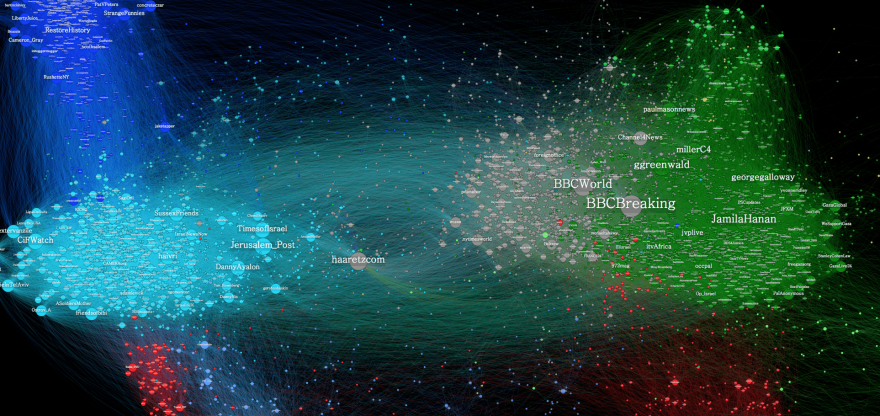
Gideon Lichfield captions the above image, which “depicts Twitter accounts that tweeted about the Israeli shelling of a UN school in Beit Hanoun on July 24th”:

The Twitter accounts are arranged according to how many connections they share; the closer two accounts are, the more accounts they both follow. The bigger the circle, the more followers that account has. What emerges from this is distinct groupings: “pro-Palestinian” in green on the right; “pro-Israel” in blue on the left. Lotan has colored most of the international journalists and media outlets in gray; they clearly have more followers among the pro-Palestinian side. The dark blue group in the upper left are American conservatives and Tea-Party types, while the lighter blue are Israeli media outlets and blogs, and American Zionist figures.