
Finding Grace In Outer Space

dish_nightsky

Mark Strauss surveys the various ways Christian theologians have considered the possibility of life on other planets, which ranges from panic to an affirmation that God extends his love even to aliens. Here’s one way to explain how the latter might work:

Assuming other beings are self-aware and capable of free will, the very idea of denying them salvation is at odds with the concept of a God who deeply loves his creations. Thomas O’Meara, a theologian at the University of Notre Dame, writes in his book, Vast Universe:

Could there not be other incarnations? Perhaps many of them, and at the same time? While the Word and Jesus are one, the life of a Jewish prophet on Earth hardly curtails the divine Word’s life. The Word loves the intelligent natures it has created, although to us they might seem strange and somewhat repellant. Incarnation is an intense way to reveal, to communicate with an intelligent animal. It is also a dramatic mode of showing love for and identification with that race. In each incarnation, the divine being communicates something from its divine life….Incarnation in a human being speaks to our race. While the possibility of extraterrestrials in the galaxies leads to possible incarnations and alternate salvation histories, incarnations would correspond to the forms of intelligent creatures with their own religious quests.

Meanwhile, Tina Nguyen notices that creationist Ken Ham, of debating-Bill Nye-fame, doesn’t think aliens exist, but that if they did they’re definitely going to hell. He explains his, uh, logic in a recent column:

Now the Bible doesn’t say whether there is or is not animal or plant life in outer space.  I certainly suspect not. The Earth was created for human life. And the sun and moon  were created for signs and our seasons—and to declare the glory of God.

And I do believe there can’t be other intelligent beings in outer space because of the meaning of the gospel. You see, the Bible makes it clear that Adam’s sin affected the whole universe. This means that any aliens would also be affected by Adam’s sin, but because they are not Adam’s descendants, they can’t have salvation. One day, the whole universe will be judged by fire, and there will be a new heavens and earth. God’s Son stepped into history to be Jesus Christ, the “Godman,” to be our relative, and to be the perfect sacrifice for sin—the Savior of mankind.

Jesus did not become the “GodKlingon” or the “GodMartian”!  Only descendants of Adam can be saved.  God’s Son remains the “Godman” as our Savior.  In fact, the Bible makes it clear that we see the Father through the Son (and we see the Son through His Word).  To suggest that aliens could respond to the gospel is just totally wrong.

(Photo of night sky at Yosemite by Waqas Mustafeez)
Raging Against The Small Screen

In a review of a recent show by Neutral Milk Hotel, Grayson Haver Currin griped that frontman Jeff Mangum’s no-photo policy for concertgoers plays like a cynical ploy:

Mangum is attempting to preserve the same legacy of an enigma that turned into a bankable career during his prolonged absence; in an age of instant information and updates, where what you had for breakfast becomes part of your digital identity, can you actually prove that you saw Neutral Milk Hotel without telling and showing your friends? … [T]he unexpected and unfortunate part … is that he’s dictating how those who actively fund him can interact with their own nostalgia, the exact thing he’s been preying on and profiting from for several touring years now. Mangum’s reluctance to be photographed seems less like a savior complex or a production concern than a brilliant financial ruse: If you can’t preserve this experience, then goddammit, you will have to pay for it again and again and again.

Judy Berman doesn’t follow:

I don’t think that logic holds up. If you’re the kind of person whose concert experience is made or broken by the ability to “preserve” it via Instagram, then what do you get out of repeatedly paying to see a band that will never, ever let you do that? If Mangum’s photo ban really were rooted in some master plan to exploit his fans’ memories, you’d hope he’d do a better job monetizing it. Where is the Neutral Milk Hotel Tour 2014 Official “Bootleg” Series? Where is the one band-affiliated photographer who will sell you his shots of each show, with a hefty percentage of the proceeds going right into Jeff Mangum’s pocket? Where are the dumb fan-exploitation schemes like this one?

She sees plenty of advantages in no-photo shows:

At most shows I’ve been to recently, especially the ones where the performers have a significant following, I’ve been practically surrounded by people who’ve had their phones out for the entirety of every set, constantly Instagramming and shooting videos and texting or Snapchatting all of it to their friends. I’m fully aware that you can’t criticize this shit in 2014 without seeming like an out-of-touch Luddite, but so be it. It’s a special kind of terrible to shell out money to see a band you love, only to realize you’ll be watching them through the iPad the guy in front you is holding over his head. I mean, is that dude’s right to spoil the show for me (and everyone else unlucky enough to stand behind him) more important than my right to a clear view of the performance I paid for?

(Video: Jeff Mangum performs an encore at MASS MoCA on February 16, 2013)

Obama’s Imperial Presidency?

Over the weekend, Douthat claimed that “the president is contemplating — indeed, all but promising — an extraordinary abuse of office: the granting of temporary legal status, by executive fiat, to up to half the country’s population of illegal immigrants.” Posner pushes back:

The executive branch spends a lot of time not enforcing laws. Congress has illegalized an enormous amount of activity without giving the president the resources to enforce the laws, so the executive has no choice but to make a list of priorities and devote its attention to law violations that, in its opinion, are the most serious. Thus, the IRS doesn’t audit paupers very often. The Justice Department ignores a lot of anticompetitive behavior that might raise prices a bit but not much. The DEA focuses on criminal syndicates rather than ordinary drug users, although both violate federal law. And so on.

Nearly all of this non-enforcement takes place with implicit congressional acquiescence; once in a while, Congress complains because the president’s priorities are not the same as its own. But the president has no obligation to listen to these complaints.

The Constitution gave him executive power while preventing Congress from compelling the president to act except by issuing the extreme and usually non-credible threat of impeachment. This is the separation of powers. People like Douthat wrongly think that separation of powers means that the president must do what Congress decides. That’s not the principle of separation of powers; that’s the principle of legislative supremacy, embodied in parliamentary systems like Britain’s, which America’s founders rejected.

Beutler finds Douthat’s crowing recklessly premature given that “we don’t know what Obama’s going to do”:

This tendency to assume the legal high ground follows naturally from a political strategy of playing up unilateral executive actions as evidence of presidential lawlessness. It’s tempting and convenient for conservatives to treat these as open and shut cases. But outside the right, it’s best to view their efforts as sophisticated attempts to work the refs rather than as judicious and conclusive interpretations of fact.

Drum weighs in:

As it happens, I think the current Republican obsession with presidential overreach is fairly pointless because their examples are so trivial. Extending the employer mandate might very well go beyond Obama’s powers, but who cares? It’s a tiny thing. Alternatively, the mini-DREAM executive action is fairly substantial but also very unlikely to represent any kind of overreach. Ditto for recent EPA actions.

Presidents do things all the time that push the envelope of statutory authority. To be worth any serious outrage, they need to be (a) significant and (b) fairly clearly beyond the scope of the president’s powers. I don’t think Obama has done anything like this yet, but if Republicans want to test that proposition in court, they should go right ahead. That’s what courts are for.

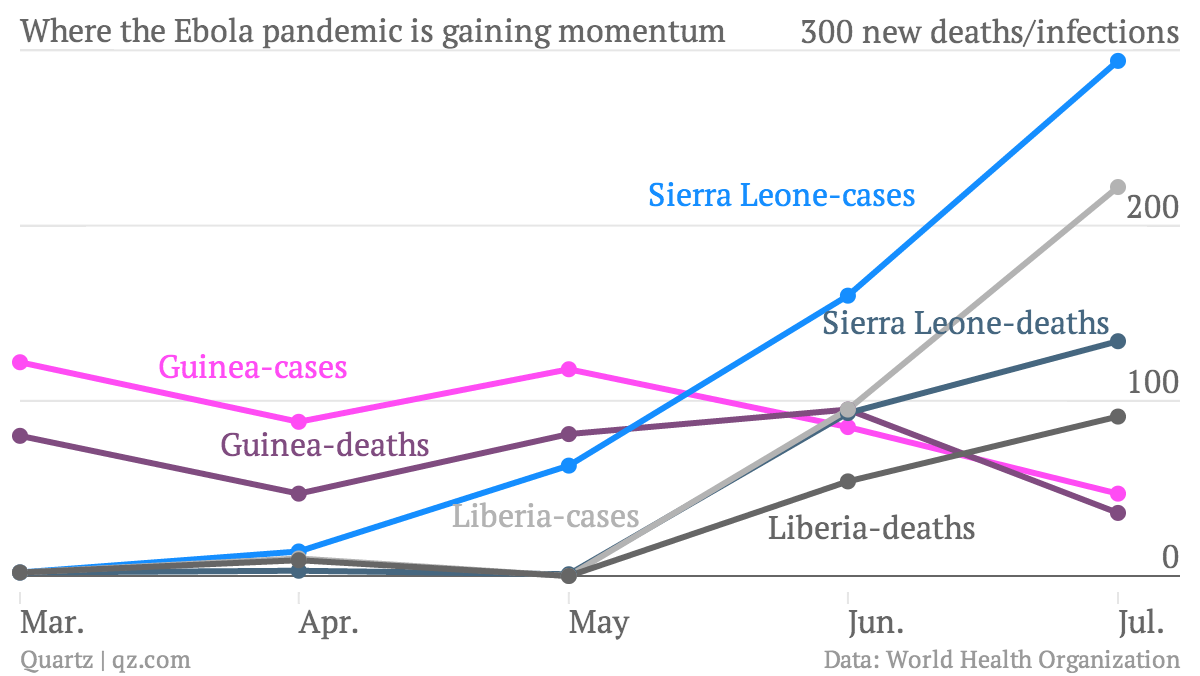
Why Is This Ebola Outbreak Different From All The Other Ones?

where-the-ebola-pandemic-is-gaining-momentum-guinea-cases-guinea-deaths-sierra-leone-cases-sierra-leone-deaths-liberia-cases-liberia-deaths_chartbuilder

Gwynn Guilford looks into it:

[A]s viral public health menaces go, Ebola should be easy to contain. Unlike airborne viruses like, say, swine flu, it’s not exactly sneaky. Ebola is spread only when infected bodily fluids come into contact with someone’s mucus membranes or open cuts. And it tends to broadcast the risk of infection pretty clearly; the symptoms include vomiting, diarrhea and, in some cases, hemorrhaging of mucus membranes. That made Ebola relatively easy to contain when it flared up in remote forests of central and eastern Africa, which are sparsely populated. But this new pandemic is a totally different story …

Why is that?

For one, Sierra Leone, Guinea and Liberia all have dreadful medical infrastructure. Sierra Leone has a single laboratory capable of Ebola testing. Earlier this week, Monrovia, Liberia’s capital, ran out of hospital space to quarantine Ebola patients. And that’s in its biggest city, where infrastructure is most robust. In other parts of Liberia, as well and in Guinea and Sierra Leone, hospitals simply aren’t available, according to data from Afrobarometer, a survey group.

Furthermore, Julia Belluz adds, a shortage of medical workers means many patients are not identified:

Ebola specialists believe one of the key reasons this outbreak has spread so far is because of the shortage of health-care personnel to deal with it: if you don’t have enough people on the ground doing the labor-intensive job of tracing the contacts of positive patients and ensuring they are identified before becoming ill too, each missed case is the new beginning of more human-to-human spread. Those missed cases are what worries Tarik Jasarevic, a World Health Organization worker on the ground in Guinea. He says that because of the geographic dispersal of the current outbreak—the demand for so many specialists in a relatively rare disease over several countries—mobilizing people and getting systems in place to care for everyone is problematic.

The doctors caring for ebola patients are also getting sick and dying:

Since the disease is transmitted through direct exposure to bodily fluids—from vomit to blood and sweat—health-care workers are advised to wear face masks, goggles, gowns and gloves while caring for patients. The trouble is, health workers in the developing-country context—especially those working in some of the poorest countries on earth, where the disease emerged this time—don’t always have access to this protective gear.

It’s important to note that they are also the ones who have died in this outbreak. Of the 60 deaths so far, none involved foreign workers (though two Americans are currently battling the virus, and one is a doctor). Foreign aid agencies such as Doctors Without Borders—which apply stringent precautions for all their health personnel—have never lost members of their teams to Ebola. So the problem this time is as much about size of the outbreak as it is about resources.

Putin’s Anti-Americanism

David Remnick captures how it has grown significantly during Putin’s time in power. Remnick talks at length with former US Ambassador to Russia Michael McFaul:

Although McFaul feels a deep sense of outrage about Putin, he also understood the mind-set of resentment and conspiracy. “I didn’t go to foment revolution,” he said. “I went to take the reset to the next stage. That was my mandate.” He added, “Obama people don’t sponsor color revolutions. Other Administrations had done this. Has the U.S. used covert operations to foment regime change? The answer is yes. I don’t want to get in trouble or go to jail, but has the U.S. supported the opposition to bring about political change? Serbia is a paradigmatic case: direct money to the opposition to destabilize things, and it was successful.” He also cited the overthrow of Mossadegh, in 1953, in Iran, and the support for the Nicaraguan Contras.

“Putin has a theory of American power that has some empirical basis,” McFaul went on. “He strongly believes this is a major component of U.S. foreign policy. He has said it to the President, to Secretary Kerry. He even believes we sparked the Arab Spring as a C.I.A. operation. He believes we use force against regimes we don’t like. . . . By the way, he damn well knows that the government of the Soviet Union used covert support. He worked for one of the instruments of that policy. He really does kind of superimpose the way his system works onto the way he thinks our system works. He grossly exaggerates the role of the C.I.A. in the making of our foreign policy. He just doesn’t get it. Or maybe he does get it and doesn’t portray it that way. I struggle with that: is he really super-clever and this is his psych op, or does he believe it? I think he does believe that we are out to get him.”

Dreher is most interested in Remnick’s “series of interviews with prominent Russian figures in Putin’s sphere.” One passage Dreher is struck by:

The world, for [Aleksandr] Dugin, is divided between conservative land powers (Russia) and libertine maritime powers (the U.S. and the U.K.)—Eternal Rome and Eternal Carthage. The maritime powers seek to impose their will, and their decadent materialism, on the rest of the world. This struggle is at the heart of history. For Dugin, Russia must rise from its prolonged post-Soviet depression and reassert itself, this time as the center of a Eurasian empire, against the dark forces of America. And this means war. Dugin rejects the racism of the Nazis, but embraces their sense of hierarchy, their romance of death. “We need a new party,” he has written. “A party of death. A party of the total vertical. God’s party, the Russian analogue to the Hezbollah, which would act according to wholly different rules and contemplate completely different pictures.”

In other Russian news, Ioffe finds it ironic that Russia is cracking down on any mention of Siberian self-determination:

All these months, Russia has been supporting Russian separatists in Crimea and eastern Ukraine, trumpeting the principle of self-determination. “The right to self-determination is formalised as one of the most important goals of the UN Charter,” said Russian foreign minister Sergei Lavrov before the Russian parliament. “As to Crimea, as you know, its autonomy was restricted several times in the past against the will of the Crimeans. After the armed coup by persons, who seized power in Kiev, actions were undertaken, which even more aggravated the possibilities of the Crimeans to exercise their right to self-determination within the Ukrainian state.”

But, in the Kremlin’s understanding, self-determination begins where Russia ends.

Did Snowden Tip Off Al-Qaeda’s Cryptographers?

The terrorist group and its allies appear to have changed their encryption systems in response to the Snowden leaks, according to a new report by the intelligence firm Recorded Future:

The report concludes that “it’s pretty clear” that there is an “increased pace of innovation in encryption technology by Al-Qaeda post Snowden.” The encryption, the report added, “is based on best practice, off the shelf, algorithms.” What’s more, the latest crypto tools follow other crypto programs terrorists have developed following the Snowden leaks. Recorded Future reported in May that three of the tools were created within five months of The Guardian first publishing the Snowden leaks in June 2013.

Though it’s not quite a “smoking gun”, Jazz Shaw urges anyone who thinks Snowden is an unmitigated hero to read the report:

None of this sounds terribly surprising and likely just serves as confirmation that the terrorists are keenly aware of international news headlines and respond to whatever information they can get accordingly. It’s also worth noting – as another analyst in the story mentions – that this isn’t absolute proof of a causal relationship between the two events. It’s possible that they just felt the software was long past due for an overhaul and would have done it anyway. But that’s relying awfully heavily on coincidence.

Of course, the real questions about the Snowden leaks go unanswered in this report. The fact that they upgraded their software is interesting, but what we still don’t know – and may never know, for obvious reasons – is how much other damage was done. How many agents had to be moved around or removed for protection? How many foreign informants supplying us with information were compromised, or simply disappeared? What opportunities were lost which our intelligence agencies clearly can’t talk about in public?

On the other hand, the jihadists’ new crypto might not make much difference:

Whatever the reason, [Bruce] Schneier says, al-Qaida’s new encryption program won’t necessarily keep communications secret, and the only way to ensure that nothing gets picked up is to not send anything electronically. Osama bin Laden understood that. That’s why he ended up resorting to couriers. Upgrading encryption software might mask communications for al-Qaida temporarily, but probably not for long, Schneier said.

“It is relatively easy to find vulnerabilities in software,” he added. “This is why cybercriminals do so well stealing our credit cards. And it is also going to be why intelligence agencies are going to be able to break whatever software these al-Qaida operatives are using.”

Patient Zero? Not So Fast

Dr. Kent Brantly, a US citizen who contracted ebola in Liberia, was evacuated to Emory University Hospital in Atlanta on Saturday for treatment in a special isolation unit. His colleague Nancy Writebol is also expected to arrive there this week. The usual suspects are busy fearmongering:

But Susannah Locke defuses fears:

Transmission of Ebola will be prevented using standard protocols, and health officials say that the two pose very little risk to the general public. Even if there were some terrible, unforeseen accident with one of these patients, Ebola wouldn’t be likely to spread very far. First, Ebola doesn’t jump from person to person through the air, but through close contact by touching bodily fluids such as sweat, vomit, or blood. The outbreak in West Africa is so severe for a number of key reasons, including a lack of resources, inadequate infection-control measures, and mistrust of health workers. The United States, by contrast, has far better public-health infrastructure. And that makes all the difference.

And Emory is taking every precaution to ensure that those fears aren’t realized:

[Dr. Bruce Ribner, the head of the unit,] went on to explain that Emory would be providing what he called “supportive care,” which consists of “carefully tracking a patient’s symptoms, vital signs and organ function and taking measures, such as blood transfusions and dialysis, to keep him or her as stable as possible.” “We just have to keep the patient alive long enough in order for the body to control this infection,” he explained. In the meantime, Brantly and Writebol will be separated from healthy people by a plate-glass window, and communication with non-medical personnel will mostly happen via intercom and telephone.

So, for now, it seems that Donald Trump and those who share his concerns don’t have much to worry about. At the very least, it seems that the people in charge of handling Ebola’s new American presence are being significantly more careful than the CDC was with that anthrax.

Kent Sepkowitz outlines the logic behind the evacuation:

[W]ith the move, the CDC, or whoever made the decision, is betting that high-tech American care using Ebola-inexperienced medical staff is better than not-so-high-tech care with remarkably experienced staff. This high-low discordance often is seen in tropical medicine. For example, many are taught in medical school that the best place to be treated for severe malaria is not the tertiary care medical palace on the American hill where a case is seen every year or two but the run-down clinic in the local country where malaria is as common as a stubbed toe and the staff knows every trick of the trade.

For Ebola treatment, though, I suspect the decision is correct: Writebol and Brantly are better off here. Much about the disease and its related conditions, called collectively the “viral hemorrhagic fevers,” is not well studied for the very reason a patient is being flown home. The resources simply are not available to articulate and record, to take extra blood, and to perform additional X-rays—all necessary to fully define any disease.

SAD In The Summer

Seasonal Affective Disorder also strikes in the warmer months. Olga Khazan outlines the possible reasons why:

One recent study suggests summertime SAD is caused by allergies, with people reporting worse moods on days the air was thick with pollen. Another theory is that the intense summer light is just as disruptive as winter’s long, cold nights. People might be staying up later in the summer, suspects Alfred Lewy, a professor of psychiatry at Oregon Health and Science University, thus throwing their body clocks for a loop. He told NBC News that he treats summertime SAD patients by suggesting they get early-morning sun and take melatonin, a hormone that promotes sleep. …

And then there’s the simplest explanation: People just can’t stand the heat. Thomas Wehr, a scientist emeritus at the National Institute of Mental Health who first documented SAD, says that when people with warm-weather depression were “wrapped in cooling blankets at night, their temperatures dropped and their symptoms disappeared. As soon as they went outside into the summer heat, their depression returned.”