
A woman performs during a parade in honor of The Savior of the World, patron saint of San Salvador city, El Salvador on August 1, 2014. By Jose Cabezas/AFP/Getty Images.
A woman performs during a parade in honor of The Savior of the World, patron saint of San Salvador city, El Salvador on August 1, 2014. By Jose Cabezas/AFP/Getty Images.
Michael Specter puts the latest outbreak in perspective:
Ebola is truly deadly, but the many lurid headlines predicting a global pandemic miss a central point. In its epidemic reach, Ebola is often compared with H.I.V. But they are nothing alike. H.I.V. has killed at least thirty million people, mostly by spreading quietly, burrowing into the cells it infects, and then, at times, lurking for years before destroying the immune system of its host. Ebola’s incubation period is between two and twenty-one days long. The virus kills rapidly. There is nothing insidious about it.
Ebola won’t kill us all, but something else might. Like everything living on Earth, viruses must evolve to survive. That is why avian influenza has provoked so much anxiety; it has not yet mutated into an infection that can spread easily. Maybe it never will, but it could happen tomorrow. A pandemic is like an earthquake that we expect but cannot quite predict. As [Spillover author David] Quammen puts it, every emerging virus “is like a sweepstakes ticket, bought by the pathogen, for the prize of a new and more grandiose existence. It’s a long-shot chance to transcend the dead end. To go where it hasn’t gone and be what it hasn’t been. Sometimes the bettor wins big.”
He’s right, of course, and it is long past time to develop a system that can easily monitor that process. If we don’t, the next pandemic could make Ebola look weak.
Three experts in disease control combat bad reporting on Ebola:
The desire of the international media to attract viewers has led some careless journalists to focus almost exclusively on the fear-invoking mode of death from the disease. While it may increase their ratings, it lets the real culprits off the hook. Limited health infrastructure, insufficient numbers of trained health workers, too few fully equipped labs, and not enough education and preventative epidemiology are the sad realities that push this scourge on. The image of a victim coughing up blood creates stigma instead of engaging international viewers with the true and preventable human tragedy in these communities. It also distracts from one of the more disturbing facts associated with this outbreak, which is how wealthy communities feel content to live in a world where society spends more on eliminating wrinkles than with basic health infrastructure that could, among many other things, help quench an outbreak like the one we’re currently experience in West Africa.
Kliff covers attempts to create a vaccine:
[Professor Daniel] Bausch says that the obstacle to developing an Ebola vaccine isn’t the science; researchers have actually made really great strides in figuring out how to fight back against Ebola and the Marburg virus, a similar disease.
“We now have a couple of different vaccine platforms that have shown to be protective with non-human primates,” says Bausch, who has received awards for his work containing disease outbreaks in Uganda. He is currently stationed in Lima, Peru, as the director of the emerging infections department of Naval Medical Research Unit 6.
The problem, instead, is the economics of drug development. Pharmaceutical companies have little incentive to pour research and development dollars into curing a disease that surfaces sporadically in low-income, African countries. They aren’t likely to see a large pay-off at the end — and could stand to lose money.
Amy Davidson finds Netanyahu’s answer to that question deeply unsatisfying:
It would be a simple thing, Netanyahu suggests, for Palestinians to listen to the I.D.F.’s warnings—which come in the form of text messages and announcements and admonitions not to let someone Israel might target live in one’s home—and go. Civilians die, according to this logic, because they didn’t listen to Israel; they listened to Hamas. But there are not “plenty of places” that are safe; there may not be any.
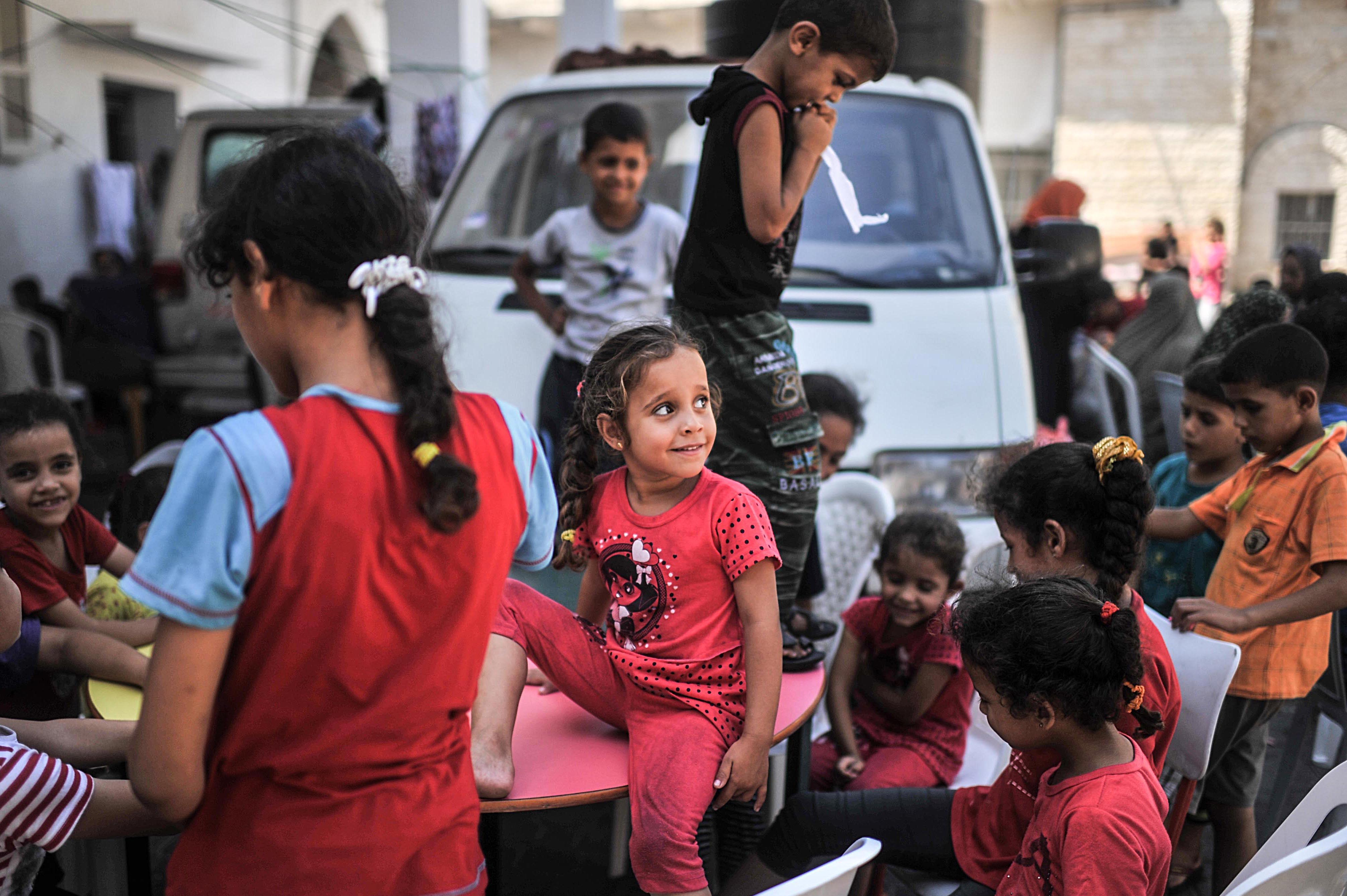
There is, one would think, a special obligation for Israel to take care about the people in the shelters, because those children had gone where it sent them. What sort of calculus is involved in leaving one’s own home for a shelter that might still be hit, or maybe for one of the multigenerational homes in Gaza—where, perhaps, there’s also a second cousin who has something to do with Hamas? Does knowing that you are in danger put all of the burden on you? Does it make you the culpable one if you can’t, or don’t, get away? It may be practical to become a refugee—even to leave Gaza, if one can—but it’s not a gift or, necessarily, a credit to the one who warned you to go. And if Hamas is “making sure that they don’t go anywhere,” what use—practically or morally—are the warnings, not only to the Palestinians but to the Israelis who look to them for reassurance?
The warnings are a form of absolute self-absolution for the slaughter of children that will follow – let alone the unimaginable trauma that so many have experienced that will haunt and cripple them for life. Nothing Israelis are experiencing even comes close to this trauma. It defies any human being who sees it not to feel utter bewilderment at a country that carries on this bombardment from the vantage point of utter moral superiority. Do they not see the cruelty? The utter imbalance of power? Have they lost any human bearings?
Needless to say, the UN is furious at Israel for Wednesday’s shelling of an UNRWA school where 3,000 Gazans had sought shelter:
[U.N. Secretary-General Ban Ki-moon] said that the United Nations had provided Israeli military authorities with the precise location and coordinates of the shelter 17 times during the conflict, including a few hours before the attack. Ban’s deputy secretary-general, Jan Eliasson, said that the United Nations found mortar fragments from Israeli shells at the scene of the strike that pointed to Israeli responsibility. “They were aware of the coordinates and exact locations where these people are being sheltered,” Ban said. “I condemn this attack in the strongest possible terms. It is outrageous. It is unjustifiable. And it demands accountability and justice.”
The remarks were uncharacteristically harsh for the U.N. chief, who has been working closely with Israel, the Palestinians, the United States, and other foreign leaders to hammer out a cease-fire plan that would guarantee Israel’s security while relieving the plight of Gazan civilians, who have borne the brunt of suffering in the conflict.
Washington, meanwhile, somehow managed to condemn the shelling without blaming Israel for it:
“The United States condemns the shelling of a UNRWA school in Gaza, which reportedly killed and injured innocent Palestinians – including children – and UN humanitarian workers,” the White House said. “We are extremely concerned that thousands of internally displaced Palestinians who have been called on by the Israeli military to evacuate their homes are not safe in UN designated shelters in Gaza. We also condemn those responsible for hiding weapons in United Nations facilities in Gaza. All of these actions, and similar ones earlier in the conflict, are inconsistent with the UN’s neutrality. This violence underscores the need to achieve a cease-fire as soon as possible.”
Beauchamp tallies the mass displacement that has resulted from the conflict:
About a quarter of the population of the Gaza Strip may have been displaced during the ongoing fighting between Israel and Hamas, according to a United Nations Office for the Coordination of Humanitarian Affairs (OCHA) tally. That is very, very bad — both in humanitarian and political terms. ….
This matters even beyond the immediate dangers and pains of displacement; after the fighting stops, it’s not just a matter of putting displaced persons back in their homes. For one thing, their homes might be destroyed. But even for those whose homes are intact, returning may not be so simple. Patricia Weiss Fagen, a former senior fellow at Georgetown’s Institute for the Study of International Migration, writes that displaced persons “lacked safety, economic opportunities, and essential services” and “may continue to live as strangers and second-class citizens even when they return to their original homes.” The upshot, according to Fagen, is that long-term relief efforts, and not just short-term humanitarian aid, are necessary to help refugees.
(Photo: Palestinian children taking shelter in Salahaddin school in Gaza City are seen on July 31, 2014. Nearly 1900 Palestinians, who escaped from cities of Shujaya and Beit Hanoun under heavy Israeli shelling, live in Salahaddin school. By Onur Coban/Anadolu Agency/Getty Images)
Argentina: default? What default? ARG USD Discount bonds near 1yr highs pic.twitter.com/kv9D0CVrna
— Bond Vigilantes (@bondvigilantes) July 31, 2014
Yesterday, the South American country went into default for the second time in 13 years:
The country’s previous default, when it reneged on $81 billion in debt in 2001, is the source of its latest one. Most of its creditors exchanged their defaulted debt for new securities in two restructurings that took place in 2005 and 2010. But a few creditors took a different path. They scooped up the cheap defaulted debt in order to chase payment of full principal plus interest in the New York courts, under whose law the original bonds were written.
Led by NML Capital, a hedge fund, a group of these hold-outs – [Argentine minister Axel] Kicillof and his boss, President Cristina Fernández de Kirchner, prefer the term “vulture” funds – won an order barring Argentina from paying its exchange bondholders unless it also coughed up the $1.3 billion plus interest they wanted. That meant Argentina either had to deal with the hold-outs or stop paying the exchange bondholders, and thereby tip into default again. The Argentine government refused even to meet the hold-outs in person until July 29th, the day before a grace period on a payment to exchange bondholders expired.
Tim Fernholz finds plenty of blame to go around:
If the vulture funds had exchanged their bonds earlier, they would have made a decent profit and saved us all this mess—but there’s no law saying they had to do that. If global finance hadn’t integrated the world’s economies, Argentina wouldn’t have suffered from capital flight – but it wouldn’t have had access to capital to begin with absent that system. If Judge [Thomas] Griesa hadn’t issued his controversial order, the holdouts contracts would be unenforceable – but it will be harder for any sovereign to borrow money if lenders fear they can’t collect. And if Argentina’s various regimes hadn’t made economic policy mistakes or had simply been more pragmatic, this whole situation might never have arisen – but it’s their citizens, and likely not the leaders themselves, who will pay the stiffest price.
But Salmon isn’t too sure about that:
[A]s for the ordinary Argentine citizen, well, there’s a lot of inflation and unemployment and black-market foreign-exchange trading going on, but that’s been true for years, and it’s far from clear how much – or even whether – the default is going to exacerbate such things. Indeed, Argentina is in pretty good financial shape right now. Both the country and its corporations have relatively little debt, which means relatively little problem rolling it over. Bank deposits are stable. The exchange rate doesn’t seem any more fragile than it has been for months. Foreign reserves have actually been going up in recent weeks. In terms of day-to-day financial life in Argentina, today looks almost identical to yesterday. Nothing much has really changed.
Meanwhile, Robert Kahn looks forward:
Negotiations will continue, and there will continue to be talk of a possible deal that would end the default, including a plan where local banks buy the debt and sell it to the government. I’m deeply skeptical. Over the last 10 years, Argentina essentially has not budged from the position that holdouts would get no better deal than those that restructured. As the court cases went against them, that offer became less and less attractive to the creditors, the courts became more resistant to stays and other rulings to protect Argentina, and the gap between the parties became so vast that it is hard to imagine any side caving now. Indeed, the political cost within Argentina of the government now paying off the holdouts seems extraordinarily high, suggesting that we may need a new government before a negotiated solution is possible.
G-d might be meant to illustrate that voice of the people-the vox populi. In this case, G-d had demanded that Saul (or the “prime minister”) enter into battle with the Amalekites (Hamas and its savage partners) and destroy them utterly even if that means to the last child, cow and goat. As cruel as this appears, it is a lesson that teaches a nation in terrible danger that it has a legitimate obligation to put a definite end to a substantial threat. The end of such a conflict must make it impossible for that enemy to rebuild and continue to vex one’s nation forever.
“We’ve all watched as the tiny state of Israel, who is with us on everything, they have had in the last three weeks 3,000 rockets filed into their country … Our number one ally — at least in my mind — is under attack,” – Harry Reid. My italics.
Here’s one from the AP at 6 am, July 29:
As much of world watches Gaza war in horror, members of Congress fall over each other to support Israel: http://t.co/DepO2etLQS — The Associated Press (@AP) July 29, 2014
Five hours later:
Many U.S. lawmakers strongly back Israel in Gaza war (revises wording in this @AP tweet: http://t.co/RZs5dh0m2L ): http://t.co/OvBKx75U6Z — The Associated Press (@AP) July 29, 2014
Jay Rosen sighs:
The original header produced the news well enough but it failed to produce enough innocence for the AP. “Many U.S. lawmakers strongly back Israel…” is not more true than “they fall over themselves.” But it is more innocent. When the switch is made the AP feed suffers a loss of vivid. Its colors wilt. There is less voice, less urgency in the language. And the AP willingly pays this cost.
And the contrast between the entire world, including the US public, and the Congress is indeed a startling one. There are countless debates going on about the Gaza war in America and around the world – on the web, across dinner tables, in schools and colleges, on vacations, in offices and even on Fox News. Everywhere, in fact, but in one place: the Congress, where, in a polity divided bitterly down the middle on almost everything, there is unanimity that Israel can never do any wrong, and that the US must support Israel under every conceivable circumstance. They cannot manage to extend unemployment benefits, they cannot pass basic infrastructure spending, they cannot deal with a refugee crisis on the border, but by unanimous consent, they agree to increase funding for Israel’s Iron Dome. They seem far more solicitous of the needs of a foreign country than of their own. And when the greatest deliberative body on the face of the earth is less open to debate than the world’s top boy band, something is wrong with our democracy.
Pointing this out is not bias; it’s essential. It’s essential because it reveals a deep rot in our deeply unrepresentative government, distorted in this as in many other instances, by the toxic, undemocratic influence of a moneyed lobby.
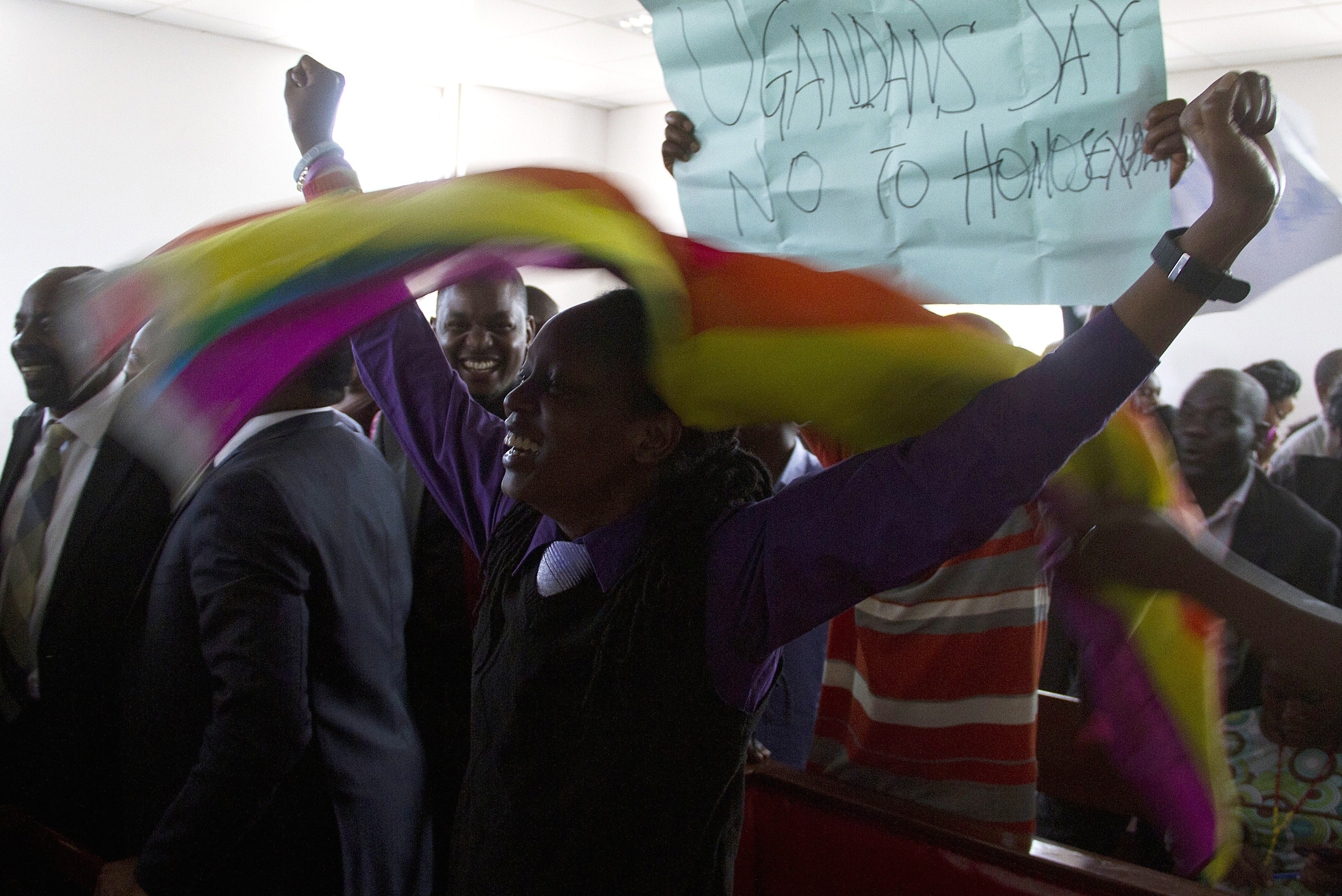
Uganda’s Constitutional Court has nullified the notorious Anti-Homosexuality Act, in a move widely viewed as a victory for the country’s gays:
Maria Burnett, a senior researcher in the Human Rights Watch’s Africa Division, said in a written statement that Friday’s decision was a “critical step forward” for LGBT rights. “We are pleased that this law cannot be enforced and entrench further abuses and discrimination.” Neela Ghoshal, another senior researcher with the HRW, tells Vox that the LGBTI community in East Africa is currently “breathing a huge sigh of relief” because of Friday’s rulings. “That law has cast a shadow over every LGBTI activist and ordinary person’s lives in Uganda and the wider region for the past six months. Now, there’s a sense a space for LGBTI people has opened up.”
Mark Joseph Stern reacts with cautious cheer:
The legal triumph of the ruling was tempered somewhat by the fact that the court did not rule on the merits of the case.
Rather, the judges held that parliament had not reached a quorum when the bill was passed, a technicality that renders the law a nullity. The ruling, then, is obviously problematic, as it implies that if parliament simply re-passes the bill with the requisite quorum, it might be constitutionally valid.
Still, the petitioners who brought the case, including journalist Andrew Mwenda, were celebrating a total victory on Friday, declaring the measure “dead as a door nail.”
But Capehart emphasizes that Uganda remains a difficult place to be gay:
Now that the “anti-homosexuality” law has been tossed, the penalty of 14 years for a first-time offense and life imprisonment for those convicted of “aggravated homosexuality” is gone. So is the threat of arrest for “promoting homosexuality” or not reporting a gay or lesbian person to the authorities. But a colonial-era law that criminalizes gay sex remains on the books. And as Ty Cobb, director of global engagement for Human Rights Campaign, said, “Uganda’s Parliament could seek to once again further enshrine anti-LGBT bigotry into its nation’s law.”
Elias Biryabarema believes the move will probably boost Uganda’s standing in the world, and its economy:
The World Bank and some European donors – Norway, Denmark and the Netherlands – withheld aid or loans worth more than $118 million. Sweden resumed financial support to Uganda this week. Uganda relies on aid to fund about 20 percent of its budget. The Ugandan shilling came under pressure when the law was passed. On Friday, it rose, with banks cutting long dollar positions on expectations of a resumption in aid. …
The United States, Uganda’s biggest donor, [had] called the legislation “atrocious”, likening it to anti-Semitic laws in Nazi Germany and apartheid in South Africa. When it was passed, Washington said it would review relations with Kampala. Ugandan President Yoweri Museveni is scheduled to travel to the United States next week for a summit of African leaders hosted by U.S. President Barack Obama.
(Photo: Ugandans react to the announcement that the Constitutional Court has overturned anti-gay laws in Kampala on August 1, 2014. By Isaac Kasamani/AFP/Getty Images)
A mysterious Syrian defector known only as “Caesar” testified to Congress yesterday that he had documented the torture and murder of 11,000 people by the Assad regime, and that 150,000 more were currently imprisoned and facing the same fate:
After spending two years meticulously documenting the systematic torture and murder of thousands of men, women, and children, he carefully planned his escape with the photos and the files that accompany them. The FBI is near complete in its effort to verify them, increasing their evidentiary value for future war crimes prosecutions. “I saw pictures of young children and the very elderly as well, and pictures of women. Sometimes I would come across the pictures of some of my own neighbors and people that I recognized. I was horrified but I would not tell them the fate of their children,” out of fear of the regime’s retaliation, Caesar sad. “My religion did not allow me to be quiet about these horrendous crimes that I have seen.” …
International war crimes prosecutor David Crane, who led the first large research project looking at the Caesar photos, said that the atrocities evoked memories of the Holocaust, a sentiment expressed last month by the State Department’s Ambassador-at-Large for War Crimes, Stephen Rapp. “We rarely get smoking gun evidence in my business… but what we found was just that,” said Crane. “The photos show crimes the likes of which we have not seen since Auschwitz.”
Some of Caesar’s gruesome photos can be viewed here. One example after the jump:

John Hudson suggests that Caesar’s testimony is part of a renewed effort to drum up support for US intervention in Syria:
Supporters of the Syrian opposition in Washington hope that the gruesome images will catalyze efforts to boost U.S. military support for Syria’s moderate opposition. The briefing was in part facilitated by the Coalition for a Democratic Syria, an umbrella group that lobbies for additional U.S. support to the rebels. “This brings it to a whole new level,” Oubai Shahbandar, an advisor to the Syrian Opposition Council, told Foreign Policy after the briefing. “This is genocide with a capital ‘G.’ You can’t ignore this. You can’t say there are no good options. We have rows and rows and rows of naked emaciated bodies.”

Oxford, England, 10.45 am
 The Dish