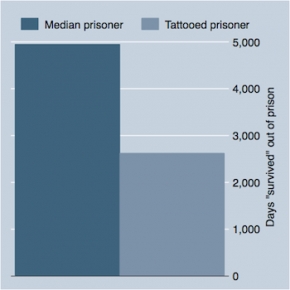
Research finds that “someone lasts 5,000 days (about 14 years) before finding themselves back in the cooler,” but “a tattooed ex-con lasts half that”:
[Researcher Kaitlyn] Harger compares people with different types of tattoos:
those that can easily be seen, and those that cannot. People with tattoos on the face, head, neck or hands go back to prison 714 days earlier than other tattooed ex-offenders. Having a visible tattoo is the real problem for employers.
What’s the cost of all this to the hard-pressed American taxpayer? Uncle Sam pays roughly $30,000 a year to house one prisoner (though this figure varies wildly from state to state). About 600,000 prisoners are released each year, 70% of whom have tattoos. Tattooed types return to prison earlier: that translates into an extra cost of $5.5 billion per year (a little less than the budget of the Federal Prison System, which houses 200,000 prisoners). Tattoo removal can cost thousands of dollars. Even so, free removal for every prisoner would be sensible economics.
Update from a reader:
As you have often pointed out, correlation does not equal causation. The data in Kaitlyn Harger’s research might lead one to assume that face tattoos are causing a higher rate of recidivism. I suspect that the reverse is true. Face tattoos are very common in gangs. The recidivism rate for gang members is high because they go back to that life when the get our of prison. Tattoo removal will not wipe away all of their connections and affiliations. They are not career criminal acts because they have face tattoos; they have face tattoos because they are career criminals.

