Readers keep the submissions coming:
A few years ago when my grandpa died, the caretakers told us, “His vitals are absent.” It took a couple more minutes of conversation for us to realize they meant “he died”.
Another:
I don’t know if this qualifies as “disguising the core reality“, but the phrase that was uttered while I was giving birth to my daughter was “non-reassuring fetal heartbeat”. I had a C-Section six minutes after I first heard it. Perhaps the emotion of the moment makes it rankle more that it ought to, but it just sounds like BS, and when I repeat it, it’s always in the slick voice of a TV ad announcer. “Do you suffer from embarrassing bouts of poorly timed non-reassuring fetal heartbeat? Then you should try … “
But another reader has sympathy for such cases. He quotes a previous reader:
While visiting a friend in a mental hospital, I witnessed a grieving husband ask a doctor about the long-term prognosis for his suffering wife. All the doctor could do was prattle on about the different “medicinal modalities” (i.e. drugs) they were utilizing to try to stabilize her. As the husband looked on helpless and dumbfounded, I wanted to punch the doctor.
Jargon can be off-putting, obfuscating, and infuriating for the layperson. But for the user, jargon can be a source of comfort and a delayer to give time when one doesn’t know what to say or how to frame bad news. I certainly don’t know if the above physician was obtuse or just unsure of how to proceed. In the moment, we certainly must sympathize with the patient and her family. Stepping back, it doesn’t hurt to realize that the doctor may deserve some empathy as well.
(Just subscribed, btw. I love the Dish and I’m glad to be in a position to support it now!)
Others turn to Orwellian language in the environmental realm:
Here’s one for you: “incidental take” – basically the “collateral damage” of the wildlife world. It’s a term used in a wide variety of state and federal contexts, most notably in regulations governing the U.S. Endangered Species Act and the Marine Mammal Protection Act (see here or here for examples), to refer to the “unintentional, but not unexpected” killing or injury of an endangered species, say, by cutting down a forest where an endangered bird lives or draining a wetland which is also home to an endangered frog. You get the gist.
Another reader:
From the obscure world of cleaning up Superfund hazardous waste sites (where I spend my time when not reading the Dish), I offer my favorite Orwellism. It’s called “monitored natural attenuation” which is gov-speak for “we’re not going to do anything.”
Mind you, doing nothing at a Superfund site is not necessarily a bad thing. Heavily contaminated sites are hideously complicated and expensive to clean up, and sometimes when the contaminant has spread deep into the ground or laterally beneath a building or a water body, there are simply no feasible means to go after it. And often, the contaminant isn’t doing any harm to people or animals anyway. The Superfund process even has a formal requirement to examine the “No Action Alternative” when selecting a remedy for a site.
But of course, no one wants to acknowledge that they’re not going to to anything, and it is nearly unheard of for the No Action Alternative to be chosen. Thus the need to rebrand inaction. The “natural attenuation” phrase refers to the hope that if the problem is ignored it will go away by itself. As you might suspect, this is seldom the case.
Another:
I wish I had a photo of the nasty square of fenced-in dirt – no bigger than 10’X10’ – at a campground in northern California. This prison-like “amenity” was (and perhaps still is) called the “Dog Freedom Area.”
Another looks to the farm at length:
I would like to nominate some more Orwellian terms. First are “cage free” and “free range.” These terms are designed to invoke images of idyllic pastures but such operations are almost always giant sheds crammed with animals living in their own waste, and the burning ammonia that that waste produces. There is a small trap door at one end that is sometimes unlocked for a short period; it leads to a small outdoor cage. Very few of the inmates will ever step out into that cage, but they are “free range” because they technically had “access” to the outdoors. Chickens held in such facilities, either for meat or eggs, have their beaks partially burned off so they do not harm each other in the overcrowded conditions. Other animals may have their tails cut off so they don’t get chewed due to overcrowding. Almost all animals from “cage free” and “free range” facilities never see the sky or set foot on natural earth. Their lives are non-stop torture. Here is an excellent short video of Jonathan Safran Foer talking about the “lie” of the term “free range”; here is a quote by him in the NY Times:
“Free range,” “cage free,” “natural” and “organic” are nearly meaningless when it comes to animal welfare.
It doesn’t get much more Orwellian than the terms “cage free” and “free range.” “Grass fed” is another Orwellian term from the animal agriculture industry. It means that an animal was fed grain (usually corn). Yes, the opposite of what one would expect. The animals start on grass and are “finished” (fattened) on grain. The grass-fed part may be in a pasture or in a CAFO; the grain-finished part is almost always in a CAFO. From a beef producer:
. . . grass fed is currently being used in reference to any animal that . . . was fed a grass-based diet prior to grain finishing . . . .
Orwell would be especially proud of the meat, egg, and dairy industries.
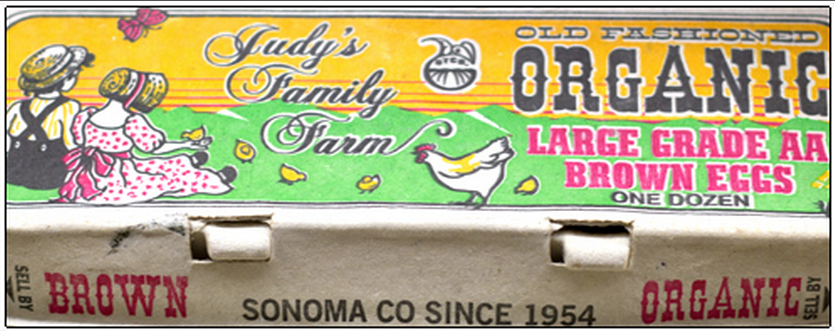
If you would like some Orwellian graphics, see this law suit. From the egg carton at issue:
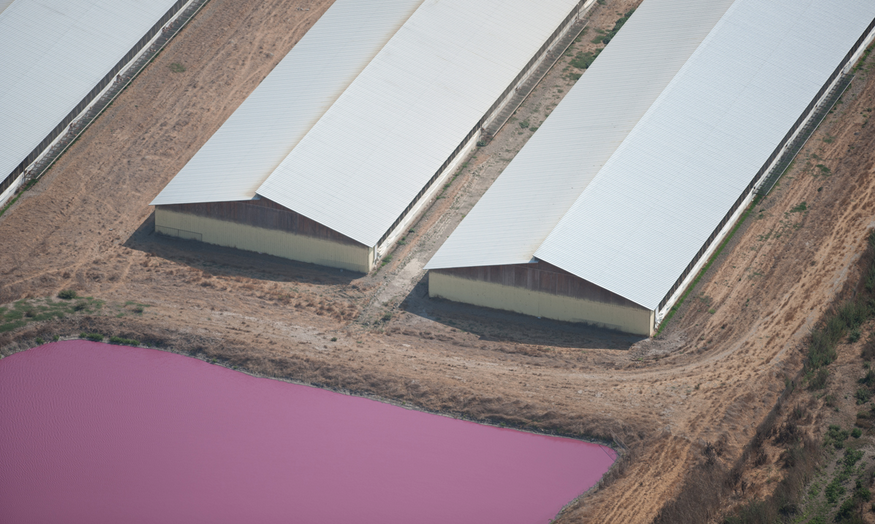
A picture of the sheds (“farm”) where the hens are held:
The egg company settled the case, agreeing to change its advertising and pay a fine. It put a statement on its website:
We would like to take a moment to respond to the controversy surrounding some of our egg cartons. As you may know, an Animal Legal Defense Fund member is suing us, claiming that we have misled consumers into thinking our eggs were produced in open pastures because our carton depicts a boy and girl on the carton interacting with a hen and some of her chicks. The boy and girl were drawn in an outdoor setting, so their claim is that we are somehow telling our customers that all of our hens are raised outdoors.
The cover on our organic egg carton is an artist’s interpretation of us growing up on poultry farms. . . .
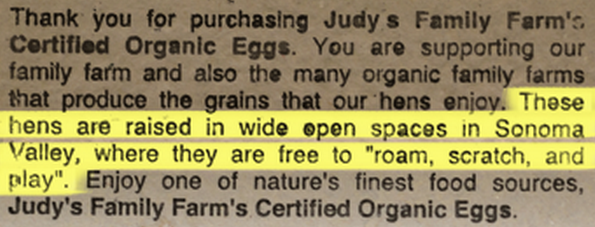
The inside of the carton also says that our hens are free to scratch, roam and play in wide open spaces. Steve wrote this when we created the carton in 1996. Steve is a farmer, not a technical writer, and he was making the comparison between caged birds and our cage free hens . . . .
. . . this lawsuit claims that all of our customers have been duped into thinking that the eggs were produced outdoors and wouldn’t have purchased them otherwise. We wholeheartedly disagree. We believe our customers are more intelligent than that . . . .
We strongly believe our customers are intelligent enough to understand the statements on our egg cartons, and to appreciate the cage free environment in which we house our hens . . . .
Their customers are too smart to fall victim to their deceptions. That’s why they buy their eggs. I think they make Orwell proud. The Cornucopia Institute’s Egg Scorecard (based upon best practices and ethics) gives this company a zero out of a possible 2200 points. This producer is very typical of organic, cage-free egg companies; it just had the misfortune of being in the same region as the Animal Legal Defense Fund’s headquarters.
The reader follows up with more:
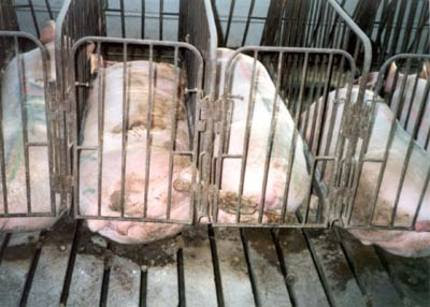
The pork industry uses the term “Individual Maternity Pens”:
Individual maternity pens (IMP) house sows during the most vulnerable duration of their pregnancy. IMPs protect sows from other animals.
Sort of sounds like a nice private room at a hospital. This is what they look like:
This is what the National Pork Producers Council said about them: “So our animals can’t turn around for the 2.5 years that they are in the stalls producing piglets. I don’t know who asked the sow if she wanted to turn around….”