Face Of The Day

Steven_Laxton_04

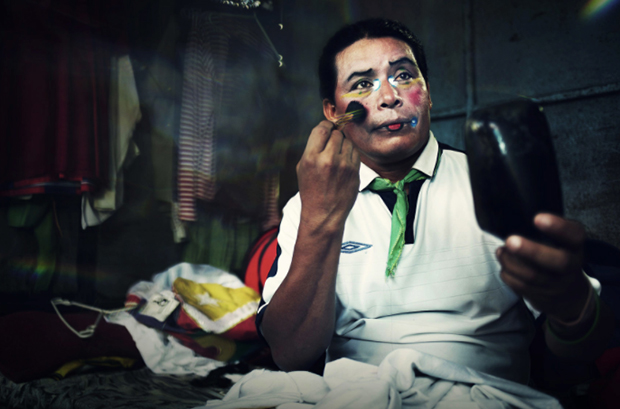
In an interview about his series Circo El Salvador, Steven Laxton describes his inspiration for a project that “captures the magical moments behind the scenes of El Salvador’s traveling circuses”:

I was looking for a new personal series, something with depth that interested me and would also lend itself to my personal style and technique. Over dinner a friend was raving about these gypsy circus families. I expressed interest, so he invited me down. I booked my tickets not really knowing much about them and not even having seen a photo of them.

I went to El Salvador the first time for three weeks on a mission to find and possibly photograph these circuses. As they have no fixed address and no travel itinerary or contact info, they were very hard to find. They literally move on a whim. I was about to go home without even seeing, let alone photographing, a circus. The day before I flew out, our detective work payed off, and I found one. As soon as I saw it, I knew I was going to come back as soon as possible and make it my next project. I loved what I saw: humble yet beautiful artists. It seemed to resemble what I imagine the gypsy circuses of yesteryear in Europe would have been like.

Check out other photographs from the series here. For more of his work, see Laxton’s website here or follow him on Instagram and Twitter here and here.

It’s A Hard Smock Life

BFAMFAPhD_ArtistsReportBack2014-8-1

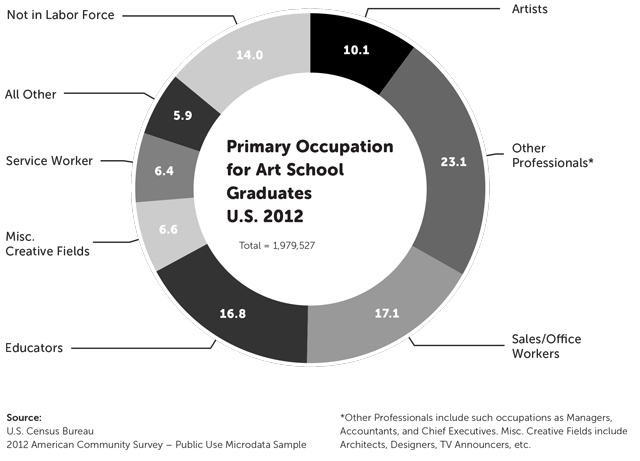
A new analysis of Census Bureau data indicates that art students have a mere 1-in-10 chance of becoming working artists. And that’s not all:

Most surprising was the lack of overlap between working artists and arts graduates. In the United States, 40 percent of working artists do not have a bachelors degree in any field. Only 16 percent of working artists have arts related bachelors degrees. Though arts graduates may acquire additional opportunities and skills from attending art school, arts graduates are likely to graduate with significant student loan debt, which makes working as an artist difficult, if not impossible. … Although there are 1.2 million working artists over the age of 25 in this country, there are only 200,000 working artists with arts-related bachelors degrees. The majority of working artists have median earnings of $30,621, but the small percentage of working artists with bachelors degrees in the arts  have median earnings of $36,105.

But Alexis Clements is skeptical:

Most reports about artists that I’ve seen (and I’ve seen a fair number) that are based on quantitative data are pretty fuzzy when it comes to the thing that many artists would love to know: How much money do artists make from their creative work?

Why is the data so imprecise? Because almost everything about the ways that artists work seems to defy typical practices for collecting labor and earnings statistics. By and large, it appears that labor statistics, like the ones collected in the American Community Survey, generally assume that most workers have a single or primary job that provides the largest share of their earnings and that job is comprised of a bounded set of tasks or modes of earning money — for example, if you say you are an auto mechanic, the assumption is that you earn most of your money fixing cars. But as many artists know, when you say you’re an artist, how you earn your money can and often does come from a wide array of sources — it could be sales or commissions, it could be royalty payments, fees for presenting work, or teaching in various forms, which many artists lump into their occupation as an artist. … All of this makes it really tough to understand what income really means for an artist when you’re trying to isolate their artistic earnings.

(Image from Artists Report Back: A National Study on the Lives of Arts Graduates and Working Artists)

Why Women Belong On Mars

dish_marspic

Last year, Kate Greene and five teammates simulated living conditions on Mars for a NASA-funded project (the experiment actually took place on a volcano in Hawaii). What she noticed while collecting and managing data:

Week in and week out, the three female crew members expended less than half the calories of the three male crew members. Less than half! We were all exercising roughly the same amount—at least 45 minutes a day for five consecutive days a week—but our metabolic furnaces were calibrated in radically different ways. During one week, the most metabolically active male burned an average of 3,450 calories per day, while the least metabolically active female expended 1,475 calories per day. It was rare for a woman on crew to burn 2,000 calories in a day and common for male crew members to exceed 3,000.

Female astronauts, Greene suggests, may simply be more cost-effective than male ones:

The more food a person needs to maintain her weight on a long space journey, the more food should launch with her. The more food launched, the heavier the payload. The heavier the payload, the more fuel required to blast it into orbit and beyond. The more fuel required, the heavier the rocket becomes, which it in turn requires more fuel to launch.

Rachel Nuwer adds:

Greene is not alone in this thinking. Alan Drysdale, a systems analyst in advanced life support and a former contractor with NASA, supports the idea of selecting for astronauts with smaller body sizes, including women. According to some figures Drysdale crunched, the smallest women in the NASA program require half the resources of the largest men, Greene reports. “There’s no reason to choose larger people for a flight crew when it’s brain power you want,” he told Greene.

(Computer-generated image of Mars at the boundary between darkness and daylight via NASA/JPL-Caltech)

“The Goldilocks Principle Of Grading”

Heidi Tworek proposes a fix for grade inflation in the US:

Why not simply have fewer grades and accept that the majority of students might receive the same mark? The United Kingdom’s system only has three classes of grades: first, second, and third (although second is split into 2:1 and 2:2). A first denotes work of outstanding quality. In 2012 to 2013, 19 percent of students graduated with a first. An overwhelming 76 percent of students received a second-class degree (51 percent earned a 2:1, 25 percent a 2:2). Only 5 percent were given a third.

The U.K. is not immune to disputes about grade inflation. But it’s telling that the most common grade by far is still a second, not a first. When employers all accept that a second-class degree already provides a stamp of quality, it removes the narcissism inherent in minor differences. There are also fewer incentives for professors to assign higher grades if students recognize that the majority of them will receive the same mark.

The Driverless Car: A Victim Of Progress?

Forget overzealous regulators; according to Ryan Avent, the biggest obstacle to widespread use of driverless vehiclesover the next decade or two at any ratemay be the effects of rapid technological progress in other parts of the economy”:

As a recent special report explains, technological change over the last generation has wiped out many middle-skill jobs, pushing millions of workers into competition for low-wage work. That glut has contributed to stagnant wages for most workers, and low pay has in turn reduced the incentive to firms to deploy labour-saving technology. … [C]heap labour could pose a formidable threat to the driverless car. The cost of the sensors and processors needed to pilot an autonomous vehicle is falling and is likely to fall much more as production ramps up. Yet the technology is still pricey, especially compared with a human, which, after all, is a rather efficient package of sensory and information-processing equipment. At low wages, a smartphone-enabled human driver is formidable competition for a driverless vehicle.

The Psychology Of Heroes

Katy Waldman cites new research on the subject. One finding? Heroes tend not to over-think it:

In a study out last week in the journal PLOS ONE, Yale researchers recruited more than 300 volunteers to read statements by 51 contemporary “heroes.” These men and women had all received the Carnegie Hero Medal for “civilians who risk their lives to save strangers”; the experimenters wanted to know whether they had acted without thinking or after exerting “conscious self-control” in order “to override negative emotions like fear.”

The volunteers—and a computer algorithm, for safesies—analyzed the medal winners’ statements for evidence of careful thought, or of unpremeditated action. Overwhelmingly, they found that day-savers rescue first and reflect second. As Christine Marty, a 21-year-old student who wrested a trapped senior citizen from her car during a flash flood, said, “I’m thankful I was able to act and not think about it.” Study author David Rand noted that people playing economic games are similarly less likely to share resources when they ruminate about their moves, but more generous when they don’t take time to consider strategy.

Waldman goes on to note previous studies that shed light on the thoughts of altruistic risk-takers:

In 2005, researchers ran personality tests on 80 Gentiles who risked their lives to shelter Jewish refugees during the Holocaust, as well as 73 bystanders. Two interesting commonalities arose among the “heroes”: First, they were more likely to embrace, or at least tolerate, danger. Second, they were more likely to say they interacted frequently with friends and family. These findings expanded on a classic 1970 study of 37 Holocaust rescuers, in which researchers determined that the helping Gentiles were animated in part by “a spirit of adventurousness.” (Related but more prosaic: Studies suggest that “sensation-seeking” is positively correlated with the willingness to give blood.) In 1984, scientists John P. Wilson and Richard Petruska determined that “high-esteem” college students—those who believed they were worthy and competent—more often rushed to aid an experimenter during a simulated explosion, while “high-safety” students, driven by a need for security and the desire to avoid anxiety, were less likely to lend a hand. In the realm of smaller, but still substantial, risk, 74 percent of kidney donors interviewed for a 1977 study said they put great faith and trust in people, compared with only 43 percent of non-donors.

The End Of Gamer Culture? Ctd

Just a short note because the last sentence in the post is being misunderstood, which is my fault, because I wrote it. Here’s the context:

That piece was not so much “covering the phenomenon” as viciously skewing it. And yes, its tone smacked of bullying and dismissal. When you’re telling people they don’t even deserve to be in a debate, and associate them with segregationists and every other entity good liberals have been taught to despise, “dismissive” is the least of it.

Look: whatever case the gamergate peeps have, they have botched it with their tactics. Those tactics have been repellent in every sense of the word. But bullying has occurred on both sides, and only one side was bullied before.

The two sides I am describing are the journalists whose work I was just criticizing and the gamergate supporters. Not the whole two sides of gamer culture; not men and women; just the journalists I’ve been citing, and the people they’ve been lambasting.

This Is Your Brain On Sleep

eddybowie

Cody C. Delistraty highlights the latest research on sleep’s importance for your mental health:

Getting less than five hours of sleep a night makes people dumber and less able to concentrate, and it can make people more susceptible to false memories, according to a new study published in the September issue of Psychological Science.

Led by Steven J. Frenda of the University of California, Irvine, the study found that of the 193 people tested, participants who slept for less than five hours a night were significantly more likely to say they had seen a news video when they in fact never had. The sleep-deprived group was also more suggestible. While recounting a personal story, 38 percent of them incorporated false information the researchers had given them, whereas only 28 percent of those who had more than five hours of sleep accepted the researchers’ false information in their story retelling. Frenda and his researchers postulate that not sleeping significantly disturbs our ability to encode information.

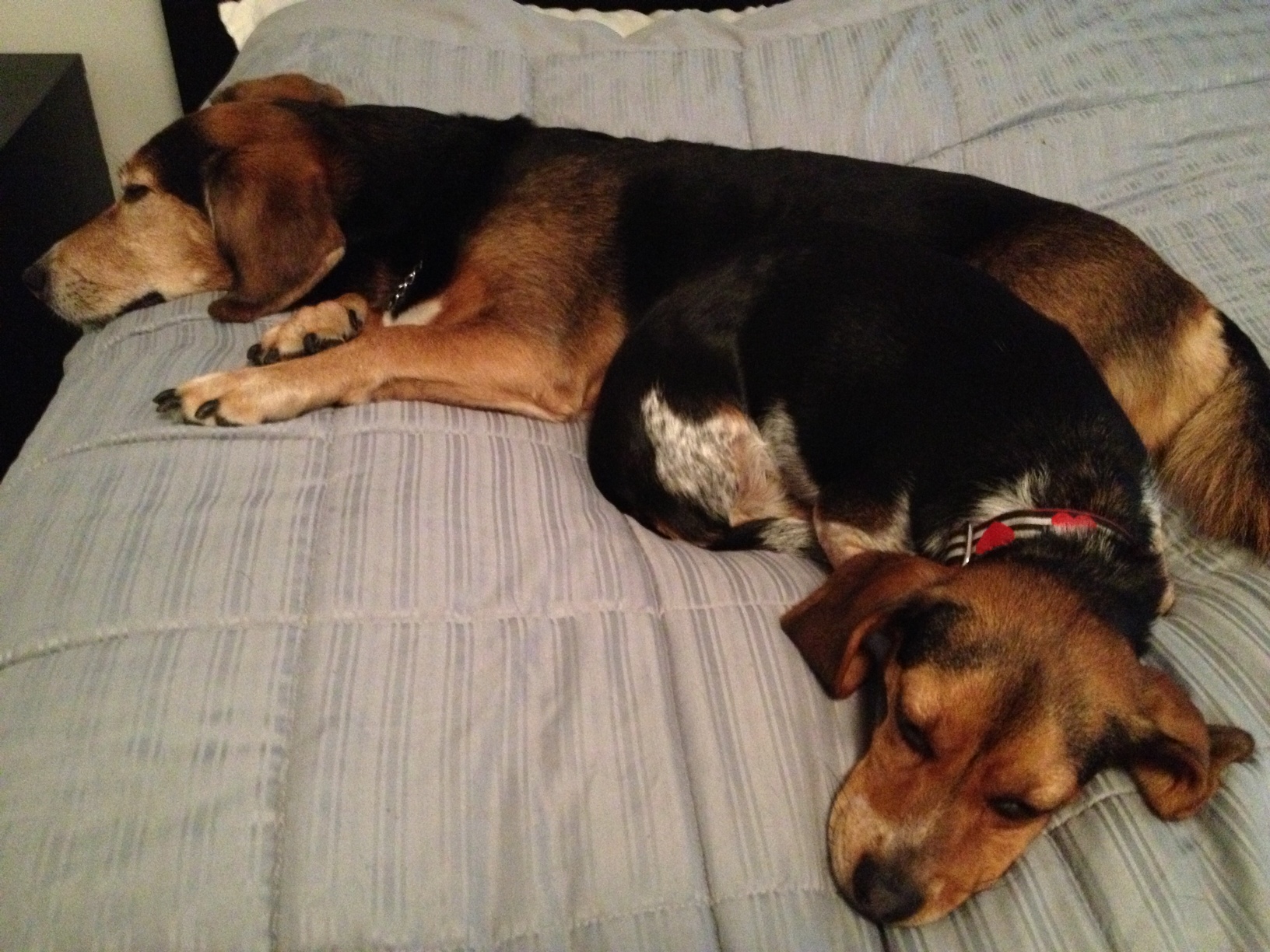
(Photo: Eddy and Bowie zonked out)

Face Of The Day

Shooting At High School In Marysville, Washington

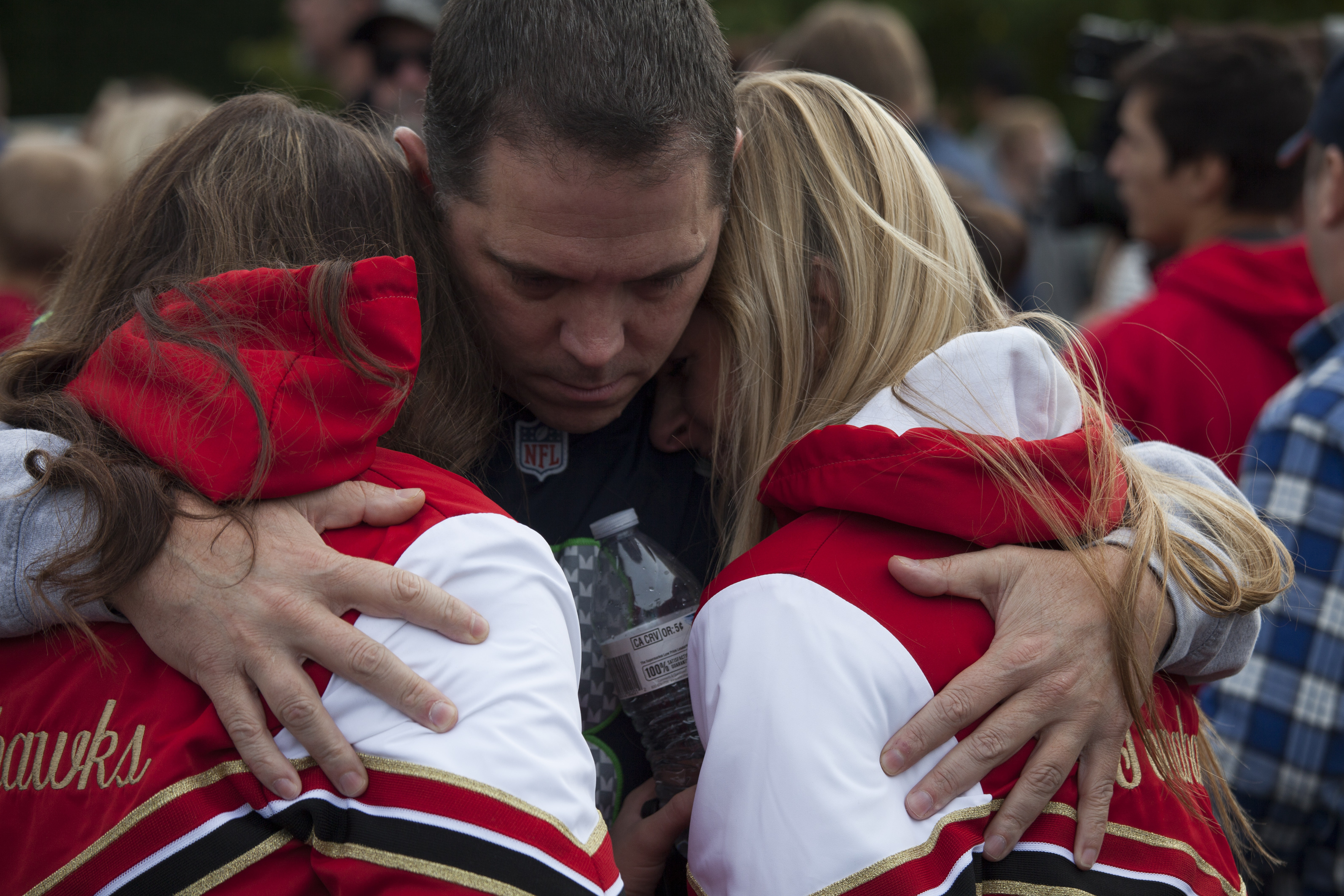
Students and family members embrace after leaving Marysville-Pilchuck High School in the aftermath of a shooting on the high school’s campus in Marysville, Washington on October 24, 2014. At least two are dead, including the shooter, according to authorities, with several more wounded. By David Ryder/Getty Images.

Why Do Americans Go Out Sick? Ctd

A reader shakes his head:

The post this morning in which Julia Ioffe blames American individualism for the tendency of Americans to go to work or school sick is missing the fundamental cause. According to a report by the Center for Economic Policy and Research, the United States is the only advanced economy that doesn’t guarantee paid vacation time and is one of only a few rich countries that doesn’t require employers to offer at least some paid holidays. A full quarter of the US workforce receives no paid vacation or holiday time. It shouldn’t be surprising to find that when faced with the prospect of not getting paid or giving up scarce vacation days, American workers choose to show up sick.

Another notes that even businesses with sick-leave policies discourage workers from calling in with the flu:

Many companies pay employees not to use sick time, encourage them to ration it for when things get “really bad,” or actively prohibit its use. For example, they have policies that don’t allow employees to use sick time during their “probationary period” of six months to a year. This makes it seem normal to go about business as usual even when you feel like something the cat dragged in off a pile of hazmat suits.

Another adds, “Even if you get sick leave and using it doesn’t cut your vacation, you’d better not use more than half of it in any given year unless you’re actually in the hospital”:

Because if you do, management will assume that either a) you’re calling in sick when you are not in order to get a paid day off, or b) you’re a slacker who is unwilling to put out a little extra effort in order to get the job done. Either of which is grounds for termination, or at the minimum a bad performance review, which will get you to the head of the queue next time layoffs come around. The job is, obviously, more important than something trivial such as the health of the staff.

Note also that, if your job allows telecommuting, you will be expected to be working from home, even if you stay home because you are sick.

Another illustrates how sick children can be a major factor:

I’ve lived in rural South Texas for 35 years, and my two children attended a public elementary school in a very small town. In order to encourage economically disadvantaged children with limited English skills to get all the way through high school, our area rewards children at the elementary level for “100 percent attendance.” This isn’t strictly a rural phenomenon; I believe our nearest metropolitan area, a city of several hundred thousand people, has a similar practice.

As a result, the number of children who would show up at my kids’ school with fevers and running noses was appalling. Their parents would drop them off with a cheery and proud assurance that this was at their child’s insistence: “They want to win that attendance award!” So civic responsibility was removed from the list of things learned at school early on. Lately, I believe, a regular school nurse has started removing children who are running a fever from class.

And consider the problem of families with working parents. What does one do with a sick child who should be at home in bed when no one is home to care for them and paid child care is out of the question? Indeed, many Americans, with or without children, go out sick because they have no other alternative if they want to pay their bills. These are not the people Julia Ioffe is describing – people who are, indeed, insufferably self-centered and who do more damage showing up for work sick than they realize.

Protestant work ethic? Nah. Just being a self-centered asshole? Could be. Just trying to get by? More likely.