Governorships Up For Grabs

Governors

Sam Wang illustrates how “the overall picture of 36 gubernatorial races is not breaking in the Republicans’ direction”:

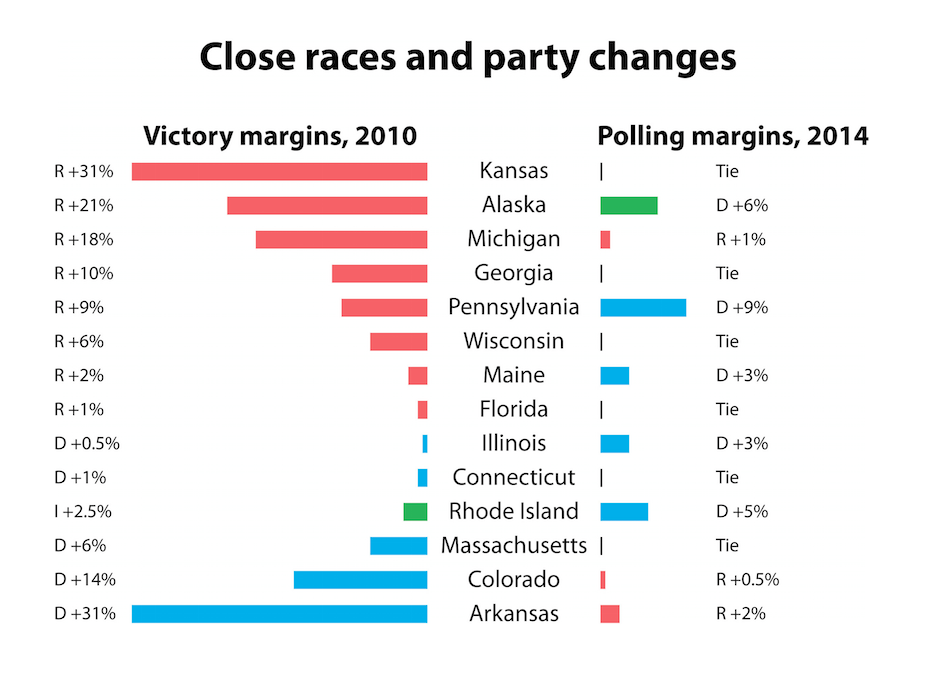
This chartcalculated from HuffPost Pollster data, using the median-based approach of the Princeton Election Consortiumshows elections that are likely to result in a switch in party control or are polling with a margin of five percentage points or less. On the left are the margins by which sitting governors won in 2010. On the right is the median performance of this year’s candidates in polls completed in the last two weeks. Red indicates a Republican in the lead, blue indicates a Democrat, and green indicates an independent.

The most remarkable feature of this chart is the widespread weakness in the Republican field. … The median outcome is a net gain of one governorship by Democrats.

Republicans Try Splitting The Obamacare Baby

The latest example:

Ohio Gov. John Kasich (R) raised some eyebrows on Monday when the Associated Press reported that he said Obamacare repeal wasn’t going to happen and opposition to the law was purely political. It was practically heresy for a Republican — which probably explains why Kasich was quickly walking the comments back just a few hours after the report.

He started by saying the AP had misquoted him, but then his defense became truly puzzling. Kasich said he was talking about Medicaid expansion, which his state has implemented at his urging, not Obamacare — and he doesn’t see the two as related.

But Beutler welcomes Kasich’s remarks:

Liberals are predictably reveling in Kasich’s contradictionthe Medicaid expansion was a huge piece of the Affordable Care Act’s overall coverage schemeand in the contortions he’s had to undergo to assure conservatives that his Obamacare apostasy extends only so far. But I don’t actually see much of a contradiction here. And more to the point, millions of poor Americans would be much better off if more Republicans adopted Kasich’s position that states should adopt the ACA’s Medicaid expansion while tilting at windmills to topple its private sector program. …

[I]f it became the GOP consensus, approximately five million poor people would be lifted out of the coverage gap and become insured almost immediately. The political fight over Obamacare would settle around the private sector coverage expansion, where there’s more room for horse trading, experimentation, and improvement. The potential damage a Republican president could do to the end of universal coverage would be greatly diminished.

David Graham examines Kasich’s predicament:

Even if Obamacare is irreversible, it’s not politically tenable to say such a thing in today’s Republican Party. Even if it’s not clear that Kasich’s hasty walkback makes a lot of sense as policy, it does seem—as Philip Klein notes—like another indication that Kasich would like to run for president in 2016. If he does, he’ll continue to be caught in a vise by Obamacare. Candidate Kasich would wish to appeal to Democrats and moderates by pointing out that he successfully governed in a purple state and expanded healthcare for needy citizens; maybe comments like this could even position him as a bold truthteller, conservative but coldly realistic. Yet he’d also want to appeal to Republican primary voters who abhor the Affordable Care Act. Those are two hard masters to serve.

Douthat thinks “the controversy around Kasich’s comments are a useful reminder that not only is there no Republican consensus on how to actually replace the health care law, but almost no G.O.P. Senate candidates are actually campaigning on a politically credible replacement plan”:

The one major exception is Ed Gillespie, running against Mark Warner in Virginia, whose plan Ramesh Ponnuru has commented on and defended here and here. … But Gillespie is also, per current polling, unlikely to join a Republican Senate majority next year, whereas many G.O.P. candidates — the potential Majority Leader included — who have hemmed and hawed or talked in anti-Obamacare boilerplate and vague generalities when asked about health care policy are more likely to pull their races out. Which will be seen by some, no doubt, as vindicating the risk-averse, somewhat cynical approach to health policy that Republicans have taken throughout the health care debate …

… except, of course, that in this cycle that debate is happening against the backdrop of a political map that heavily favors the G.O.P., whereas in 2016 (as in 2012) the map will be different, tougher, and the health care law (while no doubt still unpopular overall) will be more locked-in, more a part of people’s ordinary experience, and the promise of full repeal will look even sketchier than it does now. At which point a Republican Party that wants to be competitive nationally will start to feel a lot of pressure (probably not quite enough to counteract the influence of the primary electorate, but we’ll see) to drift toward something like Kasich’s (quite popular, in a purple state) position, which basically amounts to “if you like the single-payer part of Obamacare, you can keep the single-payer part of Obamacare, and let’s talk about the other stuff later.”

Suderman makes related points:

This is why it was so important to have a replacement plan, some alternative, or even just an explanation, ready. The question of what to do and what to say after the coverage expansion kicked in was never answered, or at least not answered effectively, and the result is clear enough. We see some Republicans refusing to answer questions about Medicaid; we see Kasich claiming that Medicaid isn’t really part of Obamacare and should be saved; and we see Sen. Mitch McConnell (R-Ky.) arguing that Kentucky’s exchange, which doles out subsidies funded by Obamacare, is not really part of the law either. Republicans don’t know what to do, because they didn’t come up with a plan in advance.

Middle Class Wealth Is So ’90s

Wealth

Tim Fernholz outlines the findings a new working paper by economists Gabriel Zucman and Emmanuel Saez, briefly referenced on the Dish last week, which “shows that growing income inequality is fueling a commensurate disparity in total wealth”:

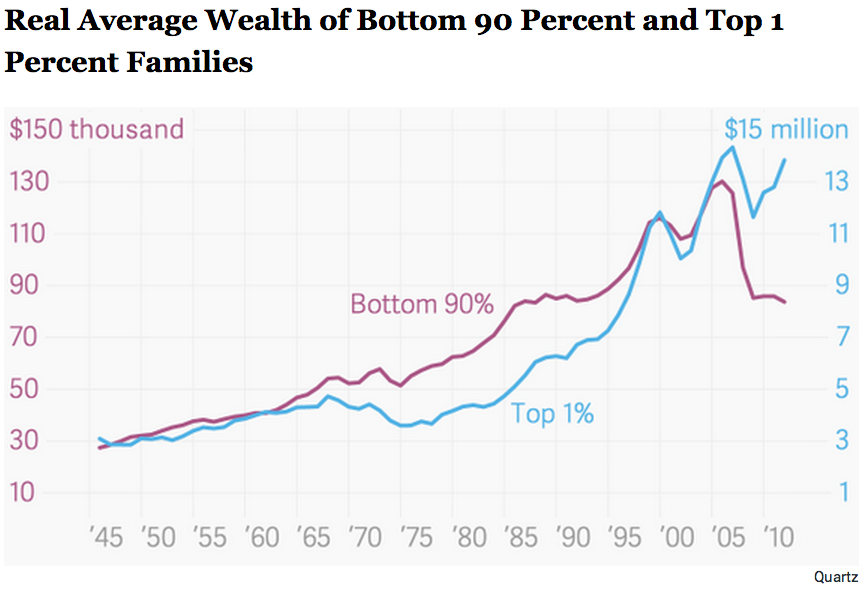
The two economists used tax data to build the most complete picture to date of U.S. wealth. Their findings are worrisome. Today, the top 0.1 percent of Americans—about 160,000 families, with net assets greater than $20 million—own 22 percent of household wealth, while the share of wealth held by the bottom 90 percent of Americans is no different than during their grandparents’ time. What does this look like at the household level? Perhaps the most striking chart produced by the economists’ efforts to measure U.S. wealth is the one [above], which shows that after a long march upward, and then a steep decline, the “average real wealth of bottom 90 percent families is no higher in 2012 than in 1986.” Meanwhile, the top 1 percent of wealthy families has almost completely recovered from the ill effects of the financial crisis.

Bryce Covert mentions how the paper connects the growing wealth gap to income inequality:

Wealth inequality is a separate phenomenon from income inequality, but one has fueled the other. “[T]he combination of higher income inequality alongside a growing disparity in the ability to save for most Americans is fuelling the explosion in wealth inequality,” the economists write. The bottom 60 percent of Americans have experienced a lost decade of either stagnant or falling wages since 2000 despite increasing their productivity 25 percent over the same period. But wages for the 1 percent grew by about 200 percent since the 1960s. At the same time, the wealthy have been able to put away more of that money into savings [while] the rest of America struggled to save. The 1 percent now saves more than a third of its income while the bottom 90 percent doesn’t save anything.

A No-Drama Ebola Policy

FRANCE-HEALTH-EBOLA

In lieu of a full-on travel ban, which would probably be counterproductive, the government has imposed new restrictions to ensure that travelers from Ebola-afflicted countries enter the US via airports with enhanced screening procedures:

The Department of Homeland Security on Tuesday announced that travelers from Liberia, Sierra Leone, and Guinea—the three countries at the center of the Ebola outbreak—will have to fly into the U.S. through one of five airports: New York’s JFK, Washington D.C.’s Dulles, Atlanta, Chicago O’Hare, and Newark, N.J. Those are the same five airports where officials began secondary screenings of travelers from those countries earlier this month.

The new rules went into effect today. Mataconis approves:

Since the majority of arrivals from the nations in question apparently already come through one of these airports, this is not likely to be a severe disruption to air travel and, at the very least, it seems far more cost effective and efficient than stationing personnel at every possible entry point in order to catch the relative handful of passengers who might arrive somewhere other than these five airports.

Allahpundit shrugs:

So, temperature checks for all west African passengers at five of America’s biggest airports, which will now exclusively handle international flights that made connections from Africa. There’s lots of buzz about that online as I write this but it’s virtually no different from what we’re already doing. Temperature checks at those five airports were ordered 10 days ago; those airports were chosen because they already handle 94 percent of passengers from west Africa traveling to the United States. From what I can tell, the only change that’s been made today is requiring the remaining six percent to connect to one of those airports too to ensure that everyone from west Africa entering the U.S. is subject to a temperature screening.

But that’s pointless because … the temperature checks don’t work. Thomas Duncan passed one when he got on the plane in Monrovia to fly to Europe and eventually on to America.

But Bryan Walsh stresses that the chances of an actual outbreak in the US were extremely low even before the new airport policy:

For all the demand to ban commercial travel to and from Ebola-hit West Africa, this region is barely connected to the U.S. in any case. Only about 150 people from that area of Africa come to the U.S. every day—less than a single full Boeing 757—and many airlines have already stopped flying. But there have been relatively few spillover cases even in African countries that are much more closer and more connected to Guinea, Sierra Leone and Liberia. Besides Nigeria, only Senegal has had cases connected to the West African outbreak—and that nation was declared Ebola-free today as well. (There have been cases in the Democratic Republic of Congo, but that’s considered a separate outbreak.) The worst Ebola outbreak ever is raging in three very poor nations—but it seems unable to establish itself anywhere else. … Even the risk of another Duncan doesn’t seem high.

Ambinder sizes up the response of US officials thus far:

In cataloging some of the early missteps, Ron Fournier writes, “Once again, Americans are reminded of the limits of U.S. social institutions — in this case various state, local, and federal government agencies and private-sector health systems that responded to the Ebola crisis slowly, inefficiently, and with a lack of candor that Americans, unfortunately, have come to expect.”

Sorry, no. They responded quickly, and in doing so, overlooked some of the basics. Then, within hours, they corrected their oversights. The limits of U.S. social institutions? Well, they’re reminded by those limits by people who have set exceptionally high expectations for government, expectations which cannot possibly be met by mortals. Actually, Americans should have faith that the CDC can prevent major epidemics like Ebola. But politicians are willfully or stupidly spreading misinformation.

As are their enablers in the right-wing press:

Indeed, the neoconservative Weekly Standard’s lead editorial this week was entitled “Six Reasons to Panic,” while the Washington Post featured an op-ed by Marc Thiessen, a right-wing Republican commentator and fellow at the American Enterprise Institute (AEI), depicting a “nightmare scenario” in which “suicide bombers infected with Ebola could blow themselves up in a crowded place—say, shopping malls in Oklahoma City, Philadelphia and Atlanta—spreading infected tissue and bodily fluids.” Commentators on Rupert Murdoch’s Fox News have conjured similar scenarios.

You gotta admit that Ebola-filled ISIS suicide bombers is a brilliant touch of hathos. Speaking of which:

https://twitter.com/Drunk_America/statuses/524953535902138368

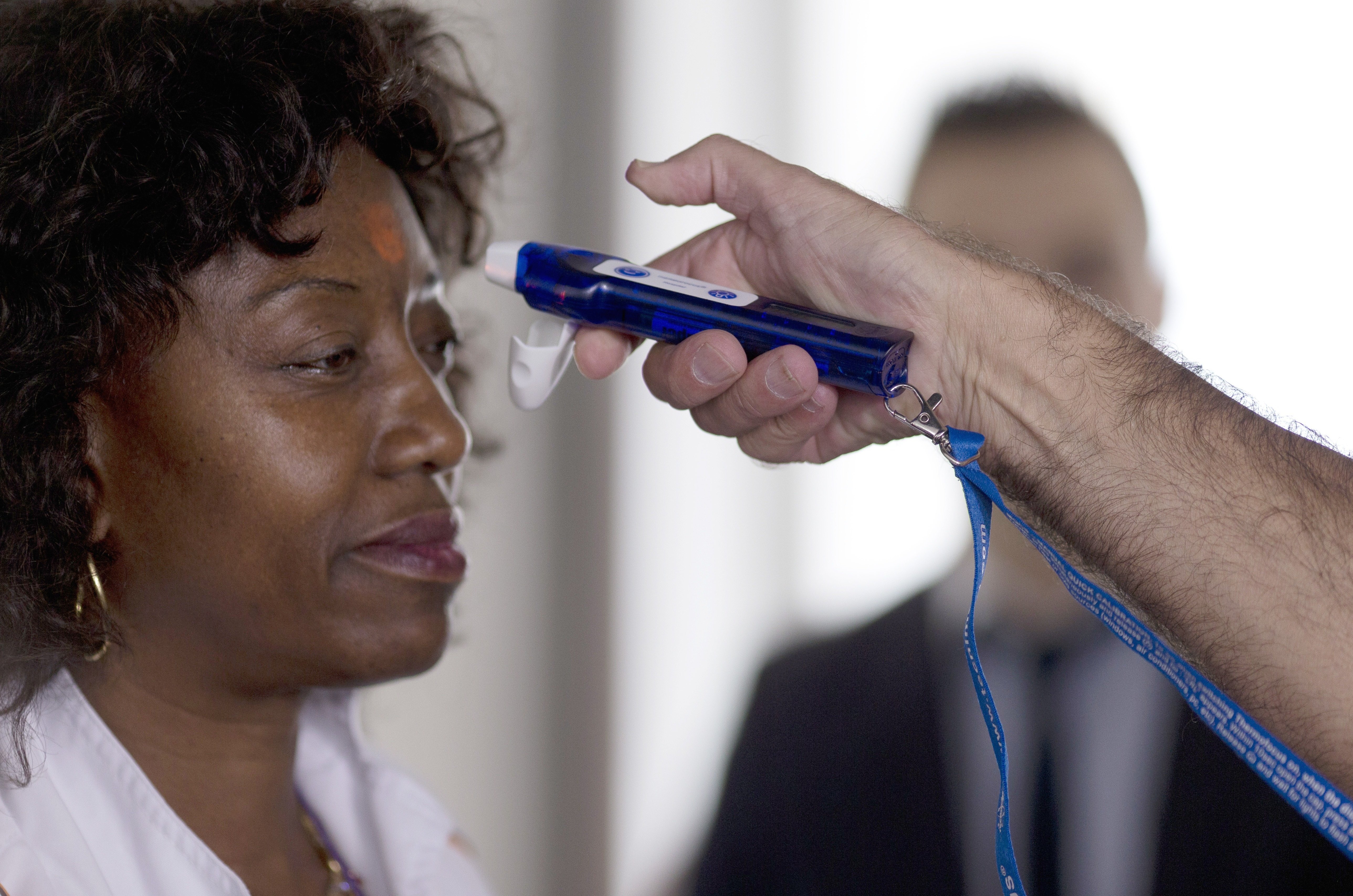
(Photo: Employees of the airport emergency medical service on October 17, 2014 make a test with an electronic thermometer as part of the fight against Ebola virus at the Roissy-Charles-de-Gaulle airport in Roissy-en-France, suburb of Paris, before carrying out health checks on travelers arriving from Guinea, one of the worst-hit nations alongside Liberia and Sierra Leone. France joins Britain, the United States and Canada in screening travellers for the disease. By Kenzo Tribouillard/AFP/Getty Images)

The Struggle For Accountability On Torture

Redacted Document

A new story in the Huffington Post confirms what I’ve been fearing for a while now: that the Obama White House, in particular chief of staff Denis McDonough, is now pulling out all the stops to protect the CIA as far as humanly possible from any accountability over its torture program. If you want to know why the report has been stymied, and why something that was completed two years ago cannot even get the executive summary in front of the American people, the answer, I’m afraid, is the president.

You’d think his chief-of-staff would have better things to do right now than plead with Senators to protect and defend John Brennan, the CIA director who has put up a ferocious fight to avoid any accountability. But no:

During the last weeks of July, the intelligence community was bracing itself for the release of the Senate investigation’s executive summary, which is expected to be damning in its findings against the CIA. The report was due to be returned to the Senate panel after undergoing an extensive declassification review, and its public release seemed imminent.

Over the span of just a few days, McDonough, who makes infrequent trips down Pennsylvania Avenue, was a regular fixture, according to people with knowledge of his visits. Sources said he pleaded with key Senate figures not to go after CIA Director John Brennan in the expected furor that would follow the release of the report’s 500-page executive summary.

Weird, huh? What is at the heart of this Brennan-McDonough alliance? And then this staggering detail:

According to sources familiar with the CIA inspector general report that details the alleged abuses by agency officials, CIA agents impersonated Senate staffers in order to gain access to Senate communications and drafts of the Intelligence Committee investigation. These sources requested anonymity because the details of the agency’s inspector general report remain classified. “If people knew the details of what they actually did to hack into the Senate computers to go search for the torture document, jaws would drop. It’s straight out of a movie,” said one Senate source familiar with the document.

All of this is out of a really bad movie: CIA goons torturing prisoners with abandon, destroying evidence of war crimes, hacking into the Senate Committee’s computers, impersonating Senate staffers and on and on.

What really seems to have set off the alarm bells is what’s called the Panetta Report, an internal CIA review of its own torture program that somehow (almost certainly accidentally) got included in the document dump given to the Committee. That report is, by all accounts, damning about the torture program, especially its vaunted “effectiveness.” And you can see why Brennan panicked. How will the CIA attack the Senate report if its own report had come to the exact same conclusion? That’s what set off this drama – because Brennan knew at that point that the CIA was busted. Since then he and McDonough have done all they can to bury the truth, even as they are “debating” whether to allow a loophole for torture if conducted overseas.

What’s also disturbing is the weakness of the Democrats, with a few exceptions (thank God for Wyden and Udall). Feinstein seems to have retreated to her usual supine role, and there’s a sense that the political climate – with ISIS hysteria at epic levels – makes this kind of accountability politically toxic. You get a flavor of how the CIA will play this from this quote in the HuffPo piece:

“At a time when ISIS is on the march and beheading American journalists, some Democrats apparently think now is not the time to be advocating going soft on terrorists. The speculation I hear is that the Senate Democrats will wait until the elections are safely over,” said Robert Grenier, a veteran CIA officer who was the top counterterrorism official from 2004 to 2006.

No one is advocating “going soft” on terrorists. We’re advocating the rule of law and core adherence to the Geneva Conventions and a thorough review of war crimes under the last administration. Those are not weaknesses in a democracy’s fight against Jihadist terror. They are strengths. And they are not negotiable.

What I worry about is if the Republicans win the Senate next month, they could bury the report for good. I simply have to hope – remember that? – that the president means what he has always said, and that massive evidence of war crimes is not buried, even if no one in the CIA or the Bush administration will ever be held accountable for anything.

Release the report. And if it is so damning that Brennan has to go, that’s the price of democratic accountability. No one is indispensable. And no one should be somehow claiming in a democracy that they are.

(Image: A heavily redacted document from the CIA released in 2008)
“A Driven Newspaperman”

Ben Bradlee

Legendary WaPo editor Ben Bradlee died yesterday at the age of 93. David Remnick reflects:

[T]he most overstated notion about Bradlee was the idea that he was an ideological man. This was a cartoon. Because of the Pentagon Papers and Watergate, he and Katharine Graham were often seen as ferociously committed liberals. They were, in fact, committed to the First Amendment, committed to publishing; they made their names by building an institution strong enough to be daring.

But Bradlee did not question deeply institutional Washington. Bradlee and his wife, the writer Sally Quinn, were at the center of what remained of old Georgetown, not outside of it. (He had been married twice before, and had four children in all.) And when, in conversation or in his memoirs, he did talk about his political ideas, they did not run very deep. As a former soldier, he was ambivalent about the anti-Vietnam War movement. After a trip to Vietnam, in 1971, he “ended up feeling uncommitted politically as usual,” he once said. …

Bradlee was, above all, a driven newspaperman, a man of his time and of his institution, and more alive than a major weather system. He was a man of great principle and of great luck, blessed in the ownership that supported him and blessed with a loving wife who cared for him to the very end–an end that was miles from easy.

Peter Osnos explains what Bradlee’s “editorial genius” consisted of:

It was his unfailing sense of what made a story stronger. His questions were precise and invariably to the point. His credo for the front page was that stories carry impact, preferably were exclusive, and were written with flair. He had particular admiration for intrepid reporting, especially when it was connected to good writing. If a piece was a dud, Ben would let you know one way or another, but he rarely held a grudge as long you came roaring back with a better version or some breakthrough on a running story.

Ben was renowned for creating the Post’s Style section, which was the ne plus ultra destination for major profiles and features that changed the character of what readers could expect to find in newspapers. The edgier writing of the kind that had previously been found in magazines like Esquire made the section hugely popular and influential.

John Dickerson adds some nuance to Bradlee’s celebrity culture:

When I think of the journalists and columnists of the Kennedy era—Teddy White, Hugh Sidey, Joe Alsop, and Bradlee—I wonder where any of them would fit today. They were all mythmakers in one form or another. White worked with Jackie Kennedy to give us the Camelot story, but Bradlee irritated the former First Lady by writing his account. He also ticked off the president at times, which accounts for the gaps in Conversations with Kennedy. This suggests at least some astringency in the relationship, and that Bradlee retained some perspective.

In retrospect, the book is such a glowing account that it’s hard to see what anyone in the Kennedy camp could be sore about. But Bradlee’s relationship with Kennedy defines a category that we could use more of: the irritating confidante. There’s plenty of critical coverage of presidents and there are plenty of official meaningless statements put out by the president’s mouthpieces. What’s required is someone who can work the gap in the middle, a sympathetic voice who gives us some insight into the office, what really happens, and what it does to a person that only access can bring. At the same time, this someone must have enough self-respect, experience, and wisdom to know that using that access to write hagiography is a special kind of dull lie.

Former WaPo writer Ezra Klein chimes in:

Most men with that kind of charisma are crippled by it. They so love to be liked that they cannot stand to be hated. But Bradlee could. The decision to run the Pentagon Papers could have destroyed the Washington Post. The decision to keep pursuing President Richard Nixon could have done much worse than that.

Bradlee was better than virtually anyone else from his generation at being liked, but he built his legend — and his paper — because he was willing to be hated in service of journalism. “As long as a journalist tells the truth, in conscience and fairness, it is not his job to worry about consequences.” he wrote in 1973. “The truth is never as dangerous as a lie in the long run. I truly believe the truth sets men free.” A lot of editors write things like that. But Bradlee really believed it, and he proved it, again and again.

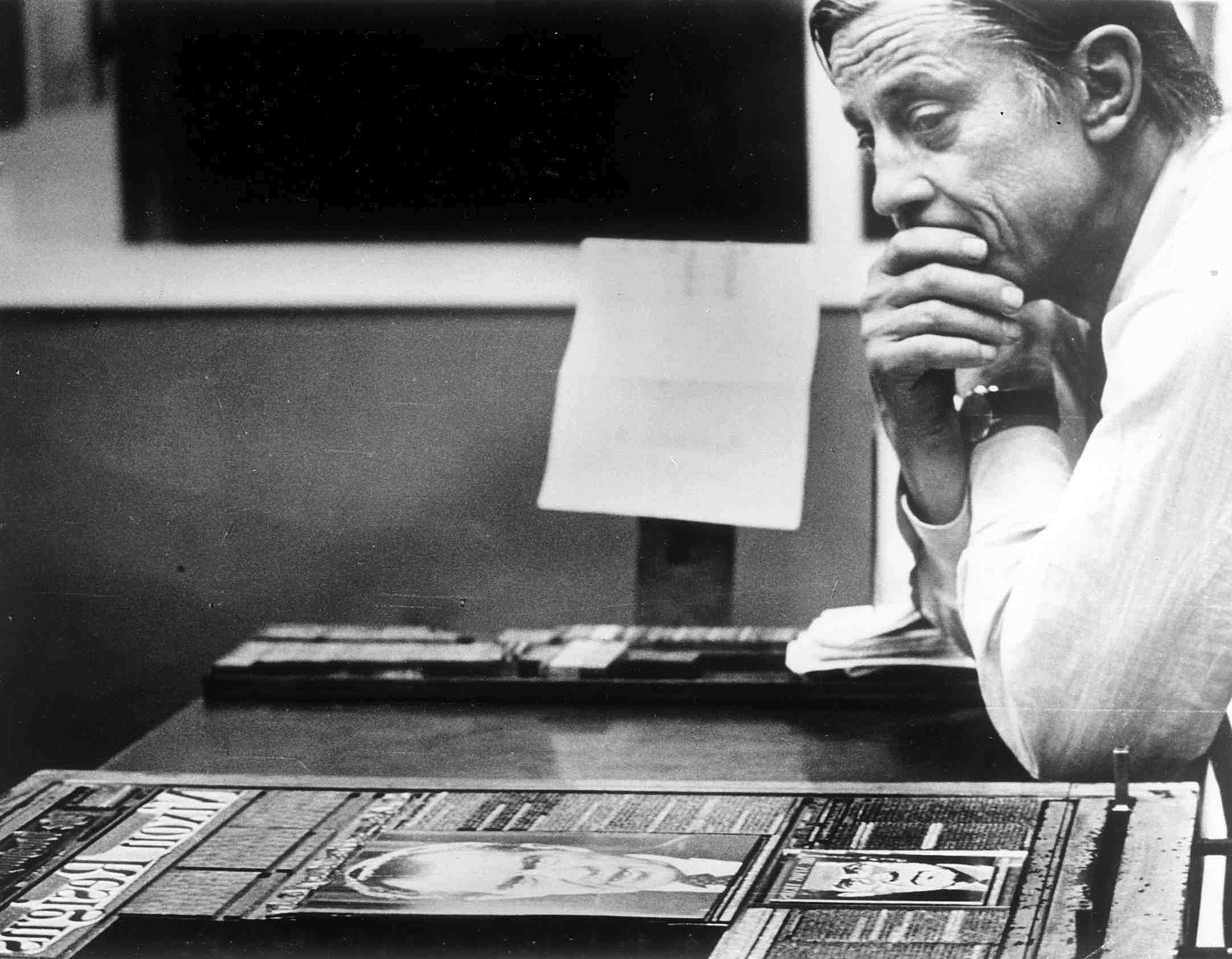
(Photo: The Washington Post’s Ben Bradlee in the composing room looking at A1 of the first edition headlined “Nixon Resigns.” By David R. Legge/The Washington Post via Getty Images)

The Future Of Sex Toys

But first, Lux Alptraum knocks much of the conversation around sexbots for omitting any consideration of female pleasure:

[I]t is women, not men, who are the primary purchasers of sex toys, and thus the consumers most likely to literally take them home. “After 37 years [in the sex toy business], women have always been our customer,” says Coyote Amrich, purchasing manager for San Francisco-based sex toy shop Good Vibrations. “That was the driving force of our business.” … An analysis of U.K. sex toy distributor LoveHoney’s sales data shows that, even as high-tech sex gadgets make their way onto the market, it’s still the century-old vibrator that holds consumer interest – 18% of all purchases.

So what might a more magical Magic Wand look like?

Instead of futuristic gadgets that remake the very notion of sex, Amrich predicts innovations that are more about improving on existing technology; making toys that are lighter, quieter, and stronger, as well as using better materials and with better battery life. Amrich also sees a future for toys that enhance the sex we’re already having, “creating ways for people to have enhanced intimacy and enhanced sensation.” …

But what sort of technology could allow for that sort of enhanced experience? Dr. Kristen Stubbs, a queer/pansexual roboticist who has a PhD from Carnegie Mellon and runs a crowdfunding startup for sexuality-focused technology, offered up one possibility. For Stubbs, the true future of sex toys lies in shifting the products from open-loop to closed-loop controllers. In layman’s terms, a device with open-loop control responds only to its on/off switch: You turn it on, it does its job (in the case of a sex toy, by vibrating), and that’s the end of the story. A closed-loop control, on the other hand, has sensors that provide the device with information about the outside world, allowing it to adapt its behavior as the situation requires.

Marriage Equality Update

Puerto Rico’s ban has been upheld:

U.S. District Judge Juan M. Pérez-Giménez said in his decision that by dismissing an appeal in Baker vs. Nelson, a 1971 case in which two men sought to marry in Minnesota, the Supreme Court bound all lower courts to assume bans on same-sex marriage do not violate the Constitution. The high court could choose to overrule itself but has not, he said.

Lyle Denniston provides important context:

The San Juan jurist said the Supreme Court has never overruled that decision, so it is still binding on lower federal courts — an argument that has failed in all of the recent rulings against such bans.  But the judge also said that he was bound to follow the Baker precedent because the First Circuit, which has binding legal authority in Puerto Rico cases, had itself done just that two years ago.

In a Massachusetts case in which the First Circuit had struck down a key part of the Defense of Marriage Act, barring all federal marital benefits to same-sex couples already legally married under their state’s laws (the same result that the Supreme Court reached last year), the First Circuit had said that Baker v. Nelson was still a binding precedent, Judge Perez-Gimenez noted.  That ruling, he added, tied his hands.

Dale Carpenter explains the significance of the ruling:

[T]he issue of Baker‘s effect is actively being considered in other circuits. Most immediately, the Sixth Circuit is already considering a case that turns in part on whether Baker controls. In the Eighth Circuit, a motion to dismiss a same-sex marriage challenge was argued in a South Dakota district court last Friday. (The challenge was brought by my former student Joshua Newville.) And the Fifth Circuit will soon schedule argument in Texas’s appeal from a district court decision striking down that state’s limitation on marriage.

No matter whether it’s decided on Baker grounds or on substantive grounds, a decision denying same-sex marriage at the appellate court level would create the circuit split on same-sex marriage that awaits resolution by the Supreme Court.

Ian Millhiser expects the Puerto Rico decision will be reversed:

[W]hile Pérez-Giménez clearly holds very passionate views on the question of whether same-sex couples are entitled to the same rights as everyone else, his views are unlikely to persuade many of his fellow judges. It’s even possible that his opinion could ultimately wind up bolstering the case for marriage equality. That’s because his decision will appeal to the United States Court of Appeals for the First Circuit, a court dominated by Democratic appointees (although, it is worth noting that Pérez-Giménez was appointed to the bench by President Jimmy Carter). All four of the states that comprise the First Circuit — Maine, Massachusetts, New Hampshire and Rhode Island — are already marriage equality states, so a decision out of a federal court in Puerto Rico is the only path to bring a marriage equality case before this circuit.

Given the makeup of the First Circuit, the overwhelming consensus among federal judges in favor of marriage equality, and the belligerent tone of Pérez-Giménez’s opinion, it is unlikely that his decision will be upheld on appeal.

Vengeance Of The Nerds, Ctd

Readers won’t let go of the debate:

As Arthur Chu artfully pointed out, the basic dynamic of #GamerGate is no different than that of the Tea Party: white dudes angry about Those People encroaching on their turf. What #GGers lambast as the “corruption” of gaming journalism isn’t part of the creeping menace of sponsored content; it’s the default mode of operation. Gaming publications have always been willing and enthusiastic adjuncts of the industry PR machine. The field’s evolution is no different than any other kind of entertainment journalism – critical film, music, and sports coverage didn’t emerge until the 1960s. To this day, no major entertainment media outlet meets the journalistic standard #GamerGate purports to demand (see: ESPN and the NFL). Really, where’s the scandal?

The difference now, of course, is the existence of social media and how it enables new ways of lashing out. No one has more skill with the Internet’s tools of harassment and abuse than the stereotypical gamer. Pretending that violent threats against outspoken women – whose collective influence in gaming, I should point out, is minuscule at best – have nothing to do with #GamerGate is absurd.

Freddie responds to these readers at length:

The video game media, generally speaking, is garbage. … But here’s the thing, you guys: if video game journalism is garbage, then #gamergate is garbage from an Egyptian restaurant that’s been baking in the sun in July in a heatwave on a New York corner, complete with extra dog poop and infested with cockroaches that have names like Misogyny and Threats Against Women. However well-intentioned some members of #gamergate may be, and however much I may agree with some criticisms of the video game media, the grimy sexism and hideous threats that have been made in the name of #gamergate renders the whole “movement” totally unpalatable to me.

Yes, it is unfortunate to define any group by the actions of its worst members, and there are times in life, particularly when it comes to political struggles, that you have to hold your nose and align with people you can’t stand. But this isn’t one of those times, and too many people who complain about how #gamergate is discussed in the media refuse to be frank about how rife with ugliness the phenomenon is.

I mean, there’s even legitimate criticism of Anita Sarkeesian, such as her unpaid appropriation of other women’s artwork, which my friend Alex Layne of the brilliant site Not Your Mama’s Gamer discussed. That behavior bothers me. But in a world where Sarkeesian is subject to such insane, violent threats, my instinct is not to criticize her about intellectual property but build a bunker to defend her from attack.

That’s the thing about surrounding your movement with threats and misogyny: people who might be inclined to listen to you feel compelled to reject you out of hand. Whether through refusal or inability, the principled people who consider themselves part of #gamergate have failed to eject the sexist, threatening core of the movement, and for someone like me, that makes it impossible to take the whole enterprise as anything but ugly.

Laura Hudson adds:

While there are legitimate ethical concerns about games journalism, it’s telling that the movement remains laser-focused not on the ethically shady behavior of the multimillion-dollar gaming studios making the mainstream games they enjoy, but small, often impoverished independent creators and critics—and even within that subset, the targets are nearly exclusively women.

Jesse Singal pens a Reddit letter to all the Gamergate people trying to convince him the press has it all wrong:

So what is Gamergate “really” about? I think this is the sort of question a philosopher of language would tear apart and scatter the remnants of to the wind, because it lacks any real referent. You guys refuse to appoint a leader or write up a platform or really do any of the things real-life, adult “movements” do. I’d argue that there isn’t really any such thing as Gamergate, because any given manifestation of it can be torn down as, again, No True Gamergate by anyone who disagrees with that manifestation or views it as an inconvenient blight from an optics standpoint. And who gets to decide what is and isn’t True Gamergate? You can’t say you want a decentralized, anonymous movement and then disown the ugly parts that inevitably pop up as a result of that structure. Either everything is in, or everything is out.

Faced with this complete lack of clarity, all I or other journalists can do, then, is journalism: We ask the people in the movement what they stand for and then try to tease out what is real and what is PR. And every, every, every substantive conversation/forum/encounter I’ve had with folks from your movement has led me to believe that a large part of the reason for its existence is discomfort with what you see as the burgeoning influence of so-called social-justice warriors in the gaming world.

Update from a reader:

In case you missed it, Clickhole has the ultimate encapsulation of GamerGate ( … unless anyone in GamerGate disagrees with it).

“Family” Business In Japan

Emily Tamkin explains how some Japanese companies date back to the 8th century:

Even though primogeniture faded with the 20th century, owners still often pass their companies on to a single heir—although keeping business in the family is often aided and abetted by adult adoption, in which the company head legally adopts the right person to run his firm and then passes it on. (These adult adoptions are sometimes facilitated by a marriage between the heir presumptive and the owner’s daughter.) In 2011, more than 90 percent of the 81,000 individuals adopted in Japan were adults. Firms run by adopted heirs, research shows, outperform those run by “blood” heirs—and both adopted and blood heirs outperform nonfamily firms.