
“Successful” Interventions Can Still Be Disastrous

Christopher Dickey puts a fresh spin on the debate over whether arming participants in foreign civil wars “works”:

Has the CIA failed repeatedly to meet its covert goals? Actually, the problem has been exactly the reverse. With the exception of the Bay of Pigs, the agency has succeeded repeatedly, sometimes spectacularly. In Afghanistan in the 1980s “the CIA arms for the mujahedin won the final and decisive battle of the Cold War, liberating Eastern Europe and destroying the USSR,” says CIA veteran Bruce Riedel, now at the Brookings Institute. “That’s victory by any measure. Of course the war had other long term consequences, but the CIA accomplished what the White House wanted, a Russian Vietnam.”

Long-term consequences indeed. What happened again and again after the agency eliminated or helped to neutralize the presumed bad guys was the spectacle of their replacements turning out to be as bad or worse. But for those tragic policy decisions one must blame every president dating back to Dwight D. Eisenhower.

It’s too tempting a tool for presidents to use – secret, unaccountable and constantly looking for new wars to fight and enemies to make. Truman saw this clearly. But by then, it was probably too late to restrain it. And no president has – least of all the current one. By the 21st Century, the CIA had fully understood that it could break the law and even commit war crimes, and all it needed to do was destroy the evidence, spy on the Senate, and lie to the public and get away with it. We await the first attempt in recent times merely to expose the facts of its brutality and incompetence. We’ve been waiting now for almost two years.

The View From Your Window Contest: Winner #227

VFYWC-227

Doug Chini is pleased:

You hear that Dish team? That sharp, repeating sound? That’s the sound of a happy Chini clapping. Nicely, nicely done. No landmarks, no giveaways, no mercy. THIS is how you do a view. Don’t get me wrong, it’s not the hardest contest we’ve had (there’s almost too many clues), but it’s still a classic example of what this little slice of Internet insanity is all about.

A less-pleased contestant:

Damn. That roof seems like France, but not the rest. Trees seem Italian. Apartments, less European. Who knows? Throwing a stab with Cagliari, Sardinia.

Another describes the scene in greater detail:

European-style architecture from the era of the Industrial Revolution, but a level of run-down shabbiness that you wouldn’t find in western Europe, which says eastern Europe, Russia or former Soviet Republic, or maybe Shanghai. A crane currently building a new high rise maybe argues for the latter.

I’m guessing that one of those cars in the lower right is of former Soviet bloc make, so I’m going to take a random guess of Kiev. I can find quite a few apartment blocks of the appropriate vintage (although nothing that looks in quite such disrepair), but I’ve got nothing to narrow it down to the building under renovation with the Mansard roof and the spiky sky light.

And just as I was about to give up, I noticed the flag on the building across the street. It looks like it’s red, blue and red horizontal stripes. Laos? Doesn’t seem likely to have a city this dense. Nope, I’ll stick to Kiev. Whatever it is, at least it’s an interesting photo.

Another zooms in on the car:

OK, I give up. Based on the metal roofs, snow fences, tall buildings and the Lada in the corner of the picture, I think we’re in Moscow. Since I can’t find the buildings or window, I’ll just send in a Lada joke:

A man buys a Lada but after only one day of ownership returns it to the garage.image1

‘The car’s no good.’ says the man.
‘What’s wrong?’ asks the car dealer.
‘Do you see that steep hill over there?’ says the man, pointing. ‘Well it will only get up to 75 up there’.
‘That’s not bad really sir, especially for a Lada. I can’t see a problem with that’.
‘Trouble is,’ said the man, ‘I live at 95’.

Almost every guess this week landed in the former Soviet Union, including cities like Kaliningrad and Tbilisi. This reader returns to the most important clue:

So many clues, but unlike past challenges, this one is just out of reach.  Let’s start with the hint of a red and blue flag at the door of the building in the middle of the photo.  I wasn’t able to get a definitive hit, but the colors are typically Slavic.  (Of course,  it’s hard not to immediately conclude that we’re in Eastern Europe anyway, based on the architecture and apparent lack of recent prosperity.)  Then there’s the indecipherable script on the van to the left.  Even after zooming in I can’t tell if it’s a Latin or Cyrillic script which would have helped enormously.

So my guess is the Northern/Central Balkans.  The consistent  use of metal roofs instead of clay tile pushes us away from the southern Balkan nations, and the shallow slope of the roofs keep us from going too far north and east into snowier climates.  So my guess is Serbia, Romania or Moldova, but I can’t seem to get any more specific than that.  I’ll stick with Serbia based on the Slavic suggestion of the flag.

Identifying that flag led to the bulk of this week’s correct guesses:

You’d think a building with a curvy gambrel roof (or flagmodified mansard?) with pyramid skylights would be easy to find. Maybe, but I sure can’t. Clues were few and far between this week. The vista looked rather post-Soviet: run-down but lots of satellite dishes. Grates on the roof edges suggested someplace snowy. All that added up to any city between Harbin, China and Krakow, Poland. The single real clue I could divine was a flag on the building across the street. It looked red-blue-red to me, which is the flag of Laos, which seemed improbable. But maybe it was red-blue-orange, like the flag of Armenia.

From all the pictures I looked at, it sure did look like Yerevan, Armenia. But I still can’t find that dang building anywhere, and it’s not for lack of trying.

Dish readers have been to Yerevan, naturally:

The moment I saw this week’s VFYW contest picture I knew it was Yerevan, Armenia. I recently had the opportunity to visit that country, and as soon as I scrolled down and saw the photo I had a strong sense of deja vu. What gives it away is the mix of Eurasian, Imperial Russian and Soviet architecture. And the pink/dark stone used for many of the older buildings, which is practically uniquely Armenian (although used to a lesser extent in Azerbaijan and Georgia).

A former winner, who nearly gets the right building, elaborates on why Yerevan is known as “The Pink City”:

Pretty tough; or should I say pretty tuff? You know, there is only one city in the world whose buildings are mainly made of pink tuff [a light, porous rock formed by consolidation of volcanic ash]. This week’s picture was taken in Yerevan, Armenia, from the northwest side of this building on Teryan Street:

14th-Floor-Hotel

There is a hotel housed in the building, the 14th Floor Hotel, but – as its name clearly implies – it is located on the 14th floor, while the contest picture was taken from about the sixth floor, so I am assuming that someone hosted in the hotel sneaked into some other place in the building to shoot the photo.

A contest veteran nails the correct building – another hotel:

Thank God for the half-obscured flag of Armenia by the door of the tan building!  Armenia has the only national flag with that pattern of colors, so we have to be in Yerevan. From there it was a matter of matching the right configuration of Soviet-era housing blocks on Google Earth and finding a photo nearby showing any of the buildings in the foreground of the view.  A photo from Amiryan Street clearly shows the tan building with the obscured flag.  That building is the Yeghishe Charents School No. 67, named for the noted Armenian poet and political prisoner under Stalin:

VFYW Yerevan

Details about the rest of the area in the shot, a block away from Yerevan’s Republic Square, were frustratingly few, but there’s enough to go on to deduce that the photo was taken from the Paris Hotel at 4/6 Amiryan Street.

Another former winner adds:

Before focusing on Yerevan, the search began in Vanadzor, Armenia because the Vanadzor State Pedagogical Institute’s building looks similar to the Yeghishe Charents Basic School No. 67 in the center of the contest photo.  (No word yet on whether Armenia will be altering its naming system for elementary schools in light of the basic American meme.)  The detour was nonetheless useful.  The resemblance between the buildings indicated that the window was likely in Armenia.  As for Teryan and Charents, they were Armenian poets of some renowned.

One reader’s struggle after IDing the flag:

“This should be easy!” I thought to myself.

Wikipedia.

“Only one city of real size … Yerevan.”

Google Map.

“Bingo … all sorts of Soviet era apartment buildings. OK … quite a few. No. An amazing amount of them.”

Hours pass.

“Oh crap, I’m going to have to go block by block.”

Hours pass.

“Maybe it isn’t Yerevan. But … the flag … an embassy? That new republic of something or other …”

I was just about to go take some ibuprofen and give it another shot in the morning. But then I saw a row of buildings that looked very solid. I went through hundreds of assumptions, and none of them panned out. Eventually, brute force won out.

Another notes:

The very small image of a flag, which is barely visible, was the only clue to quickly identify the country as Armenia. This is a very poor country with wide-spread poverty which the view from the window under-scores.  Quite a contrast with Providence, Rhode Island!

The absence of Google street view for Yerevan makes identifying the precise window or address very challenging.  This montage summarizes my search process:
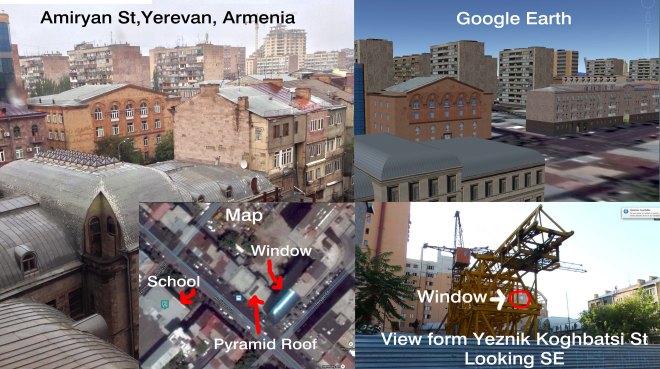
Montage

An incredibly detailed walkthrough:

My first impression of the scene was the juxtaposition of 20th Century shabbiness with some Second Empire / fin de siècle architecture.  I was immediately inclined to think we were looking at a former Soviet or Warsaw Pact city.  But the French feel of the old building in the foreground and the rising terrain in the background left me unable to rule out immediately a Parisian suburb or provincial cité.

image004The essential clue proved to be the flag on the building in the middle distance – a detail visible only when I enlarged it. (At first I thought the blue stripe appeared between two red ones, which led me astray for a while.)  When I recognized that the bottom stripe was orange, I knew we were in Armenia.  And presumably Yerevan, because I cannot even name another city in Armenia. But the degree of difficulty in pinpointing the window was raised significantly by the fact that Google does not provide Street View for Yerevan.  But at least some Armenians have created a less comprehensive version that allows a few street-level views.
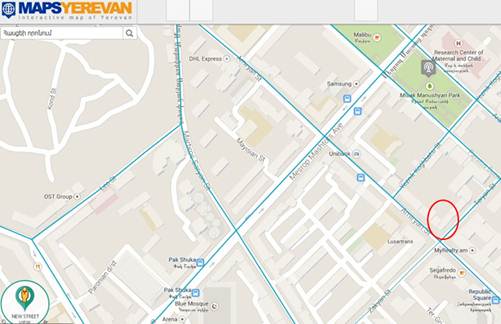
image012

And thus we match the window’s western view …
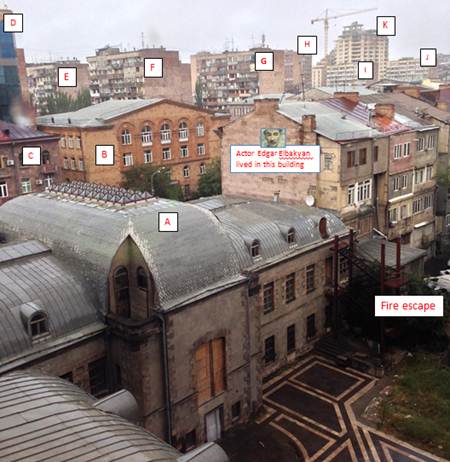
image017

… to landmarks in Yerevan:

image007

Incidentally, a southern view from an upper floor of the same building ought to show Mt. Ararat:

image019

The building in the middle distance (labeled “B”) is the Yeghishe Charents School No. 67.  Here are some other views of it:

image008

So our photographer was looking generally west from this building or set of buildings at the corner of Amiryan and Teryan Streets:
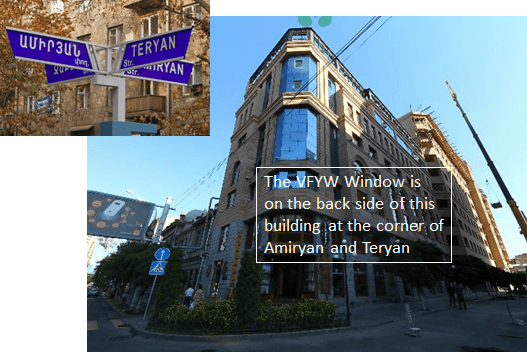
image010

Unfortunately, because “Maps of Yerevan” has fewer still images than Google Street View, one cannot adjust slightly to see around an obstacle to find the window.  And the only street view of the northwest side of the VFYW building is this – in which the photographer’s window, overlooking the fire escape of our fin de siècle building, is obscured:

image009

And so I must resort to the most inexact of tools: a Google Earth model image:

 image013

Since the scale is distorted, I find that this is as exact as I can get.  Perhaps this is the view from Deloitte’s Yerevan office on the 3rd floor of 4/6 Amiryan, but it just as likely might be the view from the Regional Studies Center on the 4th floor.

By the way, Yerevan will forever be etched into my mind as the target city for attack in the first computer simulation I ever played (on a Radio Shack TRS-80):  B-1 Nuclear Bomber.

Only one reader nailed the right floor of the building this week, for the win:

image

Seems to be looking WSW from 4/6 Teryan St, I’m going to say the 7th floor, let’s say room 715 for kicks. Though I can’t seem to find any additional information or pictures of the building and there’s no street view.

BTW, the street numbering system seems completely arbitrary. Only clue was was the Armenian (yes that’s red, blue, ORANGE, not red, blue, red) flag on the Yeghishe Charents Basic School No. 67 and the shiny roof on the building in the view.

Congrats! From the reader who submitted the photo:

Wow!  This is great! The photo was taken from my 7th floor hotel room at the Paris Hotel in Yerevan.  I was there from Oct. 3-7.

See everyone again on Saturday.

(Archive: Text|Gallery)

Epistemic Closure Watch

Media Polarization

Pew looks at how conservatives and liberals consume their news:

When it comes to getting news about politics and government, liberals and conservatives inhabit different worlds. There is little overlap in the news sources they turn to and trust. And whether discussing politics online or with friends, they are more likely than others to interact with like-minded individuals, according to a new Pew Research Center study.

John Avlon is distressed:

A few decades ago, politicians sent talking points to talk radio hosts. Today, talk radio hosts and online echo-chamber pundits send talking points to politicians. They keep their readers and listeners addicted to anger. The durable wisdom of the late, great Sen. Daniel Patrick Moynihan—“everyone is entitled to their own opinion, but not their own facts”—gets discarded when people come to political debates armed with their own facts.

Justin Elis’ take is more nuanced:

On their face, these findings might seem to lend support to the idea that we’re becoming a country of smaller and smaller filter bubbles, personalized universes of news and people that fit our own interests. But the connection between how Americans get news and their political polarization is not black and white.

Pew found that on Facebook, the majority of people only see political posts they agree with some of the time. That’s also reflected in the real world, as Pew found people on all ends of the political spectrum tend to get a mix of dissent and agreement on politics in their every day life. 58 percent of consistent liberals and 45 percent of consistent conservatives say they often get agreement and disagreement in their conversations on politics. For people with mixed political views — Pew’s middle ideological category — that jumps up to 76 percent.

Christopher Ingraham makes note of the least trusted outlets:

Overall, four of the top five least-trusted news outlets have a strong conservative lean: Limbaugh, Fox News, Glenn Beck and Sean Hannity. MSNBC rounds out the list. The most trusted news outlets, on the other hand, tend to be major TV networks: CNN, NBC News, ABC News, CBS News, with Fox at No. 5.

The Pew Study notes that “liberals, overall, trust a much larger mix of news outlets than others do. Of the 36 different outlets considered, 28 are more trusted than distrusted by consistent liberals.” By contrast, among conservatives “there are 24 sources that draw more distrust than trust.”

On the topic of distrust, Kilgore highlights a telling detail:

BuzzFeed has the dubious distinction of being more distrusted than trusted among every single ideological category. Pretty impressive for a relatively “young” site, eh?

Congrats, sponsored content. Update from a reader:

As a grad student who has studied polarization, the Pew study isn’t all that surprising (although it is very useful in confirming what many have long assumed.)  I think it may be time, however, to challenge a long-standing assertion of polarization studies.  As Bill Bishop has argued in The Big Sort, Americans seem to be increasingly segregating themselves along partisan/ideological lines.  Not only are our neighbors more likely than before to share our political views, but we also are probably consuming the same kinds of political news and cultural products.  This extends to Facebook as well.  Some people argue this creates an “echo chamber” that merely reinforces our political beliefs.  In other words, the more Fox News we listen to, the more conservative we become.

But I wonder if there isn’t an opposite effect going on as well.  The proliferation of media outlets also makes it easier for us to bump into dissenting views.  Unlike the 1950s-1980s, when there was one monopolistic media establishment that kept the heated rhetoric toned down, now there are many outlets, giving us all greater opportunity to encounter viewpoints that we find abhorrent and that we can’t believe others harbor.  Facebook didn’t so much create an echo chamber as expose us to the private opinions of people we previously assumed were “sane” in their opinions.  Consuming partisan news isn’t so much about finding the truth as it is like running for cover in a crazy world.

Another reader:

So according to that graph you posted, Liberals “are more likely to defriend someone on a social networking site because of politics”. Boy has this been true in my own experience (I’m about as far right politically as it’s possible to be). I have had significant disagreements with old and new friends alike on Facebook and Twitter over the past few years, and I have never once defriended anyone, and my conservative friends (at least the ones I’m closest to) have not done so either. But I most certainly have been told off and immediately defriended by some left-leaning friends over one relatively simple disagreement or the other.

Anecdotal yes, but I think it’s probably true in general that there is little room for disagreement allowed, and certainly less tolerance, for differing opinions on the left than on the right. Your graph and the source would seem to validate this as well. I assume that this comes from the self-righteousness and extreme confidence that modern progressives have that they are sole arbiters of truth and justice, with sole claim to the mantle of righteousness, much like they have (many times accurately) portrayed the right to be from days past. To me this point is beyond dispute: there is MUCH less tolerance for differing opinions and beliefs on the left than there is on the right today. The left is simply blind to the deep strains of religious bigotry of many in their ranks, if nothing else.

And another:

I think it’s probably worth noting that liberals are more likely to defriend conservatives over politics, but the chances are good that they weren’t very close friends in the first place (although you can find many laments over the end of long-term friendships on the left, often precipitated by relatively mild pushback and a stream of abuse in response). I’m from the Deep South originally, and of course everyone back there “knows” that Obama is a Muslim socialist, because between Fox and talk radio and right-wing churches and the NRA, that’s what all self-described respectable, well-informed people hear (plus, Democrats are the party of black people, who are widely seen as lazy, violent, and ignorant). I effectively defriended almost everyone there many years ago when I left; social media allowed for at-arms-length reconnections without my having to pretend that I had any interest in the ideology or institutions it was such a relief to leave.

FWIW, I just hide the crazies, and have been defriended a couple of times by conservatives (one a relative to whom I used to be close) even though I’m rarely aggressively political except in political fora or among like-minded acquaintances. The truth is that a) I don’t always want to know what people are thinking about important issues, and b) I do think less of political conservatives, because I consider it a mean, regressive, often self-serving inclination in practice. That’s why I left an area in which it is so unquestioned … and a state that uncoincidentally ranks at or near the bottom of every quality-of-life measure.

Book Club: Does The Self Exist?

harris-waking-up-SD-img

In our discussion of Sam Harris’ Waking Up, I want to try a different tack than in previous Book Club discussions. I want to throw this over to you as quickly as possible, rather than write a review of the entire book as an introduction. And with Sam’s dense but deep little tome, there’s one question I’m eager to ask Dish readers about: were you convinced by his argument that there is no real self as we usually understand it?

Sam makes the case with a dozen little perspective shifts. He cites the fact that the right side of the brain often has no idea what the left side is doing, and vice-versa and asks: how can there be a coherent “I” if that is true? Or he challenges us with Derek Parfit’s thought experiments about the inherently unstable entity called a self “that is carried along from one moment to the next.” Or he notes how much of our lives are lived without our active consciousness at all, where even the task of sipping a cup of coffee is undergirded by

motor neurons, muscle fibers, neurotransmitters I can’t feel or see. And how do I initiate this behavior? I haven’t a clue. In what sense, then do I initiate it? That is difficult to say.

Much of this argument is entirely by a process of elimination. He merely chips away at a stable notion of the self – even in its most intuitive form – and challenges us to ask what remains:

However one looks for it, this self is nowhere to be found. It cannot be seen amid the particulars of experience, and it cannot be seen when experience itself is viewed as a totality. However its absence can be found – and when it is, the feeling of being a self disappears. This is an empirical claim.

The key argument, it seems to me, is that we are not identical to our thoughts. Our existence is rooted elsewhere – in fact, in the banishment of thought. It reminded me of the account given by Pope Francis of his experience before he signed the document that would make him Pope:

Before I accepted I asked if I could spend a few minutes in the room next to the one with the balcony overlooking the square. My head was completely empty and I was seized by a great anxiety. To make it go away and relax I closed my eyes and made every thought disappear, even the thought of refusing to accept the position, as the liturgical procedure allows.

I closed my eyes and I no longer had any anxiety or emotion. At a certain point I was filled with a great light. It lasted a moment, but to me it seemed very long. Then the light faded, I got up suddenly and walked into the room where the cardinals were waiting and the table on which was the act of acceptance. I signed it …

For Sam, this is evidence merely that meditation works, that stilling unending thoughts enables a person to live mindfully rather than to experience life as one goddamned distraction after another. He sees this as proof of the absence of a self and a way to live with clarity and calm as we are beset by feelings and passions, good and bad.

But the Pope suggests another way of seeing this: not as proof of the absence of self so much as the simplicity and calm of being oneself with God. It is a mysterious way of being, this communion with God. And maybe, experientially, it is indistinguishable from Sam’s meditative clarity and occasional epiphanies. But in it, for a Christian like me, the self does not disappear. It is merely overwhelmed by divine love and thereby fully becomes itself. In fact, this is the core mystery of our faith: communion with something greater and other than us, and a communion marked by love. In fact, something even more miraculous than that: a divine love that actually loves you uniquely.

I can read much of Sam’s book, in other words, and yet reach a very different conclusion about what’s really going on. Or am I only projecting what I want to believe onto the experience itself? Feel free to tell me. Not that it usually requires a request.

More relevant: Did Harris persuade you on the question of the self? Where was his argument’s weakest – or strongest – link for you? Email your thoughts to bookclub@andrewsullivan.com

The First Gentleman Of Fashion

Tanya Basu considers the legacy of Oscar de la Renta, who died yesterday at the age of 82:

Before de la Renta’s entrance, American fashion was ruled by copycats: Runway looks from Paris and London were adjusted for American tastes, which strayed towards the practical and First Lady Laura Bush joins Oscar de la Renta during fall 20avoided the cutting-edge risks that defined the European scene. De la Renta changed that—he focused on the American woman, her needs, her cultural outlook, her sense of practicality but desire to be beautiful. De la Renta combined these sensibilities into what became his unmistakable brand of strong lines, very little skin-show, sumptuous fabrics, vibrant single hues, ornate details like lace and bows and pearls that evoked a purity that was at once sultry and innocent, and, most importantly, a tag bearing his calligraphic name, scrolled in smooth strokes both delightfully unexpected and surprisingly expected, just like his line. …

Indeed, de la Renta’s revolutionary designs were, ironically, steadfast in their dedication to classic form and structure, stridently maintaining a fairy-tale quality that gave the women he dressed an ethereal quality. He favored ruffles, billowing tiered gowns that evoked a concoction of Renaissance grandeur with graphic Warholian splashes of color. Unlike some of his peers, de la Renta avoided making political statements or overt experimentation (“Fashion is non-political and non-partisan,” de la Renta said in that same Clinton video while discussing how he dressed then-First Lady Hillary Clinton for a Vogue shoot).

Amanda Wills put together a gallery of first ladies in de la Renta gowns. One very reluctant late addition:

First lady Michelle Obama had a frosty relationship with de la Renta, snubbing his designs for years after he publicly criticized her choice of clothing for a meeting with Queen Elizabeth II in 2009 and at a state dinner with Chinese officials two years later. This month, she appeared in the designer’s clothing for the first time, wearing a de la Renta dress at a White House cocktail party.

Zooming back out, Robin Givhan has more on the appeal of his designs:

With French lace and delicate embroidery, he helped women subdue their insecurities. And with his eye for a gentle flounce and a keen understanding of line and silhouette, he helped them build a powerfully stylish wardrobe that never denied their femininity nor apologized for it. He helped them look like their most romantic vision of themselves. …

Today, there are designers in New York who are more adept at capturing the sexuality of the modern era. There are those who are able to speak to the esoteric, the experimental and the avant-garde. But de la Renta represented a kind of old-school fashion with its emphasis on propriety, elegance and good taste.

Lauren Indvik adds:

De la Renta’s couture training always showed. Whatever the fashion of the moment, his garments were always constructed, shaping the female body into something more perfect and swan-like than its natural shape allowed. “I don’t really know how to do casual clothes,” he told WWD in 2005.

(Photo from Getty)

The Trouble With Religion, Ctd

A reader writes:

As a professor of religion, I cannot resist responding to Reza Aslan‘s latest effort to put foolishness in the mouth of “every scholar of religion.” According to him, the “principle fallacy” of “New Atheists” and many other “critics of religion” is that “they believe that people derive their values, their morals, from their religion. That, as every scholar of religion in the world will tell you, is false.” It takes only one scholar of religion to refute that claim, and I am happy to be that scholar.

The first problem with Aslan’s view is that it treats “morals” and “religion” as if they exist in two separate boxes. The second problem is that it assumes that “morals” can impact “religion” but “religion” cannot impact “morals.”

It is of course the case, as Aslan argues, that people “bring their values to their religion.” That fact helps to explain why they can read the same texts (the Bible, the Quran) and find in them such divergent plans of action. But it is not the case (as Aslan also argues) that “people don’t derive their values from their religion.”

Aslan is quite good at telling interviewers on CNN or FOX that they are oversimplifying things. But here his own oversimplifying is epic.

Religion, culture, values, and morality all grow up together, intertwined, and there is no simple way to disentangle them, either in an individual life or in the history of a civilization. The reason we try to disentangle them is to defend one while throwing the other under the bus. Like the New Atheists, we want to indict “religion” for clitoridectomies or suicide bombings or homophobia, so we pretend that “religion” is separate and at fault. Or, like Aslan, we want to protect “religion” from Hitchens’ claim that it “poisons everything,” so we pretend that it is “culture” or “morality” that does the dirty work.

Unfortunately, it’s a lot more complicated than that. Is religion really as inert as Aslan implies? Religious beliefs, institutions, practices, and leaders shape us, both culturally and morally. A nun tells you to take care of the “least of these,” and you listen. A pastor tells you to “hate fags,” and you do. Yes, we hear these sermons in bodies and minds shaped by moral norms and cultural forms, but those are shaped in turn by religion, which is shaped itself by morality and culture. And round and round it goes, as just about every scholar of religion in the world will tell you.

Another notes a “striking juxtaposition” of two Dish posts:

In “The Trouble With Religion“, Reza Aslan tells us, “People don’t derive their values from their religion – they bring their values to their religion.” But in “Hasidic No More” (the immediately preceding post – was that deliberate?), we are told about the Satmar Hasidim, ultra-orthodox Jews who live lives that are strictly regimented: isolated from the secular world, segregated by sex, told what to wear and how not to cut their hair, commanded to say a particular prayer after their morning shits.

Another piles on:

Aslan is generally a pretty thoughtful guy, but this is just silly. First off, he talks as if all adherents of a religion come to it voluntarily as adults, already possessing set ideas about how life works. Children who are raised in a religion most definitely do not. Depending on their parents’ devoutness and how immersive the religion is, they derive their values from that religion.

He also elides the existence of religious authority. While adult adherents do come to a religion with their own values, no religion simply accepts and adopts those values. Religions have doctrines. Insofar as they are text-based, they have canonical lists of religious texts. They have authoritative interpretations of those texts.

Of course, there’s tremendous variation in how strict religions, sects, denominations, etc., are. Some tolerate a good deal more heterodoxy than others. And some build authority from the bottom up, rather than deriving it from the top. But none are completely without authority. To one degree or another, all religious communities are disciplined communities.

Aslan has more of a point in Western societies where ethnic identity has largely been divorced from religion and states no longer dictate religion, so a person can shop for the religion they want, and change at will. That’s very much the American experience nowadays, but it’s hardly universal.

Lastly, he ignores the fact that often what adult converts want – what they come to a religion for – is transformation. Their whole purpose is to lose their values and adopt the religion’s.

The GOP’s Likely Gains

Most of the midterm models expect Republicans to pick up 52 seats:

Senate Forecasts

Chris Cillizza notes that the Republicans’ chances of taking the Senate have improved. But Jonathan Bernstein focuses instead on the diminishing likelihood of a Republican blowout:

Granted, pickups in Iowa and Colorado would be a nice way to put Republicans over the top. But at least so far, they haven’t managed to add potential targets such as Minnesota, Michigan or Virginia to the list of closely contested states, and they remain unlikely to win New Hampshire or North Carolina. The result is that prediction models are converging at 52 Republican seats, not 54 or more.

I’m not playing that down. No matter what the opportunities, I doubt there has been a single point during this election cycle when Republican strategists would not have been satisfied with winning seven seats to reach 52. And just as Democratic hopes to hold a majority are still realistic, so are Republican dreams of an even larger landslide. Still, what’s happening is consistent with Republicans taking advantage of expected opportunities.


Greg Sargent maintains that “Democrats do still have paths to retaining control. But they are increasingly narrow”:

Put it this way: Republicans are favored to take the Senate. If they do, it wouldn’t be at all surprising. On the other hand, if Democrats somehow hold on, that outcome wouldn’t be all that shocking, either. But a lot has to go right for Democrats for that to happen.

Charlie Cook is keeping tabs on the Kansas and Georgia races:

The prospects remain very tough for Democrats to hold onto their majority in the Senate, but there is a new scenario emerging—albeit still unlikely—that is turning the majority math a bit on its head.

As I have said previously, Republicans need a net gain of six seats to take the majority. The question has generally been whether Republicans just need to knock off six Democratic seats to get to 51, or if they will need to gross seven seats in order to net six. Now there appears to be a real question as to whether Republicans may need to gross eight seats in order to net six, covering for the potential loss of not just Sen. Pat Roberts in Kansas but an open seat in Georgia as well.

The Grave Risks Of A Travel Ban, Ctd

With Marco Rubio preparing a bill to ban nationals of Liberia, Guinea and Sierra Leone from entering the US, and with vulnerable Dem candidates hopping on the Ebolanoia bandwagon, our political class appears to be warming more and more to an Ebola travel ban. (Ron Paul, at least, has called out such proposals as bad, politically motivated policy). So the point bears repeating that a travel ban is not as commonsensical as its supporters make it out to be. Julia Belluz and Steven Hoffman look back at past epidemics in which travel bans proved unhelpful, including the AIDS crisis:

After HIV/AIDS was discovered in 1984, governments around the world imposed entry, stay and residence restrictions on people with the disease. As one 2008 study notes: “Sixty-six of the 186 countries in the world for which data are available currently have some form of restriction in place.” In the US, the ban — instituted by President Ronald Reagan in 1987 — was only lifted when Obama came into office. But HIV/AIDS managed to spread anyway, reaching pandemic proportions by the 1990s. This 1989 review of HIV/AIDS travel restrictions found they were “ineffective, impractical, costly, harmful, and may be discriminatory.” Prevention of HIV worked better than travel restriction, the authors concluded.

And swine flu:

After the arrival of H1N1 swine flu in 2009, some countries imposed travel restrictions on flights going to and coming from Mexico, resulting in a 40 percent decrease in overall travel volume. A study looking at this event found it “only led to an average delay in the arrival of the infection in other countries (i.e. the first imported case) of less than three days.” So again, reduced travel delayed (by three days!) but didn’t stop disease spread. The authors wrote: “No containment was achieved by such restrictions and the virus was able to reach pandemic proportions in a short time.”

Another common argument against travel bans is that they would seriously harm relief efforts. Jonathan Cohn elaborates on this:

Experts, along with non-profits like Doctors Without Borders, say that they’d have a much harder time getting volunteers into the countries if those volunteers knew they could not easily return. Even with an explicit exception for aid workers, they say, the extra burden and uncertainty of having to get special clearance would dampen enthusiasm. Meanwhile, a U.S. travel ban would almost certainly cause other highly developed countries to follow, dramatically reducing the demand for flights and other transportation options to West Africa. Agencies already struggling to get supplies into the area would struggle even more.

Lots of people wonder, couldn’t the U.S. government just arrange other transportationmaybe a modern-day version of the 1948 Berlin airlift? I’ve put that question to a number of officials and experts and the answer I keep hearing is “no.” In the real world, they say, making these arrangements would be difficult and solutions would be inadequate. It’s not as if assistance is this highly organized campaign, with all the necessary aid workers and their supplies lined up at Dover Air Force base, just waiting for C-17s to take them across the Atlantic. The flow of people and wares into West Africa is a constantly changing, unpredictable blob that’s heavily dependent on freely available commercial transportation. Replacing that would take resources and time, the latter of which the region really doesn’t have.

A Burning Desire

OLYMPUS DIGITAL CAMERA

Mary Pauline Lowry confesses to pyromania:

The constraints of attentive parents kept my pyromania to a minimum for the next few years. I’d light a few matches while my mom was in the shower, or feed scraps of paper to the gas burner on the stove if she stepped out to the grocery store. I told no one about my urge to light things — not even my big sister, whom I usually told everything. My mom would sometimes let me light candles on the dinner table. She would watch me closely and joke about the incident with the advent wheel. I’d feel a twinge of guilt — she wouldn’t have laughed if she knew it wasn’t just a one-time incident, how I yearned for more ambitious conflagrations.

In sixth grade, I was deemed old enough to make the short walk home from school with my best friend and then stay at home unsupervised for an hour or so. This brief window of freedom became a time for me to explore my pyromania more fully. I did most of my fire-lighting in the bathroom, operating under the theory that bathroom tile wasn’t flammable. The first time I lit a match and sprayed the tiny flame with Aqua Net, the ensuing fireball was so big and breathtaking that I felt satisfied — and only a little afraid.

I wondered if these urges would ever be appeased. But even as I hoped I would outgrow my love of fire, I took bigger and bigger risks.

(Photo by Flickr user herval)

Pregnant With Depression, Ctd

David Bornstein argues that postpartum depression has been misunderstood:

Postpartum depressions are often assumed to be associated with hormonal changes in women. In fact, only a small fraction of them are hormonally based, said Cindy-Lee Dennis, a professor at the University of Toronto and a senior scientist at Women’s College Research Institute, who holds a Canada Research Chair in Perinatal Community Health. The misconception is itself a major obstacle, she adds. Postpartum depression is often not an isolated form of depression; nor is it typical. “We now consider depression to be a chronic condition,” Dennis says. “It reoccurs in approximately 30 to 50 percent of individuals. And a significant proportion of postpartum depression starts during the pregnancy but is not detected or treated to remission. We need to identify symptoms as early as possible, ideally long before birth.”

Regarding treatments, the following passage from Bornstein brings in a recent thread on telemedicine:

The third model grows out of Cindy-Lee Dennis’s research in Canada, and is important because it illustrates the potential of treating women through interventions over the phone. It thus reduces one of the biggest barriers low-income or rural women face in accessing treatment: transportation to and from treatment and scheduling appointments.

In one clinical trial, 700 women in the first two weeks after giving birth, who had been identified as being at a high risk of postpartum depression, were given telephone-based peer support from other mothers — volunteers from the community who had previously experienced and recovered from self-reported postpartum depression (and received four hours of training).

“We created a support network for the mothers early in the postpartum period,” Dennis explains. “It cut the risk of depression by 50 percent.” On average, each mother received just eight contacts — calls or messages, and the calls averaged 14 minutes. Over 80 percent of the mothers said they would recommend this support to a friend.

Previous Dish on depression and pregnancy here and here.