Trusting In The Polls

John Sides recommends it:

[T]here is the question of whether polling misses might mean that the Democrats end up with a slim Senate majority after all.

There are reasons to be skeptical that this will happen.  It’s not just that we can’t easily predict whether the polls will over- or under-estimate one party’s vote share, as discussed by Nate Silver and by Mark Blumenthal & Co.  And it’s not just, as Josh Katz and Sean Trende have found, that Senate polls already tend to be pretty accurate at this point in time — especially when candidates have a 3- to 4-point lead, as do Republican candidates in Alaska, Arkansas, Georgia, Kentucky and Louisiana.

The other key point is this: Late movement in Senate polls tends to be in the direction of the underlying fundamentals.

Sean Trende agrees:

The biggest problem with these sort of data — very little variance, small number of observations — is that they invite introduction of our own biases. I don’t mean bias in the crudest sense of the term, although I don’t think it is accidental that the people discussing poll skew in 2012 tended to be conservatives, and vice-versa this year. … If you only have a dozen or so data points and go looking for a pattern, sooner or later you will find something that explains those data points well. The problem is that we don’t have a great basis for sorting out the good theory from the bad, at least until the theory has survived a few trial runs.

To see the potential problem here, when I look at close races only in midterms, the pattern that jumps out at me is that pollsters understate the “victorious” party. 1994 and 2002 were good Republican years, and there was a pro-Democratic bias. 1998 and 2006 were good Democratic years, and there was a pro-Republican bias. This might suggest that there will be a pro-Democratic skew this year.

Kobani: ISIS’s Stalingrad?

Syrian Kurds Battle IS To Retain Control Of Kobani

Last night, American military transport planes delivered weapons, ammunition, and medical supplies to the Kurdish fighters still holding the northern Syrian border town of Kobani against a lengthy siege by ISIS militants:

The supplies were not provided by the U.S., but instead came from other Kurdish forces outside of Kobani, the official told FP. U.S. aircraft merely facilitated the airdrops. American warplanes have been bombing Islamic State targets in and around the city for weeks, but the airdrops escalate that effort and mean that the U.S. is now facilitating direct assistance to the Kurdish fighters defending the city.

The defenders of Kobani welcomed the aid but warned that it would not be enough to decide the battle. Much still depends on how much help Turkey will allow across its border. Obama reportedly gave Erdogan advance notice of the drop on Saturday night, but Juan Cole interprets it as defiant of the Turks’ wishes. Since then, Ankara has been sending its usual mixed signals:

In comments published by Turkish media on Monday, [Turkish President Recep Tayyip] Erdogan equated the main Syrian Kurdish group, the PYD, with the PKK. “It is also a terrorist organization.

It will be very wrong for America with whom we are allied and who we are together with in NATO to expect us to say ‘yes’ (to supporting the PYD) after openly announcing such support for a terrorist organization,” Erdogan said. Also on Monday, Turkish Foreign Minister Mevlut Cavusoglu said that Turkey was facilitating the passage of Iraqi Kurdish peshmerga fighters to Kobani to aid Syrian Kurds defending the town against Islamic State militants. Cavusoglu, speaking at a news conference, did not provide details on the transfer of the fighters.

Looking at the big picture, Henri Barkey considers the battle of Kobani a seminal moment in the national history of the Kurds:

Kobani will have two different effects on the region. First and foremost, it will be an important marker in the construction and consolidation of Kurdish nationhood. The exploits of Kobani’s defenders are quickly joining the lore of Kurdish fighting prowess. After all, the Iraqi Kurdish forces, not to mention the Iraqi army, folded in the face of a determined IS onslaught only a couple of months ago. The longer the city resists, the greater will be the reputational impact (although it is already assuming mythic proportions).

There is another, rather unique aspect of the resistance that is adding to its mythic character: the role of women in the fight. The juxtaposition of an Islamic State, which enslaves women or covers them from head to toe, with the Syrian Kurds’ Democratic Union Party (PYD), which has large numbers of women fighting and dying alongside men, is particularly striking. Social and other media outlets have brimmed with stories of the heroism and sacrifice of these women. The fighting in Kobani, and especially the emergence of women fighters, has now entered the Kurdish lore and imagination.

Paul Iddon also grasps the battle’s symbolic significance. He hopes it will prove to be the Islamic State’s Stalingrad:

The reason I stress the symbolic importance of this is because as was the case during the Battle of Stalingrad the name was of great significance to the invading Third Reich whose ruler saw destroying that city and killing all of those who resisted to be of great symbolic and psychological importance given the fact it was named after the dictator of the country they were attempting to conquer. Kobani for similar reasons has become a symbol of Kurdish defiance to IS and is the reason that group is pouring more resources into in order to try and break that towns spirit and the Syrian Kurds ability to resist and repel its advances. And like Stalingrad the locals there have shown they will fight building-to-building to the death before they let IS overrun their town.

(Photo: Heavy smoke from an airstrike by the U.S.-led coalition planes rises in Kobani, Syria, October 20, 2014 as seen from a hilltop on the outskirts of Suruc, at the Turkey-Syria border, in Sanliurfa province, Turkey. By Gokhan Sahin/Getty Images)

Fifty Shades Of Racism?

Reviewing James Booth’s Philip Larkin: Life, Art, and Love, Alexander Adams praises the biographer for pushing back against Larkin’s more vociferous critics, especially those who dwell on his private sexism and racism. About the latter charge:

Any biographer has to take into account the criticism Larkin has faced for racist comments made in private letters. Those who are quick to apply the label ‘racist’ are usually unwilling (and NPG x12937; Philip Larkin by Fay Godwinunable) to distinguish causes and types of racism.

Racism is a spectrum of views, ranging from the pseudoscientific conviction that certain groups are genetically superior/inferior to a dislike of certain cultural manifestations. The causes of racist sentiment can be anything from displaced dissatisfaction, cultural prejudice, political partisanship, religious conditioning and nationalist sentiment in time of war right up to paranoid delusion. Dyspeptic misanthropes often express disgust in racist form when their frustration is of a general unfocused kind.

There is no suggestion that Larkin ever uttered a racial insult to a person’s face or engaged in any discriminatory behaviour (indeed, Booth presents examples of where Larkin supported the careers of non-white authors). Booth points out that Larkin only voiced racist opinions to receptive individuals (Amis, Monica, etc) in private and often undercutting epithets with irony or self-mockery.

While true, this does not make Larkin’s racist expressions false.

It would be surprising if a culturally conservative white Englishman with mild nationalist sentiments did not resent some of the cultural changes of Britain from the 1950s onwards, just as it is equally unsurprising that he felt somewhat ashamed of his prejudices and unwilling to hurt anyone directly. Booth has no need to excuse Larkin’s prejudices, just as we should have no reason to require excuses. HP Lovecraft’s racist view on life is an essential part of his writing; Larkin’s racist comments about West Indian cricketers and Indian doctors are peripheral and irrelevant to understanding his poetry.

There is also a very English Amis-Larkin cultural sub-text here: the ironic private use of racist and sexist language as a kind of mock meta-protest at the forces of progress. Jonathan Raban, in a review for The New Republic, discussed this question – without flinching from the actual words – this way:

In 1978 [Larkin] wrote to Robert Conquest: “We don’t go to Test matches now, too many fucking niggers about.”

The letters to male friends like Conquest and Kingsley Amis are salted with terms like “wop”, “coon” and “wog”, just as they are salted with nursery ruderies like “bum”, “piss” and “shit”; and in context the childishness of the words counts for a good deal more than their tiresome spray-gun racism. Larkin’s alternative conservative manifesto (“Prison for strikers, Bring back the cat, Kick out the niggers—How about that?”) and his ditty addressed to *H.M.* the Queen (“After Healey’s trading figures, After Wilson’s squalid crew, And the rising tide of niggers—What a treat to look at you”) have all the political heft of a pre-schooler showing off his hoard of dirty words to épater the aunties and get in with the big kids. No word was dirtier than “nigger”, and Larkin used it extensively to his boys-room cronies, for the usual boys-room reasons.

You see this increasingly on the American right: essentially trolling liberals by semi-humorously advancing outrageously racist or sexist  ideas and images as some kind of cultural identity. Merely a glance at much conservative media sees this Breitbartian tendency in full bloom. See: Drudge and depictions of African-Americans. See: Rush passim. But the difference, of course, is that the latter is fully public; while Larkin’s foul racist language was absolutely and extremely private.

Does that distinction matter? For the poetry, it seem pretty clear to me that it doesn’t. For the human being? Of course it does. To my mind, this kind of statement is dispositive:

I find the “state of the nation” quite terrifying. In 10 years’ time we shall all be cowering under our beds as hordes of blacks steal anything they can lay their hands on.

That quote comes via a review by John G Rodwan Jr of a book exonerating Larkin. And yet, as Rodwan notes, the same person who wrote that in private could also write the following in public:

The American Negro is trying to take a step forward that can be compared only to the ending of slavery in the nineteenth century. And despite the dogs, the hosepipes and the burnings, advances have already been made towards giving the Negro his civil rights that would have been inconceivable when Louis Armstrong was a young man. These advances will doubtless continue. They will end only when the Negro is as well-housed, educated and medically cared for as the white man.

It’s also true that few racists would have devoted their critical lives to reviewing jazz, as Larkin did. It was his one true passion apart from poetry, and it is an indelibly African-American art form. Rodwan deals with that question really insightfully.

I would simply add that human beings are extremely complex. No one is immune to the primate, private aversion to “the other”, whatever it is. No one is immune from resistance to cultural change. What we are responsible for is whether we allow those impulses to control our thoughts and actions, in private and public. My rather conventional view is that we should all strive as hard as we can to obliterate those impulses in both the private and public spheres. But in actuality, given human nature, they will tend to manifest themselves in all sorts of ways that can be misread or misunderstood if the only two categories are racist or non-racist. And what I worry about – especially with the almost constant stream of easy online pieces and posts decrying the racism or homophobia or sexism of one person or another – is that we simplify things that, in most human lives, resist simplification. By defending the dignity of some, we can reduce the complex humanity of others.

It is possible for a human being to be racist and non-racist in the same day, and indeed exhibit a mountain of contradictions across a lifetime. It is possible for someone to be publicly homophobic but privately tolerant and embracing, just as it is possible for someone to publicly be a model of human virtue while harboring private impulses and acts that are truly foul at times.

What I’m saying is that Larkin was clearly both things – in many mutations and manifestations through his life. What I’m also saying is that we are all both those things to some degree or other. And the spectrum of these varying thoughts, feelings and acts is broad and wide. We are not either/or. We are both/and. We are human.

Update from a reader:

It sounds as if Larkin was fine with AMERICAN culture being multi-racial, with AMERICAN Negroes getting their civil rights, with AMERICAN jazz reflecting the indelible print of African-American tonality and rhythm … but the idea that ENGLAND was going to experience the same diversity and cultural change was very scary to him.

(Photo of Larkin by Fay Godwin, via Wiki)

Getting Ebola Under Control

Yesterday and today brought a few bits of good news:

According to the BBC, the Spanish nurse who was the first person to contract Ebola outside of West Africa has tested negative for the virus (a second test is required before she’ll be officially free of the disease). And the United States has reached an important milestone: the 21-day monitoring period for the 48 people who had contact with Thomas Eric Duncan, the Liberian man who died of Ebola in Dallas, ended on Sunday and Monday. Aside from the two nurses who cared for him, there have been no new infections.

Things are also looking up in Africa, where two countries have been declared Ebola-free:

On Friday, the World Health Organization announced that Senegal had completely contained the spread of the disease, and now on Monday Nigeria has joined them.

The ruling was made after determining that it has been six weeks without any new cases of the disease. The last reported case was on September 5. Seven Nigerians died of the disease since July, but the country is being praised for swift and decisive efforts to contain the outbreak. In particular, Nigerian officials quickly traced all those who came in contact with the first person to be diagnosed with the disease this summer.

Of course, none of this means the epidemic is over. The CDC is updating its safety guidelines for health workers in order to reduce the risk that other nurses will contract the virus if and when more Ebola patients arrive in American hospitals. And while the news from Senegal and Nigeria is worth celebrating, other West African countries remain in dire straits, with Liberian President Ellen Johnson Sirleaf warning that the disease has brought her country to a standstill:

“Across West Africa, a generation of young people risk being lost to an economic catastrophe as harvests are missed, markets are shut and borders are closed,” the Nobel Peace Prize laureate said in a “Letter to the World” broadcast on Sunday by the BBC. “The virus has been able to spread so rapidly because of the insufficient strength of the emergency, medical and military services that remain under-resourced.”

In neighboring Sierra Leone, emergency food rations were distributed for a third day on Sunday to give a nutritional lifeline to 260,000 residents of an Ebola-stricken community on the outskirts of the capital, Freetown. The Waterloo area in Freetown has 350 houses under quarantine with people suspected of having the Ebola virus and infections in the district are rising, according to the UN World Food Program.

Meanwhile, one new study suggests that the 21-day monitoring period may not always be long enough:

According to Charles Haas of Drexel University, who authored the study, the exact scientific origins of the World Health Organization’s recommended quarantine period for Ebola are murky. The recommendation could be traced to data from the 1976 Ebola outbreak in Zaire and the 2000 outbreak in Uganda, both of which reported incubation periods of 2-21 days, but nobody can be certain.

A more concrete approach is needed to determine an appropriate quarantine period, Haas wrote, so he analyzed data from the 1995 outbreak in the Congo and the current one in West Africa. After examining the newly expanded data set, Haas discovered that the probability of excedence for Ebola incubation was .1 to 12 percent. “In other words,” he wrote, “from 0.1 to 12 percent of the time, an individual case will have a greater incubation time than 21 days.”

Obama And Torture: Another Win For The CIA?

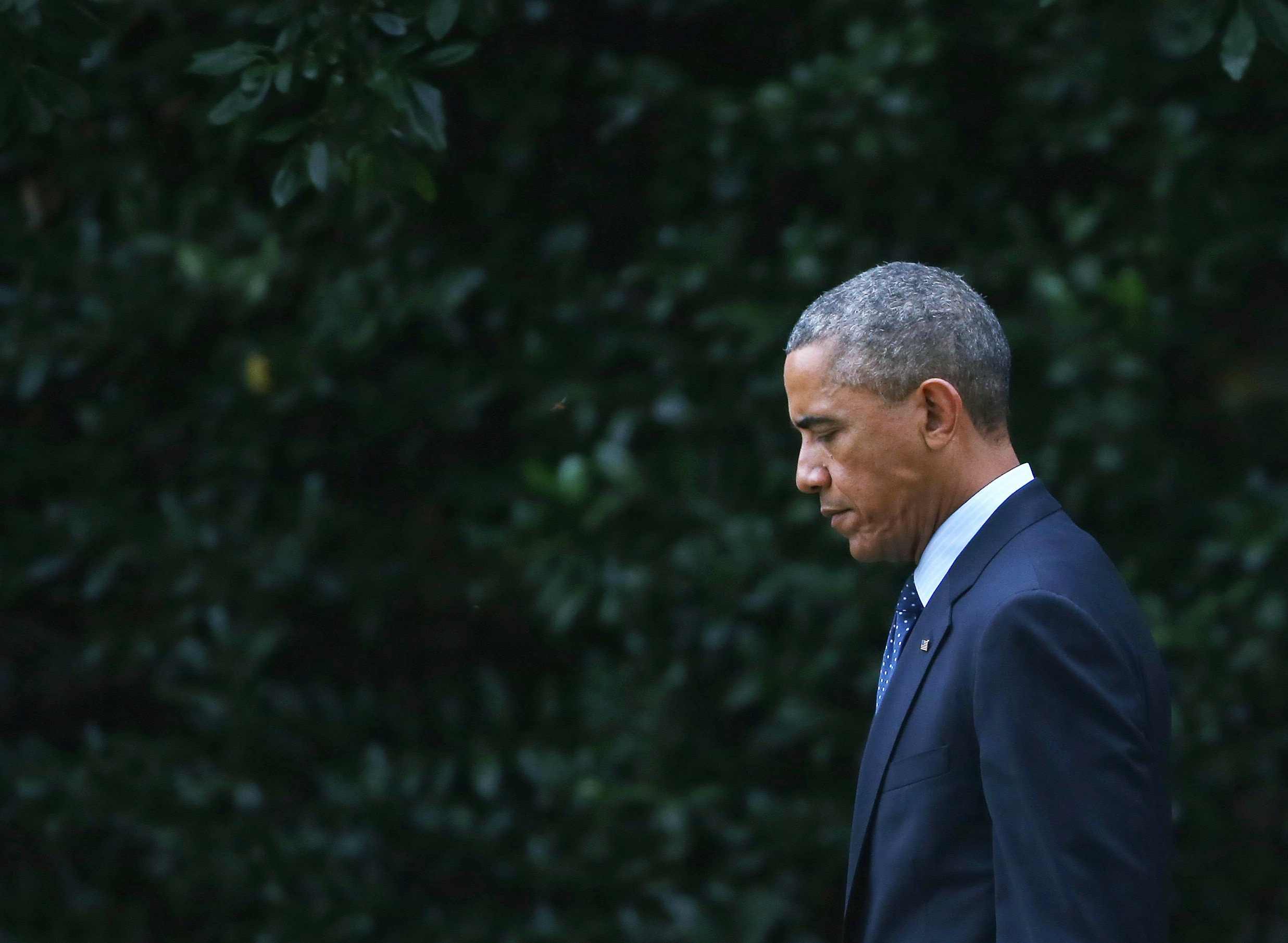
Obama Departs The White House En Route To New York

There have been posts I’ve written over the past decade and a half on this blog that have left me with a very heavy heart. Absorbing the full meaning of what was revealed at Abu Ghraib was one; reflecting on the horrifying child-abuse in the Catholic church was another; reacting to president Bush’s endorsement of a Federal Marriage Amendment or president Obama’s half-assed decision to re-fight the Iraq War one more time were not exactly easy posts to compose. I confess I find it hard to write dispassionately about these kinds of things. The abuse of children; the torture of prisoners; the madness of permanent warfare; and the citizenship and dignity of gay people: these are first order questions for me. I understand, as we all must, that politics is an inherently flawed, imperfect, deeply human and always compromised activity. But some things are not really open to compromise. And torture is one of them.

The mounting evidence that president Obama’s long game may well mean the entrenchment and legitimization of torture and abuse of prisoners is a deeply painful thing to report on. He’ll say otherwise; they’ll reach out and insist otherwise. But the record, alas, is getting clearer by the day. We have seen Obama’s rock-solid support for John Brennan’s campaign to prevent any accountability, even to the point of spying on the Senate Committee tasked with oversight, across his two terms. We have watched as the White House has refused to open up its own records for inspection, as it has allowed the CIA to obstruct, slow-walk and try to redact to meaninglessness the Senate Intelligence Committee’s still-stymied report on torture. Our jaws have dropped as the president has reduced one of the gravest crimes on the statute book to “we tortured some folks,” while doing lots of “good things” as well.

Now for the moment when the stomach lurches. The Obama administration is actually now debating whether the legal ban on torture by the CIA in black sites and brigs and gulags outside this country’s borders should be explicitly endorsed by the administration in its looming presentation before the UN’s Committee Against Torture (which might well be an interesting session, given the administration’s consistent refusal to enforce the Geneva Conventions).

One has to ask a simple question: what on earth is there to debate? Torture as well as cruel, inhuman and degrading treatment has already been banned by the executive order of the president, and it is not bound by any geographical limits. Here, moreover, is the text of the Detainee Treatment Act, pioneered by torture victim John McCain, making it even more explicit:

(a) No individual in the custody or under the physical control of the United States Government, regardless of nationality or physical location, shall be subject to cruel, inhuman, or degrading treatment or punishment.

(b) Construction. Nothing in this section shall be construed to impose any geographical limitation on the applicability of the prohibition against cruel, inhuman, or degrading treatment or punishment under this section.

Well: here is the explanation, as given by Charlie Savage in the NYT yesterday:

Military and intelligence lawyers are said to oppose accepting that the treaty imposes legal obligations on the United States’ actions abroad. They say they need more time to study whether it would have operational impacts. They have also raised concerns that current or future wartime detainees abroad might invoke the treaty to sue American officials with claims of torture, although courts have repeatedly thrown out lawsuits brought by detainees held as terrorism suspects.

The CIA’s lawyers want more time to study whether banning torture and cruel, inhuman or degrading treatment of prisoners in line with the law and Obama’s executive order would have “operational impacts”. But how could it when torture and mistreatment are hereby forever banned? Doesn’t it imply that the CIA still sees an option for restoring torture in the future, especially if a pro-torture Republican wins the presidency?

A strong case for this interpretation can be read here in a post by David Luban. It’s essential, if complex, legal reading for anyone concerned that Obama, by taking the CIA’s side in this debate and promoting and exonerating those implicated in past torture, has actually left open the real possibility of this darkness descending again.

Savage has tweeted in response that “operational impacts” could merely refer to conditions of confinement, or force-feeding, rather than to torture and abuse more broadly understood. But the question is still vague – and we know enough about the appalling record of the CIA in this matter to suspect that even the tiniest loophole in the anti-torture regime – like those dutifully carved by Yoo, Bybee et al. – can lead to more war crimes, whose very existence can be suppressed.

You can see the inherent danger here:

Bernadette Meehan, a National Security Council spokeswoman, said Mr. Obama’s opposition to torture and cruel interrogations anywhere in the world was clear, separate from the legal question of whether the United Nations treaty applies to American behavior overseas.

Say what? Is she really saying that all that matters is that Obama personally opposes torture, regardless of whether the law says so or not? Does the administration think we’re that easily placated? Does the president think that another empty rhetorical gesture to his base will suffice – even though his administration intends to be mealy-mouthed about torture in front of the UN Committee and leave a gaping loophole for the next president to exploit?

Presidents come and go; Congressional majorities go back and forth; but the CIA remains. Because this administration never even considered enforcing the Geneva Conventions on the US – by refusing to investigate and prosecute acts of torture and abuse by government officials under the previous administration – the CIA knows it can get away with war crimes in plain sight. Emboldened by that knowledge, and eager to prove that its previous actions were completely legit, it seeks now to find ways to cover up the record, and get the Obama administration to endorse a loophole for the perpetuation of torture, thus cementing a bipartisan protection of war criminals and of war crimes and prisoner abuse. It does all this for the future: so that it will never be held accountable by any body, domestic or international, and so that it can torture and abuse again, if it decides it’s in the country’s best interests. And only it will make that decision. We know by now it needs no other sanction – just some legal shenanigans to cover its own ass.

So we have a true test of what this president is made of, as the administration preps for its first appearance before the UN Committee. Is this president serious about torture? Or is he a pawn, like so many before him, of a rogue agency that is accountable to no one?

(Photo by Mark Wilson/Getty Images)

When Exactly Might DC Have Legal Weed?

know-dope-shirts

Jon Walker asks around:

“About four months” is theoretically the absolute fastest that stores could begin selling recreational marijuana in the District after the D.C. Council adopts new legislation, according to Rabbi Jeff Kahn. As the operator of Takoma Wellness Center, one of D.C.’s three functioning medical marijuana dispensaries, he is uniquely positioned to provide insight into this question.

But a year to a year-and-a-half is more likely:

One big hold up could be the council and the local regulators charged with writing the final rules.

The council is going to need to not only balance the needs of the customers, the community and business leaders, but also trying to prevent Congress and/or federal agencies from stepping in to shut down the whole thing. After all, voters in the District first approved a medical marijuana initiative back in 1998, but Congress stepped in to prevent the District from actually adopting medical marijuana rules until 2010. Earlier this year, a federal appropriations bill containing a provision to block D.C. efforts to move forward with marijuana legalization actually passed in the House, but it died when the Senate didn’t take it up.

That said, Councilmember David Grosso (I) feels that if voters show overwhelming support for Initiative 71, the council will move quickly to respect the will of the electorate.

Which is a good opportunity to highlight the absurd anomaly of the capital city’s disenfranchisement. Which reminds me: get your Know Dope DC t-shirts here. (Oregon version here and Alaska version here … full details on the shirts here.)

Why Networking Makes You Feel Icky

Jordan Gaines Lewis explains:

Describing ourselves on paper, while blindly attempting to live up to the expectations of others, makes it all feel like a giant lie, doesn’t it? Of course, personal statements and cover letters add a particularly thorny dimension – we have to brag about ourselves.

An amusing study in an upcoming issue of Administrative Science Quarterly suggests that putting ourselves out there professionally actually makes us feel dirty. Literally.

In the study, 306 adults were asked to imagine one of two scenarios. One group recalled a time when they needed to create a relationship with someone who would benefit them professionally. The other group thought about an instance where they socialized casually, like at a party. The participants then filled in the blanks to word fragments such as W _ _ H, S H _ _ E R, and S _ _ P.

Those who had relived situations of professional networking were roughly twice as likely to fill in the blanks with words related to physical cleanliness, such as “wash”, “shower,” and “soap,” while the other group tended to come up with more neutral words, such as “wish,” “shaker,” and “step.” The conclusion drawn by the study’s authors was that “networking in pursuit of professional goals can impinge on an individual’s moral purity.”

What The Market Is Thinking

Last week was a volatile one for the S&P 500, starting with the worst three-day decline since 2011. Robert Shiller contends that “fundamentally, stock markets are driven by popular narratives, which don’t need basis in solid fact. True or not, such stories may be described as ‘thought viruses.'” He focuses on secular stagnation, “the idea that there is disturbing evidence that the world economy may languish for a very long time, even for generations”:

I did a LexisNexis count of newspaper and magazine mentions, by month, of the phrase “secular stagnation,” and I found that they have exploded since November 2013. And a Google Trends search shows a similar pattern for web searches for the phrase since that time.

Why? It’s probably because Lawrence H. Summers, the former Treasury secretary and Harvard president, used the phrase in a talk he gave on Nov. 8 at the International Monetary Fund in Washington. Paul Krugman wrote approvingly about the talk in The New York Times nine days later. Mr. Summers presented his secular-stagnation idea with uncharacteristic diffidence: “This may all be madness and I may not have this right at all.” But his talk seemed to release a thought virus.

And changing the mindset of investors isn’t easy. Clive Crook points out an irony:

The more widely these psychological channels are understood, the harder it is for central banks and other policy-makers to exploit them.

If investors believe that policymakers are doing nothing but attempting to influence their mood, their mood will be more resistant to influence. Quite possibly, that resistance could increase to the point where even consequential changes in policy no longer have consequences. In central banking, as in most things, the secret of success is sincerity: If you can fake that, you’ve got it made.

Ben Casselman, however, recommends ignoring the day to day fluctuations in the market:

Wednesday was the 26th time this year that the Dow rose or fell by at least 1 percent. It happened 24 times in 2013 and 39 times in 2012. In other words, big swings in the market happen dozens of times a year — and usually mean absolutely nothing. Economist Eugene Fama won a Nobel Prize for demonstrating that the stock market is a “random walk” — its short-term moves don’t reveal anything about the long-term trend.

David Leonhardt provides a historical perspective on the stock market. He warns that stocks are currently expensive:

Since 1881, when the Standard & Poor’s 500-stock index has had a price-earnings ratio of at least 24 — just a bit below where it is now — the average return over the next 10 years is negative 3 percent.

By comparison, the average 10-year return over that entire period, regardless of P/E ratio, is 36.3 percent.

There have been times — like the last few years — when stocks are expensive and they continue rising rapidly regardless. So it is not out of the question that stocks will rebound from their recent decline and rise over the next few months or years. More often than not, though, high-priced stocks lead to mediocre returns, at best, over the ensuing decade.

Finally, Danielle Kurtzleben argues that the media pays too much attention to the stock market:

[F]or all the fearful questions about whether a market correction is coming, it’s important to take some perspective: the stock market’s latest oscillations and whatever crashes might be on the way will only directly affect around half of Americans, and their biggest effects will be on the richest people.

Federal Reserve data compiled by CNBC shows that the share of Americans who own stocks has hovered at around 50 percent for 15 years. And of course, not all of those people own the same amount of stock. As with incomes and wealth in general, stock ownership is highly concentrated at the top (and has been for a while), as this chart from the Economic Policy Institute shows. The bottom 80 percent of Americans by wealth only own just over 8 percent of all stock owned by US households.