Spoken Like A True Leader

Authors David Mark and Chuck McCutcheon highlight examples of speech patterns among politicians:

Take “my good friend”—politician-speak for somebody he or she often can’t stand. “My good friend” is most commonly used on the House or Senate floors when addressing a colleague. Usually it’s a thinly veiled way of showing contempt for the other lawmaker while adhering to congressional rules of decorum. When Democratic Rep. Gene Green of Texas first arrived on Capitol Hill in the early 1990s, he recalled, “The joke we had was, when someone calls you their good friend, look behind you. I try not to say it unless people really are my good friends.’”

A linguistic cousin of “my good friend” is another term favored by an older generation of House members:

“minimum high regard.” Former Rep. Martin Frost of Texas, who held several Democratic leadership positions during his tenure from 1979 to 2005, turned us on to this time-honored knock against political foes. Frost recalled “one House member saying to another during floor debate: ‘I hold the gentleman in minimum high regard.’” Frost helpfully translated the phrase for us: “It means, ‘You are an idiot.’”

There’s also “counterproductive,” which, as Brookings Institution President Strobe Talbott told National Public Radio, is “a word we use here in Washington to mean ‘stupid.’” And lawmakers have found they can get away with almost anything if they preface it with, “With all due respect.” That’s just what Maryland Democratic Rep. Chris Van Hollen did in a December 2013 MSNBC interview chiding Kentucky Sen. Rand Paul that Congress would be doing a “disservice” to workers by extending unemployment benefits. “With all due respect to Sen. Rand Paul, that is a ridiculous argument,” said Van Hollen.

Mark and McCutcheon’s new book, Dog Whistles, Walk-Backs, and Washington Handshakes: Decoding the Jargon, Slang, and Bluster of American Political Speech, is available here.

The Best Of The Dish Today

First up, the burning issue on everyone’s minds. Not Ebolisis – a strange pandemic in which the deaths of a handful of Westerners has caused an entire nation to brown its whites:

pt3zpm8eavkixwtkvyh5

No, I mean the relative absence of wing-wangs on TV and the big screen. (All links in this post are NSFW, BTW.) Despite Trey Parker’s fascination with the remarkably few swinging dicks on Game of Thrones, there’s still an obvious double-standard for men and women. Boobs have long been everywhere, as the charming Seth McFarlane once reminded us at the Oscars; vaginas much less so – but still common in indie movies; bare butts are now ubiquitous. But even Lena Dunham only shows a somewhat comically deflated dick on the bathroom floor after her parents have an accident during shower sex. And in the most famous dick-shot in movie-history – although readers are more than welcome to correct me – it’s pretty dark and vague down there. 

But the pendulum seems to be swinging the other way, as this rather amusing chit-chat at TNR suggests. There’s a whole thread at Deadspin, it appears, called Athlete Dong, edited by a self-style “Dongbudsman” who features the unmissable, usually in spandex. (Yes, that was an hour down the drain this afternoon.) Then there was the great Jon Hamm package followed by the more recent jogging display by The Leftovers‘ Justin Theroux – and now some question whether Ben Affleck’s dick is in Gone Girl or not. And don’t forget the penis pioneering of Jason Segel. The Starz network is apparently in the lead, but

Showtime has also had their fair share of penises on display. One fellow in particular that comes to mind is Jody (Zach McGowan) on Shameless. Not only did we get a look, they even gave us a long close up. It was, shall we say, memorable. Overkill? Heck no! It was situational and it drove the plot, which is more than I can say for countless shots of female full-frontal nudity or breast shots.

The TNR writers have various points to make about this – is it feminism finally FTW? are dicks finally being treated as objectively as boobs? etc – but one factor seems obvious to me. The dick pic is what’s new. And the dick pic has begin to change the next generation’s views about views of wandering willies.

The Dish has long celebrated the wonderful, compassionate tumblr CritiqueMyDickPic (see here and here), as well as an art exhibit of such pics, and a YouTube called “Janet Looks At 89 Dicks“. And now the great Instagram account @thatlookslikeadick makes its Dish debut:

Screen Shot 2014-10-16 at 7.42.38 PM

But the existence of all these is not (just) a function of my own curiosity, but primarily a small sign of the legion of penises marching around social media these days. Sexting has broken the taboo – for men as well as for women. Except, of course, most dick pics sent on Tinder or Grindr or whatever’r are erect, while almost all movie/TV shots are extremely flaccid, even moments after orgasm. That’s where we have yet to venture on TV. Where have you gone, Lena Dunham? A nation turns its lonely eyes to you.

Earlier on the Dish today, we covered the pretty unforgivable lapses in treating Ebola cases in the US (and some truly foul electioneering by the GOP); we hailed a possible breakthrough in nuclear fusion and took issue with some whiny lefties over it; I had some real due process concerns about the new sexual consent law in California and Harvard (Conor FTW); and I noted a somewhat pathetic effort by the American bishops to re-translate Monday’s Relatio from Rome on welcoming gay people into the church in order … well, for us to feel less welcome. Plus: the latest liberal interventionist proposal for mission creep in the Syrian-Turkish-Kurdish Clusterfuck that Obama so foolishly got us into.

The most popular post of the day was Yes, This Is A Pastoral Revolution; followed by Codifying Consent, Ctd. And the most popular t-shirts publicizing the Election Day vote to legalize pot in Alaska, DC, and Oregon are here:

know-dope-shirts

Buy the standard “Know Dope” t-shirt (seen on the left) here. Buy the DC one (on the right) here. That same design but with “Alaska” on it available here. And all you Oregonians out there, get your version here. Each version is just $20. All purchases help us keep this blog on the road. And don’t forget to email us a pic – with or without a dick – after your shirt arrives.

See you in the morning.

The Fusion Of Journalism And Advertising, Ctd

There isn’t even a fig-leaf any more. The reporter and the copy-writer are exactly the same person over at the Mail Online:

Mail Online runs journalists’ bylines on the [native advertising] pieces, a move designed not only for transparency but also for commitment to sponsor content being held to a high standard …

A recent example of this is a monthlong campaign kicked off last week for T-Mobile. Mail Online pitched the carrier with a content program that’s part of a larger ad package for T-Mobile’s new home-networking technologies … That’s where Mail Online’s U.S. technology and science editor Mark Prigg comes into the picture. In the first of five sponsored offerings, he was enlisted to create the first piece of the program, a detailed examination of the “10 surprising hacks to improve your home’s technology for FREE.” The piece is wrapped Screen-Shot-2014-10-15-at-3.02.44-PMby a T-Mobile advertising “skin,” and carries “Sponsored by T-Mobile” in blue. Unlike other publishers, Mail Online does not file its native ad stories in a sponsored section — this piece is in its science and tech vertical.

Prigg is also the “journalist” who reviews T-Mobile products for the paper. And what’s fascinating to me is how so many editors have not struggled with this obvious conflict, but regarded all criticism as absurd: “It’s amazing the debate continues to go on when advertorials have been around forever,” says Mail Online North America CEO Jo Steinberg.

Arianna Huffington has also proudly announced that HuffPo staffers will now be directly embedded in an ad agency to create the native ads that will run on HuffPo. There is not even a scintilla of concern about the journalistic ethics of that. As for whether the surrender of journalism to advertising is actually selling anything – well:

There’s more evidence that the impact of sponsored content, a hot trend in advertising, is hard to measure. According to a new report from the Content Marketing Institute, only 23% of business-to-consumer marketers polled said they were successful at tracking the return on investment of their content marketing program. That figure rose to 43% for marketers who said they had a written content marketing strategy.

And the beat goes on …

The Battle For Benghazi Heats Up

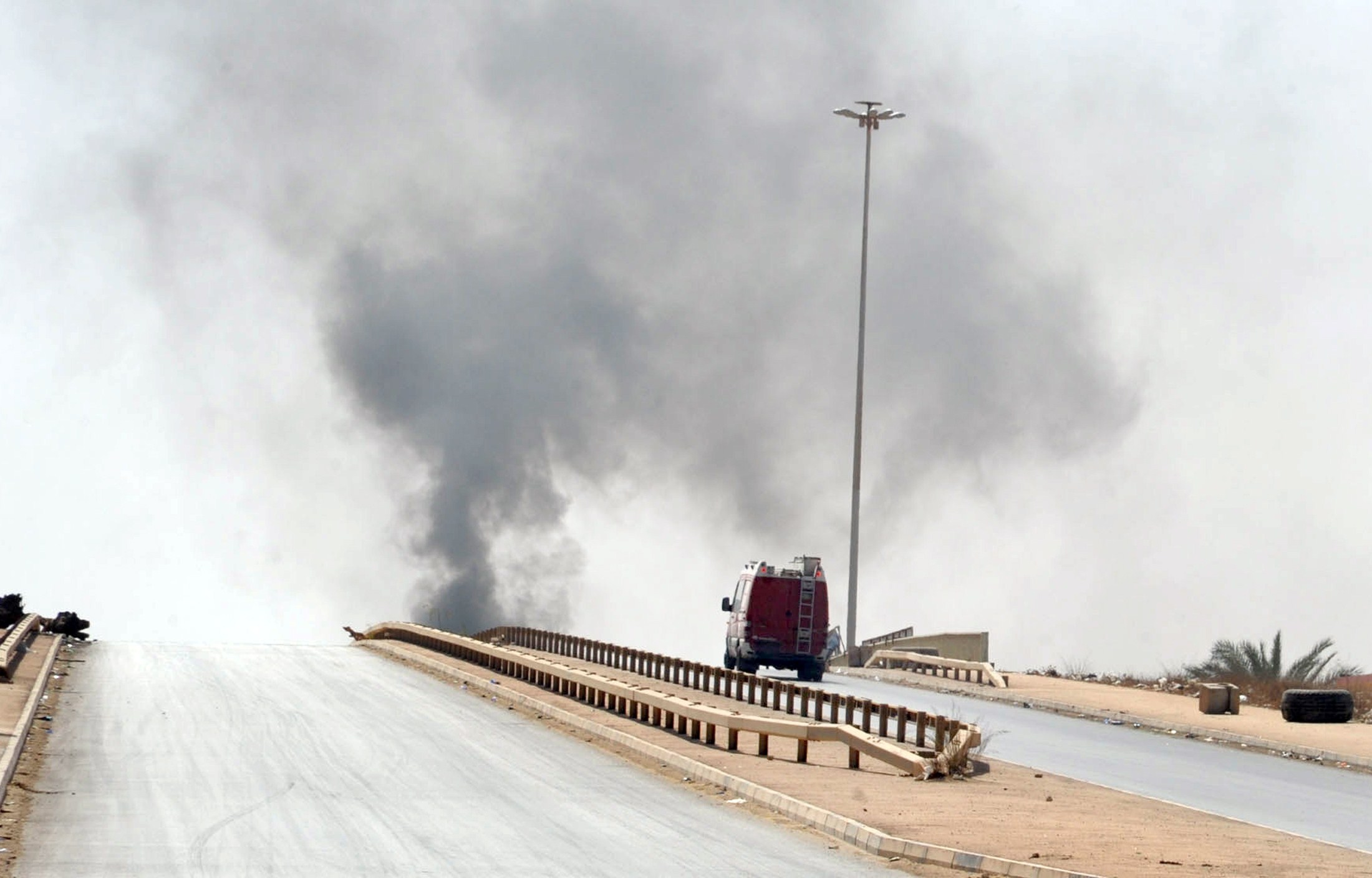
LIBYA-UNREST-BENGHAZI

Yesterday, two Egyptian officials claimed that Cairo was taking on an active role in the Libyan civil war, and that Egyptian warplanes had carried out airstrikes against Islamist militias in Benghazi:

The two officials, who have firsthand knowledge of the operation, said the use of the aircraft was part of an Egyptian-led campaign against the militiamen that will eventually involve Libyan ground troops recently trained by Egyptian forces. The operation, they said, was requested by the internationally recognized Libyan administration based in the eastern city of Tobruk. That elected administration was thrown out of the capital, Tripoli, by rival militias allied with Islamic political factions. “This is a battle for Egypt not Libya,” one of the senior officials said. “Egypt was the first country in the region to warn against terrorism and it is also the first to fight it.”

Egypt officially denied the claim. Mohamed Eljarh puts the news in context, noting that fresh fighting broke out in Benghazi just yesterday:

The clashes started a few hours after a televised statement by ex-general Khalifa Haftar in which he vowed to capture the city from a coalition of Islamist groups called The Benghazi Shura Revolutionaries Council, which is dominated by the extremist group Ansar al-Sharia. Both sides are deploying artillery and other heavy weapons in the fighting. …

The city of Benghazi, Libya’s second largest, has endured a two-year assassination campaign targeting army and police personnel as well as judges, journalists, and civilian activists. Many Libyans blame the attacks on extremist Islamist groups. The Libyan authorities have been unable to establish control in the city and its people have become correspondingly disillusioned with government institutions. Last May, General Haftar decided to seize the initiative by deploying units of the National Army in a military offensive against the militias in the city. His efforts have met with widespread support across the country.

Alaa al-Ameri predicts that Egypt’s intervention will backfire:

Egypt’s intervention in Benghazi allows Libya’s Islamists, who had hijacked Libyans’ hard-won chance at democracy at every turn, to point to the House of Representatives’ allegiance with Sisi as proof that the Islamists are the true defenders of the Libyan revolution. Their patrons in the region, most notably Qatar, can now support them more readily than when Libya’s troubles appeared to be purely internal, thereby adding more fuel to the fire and threatening a much wider regional spillover. Although Qatar has made a public show of easing back on its regional sponsorship of Islamists, it seems unlikely that it will completely abandon its allies in Libya, whom it has supported with weapons and money since the beginning of the uprising against Muammar Qaddafi’s regime in early 2011.

Frederic Wehrey notes that Libya currently has no single, legitimate governing authority:

There are now two governments in Libya. One is in the eastern city of Tobruk, backed by the rump of the elected parliament, the House of Representatives (HOR). The other, based in the capital, Tripoli, has taken de facto control over ministries, relying on a handful of former members of the HOR’s predecessor, the General National Congress (GNC), to provide a veneer of legitimacy. Each is associated with a coalition of militia forces: those supporting the rump parliament have dubbed themselves Operation Dignity; those opposing it go by Operation Dawn. And each is flush with cash, heavy weaponry, and support from outside powers — Egypt and the United Arab Emirates (UAE) have backed Dignity, while Qatar, Sudan, and Turkey are purported to be backing Dawn. Contrary to some commentary, both sides have used force against civilians and elected institutions, and both show little sign of compromise.

Mary Fitzgerald explores the complexities of the divided country and how the fighting has affected ordinary Libyans:

The militias’ fighting this summer left Tripoli scarred: The international airport is a burned-out shell, and scores of homes lie ruined in the worst-hit neighborhoods. But elsewhere in the capital, life goes on — families flock to the beach or busy cafes, and traffic snarls in the usual gridlock. There is little overt militia presence, apart from outside certain ministries and the area around the destroyed airport.

The Dawn camp knows it needs to get the people on its side. Its effort is hindered, however, by lingering memories of the killing of more than 40 demonstrators by Misratan militiamen last year. “All these militias are as bad as the other, no matter who they claim to represent,” says one shop owner who shuttered his business for weeks in July and August. “Most Libyans want to see the end of all of them.”

(Photo: A vehicle drives in a deserted road as smoke billows during clashes between soldiers and Islamists who control Benghazi, the country’s second biggest city, on October 15, 2014. By STR/AFP/Getty Images)

Inching Closer To An Agreement?

Iranian officials are reportedly considering a compromise offer by the US that would resolve one of the main sticking points in the slow-going negotiations over Iran’s nuclear program:

At issue is Iran’s uranium enrichment program, which can make both reactor fuel and the fissile core of nuclear arms. Tehran insists the program is only for future energy needs. Iran is refusing U.S. demands that it cut the number of working enriching centrifuges from nearly 10,000 to only a few thousand. That dispute has been the main stumbling block to progress since the talks began early this year.

Ahead of a Nov. 24 deadline to seal a deal, diplomats told the AP last m nth that U.S. had begun floating alternates to reducing centrifuges that would eliminate the disagreement but still accomplish the goal of increasing the time Iran would need to make a nuclear weapon. Among them was an offer to tolerate more centrifuges if Tehran agreed to reduce its stockpile of low-enriched uranium, which can fuel reactors but is also easily turned into weapons-grade material. Back then, Iran was non-committal. But the two diplomats said Thursday it recently began discussions with Moscow on possibly shipping some of its low-enriched stockpile to Russia for future use as an energy source.

Suggesting some other potential compromises, Reza Marashi hopes that both the Obama and Rouhani administrations can overcome the domestic political challenges that stand in the way of an otherwise feasible and necessary deal:

The reality facing both sides will not change:

There are spoilers in the U.S. and Iran who will try to torpedo a deal, no matter the details. Precisely because it is impossible to satisfy ideologues, they only way to defeat them is to have a deal in hand that both sides believe is a win-win outcome. That will force the ideologues to publicly flesh out the details of their alternative — and the only alternative to a comprehensive deal is war. That is Obama and Rouhani’s trump card, and as November 24 approaches, they must play to win the game.

Matthew McInnis suspects the Iranians are under more pressure now than before:

Perhaps the eagerness we are seeing from some in Tehran reflects a regime realizing it must reach an agreement even if the deal may be a more painful pill to swallow than expected. The recent substantial drop in oil prices may have convinced Rouhani and the senior leadership that their critical domestic economic reforms are in potential serious jeopardy and that sanctions relief must happen soon. That is not to mention the conflict with ISIS is also bleeding valuable resources. Fears of the Israelis starting a covert campaign against their nuclear facilities may have spooked the military.

But Drezner is less optimistic:

Complaining that domestic politics is getting in the way of a nuclear deal is a little like complaining that enriched uranium is getting in the way of a nuclear deal — they are both intrinsic to the negotiations. … It’s also not obvious to me, by the way, that either President Obama or President Hassan Rouhani will be able to make the hard sell on a compromise to their respective legislatures. It’s not like Obama’s national security street-cred is riding terribly high at the moment, and Rouhani has his own hardliners to massage.

So the political scientist in me thinks that a nuclear deal would be good for the United States in the short and long runs. But that same political scientist in me is also increasingly skeptical about arguments that leadership will somehow be able to override hardliners in both countries to get to that deal.

The Syrian-Turkish-Kurdish Clusterfuck, Ctd

Senate Armed Services Chairman Carl Levin has come out in favor of establishing a buffer zone along the Turkish-Syrian border, along with a no-fly zone, to protect civilians against both ISIS and the Assad regime:

“We should seek to establish a delineated buffer zone along the Turkish border in order to protect civilians, a zone which would be secured by Turkish boots on the ground, if Turkey is willing, protected by a coalition no-fly zone,” Levin said Wednesday morning at the United States Institute of Peace. “Both things will be necessary, for Turkey to consider Turkish boots on the ground inside Syria along that border, there must be a no-fly zone to protect that buffer zone… and we should seek to do that.”

This is not the first time Levin has called for a no-fly zone in Syria. In March of 2013, Levin endorsed the idea of a no-fly zone and airstrikes against the Assad regime. But that was before the Obama administration made a deal with Assad promising no airstrikes against his forces in exchange for Syria turning over its chemical weapons stockpiles.

Levin’s proposal would fulfill some of Turkey’s conditions for participating in the fight against ISIS in Syria. However, Kate Brannen points out, it would also be an expensive, risky undertaking that could draw us much deeper into the Syrian civil war than we’d like to get (which, in turn, would sort of fulfill Turkey’s other main condition):

Creating a no-fly zone along the Syrian-Turkish border that could serve as a refuge for civilians fleeing the Islamic State and a training ground for members of the Syrian opposition would most likely mean taking out Syrian air defense systems and possibly taking on its air force. That could result in significant numbers of Syrian military fatalities — and potentially American ones.

That type of fight would also run the risk of setting back the fight against the Islamic State, as the United States and its coalition members would essentially be fighting a war on two fronts. The Syrian military has not interfered with U.S. airstrikes against terrorist targets in eastern and northern Syria, but that could change if U.S. airplanes also start bombing Syrian targets.

As for Ankara’s surprising behavior of late, Totten stresses that it shouldn’t be surprising at all:

When [Turkish President Recep Tayyip Erdogan] looks at the map he sees dominoes. Kurdish independence in Iraq could lead to Kurdish independence in Syria which could lead to Kurdish independence in Iran which could lead to Kurdish independence in Turkey. Every time a new independent Kurdish entity pops up in the Middle East, the liklihood that Turkey will lose an enormous swath of its territory increases. His analysis is correct. So he’ll bomb the Kurds but not the Islamic State. He’d be against Kurdish independence in Syria even if the PKK didn’t exist.

Turkish animosity against Kurds is hardly a secret, so I’m not sure why so many in Washington can’t understand this guy. Maybe it’s because he lets girls go to school and doesn’t stone anybody to death.

Derek Davison seconds that:

The fact that Turkey would apparently rather let Daesh slaughter and enslave the Kurdish defenders of Kobani than do anything that might benefit long-term Kurdish political aims may be immoral, unconscionable, even indefensible on a humanitarian level, and it’s fine to condemn Turkey on those grounds, but as a pure calculation of national interest, what Turkey is doing shouldn’t surprise anybody. It’s not as though America hasn’t greatly wronged the Kurds in the past, when it was in US interests to do so. It’s also worth noting that the UK and Germany have also opted out of direct military involvement in Syria, but nobody seems to be talking about expelling them from NATO or moving American military hardware to other countries in Europe.

It may be that Turkey will still come around to America’s position on Daesh, or at least closer to it; recent Kurdish protests aside, Ankara’s Syria policy has been consistently unpopular within Turkey, and PKK threats to break-off peace talks with the government over its inaction in Kobani may yet force Erdogan’s hand. But if Erdogan is swayed, it will be because of domestic politics, not American pressure or threats.

The Grave Risks Of A Travel Ban, Ctd

quarantine1

New survey data from YouGov show that the public is pretty enthusiastic about quarantines and travel bans as means to prevent an Ebola outbreak:

Those following news about the virus are especially likely to want to take action.  82% of those who have been following news stories about Ebola very closely would quarantine travelers from countries with Ebola outbreaks; two in three would completely exclude travelers from those countries.

We covered the debate over a travel ban earlier this week. Rebecca Leber outlines how a potential quarantine policy would be enforced:

Authorities generally prefer to make recommendations and rely on people to follow them in good faith. “In the U.S. we tend to try to do a softer approach, not be too coercive, and not scare people so as to drive the epidemic underground,” says Lawrence Gostin, a Georgetown University professor and Director of the World Health Organization Collaborating Center on Public Health Law and Human Rights.  The exceptions are situations in which people are ignoring recommendations. And that’s already happened at least twice in the Ebola saga. …

In Dallas, Texas, four people who were inside the apartment when Duncan became ill are also under quarantine. But local authorities have handled it in a way that highlights the potential danger of the approach. Duncan’s partner and her family were trapped in a contaminated apartment for days, amid soiled bedsheets and clothes, before they finally could move to a clean apartment. Gostin told me this may be unconstitutional. “That’s unacceptable to subject people who are quarantined to that kind of risk to their health,” he said.

Douthat resists the suggestion – one that is gaining traction on the far right – that the Obama administration is avoiding such measures for ideological reasons:

Sure, maybe the Obama White House isn’t wild about the potential implications for immigration politics of giving ground on a quarantine or travel ban … but the potential implications of a hundred Ebola cases spread across five cities are so, so much worse that the political-ideological incentive cuts, if anything, in favor of overreacting. And what’s true of crisis politics around a specific issue like immigration is true of crisis politics writ large: Because there is nothing, nothing that would wreck Obama’s legacy and his party’s immediate fortunes alike more than a real Ebola outbreak in the United States, I have to believe that people in the White House have what they consider sound, non-ideological reasons for why a travel ban isn’t a no-brainer[.]

To J.D. Tuccille, a fear-based response to Ebola is scarier than the disease itself:

To be honest, it could all be a lot worse. In the frenzy of panic over potential bioterrorism post-9/11, many states adopted part or all of the Model State Emergency Health Powers Act, written by Lawrence O. Gostin, a professor of law and public health at universities including Georgetown and Johns Hopkins. Gostin argued that “Although security and liberty sometimes are harmonious, more often than not they collide.” He added, “The central inquiry, then, is not whether government should have the power to act… Rather, the proper inquiry is under what circumstances power can be exercised.”

The resulting legislation, the American Civil Liberties Union noted at the time, “doesn’t adequately protect citizens against the misuse of the tremendous powers that it would grant in an emergency.” Nobody has yet proposed dusting off that fear-fueled legislation. But with the whiff of cold sweat in the air, it’s all the more reason to fear panic more than a virus.

What The Hell Is Happening In Houston?

News dropped on Tuesday that pastors’ sermons had been subpoenaed in the ongoing legal maneuvering over the city of Houston’s equal rights ordinance (HERO), which includes prohibitions against discriminating on the basis of sexual orientation and gender identity:

Opponents of the equal rights ordinance are hoping to force a repeal referendum when they get their day in court in January, claiming City Attorney David Feldman wrongly determined they had not gathered enough valid signatures to qualify for the ballot. City attorneys issued subpoenas last month during the case’s discovery phase, seeking, among other communications, “all speeches, presentations, or sermons related to HERO, the Petition, Mayor Annise Parker, homosexuality, or gender identity prepared by, delivered by, revised by, or approved by you or in your possession.”

To add to the story, Mayor Annise Parker is openly lesbian – creating an irresistible opportunity for the usual suspects. Fox News hack Todd Starnes declares that, if pastors are arrested for refusing to obey the subpoenas, then “Christians across America should be willing to descend en masse upon Houston and join these brave men of God behind bars.” Dreher is having his usual cow. The issue is a little more complicated, though:

When the city rejected the petition on the ground that the signatures were invalid, some opponents of HERO—not the pastors themselves—challenged the city’s decision in court. The city issued the subpoenas in connection with that litigation.

The theory, as I understand it, is that because these pastors helped organize the petition drive and hosted meetings, the pastors’ statements about the petition are important. I guess the idea is that the pastors may have said something that induced phony signatures … So when the city says it would like to know what the pastors may have said about the petition drive itself, that’s not a completely untenable position, given the freewheeling rules of American pretrial litigation.

Still, the subpoena is disturbing to me – and way too broad, as Eugene Volokh notes. But the story falls a little flat because, well, the mayor herself claims she first heard about the subpoenas yesterday and agrees with the critics. Katie Zavadski investigated and found out the following:

The subpoenas were sent by outside attorneys working for the city pro bono. They were looking into what instructions pastors gave out to those collecting signatures for a referendum on the non-discrimination law. (What exactly the pastors said, and what the collectors knew about the rules, is one of the key issues in pending litigation around whether opponents of the law gathered enough signatures for a referendum.)

“There’s no question, the wording was overly broad. But I also think there was some deliberate misinterpretation on the other side,” Parker said at a press conference Wednesday. “The goal is to find out if there were specific instructions given on how the petitions should be accurately filled out. It’s not about, ‘What did you preach on last Sunday?'”

Katie also notes that the mayor’s office confirmed via email “that the city will narrow the scope of inquiry into the pastors’ communications to more directly target HERO petitions.” Which is a relief.

Update from a helpful reader:

I’m an attorney who does civil litigation, so subpoenas like this are very familiar to me. One important point is that the City has no ability to enforce these subpoenas itself. Any party in civil litigation can issue a subpoena on its own and without court permission. If the people who receive the subpoena think it is too broad, they can object, and the party who issued it then has to convince the judge in the litigation that the subpoena is appropriate.

Also, the typical process for dealing with an issue like this is that the person (or their attorney) who receives a subpoena would call the attorney who issued it, express their concern, and the two sides would try to reach a mutually agreeable compromise. Such “meet and confer” sessions are routine in civil litigation, and would be required before the issuing party could ask the judge to enforce the subpoena.

Thus, there are very reasonable safeguards in place against abuse.