Everyone needs a beard for the winter:
Month: October 2014
The American Bishops Try To Re-Write The Relatio
The hierarchs largely appointed by John Paul II and Benedict XVI have amended the English translation in ways that are unfaithful to the original Italian – and all as a way to tone down any outreach to gay people. So the section titled “Welcoming Homosexuals” has been changed to “Providing For Homosexuals.” So we are to infer that the Catholic bishops in America really don’t want to welcome gay people. It’s critical to note that “in nearly all cases, the first version followed the official Italian version in verbatim; the second provides a different tone altogether.” And so:
The first version asked if the church was capable of “welcoming these people, guaranteeing to them a fraternal space in our communities.” The new version asks if the church is “capable of providing for these people, guaranteeing … them … a place of fellowship in our communities.” The first version said homosexual unions can often constitute a “precious support in the life of the partners.” The new one says gay unions often constitute “valuable support in the life of these persons.”
All of which goes to show that the reactionaries are going to fight this papacy down to petty issues such as translations. This Synod is just the beginning of the struggle; and that struggle’s success will lie in the wiles and, above all, longevity of Francis.
Chart Of The Day
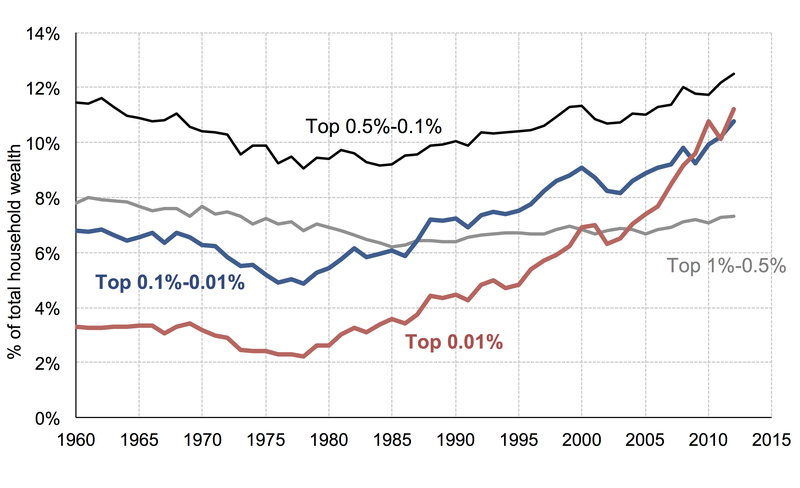
Yglesias eyes the wealthiest Americans:
The basic punchline is that wealth — accumulated asset ownership — is very, very concentrated and has been growing more concentrated for a generation. Back in 1980, 0.01 percent of the population owned three percent of national wealth. Today that top 0.01 percent, about 32,000 people, owns about 11 percent of national wealth. That’s a staggering increase from an already high base.
The Ebola Election?
Cillizza calls the outbreak in the US the “October surprise” of the midterms. How the epidemic fits into the pre-existing election narrative:
The country is as anxious and uncertain as it’s been in a very long time. Much of that anxiety had been laid at the feet of a deeply uncertain economic situation (the broad indicators improving without much to show for it closer to the ground) and the turbulence abroad (the Islamic State, Russia, the Middle East, etc.) coupled with a broader sense that the institutions that we once relied on (government, church, the justice system) are no longer reliable.
That sense of drift — caught between the old way of doing things and a not-yet-realized new way of doing things – is palpable in polling (huge majorities who say the country is headed in the wrong direction, a desire to get rid of everyone in Congress in one fell swoop) and in conversations I’ve had both with political professionals and average people. Ebola — with its sky-high mortality rate and lack of a vaccine – dovetails perfectly with those existing fears and anxieties.
Still, Waldman really wishes candidates would refrain from campaigning on it:
Here’s what I’d like to hear a candidate say when asked about this: “I don’t have an Ebola policy, because I’m running to be a legislator. It’s the job of legislators to do things like set budgets, but when there’s an actual outbreak of an infectious disease somewhere in the world, we should step back and let the people who actually know what they’re doing handle things. In this case, that’s the Centers for Disease Control. This is why we have a CDC in the first place, because if we were relying on politicians to keep us safe from infectious diseases, we’d really be screwed.”
You can call that an abdication of responsibility, but it isn’t. Even if Congress has an important role to play in setting policy priorities for agencies like the CDC, once there’s a potential crisis occuring, the idea that a bunch of yahoos like Pat Roberts should be determining the details of our response is absurd.
Nia-Malika Henderson observes that the public is weirdly confident in the government’s ability to handle an Ebola outbreak:
On the one hand, a new Washington Post/ABC News poll shows they are deeply dissatisfied with the effectiveness of the political system — a.k.a. all the people and processes that are in place to address things like health emergencies. The dissatisfaction is bipartisan, with 66 percent of Democrats and 80 percent of Republicans agreeing. But when it comes to Ebola, people are somehow confident that the federal government, which is (of course) part of that very same political system they deeply mistrust, has the ability to effectively respond to an outbreak. Again, that confidence is largely bipartisan, with 54 percent of Republicans and 76 percent of Democrats expressing confidence.
That’s still a significant gap, though. Looking at the same poll, Brendan Nyhan reflects on how partisanship drives the way people answer these questions:
This finding represents a striking reversal from the partisan divide found in a question about a potential avian influenza outbreak in 2006, when a Republican, George W. Bush, was president. An ABC/Post poll taken at the time found that 72 percent of Republicans were confident in an effective federal response compared with only 52 percent of Democrats. The partisan divide also appears to have grown as Republican disapproval of President Obama has deepened. …
These findings illustrate how people use simple partisan heuristics to make judgments about future government performance. Few people know about how the federal government responds to disease epidemics, but most people have views about President Obama and the job he is doing in office. That’s why Democrats are more confident in government’s capacity for an effective response than they were in 2006, for example, not because they approve of how the Centers for Disease Control and Prevention is being managed.
Beating New Life Into Occupy Central
Just as Hong Kong’s protest movement seemed to be losing steam, a video of a protester being assaulted by police in the pre-dawn hours of Wednesday morning has re-energized the movement:
In footage by local television station TVB, the protester, later identified as Civic Party member Ken Tsang, is escorted by six officers to a dark corner and pushed to the ground, his hands bound in a plastic tie. The government later confirmed there were seven officers involved in the assault, all of whom have now been suspended. In the video, police then punch and kick Tsang while others stand watch, which the reporter narrating the scene has said lasted for about four minutes. …
The video quickly went viral on Facebook, Hong Kong’s social network of choice, with web users launching a so-called “human-flesh search,” using social media to identify those involved in the beating. An Oct. 5 page on Facebook originally used to identify anti-occupy protesters was quickly repurposed to identify abusive police. Some netizens have even condemned police officers as “black cops,” slang meaning they have forfeited their role as public servants, working instead for undefined “dark” forces.
Suzanne Sataline was present for the police raid where the video was allegedly taken:
Around two o’clock, a cry arose from the crowd. “Police!” people shouted. The trill of whistles pierced the air. The protesters raced from the tunnel, donning safety goggles and masks. After 10 minutes, a sea of bobbing blue lights drew closer from the road’s western end. Word raced through the crowd. More police were coming from the east. And a cluster of white lights emerged from the walkway along Victoria Harbour. None had helmets — a good sign, I thought. That meant no tear gas. Hundreds of officers, with round riot shields, began pushing the crowd backwards, toward the tunnel. Another contingent pushed protesters in the other direction. Suddenly, the officers coming from the shore amassed a few feet from a group of us in Tamar Park, a small patch of lawn and trees atop the highway tunnel. The officers addressed the crowd over a bullhorn.
“They say we are here illegally,” said Lock Cheung, a freelance videographer. “Police say if they don’t leave, they will use spray.” The crowd hissed. “Gangsters!” Cheung urged us to be careful. The police, he said, “don’t follow any rules anymore.”
In Ben Leung’s opinion, the incident will likely push many fence-sitters onto the demonstrators’ side:
For the neutrals, this episode could well be the tipping point. Yes, the protests themselves had lost momentum over the past 10 days or so. Yes, people are generally fed up or simply bored of the protests and the disruptions caused. But after such a brutal beating—which we know happens all the time behind closed doors at police stations or in panda cars but just never in public—it’s become harder for many to just sit on the fence. Indeed, more people are back out on the streets Wednesday night outside the main police HQ in the Admiralty District, and angrier than ever.
In response to the news, the government quickly revived an offer to hold talks with the protesters:
Chief Executive Leung Chun-ying said the government is ready to meet with student leaders as soon as next week, but urged them to be pragmatic, reiterating that Beijing will not change its mind on election restrictions. That raised doubts that the proposed meeting can overcome the vast differences between the two sides. Alex Chow of the Hong Kong Federation of Students welcomed Leung’s offer but criticized the government for setting preconditions. Many other demonstrators gathered in the main protest zone echoed his view. “I paid attention to what (Leung) said but I couldn’t find anything constructive. He didn’t say anything new and I don’t think it is going to break this deadlock,” said Tong Wing-ho, 26.
Lily Kuo didn’t hear anything too encouraging in Leung’s presser either:
Leung did float one topic that could potentially entice protesters: changing the make-up of the mostly Beijing-appointed nominating committee. “In the second round of consultation, we can still listen to everyone’s views,” he said. “There is still room to discuss issues including the exact formation of the nomination committee.” The students have insisted that changes to the committee won’t be enough, and have publicly insisted on civic nomination. Although unlikely, the possibility that the committee could be reconfigured, potentially allowing non-Beijing approved candidates to make it onto the ballot, might be enough to tempt some of the protest leaders to make the most of their considerable political leverage—and cut a deal.
Why Do Democrats Suck Up To Big Coal?
It doesn’t get them the support of the coal industry:
Mary Landrieu of Louisiana and Mark Pryor of Arkansas are the only Senate Democrats running for re-election who have voted with the coal industry more than half the time since 2008. Yet with the red-state lawmakers’ campaigns down in the polls and their political lives on the line, the industry is spending tens of thousands of dollars more than it has donated to Landrieu and Pryor to bolster the prospects of their GOP rivals.
Dave Roberts is unsurprised by these findings:
Coal executives understand one of the basic truths of the partisan age: Most of what you need to know about a politician can be derived from the (D) or (R) after their name. As the parties become stronger and more parliamentary, a reliable vote matters more than an individual candidate’s opinions or character (or even committee rank).
After all, polarization is happening on both sides. As conservative Dem senators lose in red states, Senate Democrats are becoming more unified. For Big Coal and the kind of people who feel cultural solidarity with it — the guys “rolling coal” — the choice between a coal-friendly Dem or one step closer to a Republican majority is easy. They’d be crazy not to go for the latter.
The Latest On Legalization
The marijuana sanity movement gets a new anthem:
Recent polling suggests that “Oregon is likely to be the third state to legalize marijuana”:
The poll found 52 percent of likely voters plan to support the initiative while only 41 percent plan to vote against it. The remaining 7 percent are undecided or refused to answer.
Meanwhile, the marijuana market in Colorado continues to grow:
New figures from the Colorado Department of Revenue show that recreational marijuana sales continued to climb in August, the most recent month for which data are available. Recreational sales totaled approximately $34.1 million in August, up from $29.3 million the previous month.
But Sullum spotlights a problem facing Colorado’s cannabis tourists – they often don’t have legal places to toke up:
Public officials who do not welcome marijuana tourists have ways of making marijuana tourists feel unwelcome, most conspicuously when it comes to finding a place to legally enjoy the cannabis they are legally allowed to buy. Because Amendment 64 prohibits consumption of cannabis on the premises of the state-licensed stores that sell it, Colorado does not have anything like Amsterdam’s famous “coffee shops,” where you can buy and consume marijuana along with soft drinks and snacks.
The Colorado Clean Indoor Air Act, which has been amended to cover marijuana as well as tobacco, bans smoking inside bars and restaurants. Outdoor areas of those businesses are exempt from the smoking ban, but that does not necessarily mean tourists can enjoy their newly purchased pot there. The section of Amendment 64 that eliminated penalties for marijuana use does not apply to “consumption that is conducted openly and publicly,” which remains a petty offense under state law. Last year Denver, the state’s largest city and the center of marijuana retailing, passed an ordinance defining “openly and publicly” broadly enough to foil the plans of visitors who thought they could legally smoke pot on the patio of a bar or restaurant.
When Does Spanking Become Child Abuse? Ctd
Our reader who wrote the remarkable email that sparked the thread follows up again:
I just wanted to thank everyone, so very much, for the conversation threads and for the editorial care. Reading the emails has been a difficult, emotionally tricky experience – and an unexpectedly healing one, too. I’m profoundly grateful for it all.
The conversation continues:
Wow, this is probably the most amazing thread on the Dish to date, and there’ve been some good ones. And the key is to see all sides of the debate, not just what may be “right”. Publishing emails from those who justify abuse is just as important, so we can see what the cycle of violence produces.
My beatings always came from the by-products of my disinterest in school. I was pretty sharp as a kid, but I never liked the doldrums of doing homework. I’d get report card after report card stating that assignments were not turned in, effort was lacking, etc, even though I usually did well on the tests. The days those wretched reports came (8 times a year) were usually pretty awful. I think your original reader nailed it: no child is equipped to handle such psychological terror.
For instance, I knew that the train from the city to the suburbs arrived in the station at 6:13pm. Calculating the drive to our house: 11 minutes. A minute to put his things down, and then my mom would share the bad news with him: 3 minutes. Then the footsteps on the stairs that didn’t take long. So all afternoon, after arriving from school and finding that goddamn carbon-copied paper sitting on the kitchen counter, I’d wonder if the train would be late, or if he’d stop to get gas, offering me a few more minutes of either relief or terror, not sure which.
If everything was on schedule, I was going to get slapped around 6:28pm. I’d wait in my room, knowing that the door would soon open and I’d have to endure not only the physical hell, but the emotional hell. After one time when he ruined my glasses because they were on my face for the first hit, he’d always tell me to take my glasses off with deceptive calm. After the slapping was over and I’d calmed down enough to think again, there would follow a two-hour discussion of the merits of school and responsibility and such, me sitting there in shame with a prickling face.
Another reader shifts the focus to school itself:
I grew up in the South, but my mom was fairly progressive and my parents were divorced. So my experience with corporal punishment was in school. The teachers, who were often also the football coaches, took great pride in their paddles.
Massive, two-handed affairs with holes drilled to reduce wind resistance, painted in fearsome colors. Or a stack of yard sticks, since they would most certainly be broken if used. Switches weren’t used because, darn it, the kids needed to be clothed (I knew one guy who wore four pairs of underwear when he knew he was in trouble).
My personal experience in the ’60s and ’70s was that some kids had it a lot worse at home. The school paddling stung, but because it was done in front of the class, the embarrassment was also a part of the punishment. In general, I was a pretty good kid, so I only experienced it a few times and don’t really think of it as traumatizing. But the stories of some kids home lives was deeply disturbing to me. My best friend was so beat one day that he asked to be allowed to stand in class. He had to go the the nurse when blood started leaking through his pants.
Now I have my own child. I can’t tell you that I haven’t been tempted to hit him. Especially when he was younger, it seemed like he was deliberately obnoxious. But not so. We found that there were ways to negatively and positively incentivize him that didn’t require embarrassment or pain, like taking away a GameBoy or dessert.
Anyway, our boy now is well behaved, and I thank God I never hit him. If I had, I would have started an escalation that would have required more and more hitting to achieve “results”. Only as so many others have indicated, it rarely has the desired corrective affect; it just relieves the parents tension at the moment. But instead, my son is attentive, and responsive to correction. He now responds most to my disappointment; words aren’t even needed many times.
Another tackles a previous reader:
I just read again more justifications for hitting children as a form of discipline. This line struck me:
Indulgence is not a kindness. It is a parent’s job to raise an adult, not a life-long child incapable of tolerating frustration or following rules. If you think the results of spanking are bad, you should visit some of my former indulged clients in prison.
First, I truly wonder if this person has really worked in the prison population. My father did for years and it was very clear that the majority of the inmates were abused as children. There were not many (if any) from “indulged” backgrounds. Further, failure to perform physical violence on a child is not a form of indulgence. Indulgence connotes that improper behavior is tolerated without consequence. Such parenting is really neglect because the parent broadcasts to the child that no behavior (good or bad) can raise the parent’s attention. This lack of attentiveness creates no boundaries for children and children clearly suffer without boundaries.
Boundaries include discipline but spanking does not have to be than form of discipline. Spanking sends the wrong message. What children learn is that hitting is an acceptable method of resolving problems. For example, if my daughter hits my son, how is punishing her by hitting her in turn effective? What the child learns is that the bigger and stronger party controls the aggressive behavior.
But many readers are still defending corporal punishment:
Some kids need to be spanked sometimes, period. Not beaten, cut, smashed, bruised or battered, but swatted smartly on their backside. Why? Because nothing else works with some kids and some kids, particularly smart, willful kids, will figure out pretty quickly – as our grandson has done – that they can throw a temper tantrum in public and either get whatever they want or force their parents to leave. Our son and daughter-in-law refuse to swat our grandson’s little behind and stick him in his crib until he comes around. As a result, he plays his parents like a fiddle.
You haven’t been down this road, so you are on the outside looking in. You are hearing from folks whose parents, usually the father, went well beyond what any sane parent has in mind when disciplining a child.
If there is any tolerable reason to strike your kid, this reader has it:
I have been following the thread on spanking with interest. I find the idea of breaking a child’s spirit utterly abhorrent, especially through violence.
And yet, for my eldest son, I had to resort to some tactics I hated. From the time he could walk, he tried to run in front of cars. The moment we stepped outside, if there was a moving vehicle anywhere, he tried to get in front of it. Heavy traffic made him squeal with delight and he would do everything in his power to go and be in it.
The only way, and I mean the ONLY way – I tried everything – to get him to stop running in front of speeding vehicles was to spank him. He’d lunge for the street, I’d yank him back and whack him on the butt (hand only, his clothes on, not hard enough to bruise, but hard enough to get his attention.) He’d wail in protest. Rinse and repeat. For a year and a half. He finally, around his fourth birthday, figured out that he was not supposed to run in front of cars.
Did I break his spirit? I think you could say that the part of him that took joy in the glory of several tons of metal bearing down on him is probably gone forever. I look at it as doing what’s necessary for him to make it to adulthood, or at least to an age where he can puzzle out the harsh consequences of the laws of physics for himself.
Update from a reader with a strong counterpoint:
I’m calling bullshit again. This parent says that she spanked her son for a year and a half when he tried to dart into traffic, and it sounds like this happened pretty much every day. Well, obviously spanking DID NOT WORK. If it did, then after two or three spankings, he would have learned to not run into traffic. Instead, what likely happened was that traffic lost its attraction for him around age 4 (just as knocking over block towers probably became less interesting around age 2). Spanking her son had NO effect on his behavior.
I would have recommended she get one of those leash things and then test him every two or three months without (and with another adult to run interference if he dashed for the traffic again).
Another is on the same page:
There are products specifically designed for this! Many children try to run off and there are restraining systems built for it, thus eliminating the need for spanking. If that parent could stop them with their hand, they easily could have put a leash on him before going outside.
Yes, it’s a parent’s job to keep them from harm. But not to inflict it.
The Chemical Weapons We Uncovered
Earlier this week, CJ Chivers reported that US troops were exposed to decaying Iraqi chemical weapons on multiple occasions (accompanying video above):
In all, American troops secretly reported finding roughly 5,000 chemical warheads, shells or aviation bombs, according to interviews with dozens of participants, Iraqi and American officials, and heavily redacted intelligence documents obtained under the Freedom of Information Act.
The United States had gone to war declaring it must destroy an active weapons of mass destruction program. Instead, American troops gradually found and ultimately suffered from the remnants of long-abandoned programs, built in close collaboration with the West.
Murtaza Hussain pushes back on Iraq war supporters claiming vindication:
The inconvenient truth is that the U.S. was aware of the existence of such weapons at the Al Muthanna site as far back as 1991. Why? Because Al Muthanna was the site where the UN ordered Saddam Hussein to dispose of his declared chemical munitions in the first place.
Those weapons that could not safely be destroyed were sealed and left to decay on their own, which they did. The site was neither “active” nor “clandestine” – it was a declared munitions dump being used to hold the corroded weapons which Western powers themselves had in most cases helped Saddam procure.
The fact that people thoroughly invested in supporting the war apparently had no idea about this is in many ways emblematic of their complete cluelessness about the country which they helped destroy.
Jessica Schulberg argues along the same lines:
If the post-2003 discovery of a decaying chemical weapons program could serve as proof that the invasion was justified, the Bush White House would have seized the opportunity to proclaim so. By 2005, CIA weapons inspectors concluded in a 92-page report that the WMD investigation had “gone as far as feasible” and found no evidence of an active weapons program. The CIA report included an addendum: “military forces in Iraq may continue to find small numbers of degraded chemical weapons — most likely misplaced or improperly destroyed before the 1991 Gulf War.”
Despite that, Abe Greenwald claims that the NYT report “partially vindicates” Bush. He insists that “Saddam’s old chemical weapons were always cited as a danger in the run-up to the war”:
The 5,000 undeclared chemical weapons constitute one of the administration’s few intelligence victories in Iraq. Why, then, the secrecy? Perhaps because Iraq was a leaderless country swarming with jihadists and roiled by civil war, and advertising the amounts and whereabouts of chemical weapons would have made things much worse.
Kevin Drum, on the other hand, suspects the administration was acting politically:
Iraq had no active WMD program, and it was an embarrassment to the Bush administration that all they could find were old, rotting chemical weapons originally manufactured by the West. So they kept it a secret, even from troops in the field and military doctors. But lies beget lies, and American troops are the ones who paid the price. According to Chivers, “The government’s secrecy, victims and participants said, prevented troops in some of the war’s most dangerous jobs from receiving proper medical care and official recognition of their wounds.”
Today, the consequences of our lies continue to haunt us as the rotting carcasses of these weapons are apparently falling into the hands of ISIS.
Fusion To The Rescue?
Lockheed Martin has announced a major breakthrough in nuclear fusion. Kevin Drum sizes up the stakes:
If Lockheed Martin can actually pull this off, it would mean huge amounts of baseload power using existing grid technology. It would mean cheap power from centralized sites. It would mean not having to replace every building in the world with high-efficiency designs. It would mean not having to install wind farms on millions of acres of land. It would mean not having to spend all our political efforts on forcing people to make do with less energy. More generally, it would mean gobs of green power at no political cost. That’s huge.
Mark Kleiman calls out skeptics on the left:
Of course the Lockheed Martin folks could turn out to be wrong about the physics (though that doesn’t seem especially likely), or (much more plausibly) one of the ancillary problems such as materials development could turn out to be insoluble or too expensive to be economically practical. But the only reasonable reaction to this from someone not invested in Exxon or Koch Energy or Putinism is a (somewhat hesitant, because the idea is still more likely to fizzle than to work) “Yippeeeeee!!!!”
Therefore, I find it frustrating (and only wish I found it surprising) that ThinkProgress, run by people who consider themselves “progressives,” is rushing to pour cold water on the idea because the timeline can’t meet the arbitrary deadline someone in the global-warming PR business has dreamed up. (Really, of course, because cheap non-polluting energy would help reduce the relevance of a bunch of Green ideas about regulating this and subsidizing that, and because at some point after 1973 gloom and fear got to be the official emotions of the progressive movement, when by rights they belongs to conservatives.)
Over at Wired, Kathleen Palmer runs through the scientific skepticism. Her bottom line:
If they can iterate fast enough, they may just be the first to get to a functional nuclear reactor… probably in about 10 years.
 The Dish