A “Crisis” In US-Israel Relations?

There was a little kerfuffle yesterday as Goldblog reported on an Obama bigwig calling Bibi a “chickenshit.” My favorite bit of the column was this nugget:

“The Israelis do not show sufficient appreciation for America’s role in backing Israel, economically, militarily and politically,” Abraham Foxman, the head of the Anti-Defamation League, told me. (UPDATE: Foxman just e-mailed me this statement: “The quote is accurate, but the context is wrong. I was referring to what troubles this administration about Israel, not what troubles leaders in the American Jewish community.”)

Heh. But the more troubling aspect of the column is this idea that any obvious clash of views or interests between the US and Israel is some kind of “crisis”. It certainly isn’t a crisis for Obama or the US. Paul Pillar makes a good point (seconded by Larison):

Sweep aside the politically-driven fiction about two countries that supposedly have everything in common and nothing in conflict and instead deal with reality, and the concept of crisis does not arise at all.

Nor does it really matter if Netanyahu “writes off” Obama in his last two years.

Obama can get the critical nuclear deal with Iran without the Israelis and without the Congress, for that matter, and the deal will (and already has) made an Iranian nuclear bomb much less of a threat than it once may have been. With the Iranian threat neutralized, Netanyahu will have to find another excuse to justify his creeping annexation of East Jerusalem and the West Bank. But with the Iran issue bracketed, the Obama administration can adjust its UN veto in defense of Israel, expose it to greater international isolation over the occupation, and publish the official American view of what the borders of the future Palestinian state will be.

It was always Obama’s strategy to offer Israel and Netanyahu every chance to abandon its neo-colonial enterprise, to do everything possible to reassure Israel about its security (the Iron Dome/the security guarantees and arrangements proposed by Kerry), but, in the end, to pursue America’s core interests in the region, if Israel and its powerful lobby refuse to budge an inch.

I suspect the Israelis have under-estimated Obama’s steel in this regard; and they may be particularly foolish to write him off in his last two years, when a president often has more leeway in conducting foreign policy, when Obama’s long game is designed to reach a conclusion, and when the president has nothing left electorally to lose. If the end result is a tamed Iranian nuclear program and progress toward a real two-state solution, it will have been well worth waiting for, won’t it?

Know hope.

If The Democrats Hold The Senate

Ramesh imagines the GOP reaction:

Many conservatives … would argue that the party establishment had led them to ruin. The establishment largely got its way in the 2012 presidential primaries, and then got its way again in running an agenda-less general-election campaign. This time, Exhibit A for these conservatives would be the North Carolina Senate race, where the establishment candidate — Thom Tillis, the speaker of the state House — has persistently run a little behind his Democratic opponent. (Actually, that might be Exhibit B if Senate Minority Leader Mitch McConnell manages to lose in Kentucky.)

Conversely, a lot Republican officeholders might conclude that the Democratic attacks on them as uninterested in compromise and hostile to women had succeeded, and that they should accordingly move leftward.

Should the Democrats pull off an upset, Nate Cohn will look “to the challenges of modern polling as a big reason for the surprise”:

In 2010, the polls underestimated the Democrats in every competitive Senate race by an average of 3.1 percentage points, based on data from The Huffington Post’s Pollster model. In 2012, pre-election polls underestimated President Obama in nine of the 10 battleground states by an average of 2 percentage points.

A couple of elections in which polls tilt slightly Republican aren’t enough to prove anything. The polls have erred before, only to prove fine over the longer term. But the reasons to think that today’s polls underestimate Democrats are not based on just the last few years of results. They are also based on a fairly diverse set of methodological arguments, supported by extensive research, suggesting that many of today’s polls struggle to reach Democratic-leaning groups.

But liberals shouldn’t get too excited:

The biggest reason to be skeptical that the Democrats will fare better than the polls predict is the context: The Republicans probably have a large enough advantage to withstand another round of modest polling errors. Even if there is another three- or four-point error in Colorado, for instance, the result would be a dead heat in a race that on its own is not at all sufficient for Democrats to hold the Senate. And the Republicans could just as easily counter the effect of any polling error by winning undecided voters, who tend to disapprove of Mr. Obama’s performance — along with their incumbent Democratic senator, Mark Udall.

Even with the problems that polls have, the Republicans’ advantage is clear enough to make them favorites to win the Senate.


Views Differ On Meaning Of “Sexual Assault” Ctd

A reader comments on this post:

The excerpt from Elizabeth Nolan Brown quotes “increasing progressive activism around the idea that drunk people can’t give consent.” I’m troubled by this.  The fact is, people can (and do) give consent while intoxicated.  Intoxication does not render one a zombie or possessed by a demon.  In fact, many would argue that one’s words and actions while intoxicated reveal more of your true self than when sober (think of the guy who goes off on a racist tirade while drunk, but would never be caught saying those things out loud when sober).

The notion that a woman (or man) should be absolved of all responsibility for their sexual actions while drunk is preposterous.  Yet it seems that this is exactly what high school and college campuses are now telling their students.

But let’s look at it this way: If a female college student were to go to a frat party, get sloshed, and then – instead of climbing into bed with a frat guy – climbed into the driver’s seat of her car, took off and went on to kill someone with it, nobody would be suggesting that she was not responsible for her actions while drunk.  Why should her ability to make a judgment concerning sex while drunk be any different than if she drove a car?

Here’s another example: Let’s say a guy gets drunk and has sex with a woman without a condom and she gets pregnant.  Nine months later should he be absolved of his responsibility to provide for the child just because his judgment in deciding whether to use a condom was impaired at the time of intercourse?  Please.

Update from a reader:

The “increasing progressive activism around the idea that drunk people can’t give consent” runs smack into this reality (emphasis mine):

Typically, if either the victim or the perpetrator is drinking alcohol, then both are. For example, in Abbey et al. (1998), 47% of the sexual assaults reported by college men involved alcohol consumption. In 81% of the alcohol-related sexual assaults, both the victim and the perpetrator had consumed alcohol. Similarly, in Harrington and Leitenberg (1994), 55% of the sexual assaults reported by college women involved alcohol consumption. In 97% of the alcohol-related sexual assaults, both the victim and the perpetrator had consumed alcohol. The fact that college sexual assaults occur in social situations in which men and women are typically drinking together makes it difficult to examine hypotheses about the unique effects of perpetrators’ or victims’ intoxication.

That’s a problem. Unless, of course, the activists want to establish that men are supposed to be the guardians of helpless women’s virtue at all times, which doesn’t sound particularly progressive to me. In fact, it sounds … what’s the word I’m looking for … ah! Patriarchal.

At some point, today’s feminism and yesterday’s Victorianism will reach a perfect convergence. But the new feminists will have to impose their idea of male virtue by force of law.

QE, We Hardly Knew Thee

iUG0KbcZS9cc

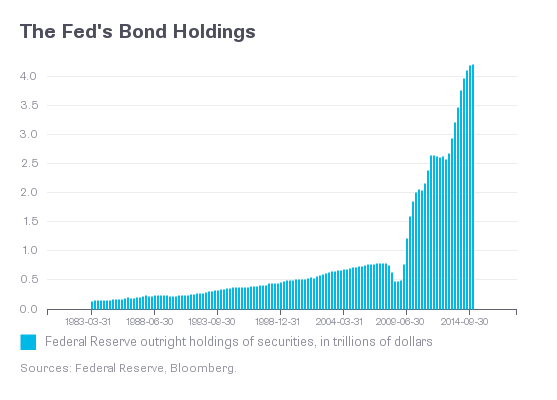
Yesterday, the Federal Reserve announced that it was halting the bond-buying program known as “quantitative easing”, the third round of which had begun in September 2012. While the Fed won’t divest itself of the more than $4 trillion in bonds it has accumulated, and has no immediate plans to raise interest rates, it won’t buy any more. Matt O’Brien fears that the Fed is sending the wrong signals as the economy remains lethargic:

The fact that it’s ending QE3 despite still-low inflation and still-high, though declining, unemployment, signals that the Fed is eager to return to normalcy. So does changing its statement from saying there’s a “significant underutilization of labor resources” to it “gradually diminishing.” The Fed, in short,  looks much more hawkish. And that’s not good, because, as Chicago Fed President Charles Evans explains, the “biggest risk” to the economy right now is that the Fed raises rates too soon.

QE isn’t magic — far from it — but it is, as Boston Fed President Eric Rosengren told me, “quite effective.” Especially at convincing markets that the Fed won’t raise rates for awhile, which is all it should be saying right now. Because the only thing worse than having to do QE is having to do QE again. The Fed, in other words, should do everything it can to make sure the economy lifts off from its zero interest rate trap before it pulls anything back. Otherwise, we might find ourselves back in the same place a few years from now.

Justin Wolfers stresses that this isn’t really “the end” of QE, since the assets the Fed holds will continue to have a stimulative effect:

Of course, the aspect of Wednesday’s Federal Reserve decision that has captured the most attention is its decision to stop purchasing further long-term securities. But don’t confuse this with a monetary tightening. It’s hanging on to the stock of securities it currently holds, and the Fed’s preferred “stock view” says that this is what matters for keeping longer-term interest rates low. By this view, the Fed’s decision to end its bond-buying program does not mark the end of its efforts to stimulate the economy. Rather, it is no longer going to keep shifting the monetary dial to yet another more stimulative notch at each meeting. The level of monetary accommodation will remain at a historical high, even if it is no longer expanding.

Over recent years, policy makers have also worked to lower long-term interest rates by shaping expectations about future monetary policy decisions, in a process known as forward guidance. Today’s statement continues this policy, repeating recent guidance that the Fed expects interest rates to remain low for “a considerable time.”

But Ylan Mui suggests that higher rates may not be as far off as promised:

The debate over when to raise rates, which has already begun, will prove tricky for the Fed — and likely the biggest challenge of Janet Yellen’s tenure since she took over as head of the central bank early this year. Fed officials, who have suggested that the move could come in the middle of next year, hope that it causes little disruption. But achieving that delicate balance is the most basic dilemma of central banking. If the Fed moves too soon, it could undermine the recovery. If it waits too long, it could breed the next financial bubble as investors take too many risks backed by the belief the Fed will always be stimulating the economy.

When Fed officials suggested in the past that they may withdraw stimulus from the economy faster than anticipated, markets have swooned and interest rates have popped up. That’s one reason central bank officials have been preaching patience in responding to the strengthening recovery — but some investors believe they will not be able to wait much longer.

The Bloomberg View editors revisit the debate over whether QE worked. They maintain that it was the right call:

Exactly how much QE has helped the economy remains a matter of debate. Former Fed Chairman Ben Bernanke said in 2012 that the Fed’s first two rounds may have boosted output by 3 percent and added more than 2 million jobs. In a more recent paper, San Francisco Fed President John Williams said such estimates were uncertain; he also noted the risks to the financial system posed by so large an intervention. Some believe QE has gradually diminishing effects; others that it has no positive effect at all.

Regardless, the gamble was justified. After the crash a persistent slump in demand hobbled the recovery and drove up long-term unemployment, threatening great and lasting economic damage. With inflation low, the risks of QE were small in relation to the possible gains. The benefits weren’t confined to the direct effects of the Fed’s purchases: Even more important, QE bolstered confidence that the central bank was willing to do everything in its power to revive the economy.

Danielle Kurtzleben also defends the program:

One key thing to consider with QE3 is the counterfactual — what would the economy have looked like had it never been put into place? One of the big benefits of QE3 was that it counteracted a Congress that insisted on holding back spending, even while the economy was sluggish. As Fed Chair, Bernanke was constantly chiding Congress for dragging on the economy, encouraging them to save deep spending cuts like those under sequestration for later.

So though 2013’s economic growth wasn’t exactly stellar compared to 2012’s, it’s important to consider how bad it could have been, says [economist Paul] Edelstein. “I mean, 2012 GDP growth was two and a quarter percent. 2013 comes, we have all the sequester-related spending cuts, and we have QE3. The result: GDP growth of two and a quarter percent,” he says. “Is two and a quarter percent good? Not really. But clearly again it could be a lot worse if we didn’t have fiscal drag.”

The Dems’ Playbook Is Getting Stale

Joe Klein is struck how Democratic candidates have “emphasized women’s issues–equal pay, parental leave, abortion rights–in the hope of luring undecided, independent women to the fold”:

[Campaigning on women’s issues] has been effective and still may be–but it has never before carried the electoral burden that it does this year. The alleged toxicity of Barack Obama has made it unsafe for Democrats to discuss much else.

The party was boosted by the failed Bush wars in 2006, 2008 and 2012, but Democrats have been boggled by what to say about ISIS in 2014. They’ve had no significant new ideas, foreign or domestic, on offer. And they’ve been too afraid to tout Obama’s complicated successes–the stimulus package that prevented a depression, the health care plan that may actually be working, and relative order at the border (a result of many years of security enhancements and a diminished flow of illegals during recent rough economic times). The argument on women’s economic issues is strong. It remains to be seen whether baby boomers who boast remarkable three-month, 3-D sonograms of their grandchildren will be quite so militant about abortion rights in the future. The fate of women’s issues, in the South and elsewhere, will have an impact on whether the party has to start rethinking its message going forward. It may not be able to count on Republicans’ continuing their boorish ways. Unless, of course, the conservatives win and overread the results this year.

Elizabeth Nolan Brown identifies why the Democrats’ War on Women demagoguery isn’t working very well:

As many political strategists, writers, and pundits have noted over the past few weeks, issues like birth control and abortion simply rank low among the list of current concerns for female voters. This likely isn’t an expression of how important women consider their availability—the vast majority of American women will use birth control in their lifetimes and one in three will have an abortion—but the fact that they genuinely aren’t pressing political matters right now at Congressional level.

The federal Life at Conception Act—which several Democrats have used as a cudgel against GOP opponents who did (Gardner) or do (Ernst) support it—has about as much chance of being enacted as your dog does of becoming president; it would take passing both chambers of Congress with two-thirds support and ratification by 75 percent of state legislatures. And as George Will noted in a recent Washington Post column, “access to contraception has been a constitutional right right for 49 years” while “the judiciary has controlled abortion policy for 41 years.”

The idea that this country will ban birth control entirely or amend the Constitution to define fertilized eggs as people is simply not plausible.

Book Club: Waking Up The Buddha

Siddharta_Gautama_Borobudur

Our first installment of reader commentary on Sam Harris’ Waking Up addressed the question of the self’s existence – or lack thereof. More emails along those lines here and here. Many of the following do the same, while offering clarifications and critiques from a Buddhist perspective. The first reader emphasizes the practical effects of rejecting our usual notions of the self:

Twenty years of meditation in the Dzogchen tradition have convinced me that the self, as it is conceived in the West, does not exist. With regard to your reaching different conclusions from Harris based on the same experiences, there is an old Zen saying “Words are a finger pointing at the moon – be careful not to confuse the finger with the moon.” I might describe the experience as one of realizing immaculate Buddha nature, but the important question is: what effect does this experience have? Am I a wiser, more compassionate human being because of it?

The concepts about the experience are just that – concepts. They no more objectively prove your experience of the love and existence of God than they prove Harris’ rejection of God. The experience belongs to no belief system. It is what it is.

Another reader wants “to clarify something about Buddhist (Mahayana) philosophy that Sam doesn’t explain”:

In Buddhist thought, there are two sorts of frames of truth. Relative truth is the truth of bookclub-beagle-trappearance, and absolute truth is how things truly exist. Computers are an excellent example of this; there’s an apparent reality to email, blogs, the internet, but we know that those things don’t exist in any true sense – they are just conceptual representations of electrical activity. The key point is that relative reality is still real, it’s just real as appearance, in the same way that a dream or videogame might be real as a dream or videogame. Relative reality from a Buddhist perspective is all of the stuff we relate with, self, other, trees, greenery etc. Ultimate reality is reality free from concept, which is therefore impossible to describe.

When Buddhists talk about the non-existence of self, what they mean is that self is a mere appearance. In particular it doesn’t have the qualities of separateness, permanence, or solidity that we ascribe to it. From a relative perspective, self exists as an appearance, but it has no reality from an ultimate point of view. Suffering arises because we try to relate with this ephemeral, shifty, appearance of self and other as though they were more than appearances.

The benefit of meditation from this standpoint is that you awaken to the unreality of self, other, and perception. This isn’t to say that those things vanish, just that are revealed to be stories we’ve told ourselves after the fact. Interestingly, this is the same puzzle that Heidegger, Heraclitus, and other Western philosophers ran into: Being seems to be fundamental, but we can’t investigate it without presupposing the verb “to be”. The Buddhist answer is that a conceptual description of being is impossible, but it’s easy to be.

This idea of ultimate reality as simply being, with no confusion about the nature of self or other, is probably compatible with certain notions of God. I can’t really comment on that, but it seems to be that if you hold the view that God is identical to reality (i.e. is not a personality) you might equate God with what ultimate reality.

I think a lot of the puzzles Sam points to are helpful in that they show that our notions of self don’t make any sense. You can do this without science by asking questions like “Where does the self reside? When did is start? When does it end?” The trouble I think is that he doesn’t take the next step and acknowledge that there’s something there, something meditating, something writing a book etc. This puzzle of how these appearances can arise from emptiness is a real conundrum, and it’s worth spending some time on.

Another questions Sam’s dismissal of the more speculative elements of how Buddhists understand the universe:

Harris basis his rejection of the “silly” parts of Buddhism on a kind of scientific rationalism. The parts of the tradition that accord with math and science get treated as truths, while the parts that don’t line up get discarded as ridiculous superstitions. The problem is that Buddhist thought profoundly disrupts these modes of thinking.

Consider the principle of non-contradiction. This holds that it’s impossible for a single mind to believe a sentence P and also believe not-P. This principle is a foundation of scientific thought, but really only operates within the borders of the self. If one person believes P and another believes not-P, they aren’t being irrational; they just disagree. The problem is that from a Buddhist point of view, the self is borderless. There’s no real distinction between a contradiction and a disagreement. Walt Whitman noted the same feature when he said “Do I contradict myself? Very well I contradict myself. I am vast, I contain multitudes.”

Now, admittedly, this make no sense conceptually. At the level of concepts, we have self and other, and rationality is important. Meditation starts from the notion that there’s actually a rich world taking place before concept, to relate directly to that world you have to have openness and curiosity.

For me, I think this is where faith comes into it, even when you don’t believe in God. There is a sense of uncertainty and wonder that takes place in genuine meditation practice, or when you interact with someone like Tulku Urgyen. The sense is that you’re relating with a world that is much much larger than the boxes you try to fit it into.

My advice for someone who’s starting to practice on the basis of this book is to not decide on anything ahead of time. It’s always possible that faith and sacredness are pointless, and that eventually we’ll invent an enlightenment drug, but it’s also possible that the lineage of meditators has some wisdom, and that you can’t really understand it until you try. I think a key to meditation is to stay in that uncertain place without collapsing into either view.

Every good meditator I’ve know has become softer, kinder, and more open as they’ve practiced. By contrast, Waking Up left me with this feeling that spirituality should be approached with aggression and intellectual fixation. I don’t think that’s right.

Another has more pushback on that front:

Sam Harris’s meditation is from the Theravadan Buddhist tradition of Vipassana. This is important. In this tradition, the dropping away of self and attainment of nirvana does not give one any insight into any wider story of meaning, or of origin, or anything like that. In the Pali canon, the Buddha is always either silent when asked metaphysical questions, or he states that the question doesn’t fit the case.

In one famous episode, some muckity muck said he’d study with him if the Buddha could tell him the origin of the universe and what happens when you die. The Buddha responded by saying that he was a like a man with a poison arrow stuck in him telling the doctor that he wouldn’t let the doctor take the arrow out until the doctor told him the history of his family, his families families, what he liked to eat, what tribe he was from, etc.

There are other Buddhist traditions, however. And there are non-Buddhist traditions that teach non-duality: Kabbalah, Vedanta, Christian gnostics, Sufism, Zen. In these traditions, when the self drops away what remains, the reality that one identifies with, is the manifestation of God. Jesus called it heaven on earth. Dogen, the founder of Soto Zen in Japan, called it “It”.

Harris’ position is a minority position in contemplative traditions, and a minority position within Buddhism itself. Harris wants to argue that his position isn’t Buddhist, but that it is scientific.  But it’s not. It is a philosophical assertion.

Moreover, what Harris calls “waking up” is not the “waking up” of Zen, for example. What Harris has done is attained an absorbed state of concentration in which his sense of self drops away. But he then immediately conceptualizes it. He states that he is not sad, but that he is the observer of sadness.  But what is the observer?  He doesn’t get to this. He hasn’t gone deep enough. But the experience is so remarkable to him that he thinks he’s jumped into the deep end of the pool when he’s really just gotten his toes wet.

More readers on meditation here. Follow the whole discussion here.  And join in by emailing your thoughts to bookclub@andrewsullivan.com.

(Photo: A bas-relief panel at Borobudur, Java, Indonesia, in which Prince Siddharta Gautama, who would become known as the Buddha, shaves the hair off his head as a sign that’s declined his status as part of the warrior class to become. an ascetic hermit. His servants hold his sword, crown, and princely jewelry while his horse Kanthaka stands on right. By Gunawan Kartapranata)

The Case Against A Clinton Coronation

Charles Pierce doesn’t want Hillary to get the nomination without a fight. He identifies “the worst thing about accepting as axiomatic the notion of the cleared field”:

It makes effective coalition-building beyond the mainstream impossible. Change within nothing but acceptable parameters is stillborn, and the really serious problems affecting the country get sanded over and obscured by tactics. People whose lives have been ground up over the past decade have their appeals drowned out by the hoofbeats of the horse race. …

To accept the idea that Hillary Clinton has cleared the field is not merely to put the Democratic party on the razor’s edge of one person’s decision. It also is to give a kind of final victory to tactics over substance, to money over argument, to an easy consensus over a hard-won mandate, and ultimately, to campaigning over governing. It is an awful, sterile place for a political party to be.

Meanwhile, Haberman and Thrush report on a meeting between Hillary and former Obama campaign guru David Plouffe. They discussed why she lost in 2008:

Plouffe told Clinton and two of her closest advisers—longtime aide Cheryl Mills and John Podesta, Bill Clinton’s chief of staff and now Obama’s White House counselor—what she needed to do to avoid another surprise upset. His advice, according to two people with knowledge of the session, looked a lot like Obama’s winning strategy in 2012: First, prioritize the use of real-time analytics, integrating data into every facet of her operation in a way Clinton’s clumsy, old-school campaign had failed to do in 2008. Second, clearly define a rationale for her candidacy that goes beyond the mere facts of her celebrity and presumed electability, rooting her campaign in a larger Democratic mission of economic equality. Third, settle on one, and only one, core messaging strategy and stick with it, to avoid the tactical, news cycle-driven approach that Plouffe had exploited so skillfully against her in the 2008 primaries.

In Plouffe’s view, articulated in the intervening years, Clinton had been too defensive, too reactive, too aware of her own weaknesses, too undisciplined in 2008. His team would goad her into making mistakes, knowing that run-of-the-mill campaign attacks (like Obama’s claim she merely had “tea,” not serious conversation, with world leaders as first lady) would get under her skin and spur a self-destructive overreaction (Clinton responded to the tea quip by falsely portraying a 1990s goodwill trip to Bosnia with the comedian Sinbad as a dangerous wartime mission). She was too easily flustered.

Plouffe’s last and most pressing point was about timing. … Plouffe, with the politesse of a man accustomed to padding around a president,  implored her to start assembling a campaign as soon as possible and to dispense with the coy fiction that she’s not running in 2016. “Why not?” he asked. “They are already going after you.”