Is North Korea Getting Any Better?

After more than a month out of public view, the country’s state media report that the young dictator has reappeared:

Last seen on Sept. 3, Kim [Jong Un]’s lack of public appearances marked his longest span of time away from the public, and while Tuesday’s Korean Central News Agency report may put to rest rumors that Kim had been deposed, he is now walking with a cane. Kim has been dogged by persistent rumors about his ill-health, including reports of gout, diabetes, and an ankle injury. The report contains no mention of Kim’s alleged health problems.

But Mark Stone finds “nothing to prove beyond doubt that the images were taken on Monday.” Zooming out, Andrei Lankov claims that the country, while still “a brutal place,” is a little less of a hellhole than it used to be:

To understand North Korea today, one needs to admit that its economy, while grim, is nowhere near breakdown. In fact, from a nadir in the late 1990s — when state-run industries collapsed and a famine killed an estimated 600,000 people — the economy has grown slowly but steadily. … The world barely noticed a remarkable achievement last year: For the first time in nearly three decades, North Korean farmers managed to produce enough food to meet the population’s basic survival needs. In spite of a drought this spring, preliminary reports indicate that this year’s harvest is likely to be good, too.

Lankov also marshals evidence that North Korea’s gulags are housing fewer prisoners:

This has much to do with the regime’s abandonment of the so-called family responsibility principle. Previously, all immediate family members of a convicted political criminal (so long as they shared his or, far less frequently, her household registration) were deemed to be political criminals as well, and thus were also dispatched to the gulag.

After the death of Kim Il Sung in 1994, his son and successor Kim Jong Il ordered that this approach be applied selectively. A few years later, the authorities were instructed to punish relatives only in cases of especially hideous crimes — such as writing anti-government graffiti. By North Korean standards, this represented a substantial improvement.

Tweeting Faith

Screen Shot 2014-10-07 at 11.03.02 PM

Kimberly Winston flags a of study of 92 million American Twitter users of varying religious backgrounds, noting that “atheists – among the smallest populations in the US – are the most prolific” tweeters. Other findings:

  • Of the five specifically religious groups studied, Muslims are the most active on Twitter based on the average number of tweets, and Muslims and Jews have the most friends and followers compared with other religions. …
  • While Pope Francis may have a lot of Twitter followers – 4.54 million – other faith-related celebrities popular among those studied include the Dalai Lama, Rick Warren, Tim Tebow and Richard Dawkins. But the bigger the religious celebrity, the more likely he or she was to have a high number of followers outside his or her own faith group.
  • The study also found that while self-identified religious Twitter users talk about topics specific to the faith they adhere to (Christians talk about Jesus, atheists talk about science), all the studied faith groups had similar concerns. A tag cloud of the most commonly tweeted words across all the studied groups were “love,” “life,” “work” and “happy.”

(Image: A ‘friend cloud’ showing the top 15 Twitter accounts followed by each group of religious users studied. Via U.S. Religious Landscape on Twitter)

The Grave Risks Of A Travel Ban

The debate over whether to impose a travel ban on Ebola-afflicted countries strikes Rod Dreher as a culture-war battle in the making:

I learned over the weekend that to raise the question of whether or not we should refuse Ebola Virustravelers from Ebola-infected countries is to identify oneself as a right-wing nut, and possibly even a racist. Apparently — according to some liberal readers of this blog — Limbaugh and the usual suspects are working Ebola fears into political talking points. It is therefore required of all decent and right-thinking people to take the opposite position. So I’ve learned.

This is crazy, and dangerous. I haven’t checked, but I have no doubt that talk-radio loudmouths are making political hay about this stuff; it’s what they do. They are, in fact, the enemy of clear thinking — but so are those whose thinking is dictated by a compulsion to take the other side of whatever Limbaugh says.

McArdle fails to see why the notion of a travel ban is so controversial:

Ivory Coast cut off all travel from the affected areas in August, and if you look at maps of the outbreak, this actually seems to be controlling it pretty well within their borders. Even if all it did was buy the government time to prepare, that might help them lower their fatality rate.

You can still argue, of course, that such bans are inhumane and costly. But at least from the evidence we have, closing the borders does seem possible, so we should probably stop insisting that it isn’t. And we should stop acting as if this has any relevance to U.S. immigration policy, which takes place in a much different context, and over a different timeframe, from African travel in the time of an epidemic.

But Julia Belluz and Steven Hoffman reiterate that there are sound, practical reasons to oppose a travel ban:

There are three reasons why it’s a crazy idea.

The first is that it just won’t work. In CDC Director Tom Freiden’s words, “Even when governments restrict travel and trade, people in affected countries still find a way to move and it is even harder to track them systematically.” In other words, determined people will find a way to cross borders anyway, but unlike at airports, we can’t track their movements.

The second is that it would actually make stopping the outbreak in West Africa more difficult. Dr. Anthony Fauci, director of the National Institute of Allergy and Infectious Diseases, said, “To completely seal off and don’t let planes in or out of the West African countries involved, then you could paradoxically make things much worse in the sense that you can’t get supplies in, you can’t get help in, you can’t get the kinds of things in there that we need to contain the epidemic.” …

The third reason closing borders is nuts is that it will devastate the economies of West Africa and further destroy the limited health systems there.

Aaron Blake examines how the public feels about it:

A new poll from the Washington Post and ABC News shows 67 percent of people say they would support restricting entry to the United States from countries struggling with Ebola. Another 91 percent would like to see stricter screening procedures at U.S. airports in response to the disease’s spread. …

Concern about Ebola, at this point, is real but not pervasive. About two-thirds (65 percent) say they are concerned about an Ebola outbreak in the United States. But while people are broadly concerned about an outbreak, they are not necessarily worried about that potential outbreak directly affecting them. Just 43 percent of people are worried about themselves or someone in their family becoming infected – including 20 percent who are “very worried.”

(Photo of the Ebola virus via Getty)

Codifying Consent, Ctd

Amanda Taub defends California’s new “Yes Means Yes” law, arguing that it “emerged as a response to a status quo that has proved to be an all-too-powerful tool for sexual predators, because it enables them to claim to see consent in everything except continuous, unequivocal rejection”:

This week, a Detroit man murdered a 27-year-old mother of three named Mary Spears after she rejected him in a bar. Right now, a woman is in critical condition in a New York City hospital because a man slashed her throat on the street after she declined to go on a date with him. In April, a Connecticut teenager was murdered by her 16-year-old classmate after she turned down his invitation to prom. Stories like these (and there are others) should remind us that women have a lot of reasons to fear the consequences of saying “no.” That’s all the more reason why silence shouldn’t be presumed to be consent.

That argument in particular changed Ezra Klein’s mind. He now supports the law, even though it’s unlikely to be enforced very often:

If the Yes Means Yes law is taken even remotely seriously it will settle like a cold winter on college campuses, throwing everyday sexual practice into doubt and creating a haze of fear and confusion over what counts as consent. This is the case against it, and also the case for it. Because for one in five women to report an attempted or completed sexual assault means that everyday sexual practices on college campuses need to be upended, and men need to feel a cold spike of fear when they begin a sexual encounter.

The Yes Means Yes law could also be called the You Better Be Pretty Damn Sure law. You Better Be Pretty Damn Sure she said yes. You Better Be Pretty Damn Sure she meant to say yes, and wasn’t consenting because she was scared, or high, or too tired of fighting. If you’re one half of a loving, committed relationship, then you probably can Be Pretty Damn Sure. If you’re not, then you better fucking ask.

Robby Soave and others fire back:

First of all: who is to say that “Yes Means Yes” will actually decrease instances of sexual assault? The law’s main function is to push colleges to investigate and adjudicate sexual assault based on a narrower set of standards and without recognition of established due process rights. Given the track record of campus rape trials, there is little reason to think colleges will excel here. I predict more lawsuits—from both accusers and the accused—and similar levels of sexual assault. The heavy hand of government does not automatically and instantly change culture in the manner that central planners envision. …

Klein’s do something at all costs approach is also an indictment of the modern left’s warped priorities and callous disregard for due process. Safeguarding the rights of the accused was once a cardinal virtue of civil liberalism. But for many so-called progressives, paranoia about sexual violence trumps all other considerations. They have much in common with the tough-on-crime conservatives of past decades, in that respect.

Freddie also goes after Ezra – and the elite media in general – for not addressing the law’s risks:

We know that the police state targets the poor. We know that false convictions are far more likely to happen to black and Hispanic men. We know those things. Doing away with the presumption of innocence will not mostly hurt privileged white frat boys. It will hurt poor people and black people the way that our judicial system always does. So if you, like Klein, want to be breezy and loose in your talk about the consequences of a law that many or most admit is badly flawed, fine. But let’s count those costs like adults.

And Judith Shulevitz stands up for the rights of accused rapists:

What’s happening at universities represents an often necessary effort to recategorize once-acceptable behaviors as unacceptable. But the government, via Title IX, is effectively acting on the notion popularized in the 1970s and ’80s by Andrea Dworkin and Catharine MacKinnon that male domination is so pervasive that women need special protection from the rigors of the law. Men, as a class, have more power than women, but American law rests on the principle that individuals have rights even when accused of doing bad things. And American liberalism has long rejected the notion that those rights may be curtailed even for a noble cause.

“We need to take into account our obligations to due process not because we are soft on rapists and other exploiters of women,” says [Harvard professor Janet] Halley, but because “the danger of holding an innocent person responsible is real.”

Meanwhile, Shikha Dalmia’s reaction to the law last week provoked this rant from Erin Gloria Ryan, under the headline “Consent Laws Are Ruining Sex, Says Writer Who Probably Has Awful Sex”:

First, the assumption that sex is a horny guy trying to convince a tired woman to lie there while he pumps away at her sex hole while she wonders to herself if this is what she really wanted is an assessment of heterosexual intercourse so grim that I feel a great deal of pity for the person whose life experiences have led to those conclusions.

That, McArdle points out, is not an argument; it’s just sex shaming:

When guys do this to them, left feminists easily recognize it for what it is: reactionary, misogynist bile spewed by angry people who couldn’t think of an actual argument. So why does Erin Gloria Ryan feel free to deploy it against a woman with whom she disagrees? Why didn’t her colleagues at Jezebel take her aside and say, “Hey, that’s not how we roll. We’re against sex shaming, remember?”

This is not the first time I’ve run into this idea that all’s fair as long as you restrict it to conservatives. Although the exact post seems to be lost to the mists of Internet time, I’ll never forget when a woman at a major feminist site accused me of holding the political opinions I do because — wait for it — I was trying to catch a man. Or the liberal men too numerous to count, or at least bother counting up over the years, who have hailed me with every misogynist slur you could imagine, and a few I’m sure you couldn’t.

Dalmia herself hits back at her detractors:

[I]n a WonketteJezebel gynocracy, discrediting someone’s (imagined) sex life = discrediting their argument.

When Limbaugh called Sandra Fluke, the Georgetown law student who wanted taxpayer funded contraceptive coverage, a “slut,” the whole feminist establishment rose in unison to condemn him—and rightly so. Ultimately, he was forced to do the decent thing and issue an apology. “I did not mean a personal attack,” he said. “My choice of words was not the best, I sincerely apologize to Ms. Fluke for the insulting word choices.” The question now is, can Gray and Ryan manage to rise to Limbaugh’s level? I’m waiting, sisters!

Chart Of The Day

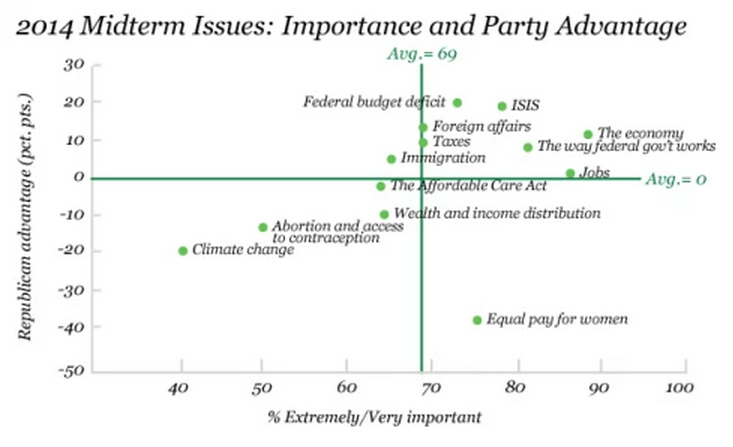
Gallup asked “registered voters to rate the importance of 13 issues to their vote for Congress, and then to indicate which party would do a better job on each issue.” Republicans came out ahead:

Midterm Issues

Aaron Blake captions:

The GOP has an advantage on eight of the nine most important issues tested by Gallup, while Democrats lead on the four least-important. Among the issues the GOP leads on: the economy, the Islamic State (ISIS), the budget deficit, foreign affairs and even immigration.

Democrats, meanwhile, have finally gained an advantage on the Affordable Care Act — a.k.a. Obamacare — only to see it wane in importance as an issue. The lone big issue on which Democrats have an advantage (and a big one, at that) is equal pay for women.

Yglesias Award Nominee

A voice of reason in the ethical swamp of “journalism”:

WWD: What are your views of native advertising? Do you run them on your site?

David Remnick, editor The New Yorker: We run all kinds of ads, as long as they are clearly marked as advertising when there’s ever a question. I think advertising is advertising. If it’s 100 percent clear what it is, then, with certain exceptions, I can live with that.

What I object to is tricking the reader and blurring the lines so that unsuspecting readers, thinking that they are getting something that is assigned and edited by the editorial side, are getting something quite different. They are getting an advertisement.

WWD: Time Inc. has editors that will work on editorial and advertising content. Is that a no-no in your book?

David Remnick: Call Time Inc. That’s not what I got into journalism to do. I got in journalism for any number of reasons, not least because it’s so much fun. Journalism should be in the business of putting pressure on power, finding out the truth, of shining a light on injustice, of, when appropriate, being amusing and entertaining — it’s a complicated and varied beast, journalism.

For a glossary of Dish Awards, see here.

Ebola Politics On The Left

Alex Rogers flags the fear-mongering ad seen above, which tries to make political hay out of the Ebola crisis by blaming the lack of preparedness on budget cuts supported by Republicans:

Erica Payne, the producer of the ad and president of the Agenda Project Action Fund, blamed the Ebola crisis wholly on the Republican Party. “I think any Republican who attempts to chalk this ad up to politics is a Republican who is too afraid to examine the results of his of her actions and the very real consequences that they have,” she said. “They have developed a governing philosophy that is so fanatically anti-investment that they literally have at their doorstop death. There is no exaggeration in this.

Dr. Francis Collins, director of the NIH, tells Sam Stein that Ebola research has been hampered by stagnant funding over the past decade:

“NIH has been working on Ebola vaccines since 2001. It’s not like we suddenly woke up and thought, ‘Oh my gosh, we should have something ready here,'” Collins told The Huffington Post on Friday. “Frankly, if we had not gone through our 10-year slide in research support, we probably would have had a vaccine in time for this that would’ve gone through clinical trials and would have been ready.” …

Money, or rather the lack of it, is a big part of the problem. NIH’s purchasing power is down 23 percent from what it was a decade ago, and its budget has remained almost static. In fiscal year 2004, the agency’s budget was $28.03 billion. In FY 2013, it was $29.31 billion — barely a change, even before adjusting for inflation. The situation is even more pronounced at the National Institute of Allergy and Infectious Diseases, a subdivision of NIH, where the budget has fallen from $4.30 billion in FY 2004 to $4.25 billion in FY 2013.

But Nick Gillespie doesn’t buy that the NIH and other government health agencies are hurting for money:

According to its budget documents, the NIH got about $23 billion in fiscal 2002 (George W. Bush’s first budget year), a figure that rose to $30.2 billion in 2009 (his last budget year) before peaking at $31 billion in 2010. It dipped a bit from then and came to $30.1 billion in 2014, which is about the same amount the NIH requested in President Obama’s 2015 budget plan.

You can argue that the United States needs to be constantly and massively increasing its spending on everything and that every time spending doesn’t go up in a lockstep fashion (and faster than inflation, as it did throughout the Bush years) that you’re killing people. You can also argue that the topline budget figures for various agencies don’t matter, but then you’re really talking about the ways in which bureaucracies, especially in the budget sector, misallocate resources. The one thing you really can’t do is say that the federal government, which is not actually controlled by the Republicans (just saying), has been slashing its spending on anything.

Noah Rothman adds:

There are some conservatives who have convinced themselves that the federal government is to blame for the spread of Ebola to the United States. A few conspiratorial types insist that Washington is indifferent to the spread of this deadly bug to America, despite the fact that this claim defies Hanlon’s razor and there is no evidence to support it. There is, however, sufficient evidence to suggest the federal agencies responsible for preventing a public health crisis – from medical care, to transportation, to oversight – are simply too unwieldy and prone to human error to take the necessary precautions which might have prevented Ebola’s spread across the Atlantic. That is a debatable point, but it is apparently so dangerous to the left that they are mounting a counteroffensive.

Quote For The Day

“I have stood by Israel through thick and thin, through the good years and the bad. I have sat down with Ministers and senior Israeli politicians and urged peaceful negotiations and a proportionate response to prevarication, and I thought that they were listening. But I realise now, in truth, looking back over the past 20 years, that Israel has been slowly drifting away from world public opinion. The annexation of the 950 acres of the West Bank just a few months ago has outraged me more than anything else in my political life, mainly because it makes me look a fool, and that is something that I resent.

Turning to the substantive motion, to be a friend of Israel is not to be an enemy of Palestine. I want them to find a way through, and I am delighted by yesterday’s reconstruction package for Gaza, but with a country that is fractured with internal rivalries, that shows such naked hostility to its neighbour, that attacks Israel by firing thousands of rockets indiscriminately, that risks the lives of its citizens through its strategic placing of weapons and that uses the little building material that it is allowed to bring in to build tunnels, rather than homes, I am not yet convinced that it is fit to be a state and should be recognised only when there is a peace agreement. Under normal circumstances, I would oppose the motion tonight; but such is my anger over Israel’s behaviour in recent months that I will not oppose the motion. I have to say to the Government of Israel that if they are losing people like me, they will be losing a lot of people,” – Richard Ottaway, conservative MP, Westminster.

The non-binding vote in the Commons to recognize a Palestinian state was overwhelming – 274 – 12. I hope it leads to more and more countries taking this position – because all other avenues to prevent or stall the grotesque and relentless attempt to annex all the land once inhabited by Palestinians – and to treat an entire people as anathema – have failed. There is no dialogue with the Israeli government on all these issues; there is simply a monologue from the Israelis to the rest of us. I feel exactly as the Tory MP feels: this has gone on long enough. If enough European parliaments take this position, maybe even the US Congress will budge from its current position that Israel can never be criticized. But I doubt it.