The Moral Intimacy Of Drone Warfare

AFGHANISTAN-FRANCE-ARMY-FILES

In a feature on the drone era and its ramifications, Ben Wallace-Wells touches on how military drone operators engage with their targets much more intimately than bomber pilots on manned missions do, despite working from thousands of miles away:

Pilots typically benefit from what psychologists call “the morality of altitude” — separated from their victims by thousands of feet of airspace, they tend to suffer far less post-traumatic stress than do their counterparts on the ground. But drones have collapsed that moral distance, bringing their operators into far greater intimacy with their targets. The details of how drone pilots work have, like the missions themselves, been largely classified, but by combing through unclassified medical studies of drone-operator stress, Peter Asaro of the New School has been able to pinpoint some of the changes. Asaro found that tasks that had been distributed through the military and intelligence bureaucracies (gathering intelligence on a target, conducting surveillance, weighing the risks of a targeted killing, navigating a plane, firing a missile, assessing what happened afterward) have now been concentrated, so that they are all performed by tiny teams often scattered at bases around the peacetime United States, working at night, monitoring targets halfway across the globe for whose survival or death they are responsible.

“A pilot traditionally might have to fly to a coordinate and drop a bomb, and that was it,” Asaro says. “Now a drone operator has much more intimacy. Often he has to track a subject for weeks beforehand. The access to the intelligence is much greater. Sometimes they have to do damage assessment in the aftermath of an attack — to count the bodies pulled from the rubble.”

Yochi Dreazen calls attention to the psychological toll the job takes on these soldiers:

The results of the growing number of studies examining what long-distance war does to those who fight it are stark and striking. An Air Force survey in 2011 found that 41% of the Air Force personnel operating the unmanned aircrafts’ advanced surveillance systems reported “high operational stress,” along with 46% of those actually piloting the robotic planes. … Last year, a study by the Armed Forces Health Surveillance Center found that drone operators were at “similar risk” for mental health issues like PTSD, depression, and anxiety as the pilots of the manned warplanes and other aircraft flying over Iraq and Afghanistan from bases in the two war zones because they were experiencing — even from the safety of their trailers thousands of miles away — “witnessing traumatic experiences” like the deaths of U.S. troops or the militants they had just killed by pulling a trigger on what looks like a video game joystick.

Recent Dish on drone pilots here and here.

(Photo: A US ‘Predator’ drone passing overhead at a forward operating base near Kandahar, Afghanistan. By Joel Saget/AFP/Getty Images)

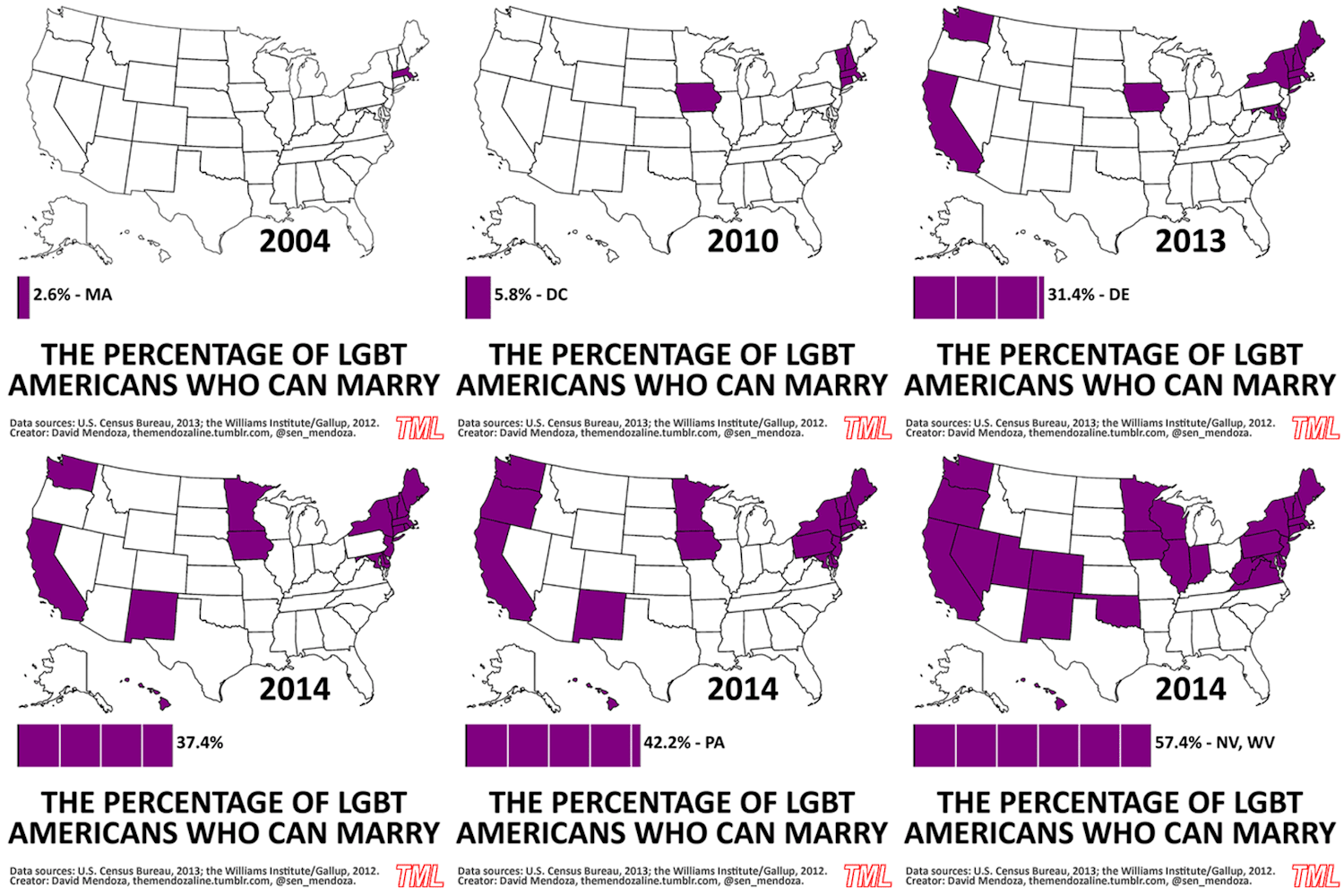
Marriage Equality Update

Marriage Equality Population

Equality has come to Nevada and West Virginia. Joe Jervis quips:

When you get to post a new Wikipedia map twice in a few hours, that was a very good day for our people. When you get to post a new Wikipedia map eight times in four days, that was one of the best weeks in our history.

Lyle Denniston checks in on those states without marriage equality:

A decision by the Ninth Circuit on Tuesday to nullify a ban in Idaho (along with the ban in Nevada) created the likelihood that prohibitions would soon be set aside also in Alaska, Arizona, and Montana.  However, Idaho has a challenge pending with Supreme Court Justice Anthony M. Kennedy; the same-sex couples involved in that case filed their response late Thursday afternoon, arguing that state officials “point to nothing that would justify” postponement of the Ninth Circuit decision “only days after the Court denied every other petition presenting the same claim.”

A decision by the Tenth Circuit against bans in Oklahoma and Utah (and left intact by the Supreme Court on Monday) suggested that similar prohibitions would be ended in Kansas and Wyoming.  In Wyoming, a federal trial judge on Thursday scheduled a hearing for October 16 on whether to allow same-sex couples to begin marrying in that state.  In Kansas, state officials have said they were studying the situation, but a state judge in a district in the Kansas City metropolitan area on Wednesday ordered clerks in that district to begin issuing marriage licenses to same-sex couples.

A case in Alaska begins today. Zack Ford examines the situation on North Carolina:

North Carolina is another state where a change could come quite soon. The state stopped defending the ban back in July, but several GOP lawmakers, led by House Speaker and U.S. Senate candidate Thom Tillis (R), are trying to take up the fight. To advise them,they’ve even hired National Organization for Marriage Chairman John Eastman. While their motion to intervene in the case has not yet been considered, a federal judge ruled Thursday night that they will not be granted the eight-day extension they requested. They have until noon Friday to file their finalized motion to intervene, and the case could advance — or be resolved — quite quickly after that.

Dahlia Lithwick and Sonja West take a closer look at Kansas and South Carolina:

The state is presumably under the jurisdiction of the 10th Circuit, which also covers Utah, whose appeal was batted away by the Supreme Court on Monday. The 10th Circuit ruling that same-sex marriage bans are unconstitutional should therefore be the law in Kansas. Moreover, state law provides that a clerk who issues a license to “unqualified” people could be found guilty of a misdemeanor. So on Wednesday, Chief District Judge Kevin Moriarty of Johnson County issued an order directing the district court clerk to issue licenses to same-sex couples without fear of prosecution, reasoning that state laws—statutory or constitutional—are void if they contradict federal law, and that after Monday Kansas is bound by the 10th Circuit decision. But other judges in the same county disagree. And a judge in a different county has already denied a couple seeking a license because, in her view, Kansas’ ban on same sex marriage has not been explicitly struck down.

Meanwhile, Kansas Attorney General Derek Schmidt and Gov. Sam Brownback declined to accept the Johnson County ruling. Brownback issued a statement Wednesday night indicating that “An overwhelming majority of Kansas voters amended the constitution to include a definition of marriage as one man and one woman.” The statement asserted, “Activist judges should not overrule the people of Kansas.” Is Judge Moriarty an “activist Judge”? Or is he merely aware of the existence of the Supremacy Clause? Who knows?

Over in South Carolina? Same deal. Depending on which courthouse you visit, you can procure either a marriage license or a refusal.

(GIF by David Mendoza)

Make Orwell Proud, Ctd

We bleg, you respond – this time by emailing “examples of jargon that is is designed explicitly as a euphemism to disguise the core reality.” One reader writes:

The use of the words “Collateral Damage” has always made me cringe. The US Dept of Defense Dictionary of Military and Associated Terms defines collateral damage as the “unintentional or incidental injury or damage to persons or objects that would not be lawful military targets in the circumstances ruling at the time.”

Really? Killing someone is “damage”. Collateral Death is more like it.

Another points to “‘disposition matrix’, to refer to the CIA’s kill list.” Another:

While the titles of most legislation coming out of Congress usually makes me cringe , I’m going to have to go with USA PATRIOT Act as perhaps the most Orwellian, in that it contains some of the most anti-Bill-of-Rights (if not anti-Constitutional) legislation ever enacted in this country. Basically, it’s little more than “be patriotic and give up a good chunk of your rights because terrorism!” I count the Patriot Act and its reauthorizations as perhaps Osama Bin Laden’s greatest accomplishment …

Another reader:

“Ethnic cleansing” always struck me as a gross Orwellian term.  Sounds like something is being made better and more clean. I was very surprised when the U.S. used the term regarding Bosnia (although using “genocide” has legal implications for a nation). Still, there has to be a better term.

Shifting to employment:

When my mother was laid off from her job as a bank teller at the age of 60, she was told that she was “non-selected”.

Another has three more: “rightsize, early retirement option, workforce imbalance correction.” Another writes:

When large companies outsource a division to a cheaper labor location, say India or even Iowa, the term used to describe the new lower cost department is “Center Of Excellence”.  The original name of New York’s deservedly world famous “Hospital for Special Surgery” was “Hospital For The Relief Of The Ruptured And Crippled”.

Another:

One of my personal favorites is “knowledge transfer” as in “China actively promotes “knowledge transfer,” a euphemism for stealing your technology.”

And another:

I used to work in the mortgage industry, and the company I worked for was in the process of merging with very similar organization. However, there was a problem that was making everyone nervous. Many of the employees from the other company did the exact same job that we did. There was significant overlap. But don’t worry! None of us were going to get fired! No firings here. That would have been bad for morale. Instead, we were told that management was looking into “eliminating unnecessary redundancies”. This cold and technical language struck me as perverse. These were fathers, mothers, husbands, and wives who were about to lose their jobs, not “redundancies” – as if they were unfeeling machines that could just be disposed of.

Another quick one. During my time with this company, we were under investigation for fraud by federal prosecutors. In the end, we agreed to pay a fine in exchange for an end to the investigation. This was reported to all employees in a positively spun email that stated we had “met all of our legal obligations”. It seems to me that when you have broken the law that’s the exact opposite of meeting your legal obligations. All we did was pay a fine to get the feds off our backs. This use of language irritates the hell out of me.

Another turns to parenting:

This might be more innocuous than most, but I’ve always gotten a kick out of the language of the Ferber Method, where parents teach babies how to “self-soothe”. This is of course, a polite way of saying let the baby cry.

This one’s a doozy:

You know the little safety talks the flight attendants always give at the beginning of flights? I was once privileged to hear one that included the phrase, “In the event of an unscheduled water landing …” Which of course begs the question, how many scheduled water landings does that airline make?

Our Pharmacist Glut, Ctd

Dish alum Katie Zavadski recently reported on the bursting of the pharmacist bubble. Freddie sympathizes with students with “practical” degrees who end up unemployed:

This country graduates 350,000 business majors a year. The metrics for those degrees are generally awful. But nobody ever includes them in their arguments about impractical majors, despite those bad numbers. And if you’re some 19 year old, out to choose a career path, business sure sounds practical. So they graduate with those degrees and flood the market with identical resumes and nobody will hire them. Meanwhile, they lost the opportunity to explore fields that they might have enjoyed, that might have deepened the information acquisition and evaluation skills that would allow them to adapt to a whole host of jobs, and that might have provided a civic and moral education. All to satisfy a vision of practicality that has no connection to replicable, reliable economic advantage. …

Chasing a particular employment market, for an individual, can be a good or a bad bet. But treating skill chasing as a long-term economic solution on the societal level is insane. We’ve responded to unprecedented labor market swings, and to our incredible exposure to risk through our financial system, by dramatically narrowing our notion of what skills are valuable and who gets to be considered a practically educated person. That makes zero sense, particularly in a time when automation threatens to cut the legs out from more and more workers as we move forward. We are manically pursuing a far narrower vision of what human beings can call a vocation, treating any endeavor that does not involve numbers or digital technology as useless and old-fashioned, with nothing resembling a sound evidentiary basis for believing that this will deliver better labor outcomes. (The numbers-based fields are the ones that computers will be best equipped to take over!)

How Do We Get On The Same Page?

Tim Parks considers how the social function of novels has changed with the times:

How often have we been involved in conversations, at a party maybe, where four or five people ask what others think of this or that novel, only to find that no one else has read it? Even, or perhaps especially, among people who read a lot it is often difficult to find a single recently published book that we have all read. The conversation founders, literature fails to bring us together, no debate is provoked. Or to find a book to talk about we have turn to one of the blockbusters or media-hyped works of the day, something one almost feels authorized to talk about whether one has read it or not: Underworld, The Girl with the Dragon Tattoo, Interview with a Vampire, My Struggle. Regardless of quality, regardless even of sales, since [Karl Ove] Knausgaard’s are nowhere near on a level with the others, these are books that have been as it were chosen for the conversation, perhaps precisely because it’s often embarrassingly difficult to find a book we’ve all read to settle on.

He goes on to speculate why people gravitate toward some titles over others:

The serialized novel has been replaced by serialized television fiction that has become so successful at generating discussion that those of us who didn’t follow The Sopranos or The Wire were often made to feel left out. Meantime, in the bookshops, readers choose from literally thousands of recently published titles. In the countries of western Europe a good 50 percent of those books will come from abroad; so people’s reading is not focused on the society they live in and the stories read are often set elsewhere.

In 2011 when I ran a little survey in a Dutch bookshop on the kind of novels people were reading, younger readers in particular said they often chose to read popular foreign, particularly American or English, authors—Dan Brown or Ian McEwan or Philip Roth or Zadie Smith—so that they would have a common subject of conversation when meeting other young people during their summer travels. Their choices seemed random and were taken regardless of quality. Rather than a situation where people are naturally finding themselves reading the same thing and then talking about it, some readers are responding to celebrity in the hope that what they read will enable them to join an international conversation.

The Best Of The Dish Today

Sydney Locals Create Bondi's Largest Fluro Wave

A reader writes:

I have had to correct this misstatement numerous times with friends, and now I’m disappointed to see you parroting Kristof, who is parroting Allah-knows who else. The data from the Pew Report [pdf] showing majorities in many Muslim countries in favor of the death penalty for apostasy come only from those Muslims who believe Sharia law should be the law of the land.

So not all Muslims, by any means. What percentage of Muslims across the diverse Muslim world favor Sharia law? The key graph from Pew on executing apostates is below. And when you do the math (and yes, fair warning that I usually do it wrong), you find that 63 percent of Egypt’s Muslims, 58 percent of Jordanian Muslims, 78 percent of Pakistani Muslims, and 53 percent of Malaysian Muslims believe that if you decide you don’t believe in Islam any more, you should be executed. Think about that for a minute.

Screen Shot 2014-10-09 at 6.57.21 PMCentral Asian and South-Eastern European Muslims are very different, as are Indonesians. You’ll notice also that in one of the least devout of the Muslim countries in the Middle East and North Africa, Tunisia, only 16 percent favor the death penalty for non-belief. It does not shock me that Tunisia’s democratic revolution is the only one that has survived.

The more devout you are, the more you tend to favor the state enforcing religious doctrine, Pew also finds. Not how poor you are, how devout you are.

But variety and diversity exists as well. And nowhere has Islam come closer to a reconciliation with modernity than in America. American Muslims are far more like American non-Muslims than Muslims in any other country. On the core question of religious liberty, 56% of American Muslims “believe that many religions can lead to eternal life … Across the world, a median of just 18% of Muslims worldwide think religions other than Islam can lead to eternal life.” Here’s another big difference between Islam in America, and Islam elsewhere:

About half of U.S. Muslims say that all (7%) or most (41%) of their close friends are followers of Islam, and half say that some (36%) or hardly any (14%) of their close friends are Muslim. By contrast, Muslims in other countries nearly universally report that all or most of their close friends are Muslim (global median of 95%). Even Muslims who also are religious minorities in their countries are less likely than U.S. Muslims to have friendships with non-Muslims. For example, 78% of Russian Muslims and 96% of Thai Muslims say most or all of their close friends are Muslim.

I think it’s essential that this is better known in America, and that dumb conflations of Islam here and around the world – leading to foul prejudice and discrimination and fear – be challenged at every point. At the same time, I just don’t think the extreme and barbaric views of so many Muslims around the world can be denied. They are dangerous for their own societies and for ours. No one should not be intimidated into silence about it.

Today, the debate about Islam continued – see the thread here. We have updates on the Senate races where the GOP is in some trouble – in South Dakota and Kansas. I pushed back against the Beltway bullshit that the Obama presidency is suddenly a failure – au contraire! The intervention in Syria is another almighty clusterfuck that the US should have avoided at all costs; and our experiment in new media is chugging along.

The most popular post of the day was my defense of Sam Harris and Bill Maher against Ben Affleck and Nick Kristof; followed by my defense of religious freedom in Gordon College.

Many of today’s posts were updated with your emails – read them all here.  You can always leave your unfiltered comments at our Facebook page and @sullydish. 29 more readers became subscribers today. You can join them here – and get access to all the readons and Deep Dish – for a little as $1.99 month. And drop us an email; we love hearing from new subscribers.

(Photo: Sydney locals line up along the waters edge dressed in fluro costumes in an attempt to create Bondi’s largest fluro wave stretching from South Bondi to North Bondi at Bondi Beach on October 10, 2014 in Sydney, Australia.  The event is to raise awareness on World Mental Day and show support for everyone who has ever suffered, or knows someone who has suffered with depression and other disorders including bi-polar and anxiety. By Ryan Pierse/Getty Images.)

Will “Tightening The Borders” Keep Ebola Out?

New York's Bellevue Hospital Prepares For Possible Ebola Cases

Thomas Eric Duncan, the first Ebola patient diagnosed in the US, succumbed to the virus yesterday, as the Centers for Disease Control announced that five key airports would begin screening passengers arriving from Guinea, Liberia, and Sierra Leone for signs of illness. Amanda Taub outlines the new screening protocols:

According to the CDC, over 94 percent of travelers from those three affected countries enter the US through one of the five airports that will implement the screening measures: JFK in New York City, Newark, Washington-Dulles, Chicago-O’Hare, and Atlanta. JFK, which receives more than half of those passengers, will begin screening on Saturday, October 11. Travelers will be screened at the border, immediately after they go through passport control, in a special area of the airport. Customs and Border Protection officers will take passengers’ temperatures and ask them a series of questions about their health and possible Ebola exposure.

Passengers who do not have fevers or any history of exposure to Ebola will be given information about the virus and asked to complete a temperature monitoring chart at home. Those who do have fevers or who give answers that raise concerns about possible Ebola exposure will be referred to a CDC officer in the airport, and then to public health authorities if it is determined that further monitoring is necessary.

Jonathan Cohn expects that the main benefit of these screenings will be psychological:

Experts have generally been skeptical that increased screening would make a difference, in part because the new precautions rely on candor from foreign visitors. Remember, similar screenings already take place at the points of departure in West Africa. Duncan got out of Liberia by lying and stating that he’d had no contact with an Ebola patient.

But a secondary goal of the new steps is to calm the American psyche and there’s a case for that. If it takes some extra vigilance and a quick temperature check to make the American people feel safe, and if it doesn’t divert precious resources, it’s probably a price worth payingin much the same way that security theater in the airports, following September 11, made it possible for the flying public and eventually the rest of the public to return to some form of normalcy.

And Maryn McKenna argues that emergency rooms, not airports, are the spaces we should be worrying about:

Screening passengers for fever makes it look like someone is doing something. (It’s also a surprisingly active area of engineering research; check these post-SARS papers from 2005, 2006, 2009, 2013 and this year.) But as Duncan’s case demonstrated, the critical point for “border control” of Ebola may be not the airport, but the emergency room. We already know — have known for years, in fact — that our emergency-care system is underfunded, overstressed, and asked to bear a larger burden for the health of the mass public than either hospital or outpatient care do. It is very disappointing that Duncan’s travel history was ignored in his first encounter with Texas Presbyterian — but as Texas health journalist Laura Beil pointed out on Twitter yesterday, not even slightly surprising given the churn of uninsured patients through the state’s big ERs.

Jason Millman checks in with some ER doctors:

One ER doctor in Denver, Eric Lavonas, said there was no Ebola panic yet, while another in the Bronx, Dan Murphy, said several patients came in on Tuesday fearing they were infected. Sudip Bose, an ER physician working in Chicago and Texas, said he’s seen an increase in visits after an inbound flight scare in Dallas this week. Hamad Husainy, an ER physician in Alabama, said two people who were recently hired as “scribes” to document patient visits quit those jobs because they feared being exposed to Ebola.

New York-based physician Bob Glatter said he thinks people are still being reasonable about the extremely low risk of contracting the disease in the United States. However, he thinks Ebola fears may start to pick up after Duncan’s death on Wednesday and with flu season rapidly approaching.

Pointing to a series of polls suggesting that a significant number of Americans are worried that they or their loved ones might get the disease, Waldman comments on the hysteria:

We’ve had only one case in America, and while there may be a few more like him—people who went to a place where the disease was spreading and returned before becoming symptomatic, all while evading the precautions that were in place—it won’t be more than a few. You aren’t going to get it. But fear always wins. Fear sure wins on TV, where they’re actually asking questions like “Could the virus mutate and become airborne?” And we’re all hard-wired for fear, because fear is highly adaptive from an evolutionary standpoint. The australopithecine who’s terrified of every bump in the night is the one who survives to pass on his genes.

Meanwhile, the totally-not-a-race-baiter Rush Limbaugh is telling his listeners that Barack Obama wants to let white Americans get Ebola as revenge for slavery. So of course we can all stay rational.

Meanwhile, Spanish ebola patient Teresa Romero Ramos’s dog Excalibur was put down yesterday. Barbie Latza Nadeau reports:

Despite an online petition that garnered more than 400,000 signatures and half a million tweets to try to save the dog’s life, a campaign launched by Romero’s husband Javier Limón from his quarantined quarters in the Carlos III hospital, the dog was euthanized on Wednesday evening in the couple’s apartment in suburban Madrid. Armed guards kept animal rights activists shouting “assassins” at bay.  The dog, which was never tested for the Ebola virus, was put to sleep before being removed from the locked-down apartment.  The body will be incinerated at a medical waste plant in Madrid. According to Spanish press reports, the dog’s corpse will not be tested for the virus, so no one will ever know whether or not Excalibur had the lethal disease.

Marc Champion puzzles over the outcry to save Excalibur:

I don’t remember people clashing with police to persuade their governments to do more to help stop the spread of Ebola in Africa, where more than 3,400 human beings have died from the disease. Indeed, an online petition to persuade the U.S. government to fast-track research for an Ebola drug has so far received 152,534 signatures. By that measure, we care half as much about finding a cure for Ebola as saving a dog.

Either way, Amy Davidson points out, neither mercy for Excalibur nor security theater at airports addresses the actual problem:

If it takes a dog to remind people to not be senselessly fearful in the face of a disease—not to just smother everything that’s frightening—Excalibur will have a real legacy. But that’s only true if the perspective he opens is broad: we can’t just deal with Ebola by looking at dog pictures while trying to close airports and banish images of Africa. There’s another set of scenes, the ones that we have been looking away from for months, in West Africa, where children orphaned by Ebola are fending for themselves. In Sierra Leone, gravediggers have gone on strike; it’s dangerous work, and they say that they haven’t been paid.

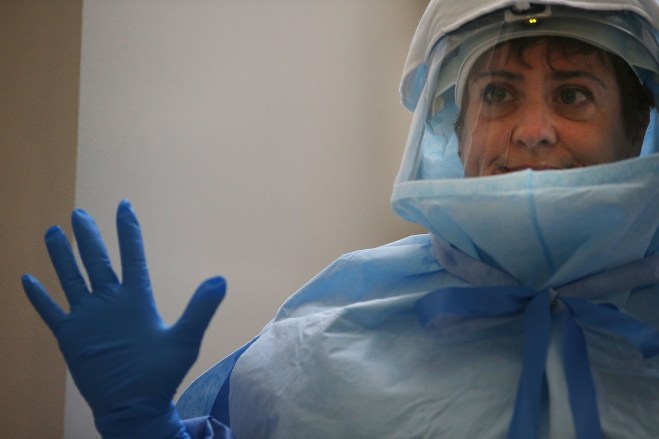
(Photo: A member of Bellevue’s Hospital staff wears protective clothing during a demonstration on how they would receive a suspected Ebola patient on October 8, 2014 in New York City. By Spencer Platt/Getty Images)

Face Of The Day

Liberia Races To Expand Ebola Treatment Facilities, As U.S. Troops Arrive

U.S. Air Force personnel put up tents to house a 25-bed hospital for sick Liberian health workers as part of Operation United Assistance in Monrovia, Liberia on October 9, 2014. U.S. President Barack Obama has committed up to 4,000 troops in West Africa to combat the Ebola epidemic, which has killed at least 3,400 people. By John Moore/Getty Images.