While visiting a friend in a mental hospital, I witnessed a grieving husband ask a doctor about the long-term prognosis for his suffering wife. All the doctor could do was prattle on about the different “medicinal modalities” (i.e. drugs) they were utilizing to try to stabilize her. As the husband looked on helpless and dumbfounded, I wanted to punch the doctor.
Let’s make sure we’re focused. Email us examples of jargon that is is designed explicitly as a euphemism to disguise the core reality. “Enhanced interrogation techniques” remains the industry standard of abusing the English language to defend the indefensible. But there must be countless others out there – bubbles of deception and blather waiting to be popped.
Tim Fernholz explains what the government is doing to protect us from killer asteroids:
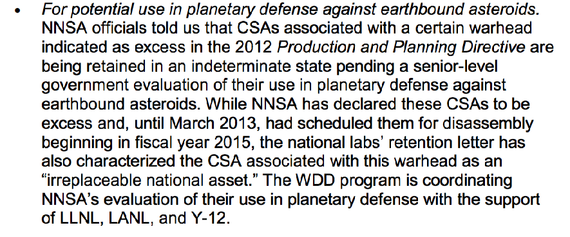
Why is the U.S. falling behind on its promises to destroy old nuclear weapons? Here’s one reason given to government auditors (pdf):
That’s right, the U.S. isn’t dismantling its old nuclear weapons, because we might need them to destroy an asteroid hurtling toward earth. To clarify some of the bureaucratic language above, NNSA is the “National Nuclear Security Administration”; CSAs are “canned subassemblies” that contain highly enriched uranium for use in nuclear weapons. And senior-level government evaluation means that somewhere in government, there is contingency planning going on around what to do in the event of an asteroid heading toward earth.
But Fernholz notes that the planners aren’t necessarily as concerned about a “planetary-extinction level asteroid” as they are about a smaller object like the near-earth asteroid seen above, which lit up the skies over Chelyabinsk, Russia, in 2013.
As noted last night, the Ninth Circuit Court of Appeals ruled in favor of marriage equality yesterday. This map shows which states each circuit court covers:
Striking down bans on same-sex marriage in two states, and setting the stage for the same outcome in three others, a federal appeals court in San Francisco on Tuesday nullified laws in Idaho and Nevada. The ruling by the U.S. Court of Appeals for the Ninth Circuit is expected to control pending challenges to bans in Alaska, Arizona, and Montana.
With developments since Monday’s refusal by the Supreme Court to get involved in the constitutional controversy at this point, it now seems clear that the same-sex marriage campaign has succeeded — or very soon will — in thirty-five of the fifty states, plus Washington, D.C.
Ari Ezra Waldman wonders “whether we will need the Supreme Court at all.” He lists “several reasons why all applicable circuits may agree and create, piece by piece, a nationwide right to marry”:
First, three circuits are already in the fold through a combination of litigation, legislative vote, and plebiscites. Marriage equality exists in all jurisdictions covered by the First, Second, and Third Circuits.
Second, we have won at the appellate court level in the Fourth, Seventh, and Tenth Circuits. And, at the Ninth Circuit, which is the largest circuit in the country, the appellate court has affirmed that any discrimination against gays merits heightened scrutiny. That means that any marriage equality ban in the Ninth Circuit will be nearly impossible to maintain. That’s seven circuits out of eleven, leaving the Fifth, Sixth, Eighth, and Eleventh.
One reason he doubts those courts will rule against equality:
[J]udges who have yet to hear marriage equality appeals do not exist in a vacuum. They see a rising tide of proequality rulings below them — at the district court level — and above them — at the Supreme Court (Windsor). They also see state court rulings and growing majorities of Americans supporting marriage equality. They also have the lessons of history. The Governor George Wallaces who literally stood in the way of racial equality do not get positive historical treatment. Judges know that marriage equality opponents are going to be forgotten, at best, and ridiculed or despised, at worst.
William Eskridge expects there “will be as many as thirty-five marriage equality states very soon – even if the Fifth and Sixth Circuits reject marriage equality claims in pending appeals”:
For example, if the Sixth Circuit were to uphold Michigan’s exclusion of lesbian and gay unions from civil marriage, the Supreme Court would very probably take the Michigan marriage equality case (or another case from the Sixth Circuit, where several are pending). That would be more good news for the marriage equality movement, because the Michigan case comes loaded with detailed findings of fact not only documenting the value of lesbian and gay families, but also soundly refuting stereotype-laced arguments supporting their exclusion.
Imagine this scenario. The Sixth Circuit upholds Michigan’s (or another state’s) exclusion in the next several months, and the Supreme Court takes review. During the briefing process, one state after another recognizes marriage equality – often through a deliberative process where elected officials support or acquiesce in lower court judgments requiring marriage equality for lesbian and gay couples. Amicus briefs fall into line behind marriage equality, with support from businesses, many religious groups, public officials from both parties and from most of the states.
As tens of thousands new marriage licenses are issued to lesbian and gay couples all over the country, it strikes me as highly unlikely that the Supreme Court would affirm Michigan’s pervasive discrimination against committed lesbian and gay couples and their families.
Jeremy Jennings reads Andrew Roberts as answering with an emphatic “yes” in his forthcoming biography, Napoleon: A Life:
As Roberts concedes, the Revolutionary and Napoleonic wars cost a total of around three million military and one million civilian deaths. Of these, 1.4 million were French. For this Napoleon must share much of the responsibility. Roberts also accepts that naval warfare was an almost total blind spot for Napoleon. Even after Trafalgar, he remained convinced that he could build a fleet capable of invading Britain, wasting men, money and material on a doomed enterprise. To this we might add Napoleon’s abandonment of his army in Egypt, the abduction and execution of the Duc d’Enghien, the reintroduction of slavery in French colonies in 1802, catastrophic defeat in Russia, and other similar blemishes to his reputation. And, of course, Napoleon ultimately brought France to her knees.
Roberts however is in no doubt that the epithet [“Napoleon the Great”] is deserved.
A general at 24, Napoleon lost only seven of 60 battles fought. In 1814 he won four separate battles in five days. His capacity for decision-making and daring on the battlefield was extraordinary. If he did not invent new military strategies, he perfected them, using new formations and artillery to maximum effect. Like Napoleon himself, his superbly trained and disciplined armies moved fast, in one case covering 400 miles in 20 marching days. None of this would have been possible without the creation of a new military culture based on honour, patriotism and devotion to Napoleon’s person.
Napoleon’s military achievements, Roberts further contends, were matched and have been outlasted by his civil achievements. Having put an end to the violence of the Terror and the disorder of the Directory, Napoleon built upon and protected the best achievements of the 1789 Revolution: meritocracy, equality before the law, property rights, religious toleration, secular education, sound finances, and efficient administration. Napoleon, Roberts writes, was no totalitarian dictator but rather “the Enlightenment on horseback”.
(Photo of a statue of Napoleon in Cherbourg-Octeville, France, by Eric Pouhier)
Bourree Lam flags new findings on the impact of clocks in the workplace:
The research of Tamar Avnet and Anne-Laure Sellier focuses on the differences between organizing one’s time by “clock time” vs. “task time.” Clock-timers organize their day by blocks of minutes and hours. For example: a meeting from 9 a.m. to 10 a.m., research from 10 a.m. to noon, etc. On the other hand, task-timers have a list of things they want the accomplish. They work down the list, each task starts when the previous task is completed. The researchers say that all of us employ a mix of both these types of planning.
They wanted to know, what are the effects of thinking about time in these different ways? Does one make us more productive? Better at the tasks at hand? Happier?
In their experiments, they had participants organize different activities—from project planning, holiday shopping, to yoga—by time or to-do list to measure how they performed under “clock time” vs “task time.” They found clock timers to be more efficient but less happy because they felt little control over their lives. Task timers are happier and more creative, but less productive. They tend to savor the moment when something good is happening, and seize opportunities that come up.
On a somewhat related note, Megan McArdle analyzes a Supreme Court case whose plaintiffs are employees of an Amazon contractor “who say they had to wait in line as long as 25 minutes — unpaid — to clear end-of-shift security screenings”:
Should they be paid for that time? The intuitive answer is obvious: of course. Their employer requires the security screenings to guard against theft; it is part of their employment. How can your employer make you spend significant time doing something, while declining to pay you for it? Labor activists call this “wage theft,” and I can’t say that’s an unfair word for it. If you want to pay your workers by the hour, you should pay for all of them.
But the law is never simple and intuitive, in large part because case law is made by the difficulty of hard corner cases. The briefs run through some of this history. For example: Does your employer have to pay you for your commuting time? That doesn’t seem reasonable; employees could relocate to the far exurbs and get themselves time and a half for hours spent driving and singing along to “Free Fallin’.” …
The workers’ brief tries to distinguish those cases from the Amazon case. The TSA case seems pretty easy: The security screening is not there for the benefit of the employer; it’s there because it’s required by law. You can’t demand that your employer pay you for commuting just because they’re located in the middle of an extended 15-mph zone. The security checks at the Amazon warehouse, on the other hand, are exclusively for the benefit of the employer, who is trying to prevent theft.
The Economistdigs into a bizarre new medical finding:
You are more likely to die within five years if you cannot recognise common smells than if you have ever been diagnosed with one of those more obviously deadly illnesses. That, at least, is the conclusion of a sobering study just published in PLOS ONE, by Martha McClintock and Jayant Pinto of the University of Chicago.
Dr McClintock and Dr Pinto were prompted to conduct their investigation because they knew olfactory problems can forewarn of neurodegenerative diseases such as Alzheimer’s and Parkinson’s. They are also associated with abnormally shortened telomeres (the caps on the ends of chromosomes), and that shortening is, in turn, implicated in the process of ageing. Moreover, a good sense of smell helps keep people healthy by detecting pathogens and toxins in the air, stimulating appetite, and aiding memory, emotions and intimacy. The researchers therefore had good reason to wonder if measuring smell loss might predict mortality.
“Obviously, people don’t die just because their olfactory system is damaged,” McClintock said in a Wednesday press statement. Obviously. Unless they do.
Australian musician Michael Hutchence, the lead singer of INXS, famously lost his sense of smell in a mysterious accident in a Copenhagen night club in 1992. He developed depression shortly thereafter and died of asphyxiation five years later in what seemed to be suicide, the culmination of what friends called a slow decline in his mental well-being that began with the accident.
In another angle on just how devastating anosmia can be, Elizabeth Zierah wrote in an essay on Slate about dealing with the aftermath of a stroke at age 30. It left her with deficits including a limp and only partial control of her left hand─but it paled in comparison to the misery of losing her sense of smell after a complicated sinus infection. “Without hesitation,” she wrote, “I can say that losing my sense of smell has been more traumatic than adapting to the disabling effects of the stroke. As the scentless and flavorless days passed, I felt trapped inside my own head, a kind of bodily claustrophobia, disassociated. It was as though I were watching a movie of my own life.”
Steven Pinker is interviewed about his new book, The Sense of Style: The Thinking Person’s Guide to Writing in the 21st Century:
Many purists have remarkably little curiosity about the history of the language or the scholarly tradition of examining issues and usage. So a stickler insists that we never let a participle dangle, that you can’t say, “Turning the corner, a beautiful view awaited me,” for example. They never stopped to ask, “Where did that rule come from and what is its basis?” It was simply taught to them and so they reiterate it.
But if you look either at the history of great writing and language as it’s been used by its exemplary stylists, you find that they use dangling modifiers all the time. And if you look at the grammar of English you find that there is no rule that prohibits a dangling modifier. If you look at the history of scholars who have examined the dangling modifier rule, you find that it was pretty much pulled out of thin air by one usage guide a century ago and copied into every one since, And you also find that lots of sentences read much better if you leave the modifier dangling.
Meanwhile, Cass Sunstein flags some findings about another irritating behavior:
New research by social scientists Irene Scopelliti, George Loewenstein and Joachim Vosgerau offers a powerful explanation for why people undermine their own goals, and create a seriously negative impression, by bragging. In a nutshell, braggarts project their own emotions onto the person they’re talking to.
The researchers tested this hypothesis by asking about 50 people to describe a situation in which they had bragged. They asked these “self-promoters” to say whether they felt positive or negative emotions while they were bragging, and also to say whether they thought those who heard them felt positive or negative emotions. At the same time, the researchers asked about 50 other people to describe a situation in which someone had bragged to them. They asked these “recipients” to say whether they felt good or bad while they listened.
The self-promoters greatly underestimated the recipients’ negative feelings. They figured that slightly more than a quarter of people reacted negatively to their bragging when, in fact, almost three-quarters of recipients said they did so. These differences mirror another finding — that most self-promoters felt positive emotions while they were bragging. Only a small minority of recipients of bragging said they felt good during the experience.
I would love your perspective on the debate Bill Maher, Ben Affleck and Sam Harris attempted to have on Friday’s Real Time. I’m sure many other Dishheads would too. Can you please weigh in? It really is a fascinating topic that is drawing a lot of attention.
There’s been so much going on I let this one pass. But since you ask, I think it’s pretty indisputable that any religion that can manifest itself in the form of something like ISIS in any period in history is in a very bad way. I know they’re outliers – even with respect to al Qaeda. But, leaving these mass murderers and sadists to one side, any religion that still cannot allow its own texts to be subject to scholarly and historical inquiry, any religion that denies in so many parts of the world any true opportunities for women, and any religion whose followers believe apostasy should be punished with death is in a terrible, terrible way. There is so much more to Islam than this – but this tendency is so widespread, and its fundamentalism so hard to budge, and the destruction wrought by its violent extremists so appalling that I find Affleck’s and Aslan’s defenses to be missing the forest for the trees.
Yes, there are Jewish extremists on the West Bank, pursuing unforgivable religious war. There are murderous Buddhist extremists in Burma. There are violent Christian extremists in Nigeria, and in Russia. All religions have a propensity to banish doubt, to suppress humility and to victimize outsiders. But today, in too many parts of the world, no other religion comes close to the menace and violence of Islam.
Christianity has a bloody past and a deeply flawed present. Islam has a glorious past in many respects, and manifests itself in many countries today, including the US, humbly, peacefully, beautifully. But far too much of contemporary Islam – from Pakistan through Iran and Iraq to Saudi Arabia – is more than usually fucked up. Some Muslims are threatening non-believers with mass murder, subjecting free societies to shameless terrorism, engaging in foul anti-Semitism, and beheading the sinful in Saudi Arabia just as much as in the Islamic State. And if liberals – in the broadest sense – cannot stand up for freedom of speech and assembly and religion, and for toleration as a core value, then what are liberals for?
Does this make me a bigot? Of course it doesn’t. Criticizing a current manifestation of a religion is a duty – not a sin. And it’s not as if I have spared my own church from brutal criticism. And it’s not as if I do not respect – because I do – those countless Muslims and Muslim-Americans whose faith is real and deep and admirable. But it’s precisely because of those true representatives of the best of their faith that we should not hesitate to point out the evil and intolerance and violence of too many others. Some things really are right in front of our nose – and contemporary Islam’s all-too-frequent extremism and fanaticism is one of them.
As for Sam Harris, we are never fully in agreement, but on this issue – the unique threat that Jihadism represents in our world and the disgrace it represents for Islam as a whole – we are as one. I do not believe that all religion is poisonous delusion – au contraire – but I do believe that this particular religion at this particular moment in time is specifically dangerous and violent, and to argue that this has nothing to do with the religion that these fanatics profess is simply denial. We’ll also very shortly be starting our discussion of Sam’s new book, Waking Up: A Guide To Spirituality Without Religion. So we can perhaps address this in that bigger discussion. Stay tuned.
Today, I tried to think through what “containment” can mean in terms of confronting Jihadist terror (I think it counsels minimalism and a defensive posture, rather than our current military gestures in Iraq and Syria). I screwed up in a post comparing Obama’s and Reagan’s record in private sector job growth – although it remains indisputable that the Obama recovery would be far stronger if it had not been strangled by willful GOP austerity in the public sector. We noticed that chickens have grown in size over the last few decades almost as much as football players; and we pondered the meaning of a sudden explosion at an Iranian nuclear research facility.
The entries for today’s window contest were particularly impressive. But one reader is left pulling out her hair:
It finally happened to me today, as it has happened to so many others. I looked at the View From Your Window pic on Saturday and said “It looks like Lake Chelan” – I grew up on the lake so I should know. Then I asked myself, “Yeah, but what are the odds?” and closed the window without sending in a guess.
I love you guys, but I kind of hate myself right now.
Many of today’s posts were updated with your emails – read them all here. You can always leave your unfiltered comments at our Facebook page and @sullydish. 19 more readers became subscribers today. You can join them here – and get access to all the readons and Deep Dish – for a little as $1.99 month. Gift subscriptions are available here. Dish t-shirts here.
From the Ninth Circuit, referring to governor “Butch” Otter of Idaho:
He also states, in conclusory fashion, that allowing same-sex marriage will lead opposite-sex couples to abuse alcohol and drugs, engage in extramarital affairs, take on demanding work schedules, and participate in time-consuming hobbies. We seriously doubt that allowing committed same-sex couples to settle down in legally recognized marriages will drive opposite-sex couples to sex, drugs, and rock-and-roll.
It’s Footnote 12 on page 21, as several Dishheads have discovered.
That’s how Geoff Manaugh describes the opening chapters of Deep Down Dark, Héctor Tobar’s account of the 2010 Chilean mine disaster. Really riveting stuff:
Tobar builds and builds to the actual moment of collapse, like an orchestra tuning itself to some inevitable and apocalyptic note that only gets more terrifying as its implications becomes clear. There are dust clouds and claps of thunder; changes in air pressure and growing suspicions; then an event unlike anything I’d ever read about before—the complete internal cleaving of a so-called “mega-block” inside the mine. Here, Tobar explains that a single block of diorite two times heavier than the Empire State Building has suddenly broken free inside the mountain.
It immediately free-falls straight downward like a cork plunging into a bottle of wine, breaking through the spiraling ramp on hundreds of underground levels and completely—seemingly fatally—trapping the miners nearly at the very bottom of the entire complex.
After hours—days, weeks—of audible strain and the popping of unseen faults, “the essential structure of the mountain must have failed.” It’s as if the entire mountain is “pancaking” from within, Tobar writes: “the vast and haphazard architecture of the mine, improvised over the course of a century of entrepreneurial ambition is finally giving way.”
For the trapped miners, the inhuman scale of this “mega-block” makes it into an almost totemic object, an otherworldly and supernatural mass. It is impossible for the miners to comprehend, let alone to see, in its entirety, and crawling around or—given their now drastically limited tools and virtually non-existent food supply—digging through. As Tobar points out, “Only later will the men learn the awesome size of the obstacle before them, to be known in a Chilean government report as a ‘megabloque.’ …
And, terrifyingly, it is not done falling.
(Photo: A view on October 13, 2011 of the tunnel that collapsed trapping 33 miners at San Jose mine, in Copiapo, Chile, 850 km north of Santiago, during the first anniversary of the rescue. By Ariel Marinkovic/AFP/Getty Images)




 The Dish
