Seeing The Mountaintop

US-JUSTICE-GAY-MARRIAGE

[Re-posted and updated from earlier today]

I’ve just been absorbing the news out of the Supreme Court this morning. Unless the composition of the court changes, it now seems close to certain that every American citizen will soon have a right to marry the person they love. An idea that once seemed preposterous now appears close to banal. The legal strategy that Evan Wolfson crafted from the early 1990s onward – a critical mass of states with marriage equality before a definitive Supreme Court ruling – has been vindicated and then some. The political and cultural strategy we pioneered at the same time – shifting public opinion slowly from the ground up, tapping into the deepest longings of gay people to become fully part of their own families and their own country for the first time, talking to so many heterosexual men and women about ourselves for the first time – also succeeded.

There have been many moments when individuals have tried to take credit for all this. No one should. The reason we persuaded so many in sully-wedding-aisle-thumbso short a time is that so many unknown private individuals – from Thanksgiving tables to church meetings to office cubicles to locker rooms – simply told the truth about who we really are. It took immense personal courage at times – and each moment someone came out, more light, more reality, seeped into the debate. The reason so many attempted the apparently impossible was because we had seen at close hand what no marriage rights meant: as spouses were kept from spouses even at the hour of death during the AIDS crisis and as our children were  at risk of being taken away from us, as we grew our families.

These were elemental issues of human dignity – not abstract arguments about federal benefits or “natural law”. And this was a moral movement about the inherent dignity and equality of all of us – tapping into some of the profoundest truths from the founding of this country, and the deeper truths of our religious traditions, still sadly incapable, in many cases, of expanding, rather than constricting, the boundaries of human love. What we have right now in America is the moral majority for the dignity of every person’s capacity to love and be loved. What we have right now is the defeat of fear and fundamentalism – the two most dangerous sirens of our time.

What I also love about this conservative but extraordinary decision from SCOTUS is that it affirms the power of federalism against the alternatives. Marriage equality will not have been prematurely foisted on the country by one single decision; it will have emerged and taken root because it slowly gained democratic legitimacy, from state to state, because the legal and constitutional arguments slowly won in the court of public opinion, and because an experiment in one state, Massachusetts, and then others, helped persuade the sincere skeptics that the consequences were, in fact, the strengthening of families, not their weakening.

Those who wished to circumvent this process, to grab the credit, to condemn all those in dissent as ipso facto bigots, have mercifully been sidelined by the court. And now in thirty states (maybe thirty-five), the reality of this social reform will be seen: the quotidian responsibilities of spouses and parents, the moments of joy and agony that are part of all marriages, the healing of wounds of separation and ostracism. It won’t happen at once, but it will slowly emerge, through a greater collective empathy and inclusion. Every time a father holds back tears as his daughter marries her beloved, every time a child feels secure with her two dads or two moms, every time a young gay kid asks himself if he is really worthy because he is gay and now knows he can one day have a relationship like his mom and dad and feels less tormented and less alone: these are the ways we humans can grow and become what we fully can be. This is an expansion not just of human freedom, but of human love.
It is so easy today to see horror all around, anger surging, hysteria rising, fear spreading. But we see also in this remarkable, unlikely transformation the possibility of something much different: that human beings can put aside fear and embrace empathy, can abandon prejudice in favor of reality, can also see in themselves something they never saw before: an enlargement of the circle of human dignity.

I think of all those who never saw this day, the countless people who lived lives of terror and self-loathing for so, so long, crippled by the deep psychic wound of being told that the very source of your happiness – the love for someone else – was somehow evil, or criminal, or unmentionable. I think of the fathomless oceans of pain we swam through, with no sight of dry land, for so long. I think of the courage of so many who, in far, far darker times than these, summoned up the courage to live with integrity, even at the risk of their lives. And I cherish America, a place where this debate properly began, a place where the opposition was relentless and impassioned, a country which allowed a truly democratic debate over decades to change minds and hearts, where the Supreme Court guided, but never pre-empted, the kind of change that is all the more durable for having taken its time.

Know hope.

(Photo: Supporters of same-sex marriage gather in front of the US Supreme Court on March 26, 2013 in Washington, DC. Same-sex marriage takes center stage at the US Supreme Court on Tuesday as the justices begin hearing oral arguments on the emotionally-charged issue that has split the nation. By Jewel Samad/AFP/Getty Images.)

Quote For The Day

IMG_2455

A reader passed it along:

This Facebook post is from a CT Supreme Court justice. When he was a state senator, he was the main proponent and author (I think) of Connecticut’s marriage equality law (which was ultimately never passed – a court decision beat the legislature to the punch). He posted it around 8 pm eastern time tonight.

Face Of The Day

Gay Marriage Becomes Legal In 5 States After Supreme Court Declines Challenges

Erika Turner (R) and Jennifer Melsop (L) of Centreville, Virginia, become the first same-sex married couple in Arlington County during a ceremony, officiated by the Rev. Linda Olson Peebles (C) of Unitarian Universalist Church of Arlingon, outside the Arlington County Courthouse on October 6, 2014. The U.S. Supreme Court announced that it will not hear the five pending same-sex marriage cases, paving the way for gay and lesbian marriage in 11 more states. By Alex Wong/Getty Images.

Mum From Republicans On Marriage Equality

Little surprise at this point:

As of Monday afternoon, Sen. Mike Lee was the lone GOP member to issue a statement. His home state of Utah was one of the states where a marriage ban was overturned by an appeals court and the state is now moving forward with allowing same-sex couples to marry. Lee called the Supreme Court decision to not review the appeals “disappointing.”

Steve Benen finds much of the same – but there’s one big exception:

I checked the websites for the House Speaker, House Majority Leader, House Majority Whip, and House Conference Chair, and combined, the four Republican leaders said a grand total of nothing. The same goes for the Republican National Committee, the National Republican Campaign Committee, and the National Republicans Senatorial Committee, all of which published literally zero words on the subject.

But at least their silence demonstrates how politically dead this issue is now, a far cry from the demagoguing of the 2004 election and the Prop 8 campaign of 2008. Timothy Kincaid likewise sees the muted reaction as “a sign that while the fighting isn’t over, we’ve already won”:

[T]he usual voices of the anti-gay extremists have been loud in condemnation. But where are RNC Committee Chairman Reince Preibus? Surely this merits a moment of his time. And as for House Majority Leader John Boehner… well perhaps he’s too busy to comment today. He’s on his way to San Diego to raise money for a gay GOP congressional candidate.

Sure they may both say something about the denial of cert. They may even remind us that they “personally uphold the traditional definition of marriage” or something of the sort. But gone are the days of blistering retort or angry denunciation.

But wait – there’s at least one big turd in the GOP punchbowl sounding off late in the day:

Sen. Ted Cruz (R-Texas) on Monday slammed the Supreme Court for declining to hear appeals on lower court rulings that overturn same-sex marriage bans, calling the justices’ move “tragic and indefensible.” “By refusing to rule if the States can define marriage, the Supreme Court is abdicating its duty to uphold the Constitution,” he said in a statement.

And yet:

“This is judicial activism at its worst,” Cruz said. “Unelected [circuit court] judges should not be imposing their policy preferences to subvert the considered judgments of democratically elected legislatures.”

Judicial activism is the worst, unless it’s judicial inactivism.

Are The Protesters Really Speaking For The People?

HONG KONG-CHINA-POLITICS-DEMOCRACY

Eric X. Li criticizes Hong Kong’s pro-democracy protests for going after the wrong target, arguing that the territory is more democratic today than ever before and that economic stagnation and inequality are the public’s real concerns:

Empirical data demonstrates the nature of public discontent, and it is fundamentally different from what is being portrayed by the protesting activists. Over the past several years, polling conducted by the Public Opinion Program at the University of Hong Kong has consistently shown that well over 80 percent of Hong Kongers’ top concerns are livelihood and economic issues, with those who are concerned with political problems in the low double digits at the most.

When the Occupy Central movement was gathering steam over the summer, the protesters garnered 800,000 votes in an unofficial poll supporting the movement. Yet less than two months later an anti-Occupy campaign collected 1.3 million signatures (from Hong Kong’s 7 million population) opposing the movement. The same University of Hong Kong program has conducted five public opinion surveys since April 2013, when protesters first began to create the movement. All but one showed that more than half of Hong Kongers opposed it, and support was in the low double digits.

But Alvin Y.H. Cheung emphasizes that the movement is about much more than the economy:

Hong Kong’s current system of governance has aptly been described as “the result of collusion between Hong Kong’s tycoons and Beijing’s Communists.”  Half of Hong Kong’s legislature is made up of “functional constituencies” representing “special interests.” The end result of this is that the 1,200-strong Election Committee that currently chooses Hong Kong’s Chief Executive disproportionately favors corporate interests. …

The Umbrella Revolution is the result of this. It is a warning of the comprehensive breakdown of confidence in Hong Kong’s governing institutions – it reflects growing public disillusion with the institutional means of making their voices heard.  The momentum of the protests reflects that disenchantment.

Meanwhile, Christian Caryl wonders why the protest leaders’ Christianity hasn’t gotten more press:

This is myopic. In its origins, Christianity is a product of the Middle East, making it just as “western” as Judaism and Islam. Modern-day Christianity is thoroughly global. The Catholic Church may have its headquarters in Rome, but nowadays the vast majority of Catholics live outside of Europe and North America. Evangelical Protestantism is expanding rapidly in Latin America and Africa — and Christians there see themselves as servants of God, not as “agents of the West.”

The same goes for China. The Pew Research Center’s Forum on Religion and Public Life put the number of Protestant Christians in China at 58 million in 2010 — greater than the number in Brazil (40 million). The scholar Fenggang Yang calculates that China is on track to become the world’s largest Christian country by 2025. Western journalists may not be paying much attention, but that’s one mistake the Chinese Communist Party isn’t about to make. The Party regards religion, and Christianity in particular, as its greatest rival. It’s probably right to do so.

Peter Rutland scrutinizes the movement through the lens of nationalism and identity politics:

Since Hong Kong joined the People’s Republic 17 years ago, young people have been taught Mandarin in school (in contrast to the Cantonese spoken by most residents of Hong Kong) and have had much more direct exposure to Mainlanders, who travel to Hong Kong as tourists in huge numbers. This experience seems to be reinforcing the sense that Hong Kong citizens have a distinct identity and not just a different political system. In recent years polling data have shown a steady rise among those who see themselves first and foremost as “Hong Kong citizens” rather than as Chinese. As one demonstrator, Ashley Au, recently told a journalist: “We don’t feel like we’re a part of China, and I don’t feel Chinese.” This fact is now colliding with frustration over Beijing’s efforts to tamp down the space for political participation.

And Anne Applebaum mulls Beijing’s impulse to paint the protests as part of an American conspiracy:

To the truly authoritarian mind, “spontaneity” is impossible. The state can and should control all organizations. There is no such thing as a self-organized crowd. If people are sleeping in tents in Hong Kong’s central business district or Kiev’s Maidan, somebody must be paying them and directing them, and if it isn’t our state, then it must be someone else’s. I don’t know whether those who talk like this necessarily believe it (for the record, I’m guessing Vladimir Putin does but Hong Kong’s leaders don’t). The vision of foreign conspiracy is self-serving: If there is a foreign power directing the protest, then the government can legitimately destroy it. The conspiracy narrative has an explanatory purpose, too. If the Hong Kong protests are an American plot, then mainland Chinese can safely ignore it.

Follow all of our Hong Kong coverage here.

(Photo: A pro-democracy protester takes part in a protest in the Mongkok district of Hong Kong on October 6, 2014. Exhausted demonstrators debated the next step in their pro-democracy campaign as their numbers dwindled after a week of rallies, and the city returned to work despite road closures and traffic gridlock. By Xaume Olleros/AFP/Getty Images)

Marriage Equality For The Majority!

Marriage Equality

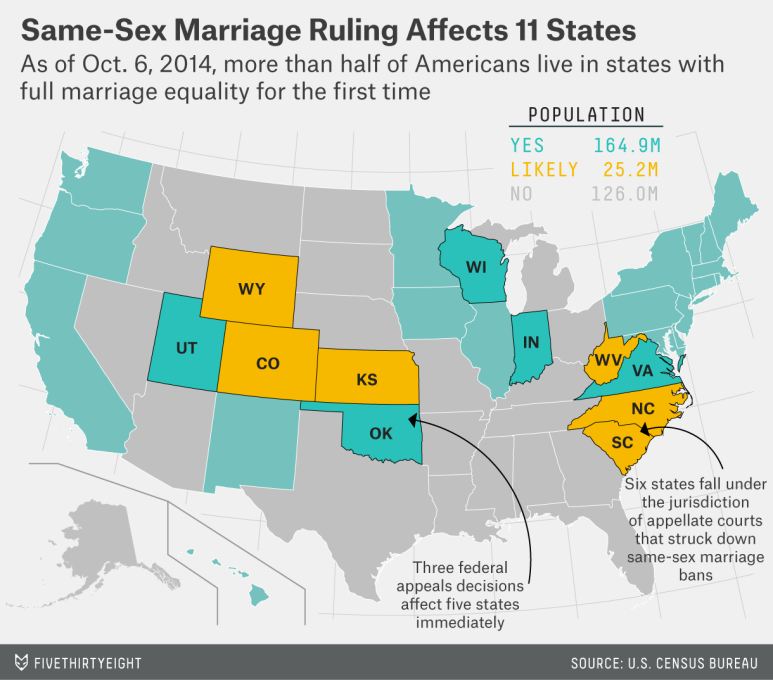
Silver calculates that marriage equality states now “have a collective population of roughly 165 million, according to 2013 census figures”:

That means for the first time, same-sex marriage is legal for the majority of the U.S. population. The 26 states where the practice is not legal have a total population of about 151 million. The Supreme Court’s decision may also lead to the legalization of same-sex marriage in Colorado, Kansas, North Carolina, South Carolina, West Virginia and Wyoming. Those states have an additional 25 million people combined. If they follow suit, 30 states and the District, totaling about 60 percent of the U.S. population, would allow same-sex marriage.

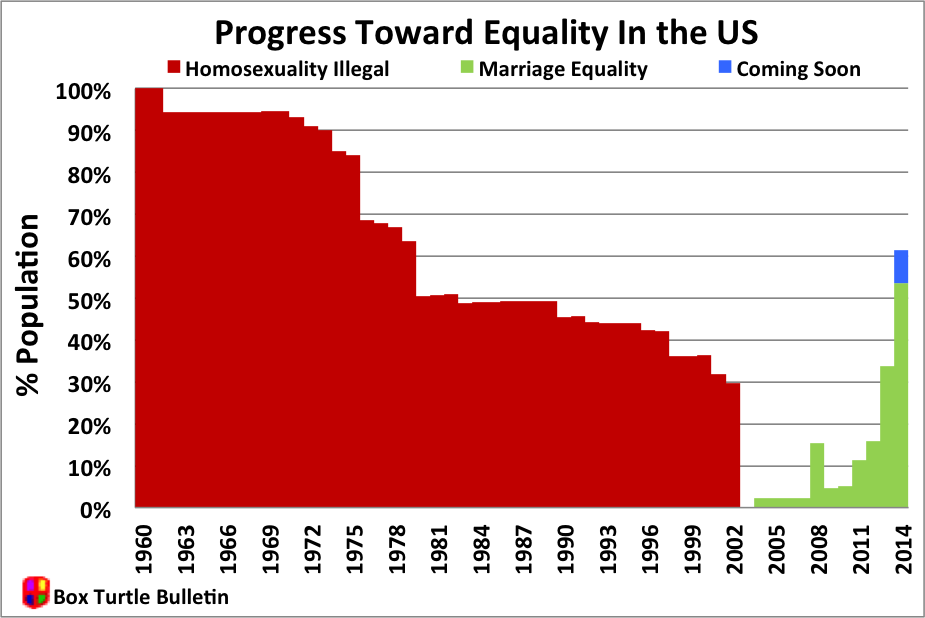
Burroway charts the progress made since the 1960s – a reversal few ever imagined: 

Equality Chart

A New Eugenics? Ctd

Last week, Michael Brendan Dougherty likened the termination of Down syndrome pregnancies to eugenics. But Noah Millman feels that Dougherty’s “fundamental objection … isn’t to eugenics but to abortion”:

[A]ssume that Down Syndrome worked like Tay-Sachs, meaning that you could avoid having a child with the condition by pre-marital screening. Would Dougherty oppose such screening? If so, why? Or, here’s another one: late childbearing significantly increases the risks of your children having Down Syndrome (which is why Down Syndrome births are up in spite of the high abortion rate). Would Dougherty say it’s wrong to take that fact into consideration when deciding at what age to start having children (and at what age to stop)? Would he say it’s wrong for public health authorities to let people know about that fact, and to encourage (via informational campaigns, not physical or financial coercion) women to have children somewhat earlier?

The point he’s trying to make:

Inasmuch as he objects to eugenic motivations, it’s because he worries that by definition any thinking about “better” children makes life into something instrumental, a product, and thereby makes abortion more acceptable. But I don’t think that’s a sustainable view; it makes perfectly normal planning for the future seem corrupt and wrong. Everybody wants their kids to be healthier, including being born healthier. There’s nothing wrong with trying to ensure that—unless there’s something wrong with what you are doing to ensure it, or unless your take your standards of what constitutes “health” to unreasonable extremes.

Meanwhile, a reader merges another thread – the one on child abuse:

Two pieces on the Dish in the past days merged in an uncanny way for me. First, there’s Dougherty trying to make some big broad point about eugenics out of people’s desire to avoid a personal tragedy by aborting Down Syndrome pregnancies. And yes, it is a personal tragedy more than anything else. My Down Syndrome sister is now 46, having lived considerably longer than the doctors in the late 1960s told my mother was the norm. The doctors’ advice then was to “put her in a home and forget about it”. In the end, my parents chose an unsatisfactory middle way of institutionalising my sister but remaining somewhat connected and bringing her home for holidays and such.

My mother, now 78, has never really recovered from that trauma. And trauma does indeed feel like the correct way to describe it. In a devout Baptist home, the sense of God’s wrath was tangible and frightening for an eight-year-old. The view from outside seemed to be that my parents had done something bad physically, spiritually or both, especially as my father was 34 years older than my mother.

If confronted now with the reality of a Down Syndrome pregnancy, I would not hesitate to support termination if my partner agreed. To lump this in with “eugenics”, free of reference to individual circumstances, is a gross distortion of what it’s really like and imputes notions of parental desire for “perfection” that do not enter into consideration.

Second, the extraordinary description of corporal punishment made me gasp, particularly because the “eugenics” claim had reminded me how the trauma of my Down Syndrome sister amplified my mother’s propensity for unrestrained violence. This was the mother that did not detect the repeated sexual abuse of a boy of five and six by a much older step-sibling, in spite of her skill in detecting all other manner of a child’s indiscretions. Indiscretions, real or not, that the mother would address through the delivery of raging, spit-flecked and red-faced beatings with sticks, belts, fists and coat hangers. These would be delivered until the blood appeared or until such time as the breathless howling was deemed to be genuine pain and not merely an attempt to get her to stop. Sometimes I feel as though I’ve achieved something merely by surviving this long.

The way the Dish pulls things together continues to demonstrate that the compartmentalised, neat-and-tidy manner that so much modern pontificating applies to assessing lives and to dispensing counsel is oblivious to the messy and messed-up reality of life. It does no one much good when we treat their choices as the linear outcome of some particular isolatable pathology. Yet that is precisely the way we continue to treat difference and suffering: there always has to be a clean explanation that permits judgments to be made and, on occasion, empathy to be expressed in calibrated doses.

Ruling Against Marriage Equality Was Actually A Bigger FD

Gay Marriage Becomes Legal in 5 States After Supreme Court Declines Challanges

Lyle Denniston digests the big news from this morning:

[F]our other circuits — the Fifth, Sixth, Ninth, and Eleventh — are currently considering the constitutionality of same-sex marriages.  Of those, the Ninth Circuit — which had earlier struck down California’s famous “Proposition 8” ban and uses a very rigorous test of laws against gay equality — is considered most likely to strike down state bans.  If that happens, it would add five more states to the marriages-allowed column (Alaska, Arizona, Idaho, Montana, and Nevada), which would bring the national total to thirty-five.

The reaction in those four circuits could depend upon how they interpret what the Supreme Court did on Monday. If the Court is not likely to uphold any state ban, either on same-sex marriage in the first place or recognition of existing such marriage, lower courts may see good reason to fall in line.  The Court’s actions, however, do not set any precedent, so lower courts are technically free to go ahead and decide as they otherwise would. If they interpret the denials of review as providing no guidance whatsoever, then they would feel free to proceed without reading anything into what the Court has in mind. It is very hard, however, to interpret the Justices’ actions as having no meaning.

In Garrett Epps’ opinion, it’s now more difficult for an appeals court to reject marriage equality:

As long as cert. was pending, the lower-court opinions were in limbo. Meanwhile the issue is pending in the Fifth, Sixth, Ninth, and 11th Circuits. Any panel in one of those circuits must now confront a huge weight of federal authority affirming same-sex marriage. True, other circuits’ decisions are not “binding”; true, the Supreme Court did not give any hint of its position. But that’s still a lot of contrary authority to move against. Any judge writing an opinion that bars same-sex marriage must explain why he or she is ignoring all the previous decisions.

That still could happen. The press has speculated that the Sixth Circuit may soon issue an opinion allowing state bans to stand. The Fifth and 11th are among the most conservative of the circuits. If one of them breaks step, then the Court will have to take that case. And it would seem to most observers that it would be granting to reverse.

Epps doesn’t believe that SCOTUS “will allow thousands of couples nationwide to celebrate marriages, change names, jointly adopt children, become legally one family—and then, in an opinion later in the term, baldly announce that their marriages are in jeopardy or even void”:

If the justices were later to decide against same-sex marriages, a number of the states where, in a few days, it will be legal, would be back at the Court asking for reconsideration. That would be, as Lyle Deniston of SCOTUSblog wisely wrote,“an invitation to legal chaos.” Beyond that, it would be an act of cruelty that I hope is beyond any five of the nine human beings who sit on this Court.

Rick Hansen is on the same page:

The fact that the Supreme Court, without saying a peep, is letting court-ordered same sex marriages go forward in Utah is a huge deal. Now you may think that this could well be reversed once there is a circuit split, perhaps in a case from the 5th or 6th Circuit. But remember, there will now be all of these children from legal same sex marriages performed until the Supreme Court could decide to take a case from another circuit. The idea that Justice Kennedy would let that happen, knowing there could well be a reversal down the line seems unlikely.

Digby nods along with that:

There are already a whole lot of gay parents (always have been, they’re just now able to parent together) and a whole lot of laws that are necessarily being created to deal with that new circumstance. Aside from the obvious moral obstacle of breaking up happy families, there will be the complications of untangling many legal issues.

(Photo: Suzanne Marelius and Kelli Frame hold hands as they wait in line at the Salt Lake County Recorders Office to get a marriage license on October 6, 2014. Marelius and Frame are the first same sex couple in Utah to get a marriage license after the U.S. Supreme Court declined challenges to gay marriage making it now legal in Utah. By George Frey/Getty Images)

A History Of Neglected Teeth, Ctd

A reader illustrates the really high stakes for some people lacking dental insurance:

The exclusion of dental from many medical plans – or the need to add it at significant cost – is completely foolhardy, especially given the links between poor oral health and heart disease.

While there doesn’t yet seem to be consensus about poor oral care causing heart disease, I know it can be fatal for at least one kind of very expensive heart patient. My boyfriend had a heart valve replacement when he was in his late 30s – the necessary outcome of a congenital birth defect that caused him to slowly develop heart disease through his first three decades. He lives a normal life now, though he’ll have at least one more valve replacement before the end of his life, hopefully about 15 years after the first.

What’s the thing that is most likely to send him in for a replacement on an earlier schedule? Bacterial endocarditis, which would attack the prosthetic tissue valve. The most likely thing to cause that? Oral bacteria entering his blood stream and causing an infection in his valve.

He takes massive doses of prophylactic antibiotics before he goes to the dentist. But he’s also one of those guys who had limited dentistry over the last few decades, because he’s self-employed and dental was too expensive in his self-purchased plan. So every time he goes to the dentist, it tends to be for more invasive processes than when I go, because I’ve gone every six months for my whole life, thanks to my insurance.

The cost for his valve replacement? Approximately $500,000 when he had it five years ago.

Obama Beats Reagan On Private Job Growth

PrivateSept2014

[See update here]

The GOP is on a roll right now, doing a rather effective job at combining all the flaws of the Obama second term into some kind of comprehensive damnation. Readers know I’m dismayed by the latest twists in foreign policy, but I am not buying the current establishment Washington consensus about a “failed presidency”. This president saved us from a second Great Depression and brought universal health insurance to America. He has presided over a civil rights revolution in marriage equality and the biggest social change in a generation in the accelerating legalization of cannabis. He has somehow slowed the rate of the escalating cost of healthcare – perhaps the most fiscally important achievement, if it holds, since the 1993 tax hike. He has dramatically shifted the equation on climate change with the regulation of carbon as a pollutant by the EPA and by much tougher fuel emissions standards. He has also presided over America’s near-energy-dependence, one critical way in which we can extricate ourselves from the lose-lose proposition of governing the ungovernable Middle East.

The economy still has to recover from the catastrophe of the Bush years, just as the world has yet to recover from the indelible disaster of the Iraq War. But it has been true from the beginning that without the GOP’s fantastic and near-unprecedented policy of total opposition from Day One, his achievements would have been much broader and harder to ignore. In particular, if the Republican-led states had not forestalled Medicaid expansion, millions more would now have access to healthcare; and if the states and the federal sequester had not cut public sector jobs on an unprecedented scale, and imposed austerity as a way to sabotage the president’s policies on a national level, the employment picture would be far better. As it is, the US now has a lower jobless rate than any other Western country save Germany, even as the federal budget deficit has fallen faster than anyone expected.

But look at the graph above, elaborated upon here by Bill McBride. And imagine if Obama were a Republican. Can you imagine how aggressively the GOP would be touting the recovery as one uniquely fueled by the private sector? I know the dismal facts of median wage stagnation and soaring inequality that make this recovery far from ideal – but still. Obama beats Reagan in private sector job growth? How on earth do the Republicans manage to spin that one away? How is it that an allegedly “socialist” president has spawned a higher level of private sector job creation than the patron saint of private enterprise?

Sometimes you get to see the steaming, cynical pile of ordure that is the GOP’s propaganda. But rarely do you see it to exposed in a single chart.