When Does Spanking Become Abuse? Ctd

A reader gasps at this account of child abuse from the in-tray:

Oh my God, Andrew.  That post on switches, told from the woman who “took it” … I was almost in tears reading it.   I have a four-year-old daughter, and I am completely opposed to hitting her. My wife likes – well, likes is too strong a word; she sometimes chooses – to spank our daughter, but it’s always with the clothes on, and always only one or two quick swats on the bottom with an open hand.  No red mark.  No scratches.  No bruises.

And no fear.  My daughter is startled, but then they hug and the incident ends with constant evocations of love – unconditional love.

But I still view it as hitting a four year old.  And your reader’s email – this incredible piece that you just printed – helped me see why. Thank you for posting it – and please thank the writer for being brave enough, strong enough, to share it.

You just did. Another reader is gobsmacked by this followup:

I don’t know if there exists a better argument against spanking than the two pro-child-abuse arguments your readers just submitted. Holy. Fuck.

Another quotes one of those readers:

“For based on the nature of your misbehavior, the broader society is unlikely to respond with, ‘Now you go sit in that chair and think about what you did.'” Actually, that’s exactly what society does. It’s called “jail.”

Several more readers, all of whom experienced some form of corporal punishment, continue the thread:

Thank you for your sharp rebuttal to the two readers who went to great lengths to defend child abuse.  I have been reading the Dish for quite some time and cannot recall ever having had such a visceral reaction of utter disgust to reader responses. While I understand that they love their abusers and choose to judge them as a whole person, that in no way justifies the behavior of the abuser any more than a wife beater is vindicated because the woman chooses to “stand by her man”.

As a child I was spanked.  Hard.

Fortunately it was neither as hard nor as vicious as your two readers describe, but at one point my dad did break the wooden paddle on my ass (and it was probably about something as silly as talking during church).  I can totally understand how the victim in the first case would not want the father to lose his career or be put in jail.  I would not have wanted my dad jailed either.

On the other hand, my dad’s actions prompted me to make a personal commitment to never lay a hand on my children as a form of punishment.  I am a firm believer that violence is not the way to solve problems and I take exception to the second reader’s implied point that the only way to learn to respect the rules is if you get beaten for breaking them.  My two boys are very respectful, compassionate, obedient, fine young men who have a tremendous respect for rules while never having a single welt to show for it.

My wife and I are both educators and see on a daily basis the scars of pain and suffering that physical, sexual, and emotional abuse leave on children.  The only certain lesson that physical abuse teaches your children is that the cycle of violence will continue.  If this leads to “Generation Wuss,” I will gladly take it over the alternative. With people like these readers going through all sorts of mental gymnastics to justify child abuse, it is no wonder our world is so screwed up.

Another has a much more nuanced take:

Regarding your two readers who don’t think spanking should be criminalized, I tend to agree with the one who said he wouldn’t want his parent jailed because of it.  I wouldn’t have wanted my parents jailed either.  But, I certainly would have appreciated having someone, anyone who could have stood up for me against (1) a mom who was clearly unhappy and angry and took out all of her emotions on me in the form of physical, emotional and verbal abuse, and (2) a dad who just stood by and did nothing because he probably was too scared to deal with the fury of my mom.  No child, no matter how disobedient, deserves the emotional trauma that comes with physical abuse.

For a long time, I (like your two readers) justified my parents behavior because accepting the alternative is too scary – i.e., adults who cannot control their own emotions and thus, beat their own children, generally make for crap parents.  Please note, I am not talking about those parents who use spank judiciously a few times a year.  I understand that there are shades of gray here and nothing is absolute.  I am talking about parents who express their rage and anger through the guise of punishment at least every 1-2 weeks, if not every other day.

I agree that it isn’t productive to live in a bubble of “victimhood.”  But, that is exactly what abusive parents are likely doing.  I realize that these parents have their own personal traumas that they haven’t acknowledged or addressed, and thus the cycle of abuse continues.  There are also plenty of parents (my mother included) who are abusive but still meet their child’s basic needs and provide solid, stable physical environments and financial support.

So it is tough to argue that these parents should be thrown in jail.  But there cannot continue to be zero consequences for parents who wield corporal punishment simply because they can and there is no one around to check their behavior.  Criminalization is certainly not appropriate in all cases and neither is removal of the child from the home, because foster care could end up being ten times worse.  But some sort of mandatory and meaningful counseling would go a long way in re-educating these parents on how to manage their own emotions, manage their discomfort with their child’s emotions, and accept that their child is not an object to be controlled and manipulated into submission and compliance.

Now that I have my own child, every day I have had to learn how to be a “grown-up” about my own emotions so that I can help her with what she is facing, and that is no easy task when the only prior management technique I was exposed to was a rolling pin, the back of a hand, lots of insults and put-downs, or the silent treatment.  I have had counseling and I am thankful for it even though I spent a good part of my life opposed to it in any shape or form.  Had my mother had counseling, life could have been so much different for me and I have had to mourn the childhood that never was.  It is a shame that any child has to feel that pain.

Another:

I wonder if the sharp divide in attitudes towards spanking has anything to do with how it has been applied in different households.  My own experience was pretty mild.  Whichever parent was on duty would take me into their room and explain to me what the offense was that I was being punished for.  Then I would get three to five swats on the backside, usually with the hand, occasionally with a spoon or belt.  As I cried, my parent would hold and console me, assure me that s/he loved me, and dry my tears.  After that, I was off to playing again.

Spankings stopped altogether when I reached an age where it would have been humiliating to receive one (maybe 8 or 9).  I don’t look back on those episodes as torturous or psychologically impairing in any way.  So when I hear people get down on “spanking,” I find it instinctively puzzling.

But then I read about Adrian Petersen and the account your reader sent in.  The descriptions sound absolutely horrifying, and I can imagine that after going through those experiences, the victim has no time or stomach for drawing fine lines between what I would consider spanking vs. physical abuse.  And despite the fact that I think my parents’ approach was a useful parenting technique (I employ it myself), I would rather live in a world of no corporal punishment where some used it wisely and others used it as a fig leaf to abuse their children.

Ebola Gets Partisan

And right-wing radio takes paranoia to new depths:

Boer Deng, a sane person, praises US officials for preempting panic:

As of now at least, hysteria has not gripped the local public en masse. It can be tricky to convey gravity but avoid undue alarm in a health situation, but [Jack] Herrmann [of the National Association of County and City Health Officials] says much has been learned from dealing with the H1N1 flu outbreak. The key is to be “proactive in keeping people informed and telling them what you know, what you don’t know, and if you don’t know something, when you will,” he says.

A number of questions remain unanswered by the CDC, like what measures will be taken with travelers from West Africa going forward, and what further international efforts this will spur. But so far, the news from Texas is heartening: Whether or not the best approach was taken when initially handling the current Ebola case, the CDC’s “Keep Calm and Carry On” public health message has generally been heeded.

But Matthew Continetti thinks Americans should be afraid:

I … believe it is entirely rational to fear the possibility of a major Ebola outbreak, of a threat to the president and his family, of jihadists crossing the border, of a large-scale European or Asian war, of nuclear proliferation, of terrorists detonating a weapon of mass destruction. These dangers are real, and pressing, and though the probability of their occurrence is not high, it is amplified by the staggering incompetence and failure and misplaced priorities of the U.S. government. It is not Ebola I am afraid of. It is our government’s ability to deal with Ebola.

Margaret Hartmann notes other figures on the right who share this view:

Over the past few days, Republican lawmakers have been sharing some terrifying thoughts about the Obama administration’s Ebola response. “It’s a big mistake to downplay and act as if ‘oh, this is not a big deal, we can control all this,'” Senator Rand Paul warned. “This could get beyond our control.” … Republican senator Jerry Moran is one of several Republicans calling on the president to appoint an Ebola czar. He told BuzzFeed that even lawmakers are having a hard time figuring out who to talk to. “I don’t think there is a person in charge,” he said. “And I don’t think there is a plan internationally to bring the folks together to combat this.”

And Brian Powell catches Laura Ingraham peddling bad science:

After news outlets reported the discovery of an Ebola patient diagnosed in the United States, radio host and Fox News contributor Laura Ingraham hosted Dr. Elizabeth Vliet to inform listeners about the disease. Vliet used the platform to accuse President Obama of “underplaying the risk” of Ebola and suggested the disease could be transmitted through the air, an opinion that runs contrary to widespread medical opinion. To make her case, Vliet cited a debunked study from 2012 that studied transmission of the virus between pigs and monkeys.

Charles Pierce is alarmed by this sort of irresponsible journalism:

What we had in the AIDS epidemic was political opportunism married to what became obvious ignorance. What we are seeing now, promulgated by a conservative bubble machine that has built a self-sustaining universe around itself, is political opportunism married to an active campaign of disinformation.

Josh Marshall chimes in:

There’s a new meme emerging on the right which I’ve noticed in the last 24 hours. It goes like this: The ‘government’ or President Obama promised Ebola wouldn’t or couldn’t get to the United States. But now it’s here. So people, the argument goes, are rightly worried that the ‘government’ is lying to them or isn’t telling them the whole story. In other words, when you see the next ignoramus on Fox News jonesing on about how he’s not going to be a patsy for the virology elite, that’s the story.

I’ve now heard it on Fox, in National Review and a few other outlets. It’s hard for me to tell whether this is simply lying about what various officials including the President have said, ignorance of how contagious diseases (and particularly Ebola) work or just a blase willingness to fan hysteria. Unfortunately it seems like all three.

“Government Thugs” On The Attack

Sit In Protest Continues In Hong Kong Despite Chief Executive's Calls To Withdraw

Some of Hong Kong’s protest camps were assaulted today, not by police, but by groups of “anti-occupiers”, mostly men, who said they were fed up with blocked roads and wanted the demonstrators to disperse:

The protesters said the attackers were pro-government gangs, and several of the groups leading the protest issued a joint statement warning that they would call off proposed negotiations with the government “if the government does not immediately prevent the organized attacks.” A week after the pro-democracy protests started at a student rally, the movement showed increasing strains on Friday from both external blows and from internal discord and exhaustion, even before the attacks began. …

As skies darkened and rain fell, a couple of dozen men stormed the encampment in the middle of Nathan Road, a major thoroughfare usually packed with traffic and shoppers. The men pushed and pummeled the protesters, grabbed the scaffolding of canopies and pulled until the tents collapsed in heaps.

Lily Kuo and Heather Timmons report from the scene:

Some anti-occupiers insisted that they had not been paid to be there. Lau Lee Keung who lives in the New Territories said he was there because the occupation in Mongkok disrupted his commute home from the airport where he works.”I came on my own. No one paid me,” he said, showing Quartz his Hong Kong identity card to prove that he had not been sent from mainland China to protest. “I support the Hong Kong government,” said 51 year old Cheung Chiu Wan, who also showed his Hong Kong identity card.

Other residents didn’t believe the protest movement in Mongkok disrupted their daily lives as much as the anti-occupiers said. “It’s actually nice. The air is fresh,” said David Chen, 35, who works at law firm nearby, referring to the lack of traffic.

Ben Leung has more on the state of affairs:

There are, of course, inevitable doubts about where some of the anti-protest protesters come from. Some are genuinely aggrieved by the disruption caused to the transport system. “Wanting democracy is fine—just don’t affect the rest of us!” said one of them. Others point to the “silent” majority who had never taken part in the protest to demonstrate that the little anti-protest movement is “not alone.” Others seemed to be performing bombastic recitals of their grievances as if they were ill-trained actors or undercover agents.  And these kinds of people—thugs, mercenaries, undercover agents, and paid informants—are exactly the kind of provocateurs that pro-democracy activists say they fear will bring on real chaos.

Kaveh Waddell, meanwhile, wonders whether the protest movement’s commitment to nonviolence and orderliness hasn’t somehow undercut their message:

Taken to an extreme, nonviolence can have the same effect on media coverage as physical confrontation. Just like it might have been if the protests were characterized by clashes, Hong Kong media coverage has been focused on demonstrators’ tactics. Instead of showing burning tires and rock-throwing, however, stories like this one from the BBC described “things that could only happen in a Hong Kong protest“: students who sat in the street to complete their homework, demonstrators who posted apologies on makeshift barricades for inconveniencing commuters, and complete compliance with a sign that asked protesters to keep off a neatly trimmed grassy plaza. In this and other stories, the movements’ goals are relegated to a footnote or aren’t mentioned at all.

Zack Beauchamp interviews Erica Chenoweth on how the protesters could prevail:

There’s a common misconception that non-violent movements win by showing the other side the light: in this case, persuading Hong Kong and mainland officials that Hong Kong really deserves democracy. That’s wrong. “The pressure works by imposing enough costs on their opponents that there are loyalty shifts,” Chenoweth explains. “The people on whom that the opponent relies on to implement its power locally change their mind about whether it’s a good idea” to go along with the repressive program. … Chenoweth thinks that, if the pressure stays on, Hong Kong and mainland elites may end up deciding that handing the protestors a partial victory makes more sense than dispersing them with a full-on, Tiananmen-style crackdown.

And William Pesek points out that China’s already tarnished reputation in the region is on the line here:

Even China’s Asian neighbors — many of whom, like Vietnam, don’t spend much time worrying about human rights — haven’t forgotten 1989. That legacy explains why China’s strengthening economic relationships aren’t translating into genuine soft power across the region. In one recent survey of elites in 11 Asia-Pacific nations, more than 60 percent thought China was having a negative impact on regional stability. …

In that sense, China has more to lose from another Tiananmen than Hong Kong’s 7 million people do. Any move by Xi to crack down on students would be carried live on BBC, CNN and networks in Taiwan, where the mainland is trying to curry favor. It would have the vast majority of Asian governments edging closer to Washington as the U.S. seeks to shore up its position in Asia.

Perhaps that’s why they’re counting on the “anti-occupiers” to crack down for them.

(Photo: Local residents and pro-government supporters scream at pro-democracy protesters on October 3, 2014 in Mong Kok, Hong Kong. Fights broke out between local residents and pro government supporters when they attempted to force pro-democracy activists from their protest site. By Chris McGrath/Getty Images)

“Nothing”

Well, I thought the frankness of that might provoke a response. I was asked whether I was an isolationist (no) and what I actually proposed we do with respect to the latest Sunni insurgency in Iraq – an insurgency I think will continue until the Sunnis regain what they believe is their rightful place running the whole “country”. A reader notes:

George Kennan was asked the same question. His reply (from his diaries) was this: “…there are two kinds of isolationist: those who hold the outside world too unimportant or wholly wicked and therefore not worth bothering about, and those who distrust the ability of the United States Government, so constituted and inspired as it is, to involve itself to any useful effect in most foreign situations. I… belong to the latter school.”

I won’t add to your very large dissent pile on Syria, etc., just to recall the State Dept conventional wisdom back in the day: if you want someone to diagnose a difficult problem, ask Kennan; if you want someone to manage or solve it, never ask Kennan.

Except, of course, it was Kennan’s careful and conservative case for containment that ultimately won the Cold War without the near-Armageddon that the predecessors of today’s chronic interventionists (Kennedy especially) nearly brought us to. So the State Department was wrong.

I favor US military action and leadership in cases where we carefully assess what we can do,iraq2 have a clear strategy, a clear definition of victory and an exit plan. I favored the bombing in the Balkans to end genocide; I favored the Gulf War to get Saddam out of Kuwait; I favored getting the Falklands back. I opposed the intervention in Lebanon under Reagan; I opposed the Somalia intervention under the first Bush; I opposed the Libya intervention under Obama. And then, of course, in the wake of 9/11, I supported the war in Afghanistan and the invasion of Iraq. And I have to say that living through all those events has only helped me better understand the wisdom of Kennan.
Of the two kinds of “isolationists”, I guess I’m around 30 percent who thinks the world is far too fucked up or irrelevant to try to intervene and 70 percent fully aware that the US simply does not have the ability to do anything but make so much so much worse. Almost every intervention in the Middle East – save the Gulf War – has made things worse. And the Gulf War, of course, gave us al Qaeda, in response to bases in Saudi Arabia. Just as the intervention against the Soviets in Afghanistan empowered Islamist terror in the long run as well. As for the CIA deposing Mossadegh, well … look what nightmares came from that. My contention is that the CIA has done more damage to the interests of the United States over the years than any other institution.

Another reader counters my perhaps too melodramatic dismay at Obama’s latest folly:

1. To the extent ISIS etc. hurts Dems in the polls, it will be because Obama is perceived to have let ISIS metastasize, not because he’s striking the group now.

2. No American president could have afforded to sit back and let ISIS overrun Kurdistan or assault Baghdad. And the first strikes in Iraq seem to have been effective. To the extent that minimalists have a beef with Obama, it’s about extending the strikes to Syria and purporting to build up Syrian “moderates.”

3. Just because the threat to the US from ISIS isn’t imminent doesn’t mean it’s not real. If that monstrous quasi-state continues to grow, or even gets equilibrium, it’s a bigger/stronger haven for worse nuts than al Qaeeda ever had in Afghanistan/Pakistan.

4. To “hope both sides will lose” is cruel and nihilist.

5. Both Obama’s rhetoric and his likely course of action are far more restrained than you give him credit for.

6. “Betrayal” is an hysterical term.

Let me respond to each point in turn.

1. My point is not that the Obama won’t get punished in the elections because he is perceived to have let ISIS metastasize; it is simply that by re-starting the war he was elected to end, and arguing that it will not end for years, Obama’s base is likely to stay home. I’m not advocating that, I’m predicting it.

2. We have no reason to believe ISIS can over-run Kurdistan or Baghdad without one hell of a fight. But if the ISIS-led Sunnis could do that – and ISIS is really a product of Sunni disempowerment – then it merely proves that the Shiites cannot really run Iraq, have no experience in doing so, and our propping them up in power will simply mean greater and greater strength for ISIS. We gave the Shiites, a vast, well-trained hugely expensive military and even then, they cannot beat back this insurgency. Hell, the US couldn’t really beat it back over ten years – until we bribed the Anbar tribes. What chance the hapless, militias of the Shiites? Propping up an inherently unstable power structure is not a recipe for pacifying Iraq; it’s a recipe for permanent warfare.

3. There are terror enclaves all over the world. To name one: Saudi Arabia, a state that beheaded more people in the last few months than ISIS, a state that has funded this kind of extremism for a very long time, a state with enormous wealth it has poured into Islamist terrorism and from which the 9/11 attackers hailed. To name another: Pakistan. How many countries do we have to invade to prevent havens for potential Islamist terror? We are now doing this in Yemen and Somalia – and Obama actually called them a success! And in the end, these enclaves can only be defeated by the Arabs and Persians. The moment we take responsibility, the odds of any success collapse. And have we seen a mutli-sectarian government which not so long ago Obama said was a pre-requisite for intervention? Fuck no. Obama has already violated the one condition he placed on intervention. He’s making this shit up as he goes along.

4. Who would you want to have won the Iran-Iraq war? I’m with Kissinger on that one. Between Saddam and Khomeini, who would you have sided with? But in this case, the United States is actually trying to take sides in an ancient Sunni-Shi’a religious civil war! Why on earth should America have any position on that question whatsoever? A plague on both their sectarian houses! And it was not nihilist to see that in similar horrifying religious wars in Europe in the sixteenth and seventeenth centuries, both sides had to lose before either realized they had to get past that kind of insanity. But we keep preventing that outcome from happening in the current Middle East, arresting the very evolution that gave us some kind of Western toleration. It was horrifying, but we are not responsible for the religious hatred and violence of others, and we should stop deluding ourselves that we are.

5. No, we haven’t invaded with a full army. But in the first weeks, we have more than a thousand boots on the ground – and the neocons want more, and under a Republican president, will doubtless ramp it up still further. And as ISIS fails to lose territory, and gains credibility indexbecause they are now fighting the Crusader forces, they may well gain even more support. We have already elevated their status in the crazy Jihadist world; we have already won them at least 6,000 more recruits; we have already turned the Syrian “moderates” against us. And we are told this “mowing the lawn” will continue way past this presidency – and if we get a Clinton or a Cruz in power, it will only intensify. You know what “mowing the lawn” really means? It means the mass killing of civilians – as already seems to be taking place once the easy targets have been hit. ISIS is adapting. They will do to us what Hamas did to the Israelis. And do you really think the Israelis have a winning strategy? “Mowing the lawn” is the real nihilism.

6. Maybe betrayal is too strong. Obama’s in a tough position, in which ISIS and the GOP and the terrified, so-easily panicked American public are demanding action. I don’t envy him. But hey, he asked to be president. I know that standing back and insisting that ISIS is the region’s problem, not ours, is tough to do as president. But avoiding this quicksand is precisely what he was elected to do. He is not up for election again. He has a critical task not to empower the very forces he was elected to defuse. Sometimes a president has to make a tough call – like Eisenhower in Korea – and say no.

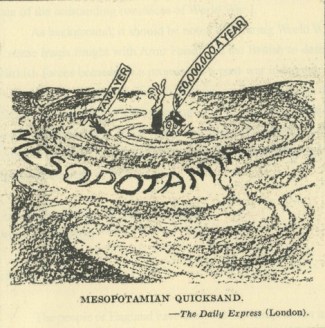
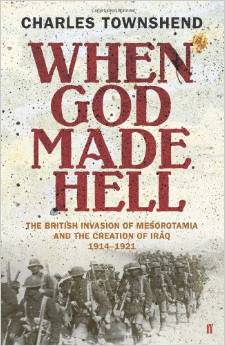
And I would be far less depressed if we had not just spent a decade fighting the very same insurgency, based on the very same fantasies of a multi-sectarian democratic Iraq, and failed so spectacularly. Indeed, every single time a foreign power has attempted to somehow keep Iraq together, it has failed. Every. Single. Time. Just take a look at the British in the 1920s – which prompted the cartoon above. A book just came out on that history, and its title is from an Arab proverb: “When God made Hell he did not think it bad enough so he created Mesopotamia.” To believe that this time, it will work, when Americans are far more incompetent and clueless imperialists than the British once were, is a form of insanity. Some things cannot be solved by outside forces.

I would also be far less depressed if this president hadn’t already done exactly the same thing in Libya – to prevent an alleged impending humanitarian disaster – and created far more deaths, far more chaos and far more disorder than existed before. To repeat this catastrophic error with the same bland notions of this is America’s indispensable role is just madness. In the Middle East, our role has long been to generate chaos and conflict and mayhem. At what point will Americans not realize that they are just not capable of solving problems in places we do not understand, beset by forces more powerful than even the mightiest military in the world can counter?

But maybe this time, I’m wrong. Maybe this time, a new American war in the Middle East will succeed. Maybe this time, history will defy everything that history has proven before. But I remain a conservative, not a utopian. And those who in Elysian fields would dwell do but extend the boundaries of hell.

Veiled Women Need Not Apply

Noah Feldman analyzes a veiling case that has made it to the US Supreme Court:

The case, Equal Employment Opportunity Commission v. Abercrombie & Fitch, started in 2008 when 17-year-old Samantha Elauf applied for a job at the Abercrombie Kids store in the Woodland Hills Mall in Tulsa, Oklahoma. At Abercrombie, salespeople are called “models,” and part of the job interview is scored on how you look. Once hired, the “models” must comply with an Abercrombie “look policy” that governs how they dress.

Elauf knew the score. Before the interview, she asked a friend who knew the store’s assistant manager whether she would be able to wear a hijab on the job. The manager told her friend that because he’d worked with someone who wore a yarmulke at Abercrombie, he expected the hijab would be fine.

But, as Feldman explains, it was not fine:

Elauf didn’t get the job — and the EEOC sued Abercrombie for religious discrimination. A federal district court thought it was an open and shut case and decided summarily for the EEOC. The 10th Circuit reversed. In a split decision, the court didn’t just send the issue to trial; it issued summary judgment for Abercrombie.

Althouse analyzes the case:

The company has changed its dress code since then, but it’s fighting this case on the ground that it didn’t deny her a religious accommodation because she didn’t ask for a religious accommodation. That is, it had a dress code that applied to everyone, and she violated it, so she was treated like anyone else who fails to comply with the dress code, not subjected to discrimination based on religion.

If she’d asked for an accommodation based on religion, the company would have had to make some conscious decision about whether an exception to the usual rule could be made. Without having been given that chance, the company argues, there’s no discrimination, the company says. The EEOC, which brought the case on behalf of Elauf, doesn’t want the burden to bring up religion to rest entirely on the employee.

Jessica Glenza provides some background on the company’s attitude towards headscarves:

This is not the only case brought against Abercrombie & Fitch for religious discrimination.

Halla Banafa, a Muslim woman who applied to an Abercrombie Kids store in California, was asked about her hijab during an interview, and then not hired. Abercrombie argued that accommodating Banafa’s headscarf would place an undue hardship on its business.

Umme-Hani Khan was fired from Hollister, an Abercrombie subsidiary. She said she was dismissed for wearing a headscarf. She worked for several months at a California store before a district manager visited. She was later asked to remove her headscarf, refused, and was suspended and fired.

Both were awarded $71,000 in a joint settlement in September 2013.

Brent Kendall puts the case into a broader (and beard-involving) context:

The court next week will weigh whether a Muslim inmate in Arkansas has the right to grow a half-inch beard, despite state-prison regulations forbidding facial hair.

Amy Howe provides background on that case:

Arkansas sets the theme for its argument from the very first paragraph of its brief: prisons are dangerous places, in which inmates can (as another inmate did in 2012) stab a prison guard to death with a homemade knife. So although it “takes religious freedom very seriously,” it explains, “it takes seriously its paramount interests in safety and security too.” When Congress passed RLUIPA, the state says, it fully expected that courts would continue to defer to prison officials on important issues like security. And it should do so even if they can’t point to actual examples of the problem that they are trying to prevent: prison officials shouldn’t have to sit around and wait for an incident to happen before taking steps to head off those kinds of incidents. Moreover, it shouldn’t matter that the state does allow prisoners with skin problems to have a quarter-inch beard. Such beards are rare and (because they are shorter) more easily monitored for contraband. Nor should it matter, according to the state, that Holt might be able to grow a beard in some other prison. We don’t know why other states do what they do – perhaps, the state suggests, they are just less risk averse than Arkansas?

Recent Dish on veiling here.

President Butters?

Senators Attend Briefing On Release Of Sgt. Bowe Bergdahl

He’s apparently considering a run. The man who has been running around like a chicken with his head cut off fretting that we’re all gonna die in our sleep as ISIS takes over the US … well, he is the perfect candidate to describe the current GOP, isn’t he? Except, of course, he’s single. And been wrong about almost every single foreign policy question in the last decade. Larison piles on:

Graham is kidding himself if he thinks he could be the nominee, so I’m not sure what the point of this would be. The likely 2016 field will already be filled with reliably hawkish candidates. Graham distinguishes himself from that field in that he has never encountered a foreign intervention that he didn’t like and by being wildly out of step with most Republicans on immigration. Those will make him an easy target and useful foil for all of the others, who will be able to point at the second “amigo” and say something like, “I want to keep America secure, but I don’t want to bomb every a new country every five minutes as Sen. Graham does.”

A Graham bid is the closest one can get to re-running a McCain campaign, and Republicans are even less interested in doing that than they are in giving Romney another chance. Worse for the party, he is the embodiment of everything that is wrong with the party, especially when it comes to the issues of foreign policy and immigration. He is the walking reminder of why most Americans shouldn’t trust Republicans to conduct foreign policy and why most conservatives don’t trust their party leaders.

Scott Shackford adds:

So Graham could run as the next McCain, but without the charisma, or an alternative to Rubio, but without the youthful appeal or energy (or charisma). But who can resist the charms of a presidential candidate who believes that ISIS is coming to kill us all, each and every one of us? Who can better instill the belief in American Exceptionalism than the guy who keeps screaming about monsters under the bed?

Allahpundit suggests a slogan of “He’s not the RINO America wants. He’s the RINO America needs.”:

The obvious play for centrist hawks who are worried about Paul and Cruz is to unify behind a candidate early and try to push that guy to victory in Iowa and New Hampshire, all but locking up the nomination. Rubio’s their best bet (unless, I guess, Jeb runs), yet here Graham is not only tearing him down for caring what the party’s base thinks but threatening to actually siphon off votes from Rubio by running himself. It’d be like Sarah Palin deciding to jump in and cannibalize some of Ted Cruz’s tea-party support because, even though she agrees with him on basically everything, he’s a little too green for a big campaign. Why risk blocking your faction’s best chance at that nomination?

(Photo: U.S. Sen. Lindsey Graham (R-SC) talks to reporters. By Alex Wong/Getty Images)

The Crime Of Ebola Transmission

Allahpundit considers Liberia’s plans to prosecute Thomas Eric Duncan:

Should Duncan be prosecuted? Ace worries that if you throw jail time into the mix, Liberians who fear they might have Ebola will panic and become more determined to conceal their symptoms, putting the people around them at risk. I can understand that as a matter of Liberian domestic policy; you want people to feel as comfortable as possible in reporting their symptoms so that you can treat them (and isolate them) ASAP. But you also don’t want them getting on planes, and the prospect of jail time if they decide to fly when they fear they might be infected would deter that. No? What am I missing here?

Oh, by the way, Duncan did tell the staff at the hospital in Dallas that he’d just come from Liberia when he first showed up sick to the ER last week. They sent him home with antibiotics.

Scott Neuman points out that Duncan may have actually been less than forthcoming:

Officials at Texas Health Presbyterian Hospital now say Duncan wasn’t honest with them either. When asked if he had been around anyone who had been ill, Duncan told them he had not.

Adam Chandler puts the prosecution in context:

As West African countries battle the largest Ebola outbreak on record, the notion of pursing criminal charges against a man who claims he wasn’t exposed to the virus may come off as wasteful, if not extreme. Given that thousands of people continue to move between the borders of West African countries, Liberia’s intention to prosecute Duncan for traveling to the United States with Ebola—unwittingly or not—also rings a little hypocritical.

But as Jens David Ohlin of Cornell University Law School contends, the prosecution of Duncan may have less to do with what he did (or did not) do and more with the precedent his case could set.

“Liberia is probably anxious about maintaining travel connections to the United States and other countries,” Ohlin told me. “And countries have probably felt comfortable keeping air connections with Liberia so long as protocols for screening passengers are in place.” He added that were Liberia to ignore this potential breach of its screening process, it would ultimately convey that “these protocols are worthless.”

The Walrus Is The New Polar Bear

A lack of arctic ice has forced Alaskan walruses onto land:

Katie Valentine reports on the phenomenon:

Tony Fischbach is a wildlife biologist with the U.S. Geological Survey who’s a member of the Walrus Research Program in Anchorage, Alaska. He told ThinkProgress that when summer sea ice is at normal levels, only a small number of walrus will come to shore in Alaska — numbers typically in the tens or sometimes low hundreds of animals. This mass convergence of walrus — most of whom are females and calves — is a new phenomenon, he said.

Gwynn Guilford adds further context:

As it happens, the chunk of sea ice that caps the Arctic was, this year, the sixth-smallest on record.

“The walruses are telling us what the polar bears have told us and what many indigenous people have told us in the high Arctic,” Margaret Williams, managing director of the World Wildlife Fund’s Arctic program,told the AP, “and that is that the Arctic environment is changing extremely rapidly and it is time for the rest of the world to take notice and also to take action to address the root causes of climate change.”

Linda Qiu explains how living on land could hurt the walrus population:

For one, calves are particularly at risk of disease and from stampedes. Upon a disturbance, whether that’s a polar bear or a boat in the distance, walruses tend to rush to the water.

“The calves get trampled,” [Lori] Polasek [a marine biologist at the Alaska SeaLife Center] said.

In 2009, about a tenth of the walruses that hauled out died. This year, at least 36 walrus carcasses have been spotted, according to NOAA. That track record does not bode well for the species.

Extending Life By Accepting Death

The Economist reviews Atul Gawande’s forthcoming book on end-of-life care. A fascinating detail:

Many people fear that a doctor who does not try everything possible has abandoned his patients, and they will die earlier as a result. Surprisingly, however, the try-everything approach appears not even to offer a longer life. Multiple studies have shown that patients entering hospice care, which usually means abandoning attempts at a cure, live at least as long as those receiving traditional care. A startling study in 2010 found that patients with advanced lung cancer who saw a specialist in palliative care as well as receiving the usual oncological treatment stopped chemotherapy sooner, entered a hospice earlier, suffered less—and lived 25% longer than comparable patients who received only the standard care. “If end-of-life discussions were an experimental drug, the FDA [an American regulatory body] would approve it,” says Dr Gawande. In life, as in all stories, he writes, “endings matter”.

The Dish recently tackled related issues.

Did Vice “Support” Terrorism?

Andrew March suggests that the gutsy journalist Medyan Dairieh, who embedded with ISIS militants in Syria to get an inside look at the group’s operations and produced this stunning documentary (trailer above), may have violated the law against providing material support to terrorists, given how nebulously that support is defined:

In the test case that came before the Supreme Court in 2010, Holder v. Humanitarian Law Project, the Court held that it was constitutional to prohibit a group of humanitarian legal professionals (including a retired U.S. judge) “from engaging in certain specified activities, including training PKK members to use international law to resolve disputes peacefully; teaching PKK members to petition the United Nations and other representative bodies for relief; and engaging in political advocacy on behalf of Kurds living in Turkey and Tamils living in Sri Lanka.” The Court rejected the claim that the statute “should be interpreted to require proof that a defendant intended to further a foreign terrorist organization’s illegal activities.” Instead it affirmed that the statute prohibits “‘knowingly’ providing material support” and that Congress was within its rights to choose “knowledge about the organization’s connection to terrorism, not specific intent to further its terrorist activities, as the necessary mental state for a violation.” In short, according to the Court: expert advice + coordination with a terrorist group = federal crime.

That decision means, for example, that Jimmy Carter and his Carter Center could be in violation of federal law for giving peacemaking advice to groups on the State Department’s FTO list. Any private individual who coordinates with a group on that list, or a group that the individual ought to know engages in terrorism, with the purposes of providing it advice or assistance—even on how to pursue an end to its campaign of violence—is guilty of a crime by the logic of the Roberts Court.