What Do Prisoners Value Most?

Sarah Shourd argues that a certain “progressive” jail in New Hampshire has major drawbacks:

There are many things about Cheshire County Jail that you’d be hard-pressed to find in any other carceral space in the country. The warden, Rick Van Wickler, prides himself on the building’s environmental design—complete with a geo-thermic heating and cooling system—and overall low-carbon footprint. The correctional officers insist that there’s “very little conflict” between the 150 prisoners currently being held at this 240-bed facility. They also claim that they’ve had relatively few issues with contraband and zero escapes in the 4 years of the jail’s existence, thanks in part to high-tech surveillance and the 118 cameras spread throughout the site. Boasting accessible health and psychiatric services, over 100 community volunteers and the strict enforcement of U.N. standards on the use of solitary confinement, which limit isolating a prisoner to 15 days, Cheshire County Jail has attracted national attention as a rare model of progressive incarceration.

The prisoners at Cheshire offer a different perspective. …

“Yeah, there’s a lot less violence here,” says Arthur Labshere, “but I’d take two years at a federal facility over one here. I spent 10 years at the Fed—at least there I could go outside.”

“I’m here for a reason,” he added. “I’m gonna do my time, but I can’t just sit on a block like this all the time. What’s the point? I’m going crazy.”

In most jails and prisons, exercise takes place outside, in a yard. But at Cheshire, prisoners rarely, if ever, leave their pod. That means no fresh air and no sunlight. Cheshire is supposed to be a “short-term” facility, with 60 percent of its prisoners awaiting trial. Yet, with the courts backed up it often takes years—in at least one instance four years—for these detainees to see the inside of a courtroom, let alone freedom. “I’m strictly about family,” another prisoner, Bessette Robert, adds to the conversation, “but since I don’t have any money I can’t visit with my family much, I can’t even afford to call them on the phone.”

The only visitation available to prisoners at Cheshire is through a video screen, a privilege for which they are charged $1 per minute (with some exceptions for holidays).

New York Shitty, Ctd

A reader sends an ominous view from his East Village window yesterday morning:

unnamed (4)

Another New Yorker pounces on my recent snark over the subway:

Really, your pique about New York merely makes you look like an idiot. It’s like a bad breakup that you can’t get over. Well, try.

You would also have a stronger case if you didn’t live in a city where the Metro stations look like the set of a science fiction film about the dystopian future. Every time I’m there, I half expect someone to come running into the Dupont Circle station screaming, “Soylent Green is people!”

Several more dissenters have the floor:

I can’t believe I am writing once again to rail against your railing against NYC, but here I am. Yes, the subway is different from the London Underground. I found the tube-medium-zonedUnderground dizzyingly different when I first encountered it. But yes, it is cheap, and all the millions of people who ride it to school or work really appreciate it! One price takes you to wherever you want to go, no matter how far you have to go, unlike the Underground, which had me standing in front of the map longer than I wished, wondering which zone I will be in if I went here or there. But I just assumed it is just one of many different ways in which seeing the world teaches us to adapt and adjust. If I whined every time a city didn’t live up to my dream image of it, I would never leave my house!

You hate NYC, so you left. Good for you! But can you please remember that it is still home to many, many people and we don’t appreciate someone bashing it again and again, even after he has left, and even if we may actually agree with some of your opinions about it? Please give it a rest!

If I am so inclined, I can find faults with and rail against every city I have lived in or visited, but I accept that every city is what it is! Yes, NYC is a chaotic city; yes, it has all the faults of a giant sprawling city, and yes!, some people have bad experiences there, but tell me in which city all these things are not true!

And no, even in your own dramatic heart of hearts, you know that Lagos is not more civilized than NYC. Sorry for the rant, but your last jab at it actually made me think one more post like it will make me give up my subscription, despite the cool Dish t-shirts I’ve been sporting.

Another isn’t as threatening:

I’ve been a constant reader since, I don’t know, 2001. And I’m a subscriber, too. Maybe due to re-up right about now.  And I will.

I admire and appreciate so much about The Dish – up to and including your self-confessed hysteria sometimes. I mean – go for it. Leave the hand-wringing for the rest of us. Still, you threw me one that rankles tonight.

I’m sorry you hated New York City. That sucks. Lots of people hate it. I lived there from 1997 to 2003, and I was aware every day that there were so, so many people having a hard time of it. People getting just crushed. Or less dramatic than that, people getting worn down by the endless indignities. People in all corners of the economic tangle getting pummeled by this city. My partner at the time was one of them, even though it was she who insisted we move there. I didn’t want to. I didn’t give a shit about New York.

Until I got there. I fucking loved that city. And I had lived in so many places – in the U.S., Europe, Asia, Latin America. But somehow it felt like it was New York that blew my horizons open. Go figure.

I live in San Francisco now, and it’s a lovely town. But the rest of my life I’ll be hoping I get to move back to New York some day.  And every time I visit, I feel it instantly. Put me in the bustle of mid-town, the crush of a  subway, the off-kilter alleys below Houston, the tiny tangle of shelves at your neighborhood bodega – why do I love this shit? I don’t know. I have some ideas. But I don’t think you’d be interested in them.

I can say this. Even most of the people I know who have had a hard time in New York, who even hated New York, at least know what they still love about the place. You, on the other hand, left in a hurry and keep throwing shit over your shoulder at people who are dumb enough to imagine they like living there. A “cult”? Jesus, Andrew. Why the schoolyard insults? For a man of your age, experience, stature and maturity, it’s amazing how sometimes, you still just need to grow the fuck up.

Another circles back to the subway-underground showdown:

As a regular user of the subway in NYC and an occasional user in London, I can’t let yesterday’s shot at NYC signage and route complexity go unchallenged.  There are lots of things to hate about the NYC subway sytem, but I don’t think this is one of them.

In brief, both systems have to come up with a visual means to communicate that many of their lines fan out into branches at their distal ends.  If you board a train in the city center, you can ignore all this if your destination is in the center.  But if you’re headed for the distal fringes, you need to know which branch this train is going to follow.

New York does that by giving each branch a name (a number or letter) and grouping the related branches that share a common trunk by color. Within each color family, the routes may also be distinguished by whether they are all-stops locals or skip-stop expresses.

London names the whole group of lines the same, but you need to know London pretty well to know which train to board, since the only clue you will get is a sign on the train with a destination that the visitor has probably never heard of.  Do I really need to get on a train marked “Barking” to get to a spot only a few stations to the east?  Personally, I find the NYC system easier to remember. This system hardly applies in the rest of the US, since our transit systems are so underdeveloped that most rail lines elsewhere have few branches or none at all.

As for signage in London, could someone please explain to me why the Circle Line isn’t actually a circle, and why the direction of travel isn’t simply indicated as clockwise or counter clockwise?

Update from a reader, who might have our Email of the Day:

I’m so envious over all y’all fighting over subway systems … I wish we (Houston – 4th largest city in the US) had a mass transit system to bitch about.

But another reader demonstrates that I’m not alone:

I lived in NYC for two years before moving to London for the past three, and I have strong views on this subject. First, let me dismiss the comparative advantages of map designs outright. If you are visiting either city, and you don’t understand something, ask for help or spend an extra minute using your brain. Within a handful of journeys on either subway you probably know enough to navigate the system without a major blunder. If you don’t, it’s really your own fault. It’s a fucking subway map, not your tax return.

Second, living in London has opened my eyes to what an impact the subway system can have on your entire day-to-day experience. While some lines are better than others, the veins of the London Underground are an absolute marvel, humming along like a well-oiled machine. The average wait time is a few minutes at most. Even late in the evenings the reduction in service is marginal, adding one or two minutes on average. I am able to pick up the phone, agree to meet someone, and estimate with incredibly accuracy the time I will arrive.

The NYC subway? Not a chance. I had to take the 4/5/6 to and from work each day from lower Manhattan to Midtown, and I can’t even count the number of times I worked myself into an homicidal state pacing on the platform. During rush hour the range of wait times was anywhere from one to twenty minutes, and I am not joking. This incredibly important line under Lex was constantly behind schedule, or more likely, just under serviced. During the endless “waits” between stations, we’d be given cookie cutter updates that you knew were bullshit. I think this patronizing approach towards its ridership is the ultimate difference between the attitudes of the MTA and the Tfl.

New York City is a tough city, without a doubt, but it doesn’t help itself. The subway is a mess, and you don’t ever get the feeling anyone is trying to make it better. Can you imagine a New York City with the Underground beneath it? I’d move back tomorrow. I much prefer London in terms of the level of stress it requires from me. The apologists for the New York subway are either ignorant or not being objective.


Damon Linker Goes Trolling

I’ve read quite a few slippery slope arguments from the religious right against allowing gay people to marry … but Damon really has discovered a doozy. He notes that a German Ethics Council has come out in support of allowing adult siblings to marry (something that the German government opposes):

The council’s position is based on the claim that “the fundamental right of adult siblings to sexual self-determination” overrides all other moral considerations, including “the abstract idea of protection of the family.” That is very similar to the rationales that have been used to uphold reproductive rights and to strike down bans on same-sex marriage throughout the United States.

Except it isn’t “very similar” to any such arguments. In fact, the argument for gay couples to be able to marry is based precisely on “the abstract idea of protection of the family.” Here’s why: By singling out gay people alone and barring them from the same civil institution that binds their own families together, we are actually attacking the family itself. So the point of gay marriage is the very opposite of the case for incest or polygamy, both of which tear families apart and undermine social order.

And unlike heterosexual adult siblings, gay people have historically been barred from marrying anyone they fall in love with and want to spend their lives with. Siblings can marry anyone they want right now, as long as they’re straight, except their siblings. The case for incestuous marriages is therefore to add another option to an already vast array of choices. The case for gay marriage is to give gay people just one option, like heterosexuals, where before they had none at all.

Whom Exactly Are We Bombing In Syria?

Last week, a US air strike meant to hit a base held by the al-Qaeda affiliated Nusra Front almost hit a Free Syrian Army facility instead:

Since U.S. airstrikes against ISIS in Syria began on Sept. 22, there has been no coordination between the U.S. military and its alleged partners on the ground, according to FSA leaders, civilian opposition leaders, and intelligence sources who have been briefed on the U.S. and allied military operation. It’s this lack of communication that led to an airstrike that hit only 200 meters from an FSA facility in the suburbs of Idlib. One source briefed on the incident said multiple FSA fighters were killed in the attack.

“Unfortunately, there is zero coordination with the Free Syrian Army. Because there is no coordination, we are seeing civilian casualties. Because there is no coordination, they are hitting empty buildings for ISIS,” Hussam Al Marie, the spokesman for the FSA in northern Syria, told The Daily Beast.

Shocking that things can go awry like this during a war “effort”. Allahpundit rightly sees downsides to targeting both ISIS and other jihadist groups at the same time:

What’s at risk of happening here, as ISIS and the Nusra Front congeal, is our allies in the Free Syrian Army suddenly getting it on all sides. Assad has every reason to keep killing the “moderates”; the west has always eyed them as a potential governing regime in Syria once Assad is gone, so by eliminating them Assad makes himself the only anti-ISIS game in town. And now both ISIS and the Nusra Front have a strong reason to target the FSA.

Notwithstanding this week’s mishap, Nusra will suspect that the “moderates” are either already [feeding] intelligence to the Pentagon about their locations or will be soon. The smarter strategic play here, surreal though it may seem, might have been to leave Al Qaeda alone at first and concentrate on ISIS, so as to better isolate the latter group.

But then, maybe that was impossible. Once ISIS is gone, who’s likely to replace them in control of Sunni areas? Right — Al Qaeda. We’re holding the weakest hand on the field with the FSA. To clear a path for them to rule, we’ll have to eliminate … everyone, basically.

And the quicksand will get deeper and deeper. As if that’s not enough, Fred Hof insists that the US treat Assad as our enemy as well:

The salient fact governing today’s situation in Syria is that there would be no Islamic State were it not for the criminally sectarian manner in which the Assad regime chose to respond to peaceful political protest. This would be true even if the Assad regime had had nothing to do with sustaining Al Qaeda in Iraq during the years of American occupation. This would be true even if regime-IS collaboration on the ground in western Syria were merely happenstance: an accident produced by the existence of a common enemy.

Aaron David Miller illustrates why all of this is nuts:

So, here’s my latest worry. Looking at our Syria policy, it has begun to dawn on me that we really face a two-part conundrum that we will have difficulty unpacking. First, there’s the obvious: hitting the Islamic State (IS) strengthens Syria’s President Bashar al-Assad. Second: If we choose to hit him, we’ll buck up IS, al-Nusra, and the rest of the swell groups who are in the Syrian opposition, not to mention alienating our new friends, Iraq’s prime minister, and of course, Iran, and a few of our old acquaintances like Putin.

That two-part conundrum only reinforces my real concern: the new and potentially slippery slope that is at the heart of our approach. And it’s not boots on the ground. Instead, it’s the reality that we’re being pulled inexorably like a moth to a flame not just toward a military conflict with Assad, but toward bearing the responsibility for fixing — or worse for creating — the new Syria. Indeed, under the realist’s rubric of striking IS to keep America safe, we may well end up in the very place U.S. President Barack Obama has willfully tried to avoid: nation-building.

And the beat goes on, and on, and on …

What Non-Nuclear Powers Want From America

It’s simple really, says Elaine Scarry:

Last spring I went, as did many other people, to the UN when they had a conference in preparation for next spring’s Nonproliferation Treaty review. Country after country said, “We want a guarantee that the United States will never target us with a nuclear weapon.” I mean, that may seem ho-hum to us. But imagine now if you’re a citizen of this other country and you don’t feel an absolute guarantee that the United States won’t do this?

In the 2010 Nuclear Posture Review, President Obama wanted to present an improvement—and it was an improvement. But do you know what its improvement was?

It said, “We will not use nuclear weapons against any country that is a signer of the Nonproliferation Treaty and themselves do not have nuclear weapons, but we also reserve the right to change our mind.” Okay? Now, you think, “We won’t use them against countries that don’t have them? Wasn’t that always something we had a rule about?” Well, apparently not. This was seen as a big breakthrough. That’s as close as we have to a step forward. So I do think, you know, I think next spring, country after country is going to say, “The nuclear states still haven’t made enough progress. They have not honored Article 6 which requires them to abolish their nuclear arms.”

Jeffrey Lewis addresses another nuclear issue – the US government’s denial that Israel has nukes:

One obvious downside to our absurd policy of refusing to acknowledge Israel’s bomb is that it ends up being enforced in an arbitrary and capricious manner. When Bob Gates, during his 2006 confirmation hearing to be secretary of Defense, referred to Iran being surrounded by nuclear-armed neighbors including “the Israelis to the West,” nothing happened — even though he had served as director of central intelligence and maintained his clearances. I’ve certainly heard plenty of current and former officials, in private conversation, state the obvious. It’s hard not to mention. Hell, even Ehud Olmert, when he was Israeli prime minister, slipped up once. As a result, the classification is little more than a handy excuse to prosecute someone we don’t like for some other reason — such as writing annoying articles about disarmament while working for a nuclear weapons lab or something.

There is one simple solution to this problem. Change WPN-136 Foreign Nuclear Capabilities to declassify the “fact” that the United States intelligence community has believed that Israel has possessed nuclear weapons since the 1970s. That’s it. We don’t have to declassify the details of the stockpile. And we don’t have to hold a press conference. (WPN-136 is classified anyway, so there will be no roll-out.) But U.S. officials should be free to acknowledge the obvious without fear of losing their clearances and their jobs. That’s all.

Our Carbon Footprint Is Crushing Wildlife

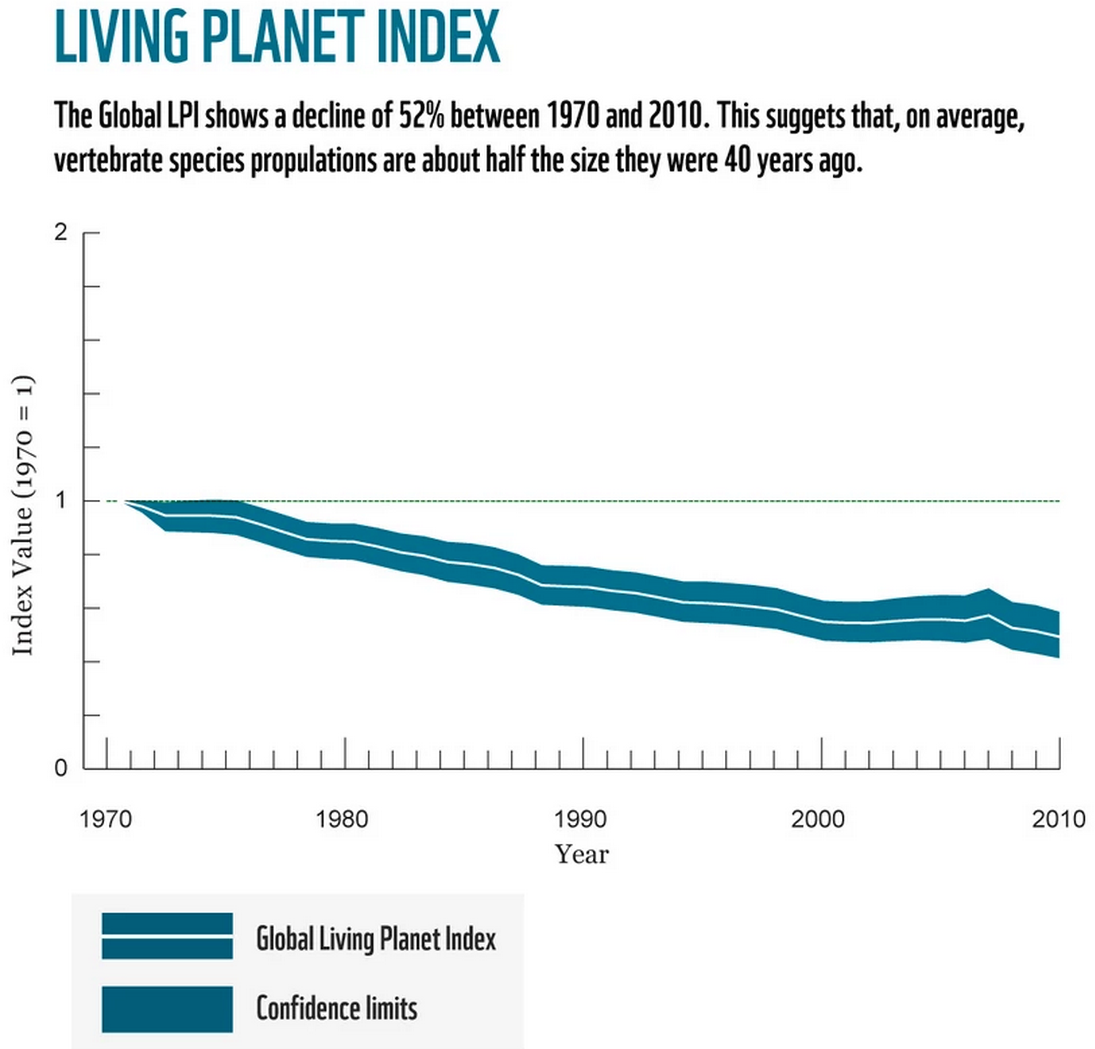
Living Planet Index

Christopher Ingraham flags a highly disturbing study:

The new Living Planet Index report from the World Wildlife Fund opens with a jaw-dropping statistic: we’ve killed roughly half of the world’s non-human vertebrate animal population since 1970. … The declines are almost exclusively caused by humans’ ever-increasing footprint on planet earth. “Humanity currently needs the regenerative capacity of 1.5 Earths to provide the ecological goods and services we use each year,” according to the report. The only reason we’re able to run above max capacity – for now – is that we’re stripping away resources faster than we can replenish them.

The report attributes this insane drop almost entirely to human activity, including overfishing, unsustainable agriculture, a dramatic loss in natural habitats, and—of course—climate change. The most severe decline was experienced by freshwater species, whose populations fell a shocking 76 percent—nearly twice the rate experienced by marine and terrestrial species (both of which dropped by 39 percent).

Brad Plumer compares this report to an earlier one:

In its previous 2012 report, the WWF estimated that vertebrate populations had declined just 28 percent since 1970. Now they estimate that there’s been a 52 percent decline. Why the change? In that previous report, the WWF’s scientists said, they had been over-representing trends in North America and Europe, which have actually had fairly stable wildlife populations in recent decades. Re-weighting their sample to account for steeper declines in the species-rich tropics — particularly in Latin America and Southeast Asia — makes for a bleaker picture.

Roger Cohen Sees Hitler In The Desert

Well, we all see mirages, I guess. But it says something about the hysteria about the latest incarnation of the Sunni insurgency in Iraq that we’re suddenly comparing them to Nazis and to non-humans. Even as Cohen himself acknowledges that “the Nazi death machine was unique. Facile invocation of it is too frequent, belittling the phenomenon and its victims.”

So why break Godwin’s Law so egregiously? Cohen wants us to believe, channeling Martin Amis and Primo Levi, that there was no “why” in the unconscionable unique act of the Holocaust. And yet, mountains of evidence explain exactly why: it was a function of a vile racism that regarded the Jewish people as vermin that needed to be exterminated in order to allow the master race to flourish. It was not some random act of mass murder; it had a grotesque but clear and constantly trumpeted rationale. Then Cohen seems to endorse the idea that the Nazis were somehow unhumans or “counter-humans”, in Levi’s words. But that too, it seems to me, lets them off the hook. The Holocaust was a deeply human act  – a function of humankind’s capacity, revealed throughout history, of extraordinary levels of hatred and violence, brought to new and unfathomable evil in the age of the industrialized state.

And equally, it is absurd to argue that “there is no why to the barbarism of ISIS.”

This is after Cohen actually produces a long litany of reasons for ISIS’s brutality and evil, mind you, none of which he deems sufficient to explain the ISIS propaganda beheadings he watched on video. But why should we not take the Islamists’ word for it? They are committing slaughter and rape and attempted genocide for one core reason: because God demands that they slaughter infidels. Their mandate is beyond any human one but results in so-very-human evil.

Again, you’d think, reading Cohen, that this has never happened before. You’d think that genocide was invented by the Nazis. You’d think that religious slaughter was invented in the last couple of months. And all of this is designed to hype even further the propaganda behind this war without end, without providing any actual strategy for doing anything that could possibly alter the onslaught, or in some way win it.

And so we have the final cry of the liberal interventionist:

“Leave it to the Arabs, it’s their mess, they can clean it up,” is an inadequate (if understandable) response to ISIS. It would have been the wrong one. President Obama’s coalition in the war to eradicate ISIS may be flimsy but passivity was not an option.

And then he equates them with the Nazis yet again. The point of this facile invocation is simply to scream: Something Must Be Done. No war based on that vague slogan has ever ended in anything but disaster. But here we go again …

Ebola On The Move

Ebola cases

The disease poses a limited threat to America, but Michael Osterholm anticipates it spreading to other parts of Africa:

We know how the disease will likely spread in the months ahead.

Each year, thousands of young West African men and boys are part of a migratory work population not too dissimilar from U.S. migrant farm workers. Crop-friendly rains wash over West Africa from May to October, forming the growing season. These young men typically help with harvesting in their home villages from August to early October, but afterward head off for temporary jobs in artisanal gold mines in Burkina Faso, Mali, Niger and Ghana; cocoa nut and palm oil plantations in Ghana and Cote d’Ivoire; palm date harvesting and fishing in Mauritania and Senegal; and illicit charcoal production in Senegal, Mali, Cote d’Ivoire, Ghana, Burkina Faso and Niger.

This migration is about to begin, even for young men whose villages have been recently hit by [Ebola virus disease (EVD)]. These workers find daily laborer jobs at $5 per day, half of which they remit to their families back home. Like their ancestors before them, they use little-known routes and layovers through forests to avoid frontier checkpoints. They usually have ECOWAS ID cards, providing free passage to all the member states of the Economic Community of West Africa States. It takes one to three days to travel from the EVD-affected countries to these work destinations. There is no need for Ebola to hop a ride on an airplane to move across Africa: It can travel by foot.

He wants massive international mobilization against Ebola:

The first critical mistake public-health officials often make amid such outbreaks is failing to consider another black-swan scenario. At the moment, they are focused only on meeting the vaccine need in the three affected countries. If this virus makes it to the slums of other cities, the epidemic to date will just be an opening chapter. Africa contains more than a billion people, and is growing faster than anywhere else in the world. If world leaders don’t make it a priority now to secure up to 500 million doses of an effective Ebola virus vaccine, we may live to regret our inaction. It’s that serious.

Securing 500 million doses of an effective Ebola virus vaccine is going to require a partnership between government and vaccine manufacturers that puts it on the same footing as our response to an emerging global influenza pandemic. This will require mobilizing people and resources on a massive scale—it has to be the international community’s top priority.

Follow all our Ebola coverage here.

(Map from Julia Belluz)

The NYT’s Guru Of “Re-Purposed Bovine Waste”

Every now and again you come across a quote that tells you everything you need to know about what’s going in journalism. It’s from the New York Times’ pioneer of native advertising/sponsored content/brand journalism, Meredith Kopit Levien. Her blather about deceiving readers into believing they’re reading journalism when they’re actually reading advertising was brilliantly skewered by John Oliver over the summer. Now over to Joe Pompeo:

Levien watched the clip for the first time the next day with Times publisher and chairman Arthur Sulzberger Jr., who encouraged her to have a good laugh over it.

“I think John Oliver is hilarious, and I think he did the most clever take one could have on the risks and downsides of native,” Levien told me a month later during an interview in her glass-enclosed 19th-floor office with enviable Hudson River views, though she admitted: “It was my first experience with random people tweeting negative things at me.”

Her rebuttal? “The best way to preserve editorially independent, high quality journalism is to preserve the business model. And I think the idea of branded content that shares a form factor with editorial is a great first step.”

Let’s look at that quote a little more closely, shall we?

The best way to preserve editorially independent, high quality journalism is to preserve the business model.

But the NYT is not “preserving” the business model. If it were, Ms Levien would not have a job. The NYT would be relying on advertising as it always has  – and clearly distinct from its editorial side. She was brought in explicitly to change the business model, by fusing advertising and editorial so that it becomes increasingly hard to tell the difference between the two, and thereby to get higher rates from advertisers. She was brought in to sell the newspaper’s core integrity for revenues. Then this:

I think the idea of branded content that shares a form factor with editorial is a great first step.

How does a person who speaks English translate that? “Branded content” is what we once called advertising. “Shares a form factor with editorial” means an advertisement designed to look as much like editorial as possible. So let’s put this in English:

The best way to preserve expensive journalism is to change the business model so that corporations will buy advertisements at higher rates because we promise to disguise them as editorial.

And that, one realizes with a shudder, is just a “great first step.” I wonder what the second one will be, don’t you?

Neither Cracking Down Nor Backing Down

Sit In Protest Continues In Hong Kong Despite Chief Executive's Calls To Withdraw

Authorities in Hong Kong and Beijing appear to be eschewing another attempt to forcibly disperse the island’s massive student-driven protests, which grew in numbers today as China held its national day celebrations, but they won’t negotiate with the demonstrators either. Peter Ford reports that the government is banking on the movement wearing out its welcome with the public:

They have withdrawn almost all policemen from the protest areas, where the atmosphere is relaxed. A protracted national holiday means that the strikes blocking streets in four spots around the city will not disrupt much until next Monday. … Government supporters expect the crowds to disperse if the protests continue into next week and prove to disrupt the city’s normal life. Polls have found that Hong Kongers are pretty evenly split over the merits of the government’s plans for political reform, and over how they regard the “Occupy Central” movement.

But with the protestors demanding that Chief Executive Leung Chun-ying resign by tomorrow and threatening again to occupy government buildings, the situation could easily come to a head again soon. Heather Timmons and Lily Kuo pass along a harshly-worded editorial in a party-line newspaper and worry:

Not only is Beijing unwilling to reconsider the August decision to allow only Communist Party-approved candidates to run for Hong Kong’s highest office, but Hong Kongers who continue to participate in the protests should expect dire consequences, an editorial in the People’s Daily newspaper warned today. Some activists and analysts, including a former Tiananmen student leader, say the piece bears a marked similarity to a notorious editorial that ran the People’s Daily more than 25 years ago. That piece was later blamed for leading to the brutal crackdown on demonstrations, which killed hundreds or thousands, depending on estimates.

Chris Beam checks out protester-police relations and finds them surprisingly cordial:

Most protestors I spoke with sympathized with the plight of the police. “They don’t want to hurt any Hong Kong citizens,” said Andy Loh, 25, a travel guide whom I found near a barricade outside the police headquarters. “They just listen to their bosses.” Icarus Cheng, a 30-year-old financier, said he had friends on the force who had been working nearly straight for the previous 30 hours. “They’re suffering,” he said. “Of course, we are too.” Part of the problem is that, while Hong Kong has plenty of protests, they rarely occur on this scale, and with the outcome so unpredictable. “Policemen don’t have much experience handling this situation,” he said.

The police don’t seem especially offended by the protesters either. “They’re nice,” said a youthful officer who was guarding the headquarters on Tuesday. He said that some students have offered him and his colleagues food and drinks, which of course they have to refuse. (A similar thing occurred at the Tiananmen Square protests in 1989, and some hungry officers accepted.) I asked what he thought of the movement overall. “Freedom of speech,” he said.

Jessica Chen Weiss reflects:

Even if foreign governments stay out of the public fracas, it is unclear whether peaceful demonstrations will compel Beijing to do more to abide by past promises to grant “universal suffrage upon nomination by a broadly representative nominating committee in accordance with democratic procedures,” as stated in Hong Kong’s mini-constitution, the Basic Law. Indeed, China has offered Hong Kong more than any other city under its jurisdiction: universal suffrage. But protesters in Hong Kong have rejected what they see as an ultimatum from Beijing, demanding a more democratic nomination process.

Whose move is next? Commentators have painted Xi Jinping into a corner: Back down and be seen as weak, or stand firm and be seen as reneging on “one country, two systems.” With Hong Kong protesters depicting Chief Executive C. Y. Leung as a vampire with fangs, and pro-Beijing media smearing Hong Kong activists as U.S. and British accomplices, the outlook for “gradual and orderly progress” toward a more democratic Hong Kong appears bleak.

Fisher doesn’t discount the possibility of another Tiananmen-style massacre:

That would seem unthinkable, given the global backlash that image-conscious China would face for using force in a city full of foreigners and foreign media. But perhaps the most essential eternal truth for understanding China’s government is that the ruling Communist Party prioritizes the preservation of one-party rule way before anything else, including the outrage of the entire world, to the extent that it will sacrifice just about anything to maintain the system. The world has changed a lot since 1989, and so has China’s role in it, but it was also true in 1989 that Beijing was full of Western journalists and China knew it would pay heavily for massacring protesters, but did it anyway.

Gwynn Guilford surmises that “China’s leaders may think they have little to lose by cracking down even harder on protesters—and less to gain by reversing their ban on universal suffrage in 2017”:

Any compromise on that point might stoke similar demands from the four other territories and countries that the People’s Republic claims: Macau, Tibet, Xinjiang, and Taiwan. … The fact that students in Taiwan are aligning with the Hong Kong demonstrators—and that Ma Ying-jeou, Taiwan’s generally pro-Beijing president, is supporting them—threatens the Communist Party’s policy of “reunification.” Meanwhile, an insurgency in Muslim-dominated Xinjiang is quickly gathering momentum. Of course these are the reasons China’s leaders might think they should maintain a hard line. There are plenty of ways that violence in Hong Kong could hurt the mainland.

Richard C. Bush III points out that income inequality has also played a role in driving discontent in the territory:

On the economic side, income inequality in Hong Kong is among the highest in the world. According to Forbes’s rankings, Hong Kong has forty-four billionaires, which is the highest in the world once population is taken into account. Young people believe, with some justification, that they will not be able to secure a standard of living that is as high as their parents. A key reason is the control that a small number of property firms have over the real estate market, which raises prices for both residential and commercial space. For many couples, owning even a small apartment is increasingly out of reach. Moreover, competition for jobs has intensified as the flow of smart, eager applicants from China grows. The divide between the One Percent and The Rest continues to deepen. In most advanced societies, democracy provides a check against excessive wealth and market concentration. Not in Hong Kong.

Finally, Jay Ulfelder expresses some cautious long-term optimism, noting that “this uprising was not born last Friday”:

The longer arc of this challenge includes a much wider array of methods and spaces, including this summer’s referendum and the marches and actions of political and business elites that accompanied and surrounded them. … Based on patterns from similar moments around the world in recent decades and the Communist Party of China’s demonstrated intolerance for popular challenges, I continue to anticipate that the ongoing occupations will soon face even harsher attempts to repress them than the relatively modest ones we saw last weekend. Perhaps that won’t happen, though, and if it does, I am optimistic that the larger movement will survive that response and eventually realize its goals, hopefully sooner rather than later.

(Photo: Thousands of protesters gather outside the Hong Kong Government Complex on October 1, 2014 in Hong Kong, Hong Kong. By Chris McGrath/Getty Images)