We War-Loving Americans

Aaron Blake highlights a new poll showing rising public support for Obama’s ISIS strategy:

The newest WaPo-ABC poll shows 50 percent approve of Obama’s handling of the Islamic State, as compared to 44 percent who disapprove. That’s an improvement from August, when the question referenced only Iraq and not Syria, and 42 percent of Americans gave Obama a vote of confidence. Obama’s new polling heights come as Americans overwhelmingly approve of the airstrikes he ordered in Syria. Seven in 10 Americans (70 percent) support the airstrikes — up from 65 percent in early September. His decision to send American forces to train Iraqi troops and coordinate airstrikes against the Islamic State in that country is less popular, but still gets positive marks: 53 percent support and 44 percent opposition.

Drum is dismayed at how comfortable we are with going to war yet again:

According to polls, nearly two-thirds of Americans are on board with the fight against ISIS and nearly half think we ought to be sending in ground troops. That’s despite the fact that practically every opinion leader in the country says in public that they oppose ground troops. At this point it would take only a tiny shove—a bomb scare, an atrocity of some kind, pretty much anything—and 70 percent of the country would be in full-bore war frenzy mode.

It’s like we’ve learned nothing from the past decade. Our politicians are in love with war. The public is in love with war. And the press is really in love with war. It just never ends.

Larison rejects at least one of Drum’s conclusions:

I don’t see much evidence that the public is “in love” with war. Yes, there is currently majority support for the administration’s decision to attack ISIS from the air, but there is reason to believe that this support is shallow and likely to evaporate as the war drags on. According to at least one survey, most Americans also consider ISIS to be a “very serious” or “fairly serious” threat to the U.S., and that simply isn’t true. This false belief has inflated public support for action against ISIS, and that is going to wear off over time. Far from being “in love” with war, a better way to think of the public’s reaction is that they have been whipped into a panic about a vastly exaggerated threat by irresponsible fear-mongers. Most Americans support the current intervention because they wrongly think it is necessary for U.S. security, and they have been encouraged in that wrong view by their sorry excuse for political leaders.

Linker sees the entire 2016 field subscribing to war love:

From the president and Hillary Clinton on through a long line of possible Republican candidates, no one likely to be involved in the 2016 race for the White House seems inclined to diverge from the militaristic consensus that dominates official Washington and plays so well in the American heartland. It’s war-lovers everywhere you look. Very much including when the American people look at themselves in the mirror.

Not So Fast With The Nudging

Jeremy Waldron expresses his worries about the vision laid out in Cass Sunstein’s Why Nudge?: The Politics of Libertarian Paternalism:

Every day we are bombarded with offers whose choice architecture is manipulated, not necessarily in our favor. The latest deal from the phone company is designed to bamboozle us, and we may well want such blandishments regulated. But it is not clear whether the regulators themselves are trustworthy. Governments don’t just make mistakes; they sometimes set out deliberately to mislead us. The mendacity of elected officials is legendary and claims on our trust and credulity have often been squandered. It is against this background that we have to consider how nudging might be abused.

There are deeper questions, too, than these issues of trust and competence.

As befits someone who was “regulation czar” in the Obama White House, Sunstein’s point of view is a rather lofty one and at times it has an uncomfortable affinity with what Bernard Williams once called “Government House utilitarianism.” Government House utilitarianism was a moral philosophy that envisaged an elite who knew the moral truth and could put out simple rules for the natives (or ordinary people) to use, even though in the commissioner’s bungalow it was known that the use of these rules would not always be justified. We (the governors) know that lying, for example, is sometimes justified, but we don’t want to let on to the natives, who may not have the wit to figure out when this is so; we don’t trust them to make the calculations that we make about when the ordinary rules should not be followed. Williams saw the element of insult in this sort of approach to morality, and I think it is discernable in Sunstein’s nudging as well.

Ebola Makes It To America

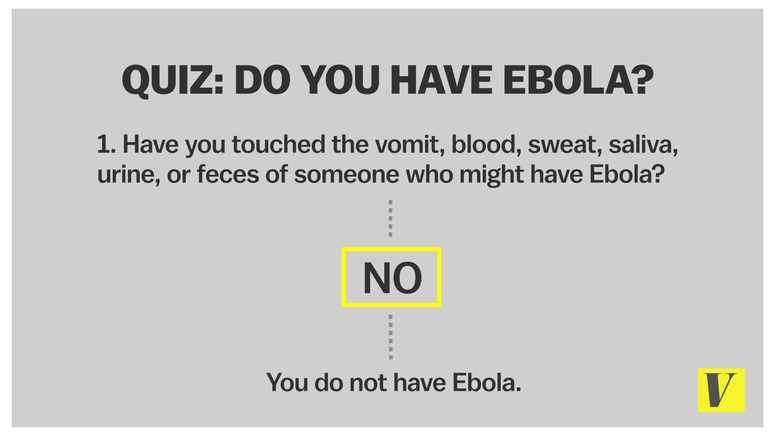
Ebola Quiz

As we noted yesterday, a man who flew from Liberia to Dallas has been diagnosed with Ebola. Kent Sepkowitz examines the precautions we’d taken:

The Dallas case is breaking some of our ironclad assumptions. The CDC has a well-considered algorithm that places those returning from the three endemic West Africa countries—Sierra Leone, Guinea, and Liberia—into a measure of extra vigilance if and only if the person has had exposure to a known case of Ebola. Per the press conference, the Dallas case had no such exposure. He was not a health-care worker treating patients, nor was he from a family battling active disease. Of course, more facts may emerge that contradict today’s story—but today’s facts, if they hold up, mean that yesterday’s assumptions are no longer correct. Liberia may indeed be enough of a hotbed of Ebola that anyone arriving from the area will need to be considered for extra vigilance.

Ezra recommends calming down and taking the quiz seen above:

On average, Guinea spends $32 on health care per-person, per-year. Liberia spends $65. Nigeria spends $94. The United States spends $8,895.

That money buys trained health workers, disease investigators, isolation wards, fever screening, protective gear, and much more. That money buys advanced hospitals all across the country, and labs that can quickly test for the disease, and the ability to do contact tracing and follow-up visits on a tremendous scale. That money also buys public-health officials with long experience combatting infectious diseases — both here and in other countries.

Susannah Locke imagines best and worst case scenarios:

The best-case scenario for the United States is that a patient traveling from West Africa realizes that they might possibly have Ebola as soon as they start feeling sick. Everyone else makes sure not to come in contact with this person’s bodily fluids. And the outbreak ends with just one patient. Hopefully, that’s how this Texas case will end.

The worst-case scenario, meanwhile, is that an Ebola patient comes to America, is ill for days, and comes in contact with a lot of people before anyone realizes that something unusual is going on. That would be much worse. But even in that case, it’s still much less likely that Ebola will get farther one city or town. “I don’t think we’ll have a serious public health threat in any of the developed countries,” Osterholm told mein July. The real problems are for countries like Guinea, Liberia, and Sierra Leone that don’t have the resources to contain the outbreak quickly.

Margaret Hartmann explains the next steps in our response:

The challenge now is to find everyone the Dallas patient came into contact with and begin monitoring them as well. The “contact tracing” process is how Nigeria managed to eliminate its Ebola outbreak. After identifying one Ebola patient who arrived at the Lagos airport in July, Nigerian officials were able to find 72 people he might have infected. By tracing their contact, they found a pool of 894 people potentially infected with Ebola. Eight people died, including the first patient, but the rest have been cleared.

CDC director Thomas Frieden, like the White House, has urged Americans to stay calm. Abby Haglage summarizes his statement. An important part:

Asked how many people the patient came in contact with, Frieden estimated fewer than five. “Handful is the right characterization,” he said. “We know there were family members who came in contact, and there may be other community members, but we will cast the net wide.”

And Olga Khazan cracks open the history books:

At arrival gates, border protection officers keep their eyes peeled for passengers who show signs of fever, sweating, or vomiting. They also try to confiscate any monkey meat or other bushmeat that passengers might have in their luggage.

In some ways, our approach to keeping scary diseases outside of our borders hasn’t changed much since the Middle Ages. As Defense One‘s Patrick Tuckerexplained, when the Black Death was mowing down Europeans, the Doge of Venice instructed so-called “Guardians of Health” to board arriving ships and check the crew for inflamed lymph nodes. Those considered suspect weren’t permitted to dock for 40 days—quaranta giorni. Ever since, “quarantine” has been the way to keep newer plagues from spreading once they reach our shores.

Update from a reader:

You lauded the role HealthMap played in breaking the news of Ebola outbreak before WHO. From Kalev Leetaru’s article you highlighted: “Much of the coverage of HealthMap’s success has emphasized that its early warning came from using massive computing power to sift out early indicators from millions of social media posts and other informal media.” Unfortunately, that is not quite accurate. HealthMap is not quite a “success” here, as you can see from this Foreign Policy story.

An Anti-Jihadist Dilemma

Colum Lynch and Elias Groll point out an inherent danger in Obama’s effort to cut off ISIS’s supply of foreign fighters, warning that illiberal regimes will likely use it as an excuse to further stifle dissent:

[At last week’s UN Security Council session], the Obama administration pushed through a measure that requires member states to prevent their citizens from traveling abroad to participate in or finance acts of terrorism. It was unanimously approved by the assembled world powers, but the vote wasn’t the clear-cut win for American diplomacy that it may appear to be.

Instead, the measure, in a textbook example of the dangers of unintended consequences, could end up giving China and similarly repressive states such as Russia and Middle Eastern monarchies powerful new tools for cracking down on separatist groups branded as terrorists. The resolution, which is legally binding, is so sweeping and vague that it effectively leaves it to each country to decide who to target, and how, because there is no internationally agreed upon definition of terrorism. For instance, the resolution requires that law enforcement agents prevent people from traveling if they have “credible information that provides reasonable grounds” for suspecting they might commit terrorist attacks during their travels. The standard of proof required to ban travel is likely to vary sharply in democratic and autocratic countries, opening the door to potential abuse of, for example, political opposition groups and ethnic minorities.

Akil Awan asks how countries whose citizens travel to Syria and Iraq to join ISIS should best deal with them when they return home. Every option, he finds, has limitations and downsides:

The third and final option being mooted by some governments, is to seek a punitive, rather than rehabilitative, response by criminalizing all those who return from fighting in Syria. And whilst we certainly should hold those who have committed crimes accountable, in the absence of clear evidence of criminality, this is simply not feasible for the rest. Not only is it impracticable and cost-prohibitive, but also morally indefensible, considering that some of the young men and women who traveled there to fight did so for largely altruistic reasons, moved by the plight of Syrians suffering under Assad’s brutal regime. Of course, others had far less idealistic motives, stirred by the thrill of adventure, or escapism from the ennui of their lives back home, or simply swept up in the raw euphoria of being part of the Jihadist zeitgeist. Many of these young people will no doubt have made mistakes in their youthful exuberance that they will surely come to regret later. How many of us are now proud of every life decision we made at the age of nineteen?

Making Cents Of Hong Kong

Screen Shot 2014-09-30 at 10.09.12 AM

While the ongoing protests are primarily about political freedoms, Matt O’Brien observes that the island has “already seen what being subsumed by the mainland means economically. And it’s had enough of that”:

It’s true that China’s growth has been good for Hong Kong’s—especially their retailers—but it hasn’t been as good for their relative standard of living. Not only have the richest mainlanders caught, or even surpassed, them, but now those Chinese are pushing up their cost-of-living and snatching up everything from their stores. That’s why Hong Kongers say the mainlanders are “locusts” who come in, take everything, and then leave—and with bad manners, too. Indeed, it set off a social media firestorm this year when a mainland parent was caught letting their two year-old urinate in one of Hong Kong’s streets. In other words, it’s the same old story of old money versus the nouveau riche.

But Yglesias attributes Hong Kong’s recent economic slump, which may also play a part in driving the protest movement, to the absence of these rich mainlanders:

Economic weakness in Hong Kong in part reflects a broader slowdown in the Chinese economy, which seems to be no longer capable of sustaining ultra-fast growth rates. But Hong Kong has a particular problem because of an ongoing decline in luxury goods sales that appears to be linked to a Chinese government crackdown on corruption and conspicuous consumption. … Hong Kong is pretty much the closest you can be to mainland China without being subject to mainland China’s luxury taxes. Consequently, the island is crawling with upscale malls with large mainland client bases. Lately, those customers have been staying away, and it’s dragging Hong Kong’s economy down.

William Pesek considers what the demonstrations mean for the economic futures of the island and China itself:

As I’ve pointed out before, China should be learning from Hong Kong’s first-world institutions. It should emulate the laissez-faire ethos, rule of law, open capital accounts and free-wheeling media environment that underpin Hong Kong’s success — not stamp them out. Instead, Xi’s government appears to be intent on remaking Hong Kong in China’s deteriorating image. If Beijing continues to erode the liberties and institutions that have made Hong Kong such a great place to do business, multinationals aren’t suddenly going to shift base to Shanghai. Indeed, by the time the mainland’s favored hub reaches Hong Kong’s current level of transparency and financial sophistication — if it ever does — all the banks and household corporate names would’ve already moved to Singapore, or elsewhere in the region.

Mohamed El-Erian agrees that China’s decision to double down on repression will likely backfire economically:

Indeed, the Chinese government is likely to prevail over the Occupy Central movement in Hong Kong. But in doing so, it will probably be inclined to slow certain economic reforms for now, seeking instead to squeeze more growth from the old and increasingly exhausted model — similar to how Brazil’s government responded to protests there ahead of the World Cup a few months ago. And while this would be part of a broader political strategy to defuse tensions and avoid an immediate growth shock to both China and the global economy, it would undermine the longer-term economic vibrancy of both.

The Natural Gas Hype, Ctd

A reader writes:

Good piece overall, but I want to point out this sentence: “Brooks Miner adds that ‘natural gas does have a dark side: It is composed primarily of methane, which has a much stronger climate-warming effect than carbon dioxide.'” That’s misleading without context. Methane is, indeed, a potent GHG. But it only has this impact if it is allowed to escape, unburned, directly to the atmosphere. If it is burned completely, it becomes CO2 and water like any other fuel. So the global warming impact of used methane is equal only to its carbon content (which is lower, per unit of energy, than petroleum). It is only leaked methane that has this “dark side” – and since we should be economically averse to wasting fuel through leakage anyway, it’s only a problem when something goes wrong.

The other thing to note is that leaked methane will only circulate for a few decades because it will naturally combust in the atmosphere and degrade to CO2. So while its immediate impact is high, it won’t have the same centuries-long effects as a commensurate amount of carbon emission.

Another goes into greater detail and more:

It’s worth clarifying that the reason we should be worried about natural gas‘ (methane’s) relative radiative forcing is not because of its use in combustion for power generation, but because of potential leaks. When combusted, it leads to fewer emissions per kilowatt-hour than coal. The study Leber quotes found there was no difference between assuming 0% and 3% leakage, so while this is not something we should totally ignore, it’s not likely to have a huge effect.

The item from The New Republic conflates a few different studies, and in my mind, makes the future for natural gas sound more dire than it really is. They cite this study in Environmental Research Letters to say people will increase their usage, and then the EIA chart which shows no decline in coal use.  But the finding in the study to which Leber points is much more nuanced.

First, they note that “across a range of climate policies, we find that abundant natural gas decreases use of both coal and renewable energy technologies in the future.” Leber focuses on the decreased renewables, but there is a reduction in the amount of coal used. This is worse than a future in which we go heavy on renewables, but better than a future in which we go heavy on coal.

More importantly, though, is the following from their abstract: “Without a climate policy, overall electricity use also increases as the gas supply increases.” The thrust of that article as I read it, rather than being simply pessimistic about natural gas future, is rather the importance of climate policy in achieving real gains.

And this is where it gets trickier. As the authors of the article note, “Some analysts have noted that natural gas may complement and support variable renewable energy technologies such as wind and solar by providing flexible back-up power that can ramp up quickly. The model we use, MARKAL, is not well-suited to evaluating the potential for this relationship because it does not represent the details of dispatch, unit commitment, and other short-term facets of grid operation.”

As the study that you posted about in July notes, one of the biggest problems that we have going forward is that “the technology we need to succeed may exist, but most of it hasn’t been proven to scale sufficiently.” To meet any sort of goals, we need to figure out a low-carbon baseload resource (nuclear, coal with carbon capture, something) and figure out a way to design the power system to cope with the challenges of high renewable penetration. As page XI in the deep decarbonization report reports, these technologies are still developing. A renewables-only future isn’t yet realistic… the question is, in the short- and long-term, how can we maintain the reliability of the electrical grid and promote the deployment of more renewable technologies while balancing with (very real) concerns concerns about the cost of doing so and continuing worldwide development. I think that natural gas, as part of a broader climate policy, has an important role to play in getting to that future.

By the way, discussion about the promise of solar wouldn’t be complete without a mention of this new energy storage project opened by SoCal Edison recently. These kind of projects will be hugely important for our ability to ramp up the amount of solar and / or wind in our electricity mix, whatever kinds of cost advancements are being made.

(Disclaimer: the US team for the Deep Decarbonization report was mostly my colleagues from my old job. So that provides some of the background from which I draw.)

Update from a reader:

Your reader said that methane leakage is only a problem “when something goes wrong” but studies show it is a large and constant problem with natural gas extraction:

Drilling operations at several natural gas wells in southwestern Pennsylvania released methane into the atmosphere at rates that were 100 to 1,000 times greater than federal regulators had estimated, new research shows.

Using a plane that was specially equipped to measure greenhouse gas emissions in the air, scientists found that drilling activities at seven well pads in the booming Marcellus shale formation emitted 34 grams of methane per second, on average. The Environmental Protection Agency has estimated that such drilling releases between 0.04 grams and 0.30 grams of methane per second. . . .

The researchers determined that the wells leaking the most methane were in the drilling phase, a period that has not been known for high emissions. Experts had thought that methane was more likely to be released during subsequent phases of production, including hydraulic fracturing, well completion or transport through pipelines.

Bill McKibben agrees: “Up to 5 percent of the methane probably leaks out before the gas is finally burned.” Importantly, the livestock industry is responsible for 37% of methane pollution. Anyone who cares about the environment should eat plants.

And another:

I’d like to add some observations about methane’s role as a greenhouse gas. Your post correctly notes that methane has a role as a greenhouse gas only if it is leaked prior to combustion. It’s even more restricted than than that. Its role depends heavily on where the leakage takes place. I suspect the amount of gas that actually ends up in the atmosphere as methane is wildly overestimated.

Methane is highly digestible. It is essentially snack food for a wide variety of bacteria, particularly soil bacteria. The vast majority of natural gas pipes are buried several feet underground, in environments where these bacteria are widespread. Gas leakage which occurs at a slow rate from subsurface piping is very likely to be metabolized by those bacteria (and thus converted to carbon dioxide) before it ever makes it to the ground surface.

There’s an analogy for this that’s widely known in the environmental cleanup business that I work in. Gasoline leakage from subsurface pipes and tanks is a widespread problem. Given the ubiquity of the problem, you would expect to find gasoline vapors (especially the more volatile constituents like benzene) infiltrating into buildings all over the place. But in practice, this infiltration is quite rare. Why? Because soil bacteris eat the vapor-phase benzene before it gets a chance to move up toward the ground surface. By comparison, methane is far easier for bacteria to digest than benzene is, so it is very likely that subsurface methane leaks are not a big issue.