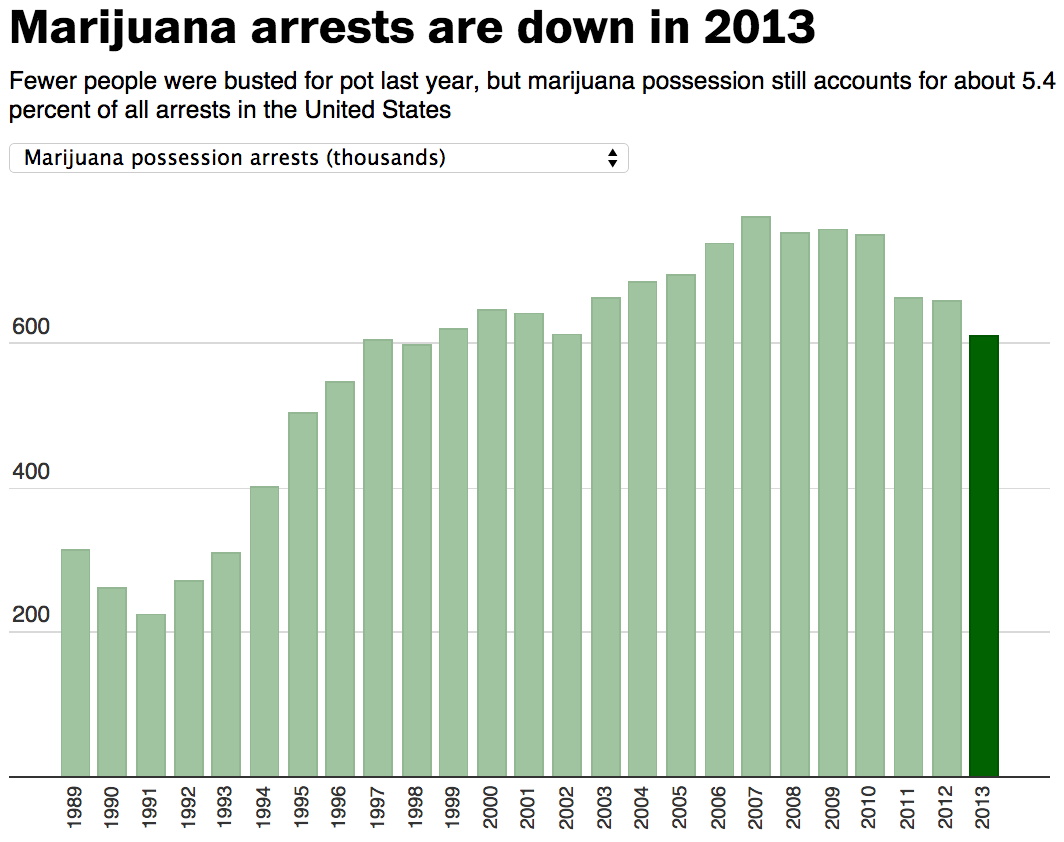
Ingraham reviews new FBI data:
The total number of arrests for all offenses continues to drop sharply, from a high of 15.3 million in 1997 to 11.3 million in 2013. But marijuana possession arrests have not declined at the same rate – these arrests accounted for 1.6 percent of all arrests in 1990, but make up 5.4 percent of all arrests today. Moreover, arrests for all drug offenses made up a record share – 13.3 percent – of total arrests this year. Drug violations represent the single largest category of arrests tracked by the FBI. As NORML notes, if we assume ACLU’s conservative estimate of a cost of $750 for each marijuana possession arrest, it means that states spent more than $450 million on these arrests in 2013 alone.
Sullum examines the big picture:
The peak year for marijuana arrests was 2007, when there were about 873,000, three times as many as in 1991. The number fell to 848,000 in 2008, rebounded to 858,000 in 2009, and has been declining since then. Contributing to that trend, Colorado and Washington last year stopped arresting people for possessing less than an ounce of marijuana, as required by legalization measures that voters approved in 2012. Prior to that change, Colorado police were arresting about 10,000 people for marijuana possession each year. The annual number in Washington was about 6,000. Marijuana possession arrests in New York City, which peaked at more than 50,000 in 2011, also fell last year, from 39,218 to 28,644.
The downward national trend should continue. Washington, D.C., decriminalizedmarijuana possession last spring, and [yesterday] the NYPD announced that it will further reduce arrests of cannabis consumers, beginning later this month.
Matt Taylor explains the forthcoming NYC policy:
Starting next Wednesday, November 19, possession of 25 grams or less of pot—even in public view—will no longer get you cuffed and brought downtown by the cops. Instead, police will begin issuing criminal court summons, or desk appearance tickets, requiring guilty parties show up in front of a judge at a future date. The bad news for pot lovers is that smoking the stuff in public will still be sufficient to earn you a night or two in jail. And since many New Yorkers—especially young men of color—fail to show up when issued desk appearance tickets, this isn’t exactly a game-changer when it comes to the war on drugs in America’s largest city.
Matt Schiavenza hears from skeptical drug policy experts:
“It’s not decriminalization,” said Joanne Naughton, a former NYPD officer and member of Law Enforcement Against Prohibition, or LEAP. “People will be summoned into a criminal court to answer to criminal charges.” If those summoned fail to appear in court, judges could issue arrest warrants.
Kenneth P. Thompson, the Brooklyn District Attorney, is another skeptic. Thompson, who stopped prosecuting marijuana possession charges earlier this year, argued that a ticket and court summons would cause additional complications. Because summons without an arrest warrant don’t receive prosecutorial review, violators may not have access to full legal oversight and won’t automatically be appointed a lawyer. “These cases will move forward even when due process violations might have occurred,” Thompson said.

